

StudiCare mindfulness-study protocol of a randomized controlled trial evaluating an internet- and mobile-based intervention for college students with no and "on demand" guidance.
Open accessThe DOI matches its Crossref record; 106 of the 108 references it cites were found in a registry or an index; 46 of the 98 sources its claims cite were checked for support.
Abstract
Background: College is an exciting but also challenging time with an increased risk for mental health issues. Only a minority of the college students concerned get professional help, a problem that might be improvable by internet- and mobile-based interventions (IMIs). However, adherence of IMIs is a concern. While guidance might be a solution, it is resource-intensive, derailing potential implementation on population level. The first aim of this trial is to evaluate the efficacy of the IMI StudiCare Mindfulness (StudiCare-M) for college students with "on demand" and no guidance. The second aim is to examine potential moderators and mediators, contributing to the questions of "how" and "for whom" such interventions work.Methods: In this three-armed randomized controlled trial, both an unguided and "guidance on demand" (GoD) condition of StudiCare-M are compared to a waitlist control group. StudiCare-M is based on principles of acceptance and commitment therapy and stress management and consists of 7 modules plus two booster sessions. Participants in the GoD condition may ask their e-coach for support whenever needed. A total of 387 college students with moderate to low mindfulness are recruited at 15+ cooperating universities in Germany, Austria, and Switzerland via circular emails. Assessments take place before as well as 1, 2, and 6 months after randomization. The primary outcome is mindfulness. Secondary outcomes include stress, depression, anxiety, interoception, presenteeism, wellbeing, intervention satisfaction, adherence, and potential side effects. Among examined moderators and mediators are sociodemographic variables, pre-treatment symptomatology, treatment expectancy, self-efficacy, cognitive fusion, emotion regulation, and alexithymia. All data will be analyzed according to intention-to-treat (ITT) principles.Discussion: Providing effective interventions to help college students become more resilient can make a valuable contribution to the health and functionality of future society. If effective under the condition of minimal or no guidance, StudiCare-M offers a low-threshold potentially resource-efficient possibility to enhance college student mental health on a population level. Moderation- and mediation analyses will deliver further insights for optimization of target groups and intervention content.Trial Registration: WHO International Clinical Trials Registry Platform via the German Clinical Studies Trial Register DRKS00014774 . Registered on 18 May 2018.
Overview
CoChat Summary
## TL;DR
This is a randomized controlled trial protocol, not results, for testing unguided versus “guidance on demand” versions of the StudiCare Mindfulness internet/mobile intervention in college students. The trial is designed to assess effects on mindfulness and related mental health outcomes, plus moderators, mediators, adherence, and side effects.
## Key findings
- Not stated in the paper.
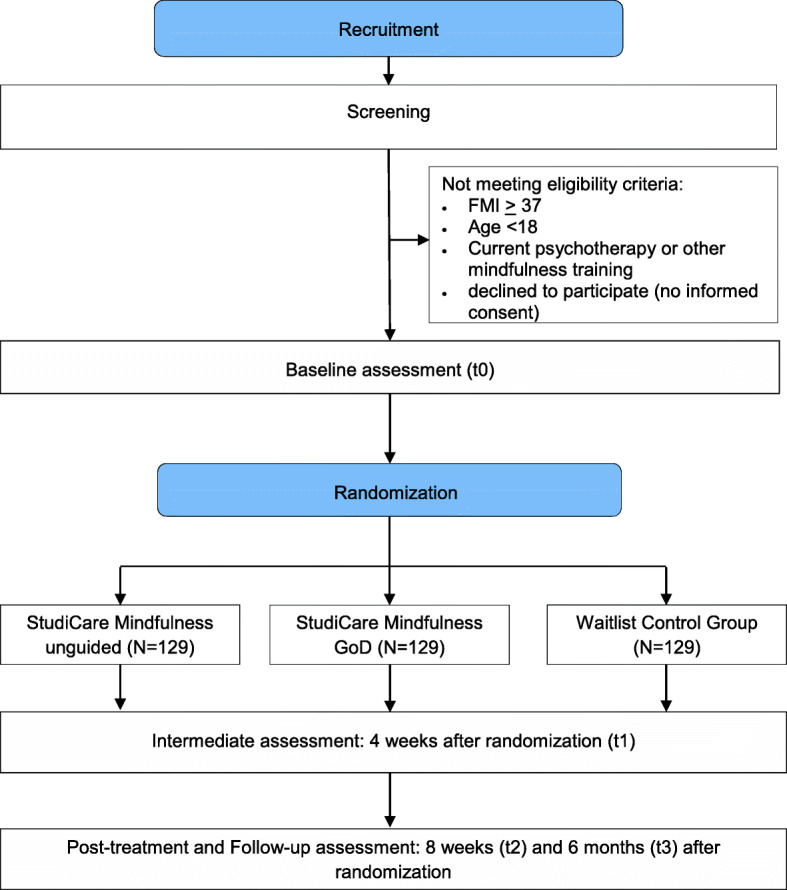
- The planned trial is three-armed: unguided StudiCare-M, guidance-on-demand (GoD) StudiCare-M, and waitlist control. It targets 387 college students with moderate to low mindfulness recruited from 15+ universities in Germany, Austria, and Switzerland.
- The intervention consists of 7 weekly core modules plus 2 booster sessions, with assessments at baseline, 1 month, 2 months (post-treatment), and 6 months.
- The protocol specifies the primary outcome as mindfulness and secondary outcomes including stress, depression, anxiety, interoception, presenteeism, wellbeing, intervention satisfaction, adherence, and potential side effects.
## Methods
- Multicenter, three-armed randomized controlled trial with parallel design; participants are randomized 1:1:1 to unguided, GoD, or waitlist control.
- Recruitment is through circular emails and other channels at 15+ cooperating colleges in Germany, Austria, and Switzerland; inclusion requires age 18+, enrollment in college/university, German proficiency, internet access, and FMI ≤ 37.
- Main analysis is planned on an intention-to-treat basis; linear regression will test the primary outcome, with secondary outcomes analyzed similarly, and exploratory moderator and time-lagged mediation analyses.
## Limitations
- The paper states that high dropout is a common problem in internet interventions; this is a limitation of the field and a concern for this trial, though the study adds SMS coaching, e-coach support, and automated feedback to mitigate it.
- The discussion says the sample includes only students with moderate to low mindfulness, which reduces generalizability to students already high in mindfulness.
- Evident from the text: this is a protocol, so it reports planned methods and outcomes rather than empirical results; therefore efficacy findings are not yet available.
Model-written summary. Check it against the paper before relying on it.
Integrity signals
Registry
Cites
Statistics
Figures
Verification
Claims the paper makes
37 Valid · 0 Not valid · 23 Not checked · 12 Own results and interpretations
Every source the paper cites for this claim was checked and supports it.
In the paper
“The authors found small to medium effect sizes concerning the improvement of depression (g = 0.29, 95% CI 0.13–0.46), anxiety (g = 0.22, 95% CI 0.05–0.39), well-being (g = 0.23, 95% CI 0.09–0.38), and mindfulness (g = 0.32, 95% CI 0.23–0.42).”
§ StudiCare mindfulness—study protocol of a randomized controlled trial evaluating an internet- and mobile-based intervention for college students with no and “on demand” guidance > Introduction
What the sources say
- Supportedcites [25] Spijkerman MPJ, Pots WTM, Bohlmeijer ET. Effectiveness of online mindfulness-based interventions in improving mental health: a review and meta-analysis of randomised controlled trials. Clin Psychol Rev. 2016;45:102–14. source
The abstract reports that the meta-analysis included 15 randomised controlled trials of online mindfulness-based interventions. Section 3.4.1 reports a small effect on depression of g = 0.29 (95% CI: 0.13 to 0.46), exactly matching the attributed estimate. (LLM, conf=0.94)
plainstates a cause- Asserted: passes — The authors put it forward as true.
- Checkable: passes — It can be checked against evidence.
- Load-bearing: passes — The paper’s conclusions depend on it.
- Based: passes — The paper gives a reason why it holds.
- Supported
The sources with a verdict support this claim; the rest weren’t checked yet, have no full text we could read, or their verdicts aren’t rated yet.
In the paper
“So far, only two trials examined GoD-IMIs, delivering cognitive behavioral therapy (CBT) to people with social phobia [35] and tinnitus [36].”
§ StudiCare mindfulness—study protocol of a randomized controlled trial evaluating an internet- and mobile-based intervention for college students with no and “on demand” guidance > Introduction
What the sources say
- Not checked — no full text of the sourcecites [35] Berger T, Caspar F, Richardson R, Kneubühler B, Sutter D, Andersson G. Internet-based treatment of social phobia: a randomized controlled trial comparing unguided with two types of guided self-help. Behav Res Ther. 2011;49(3):158–69. source
- Supportedcites [36] Rheker J, Andersson G, Weise C. The role of “on demand” therapist guidance vs. no support in the treatment of tinnitus via the internet: a randomized controlled trial. Internet Interv. 2015;2(2):189–99. source
The Procedure section describes a randomized trial in which people with tinnitus received internet-based CBT with either support on demand or no support. This confirms the tinnitus trial identified by citation [36]; the social-phobia trial has a separate citation, and the count of two trials is the citing authors’ framing. (LLM, conf=0.93)
plain- Asserted: passes — The authors put it forward as true.
- Checkable: passes — It can be checked against evidence.
- Load-bearing: passes — The paper’s conclusions depend on it.
- Based: passes — The paper gives a reason why it holds.
The cited sources support only part of this claim — read each source’s verdict below.
In the paper
“Whereas internet and mobile-based interventions (IMIs) have shown to be equally effective as face-to-face treatments for numerous mental health problems [19]”
§ StudiCare mindfulness—study protocol of a randomized controlled trial evaluating an internet- and mobile-based intervention for college students with no and “on demand” guidance > Introduction
What the sources say
- Partly supportedcites [19] Carlbring P, Andersson G, Cuijpers P, Riper H, Hedman-Lagerlöf E. Internet-based vs. face-to-face cognitive behavior therapy for psychiatric and somatic disorders: an updated systematic review and meta-analysis. Cogn Behav Ther. 2018;47(1):1–18. sourceExperimental — accuracy not yet measured
The All studies results (p. 11) report equivalent overall effects for internet-delivered CBT and face-to-face CBT across 20 studies. The claim is broader than that evidence: the Discussion (p. 15) cautions that equivalence cannot yet be concluded for every condition and that the findings are difficult to generalize beyond CBT. The cited comparison also does not establish equivalence for mobile-based interventions generally. (LLM, conf=0.88)
boosted- Asserted: passes — The authors put it forward as true.
- Checkable: passes — It can be checked against evidence.
- Load-bearing: passes — The paper’s conclusions depend on it.
- Based: passes — The paper gives a reason why it holds.
- Partly supported
Every source the paper cites for this claim was checked and supports it.
In the paper
“The largest effect was shown for stress (g = .51, 95% CI 0.26–0.75).”
§ StudiCare mindfulness—study protocol of a randomized controlled trial evaluating an internet- and mobile-based intervention for college students with no and “on demand” guidance > Introduction
What the sources say
- Supportedcites [25] Spijkerman MPJ, Pots WTM, Bohlmeijer ET. Effectiveness of online mindfulness-based interventions in improving mental health: a review and meta-analysis of randomised controlled trials. Clin Psychol Rev. 2016;45:102–14. source
The abstract states that the meta-analysis included 15 randomised controlled trials and that stress had the largest effect. Section 3.4.3 reports the claimed effect size and confidence interval for stress; it also notes that the estimate fell to g = 0.39 after an outlier was removed. Page numbers are not available in the supplied copy. (LLM, conf=0.95)
plainstates a cause- Asserted: passes — The authors put it forward as true.
- Checkable: passes — It can be checked against evidence.
- Load-bearing: unclear — It is unclear whether the paper’s conclusions depend on it.
- Based: passes — The paper gives a reason why it holds.
- Supported
The sources with a verdict support this claim; the rest weren’t checked yet, have no full text we could read, or their verdicts aren’t rated yet.
In the paper
“Contrary to what one would expect, both studies did not find any significant differences in efficacy or adherence of GoD-IMIs compared to unguided IMIs.”
§ StudiCare mindfulness—study protocol of a randomized controlled trial evaluating an internet- and mobile-based intervention for college students with no and “on demand” guidance > Introduction
What the sources say
- Not checked — no full text of the sourcecites [35] Berger T, Caspar F, Richardson R, Kneubühler B, Sutter D, Andersson G. Internet-based treatment of social phobia: a randomized controlled trial comparing unguided with two types of guided self-help. Behav Res Ther. 2011;49(3):158–69. source
- Supportedcites [36] Rheker J, Andersson G, Weise C. The role of “on demand” therapist guidance vs. no support in the treatment of tinnitus via the internet: a randomized controlled trial. Internet Interv. 2015;2(2):189–99. source
The Primary outcome section (3.2.1; page unavailable) reports no significant efficacy difference between the support-on-demand and non-support groups. The Flow of participants section (3.1; page unavailable) also reports no statistically significant difference in treatment dropouts, an adherence measure. This paper supports the claim for its own trial; it does not establish the result for the other study implied by “both.” (LLM, conf=0.90)
plain- Asserted: passes — The authors put it forward as true.
- Checkable: passes — It can be checked against evidence.
- Load-bearing: passes — The paper’s conclusions depend on it.
- Based: passes — The paper gives a reason why it holds.
24 more claims · 16 with their cited sources checked
Create a free account to see all 72 claims and to verify the 3 references still open.
- It may state two separate claims as one. 30
- Probably not a substantial claim. 26
Citations
Cites
Faul, F., Erdfelder, E., Lang, A.-G., & Buchner, A. (2007) · Behavior Research Methods · doi:10.3758/bf03193146 · Cited by 65,971
The PHQ-9: Validity of a brief depression severity measure
Kroenke, K., Spitzer, R. L., & Williams, J. B. W. (2001) · Journal of General Internal Medicine · doi:10.1046/j.1525-1497.2001.016009606.x · Cited by 44,910
A Brief Measure for Assessing Generalized Anxiety Disorder: The GAD-7
Spitzer, R. L., Kroenke, K., Williams, J. B. W., & Löwe, B. (2006) · Archives of Internal Medicine · doi:10.1001/archinte.166.10.1092 · Cited by 31,765
Emerging adulthood: A theory of development from the late teens through the twenties.
Arnett, J. J. (2000) · American Psychologist · doi:10.1037/0003-066x.55.5.469 · Cited by 16,843
CONSORT 2010 Statement: updated guidelines for reporting parallel group randomised trials
the CONSORT Group, Schulz, K. F., Altman, D. G., & Moher, D. (2010) · BMC Medicine · doi:10.1186/1741-7015-8-18 · Cited by 13,371
Gross, J. J., & John, O. P. (2003) · Journal of Personality and Social Psychology · doi:10.1037/0022-3514.85.2.348 · Cited by 11,929
CONSORT 2010 Statement: updated guidelines for reporting parallel group randomised trials
Schulz, K. F., Altman, D. G., Moher, D., & for the CONSORT Group (2010) · BMJ · doi:10.1136/bmj.c332 · Cited by 9,329
Jacobson, N. S., & Truax, P. (1991) · Journal of Consulting and Clinical Psychology · doi:10.1037/0022-006x.59.1.12 · Cited by 7,770
SPIRIT 2013 Statement: Defining Standard Protocol Items for Clinical Trials
Chan, A.-W., Tetzlaff, J. M., Altman, D. G., Laupacis, A., Gøtzsche, P. C., Krleža-Jerić, K., Hróbjartsson, A., Mann, H., Dickersin, K., Berlin, J. A., et al. (2013) · Annals of Internal Medicine · doi:10.7326/0003-4819-158-3-201302050-00583 · Cited by 7,363 · cited 1×
“The study protocol follows recommendations of the SPIRIT 2013 Checklist for clinical trial protocols [55].”
Method(1999) · Cited by 5,934
Research works printed but not linked: 5
- Kaluza G. Stressbewältigung - Trainingsmanual zur psychologischen Gesundheitsförderung. Berlin Heidelberg: Springer-Verlag; 2011.
- Porges S. Body Perception Questionnaire. Laboratory of Development Assessment, University of Maryland; 1993.
- Kriz D, Nübling R, Steffanowski A, Rieger J, Schmidt J. Patientenzufriedenheit: Psychometrische Reanalyse des ZUF-8. DRV Schriften. 2008;77:84–5.
- Schwarzer R, Jerusalem M. Generalized self-efficacy scale. In: Weinman J, Wright S, Johnston M, editors. Measures in health psychology: a user’s portfolio causal and control beliefs. UK: NFER-Nelson; 1995. p. 35–7.
- Kupfer J, Brosig B, Brähler E. Toronto-Alexithymie-Skala-20 (TAS-20). Göttingen: Hogrefe; 2001.
Cited by
Xu, J. H., Khanotia, A., Juni, S., Ku, J., Sami, H., Lin, V., Walterson, R., Payne, E., Jo, H., & Rahimpoor-Marnani, P. (2024) · JMIR Mental Health · doi:10.2196/52186 · Cited by 52
Küchler, A., Schultchen, D., Dretzler, T., Moshagen, M., Ebert, D. D., & Baumeister, H. (2023) · International Journal of Environmental Research and Public Health · doi:10.3390/ijerph20043208 · Cited by 39
Self-citationKüchler, A., Kählke, F., Vollbrecht, D., Peip, K., Ebert, D. D., & Baumeister, H. (2022) · Mindfulness · doi:10.1007/s12671-022-01949-w · Cited by 45
Self-citationBolinski, F., Kleiboer, A., Neijenhuijs, K., Karyotaki, E., Wiers, R., de Koning, L., Jacobi, C., Zarski, A.-C., Weisel, K. K., Cuijpers, P., et al. (2022) · Journal of Medical Internet Research · doi:10.2196/40892 · Cited by 24
“Digital interventions provided via the internet on computers or via smartphone apps have been proposed as a way to overcome barriers to the availability of counseling services and help seeking by offering the privacy and autonomy desired by students [37].”
Balci, S., Küchler, A., Ebert, D. D., & Baumeister, H. (2023) · Clinical Psychology in Europe · doi:10.32872/cpe.9341 · Cited by 26
“For English-speaking international students, the intervention content of StudiCare-Mindfulness (Küchler et al., 2020; Schultchen et al., 2020) was translated to English and certain aspects (e.g. language barrier, different education systems) changed in accordance with student life and stress sources.”
MethodResultSelf-citation
Metadata
- Authors
- Küchler, A.-M., Schultchen, D., Pollatos, O., Moshagen, M., Ebert, D. D., & Baumeister, H.
- Affiliations
- Universität Ulm (DE)
- Vrije Universiteit Amsterdam (NL)
- Corresponding author
- Küchler, Ann-Marie
- ORCID
- Venue
- Trials
- Published
- 2020-11-26
- Volume
- 21
- Issue
- 1
- Pages
- 975-975
- ISSN
- 1745-6215 (ISSN-L)
- PMC
- PMC7691111
- OpenAlex
- W3108428785
- Cited by
- 12
- References
- 108
- Citations by year
- 2026: 1 · 2025: 1 · 2024: 3 · 2023: 4 · 2022: 2 · 2020: 1
- FWCI
- 1.58
- Type
- journal article
- Language
- en
- Open access
- gold
- doi.org
- Licence
- cc-by
- creativecommons.org/licenses/by/4.0/ (tdm)
- creativecommons.org/licenses/by/4.0/ (vor)
- Locations
- Trials (publishedVersion, cc-by)
- PubMed Central (publishedVersion, cc-by)
- PubMed (publishedVersion)
- VU Research Portal (publishedVersion, other-oa)
- DOAJ (DOAJ: Directory of Open Access Journals) (submittedVersion)
- Informationszentrum Lebenswissenschaften (ZB MED) (submittedVersion, cc-by)
- OPen Access Repositorium der Universität Ulm (OPARU) (Ulm University) (submittedVersion, cc-by)
- Data Archiving and Networked Services (DANS) (submittedVersion, other-oa)
- Universität Ulm, Kommunikations- und Informationszentrum (kiz) (cc-by)
- Funders
- Barmer
- Topics
- Social Sciences › Psychology › Applied Psychology › Digital Mental Health Interventions
- Social Sciences › Psychology › Clinical Psychology › Mindfulness and Compassion Interventions
- Social Sciences › Psychology › Experimental and Cognitive Psychology › Mental Health Research Topics
- Keywords
- mindfulness-based interventions, university students, student mental health, e-coaching, acceptance and commitment therapy, stress management, intervention adherence, mediators and moderators, alexithymia, emotion regulation, cognitive fusion, self-efficacy, depression, anxiety, interoception, presenteeism, well-being
- MeSH terms
- Austria, Germany, Humans, Students, Switzerland, Universities, Randomized Controlled Trials as Topic, Internet, Mindfulness, Acceptance and Commitment Therapy
About these checks
Registry, retraction, Cites and statistics results are computed, not judged, with one exception: a printed reference that no index lists is read once by a model before it counts as a citation error. Claims are extracted by a model and kept only when their quote appears verbatim in the text; each cited source is then checked, with a model’s help, for whether it says what the claim relies on. Those verdicts can be wrong — read the claim’s quote and the cited source before relying on one.
The claim verdicts this report counts are experimental: their accuracy is not yet measured.
A language model drew the claims from the paper on 2026-10-11, under version 3 of the claim definition (model deepseek-v4.1-flash, prompt extract-v3).
A second model labelled each claim on 2026-10-11 (model jev-1.13-20260917, definition revision gold-guideline-v0.2).
Cited sources are checked with a language model’s help (gpt-6-sol).
Statistics and arithmetic are recomputed, not judged.
Confidence bands are shown only for fields calibrated on our annotated test set. None is calibrated yet, so no band is shown.
What counts as a claim ›How we measure confidence ›How we check this ›
Are you an author, or do you see a problem with this page? Request a review
How to cite
Cite CoChat for the checks on this page, and the paper for its own findings.
- This page
- CoChat. (2026). Citation check: StudiCare mindfulness-study protocol of a randomized controlled trial evaluating an internet- and mobile-based intervention for college students with no and "on demand" guidance. https://app.cochat.ai/papers/10.1186/s13063-020-04868-0
- The paper
- Küchler, A.-M., Schultchen, D., Pollatos, O., Moshagen, M., Ebert, D. D., & Baumeister, H. (2020). StudiCare mindfulness-study protocol of a randomized controlled trial evaluating an internet- and mobile-based intervention for college students with no and "on demand" guidance. Trials. https://doi.org/10.1186/s13063-020-04868-0
Data sources
Bibliographic data: Semantic Scholar, OpenAlex, Crossref.
Contains information from the Semantic Scholar Academic Graph Datasets, made available under the ODC Attribution License (ODC-BY 1.0).
Semantic Scholar’s data is described in: Kinney, R., et al. (2023). The Semantic Scholar Open Data Platform. arXiv:2301.10140.
