

The DOI matches its Crossref record; 4 of the 4 references it cites were found in a registry or an index.
The effectiveness of battlefield acupuncture in addition to standard physical therapy treatment after shoulder surgery: a protocol for a randomized clinical trial
Open accessPublished version of a preprint
Abstract
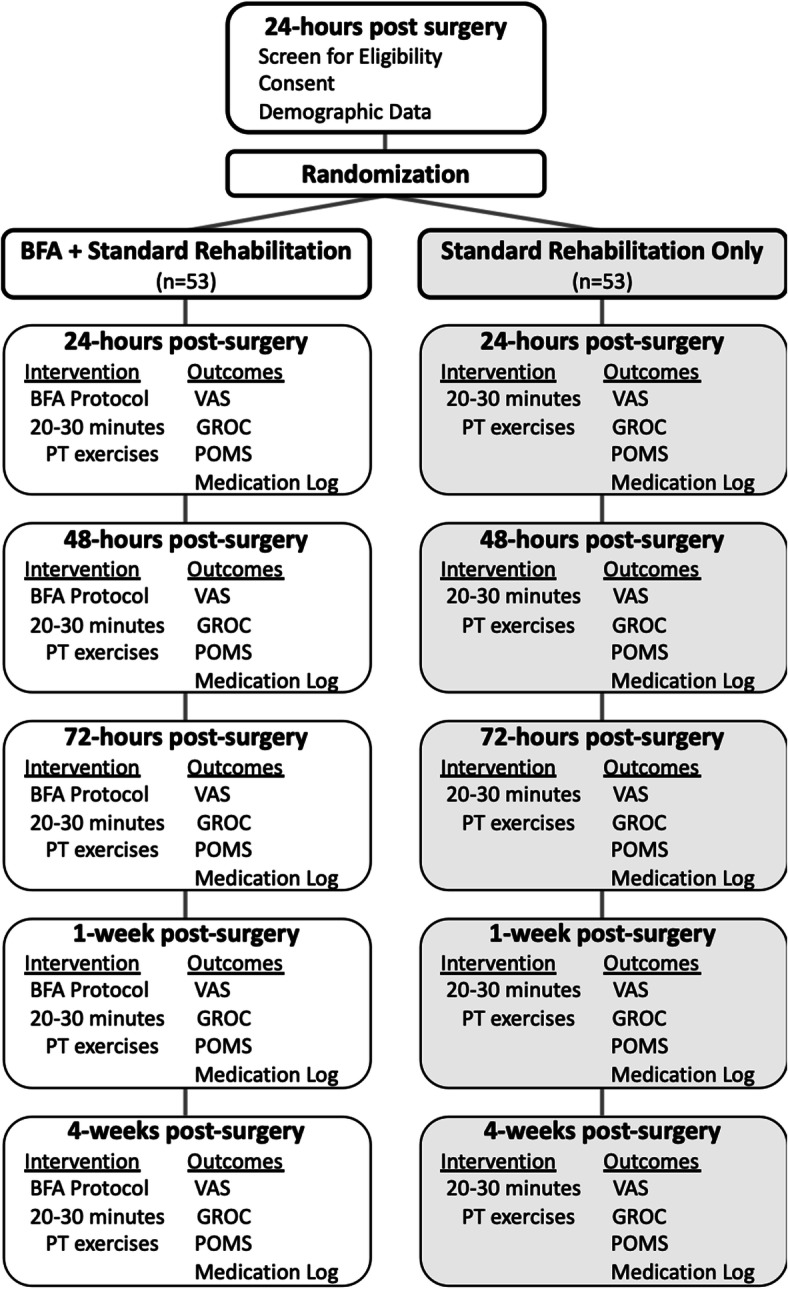
Introduction: There is a large incidence of shoulder instability among active young athletes and military personnel. Shoulder stabilization surgery is the commonly employed intervention for treating individuals with instability. Following surgery, a substantial proportion of individuals experience acute post-operative pain, which is usually managed with opioid pain medications. Unfortunately, the extended use of opioid medications can have adverse effects that impair function and reduce military operational readiness, but there are currently few alternatives. However, battlefield acupuncture (BFA) is a minimally invasive therapy demonstrating promise as a non-pharmaceutical intervention for managing acute post-operative pain. Methods: This is a parallel, two-arm, single-blind randomized clinical trial. The two independent variables are intervention (2 levels, standard physical therapy and standard physical therapy plus battlefield acupuncture) and time (5 levels, 24 h, 48 h, 72 h, 1 week, and 4 weeks post shoulder stabilization surgery). The primary dependent variables are worst and average pain as measured on the visual analog scale. Secondary outcomes include medication usage, Profile of Mood States, and Global Rating of Change. Discussion: The magnitude of the effect of BFA is uncertain; current studies report confidence intervals of between-group differences that include minimal clinically important differences between intervention and control groups. The results of this study may help determine if BFA is an effective adjunct to physical therapy in reducing pain and opioid usage in acute pain conditions. Trial registration: ClinicalTrials.gov NCT04094246 . Registered on 16 September 2019.
Overview
The claims and statistics of this paper haven’t been checked yet.
Run the check — free, no account needed. It reads the open-access text and checks the sources it cites.
Integrity signals
Registry
Cites
Statistics
Figures
Verification
Claims the paper makes
The claims and statistics of this paper haven’t been checked yet.
Run the check — free, no account needed. It reads the open-access text and checks the sources it cites.
Self-check
Percentages, sums and reported differences re-computed from the paper’s own numbers.
The self-check needs the paper’s full text.
Citations
Cites
Hoffmann, T. C., Glasziou, P. P., Boutron, I., Milne, R., Perera, R., Moher, D., Altman, D. G., Barbour, V., Macdonald, H., Johnston, M., et al. (2014) · BMJ · doi:10.1136/bmj.g1687 · Cited by 10,548
CONSORT 2010 Statement: updated guidelines for reporting parallel group randomised trials
the CONSORT Group, Schulz, K. F., Altman, D. G., & Moher, D. (2010) · Trials · doi:10.1186/1745-6215-11-32 · Cited by 1,871
Price, D. D., Bush, F. M., Long, S., & Harkins, S. W. (1994) · Pain · doi:10.1016/0304-3959(94)90097-3 · Cited by 1,174
Reporting methods of blinding in randomized trials assessing nonpharmacological treatments
Boutron, I., Guittet, L., Estellat, C., Moher, D., Hróbjartsson, A., & Ravaud, P. (2007) · PLoS Medicine · doi:10.1371/journal.pmed.0040061 · Cited by 389
Research works printed but not linked: 41
- Amako M, Arino H, Tsuda Y, Tsuchihara T, Nemoto K. Recovery of shoulder rotational muscle strength after arthroscopic bankart repair. Orthop J Sports Med. 2017;5:2325967117728684. https://doi.org/10.1177/2325967117728684 journals.sagepub.com. · DOI
- Owens BD, Dawson L, Burks R, Cameron KL. Incidence of shoulder dislocation in the United States military: demographic considerations from a high-risk population. J Bone Joint Surg - Ser A. 2009;91:791–6. https://doi.org/10.2106/JBJS.H.00514. · DOI
- Brelin A, Dickens J. Posterior shoulder instability. Sports Med Arthrosc Rev. 2017;25:136–43. · DOI
- Owens BD, Agel J, Mountcastle SB, Cameron KL, Nelson BJ. Incidence of glenohumeral instability in collegiate athletics. Am J Sports Med. 2009;37:1750–4. · DOI
- Owens BD, Duffey ML, Nelson BJ, DeBerardino TM, Taylor DC, Mountcastle SB. The incidence and characteristics of shoulder instability at the United States Military Academy. Am J Sports Med. 2007;35:1168–73. · DOI
- Waterman B, Owens BD, Tokish JM. Anterior shoulder instability in the military athlete. Sports Health. 2016;8:514–9. · DOI
- Kardouni JR, Mckinnon CJ, Seitz AL. Incidence of shoulder dislocations and the rate of recurrent instability in soldiers. Med Sci Sports Exerc. 2016;48:2150–6. https://doi.org/10.1249/MSS.0000000000001011. · DOI
- Cameron KL, Mauntel TC, Owens BD. The epidemiology of glenohumeral joint instability: incidence, burden, and long-term consequences. Sports Med Arthrosc Rev. 2017;25:144–9. https://doi.org/10.1097/JSA.0000000000000155. · DOI
- Longo UG, Loppini M, Rizzello G, Ciuffreda M, Maffulli N, Denaro V. Management of primary acute anterior shoulder dislocation: systematic review and quantitative synthesis of the literature. Arthroscopy. 2014;30:506–22. · DOI
- Bottoni CR, Wilckens JH, DeBerardino TM, D’Alleyrand JCG, Rooney RC, Harpstrite JK, et al. A prospective, randomized evaluation of arthroscopic stabilization versus nonoperative treatment in patients with acute, traumatic, first-time shoulder dislocations. Am J Sports Med. 2002;30:576–80. · DOI
- Godin J, Sekiya JK. Systematic review of rehabilitation versus operative stabilization for the treatment of first-time anterior shoulder dislocations. Sports Health. 2010;2:156–65. · DOI
- Veal FC, Bereznicki LRE, Thompson AJ, Peterson GM, Orlikowski C. Subacute pain as a predictor of long-term pain following orthopedic surgery: an Australian prospective 12 month observational cohort study. Medicine. 2015;94:e1498. · DOI
- Johnson M. Rehabilitation following surgery for Glenohumeral instability. Sports Med Arthrosc. 2017;25:116–22. · DOI
- DeFroda SF, Mehta N, Owens BD. Physical therapy protocols for arthroscopic bankart repair. Sports Health. 2018;10:250–8. · DOI
- Gaunt BW, Shaffer MA, Sauers EL, Michener LA, Mccluskey GM, Thigpen CA. The American Society of Shoulder and Elbow Therapists’ consensus rehabilitation guideline for arthroscopic anterior capsulolabral repair of the shoulder. J Orthop Sports Phys Ther. 2010;40:155–68. · DOI
- Sheth U, Mehta M, Huyke F, Terry MA, Tjong VK. Opioid use after common sports medicine procedures: a systematic review. Sports Health. 2020;12:225–33. https://doi.org/10.1177/1941738120913293. · DOI
- Mudumbai SC, Oliva EM, Lewis ET, Trafton J, Posner D, Mariano ER, et al. Time-to-cessation of postoperative opioids: a population-level analysis of the Veterans Affairs Health Care System. Pain Med. 2016;17:1732–43. https://doi.org/10.1093/pm/pnw015. · DOI
- Niemtzow RC. Battlefield acupuncture. Med Acupunct. 2007;19:225–8. https://doi.org/10.1089/acu.2007.0603. · DOI
- Usichenko TI, Hermsen M, Witstruck T, Hofer A, Pavlovic D, Lehmann C, et al. Auricular acupuncture for pain relief after ambulatory knee arthroscopy-a pilot study. Evid Based Complement Alternat Med. 2005;2:185–9. https://doi.org/10.1093/ecam/neh097. · DOI
- Moss DA, Crawford P. Ear acupuncture for acute sore throat: a randomized controlled trial. J Am Board Fam Med. 2015;28:697–705. https://doi.org/10.3122/jabfm.2015.06.150014. · DOI
- Jan AL, Aldridge ES, Rogers IR, Visser EJ, Bulsara MK, Niemtzow RC. Does ear acupuncture have a role for pain relief in the emergency setting? A systematic review and meta-analysis. Med Acupunct. 2017;29:276–89. https://doi.org/10.1089/acu.2017.1237. · DOI
- Walker PH, Pock A, Ling CG, Kwon KN, Vaughan M. Battlefield acupuncture: opening the door for acupuncture in Department of Defense/Veteran’s Administration health care. Nurs Outlook. 2016;64:491–8. · DOI
- Soliman N, Frank BL. Auricular acupuncture and auricular medicine. Phys Med Rehabil Clin N Am. 1999;10:547–54. · DOI
- Clement-Jones V, McLoughlin L, Tomlin S, Besser GM, Rees LH, Wen HL. Increased β-endorphin but not Met-enkephalin levels in human cerebrospinal fluid after acupuncture for recurrent pain. Lancet. 1980;316:946–. · DOI
- Cho ZH, Oleson TD, Alimi D, Niemtzow RC. Acupuncture: the search for biologic evidence with functional magnetic resonance imaging and positron emission tomography techniques. J Altern Complement Med. 2002;8:399–401. https://doi.org/10.1089/107555302760253577. · DOI
- Crawford P, Moss DA, Crawford AJ, Sharon DJ. Modified battlefield acupuncture does not reduce pain or improve quality of life in patients with lower extremity surgery. Mil Med. 2019;184(Suppl 1):545–9. https://doi.org/10.1093/milmed/usy277. · DOI
- Collinsworth KM, Goss DL. Battlefield acupuncture and physical therapy versus physical therapy alone after shoulder surgery. Med Acupunct. 2019;31:228–38. https://doi.org/10.1089/acu.2019.1372. · DOI
- Chan AW, Tetzlaff JM, Altman DG, Laupacis A, Gøtzsche PC, Krleža-Jerić K, et al. SPIRIT 2013 statement: defining standard protocol items for clinical trials. Ann Intern Med. 2013;158:200–7. https://doi.org/10.7326/0003-4819-158-3-201302050-00583. · DOI · Paper page
- Altman DG, Bland JM. How to randomise. BMJ. 1999;319:703–4. https://doi.org/10.1136/bmj.319.7211.703. · DOI · Paper page
- Halle R, Crowell M, Goss D. Dry needling and physical therapy versus physical therapy alone following shoulder stabilization repair: a randomized clinical trial. Int J Sports Phys Ther. 2020;15:81–102. · DOI
- Fox LM, Murakami M, Danesh H, Manini AF. Battlefield acupuncture to treat low back pain in the emergency department. Am J Emerg Med. 2018;36:1045–8. https://doi.org/10.1016/j.ajem.2018.02.038. · DOI
- Price DD, McGrath PA, Rafii A, Buckingham B. The validation of visual analogue scales as ratio scale measures for chronic and experimental pain. Pain. 1983;17:45–56. https://doi.org/10.1016/0304-3959(83)90126-4. · DOI · Paper page
- Lee JS, Hobden E, Stiell IG, Wells GA. Clinically important change in the visual analog scale after adequate pain control. Acad Emerg Med. 2003;10:1128–30. · DOI
- Myles PS, Myles DB, Galagher W, Boyd D, Chew C, MacDonald N, et al. Measuring acute postoperative pain using the visual analog scale: the minimal clinically important difference and patient acceptable symptom state. Br J Anaesth. 2017;118:424–9. https://doi.org/10.1093/bja/aew466. · DOI
- Briggs M. A descriptive study of the use of visual analogue scales and verbal rating scales for the assessment of postoperative pain in orthopedic patients. J Pain Symptom Manag. 1999;18:438–46. · DOI
- Grove JR, Prapavessis H. Preliminary evidence for the reliability and validity of an abbreviated Profile of Mood States. Int J Sport Psychol. 1992;23:93–109.
- Leunes A, Burger J. Profile of Mood States research in sport and exercise psychology: past, present, and future. J Appl Sport Psychol. 2000;12:5–15. · DOI
- Kamper S. Global Rating of Change Scales: a review of strengths and weaknesses and considerations for design. J Man Manip Ther. 2009;17:163–70. · DOI · Paper page
- Sterne JAC, White IR, Carlin JB, Spratt M, Royston P, Kenward MG, et al. Multiple imputation for missing data in epidemiological and clinical research: potential and pitfalls. BMJ. 2009;339:157–60.
- Bialosky JE, Bishop MD, Penza CW. Placebo mechanisms of manual therapy: a sheep in Wolf’s clothing? J Orthop Sports Phys Ther. 2017;47:301–4. · DOI
- Benz LN, Flynn TW. Placebo, nocebo, and expectations: leveraging positive outcomes. J Orthop Sports Phys Ther. 2013;43:439–41. · DOI
Metadata
- Authors
- Crowell, M. S., Brindle, R. A., Mason, J. S., Pitt, W., Miller, E. M., Posner, M. A., Cameron, K. L., & Goss, D. L.
- Affiliations
- Baylor University (US)
- Keller Army Community Hospital (US)
- High Point University (US)
- Corresponding author
- Crowell, Michael S.
- Venue
- Trials
- Published
- 2020-12
- Volume
- 21
- Issue
- 1
- Pages
- 995-995
- ISSN
- 1745-6215 (ISSN-L)
- PMC
- PMC7713004
- OpenAlex
- W3109050067
- Cited by
- 2
- References
- 4
- Citations by year
- 2025: 1 · 2023: 1
- FWCI
- 0.28
- Type
- journal article
- Language
- en
- Open access
- gold
- doi.org
- Licence
- Locations
- Trials (publishedVersion, cc-by)
- Research Square (acceptedVersion, cc-by)
- PubMed Central (publishedVersion, cc-by)
- PubMed (publishedVersion)
- DOAJ (DOAJ: Directory of Open Access Journals) (submittedVersion, cc-by-sa)
- Funders
- Uniformed Services University of the Health Sciences (MIRROR)
- Topics
- Health Sciences › Medicine › Complementary and alternative medicine › Acupuncture Treatment Research Studies
- Health Sciences › Medicine › Anesthesiology and Pain Medicine › Anesthesia and Pain Management
- Health Sciences › Medicine › Surgery › Shoulder Injury and Treatment
- Keywords
- battlefield acupuncture, shoulder stabilization surgery, shoulder instability, postoperative pain, physiotherapy, opioid use, non-pharmacological pain management, military personnel, mood states
- MeSH terms
- Humans, Joint Instability, Shoulder, Shoulder Joint, Acupuncture Therapy, Randomized Controlled Trials as Topic, Single-Blind Method, Treatment Outcome, Physical Therapy Modalities
About these checks
Registry, retraction, Cites and statistics results are computed, not judged, with one exception: a printed reference that no index lists is read once by a model before it counts as a citation error. Claims are extracted by a model and kept only when their quote appears verbatim in the text; each cited source is then checked, with a model’s help, for whether it says what the claim relies on. Those verdicts can be wrong — read the claim’s quote and the cited source before relying on one.
Statistics and arithmetic are recomputed, not judged.
Confidence bands are shown only for fields calibrated on our annotated test set. None is calibrated yet, so no band is shown.
What counts as a claim ›How we measure confidence ›How we check this ›
Are you an author, or do you see a problem with this page? Request a review
How to cite
Cite CoChat for the checks on this page, and the paper for its own findings.
- This page
- CoChat. (2026). Citation check: The effectiveness of battlefield acupuncture in addition to standard physical therapy treatment after shoulder surgery: a protocol for a randomized clinical trial. https://app.cochat.ai/papers/10.1186/s13063-020-04909-8
- The paper
- Crowell, M. S., Brindle, R. A., Mason, J. S., Pitt, W., Miller, E. M., Posner, M. A., Cameron, K. L., & Goss, D. L. (2020). The effectiveness of battlefield acupuncture in addition to standard physical therapy treatment after shoulder surgery: a protocol for a randomized clinical trial. Trials. https://doi.org/10.1186/s13063-020-04909-8
