

The DOI matches its Crossref record; 55 of the 56 references it cites were found in a registry or an index.
Why do patients take part in research? An overview of systematic reviews of psychosocial barriers and facilitators
Open accessAbstract
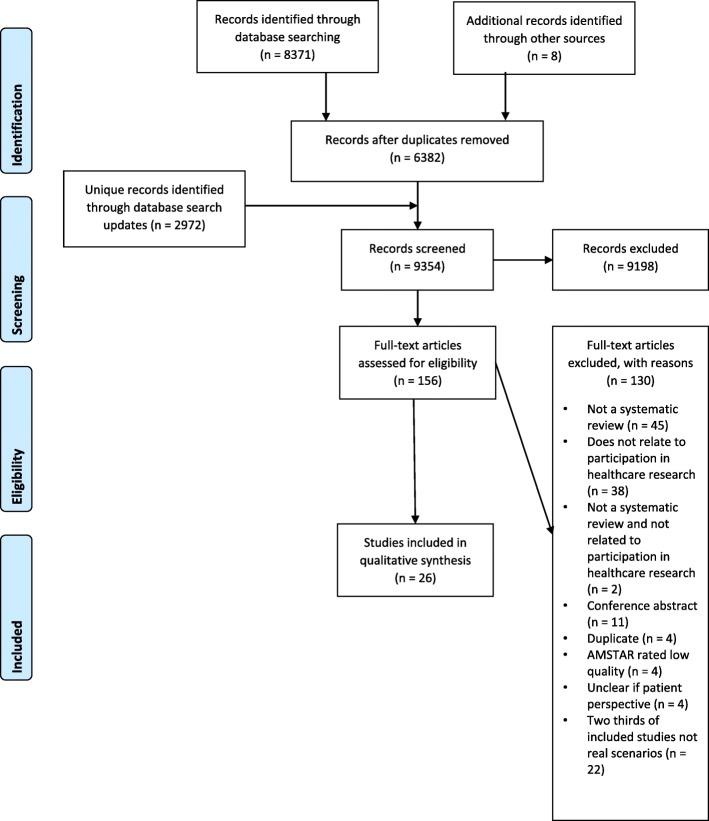
Background: Understanding why people take part in health research is critical to improve research efficiency and generalisability. The aim of this overview of systematic reviews was to identify psychosocial determinants of research participation and map them to psychological theory and empirical recruitment research, to identify effective strategies to increase research participation. Methods: Qualitative and quantitative systematic reviews were systematically identified. No date or language limits were applied. Two reviewers independently selected reviews. Methodological quality was rated using AMSTAR, and poor-quality reviews (scoring 0–3) were excluded. Barriers and facilitators were coded to psychological theory (Theoretical Domains Framework) and empirical recruitment research (recruitment interventions that had been subjected to randomised controlled trial evaluation). Results: We included 26 systematic reviews (429 unique primary studies), covering a wide range of patient populations and health settings. We identified five groups of facilitators, of which three were dominant (potential for personal benefit, altruism, trust) and appear to be relevant across research setting and design. We identified nine groups of barriers, which were more dependent on the particular study (context, population, design). Two determinants (participant information, social influences) were found to be both barriers and facilitators. Barriers and facilitators could be coded to the Motivation and Opportunity components of the Theoretical Domains Framework; only one was coded to a Capability component. There was some overlap between psychosocial determinants and empirical recruitment research, but some barriers and facilitators had not been tested at all. Conclusions: Identifying effective recruitment strategies could increase the efficiency and generalisability of primary research. We identified a number of barriers and facilitators that could be addressed by researchers. There is a need for more research to identify effective recruitment strategies that draw on the psychosocial facilitators and barriers identified in this overview.
Overview
The claims and statistics of this paper haven’t been checked yet.
Run the check — free, no account needed. It reads the open-access text and checks the sources it cites.
Integrity signals
Registry
Cites
Statistics
Figures
Verification
Claims the paper makes
The claims and statistics of this paper haven’t been checked yet.
Run the check — free, no account needed. It reads the open-access text and checks the sources it cites.
Claims other papers make about this one
Each is checked against this paper’s own text: does it say what the citing paper says it does?
The source backs part of the claim, not all of it — or backs it for a different population, condition or comparison.
In the citing paper
“difficulties understanding safety protocols or perceptions that health sites were not stringent enough and [2] worry that visiting health settings could pose a threat to the participant’s health from infection of Covid-19 [6,9].”
From Legacy lessons from the COVID-19 era to improve trial participation and retention: Views from trial participants, PPIE contributors and trial staff across the NIHR portfolio (2024) · cites this paper as [6]
Experimental — accuracy not yet measuredThe source backs part of the claim, not all of it — or backs it for a different population, condition or comparison.
In the citing paper
“They cited the low uptake stemming from a lack of knowledge on the purpose/function of research and if the research was safe to participate in.”
From Legacy lessons from the COVID-19 era to improve trial participation and retention: Views from trial participants, PPIE contributors and trial staff across the NIHR portfolio (2024) · cites this paper as [6]
Experimental — accuracy not yet measuredThe cited source says what the claim attributes to it.
In the citing paper
“Sheridan (2020) and colleagues noted that research participation, even before the onset of Covid-19, had a low uptake [6].”
The cited source says what the claim attributes to it.
In the citing paper
“Other concerns included: feeling that their privacy or confidentiality may be breached, being used as a ‘guinea pig’, and a general mistrust of researchers’ intentions [6].”
The check wasn’t confident either way, so it gives no verdict — never disputed.
In the citing paper
“difficulties understanding safety protocols or perceptions that health sites were not stringent enough and [2] worry that visiting health settings could pose a threat to the participant’s health from infection of Covid-19 [6,9].”
From Legacy lessons from the COVID-19 era to improve trial participation and retention: Views from trial participants, PPIE contributors and trial staff across the NIHR portfolio (2024) · cites this paper as [6]
Experimental — accuracy not yet measured
Self-check
Percentages, sums and reported differences re-computed from the paper’s own numbers.
The self-check needs the paper’s full text.
Citations
Cites
Preferred Reporting Items for Systematic Reviews and Meta-Analyses: the PRISMA statement
Moher, D., Liberati, A., Tetzlaff, J., Altman, D. G., & for the PRISMA Group (2009) · BMJ · doi:10.1136/bmj.b2535 · Cited by 83,823
Preferred reporting items for systematic reviews and meta-analyses: the PRISMA Statement.
(2009) · PubMed Central · Cited by 44,859
Preferred reporting items for systematic reviews and meta-analyses: The PRISMA statement
Moher, D., Liberati, A., Tetzlaff, J., Altman, D. G., & the PRISMA Group* (2009) · Annals of Internal Medicine · doi:10.7326/0003-4819-151-4-200908180-00135 · Cited by 37,554
Michie, S., van Stralen, M. M., & West, R. (2011) · Implementation Science · doi:10.1186/1748-5908-6-42 · Cited by 13,697
Cane, J., O’Connor, D., & Michie, S. (2012) · Implementation Science · doi:10.1186/1748-5908-7-37 · Cited by 4,888
Development of AMSTAR: A measurement tool to assess the methodological quality of systematic reviews
Shea, B. J., Grimshaw, J. M., Wells, G. A., Boers, M., Andersson, N., Hamel, C., Porter, A. C., Tugwell, P., Moher, D., & Bouter, L. M. (2007) · BMC Medical Research Methodology · doi:10.1186/1471-2288-7-10 · Cited by 4,374
Atkins, L., Francis, J., Islam, R., O’Connor, D., Patey, A., Ivers, N., Foy, R., Duncan, E. M., Colquhoun, H., Grimshaw, J. M., et al. (2017) · Implementation Science · doi:10.1186/s13012-017-0605-9 · Cited by 3,819
Systematic review finds overlapping reviews were not mentioned in every other overview
Pieper, D., Antoine, S.-L., Mathes, T., Neugebauer, E. A. M., & Eikermann, M. (2014) · Journal of Clinical Epidemiology · doi:10.1016/j.jclinepi.2013.11.007 · Cited by 1,318
Risks associated with obesity in pregnancy, for the mother and baby: a systematic review of reviews
Marchi, J., Berg, M., Dencker, A., Olander, E. K., & Begley, C. (2015) · Obesity Reviews · doi:10.1111/obr.12288 · Cited by 991
McDonald, A. M., Knight, R. C., Campbell, M. K., Entwistle, V. A., Grant, A. M., Cook, J. A., Elbourne, D. R., Francis, D., Garcia, J., Roberts, I., et al. (2006) · Trials · doi:10.1186/1745-6215-7-9 · Cited by 946
Cited by
Sorted by citations
Health data poverty: an assailable barrier to equitable digital health care
Ibrahim, H., Liu, X., Zariffa, N., Morris, A. D., & Denniston, A. K. (2021) · The Lancet Digital Health · doi:10.1016/s2589-7500(20)30317-4 · Cited by 326
Allison, K., Patel, D., & Kaur, R. (2022) · Cureus · doi:10.7759/cureus.24424 · Cited by 64
Song, L., Qan'ir, Y., Guan, T., Guo, P., Xu, S., Jung, A., Idiagbonya, E., Song, F., & Kent, E. E. (2021) · Journal of Pain and Symptom Management · doi:10.1016/j.jpainsymman.2021.04.019 · Cited by 54
Mäder, M., Timpel, P., Schönfelder, T., Militzer-Horstmann, C., Scheibe, S., Heinrich, R., & Häckl, D. (2023) · BMC Health Services Research · doi:10.1186/s12913-023-09287-w · Cited by 57
Antonio, M. G., Williamson, A. K., Kameswaran, V., Bhogal, A. N.-B., Ankrah, E. A., Goulet, S., Wang, Y., Macias, G., James-Gist, J., Brown, L. K., et al. (2022) · Journal of Medical Internet Research · doi:10.2196/42586 · Cited by 44
Metadata
- Authors
- Sheridan, R., Martin-Kerry, J., Hudson, J., Parker, A., Bower, P., & Knapp, P.
- Affiliations
- University of York (GB)
- King's College London (GB)
- University of Manchester (GB)
- Corresponding author
- Knapp, Peter
- Venue
- Trials
- Published
- 2020-03-12
- Volume
- 21
- Issue
- 1
- Pages
- 259-259
- ISSN
- 1745-6215 (ISSN-L)
- PMC
- PMC7069042
- OpenAlex
- W3011041837
- Cited by
- 223
- References
- 56
- Citations by year
- 2026: 35 · 2025: 44 · 2024: 44 · 2023: 41 · 2022: 34 · 2021: 18 · 2020: 7
- FWCI
- 4.18
- Type
- journal article
- Language
- en
- Update notices
- correction (2020-10-08)
- Open access
- gold
- doi.org
- Locations
- Trials (publishedVersion, cc-by)
- PubMed Central (publishedVersion, cc-by)
- PubMed (publishedVersion)
- White Rose Research Online (University of Leeds, The University of Sheffield, University of York) (acceptedVersion)
- UEA Digital Repository (University of East Anglia) (acceptedVersion)
- DOAJ (DOAJ: Directory of Open Access Journals) (submittedVersion, cc-by-sa)
- Topics
- Health Sciences › Medicine › Public Health, Environmental and Occupational Health › Ethics in Clinical Research
- Health Sciences › Health Professions › General Health Professions › Health Policy Implementation Science
- Health Sciences › Health Professions › General Health Professions › Mental Health and Patient Involvement
- Keywords
- research participation, barriers and facilitators, psychosocial factors, participant recruitment, altruism, trust, personal benefits, Theoretical Domains Framework, recruitment interventions, social influence, participant information
- MeSH terms
- Systematic Reviews as Topic, Humans, Motivation, Patient Participation, Research, Patient Selection
About these checks
Registry, retraction, Cites and statistics results are computed, not judged, with one exception: a printed reference that no index lists is read once by a model before it counts as a citation error. Claims are extracted by a model and kept only when their quote appears verbatim in the text; each cited source is then checked, with a model’s help, for whether it says what the claim relies on. Those verdicts can be wrong — read the claim’s quote and the cited source before relying on one.
Statistics and arithmetic are recomputed, not judged.
Confidence bands are shown only for fields calibrated on our annotated test set. None is calibrated yet, so no band is shown.
What counts as a claim ›How we measure confidence ›How we check this ›
Are you an author, or do you see a problem with this page? Request a review
