

Individual psychotherapy for cluster-C personality disorders: protocol of a pragmatic RCT comparing short-term psychodynamic supportive psychotherapy, affect phobia therapy and schema therapy (I-FORCE)
Open accessThe DOI matches its Crossref record; 97 of the 99 references it cites were found in a registry or an index, and 1 are not checked yet; 18 of the 81 sources its claims cite were checked for support.
Abstract
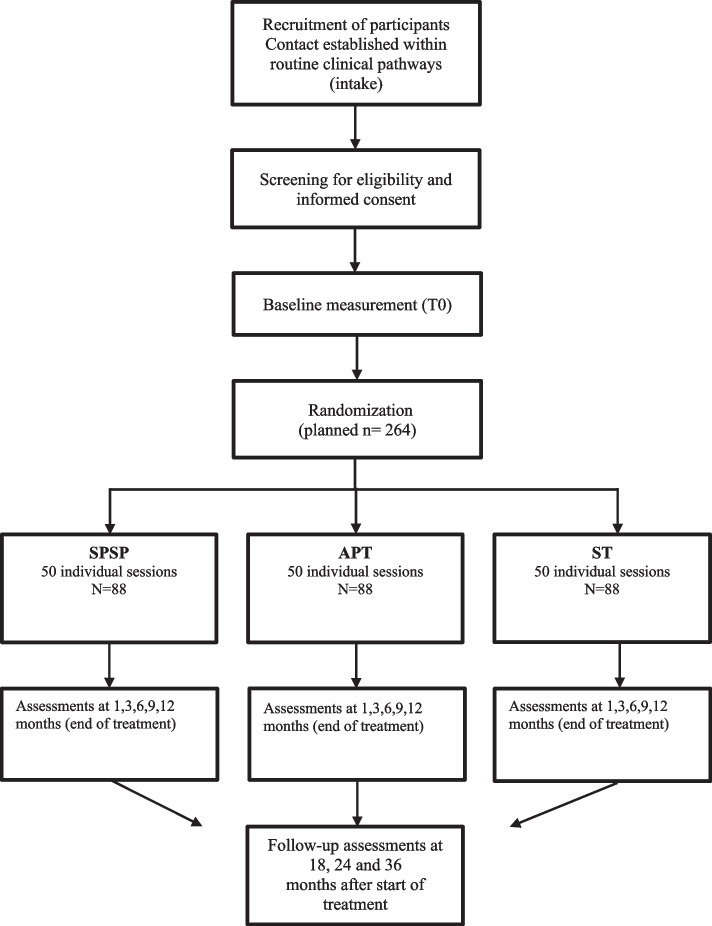
Background: Cluster-C personality disorders (PDs) are highly prevalent in clinical practice and are associated with unfavourable outcome and chronicity of all common mental health disorders (e.g. depression and anxiety disorders). Although several forms of individual psychotherapy are commonly offered in clinical practice for this population, evidence for differential effectiveness of different forms of psychotherapy is lacking. Also, very little is known about the underlying working mechanisms of these psychotherapies. Finding evidence on the differential (cost)-effectiveness for this group of patients and the working mechanisms of change is important to improve the quality of care for this vulnerable group of patients. Objective: In this study, we will compare the differential (cost)-effectiveness of three individual psychotherapies: short-term psychodynamic supportive psychotherapy (SPSP), affect phobia therapy (APT) and schema therapy (ST). Although these psychotherapies are commonly used in clinical practice, evidence for the Cluster-C PDs is limited. Additionally, we will investigate predictive factors, non-specific and therapy-specific mediators. Methods: This is a mono-centre randomized clinical trial with three parallel groups: (1) SPSP, (2) APT, (3) ST. Randomization on patient level will be pre-stratified according to type of PD. The total study population to be included consists of 264 patients with Cluster-C PDs or other specified PD with mainly Cluster-C traits, aged 18–65 years, seeking treatment at NPI, a Dutch mental health care institute specialized in PDs. SPSP, APT and ST (50 sessions per treatment) are offered twice a week in sessions of 50 min for the first 4 to 5 months. After that, session frequency decreases to once a week. All treatments have a maximum duration of 1 year. Change in the severity of the PD (ADP-IV) will be the primary outcome measure. Secondary outcome measures are personality functioning, psychiatric symptoms and quality of life. Several potential mediators, predictors and moderators of outcome are also assessed. The effectiveness study is complemented with a cost-effectiveness/utility study, using both clinical effects and quality-adjusted life-years, and primarily based on a societal approach. Assessments will take place at baseline, start of treatment and at 1, 3, 6, 9, 12, 18, 24 and 36 months. Discussion: This is the first study comparing psychodynamic treatment to schema therapy for Cluster-C PDs. The naturalistic design enhances the clinical validity of the outcome. A limitation is the lack of a control group for ethical reasons. Trial registration: NL72823.029.20 [Registry ID: CCMO]. Registered on 31 August 2020. First participant included on 23 October 2020. © 2023, The Author(s).
Verified 2026-11-25 · 1 reference not checked yet
Overview
CoChat Summary
## TL;DR
This protocol describes I-FORCE, a mono-centre pragmatic RCT comparing three 50-session individual psychotherapies for Cluster-C personality disorders: short-term psychodynamic supportive psychotherapy (SPSP), affect phobia therapy (APT), and schema therapy (ST). It is designed to test differential effectiveness, cost-effectiveness, and treatment mechanisms in 264 patients aged 18–65 years.
## Key findings
- The study is a protocol, so it does not report trial results.
- The planned sample is 264 patients total, with 88 per arm, to detect a medium effect size (f = 0.11; equivalent to Cohen’s d = .492) with power = 0.80 and Bonferroni-corrected p = 0.0167.
- Prior evidence summarized in the paper includes a multicentre study of N = 323, where schema therapy was superior to treatment-as-usual and clarification-oriented psychotherapy on interview-based outcome for mainly Cluster-C PD.
- The authors state the trial will compare outcomes over 0 to 12 months, with follow-up at 18, 24, and 36 months, and will also assess cost-effectiveness using quality-adjusted life-years and societal costs.
## Methods
- Design: Mono-centre, pragmatic randomized clinical trial with three parallel groups and 1:1:1 allocation; randomization is stratified by type of PD and location.
- Sample/data: 264 patients with Cluster-C PD or otherwise specified PD with predominantly Cluster-C traits, aged 18–65, recruited at NPI in the Netherlands; treatments are 50 sessions over a maximum of 1 year.
- Analysis: Primary and secondary outcomes will be analyzed under intention-to-treat using linear mixed models / mixed regression; moderators and mediators will be examined with regression, multilevel mediation, and structural equation models; cost-effectiveness will use multiple imputation and bootstrapping with 5000 replications.
## Limitations
- The paper explicitly states there is no inactive control / no-treatment group, due to ethical reasons; the authors note this means the influence of natural course variation over time cannot be ruled out.
- The authors state the sample may be more heterogeneous because it includes both full Cluster-C PD and otherwise specified PD with predominantly Cluster-C traits; this is a limitation stated in the paper, though they argue it improves clinical relevance.
- The authors note they did not adjust the sample size for dropout, which might negatively impact power; this is a limitation stated in the paper.
- Evident from the protocol: because this is a protocol, the paper contains planned methods but no outcome data yet.
Model-written summary. Check it against the paper before relying on it.
Integrity signals
Registry
Cites
Statistics
Figures
Verification
Claims the paper makes
17 Valid · 9 Not valid · 44 Not checked · 73 Own results and interpretations
The cited sources support only part of this claim — read each source’s verdict below.
In the paper
“Weston et al. [102] found lower effectiveness of treatment (cognitive behavioural therapy) of affective disorders within patients with ASD.”
§ Individual psychotherapy for cluster-C personality disorders: protocol of a pragmatic RCT comparing short-term psychodynamic supportive psychotherapy, affect phobia therapy and schema therapy (I-FORCE) > Introduction > Explanation for the choice of comparators {6b}
What the sources say
- Partly supportedcites [102] Weston L Hodgekins J Langdon PE Effectiveness of cognitive behavioural therapy with people who have autistic spectrum disorders: a systematic review and meta-analysis Clin Psychol Rev 2016 49 41 54 10.1016/j.cpr.2016.08.001 27592496 sourceExperimental — accuracy not yet measured
The Discussion (pp. 10–11) reports limited or no benefit on self-report measures and a small, non-significant effect in the adult subgroup. But it also reports significant medium effects on informant- and clinician-report measures for affective disorders. The unqualified statement that CBT had “lower effectiveness” across patients with ASD overstates these mixed findings and does not specify a comparator. (LLM, conf=0.83)
plainstates a cause- Asserted: passes — The authors put it forward as true.
- Checkable: passes — It can be checked against evidence.
- Load-bearing: passes — The paper’s conclusions depend on it.
- Based: passes — The paper gives a reason why it holds.
- Partly supported
Every source the paper cites for this claim was checked and supports it.
In the paper
“Emmelkamp et al. [33] found greater improvement in 20 sessions of cognitive psychotherapy in comparison with psychodynamic psychotherapy for avoidant PD (N=62).”
§ Individual psychotherapy for cluster-C personality disorders: protocol of a pragmatic RCT comparing short-term psychodynamic supportive psychotherapy, affect phobia therapy and schema therapy (I-FORCE) > Introduction > Background and rationale {6a}
What the sources say
- Supportedcites [33] Emmelkamp PM Benner A Kuipers A Feiertag GA Koster HC Van Apeldoorn FJ Comparison of brief dynamic and cognitive–behavioural therapies in avoidant personality disorder Br J Psychiatry 2006 189 1 60 64 10.1192/bjp.bp.105.012153 16816307 source
The Abstract describes 62 patients with avoidant personality disorder assigned to 20 weekly sessions of cognitive-behavioural or brief dynamic therapy, or to a waiting-list group. Its Results report significantly greater improvement on a number of measures with cognitive-behavioural therapy than with brief dynamic psychotherapy. (LLM, conf=0.94)
plainstates a causen = 62- Asserted: passes — The authors put it forward as true.
- Checkable: passes — It can be checked against evidence.
- Load-bearing: unclear — It is unclear whether the paper’s conclusions depend on it.
- Based: passes — The paper gives a reason why it holds.
- Supported
The cited sources support only part of this claim — read each source’s verdict below.
In the paper
“Overall, in Cluster-C PDs, higher levels of personality organization were found than for Cluster-A or B PDs [29].”
§ Individual psychotherapy for cluster-C personality disorders: protocol of a pragmatic RCT comparing short-term psychodynamic supportive psychotherapy, affect phobia therapy and schema therapy (I-FORCE) > Introduction > Explanation for the choice of comparators {6b}
What the sources say
- Partly supportedcites [29] Doering S Burgmer M Heuft G Menke D Bäumer B Lübking M Reliability and validity of the German version of the structured interview of personality organization (STIPO) BMC Psychiatry 2013 13 1 1 13 10.1186/1471-244X-13-210 23941404 PMC3751705 sourceExperimental — accuracy not yet measured
The Results (Table 5) show higher personality organization for patients with cluster C than cluster B personality disorders, as indicated by lower STIPO total scores. The Background places cluster C above both A and B in a theoretical model, but the reported results do not establish a cluster C–cluster A comparison; that part of the claimed finding is unsupported. (LLM, conf=0.86)
plainstates an association- Asserted: passes — The authors put it forward as true.
- Checkable: passes — It can be checked against evidence.
- Load-bearing: passes — The paper’s conclusions depend on it.
- Based: passes — The paper gives a reason why it holds.
- Partly supported
The cited sources support only part of this claim — read each source’s verdict below.
In the paper
“Evidence for the effectiveness of ST has also been found for various anxiety and depression disorders [51, 72].”
§ Individual psychotherapy for cluster-C personality disorders: protocol of a pragmatic RCT comparing short-term psychodynamic supportive psychotherapy, affect phobia therapy and schema therapy (I-FORCE) > Introduction > Explanation for the choice of comparators {6b}
What the sources say
- Not checked — no full text of the sourcecites [51] Jacob GA Arntz A Schema therapy for personality disorders—a review Int J Cogn Ther 2013 6 2 171 185 10.1521/ijct.2013.6.2.171 source
- Partly supportedcites [72] Masley SA Gillanders DT Simpson SG Taylor MA A systematic review of the evidence base for schema therapy Cogn Behav Ther 2012 41 3 185 202 10.1080/16506073.2011.614274 22074317 sourceExperimental — accuracy not yet measured
The Included studies section (p. 14) lists studies involving agoraphobia, and the study summary (p. 15) reports reduced anxiety and depression symptoms in veterans treated for PTSD. It does not identify studies of schema therapy for depressive disorders; the claim extends symptom findings to effectiveness for various anxiety and depression disorders. The review also cautions that the agoraphobia findings do not permit clear conclusions (p. 25). (LLM, conf=0.86)
plainstates a cause- Asserted: passes — The authors put it forward as true.
- Checkable: passes — It can be checked against evidence.
- Load-bearing: unclear — It is unclear whether the paper’s conclusions depend on it.
- Based: passes — The paper gives a reason why it holds.
The cited sources support only part of this claim — read each source’s verdict below.
In the paper
“Internal consistencies of subsequent subscales were fair to good, ranging .71 to .91 in healthy controls and .67 to .88 in the patient sample.”
§ Individual psychotherapy for cluster-C personality disorders: protocol of a pragmatic RCT comparing short-term psychodynamic supportive psychotherapy, affect phobia therapy and schema therapy (I-FORCE) > Outcomes {12}2 > Secondary outcomes
What the sources say
- Partly supportedcites [82] Polak MG Van Riel L Ingenhoven TJ Van HL The developmental profile inventory: constructing a clinically useful self-report for levels of psychodynamic personality functioning J Psychiatr Pract 2018 24 4 239 10.1097/PRA.0000000000000323 30427807 PMC6278880 sourceExperimental — accuracy not yet measured
The Results (Internal Consistency and Test-retest Reliability; page unavailable) report acceptable-to-good internal consistency in healthy controls and almost all personality-disorder scales. However, the paper evaluates the 108-item DPI, not the DPI-SF, and the available text does not give the claimed numerical ranges; it also notes that Resistance fell just below 0.70 in the patient sample. (LLM, conf=0.86)
plain- Asserted: passes — The authors put it forward as true.
- Checkable: passes — It can be checked against evidence.
- Load-bearing: unclear — It is unclear whether the paper’s conclusions depend on it.
- Based: passes — The paper gives a reason why it holds.
- Partly supported
35 more claims · 3 with their cited sources checked
Create a free account to see all 143 claims and to verify the 5 references still open.
- Probably not a substantial claim. 85
- It may state two separate claims as one. 39
Citations
Cites
Diagnostic and Statistical Manual of Mental Disorders
American Psychiatric Association (2013) · doi:10.1176/appi.books.9780890425596 · Cited by 116,369
Development and preliminary testing of the new five-level version of EQ-5D (EQ-5D-5L)
Herdman, M., Gudex, C., Lloyd, A., Janssen, M., Kind, P., Parkin, D., Bonsel, G., & Badia, X. (2011) · Quality of Life Research · doi:10.1007/s11136-011-9903-x · Cited by 9,795 · cited 1×
“Psychometric study of the EQ-5D-5L has shown this version to be a valid and reliable extension of the three-level system [48, 52].”
MethodThe brief symptom inventory: an introductory report.
Derogatis, L. R., & Melisaratos, N. (1983) · Psychological Medicine · doi:10.1017/s0033291700048017 · Cited by 6,650
Development and validation of a brief screening version of the Childhood Trauma Questionnaire
Bernstein, D. P., Stein, J. A., Newcomb, M. D., Walker, E., Pogge, D., Ahluvalia, T., Stokes, J., Handelsman, L., Medrano, M., Desmond, D., et al. (2003) · Child Abuse & Neglect · doi:10.1016/s0145-2134(02)00541-0 · Cited by 6,419 · cited 2×
“• Childhood Trauma Questionnaire-Short Form (CTQ-SF, [17]).”
BackgroundMediators and Mechanisms of Change in Psychotherapy Research
Kazdin, A. E. (2007) · Annual Review of Clinical Psychology · doi:10.1146/annurev.clinpsy.3.022806.091432 · Cited by 2,504 · cited 3×
“Kazdin AE.”
BackgroundInfluentialSociety and the Adolescent Self-Image.
Winch, R. F., & Rosenberg, M. (1965) · Social Forces · doi:10.2307/2575639 · Cited by 1,876
Developing the World Health Organization Disability Assessment Schedule 2.0
Üstün, T. B., Chatterji, S., Kostanjsek, N., Rehm, J., Kennedy, C., Epping-Jordan, J., Saxena, S., von Korff, M., & Pull, C. (2010) · Bulletin of the World Health Organization · doi:10.2471/blt.09.067231 · Cited by 1,851
Nanni, V., Uher, R., & Danese, A. (2012) · American Journal of Psychiatry · doi:10.1176/appi.ajp.2011.11020335 · Cited by 1,480 · cited 1×
“It has been identified as a negative predictor of treatment outcome for different psychiatric disorder [79], • Level of autism traits: There is a high comorbidity and considerable overlap in symptoms between autism and PDs [69, 100].”
BackgroundDSM-IV Personality Disorders in the National Comorbidity Survey Replication
Lenzenweger, M. F., Lane, M. C., Loranger, A. W., & Kessler, R. C. (2007) · Biological Psychiatry · doi:10.1016/j.biopsych.2006.09.019 · Cited by 1,352 · cited 1×
“Cluster-C PDs, including avoidant, dependent and obsessive-compulsive PDs, are among the most common mental disorders in the general population, with reported prevalence rates of 3–9% [64, 94].”
BackgroundBorderline Personality Organization
Kernberg, O. (1967) · Journal of the American Psychoanalytic Association · doi:10.1177/000306516701500309 · Cited by 1,295 · cited 7×
“Secondly, we expect that patients with more severe personality pathology (e.g. borderline personality organization (Kernberg, [57]) will profit more from ST or SPSP than APT.”
BackgroundInfluential
Research works printed but not linked: 9
- Bernstein DP Fink L Childhood trauma questionnaire: a retrospective self-report 1998 San Antonio NCS Pearson
- De Beurs E Zitman F De brief symptom inventory (BSI). De betrouwbaarheid en validiteit van een handzaam alternatief voor de SCL-90 2005 Leiden Leids universitair medisch centrum
- de Ruiter H van Dam Q Affectfobietherapie in de praktijk 2019
- Forster C Berthollier N Rawlinson D A systematic review of potential mechanisms of change in psychotherapeutic interventions for personality disorder J Psychol Psychother 2014 4 133 2161 0487
- Ingenhoven T Poolen F Berghuis H The inventory of personality organisation: Dutch translation 2004 Amersfoort Psychiatrisch Centrum Symfora Groep
- Kool M Van R Arntz A Bartak A Peen J Dekker J The effects of 25- versus 50- sessions in a year on psychotherapy outcome in patients with comorbid depression and personality disorders: a pragmatic randomized factorial trial 2021
- McCullough L Treating affect phobia: a manual for short-term dynamic psychotherapy 2003 Guilford Press
- Van Dam Q Affectfobietherapie in de praktijk 2016 Hogrefe Uitgevers Amsterdam
- Van Hakkaart-van RL Van Straten A Donker M Tiemens B Trimbos/iMTA questionnaire for costs associated with psychiatric illness (TIC-P) 2002 Institute for Medical Technology Assessment
Cited by
The Efficacy of Experiential Dynamic Therapies: A 10‐Year Systematic Review and Meta‐Analysis Update
Lilliengren, P., Mechler, J., Lindqvist, K., Maroti, D., & Johansson, R. (2025) · Clinical Psychology & Psychotherapy · doi:10.1002/cpp.70086 · Cited by 19
van den End, A., Beekman, A. T. F., Dekker, J., Aarts, I., Snoek, A., Blankers, M., Vriend, C., van den Heuvel, O. A., & Thomaes, K. (2024) · European Journal of Psychotraumatology · doi:10.1080/20008066.2024.2382652 · Cited by 14
“Yet, they are underrecognized and poorly studied, although some evidence suggests that schema therapy is effective (Bamelis et al., 2014) and more research is currently being conducted (Baljé et al., 2016; Daniëls et al., 2023; Groot et al., 2022).”
BackgroundSelf-citationPsychotherapies for the treatment of personality disorders: the state of the art
Emmelkamp, P. M. G., & Meyerbröker, K. (2024) · Current Opinion in Psychiatry · doi:10.1097/yco.0000000000000968 · Cited by 10
Psychopharmacological Treatment of Depression and Anxiety and their Different Drug Delivery Targets
Sharma, A., Alam, M. A., Kaur, A., Sharma, S., & Yadav, S. (2024) · Current Psychiatry Research and Reviews · doi:10.2174/2666082219666230822140902 · Cited by 3
van den Heuvel, B. B., Dekker, J., Daniëls, M., Van, H. L., Peen, J., Bosmans, J. E., Arntz, A. R., & Huibers, M. J. H. (2023) · Trials · doi:10.1186/s13063-023-07309-w · Cited by 7
Self-citation
Metadata
- Authors
- Daniëls, M., Van, H. L., van den Heuvel, B., Dekker, J. J. M., Peen, J., Bosmans, J., Arntz, A., & Huibers, M. J. H.
- Affiliations
- Arkin (NL)
- Vrije Universiteit Amsterdam (NL)
- Amsterdam Public Health (NL)
- University of Amsterdam (NL)
- Utrecht University (NL)
- Corresponding author
- Daniëls, Martine
- ORCID
- Venue
- Trials
- Published
- 2023-04-05
- Volume
- 24
- Issue
- 1
- Pages
- 260-260
- ISSN
- 1745-6215 (ISSN-L)
- PMC
- PMC10077625
- OpenAlex
- W4362603895
- Semantic Scholar
- bcd913c92b4258db716c2b50b6960f744f152ac2
- Cited by
- 9
- References
- 99
- Citations by year
- 2026: 1 · 2025: 3 · 2024: 3 · 2023: 2
- FWCI
- 2.61
- Type
- journal article
- Language
- en
- Open access
- gold
- doi.org
- Licence
- cc-by
- creativecommons.org/licenses/by/4.0 (tdm)
- creativecommons.org/licenses/by/4.0 (vor)
- Locations
- Trials (publishedVersion, cc-by)
- PubMed Central (publishedVersion, cc-by)
- PubMed (publishedVersion)
- VU Research Portal (publishedVersion, cc-by)
- UvA-DARE (University of Amsterdam) (submittedVersion, other-oa)
- DOAJ (DOAJ: Directory of Open Access Journals) (submittedVersion, cc-by-sa)
- Data Archiving and Networked Services (DANS) (submittedVersion, other-oa)
- Topics
- Social Sciences › Psychology › Clinical Psychology › Personality Disorders and Psychopathology
- Social Sciences › Psychology › Clinical Psychology › Psychotherapy Techniques and Applications
- Social Sciences › Psychology › Clinical Psychology › Psychoanalysis and Psychopathology Research
- Keywords
- personality disorders, schema therapy, brief psychotherapy, cost-effectiveness, quality-adjusted life years, personality functioning, quality of life, psychiatric symptoms, psychotherapy comparison, non-specific treatment effects, treatment discontinuation, treatment acceptability
- MeSH terms
- Schema Therapy, Humans, Personality Disorders, Phobic Disorders, Psychotherapy, Quality of Life, Randomized Controlled Trials as Topic, Treatment Outcome, Pragmatic Clinical Trials as Topic
About these checks
Registry, retraction, Cites and statistics results are computed, not judged, with one exception: a printed reference that no index lists is read once by a model before it counts as a citation error. Claims are extracted by a model and kept only when their quote appears verbatim in the text; each cited source is then checked, with a model’s help, for whether it says what the claim relies on. Those verdicts can be wrong — read the claim’s quote and the cited source before relying on one.
The claim verdicts this report counts are experimental: their accuracy is not yet measured.
A language model drew the claims from the paper on 2026-10-11, under version 3 of the claim definition (model deepseek-v4.1-flash, prompt extract-v3).
A second model labelled each claim on 2026-10-11 (model jev-1.13-20260917, definition revision gold-guideline-v0.2).
Cited sources are checked with a language model’s help (gpt-6-sol).
Statistics and arithmetic are recomputed, not judged.
Confidence bands are shown only for fields calibrated on our annotated test set. None is calibrated yet, so no band is shown.
What counts as a claim ›How we measure confidence ›How we check this ›
Are you an author, or do you see a problem with this page? Request a review
Data sources
Bibliographic data: Semantic Scholar, OpenAlex, Crossref.
Contains information from the Semantic Scholar Academic Graph Datasets, made available under the ODC Attribution License (ODC-BY 1.0).
Semantic Scholar’s data is described in: Kinney, R., et al. (2023). The Semantic Scholar Open Data Platform. arXiv:2301.10140.
