

Hydrocarbon bio-jet fuel from bioconversion of poplar biomass: techno-economic assessment
Open accessThe DOI matches its Crossref record; 40 of the 44 references it cites were found in a registry or an index; none of the 75 sources its claims cite is checked for support yet.
Abstract
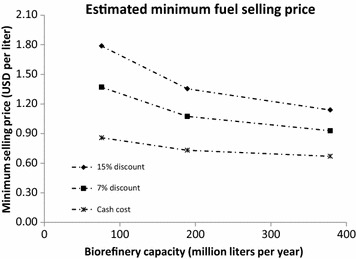
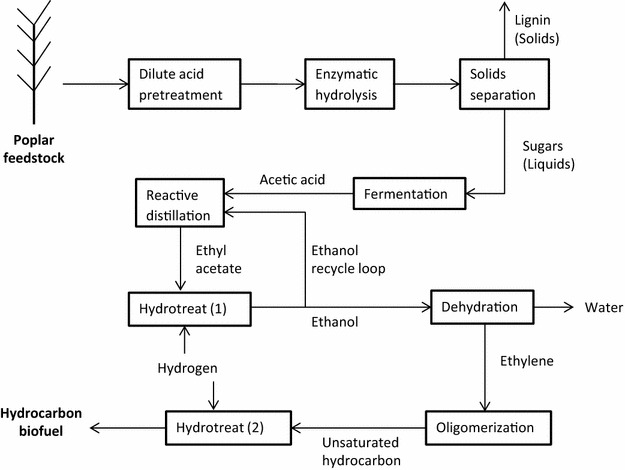
Infrastructure compatible hydrocarbon biofuel proposed to qualify as renewable transportation fuel under the U.S. Energy Independence and Security Act of 2007 and Renewable Fuel Standard (RFS2) is evaluated. The process uses a hybrid poplar feedstock, which undergoes dilute acid pretreatment and enzymatic hydrolysis. Sugars are fermented to acetic acid, which undergoes conversion to ethyl acetate, ethanol, ethylene, and finally a saturated hydrocarbon end product. An unfermentable lignin stream may be burned for steam and electricity production, or gasified to produce hydrogen. During biofuel production, hydrogen gas is required and may be obtained by various methods including lignin gasification. Both technical and economic aspects of the biorefinery are analyzed, with different hydrogen sources considered including steam reforming of natural gas and gasification of lignin. Cash operating costs for jet fuel production are estimated to range from 0.67 to 0.86 USD L −1 depending on facility capacity. Minimum fuel selling prices with a 15 % discount rate are estimated to range from 1.14 to 1.79 USD L −1 . Capacities of 76, 190, and 380 million liters of jet fuel per year are investigated. Capital investments range from 356 to 1026 million USD. A unique biorefinery is explored to produce a hydrocarbon biofuel with a high yield from bone dry wood of 330 L t −1 . This yield is achieved chiefly due to the use of acetogenic bacteria that do not produce carbon dioxide as a co-product during fermentation. Capital investment is significant in the biorefinery in part because hydrogen is required to produce a fully de-oxygenated fuel. Minimum selling price to achieve reasonable returns on investment is sensitive to capital financing options because of high capital costs. Various strategies, such as producing alternative, intermediate products, are investigated with the intent to reduce risk in building the proposed facility. It appears that producing and selling these intermediates may be more profitable than converting all the biomass into aviation fuel. With variability in historical petroleum prices and environmental subsidies, a high internal rate of return would be required to attract investors.
Overview
CoChat Summary
TL;DR
This techno-economic assessment models a poplar-to-hydrocarbon bio-jet fuel biorefinery that ferments sugars to acetic acid and converts intermediates to a saturated jet fuel, evaluating natural gas reforming versus lignin gasification for hydrogen. It reports a yield of 330 L t−1 bone dry wood, cash operating costs of 0.67–0.86 USD L−1, and minimum selling prices of 1.14–1.79 USD L−1 at a 15% discount rate across 76–380 ML y−1 capacities.
Key findings
- The modeled biorefinery achieves a practical hydrocarbon biofuel yield of 330 L t−1 bone dry poplar, versus a theoretical yield of 450 L t−1, largely because acetogenic bacteria do not produce CO2 as a fermentation co-product.
- Cash operating costs are estimated at 0.67–0.86 USD L−1 depending on facility capacity; for a 380 ML y−1 facility, total cash cost is 0.67 USD L−1 with natural gas reforming and 0.70 USD L−1 with lignin gasification. Minimum selling prices with a 15% discount rate range from 1.14 to 1.79 USD L−1, with 380 ML y−1 values of 1.13 USD L−1 (reforming) and 1.22 USD L−1 (gasification).
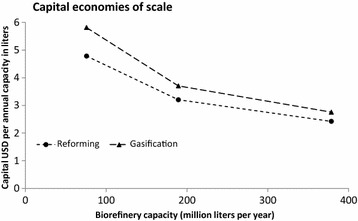
- Capital investments range from 356 to 1026 million USD across the three capacities; for 380 ML y−1, total fixed capital is 902 million USD with natural gas reforming and 1026 million USD with lignin gasification. Capital cost per annual liter is 4.70, 3.14, and 2.37 USD for 76, 190, and 380 ML y−1, respectively, using natural gas reforming.
- Selling chemical intermediates may be more profitable than converting all biomass to jet fuel: for a facility processing 1.13 Mt y−1 bone dry biomass, estimated gross revenues are 300 million USD for jet fuel, 330 million USD for ethanol, 375 million USD for ethylene, and 625 million USD for ethyl acetate.
Methods
- Process design: hybrid poplar undergoes dilute acid pretreatment and enzymatic hydrolysis; sugars are fermented to acetic acid using an acetogenic bacterium, then converted through reactive distillation to ethyl acetate, hydrotreating to ethanol, dehydration to ethylene, oligomerization, and final hydrotreating to a saturated hydrocarbon jet fuel surrogate. The process is modeled in Aspen Plus with RStoic, RYield, RGibbs, REquil, and other blocks.
- Data and scenarios: three biorefinery capacities are analyzed—76, 190, and 380 ML y−1. Hydrogen is supplied either by natural gas steam reforming or by lignin gasification supplemented with natural gas; electrolysis is preliminarily rejected as economically prohibitive. Feedstock composition is 42.0% cellulose, 22.9% hemicellulose, and 25.8% lignin on a dry basis.
- Economic analysis: capital costs are estimated using factored estimation with installation factors and updated to 2014 USD; operating costs are compiled from simulation inputs/outputs and literature or industry quotes. Minimum selling prices are calculated via discounted cash flow rate of return analysis using 7% and 15% discount rates, a 20-year project lifetime, 3-year construction, 100% equity, 0% tax, and 10% working capital.
Limitations
- Stated in the paper: capital cost estimates may include uncertainties of as much as ±30%; the biorefinery is hypothetical and represents a possible future commercial configuration; no carbon tax or government incentives are considered; the analysis uses a pre-tax 0% tax rate and does not include land cost; alternative-product capital cost implications and purification to commodity chemical purity are not explored; lignin gasification is described as more complex, capital intensive, and an unproven technology with higher risk.
- Evident from the text: the modeled jet fuel end product is n-dodecane as a surrogate for kerosene-type jet fuel, not an actual jet fuel mixture; practical yields are conservative estimates based on literature and personal communication with industry partners; no thermodynamic data for lignin, tar, and ash were available in the Aspen Plus database, so they were defined as nonconventional components.
Model-written summary. Check it against the paper before relying on it.
Integrity signals
Registry
Cites
Statistics
Figures
Verification
Claims the paper makes
0 Valid · 14 Not valid · 50 Not checked · 79 Own results and interpretations
A result the paper reports from its own data — it cites no other source for it, so there is none to check. The quote shows it is in the paper.
In the paper
“Minimum fuel selling prices with a 15 % discount rate are estimated to range from 1.14 to 1.79 USD L−1.”
§ Hydrocarbon bio-jet fuel from bioconversion of poplar biomass: techno-economic assessment > Abstract > Results
hedged- Asserted: passes — The authors put it forward as true.
- Checkable: passes — It can be checked against evidence.
- Load-bearing: passes — The paper’s conclusions depend on it.
- Based: passes — The paper gives a reason why it holds.
A result the paper reports from its own data — it cites no other source for it, so there is none to check. The quote shows it is in the paper.
In the paper
“Cash operating costs for jet fuel production are estimated to range from 0.67 to 0.86 USD L−1 depending on facility capacity.”
§ Hydrocarbon bio-jet fuel from bioconversion of poplar biomass: techno-economic assessment > Abstract > Results
hedgedstates an association- Asserted: passes — The authors put it forward as true.
- Checkable: passes — It can be checked against evidence.
- Load-bearing: passes — The paper’s conclusions depend on it.
- Based: passes — The paper gives a reason why it holds.
A result the paper reports from its own data — it cites no other source for it, so there is none to check. The quote shows it is in the paper.
In the paper
“Capital investments range from 356 to 1026 million USD.”
§ Hydrocarbon bio-jet fuel from bioconversion of poplar biomass: techno-economic assessment > Abstract > Results
plain- Asserted: passes — The authors put it forward as true.
- Checkable: passes — It can be checked against evidence.
- Load-bearing: unclear — It is unclear whether the paper’s conclusions depend on it.
- Based: passes — The paper gives a reason why it holds.
A result the paper states — it cites no source for it, so there is none to check. The quote shows it is in the paper.
In the paper
“A unique biorefinery is explored to produce a hydrocarbon biofuel with a high yield from bone dry wood of 330 L t−1.”
§ Hydrocarbon bio-jet fuel from bioconversion of poplar biomass: techno-economic assessment > Abstract > Conclusions
plain- Asserted: passes — The authors put it forward as true.
- Checkable: passes — It can be checked against evidence.
- Load-bearing: passes — The paper’s conclusions depend on it.
- Based: passes — The paper gives a reason why it holds.
None of the sources cited for this claim have been checked yet.
In the paper
“Given the estimated selling prices [20, 21] revenue could increase compared to producing only jet fuel.”
§ Hydrocarbon bio-jet fuel from bioconversion of poplar biomass: techno-economic assessment > Results and discussion > Alternative products
What the sources say
- Not checked yetcites [20] International Air Transportation Association (IATA). Fuel price analysis. http://www.iata.org/publications/economics/fuel-monitor/Pages/price-analysis.aspx. 2015.
- Not checked yetcites [21] Chang J (ed). Indicative chemical prices A–Z. http://www.icis.com/chemicals/channel-info-chemicals-a-z/#top.ICIS.
hedgedstates a possible cause- Asserted: passes — The authors put it forward as true.
- Checkable: passes — It can be checked against evidence.
- Load-bearing: unclear — It is unclear whether the paper’s conclusions depend on it.
- Based: passes — The paper gives a reason why it holds.
55 more claims
Create a free account to see all 143 claims and to verify the 75 references still open.
- It may state two separate claims as one. 50
- Probably not a substantial claim. 54
- The quote only partly states this claim. 3
Claims other papers make about this one
Each is checked against this paper’s own text: does it say what the citing paper says it does?
The source backs part of the claim, not all of it — or backs it for a different population, condition or comparison.
In the citing paper
“As technology improves gasifying lignin may become financially feasible, but at this time, the cheapest pathway to bio-jet fuel production with the lowest lifecycle impacts is using natural gas to produce hydrogen and hog fuel to meet the excess heat/steam demand [11].”
From Hydrocarbon bio-jet fuel from bioconversion of poplar biomass: life cycle assessment (2016) · cites this paper as [11]
Experimental — accuracy not yet measuredThe cited source says what the claim attributes to it.
In the citing paper
“Techno-economic assessment of these four bio-jet simulations, however, finds that gasifying lignin is more expensive and complicated than natural gas steam reforming.”
From Hydrocarbon bio-jet fuel from bioconversion of poplar biomass: life cycle assessment (2016) · cites this paper as [11]
Self-check
Percentages, sums and reported differences re-computed from the paper’s own numbers.
Each contradiction between two passages listed here was confirmed by an independent check.
Rated minor: it would not touch a result — a value no result rests on, a p-value that stays on the same side of the significance level, or a conflict that is clerical, resolved elsewhere in the paper, or outside its own findings.
In the paper
§ Hydrocarbon bio-jet fuel from bioconversion of poplar biomass: techno-economic assessment > Conclusions
“A discount rate of 15 % increases the minimum selling price even further to 1.14 USD L−1.”
§ Hydrocarbon bio-jet fuel from bioconversion of poplar biomass: techno-economic assessment > Results and discussion > Expense estimates
“| Minimum selling price with 15 % discount | 1.13 | 1.22 |”
Rated minor: it would not touch a result — a value no result rests on, a p-value that stays on the same side of the significance level, or a conflict that is clerical, resolved elsewhere in the paper, or outside its own findings.
In the paper
“| Consumed | 0.93 | 1.07 |”
§ Hydrocarbon bio-jet fuel from bioconversion of poplar biomass: techno-economic assessment > Results and discussion > Process analysis
Reported 0.93 · recomputed 0.77
Citations
Cites
The United States Department of Agriculture
True, A. C. (1912) · The ANNALS of the American Academy of Political and Social Science · doi:10.1177/000271621204000113 · Cited by 5,113
Analysis, synthesis, and design of chemical processes
(1998) · Choice Reviews Online · doi:10.5860/choice.36-0974 · Cited by 3,433 · cited 1×
“68 to include additional costs—contingency, contractor fee, site development, auxiliary buildings, off-sites, and utilities [49].”
BackgroundNational Renewable Energy Laboratory
Karim, S., Faissal, A., & Noureddine, E. B. (2022) · Handbook of Algal Biofuels · doi:10.1016/b978-0-12-823764-9.00006-6 · Cited by 2,558
Ethanol from lignocellulosic biomass: techno-economic performance in short-, middle- and long-term
Hamelinck, C. N., Hooijdonk, G. V., & Faaij, A. P. (2005) · Biomass and Bioenergy · doi:10.1016/j.biombioe.2004.09.002 · Cited by 1,620 · cited 2×
“Economic modeling: capital expenses The capital cost is estimated using a well-known method of factored estimation, and may include uncertainties of as much as ±30 % [18, 42].”
BackgroundMethodPretreatment: the key to unlocking low‐cost cellulosic ethanol
Yang, B., & Wyman, C. E. (2008) · Biofuels, Bioproducts and Biorefining · doi:10.1002/bbb.49 · Cited by 1,524 · cited 1×
“Pretreatment is the subject of intense research with many competing technologies, such as dilute sulfuric acid, sulfur dioxide catalyzed steam explosion, controlled pH, ammonia fiber expansion, or lime pretreatment [15].”
BackgroundThe challenge of enzyme cost in the production of lignocellulosic biofuels
Klein‐Marcuschamer, D., Oleskowicz‐Popiel, P., Simmons, B. A., & Blanch, H. W. (2012) · Biotechnology and Bioengineering · doi:10.1002/bit.24370 · Cited by 998 · cited 1×
“Some costs, such as enzymes, are not narrowly defined but may be estimated based on literature [50].”
BackgroundSubstrate and Enzyme Characteristics that Limit Cellulose Hydrolysis
Mansfield, S. D., Mooney, C., & Saddler, J. N. (1999) · Biotechnology Progress · doi:10.1021/bp9900864 · Cited by 869 · cited 1×
“The lignocellulosic material in the wood can also be fractionated without extensive pretreatment [26] and hardwoods do not exhibit the recalcitrance reported in softwoods [27].”
BackgroundTechno-economic analysis of biomass fast pyrolysis to transportation fuels
Wright, M. M., Daugaard, D. E., Satrio, J. A., & Brown, R. C. (2010) · Fuel · doi:10.1016/j.fuel.2010.07.029 · Cited by 814 · cited 1×
“Analyses have been performed for various clean energy-related projects, such as biodiesel production [3], hydrogen production [4], hydrogen sourced power generation [5], carbon dioxide capture from coal fired power plants [6], and fast pyrolysis of biomass for fuel and energy [7, 8].”
BackgroundFermentation of lignocellulosic hydrolysates for ethanol production
Olsson, L., & Hahn-Hägerdal, B. (1996) · Enzyme and Microbial Technology · doi:10.1016/0141-0229(95)00157-3 · Cited by 783 · cited 1×
“A range of bacteria, yeasts, and fungi have been investigated, some naturally occurring and some recombinant, for ethanol production from lignocellulosic hydrolysate [17].”
BackgroundPoplar as a feedstock for biofuels: A review of compositional characteristics
Sannigrahi, P., Ragauskas, A. J., & Tuskan, G. A. (2010) · Biofuels, Bioproducts and Biorefining · doi:10.1002/bbb.206 · Cited by 688 · cited 2×
“The composition assumed for biomass, which falls within ranges given in literature [28], entering the biorefinery is shown in Table 8.”
Background
Research works printed but not linked: 4
- Treasure T, Gonzalez R, Jameel H, Phillips RB, Park S, Kelley S. Integrated process, financial, and risk modeling of cellulosic ethanol from woody and non-woody feedstocks via dilute acid pretreatment. In: McMillan J, Decker S, program chairs. Proceedings of 35th symposium on biotechnology for fuels and chemicals. Portland. 2013; 70.
- Wood RA HTGR-integrated hydrogen production via steam methane reforming (SMR) process analysis, TEV-953 2010 Idaho Falls, ID, USA Idaho National Laboratory
- Levene JI Mann MK Margolis R Milbrandt A An analysis of hydrogen production from renewable electricity sources, NREL/CP-560-37612 2005 Golden National Renewable Energy Laboratory
- Molburg JC, Doctor RD. Hydrogen from steam-methane reforming with CO2 capture. Prepared at Argonne National Laboratory for 20th Annual International Pittsburgh Coal Conference. Jun 2003.
Cited by
Renewable bio-jet fuel production for aviation: a review
Wei, H., Liu, W., Chen, X., Yang, Q., Li, J., & Chen, H. (2019) · Fuel · doi:10.1016/j.fuel.2019.06.007 · Cited by 435
Bio-aviation Fuel: A Comprehensive Review and Analysis of the Supply Chain Components
Doliente, S. S., Narayan, A., Tapia, J. F. D., Samsatli, N. J., Zhao, Y., & Samsatli, S. (2020) · Frontiers in Energy Research · doi:10.3389/fenrg.2020.00110 · Cited by 295
Shahriar, M. F., & Khanal, A. (2022) · Fuel · doi:10.1016/j.fuel.2022.124905 · Cited by 255
Klein, B. C., Chagas, M. F., Junqueira, T. L., Rezende, M. C. A. F., Cardoso, T. D. F., Cavalett, O., & Bonomi, A. (2018) · Applied Energy · doi:10.1016/j.apenergy.2017.10.079 · Cited by 177
“In this way, it can be said that the FT thermochemical route greatly profits from the integration with ethanol distilleries, with superior economic indices than standalone FT plants [32,35].”
BackgroundMethodRecent Development of Extremophilic Bacteria and Their Application in Biorefinery
Zhu, D., Adebisi, W. A., Ahmad, F., Sethupathy, S., Danso, B., & Sun, J. (2020) · Frontiers in Bioengineering and Biotechnology · doi:10.3389/fbioe.2020.00483 · Cited by 175
“A research report has pointed out that the use of acetogenic bacteria that do not produce carbon dioxide by-products during fermentation can achieve high hydrocarbon biofuel production (330 L/t feedstock) (Crawford et al., 2016).”
BackgroundWang, B., Ting, Z., & Zhao, M. M. (2024) · Carbon Capture Science & Technology · doi:10.1016/j.ccst.2024.100263 · Cited by 278
Clifton‐Brown, J., Harfouche, A., Casler, M. D., Dylan Jones, H., Macalpine, W. J., Murphy‐Bokern, D., Smart, L. B., Adler, A., Ashman, C., Awty‐Carroll, D., et al. (2019) · GCB Bioenergy · doi:10.1111/gcbb.12566 · Cited by 159
“Aviation fuel is a significant 140 | CLIFTON‐BROWN ET AL. target market (Crawford et al., 2016).”
BackgroundTechno-economic review of alternative fuels and propulsion systems for the aviation sector
Dahal, K., Brynolf, S., Xisto, C., Hansson, J., Grahn, M., Grönstedt, T., & Lehtveer, M. (2021) · Renewable and Sustainable Energy Reviews · doi:10.1016/j.rser.2021.111564 · Cited by 158
Sorunmu, Y., Billen, P., & Spatari, S. (2020) · GCB Bioenergy · doi:10.1111/gcbb.12658 · Cited by 150
“, 2017; Iribarren, Peters, & Dufour, 2012; Spatari, Zhang, & MacLean, 2005; Wiloso, Heijungs, & Snoo, 2012; Zaimes, Soratana, Harden, Landis, & Khanna, 2015; Zhang, Hu, & Brown, 2013) and techno-economic analysis (TEA; Beckman et al., 1990; Brown, 2015; Brown, Thilakaratne, Brown, & Hu, 2013; Crawford et al., 2016; Du…”
Makepa, D. C., Chihobo, C. H., Ruziwa, W. R., & Musademba, D. (2023) · Fuel Communications · doi:10.1016/j.jfueco.2023.100086 · Cited by 111
Grim, R. G., Ravikumar, D., Tan, E. C. D., Huang, Z. Z., Ferrell, J. R., Resch, M. G., Li, Z., Mevawala, C., Phillips, S. D., Snowden-Swan, L. J., et al. (2022) · Energy & Environmental Science · doi:10.1039/d2ee02439j · Cited by 107
Phytomanagement of Metal(loid)-Contaminated Soils: Options, Efficiency and Value
Moreira, H., Pereira, S. I. A., Mench, M. J., Garbisu, C., Kidd, P., & Castro, P. M. L. (2021) · Frontiers in Environmental Science · doi:10.3389/fenvs.2021.661423 · Cited by 97
Updates on high value products from cellulosic biorefinery
Rajasekharan, R., Paulose, T. A. P., Philip, E., Thomas, D., Madhavan, A., Sirohi, R., Binod, P., Awasthi, M. K., Pandey, A., & Sindhu, R. (2021) · Fuel · doi:10.1016/j.fuel.2021.122056 · Cited by 85
Hydrocarbon bio-jet fuel from bioconversion of poplar biomass: life cycle assessment
Budsberg, E., Crawford, J. T., Morgan, H., Chin, W. S., Bura, R., & Gustafson, R. (2016) · Biotechnology for Biofuels · doi:10.1186/s13068-016-0582-2 · Cited by 76
Self-citationProduction routes to bio-acetic acid: life cycle assessment
Budsberg, E., Morales-Vera, R., Crawford, J. T., Bura, R., & Gustafson, R. (2020) · Biotechnology for Biofuels · doi:10.1186/s13068-020-01784-y · Cited by 81
Self-citationImpacts of the Inflation Reduction Act on the Economics of Clean Hydrogen and Synthetic Liquid Fuels
Cheng, F., Luo, H., Jenkins, J., & Larson, E. D. (2023) · Environmental Science & Technology · doi:10.1021/acs.est.3c03063 · Cited by 70
Cho, J. S., Jeon, H., Kim, M., Vo, T. K., Kim, J., Park, E., Choi, Y., Lee, H., Han, K., & Ko, J. (2018) · Plant Biotechnology Journal · doi:10.1111/pbi.13036 · Cited by 64
“Recently, many studies have been conducted to produce biofuels from woody biomass, which account for more than 90% of the total biomass produced on Earth (Castro et al., 2014; Crawford et al., 2016; Ko et al., 2017; Serapiglia et al., 2013; Vo et al., 2017; Zhu et al., 2010).”
BackgroundKumar, D., Long, S. P., & Singh, V. (2017) · GCB Bioenergy · doi:10.1111/gcbb.12478 · Cited by 63
“…value (NPV) of zero at minimum acceptable internal rate of return (IRR) of 10%, an approach used in most of techno-economic studies including NREL project reports (Kazi et al., 2010; Humbird et al., 2011; Pearlson, 2011; Natelson et al., 2015; Crawford et al., 2016; Diederichs et al., 2016).”
BackgroundMethodInfluentialWang, W. (2019) · Energy · doi:10.1016/j.energy.2019.04.181 · Cited by 61
Stochastic techno-economic analysis of the production of aviation biofuel from oilseeds
Diniz, A. P. M. M., Sargeant, R., & Millar, G. J. (2018) · Biotechnology for Biofuels · doi:10.1186/s13068-018-1158-0 · Cited by 61
“[20] affirmed that the combination of engineering and economics approach is critical for any technology to transition from research to industry.”
BackgroundTang, W., Wu, X., Huang, C., Ling, Z., Lai, C., & Yong, Q. (2021) · Bioresource Technology · doi:10.1016/j.biortech.2021.125983 · Cited by 45
Farooq, Z., Wetterlund, E., Mesfun, S., & Furusjö, E. (2025) · Energy Conversion and Management · doi:10.1016/j.enconman.2025.120076 · Cited by 47
“Similar to the PTJ pathway, hydrogen is a significant contributor to total OPEX for the ATJ pathway, as shown in [52,53].”
InfluentialLiquid hydrocarbon production via ethylene oligomerization over Ni-Hβ
Jan, O., & Resende, F. L. P. (2018) · Fuel Processing Technology · doi:10.1016/j.fuproc.2018.07.004 · Cited by 41
Braz, D. S., & Mariano, A. P. (2018) · Bioresource Technology · doi:10.1016/j.biortech.2018.07.102 · Cited by 45
Market profitability of CSP-biomass hybrid power plants: Towards a firm supply of renewable energy
Gutiérrez-Alvarez, R., Guerra, K., & Haro, P. (2023) · Applied Energy · doi:10.1016/j.apenergy.2023.120754 · Cited by 41
Liquid fuel generation from algal biomass via a two-step process: effect of feedstocks
Xu, Y.-P., Duan, P.-G., Wang, F., & Guan, Q.-Q. (2018) · Biotechnology for Biofuels · doi:10.1186/s13068-018-1083-2 · Cited by 40
“Of these alternative candidates, biomass has emerged as one of the most prospective sources for liquid fuel production due to their high productivity, low pollution, and lack of CO2 emission [1, 2].”
BackgroundVela-García, N., Bolonio, D., García-Martínez, M., Ortega, M. F., Streitwieser, D. A., & Canoira, L. J. (2021) · Energy Conversion and Management · doi:10.1016/j.enconman.2021.114534 · Cited by 39
Li, Y., Zhao, C., Chen, L., Zhang, X., Zhang, Q., Wang, T., Qiu, S., Tan, J., Li, K., Wang, C., et al. (2017) · Applied Energy · doi:10.1016/j.apenergy.2017.07.133 · Cited by 37
Techno-Economic Analysis of Producing Glacial Acetic Acid from Poplar Biomass via Bioconversion
Morales-Vera, R., Crawford, J. T., Dou, C., Bura, R., & Gustafson, R. (2020) · Molecules · doi:10.3390/molecules25184328 · Cited by 40
“Similar to Crawford et al. (2016), the first two major unit operations, pretreatment, and enzymatic hydrolysis, convert raw cellulosic biomass into fermentable sugars [22].”
BackgroundSelf-citationEconomic opportunities and challenges in biojet production: A literature review and analysis
Lim, M., Luckert, M. K., & Qiu, F. (2023) · Biomass and Bioenergy · doi:10.1016/j.biombioe.2023.106727 · Cited by 40
Stanton, B. J., Bourque, A., Coleman, M. D., Eisenbies, M. H., Emerson, R., Espinoza, J., Gantz, C., Himes, A., Rodstrom, A., Shuren, R., et al. (2020) · BioEnergy Research · doi:10.1007/s12155-020-10164-1 · Cited by 35
Michaga, M. F. R., Michailos, S. E., Hughes, K. J., Ingham, D. B., & Pourkashanian, M. M. (2021) · Elsevier eBooks · doi:10.1016/b978-0-12-820297-5.00012-8 · Cited by 44
Hao, J., Xiao, J., Song, G., & Zhang, Q. (2021) · Case Studies in Thermal Engineering · doi:10.1016/j.csite.2021.101006 · Cited by 31
The economics of dedicated hybrid poplar biomass plantations in the western U.S.
Chudy, R. P., Busby, G., Binkley, C. S., & Stanton, B. J. (2019) · Biomass and Bioenergy · doi:10.1016/j.biombioe.2019.03.010 · Cited by 30
Seufitelli, G. V. S., El-Husseini, H., Pascoli, D. U., Bura, R., & Gustafson, R. R. (2022) · Biotechnology for Biofuels and Bioproducts · doi:10.1186/s13068-022-02246-3 · Cited by 31
“Also, poplar requires low fertilizer input, can re-sprout after multiple harvests, and has a high growth rate and large biomass accumulation [21, 36, 37].”
BackgroundSelf-citationHydrocracking of algae oil to aviation fuel-ranged hydrocarbons over NiMo-supported catalysts
Liu, Y., Murata, K., & Inaba, M. (2018) · Catalysis Today · doi:10.1016/j.cattod.2018.07.047 · Cited by 27
Zhang, Q., Xiao, J., Hao, J., Wu, Q., & Song, G. (2021) · Applied Thermal Engineering · doi:10.1016/j.applthermaleng.2021.117723 · Cited by 27
Karthick, M., Logesh, K., Baskar, S., & Sharma, A. (2022) · Lecture notes in mechanical engineering · doi:10.1007/978-981-16-8341-1_44 · Cited by 29
Brandt, K. L., Wooley, R. J., Geleynse, S. C., Gao, J., Zhu, J. Y., Cavalieri, R. P., & Wolcott, M. P. (2020) · Biofuels Bioproducts and Biorefining · doi:10.1002/bbb.2111 · Cited by 25
Akter, H. A., Masum, F. H., & Dwivedi, P. (2024) · Renewable Energy · doi:10.1016/j.renene.2024.120611 · Cited by 24
Ethanol to diesel: a sustainable alternative for the heavy-duty transportation sector
Restrepo-Flórez, J. M., Cuello-Penaloza, P. A., Canales, E., Witkowski, D., Rothamer, D. A., Huber, G. W., & Maravelias, C. T. (2022) · Sustainable Energy & Fuels · doi:10.1039/d2se01377k · Cited by 23
Scalable Technologies for Lignocellulosic Biomass Processing into Cellulosic Ethanol
Bhatia, L., Garlapati, V. K., & Chandel, A. K. (2019) · Springer eBooks · doi:10.1007/978-3-030-29069-6_5 · Cited by 22
Fueling the future: A comparative analysis of sustainable aviation fuel pathways
He, S., Dong, K. Y., Hou, M., Song, H., Ting, Z., Li, A., & Jiang, C. (2025) · Transport Policy · doi:10.1016/j.tranpol.2025.103843 · Cited by 27
Bioresources and their significance
Ingle, A. P., Philippini, R. R., Martiniano, S. E., Marcelino, P. R. F., Gupta, I. R., Prasad, S., & da Silva, S. S. (2020) · Elsevier eBooks · doi:10.1016/b978-0-444-64309-4.00001-5 · Cited by 27
Alrebei, O. F., Alherbawi, M., Thiehmed, Z., Ismail, R., Nasery, M., Amhamed, A. I., & Al‐Ansari, T. A. (2024) · Energy Conversion and Management X · doi:10.1016/j.ecmx.2024.100739 · Cited by 33
Zhang, Q., Xiao, J., & Hao, J. (2022) · Energy · doi:10.1016/j.energy.2022.126301 · Cited by 13
Elmegaard, B., Sciubba, E., Blanco-Marigorta, A. M., Jensen, J. K., Markussen, W. B., Meesenburg, W., Arjomand Kermnai, N., Zhu, T., & Kofler, R. (2023) · Open Repository and Bibliography (University of Liège) · doi:10.11581/dtu.00000267 · Cited by 12
Stanton, B. J., & Gustafson, R. R. (2019) · Applied Sciences · doi:10.3390/app9214644 · Cited by 10
Self-citationZhong, Y., Guo, Z., Li, M., Jia, X., & Zeng, B. (2024) · Frontiers in Microbiology · doi:10.3389/fmicb.2024.1330079 · Cited by 9
“In addition to the application in packaging, building materials, and improving the performance of other materials, it can also be used to produce biofuel, lipid, and so on (Crawford et al., 2016; Samavi et al., 2019).”
BackgroundBio-jet fuel: An overview of various feedstock and production routes
Ahmed, M., Alam, M. N., Abdullah, A., & Ahmad, Z. A. (2023) · AIP conference proceedings · doi:10.1063/5.0147982 · Cited by 15
Mahmud, N., & Rosentrater, K. A. (2019) · Biomass Conversion and Biorefinery · doi:10.1007/s13399-019-00564-5 · Cited by 9
“The power-law exponent recorded was smaller than one, in line and of the same pattern with previous economies of scale studies on biorefineries [26, 60].”
ResultMerz, J., Bandaru, V., Hart, Q. J., Parker, N., & Jenkins, B. M. (2018) · Computers and Electronics in Agriculture · doi:10.1016/j.compag.2018.09.042 · Cited by 8
Production of biojet fuel: Conversion technologies, technoeconomics, and commercial implementation
Mupondwa, E., Li, X., & Tabil, L. G. (2022) · Elsevier eBooks · doi:10.1016/b978-0-12-824116-5.00005-2 · Cited by 13
Budsberg, E., Parker, N., Bandaru, V., Bura, R., & Gustafson, R. (2022) · Forests · doi:10.3390/f13040549 · Cited by 7
Self-citationCho, J. S., Kim, M.-H., Bae, E., Choi, Y., Jeon, H., Han, K.-H., & Ko, J. (2021) · Biotechnology for Biofuels · doi:10.1186/s13068-021-02029-2 · Cited by 7
Chen, L., Zafar, A. A., Xu, Z., Zhong, S., Wang, M., Fan, Y., Zhang, Y., Shi, W., & Hu, X. (2025) · Progress in Aerospace Sciences · doi:10.1016/j.paerosci.2025.101172 · Cited by 13
Current Technological Status and Future Prospect of Biojet Fuel Production
Yadav, P., Dixit, Y., & Sharma, A. K. (2024) · Clean Energy Production Technologies · doi:10.1007/978-981-99-8783-2_11 · Cited by 6
Biotechnology for bioenergy production: current status, challenges, and prospects
Auta, H. S., Aboyeji, D. O., Adelere, I. A., BABAYI, H. M., Bala, J. D., Fauziah, S. H., & Aransiola, S. A. (2024) · Elsevier eBooks · doi:10.1016/b978-0-443-14112-6.00014-6 · Cited by 8
Biochemical Strategies for Enhanced Biofuel Production
Lugani, Y., Sooch, B. S., & Kumar, S. (2019) · Biofuel and biorefinery technologies · doi:10.1007/978-3-030-14463-0_2 · Cited by 5
Techno-economic Analysis and Life Cycle Assessment of Sustainable Aviation Fuel (SAF) Production
Verduzco, L. F. R., Ramírez, J. E. C., & Amezcua‐Allieri, M. A. (2025) · Sustainable aviation · doi:10.1007/978-3-031-83721-0_13 · Cited by 5
Kazmi, B., Zabiri, H. B., & Azeem, B. (2026) · Process Safety and Environmental Protection · doi:10.1016/j.psep.2026.108804 · Cited by 4
Fontanilla-Díaz, C. A., Trejo‐Pech, C. O., Yu, T.-H. “., Larson, J. A., English, B. C., & Wilson, B. S. (2024) · Biofuels · doi:10.1080/17597269.2024.2432143 · Cited by 6
“The theoretical (potential) conversion rate for hybrid poplar is 105 gallons of SAF per dry ton of feed-stock, but conversion rates with current technology have been reported at 77.14 gallons per dry ton [10].”
InfluentialLife cycle assessment of biojet fuels
Yang, Q., & Chen, F. (2022) · Elsevier eBooks · doi:10.1016/b978-0-323-85715-4.00004-5 · Cited by 5
El‐Sayed, H. E. M., Gartley, B., Sehdev, R., Lehoux, R., Link, F., Halmenschlager, C. M., Sánchez, N. M., & de Klerk, A. (2025) · Energy Science & Engineering · doi:10.1002/ese3.70214 · Cited by 3
Economic feasibility of gasoline production from lignocellulosic wastes in Hong Kong
Guan, W., Chua, S.-Y., Tsang, C., Chen, X., Lin, C. S. K., Fu, R. S. W., Hu, H., & Liang, C. (2019) · BMC Chemical Engineering · doi:10.1186/s42480-019-0024-6 · Cited by 3
Liu, Y. (2025) · Processes · doi:10.3390/pr13103129 · Cited by 2
Zafar, A., Nauman, M., Usman, M., Laghari, R. A., Akhtar, M. I., Khosa, A. A., Shahzad, M. K., Shaukat, A. R., Farhan, S. M., Abbas, M. H., et al. (2026) · Fuel · doi:10.1016/j.fuel.2026.141095 · Cited by 2
Tabssum, F., & Khan, M. N. (2022) · Environment Development and Sustainability · doi:10.1007/s10668-022-02143-7 · Cited by 2
“The poplar biomass is a very popular substrate for development of biofuels’ generation processes through different pretreatments and bioconversion strategies (Antczak et al., 2021; Crawford et al., 2016).”
Role of catalysts in sustainable production of biojet fuel from renewable feedstocks
Yousuf, A., Rahman, M. A., Rahman, M. J., & Hossain, M. S. (2022) · Elsevier eBooks · doi:10.1016/b978-0-323-85715-4.00006-9 · Cited by 3
Wadgama, M. H., & Shi, R. (2026) · Sustainability Science and Technology · doi:10.1088/2977-3504/ae7801 · Cited by 1
“Other promising biomass feedstocks, such as poplar [27, 28] and switchgrass [28–30] can be valorized to produce ethanol, but are not included of this study.”
Muthmainnah, A. K., Kristanto, J., Azis, M. M., & Purwono, S. (2026) · Energy & Fuels · doi:10.1021/acs.energyfuels.6c01361 · Cited by 1
Circular Bioeconomy Approaches for Valorizing Waste Streams into Bio-jet Fuel
Goveas, L. C., Vidya, S. M., Vinayagam, R., & Selvaraj, R. (2024) · Energy, environment, and sustainability · doi:10.1007/978-981-97-2523-6_15 · Cited by 1
Feasibility analysis of a hybrid poplar-based biorefinery in southwestern Washington
Chowyuk, A. N. (2019) · ResearchWorks at the University of Washington (University of Washington) · Cited by 2
García, F. N. V. (2021) · UPM Digital Archive (Technical University of Madrid) · doi:10.20868/upm.thesis.68667 · Cited by 4
Features of the use of bioenergy in the aviation industry
Poshtarenko, A., & Reshetnyak, L. (2023) · Ecological Sciences · doi:10.32846/2306-9716/2023.eco.2-47.33
Transcriptomic Time Series Analysis in Poplars in Response to Sphaerulina StressPreprint
Esmaeilpour, M. (2024) · SSRN Electronic Journal · doi:10.2139/ssrn.4854573
Gunerhan, A., Altuntaş, Ö., & Çalışkan, H. (2025) · International Journal of Hydrogen Energy · doi:10.1016/j.ijhydene.2025.151735
Sustainable Uses of Forest Bioresources
Kumari, P., Puri, S., & Kapoor, D. (2026) · Springer eBooks · doi:10.1007/978-981-97-9859-9_11
Cho, J.-S., Kim, M.-H., Bae, E.-K., 최영임, Jeon, H.-W., Han, K.-H., & Ko, J.-H. (2021) · Figshare · doi:10.6084/m9.figshare.16584584
Seufitelli, G. V. S., El-Husseini, H., Pascoli, D. U., Bura, R., & Gustafson, R. R. (2024) · Figshare · doi:10.6084/m9.figshare.26556383
Self-citationMechanisms and kinetics of ethylene oligomerization over nickel-based heterogeneous catalysts
Viana Sueth Seufitelli, G. (2021) · ResearchWorks at the University of Washington (University of Washington) · Cited by 1
van Santen, T. (. (2024) · Research Repository (Delft University of Technology)
Biomass-to-liquid (BTL) Processes for SAF Production
Shafiee, P., & Arellano‐García, H. (2026) · Royal Society of Chemistry eBooks · doi:10.1039/9781837678723-00137
Pascoli, D. U., Seufitelli, G. V. S., Dichiara, A. B., Bura, R., & Gustafson, R. (2026) · ACS Sustainable Resource Management · doi:10.1021/acssusresmgt.6c00367
Self-citationCalise, F., Cappiello, F. L., Cimmino, L., d’Accadia, M. D., & Vicidomini, M. (2026) · Elsevier eBooks · doi:10.1016/b978-0-443-27749-8.00002-0
Zhong, Y., Guo, Z., Li, M., Jia, X., & Zeng, B. (2024) · doi:10.3389/fmicb.2024.1330079.s002
Metadata
- Authors
- Crawford, J. T., Shan, C. W., Budsberg, E., Morgan, H., Bura, R., & Gustafson, R.
- Affiliations
- University of Washington (US)
- Corresponding author
- Gustafson, Rick
- Venue
- Biotechnology for Biofuels
- Published
- 2016-06-23
- Volume
- 9
- Issue
- 1
- Pages
- 141-141
- ISSN
- 1754-6834 (ISSN-L)
- PMC
- PMC5467060
- OpenAlex
- W2464146812
- Cited by
- 80
- References
- 44
- Citations by year
- 2026: 6 · 2025: 8 · 2024: 10 · 2023: 6 · 2022: 11 · 2021: 11 · 2020: 7 · 2019: 9 · 2018: 8 · 2017: 3 · 2016: 1
- FWCI
- 3.37
- Type
- journal article
- Language
- en
- Open access
- gold
- doi.org
- Licence
- cc-by
- creativecommons.org/licenses/by/4.0/ (tdm)
- creativecommons.org/licenses/by/4.0/ (vor)
- Locations
- Biotechnology for Biofuels (publishedVersion, cc-by)
- Europe PMC (PubMed Central) (publishedVersion, other-oa)
- PubMed Central (publishedVersion, cc-by)
- PubMed (publishedVersion)
- Funders
- National Institute of Food and Agriculture (2011-68005-30407)
- Topics
- Physical Sciences › Engineering › Biomedical Engineering › Biofuel production and bioconversion
- Life Sciences › Biochemistry, Genetics and Molecular Biology › Molecular Biology › Microbial Metabolic Engineering and Bioproduction
- Physical Sciences › Chemical Engineering › Catalysis › Catalysis for Biomass Conversion
- Keywords
- poplar biomass, biorefinery, lignocellulosic biomass, dilute acid pretreatment, enzymatic hydrolysis, acetic acid fermentation, ethyl acetate, hydrogen production, steam reforming of natural gas, capital investment, operating costs, minimum selling price, internal rate of return, sustainable aviation fuel, bio-oil upgrading
About these checks
Registry, retraction, Cites and statistics results are computed, not judged, with one exception: a printed reference that no index lists is read once by a model before it counts as a citation error. Claims are extracted by a model and kept only when their quote appears verbatim in the text; each cited source is then checked, with a model’s help, for whether it says what the claim relies on. Those verdicts can be wrong — read the claim’s quote and the cited source before relying on one.
A language model drew the claims from the paper on 2026-10-04, under version 3 of the claim definition (model deepseek-v4.1-flash, prompt extract-v3).
A second model labelled each claim on 2026-10-04 (model jev-1.13-20260917, definition revision gold-guideline-v0.2).
Statistics and arithmetic are recomputed, not judged.
Confidence bands are shown only for fields calibrated on our annotated test set. None is calibrated yet, so no band is shown.
What counts as a claim ›How we measure confidence ›How we check this ›
Are you an author, or do you see a problem with this page? Request a review
Data sources
Bibliographic data: Semantic Scholar, OpenAlex, Crossref.
Contains information from the Semantic Scholar Academic Graph Datasets, made available under the ODC Attribution License (ODC-BY 1.0).
Semantic Scholar’s data is described in: Kinney, R., et al. (2023). The Semantic Scholar Open Data Platform. arXiv:2301.10140.
