

The DOI matches its Crossref record; 36 of the 36 references it cites were found in a registry or an index.
Photoautotrophic production of polyhydroxyalkanoates in a synthetic mixed culture of Synechococcus elongatus cscB and Pseudomonas putida cscAB
Open accessAbstract
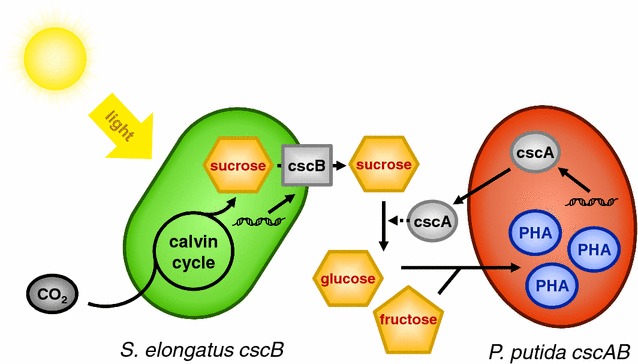
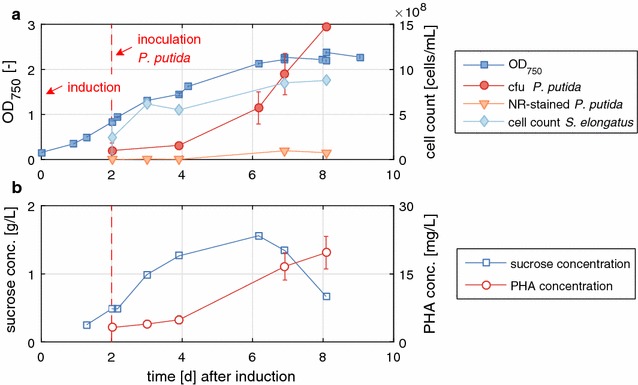
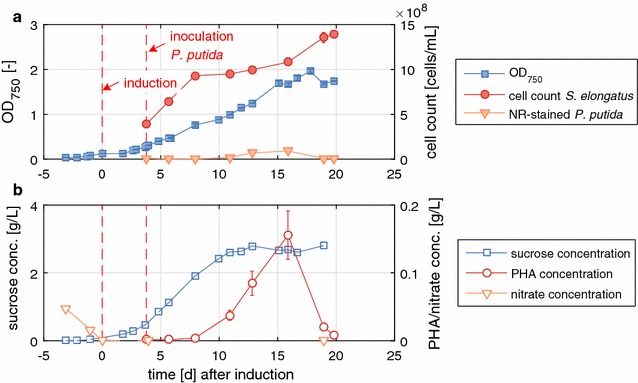
One of the major challenges for the present and future generations is to find suitable substitutes for the fossil resources we rely on today. Cyanobacterial carbohydrates have been discussed as an emerging renewable feedstock in industrial biotechnology for the production of fuels and chemicals, showing promising production rates when compared to crop-based feedstock. However, intrinsic capacities of cyanobacteria to produce biotechnological compounds are limited and yields are low. Here, we present an approach to circumvent these problems by employing a synthetic bacterial co-culture for the carbon-neutral production of polyhydroxyalkanoates (PHAs) from CO 2 . The co-culture consists of two bio - modules : Bio - module I , in which the cyanobacterial strain Synechococcus elongatus cscB fixes CO 2 , converts it to sucrose, and exports it into the culture supernatant; and bio - module II , where this sugar serves as C-source for Pseudomonas putida cscAB and is converted to PHAs that are accumulated in the cytoplasm. By applying a nitrogen-limited process, we achieved a maximal PHA production rate of 23.8 mg/(L day) and a maximal titer of 156 mg/L. We will discuss the present shortcomings of the process and show the potential for future improvement. These results demonstrate the feasibility of mixed cultures of S. elongatus cscB and P. putida cscAB for PHA production, making room for the cornucopia of possible products that are described for P. putida . The construction of more efficient sucrose-utilizing P. putida phenotypes and the optimization of process conditions will increase yields and productivities and eventually close the gap in the contemporary process. In the long term, the co-culture may serve as a platform process, in which P. putida is used as a chassis for the implementation of synthetic metabolic pathways for biotechnological production of value-added products.
Overview
The claims and statistics of this paper haven’t been checked yet.
Run the check — free, no account needed. It reads the open-access text and checks the sources it cites.
Integrity signals
Registry
Cites
Statistics
Figures
Verification
Claims the paper makes
The claims and statistics of this paper haven’t been checked yet.
Run the check — free, no account needed. It reads the open-access text and checks the sources it cites.
Claims other papers make about this one
Each is checked against this paper’s own text: does it say what the citing paper says it does?
The cited source says what the claim attributes to it.
In the citing paper
“Löwe et al. demonstrated a similar two-module design pairing S. elongatus CscB with Pseudomonas putida for photoautotrophic PHA production from CO2 [194].”
From Cyanobacteria as a Photosynthetic Chassis for Metabolic Pathway Engineering with Heterologous Gene Expression (2026) · cites this paper as [194]
Self-check
Percentages, sums and reported differences re-computed from the paper’s own numbers.
The self-check needs the paper’s full text.
Citations
Cites
Plastic waste inputs from land into the ocean
Jambeck, J. R., Geyer, R., Wilcox, C., Siegler, T. R., Perryman, M., Andrady, A., Narayan, R., & Law, K. L. (2015) · Science · doi:10.1126/science.1260352 · Cited by 13,163
Purification and properties of unicellular blue-green algae (order Chroococcales)
Stanier, R. Y., Kunisawa, R., Mandel, M., & Cohen-Bazire, G. (1971) · Bacteriological Reviews · doi:10.1128/br.35.2.171-205.1971 · Cited by 3,699
Applications and societal benefits of plastics
Andrady, A. L., & Neal, M. A. (2009) · Philosophical Transactions of the Royal Society B: Biological Sciences · doi:10.1098/rstb.2008.0304 · Cited by 2,464
Purification and properties of unicellular blue-green algae (order Chroococcales).
Stanier, R. Y., Kunisawa, R., Mandel, M., et al. (1971) · Bacteriological Reviews · doi:10.1128/mmbr.35.2.171-205.1971 · Cited by 1,455
A microbial polyhydroxyalkanoates (PHA) based bio- and materials industry
Chen, G. (2009) · Chemical Society Reviews · doi:10.1039/b812677c · Cited by 1,342
Spiekermann, P., Rehm, B. H. A., Kalscheuer, R., Baumeister, D., & Steinbüchel, A. (1999) · Archives of Microbiology · doi:10.1007/s002030050681 · Cited by 746
Constraints to Commercialization of Algal Fuels
Chisti, Y. (2013) · Journal of Biotechnology · doi:10.1016/j.jbiotec.2013.07.020 · Cited by 719
Microalgae—novel highly efficient starch producers
Brányiková, I., Maršálková, B., Doucha, J., Brányik, T., Bišová, K., Zachleder, V., & Vítová, M. (2010) · Biotechnology and Bioengineering · doi:10.1002/bit.23016 · Cited by 489
Rerouting Carbon Flux to Enhance Photosynthetic Productivity
Ducat, D. C., Avelar-Rivas, J. A., Way, J. C., & Silver, P. A. (2012) · Applied and Environmental Microbiology · doi:10.1128/aem.07901-11 · Cited by 362
Riis, V., & Mai, W. (1988) · Journal of Chromatography A · doi:10.1016/s0021-9673(01)84535-0 · Cited by 361
Pseudomonas putida—a versatile host for the production of natural products
Loeschcke, A., & Thies, S. (2015) · Applied Microbiology and Biotechnology · doi:10.1007/s00253-015-6745-4 · Cited by 294
A holistic view of polyhydroxyalkanoate metabolism in Pseudomonas putida
Prieto, M. A., Escapa, I. F., Martínez, V., Dinjaski, N., Herencias, C., de la Peña, F., Tarazona, N. A., & Revelles, O. (2014) · Environmental Microbiology · doi:10.1111/1462-2920.12760 · Cited by 240
Nikel, P. I., Chavarría, M., Danchin, A., & de Lorenzo, V. (2016) · Current Opinion in Chemical Biology · doi:10.1016/j.cbpa.2016.05.011 · Cited by 229
Synthetic photosynthetic consortia define interactions leading to robustness and photoproduction
Hays, S. G., Yan, L. L. W., Silver, P. A., & Ducat, D. C. (2017) · Journal of Biological Engineering · doi:10.1186/s13036-017-0048-5 · Cited by 147
The diversity of cyanobacterial metabolism: genome analysis of multiple phototrophic microorganisms
Beck, C., Knoop, H., Axmann, I. M. I., & Steuer, R. (2012) · BMC Genomics · doi:10.1186/1471-2164-13-56 · Cited by 144
Polysialic acid biosynthesis and production in Escherichia coli: current state and perspectives
Lin, B., Qiao, Y., Shi, B., & Tao, Y. (2015) · Applied Microbiology and Biotechnology · doi:10.1007/s00253-015-7019-x · Cited by 139
Poblete‐Castro, I., Escapa, I. F., Jäger, C., Puchałka, J., Lam, C.-C., Schomburg, D., Prieto, M., & dos Santos, V. A. P. M. (2012) · Microbial Cell Factories · doi:10.1186/1475-2859-11-34 · Cited by 139
The potential of Synechococcus elongatus UTEX 2973 for sugar feedstock production
Song, K., Tan, X., Liang, Y., & Lü, X. (2016) · Applied Microbiology and Biotechnology · doi:10.1007/s00253-016-7510-z · Cited by 135
Exploring the photosynthetic production capacity of sucrose by cyanobacteria
Du, W., Liang, F., Duan, Y., Tan, X., & Lü, X. (2013) · Metabolic Engineering · doi:10.1016/j.ymben.2013.05.001 · Cited by 133
Abed, R. M. M. (2009) · International Biodeterioration & Biodegradation · doi:10.1016/j.ibiod.2009.10.008 · Cited by 131
Acuña, J. M. B., Bielecka, A., Häußler, S., Schobert, M., Jahn, M., Wittmann, C., Jahn, D., & Poblete‐Castro, I. (2014) · Microbial Cell Factories · doi:10.1186/1475-2859-13-88 · Cited by 121
Li, T., Li, C., Butler, K., Hays, S. G., Guarnieri, M. T., Oyler, G. A., & Betenbaugh, M. J. (2017) · Biotechnology for Biofuels · doi:10.1186/s13068-017-0736-x · Cited by 108
Poly‐β‐hydroxybutyrate accumulation in cyanobacteria under photoautotrophy
Bhati, R., Samantaray, S., Sharma, L., & Mallick, N. (2010) · Biotechnology Journal · doi:10.1002/biot.201000252 · Cited by 80
Dynamics of photosynthetic photon flux density (PPFD) and estimates in coastal northern California
Ge, S., Smith, R. G., Jacovides, C. P., Kramer, M. G., & Carruthers, R. I. (2010) · Theoretical and Applied Climatology · doi:10.1007/s00704-010-0368-6 · Cited by 79
Ortiz-Marquez, J. C. F., Nascimento, M. D., Zehr, J. P., & Curatti, L. (2013) · Trends in biotechnology · doi:10.1016/j.tibtech.2013.05.006 · Cited by 75
Smith, M. J., & Francis, M. B. (2016) · ACS Synthetic Biology · doi:10.1021/acssynbio.6b00107 · Cited by 72
Furrer, P., Hany, R., Rentsch, D., Grubelnik, A., Ruth, K., Panke, S., & Zinn, M. (2007) · Journal of Chromatography A · doi:10.1016/j.chroma.2007.01.002 · Cited by 67
Enhanced gas chromatography-mass spectrometry method for bacterial polyhydroxyalkanoates analysis
Tan, G.-Y. A., Chen, C.-L., Ge, L., Li, L., Wang, L., Zhao, L., Mo, Y., Tan, S. N., & Wang, J. (2013) · Journal of Bioscience and Bioengineering · doi:10.1016/j.jbiosc.2013.08.020 · Cited by 66
Poblete‐Castro, I., Rodriguez, A. L., Lam, C. M. C., & Kessler, W. (2014) · Journal of Microbiology and Biotechnology · doi:10.4014/jmb.1308.08052 · Cited by 60
Akiyama, H., Okuhata, H., Onizuka, T., Kanai, S., Hirano, M., Tanaka, S., Sasaki, K., & Miyasaka, H. (2011) · Bioresource Technology · doi:10.1016/j.biortech.2011.09.058 · Cited by 53
Follonier, S., Panke, S., & Zinn, M. (2011) · Microbial Cell Factories · doi:10.1186/1475-2859-10-25 · Cited by 50
Metabolic engineering to expand the substrate spectrum of Pseudomonas putida toward sucrose
Löwe, H., Schmauder, L., Hobmeier, K., Kremling, A., & Pflüger‐Grau, K. (2017) · MicrobiologyOpen · doi:10.1002/mbo3.473 · Cited by 34
Self-citationImproving metabolite production in microbial co‐cultures using a spatially constrained hydrogel
Smith, M. J., & Francis, M. B. (2016) · Biotechnology and Bioengineering · doi:10.1002/bit.26235 · Cited by 22
Development of a light-regulated cell-recovery system for non-photosynthetic bacteria
Nakajima, M., Abe, K., Ferri, S. R., & Sode, K. (2016) · Microbial Cell Factories · doi:10.1186/s12934-016-0426-6 · Cited by 17
Patel, V., Sahoo, N. K., Patel, A. K., Rout, P. K., Naik, S. N., & Kalra, A. (2017) · Springer eBooks · doi:10.1007/978-3-319-51010-1_6 · Cited by 13
Bioplastik aus Licht und Luft – das Konzept einer synthetischen Ko-Kultur
Löwe, H., Kremling, A., & Pflüger‐Grau, K. (2017) · BIOspektrum · doi:10.1007/s12268-017-0802-8 · Cited by 1
Self-citation
Cited by
Sorted by citations
Nikel, P. I., & de Lorenzo, V. (2018) · Metabolic Engineering · doi:10.1016/j.ymben.2018.05.005 · Cited by 480
Recent advances in microbial CO2 fixation and conversion to value-added products
Salehizadeh, H., Yan, N., & Farnood, R. (2020) · Chemical Engineering Journal · doi:10.1016/j.cej.2020.124584 · Cited by 258
Engineering biosynthesis of polyhydroxyalkanoates (PHA) for diversity and cost reduction
Zheng, Y., Chen, J., Ma, Y., & Chen, G. (2019) · Metabolic Engineering · doi:10.1016/j.ymben.2019.07.004 · Cited by 218
Biotechnological potential of microbial consortia and future perspectives
Bhatia, S. K., Bhatia, R. K., Choi, Y., Kan, E., Kim, Y., & Yang, Y. (2018) · Critical Reviews in Biotechnology · doi:10.1080/07388551.2018.1471445 · Cited by 157
Weiss, T. L., Young, E. J., & Ducat, D. C. (2017) · Metabolic Engineering · doi:10.1016/j.ymben.2017.10.009 · Cited by 152
Metadata
- Authors
- Löwe, H., Hobmeier, K., Moos, M., Kremling, A., & Pflüger-Grau, K.
- Affiliations
- Technical University of Munich (DE)
- Venue
- Biotechnology for Biofuels
- Published
- 2017-07-19
- Volume
- 10
- Issue
- 1
- Pages
- 190-190
- ISSN
- 1754-6834 (ISSN-L)
- PMC
- PMC5517840
- OpenAlex
- W2736712864
- Cited by
- 114
- References
- 35
- Citations by year
- 2026: 6 · 2025: 10 · 2024: 13 · 2023: 15 · 2022: 20 · 2021: 18 · 2020: 21 · 2019: 3 · 2018: 7 · 2017: 1
- FWCI
- 3.15
- Type
- journal article
- Language
- en
- Open access
- gold
- doi.org
- Licence
- cc-by
- Locations
- Biotechnology for Biofuels (publishedVersion, cc-by)
- PubMed Central (publishedVersion, cc-by)
- PubMed (publishedVersion)
- DOAJ (DOAJ: Directory of Open Access Journals) (submittedVersion, cc-by-sa)
- mediaTUM – the media and publications repository of the Technical University Munich (Technical University Munich) (submittedVersion, other-oa)
- Funders
- U.S. Department of Defense
- Technische Universität München
- Centro Nacional de Biotecnología
- Topics
- Physical Sciences › Materials Science › Biomaterials › biodegradable polymer synthesis and properties
- Life Sciences › Biochemistry, Genetics and Molecular Biology › Molecular Biology › Microbial Metabolic Engineering and Bioproduction
- Physical Sciences › Energy › Renewable Energy, Sustainability and the Environment › Algal biology and biofuel production
- Keywords
- polyhydroxyalkanoates, sucrose export, renewable raw materials, biopolymer production, chassis strain, synthetic metabolic pathways
About these checks
Registry, retraction, Cites and statistics results are computed, not judged, with one exception: a printed reference that no index lists is read once by a model before it counts as a citation error. Claims are extracted by a model and kept only when their quote appears verbatim in the text; each cited source is then checked, with a model’s help, for whether it says what the claim relies on. Those verdicts can be wrong — read the claim’s quote and the cited source before relying on one.
Statistics and arithmetic are recomputed, not judged.
Confidence bands are shown only for fields calibrated on our annotated test set. None is calibrated yet, so no band is shown.
What counts as a claim ›How we measure confidence ›How we check this ›
Are you an author, or do you see a problem with this page? Request a review
