

Molecular detection of Anaplasma phagocytophilum and Borrelia burgdorferi sensu lato genospecies in red foxes (Vulpes vulpes) from Romania
Open accessThe DOI matches its Crossref record; 22 of the 22 references it cites were found in a registry or an index.
Abstract
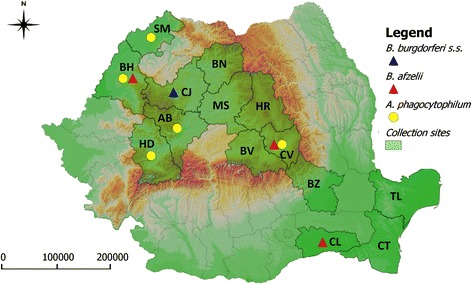
BACKGROUND: Red foxes (Vulpes vulpes) are one of the most widespread wild carnivores in the world, being recognized to harbor and transmit a wide range of vector-borne diseases. Anaplasma phagocytophilum and Borrelia burgdorferi sensu lato are zoonotic tick-borne pathogens causing emerging diseases. Wild animals play an essential role in the transmission of diseases and pathogens maintenance in nature. Epidemiological studies regarding the prevalence of tick-borne pathogens in red foxes are of public health importance, as they may successfully act as a pathogen transmission interface between wildlife, domestic animals and humans. FINDINGS: This study included 14 counties from Romania. A total number of 353 red foxes (Vulpes vulpes) were examined. Heart tissue samples were collected during necropsy and stored at -20 °C. Genomic DNA extraction was performed and all samples were examined by polymerase chain reaction (PCR). Specific primers for A. phagocytophilum, A. platys, E. canis and Borrelia burgdorferi s.l. were used. Sequence analysis was performed (Macrogen Europe, Amsterdam) and obtained sequences are available at GenBank™. Out of the 353 samples, 9 (2.55 %; 95 % CI: 1.25-4.96 %) were positive for A. phagocytophilum. Positive animals originated from 5 counties. In total, 5 out of 353 heart tissue samples (1.42 %; 95 % CI: 0.52-3.47 %) collected from red foxes were positive for B. burgdorferi s.l. Red foxes originated from 4 counties. None of the samples were positive for A. platys or E. canis. No co-infection with A. phagocytophilum and B. burgdorferi s.l. was found. CONCLUSION: This first report of A. phagocytophilum and B. burgdorferi s.l. in red foxes from Romania suggests a limited role of foxes in the maintenance of the two related pathogens, but may represent a potential risk from a public health perspective.
Overview
The claims and statistics of this paper haven’t been checked yet.
Free: it reads the open-access text and checks the first 5 claims that cite a source we can check. Create a free account to check every claim.
Integrity signals
Registry
Cites
Statistics
Figures
Verification
Claims the paper makes
The claims and statistics of this paper haven’t been checked yet.
Free: it reads the open-access text and checks the first 5 claims that cite a source we can check. Create a free account to check every claim.
Claims other papers make about this one
Each is checked against this paper’s own text: does it say what the citing paper says it does?
The cited source doesn’t support the claim as written.
In the citing paper
“Surveys carried out in Europe found prevalence rates ranging from 0% to 8.2% for A. phagocytophilum and from 0% to 52% for E. canis [93,112,117,118].”
From Secrets of the Astute Red Fox (Vulpes vulpes, Linnaeus, 1758): An Inside-Ecosystem Secret Agent Serving One Health (2021) · cites this paper as [118]
Checked by a reasoning model — may be wrong.
Experimental — accuracy not yet measured
Self-check
Percentages, sums and reported differences re-computed from the paper’s own numbers.
The self-check needs the paper’s full text.
Citations
Cites
Anaplasma phagocytophilum—a widespread multi-host pathogen with highly adaptive strategies
Stuen, S., Granquist, E. G., & Silaghi, C. (2013) · Frontiers in Cellular and Infection Microbiology · doi:10.3389/fcimb.2013.00031 · Cited by 603 · cited 1×
“hexagonus, the vector competence of this tick species needs to be further investigated [23].”
BackgroundRizzoli, A., Silaghi, C., Obiegala, A., Rudolf, I., Hubálek, Z., Földvári, G., Plantard, O., Vayssier-Taussat, M., Bonnet, S., Å pitalská, E., et al. (2014) · Frontiers in Public Health · doi:10.3389/fpubh.2014.00251 · Cited by 513
POSTIC, D., ASSOUS, M. V., GRIMONT, P. A. D., & BARANTON, G. (1994) · International Journal of Systematic Bacteriology · doi:10.1099/00207713-44-4-743 · Cited by 499 · cited 1×
“was performed targeting the region of 5S-23S rRNA (rrf-rrl) intergenic spacer (IGS) in Bio-Rad T1000 Thermal Cycler, according to a previously described protocol [11].”
MethodDetection of ehrlichiae in African ticks by polymerase chain reaction
Parola, P., Roux, V., Camicas, J.-L., Baradji, I., Brouqui, P., & Raoult, D. (2000) · Transactions of the Royal Society of Tropical Medicine and Hygiene · doi:10.1016/s0035-9203(00)90243-8 · Cited by 345
Murphy, G. L., Ewing, S. A., Whitworth, L. C., Fox, J. C., & Kocan, A. A. (1998) · Veterinary Parasitology · doi:10.1016/s0304-4017(98)00179-4 · Cited by 294 · cited 1×
“platys DNA was amplified using specific primers EPLAT5 (5′-TTTGTCGTAGCT TGCTATGAT-3′) and EPLAT3 (5′-CTTCTGTGGGTACCGTC-3′) targeting a 359-bp fragment of the 16S rRNA gene [9].”
MethodEuropean Reservoir Hosts of Borrelia burgdorferi sensu lato
Gern, L., Estrada-Peña, A., Frandsen, F., Gray, J. S., Jaenson, T. G. T., Jongejan, F., Kahl, O., Korenberg, E., Mehl, R., & Nuttall, P. A. (1998) · Zentralblatt für Bakteriologie · doi:10.1016/s0934-8840(98)80121-7 · Cited by 256
Tick-borne infections of animals and humans: a common ground
Baneth, G. (2014) · International Journal for Parasitology · doi:10.1016/j.ijpara.2014.03.011 · Cited by 190 · cited 2×
“Both transmission and maintenance of these pathogens in nature are following an enzootic lifecycle that involves ticks and a broad range of reservoir hosts [5] in which wildlife is an essential component [4].”
BackgroundPCR PROTOCOLS FOR EMERGING INFECTIOUS DISEASES
Persing, D. H., & Edmiston, C. E. (1997) · Shock · doi:10.1097/00024382-199702000-00014 · Cited by 126
Hodžić, A., Alić, A., Fuehrer, H.-P., Harl, J., Wille-Piazzai, W., & Duscher, G. (2015) · Parasites & Vectors · doi:10.1186/s13071-015-0692-x · Cited by 125 · cited 1×
“No positive foxes were found in studies conducted in Austria [1] or Bosnia and Herzegovina [16].”
BackgroundMihalca, A. D., Dumitrache, M. O., Magdaş, C., Gherman, C. M., Domşa, C., Mircean, V., Ghira, I., Pocora, V., Ionescu, D. T., Barabási, S. S., et al. (2012) · Experimental and Applied Acarology · doi:10.1007/s10493-012-9566-5 · Cited by 109 · cited 1×
“crenulatus and Dermacentor marginatus [21].”
Self-citation
Research works printed but not linked: 3
- Martínez-Carrasco C Ruiz de Ybáñez MR Sagarminaga JL Garijo MM Moreno F Acosta I Hernández S Alonso FD Parasites of red fox (Vulpes vulpes Linnaeus, 1758) in Murcia, Southeast Spain Rev Med Vet 2007 7 158 331 5
- Liebisch G Dimpfl B Finkbeiner-Weber B Liebisch A Frosch M The red fox (Vulpes vulpes) a reservoir competent host for for Borrelia burgdorferi sensu lato Proc 2nd Int Conf Tick-Host-Pathogen Interactions 1995 238
- Kahl O Geue L Laboratory study on the possible role of the European fox, Vulpes vulpes as potential reservoir of Borrelia burgdorferi s.l Proc 2nd Int Conf Tick-Host-Pathogen Interactions 1995 239
Cited by
Predicting psychological and subjective well-being from personality: A meta-analysis
Anglim, J., Horwood, S., Smillie, L. D., Marrero, R. J., & Wood, J. K. (2020) · Psychological Bulletin · doi:10.1037/bul0000226 · Cited by 855
Molecular Survey on Vector-Borne Pathogens in Alpine Wild Carnivorans
Battisti, E., Zanet, S., Khalili, S., Trisciuoglio, A., Hertel, B., & Ferroglio, E. (2020) · Frontiers in Veterinary Science · doi:10.3389/fvets.2020.00001 · Cited by 191
“In foxes, the occurrence of these bacteria has been previously investigated in Italy (17), Germany (66), Poland (67), The Netherland (68), Romania (69), Switzerland (70), Czech Republic (71), Austria (65), Hungary (16), and Spain (37), with results that are in line with our findings.”
ResultAndré, M. R. (2018) · Frontiers in Veterinary Science · doi:10.3389/fvets.2018.00293 · Cited by 125
Borrelia Diversity and Co-infection with Other Tick Borne Pathogens in Ticks
Răileanu, C., Moutailler, S., Pavel, I., Porea, D., Mihalca, A. D., Săvuţă, G., & Vayssier‐Taussat, M. (2017) · Frontiers in Cellular and Infection Microbiology · doi:10.3389/fcimb.2017.00036 · Cited by 107
Self-citationHodžić, A., Mrowietz, N., Cézanne, R., Bruckschwaiger, P., Punz, S., Habler, V. E., Tomsik, V., Lazar, J., Duscher, G. G., Glawischnig, W., et al. (2017) · Parasitology · doi:10.1017/s0031182017001536 · Cited by 71
“…infections transmitted by haematophagous arthropod vectors, as they seem to play an important role in the maintenance and transmission of the agents (Henn et al. 2009; Torina et al. 2013; Millán et al. 2014; Penezić et al. 2014; Cardoso et al. 2015; Dumitrache et al. 2015; Hodžić et al. 2015).”
BackgroundInfluentialKauffmann, M., Rehbein, S., Hamel, D., Lutz, W., Heddergott, M., Pfister, K., & Silaghi, C. (2016) · Molecular and Cellular Probes · doi:10.1016/j.mcp.2016.08.008 · Cited by 62
Mihalca, A. D., D’Amico, G., Scurtu, I., Chirilă, R., Matei, I. A., & Ionică, A. M. (2015) · Parasites & Vectors · doi:10.1186/s13071-015-0663-2 · Cited by 59
Self-citationMolecular detection of tick-borne pathogens in wild red foxes ( Vulpes vulpes ) from Central Italy
Ebani, V. V., Rocchigiani, G., Nardoni, S., Bertelloni, F., Vasta, V., Papini, R. A., Verin, R., Poli, A., & Mancianti, F. (2017) · Acta Tropica · doi:10.1016/j.actatropica.2017.05.014 · Cited by 58
“168 E. canis DNA was not detected in foxes examined in Romania (Dumitrache et al., 2015) and Bosnia 169 Herzegovina (Hodzic et al., 2015), but other molecular surveys found E. canis positivity rates of 2.9% 170 in Portugal (Cardoso et al., 2015), 16.6% in Spain (Millán et al., 2016) and 52% in…”
BackgroundInfluentialBorșan, S.-D., Ionică, A. M., Galon, C., Toma-Naic, A., Peștean, C. P., Sándor, A. D., Moutailler, S., & Mihalca, A. D. (2021) · Frontiers in Microbiology · doi:10.3389/fmicb.2021.645002 · Cited by 51
Self-citationSgroi, G., Iatta, R., Veneziano, V., Bezerra‐Santos, M. A., Lesiczka, P. M., Hrazdilová, K., Annoscia, G., D’Alessio, N., Golovchenko, M., Rudenko, N., et al. (2021) · Ticks and Tick-borne Diseases · doi:10.1016/j.ttbdis.2021.101669 · Cited by 52
MOLECULAR INVESTIGATION OF VECTOR-BORNE PATHOGENS IN RED FOXES (VULPES VULPES) FROM SOUTHERN FRANCE
Medkour, H., Laidoudi, Y., Marié, J.-L., Fenollar, F., Davoust, B., & Mediannikov, O. (2020) · Journal of Wildlife Diseases · doi:10.7589/2019-09-234 · Cited by 38
“In Europe, foxes are the most widespread and abundant of wild carnivores (Dumitrache et al. 2015; Otranto et al. 2015a, b).”
BackgroundHodžić, A., Georges, I., Postl, M., Duscher, G. G., Jeschke, D., Szentiks, C. A., Ansorge, H., & Heddergott, M. (2020) · Ticks and Tick-borne Diseases · doi:10.1016/j.ttbdis.2020.101389 · Cited by 32
Fox Vulpes vulpes population trends in Western Europe during and after the eradication of rabies
Delcourt, J., Brochier, B., Delvaux, D., Vangeluwe, D., & Poncin, P. (2022) · Mammal Review · doi:10.1111/mam.12289 · Cited by 33
Multiple Tick-Borne Pathogens in Ixodes ricinus Ticks Collected from Humans in Romania
Kalmár, Z., Dumitrache, M. O., D’Amico, G., Matei, I. A., Ionică, A. M., Gherman, C. M., Lupșe, M. S., & Mihalca, A. D. (2020) · Pathogens · doi:10.3390/pathogens9050390 · Cited by 28
Self-citationRold, G. D., Ravagnan, S., Soppelsa, F., Porcellato, E., Soppelsa, M., Obber, F., Citterio, C. V., Carlin, S., Danesi, P., Montarsi, F., et al. (2018) · Parasites & Vectors · doi:10.1186/s13071-018-2726-7 · Cited by 28
“phagocytophilum have been found in foxes around Europe, especially in central eastern European countries [30, 31, 43], where I.”
BackgroundRed fox (Vulpes vulpes) play an important role in the propagation of tick-borne pathogens
Lesiczka, P. M., Rudenko, N., Golovchenko, M., Juránková, J., Daněk, O., Modrý, D., & Hrazdilová, K. (2022) · Ticks and Tick-borne Diseases · doi:10.1016/j.ttbdis.2022.102076 · Cited by 27
Molecular detection of Anaplasma phagocytophilum in wild carnivores in north-eastern Poland
Szewczyk, T., Werszko, J., Myczka, A. W., Laskowski, Z., & Karbowiak, G. (2019) · Parasites & Vectors · doi:10.1186/s13071-019-3734-y · Cited by 25
Angiostrongylus vasorum in Romania: an extensive survey in red foxes, Vulpes vulpes
Deak, G., Gherman, C. M., Ionică, A. M., Vezendan, A. D., D’Amico, G., Matei, I. A., Daskalaki, A. A., Marian, I., Damian, A., Cozma, V., et al. (2017) · Parasites & Vectors · doi:10.1186/s13071-017-2270-x · Cited by 28
Self-citationČobádiová, A., Reiterová, K., Derdáková, M., Špilovská, S., Turčeková, L., Hviščová, I., & Hisira, V. (2013) · Acta Parasitologica · doi:10.2478/s11686-013-0171-5 · Cited by 23
Molecular Detection of Anaplasma and Ehrlichia Infection in Ticks in Borderline of Iran-Afghanistan
Jafarbekloo, A., Bakhshi, H., Faghihi, F., Telmadarraiy, Z., Khazeni, A., Oshaghi, M. A., Ramzgouyan, M. R., & Sedaghat, M. M. (2014) · Journal of Biomedical Science and Engineering · doi:10.4236/jbise.2014.711089 · Cited by 22
Pluemer, M., Dubay, S. A., Drake, D., Crimmins, S. M., Veverka, T., Hovanec, H., Torkelson, M. R., & Mueller, M. A. (2019) · Journal of Urban Ecology · doi:10.1093/jue/juz022 · Cited by 27
Borrelia spp. in small mammals in Romania
Kalmár, Z., Sándor, A. D., Matei, I. A., Ionică, A. M., D’Amico, G., Gherman, C. M., & Mihalca, A. D. (2019) · Parasites & Vectors · doi:10.1186/s13071-019-3713-3 · Cited by 19
Self-citationGarcês, A., & Pires, I. (2021) · Environments · doi:10.3390/environments8100103 · Cited by 18
Wodecka, B., Michalik, J., & Grochowalska, R. (2022) · Pathogens · doi:10.3390/pathogens11060696 · Cited by 20
“Dumitrache et al. [16] found only B. afzelii (n = 4) and B. burgdorferi s.s. (n = 1) in 1.4% of 353 fox heart isolates tested in Romania.”
BackgroundInfluentialKalmár, Z., Briciu, V. T., Coroian, M., Flonta, M., Rădulescu, A.-L., Topan, A. V., Mihalca, A. D., & Lupșe, M. S. (2021) · Parasites & Vectors · doi:10.1186/s13071-021-05099-1 · Cited by 17
Self-citationHou, J., Ling, F., Liu, Y., Zhang, R., Song, X., RuTing, H., Wu, Y., Wang, J., Sun, J., & Gong, Z. (2019) · Experimental and Applied Acarology · doi:10.1007/s10493-019-00411-2 · Cited by 11
Occurrence of Bacterial and Protozoan Pathogens in Red Foxes (Vulpes vulpes) in Central Italy
Ebani, V. V., Trebino, C., Guardone, L., Bertelloni, F., Cagnoli, G. A., Nardoni, S., Sel, E., Wilde, E., Poli, A., & Mancianti, F. (2022) · Animals · doi:10.3390/ani12202891 · Cited by 15
“pahgocytophilum [5,36,39], from 0% to 17% for C.”
BackgroundArthropod-Borne Pathogens in Wild Canids
Ebani, V. V., Nardoni, S., & Mancianti, F. (2023) · Veterinary Sciences · doi:10.3390/vetsci10020165 · Cited by 16
Serological Evidence of Natural Exposure to Tick-Borne Pathogens in Horses, Romania
Bogdan, A. M., Ioniță, M., & Mitrea, I. L. (2021) · Microorganisms · doi:10.3390/microorganisms9020373 · Cited by 11
Occurrence of Borrelia sp. among Wild Living Invasive and Native Mesocarnivores in Poland
Hildebrand, J., Jurczyk, K., Popiołek, M., Buńkowska‐Gawlik, K., & Perec‐Matysiak, A. (2022) · Animals · doi:10.3390/ani12202829 · Cited by 11
“The comparison between these lines and the homological sequences available in GenBank showed 100% to 99.2% similarity to samples derived from humans (CP018262, CP002933, JX888444), Ixodes ticks from Russia, Estonia, Germany (CP009212, KX418638, AY772053, MW489224, OL848283) as well as to sequences obtained from rodent…”
BackgroundInfluentialBogdan, A. M., Mitrea, I. L., & Ioniță, M. (2024) · Veterinary Sciences · doi:10.3390/vetsci11060269 · Cited by 15
Pathogen screening in the red fox (Vulpes Vulpes) from Lithuania
Sakalauskas, P., Lipatova, I., Radzijevskaja, J., & Paulauskas, A. (2020) · Biologija · doi:10.6001/biologija.v65i4.4122 · Cited by 14
Sukara, R., Juwaid, S., Ćirović, D., Penezić, A., Mihaljica, D., Veinović, G., Radojičić, S., Hodžić, A., Duscher, G. G., & Tomanović, S. (2019) · Acta Veterinaria · doi:10.2478/acve-2019-0026 · Cited by 7
Strategies for the Diagnosis of Granulocytic Anaplasmosis in Two Naturally Infected Dogs
MARTINESCU, G.-V., Ivanescu, L. M., Ștefănescu, R. A., ANDRONIC, L., MĂTIUȚ, S., MÎNDRU, R., Solcan, G., & Miron, L. D. (2023) · Animals · doi:10.3390/ani14010049 · Cited by 8
“Consequently, several animal species were tested, such as dogs [18], cattle [19,20], wild birds [21], red foxes [22], small mammals [23], and wild boar [17].”
BackgroundPavlak, M., Prpić, J., Matei, I. A., Trninić, K., Čurković, S., Mihaljević, Ž., Štritof, Z., Vlahović, K., Udiljak, Ž., & Jemeršić, L. (2025) · Pathogens · doi:10.3390/pathogens14090858 · Cited by 2
Self-citationWild canids as hosts for ticks and tick-borne zoonotic pathogens in Serbia
Sukara, R., Mihaljica, D., Veinović, G., Ćirović, D., & Tomanović, S. (2020) · Veterinarski glasnik · doi:10.2298/vetgl200810017s · Cited by 3
First identification of Brucella melitensis and Rickettsia monacensis in a red fox, Vulpes vulpes
Selmi, R., Belkahia, H., Abdallah, M. B., Mamlouk, A., Dâaloul-Jedidi, M., Saïd, M. B., & Messadi, L. (2025) · Comparative Immunology Microbiology and Infectious Diseases · doi:10.1016/j.cimid.2025.102315 · Cited by 3
Lindhorst, Z. T. L., Frangl, M. T., Eigner, B., Shahi‐Barogh, B., Duscher, G. G., Schliephake, A., Gaede, W., Fuehrer, H., & Heddergott, M. (2025) · International Journal for Parasitology Parasites and Wildlife · doi:10.1016/j.ijppaw.2025.101162 · Cited by 1
“…as canine and equine anaplasmosis, and tick-borne fever in ruminants (Woldehiwet, 2010), was detected in foxes from multiple European countries (Dumitrache et al., 2015; Ebani et al., 2011; H ¨ artwig et al., 2014; Hod ˇ zi ´ c et al., 2018; Hofmann-Lehmann et al., 2016; Jahfari et al., 2014;…”
MITREA, E., Bogdan, A. M., ZISOPOL, A. M., Mitrea, I. L., & Ioniță, M. (2024) · Lucrări Ştiinţifice - Medicină Veterinară, Universitatea de Ştiinţe Agricole şi Medicină Veterinară "Ion Ionescu de la Brad" Iaşi · doi:10.61900/spjvs.2024.01.04 · Cited by 1
Molecular detection of Anaplasma phagocytophilum DNA in Olive Baboons and Vervet monkeys in KenyaPreprint
Masika, S. J., Muchemi, G. M., Kamau, J., Okumu, T. A., & Mutura, S. (2021) · Research Square · doi:10.21203/rs.3.rs-355087/v1 · Cited by 1
Trninić, K., Cvitković, D., Pavlak, M., Kunštek, S., Udiljak, Ž., Čurković, S., & Vlahović, K. (2022) · Veterinarska stanica · doi:10.46419/vs.54.2.10 · Cited by 2
Gilot‐Fromont, E., Villena, I., Bonnaud, E., Fischer, C., Giraud, É., Linden, A. S., Meurens, F., Paraud, C., Raoul, F., Richomme, C., et al. (2025) · Food Risk Assess Europe · doi:10.2903/fr.efsa.2025.fr-0062
Medkour, H. (2020) · theses.fr (ABES) · doi:10.70675/58a94f04z314bz4dccz923dz78a302d8cca3
Helminthoses vectorielles : caractérisation, diagnostic et moyens de contrôle
Laidoudi, Y. (2020) · theses.fr (ABES) · doi:10.70675/357e15d5z2da0z4ecez86c1z42fb4b9086e7
Metadata
- Authors
- Dumitrache, M. O., Matei, I. A., Ionică, A. M., Kalmár, Z., D’Amico, G., Sikó-Barabási, S., Ionescu, D. T., Gherman, C. M., & Mihalca, A. D.
- Affiliations
- University of Agricultural Sciences and Veterinary Medicine of Cluj-Napoca (RO)
- Transilvania University of Brașov (RO)
- Corresponding author
- Matei, Ioana Adriana
- ORCID
- Venue
- Parasites & Vectors
- Published
- 2015-10-08
- Volume
- 8
- Issue
- 1
- Pages
- 514-514
- ISSN
- 1756-3305 (ISSN-L)
- PMC
- PMC4599586
- OpenAlex
- W1958721821
- Cited by
- 45
- References
- 22
- Citations by year
- 2025: 4 · 2024: 2 · 2023: 2 · 2022: 6 · 2021: 6 · 2020: 9 · 2019: 5 · 2018: 2 · 2017: 4 · 2016: 2 · 2015: 1
- FWCI
- 2.39
- Type
- journal article
- Language
- en
- Open access
- gold
- doi.org
- Licence
- cc-by
- Locations
- Parasites & Vectors (publishedVersion, cc-by)
- Europe PMC (PubMed Central) (publishedVersion, cc-by)
- PubMed Central (publishedVersion, cc-by)
- PubMed (publishedVersion)
- DOAJ (DOAJ: Directory of Open Access Journals) (submittedVersion)
- Topics
- Life Sciences › Immunology and Microbiology › Parasitology › Vector-borne infectious diseases
- Health Sciences › Medicine › Infectious Diseases › Bartonella species infections research
- Health Sciences › Medicine › Infectious Diseases › Viral Infections and Vectors
- Keywords
- Anaplasma phagocytophilum, Borrelia burgdorferi sensu lato, red fox, tick-borne pathogens, zoonotic pathogens, wildlife reservoirs, pathogen prevalence, co-infection, Romania
- MeSH terms
- Animals, Base Sequence, DNA, Bacterial, Foxes, Geography, Heart, Lyme Disease, Molecular Sequence Data, Romania, Ticks, Borrelia burgdorferi Group, Ehrlichiosis, Sequence Analysis, DNA, DNA Primers, Anaplasma phagocytophilum
About these checks
Registry, retraction, Cites and statistics results are computed, not judged, with one exception: a printed reference that no index lists is read once by a model before it counts as a citation error. Claims are extracted by a model and kept only when their quote appears verbatim in the text; each cited source is then checked, with a model’s help, for whether it says what the claim relies on. Those verdicts can be wrong — read the claim’s quote and the cited source before relying on one.
Statistics and arithmetic are recomputed, not judged.
Confidence bands are shown only for fields calibrated on our annotated test set. None is calibrated yet, so no band is shown.
What counts as a claim ›How we measure confidence ›How we check this ›
Are you an author, or do you see a problem with this page? Request a review
Data sources
Bibliographic data: Semantic Scholar, OpenAlex, Crossref.
Contains information from the Semantic Scholar Academic Graph Datasets, made available under the ODC Attribution License (ODC-BY 1.0).
Semantic Scholar’s data is described in: Kinney, R., et al. (2023). The Semantic Scholar Open Data Platform. arXiv:2301.10140.
