

Spatiotemporal spread of sarcoptic mange in the red fox (Vulpes vulpes) in Switzerland over more than 60 years: lessons learnt from comparative analysis of multiple surveillance tools
Open accessThe DOI matches its Crossref record; 100 of the 100 references it cites were found in a registry or an index.
Abstract
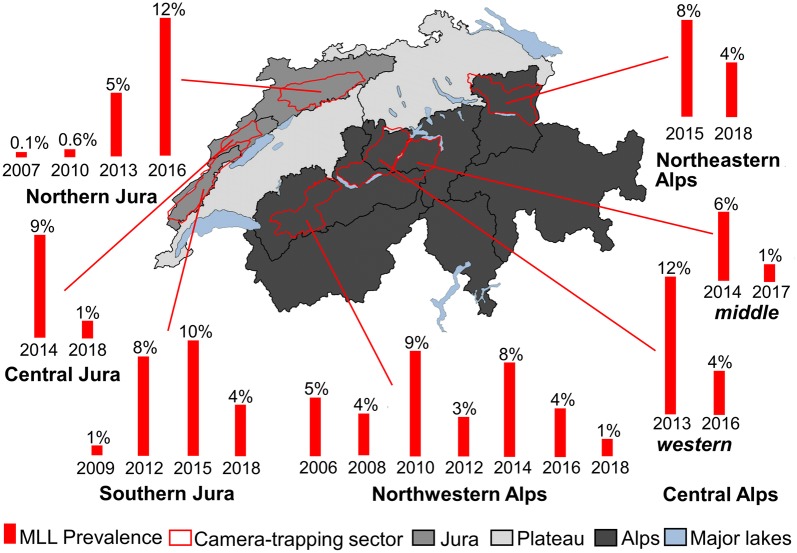
Background: Sarcoptic mange is a contagious skin disease of wild and domestic mammals caused by the mite Sarcoptes scabiei. Reports of sarcoptic mange in wildlife increased worldwide in the second half of the 20th century, especially since the 1990s. The aim of this study was to provide new insights into the epidemiology of mange by (i) documenting the emergence of sarcoptic mange in the red fox (Vulpes vulpes) in the last decades in Switzerland; and (ii) describing its spatiotemporal spread combining data obtained through different surveillance methods. Methods: Retrospective analysis of archived material together with prospective data collection delivered a large dataset from the 19th century to 2018. Methods included: (i) a review of historical literature; (ii) screening of necropsy reports from general health surveillance (1958–2018); (iii) screening of data on mange (1968–1992) collected during the sylvatic rabies eradication campaign; (iv) a questionnaire survey (<1980–2017) and (v) evaluation of camera-trap bycatch data (2005–2018). Results: Sarcoptic mange in red foxes was reported as early as 1835 in Switzerland. The first case diagnosed in the framework of the general health surveillance was in 1959. Prior to 1980, sarcoptic mange occurred in non-adjacent surveillance districts scattered all over the country. During the period of the rabies epidemic (1970s-early 1990s), the percentage of foxes tested for rabies with sarcoptic mange significantly decreased in subregions with rabies, whereas it remained high in the few rabies-free subregions. Sarcoptic mange re-emerged in the mid-1990s and continuously spread during the 2000–2010s, to finally extend to the whole country in 2017. The yearly prevalence of mange in foxes estimated by camera-trapping ranged from 0.1–12%. Conclusions: Sarcoptic mange has likely been endemic in Switzerland as well as in other European countries at least since the mid-19th century. The rabies epidemics seem to have influenced the pattern of spread of mange in several locations, revealing an interesting example of disease interaction in free-ranging wildlife populations. The combination of multiple surveillance tools to study the long-term dynamics of sarcoptic mange in red foxes in Switzerland proved to be a successful strategy, which underlined the usefulness of questionnaire surveys.
Overview
The claims and statistics of this paper haven’t been checked yet.
Free: it reads the open-access text and checks the first 5 claims that cite a source we can check. Create a free account to check every claim.
Integrity signals
Registry
Cites
Statistics
Figures
Verification
Claims the paper makes
The claims and statistics of this paper haven’t been checked yet.
Free: it reads the open-access text and checks the first 5 claims that cite a source we can check. Create a free account to check every claim.
Claims other papers make about this one
Each is checked against this paper’s own text: does it say what the citing paper says it does?
The cited source says what the claim attributes to it.
In the citing paper
“In Switzerland, studies of foxes estimated by camera trapping have shown a prevalence of Sarcoptes scabiae mange between 0.1% and 12% over the 2005-2018 period [110].”
From Secrets of the Astute Red Fox (Vulpes vulpes, Linnaeus, 1758): An Inside-Ecosystem Secret Agent Serving One Health (2021) · cites this paper as [110]
Self-check
Percentages, sums and reported differences re-computed from the paper’s own numbers.
The self-check needs the paper’s full text.
Citations
Cites
Computing Inter-Rater Reliability for Observational Data: An Overview and Tutorial
Hallgren, K. A. (2012) · Tutorials in Quantitative Methods for Psychology · doi:10.20982/tqmp.08.1.p023 · Cited by 3,884
Searching for grey literature for systematic reviews: challenges and benefits
Mahood, Q., Van Eerd, D., & Irvin, E. (2014) · Research Synthesis Methods · doi:10.1002/jrsm.1106 · Cited by 814
Rapid evolutionary dynamics and disease threats to biodiversity
Altizer, S., Harvell, D., & Friedle, E. (2003) · Trends in Ecology & Evolution · doi:10.1016/j.tree.2003.08.013 · Cited by 532
Effects of Host Diversity on Infectious Disease
Ostfeld, R. S., & Keesing, F. (2012) · Annual Review of Ecology, Evolution, and Systematics · doi:10.1146/annurev-ecolsys-102710-145022 · Cited by 528
Interactive influence of infectious disease and genetic diversity in natural populations
O'Brien, S. J., & Evermann, J. F. (1988) · Trends in Ecology & Evolution · doi:10.1016/0169-5347(88)90058-4 · Cited by 521
A review of Sarcoptes scabiei: past, present and future
Arlian, L. G., & Morgan, M. S. (2017) · Parasites & Vectors · doi:10.1186/s13071-017-2234-1 · Cited by 365
Disease Reveals the Predator: Sarcoptic Mange, Red Fox Predation, and Prey Populations
Lindström, E. R., Andrén, H., Angelstam, P., Cederlund, G., Hörnfeldt, B., Jäderberg, L., Lemnell, P., Martinsson, B., Sköld, K., & Swenson, J. E. (1994) · Ecology · doi:10.2307/1939428 · Cited by 335
Sarcoptic mange in wildlife: -EN- -FR- -ES-
PENCE, D. B., & UECKERMANN, E. (2002) · Revue Scientifique et Technique de l'OIE · doi:10.20506/rst.21.2.1335 · Cited by 317
Pence, D. B., & Ueckermann, E. (2002) · PubMed · Cited by 287
Wildlife health investigations: needs, challenges and recommendations
Ryser-Degiorgis, M.-P. (2013) · BMC Veterinary Research · doi:10.1186/1746-6148-9-223 · Cited by 276
Self-citationTrewhella, W. J., Harris, S., & McAllister, F. E. (1988) · The Journal of Applied Ecology · doi:10.2307/2403834 · Cited by 257
The rise of urban fox population in Switzerland
Gloor, S., Bontadina, F., Hegglin, D., Deplazes, P., & Breitenmoser, U. (2001) · Biodiversity Heritage Library (Smithsonian Institution) · doi:10.5167/uzh-141504 · Cited by 232
Baker, P. J., Funk, S. M., Harris, S., & White, P. C. L. (2000) · Animal Behaviour · doi:10.1006/anbe.1999.1285 · Cited by 228
SARCOPTIC MANGE IN SPANISH IBEX FROM SPAIN
León-Vizcaíno, L., de Ybáñez, R. R., Pablo, M. J. C., Ortíz, J. M., Espinosa, J., Pérez, L., Simón, M. A., & Alonso, F. (1999) · Journal of Wildlife Diseases · doi:10.7589/0090-3558-35.4.647 · Cited by 177
Ecological interference between fatal diseases
Rohani, P., Green, C. J., Mantilla-Beniers, N. B., & Grenfell, B. T. (2003) · Nature · doi:10.1038/nature01542 · Cited by 174
The rise of urban fox populations in Switzerland
Gloor, S., Bontadina, F., Hegglin, D., Deplazes, P., & Breitenmoser, U. (2001) · Biodiversity Heritage Library (Smithsonian Institution) · doi:10.5281/zenodo.13673969 · Cited by 171
Wild Animals as Reservoirs of Infectious Diseases in the UK
Simpson, V. R. (2002) · The Veterinary Journal · doi:10.1053/tvjl.2001.0662 · Cited by 165
Hofmeester, T. R., Cromsigt, J. P. G. M., Odden, J., Andrén, H., Kindberg, J., & Linnell, J. D. C. (2019) · Ecology and Evolution · doi:10.1002/ece3.4878 · Cited by 161
Role of rabies in recent demographic changes in Red Fox (Vulpes vulpes) populations in Europe
CHAUTAN, M., PONTIER, D., & ARTOIS, M. (2000) · mamm · doi:10.1515/mamm.2000.64.4.391 · Cited by 154
Etude de la variabilité de Sarcoptes scabiei avec une révision des Sarcoptidae
Fain, A. (1968) · Cited by 148
THE EPIDEMIOLOGY OF FOX RABIES IN EUROPE
Steck, F. T., & Wandeler, A. I. (1980) · Epidemiologic Reviews · doi:10.1093/oxfordjournals.epirev.a036227 · Cited by 144
Parasite invasion following host reintroduction: a case study of Yellowstone's wolves
Almberg, E. S., Cross, P. C., Dobson, A. P., Smith, D. W., & Hudson, P. J. (2012) · Philosophical Transactions of the Royal Society B Biological Sciences · doi:10.1098/rstb.2011.0369 · Cited by 144
Manville, R. H., & Jackson, H. H. T. (1961) · Journal of Mammalogy · doi:10.2307/1376868 · Cited by 128
The impact of sarcoptic mange Sarcoptes scabiei on the British fox Vulpes vulpes population
SOULSBURY, C. D., IOSSA, G., BAKER, P. J., COLE, N. C., FUNK, S. M., & HARRIS, S. (2007) · Mammal Review · doi:10.1111/j.1365-2907.2007.00100.x · Cited by 128
Methods of monitoring red foxes Vulpes vulpes and badgers Meles meles: are field signs the answer?
SADLIER, L. M. J., WEBBON, C. C., BAKER, P. J., & HARRIS, S. (2004) · Mammal Review · doi:10.1046/j.0305-1838.2003.00029.x · Cited by 116
Murray, K. A., Olivero, J., Roche, B., Tiedt, S., & Guégan, J. (2018) · Ecography · doi:10.1111/ecog.03625 · Cited by 108
Walton, Z., Samelius, G., Odden, M., & Willebrand, T. (2017) · PLOS ONE · doi:10.1371/journal.pone.0175291 · Cited by 107
Sarcopic mange in Swedish wildlife
Mörner, T. (1992) · Scientific and Technical Review (World Organisation for Animal Health) · doi:10.20506/rst.11.4.658 · Cited by 107
Canine Distemper in Endangered Ethiopian Wolves
Gordon, C. H., Banyard, A. C., Hussein, A., Laurenson, M. K., Malcolm, J. R., Mariño, J., Regassa, F., Stewart, A.-M. E., Fooks, A. R., & Sillero‐Zubiri, C. (2015) · Emerging infectious diseases · doi:10.3201/eid2105.141920 · Cited by 107
Invading parasites cause a structural shift in red fox dynamics
Forchhammer, M. C., & Asferg, T. (2000) · Proceedings of the Royal Society of London. Series B: Biological Sciences · doi:10.1098/rspb.2000.1071 · Cited by 105
New techniques for an old disease: Sarcoptic mange in the Iberian wolf
Oleaga, Á., Casais, R., Balseiro, A., Espí, A., Llaneza, L., Hartasánchez, A., & Gortázar, C. (2011) · Veterinary Parasitology · doi:10.1016/j.vetpar.2011.04.036 · Cited by 105
Origgi, F. C., Plattet, P., Sattler, U., Robert, N., Casaubon, J., Mavrot, F., Pewsner, M., Wu, N., Giovannini, S., Oevermann, A., et al. (2012) · Veterinary Pathology · doi:10.1177/0300985812436743 · Cited by 104
Self-citationImpact of a Sarcoptic Mange Epizootic on a Coyote Population
Pence, D. B., & Windberg, L. A. (1994) · Journal of Wildlife Management · doi:10.2307/3809675 · Cited by 104
RECENT CHANGES IN INFECTIOUS DISEASES IN EUROPEAN WILDLIFE
Yon, L., Duff, J. P., Ågren, E. O., Erdélyi, K., Ferroglio, E., Godfroid, J., Hars, J., Hestvik, G., Horton, D. L., Kuiken, T., et al. (2018) · Journal of Wildlife Diseases · doi:10.7589/2017-07-172 · Cited by 104
Self-citationScabies in animals and humans: history, evolutionary perspectives, and modern clinical management
Currier, R. W., Walton, S. F., & Currie, B. J. (2011) · Annals of the New York Academy of Sciences · doi:10.1111/j.1749-6632.2011.06364.x · Cited by 98
Plumer, L., Davison, J., & Saarma, U. (2014) · PLoS ONE · doi:10.1371/journal.pone.0115124 · Cited by 96
Kozakiewicz, C. P., Burridge, C. P., Funk, W. C., VandeWoude, S., Craft, M. E., Crooks, K. R., Ernest, H. B., Fountain‐Jones, N. M., & Carver, S. (2018) · Evolutionary Applications · doi:10.1111/eva.12678 · Cited by 93
Etude de la variabilité de Sarcoptes scabiei avec une révision des Sarcoptidae
Fain, A. D. (1968) · Acta Zoologica et Pathologica Antverpiensia · Cited by 93
Nimmervoll, H., Hoby, S., Robert, N., Lommano, E., Welle, M. M., & Ryser‐Degiorgis, M. (2013) · Journal of Wildlife Diseases · doi:10.7589/2010-11-316 · Cited by 85
Self-citation(2006) · Molecular Ecology · doi:10.1111/j.1365-2907.2007.00101.x · Cited by 82
Infectious Disease, Endangerment, and Extinction
MacPhee, R. D. E., & Greenwood, A. D. (2013) · International Journal of Evolutionary Biology · doi:10.1155/2013/571939 · Cited by 77
Behavioural ecology and infectious disease: implications for conservation of biodiversity
Herrera, J. P., & Nunn, C. L. (2019) · Philosophical Transactions of the Royal Society B Biological Sciences · doi:10.1098/rstb.2018.0054 · Cited by 76
The emergence of sarcoptic mange in Australian wildlife: an unresolved debate
Fraser, T. A., Charleston, M., Martin, A. M., Polkinghorne, A., & Carver, S. (2016) · Parasites & Vectors · doi:10.1186/s13071-016-1578-2 · Cited by 75
Carricondo‐Sanchez, D., Odden, M., Linnell, J. D. C., & Oddén, J. (2017) · PLoS ONE · doi:10.1371/journal.pone.0176200 · Cited by 74
Home ranges and movements of red foxes in central Europe: stability despite environmental changes
Meia, J.-S., & Weber, J.-M. (1995) · Canadian Journal of Zoology · doi:10.1139/z95-230 · Cited by 71
Rabies control in Europe: an overview of past, current and future strategies
F., T. M., & Freuling, C. M. (2018) · Scientific and Technical Review (World Organisation for Animal Health) · doi:10.20506/rst.37.2.2811 · Cited by 70
Notoedric and Sarcoptic Mange in Free-ranging Lynx from Switzerland
Ryser‐Degiorgis, M., Ryser, A., Bacciarini, L. N., Angst, C., Gottstein, B., Janovsky, M., & Breitenmoser, U. (2002) · Journal of Wildlife Diseases · doi:10.7589/0090-3558-38.1.228 · Cited by 69
Self-citationAkdeşir, E., Origgi, F. C., Wimmershoff, J., Frey, J., Frey, C. F., & Ryser‐Degiorgis, M. (2018) · BMC Veterinary Research · doi:10.1186/s12917-018-1494-0 · Cited by 69
Self-citationCliquet, F., Robardet, E., Must, K., Laine, M., Peik, K., Meyer, E. P., Guiot, A.-L., & Niin, E. (2012) · PLoS neglected tropical diseases · doi:10.1371/journal.pntd.0001535 · Cited by 66
Evaluation of Camera Trapping for Estimating Red Fox Abundance
Sarmento, P. B., Cruz, J., Eira, C., & Fonseca, C. M. D. (2009) · Journal of Wildlife Management · doi:10.2193/2008-288 · Cited by 66
Rabies and Canine Distemper Virus Epidemics in the Red Fox Population of Northern Italy (2006–2010)
Nouvellet, P., Donnelly, C. A., De Nardi, M., Rhodes, C. J., De Benedictis, P., Citterio, C., Obber, F., Lorenzetto, M., Pozza, M. D., Cauchemez, S., et al. (2013) · PLoS ONE · doi:10.1371/journal.pone.0061588 · Cited by 65
Niedringhaus, K. D., Brown, J. D., Ternent, M. A., Childress, W., Gettings, J. R., & Yabsley, M. J. (2019) · Veterinary Parasitology Regional Studies and Reports · doi:10.1016/j.vprsr.2019.100303 · Cited by 64
Wetzel, R., & Rieck, W. (1962) · Journal of Pest Science · doi:10.1007/bf01865009 · Cited by 62
International meeting on sarcoptic mange in wildlife, June 2018, Blacksburg, Virginia, USA
Astorga, F., Carver, S., Almberg, E. S., Sousa, G. R., Wingfield, K., Niedringhaus, K. D., Wick, P. V., Rossi, L., Xie, Y., Cross, P. C., et al. (2018) · Parasites & Vectors · doi:10.1186/s13071-018-3015-1 · Cited by 62
Self-citationKołodziej‐Sobocińska, M., Zalewski, A., & Kowalczyk, R. (2013) · Ecological Research · doi:10.1007/s11284-013-1118-x · Cited by 61
Davidson, R. K., Bornstein, S., & Handeland, K. (2008) · Veterinary Parasitology · doi:10.1016/j.vetpar.2008.05.019 · Cited by 56
Pewsner, M., Origgi, F. C., Frey, J., & Ryser‐Degiorgis, M. (2017) · PLoS ONE · doi:10.1371/journal.pone.0170338 · Cited by 55
Self-citationEnzootic sarcoptic mange in red foxes in spain
Gortázar, C., Villafuerte, R., Blanco, J. C., & Fernández-De-Luco, D. (1998) · European Journal of Wildlife Research · doi:10.1007/bf02242030 · Cited by 54
The history of scabies in veterinary and human medicine from biblical to modern times
Roncalli, R. A. (1987) · Veterinary Parasitology · doi:10.1016/0304-4017(87)90104-x · Cited by 54
Süld, K., Valdmann, H., Laurimaa, L., Soe, E., Davison, J., & Saarma, U. (2014) · PLoS ONE · doi:10.1371/journal.pone.0096358 · Cited by 54
Ungulates as model systems for the study of disease processes in natural populations
Jolles, A. E., & Ezenwa, V. O. (2015) · Journal of Mammalogy · doi:10.1093/jmammal/gyu007 · Cited by 46
Genetic epidemiology and pathology of raccoon‐derived Sarcoptes mites from urban areas of G ermany
Rentería-Solís, Z. M., Min, A. R. M., Alasaad, S., Müller, K., Michler, F., Schmäschke, R., Wittstatt, U., Rossi, L., & Wibbelt, G. (2014) · Medical and Veterinary Entomology · doi:10.1111/mve.12079 · Cited by 45
Self-citationMulti-host disease management: the why and the how to include wildlife
Portier, J., Ryser‐Degiorgis, M., Hutchings, M. R., Monchâtre-Leroy, É., Richomme, C., Larrat, S., van der Poel, W. H. M., Dominguez, M., Linden, A. S., Santos, P. T., et al. (2019) · BMC Veterinary Research · doi:10.1186/s12917-019-2030-6 · Cited by 45
Self-citationPloshnitsa, A. I., Goltsman, M. E., Macdonald, D. W., Kennedy, L. J., & Sommer, S. (2011) · Ecology and Evolution · doi:10.1002/ece3.42 · Cited by 42
Climate change in Switzerland: a review of physical, institutional, and political aspects
Brönnimann, S., Appenzeller, C., Croci‐Maspoli, M., Fuhrer, J., Grosjean, M., Hohmann, R., Ingold, K. M., Knutti, R., Liniger, M. A., Raible, C. C., et al. (2014) · Wiley Interdisciplinary Reviews Climate Change · doi:10.1002/wcc.280 · Cited by 42
Sarcoptes mite from collection to DNA extraction: the lost realm of the neglected parasite
Alasaad, S., Rossi, L., Soriguer, R. C., Rambozzi, L., Soglia, D., Pérez, J. M., & Zhu, X. (2009) · Parasitology Research · doi:10.1007/s00436-009-1333-0 · Cited by 41
Self-citationThe effect of parasites on wildlife
Borgsteede, F. H. M. (1996) · Veterinary Quarterly · doi:10.1080/01652176.1996.9694717 · Cited by 40
Bates, P. (2003) · Veterinary Record · doi:10.1136/vr.152.4.112 · Cited by 39
Echinococcus multilocularis and other zoonotic parasites in red foxes in Estonia
LAURIMAA, L., MOKS, E., SOE, E., VALDMANN, H., & SAARMA, U. (2016) · Parasitology · doi:10.1017/s0031182016001013 · Cited by 37
Concomitance and interactions of pathogens in the Iberian wolf (Canis lupus)
Oleaga, Á., Vicente, J., Ferroglio, E., de Macedo, M. R. P., Casais, R., del Cerro, A., Espí, A., García, E. J., & Gortázar, C. (2015) · Research in Veterinary Science · doi:10.1016/j.rvsc.2015.05.010 · Cited by 37
Experimental infection of red foxes (Vulpes vulpes) with Sarcoptes scabiei var. vulpes
Mörner, T., & Christensson, D. A. (1984) · Veterinary Parasitology · doi:10.1016/0304-4017(84)90031-1 · Cited by 37
Independent and Competing Disease Risks: Implications for Host Populations in Variable Environments
Jolles, A. E., Etienne, R. S., & Olff, H. (2006) · The American Naturalist · doi:10.1086/503055 · Cited by 35
Peltier, S. K., Brown, J. D., Ternent, M. A., Niedringhaus, K. D., Schuler, K. L., Bunting, E. M., Kirchgessner, M. S., & Yabsley, M. J. (2017) · Journal of Parasitology · doi:10.1645/17-26 · Cited by 35
Urban colonization through multiple genetic lenses: The city‐fox phenomenon revisited
DeCandia, A. L., Brzeski, K. E., Heppenheimer, E., Caro, C. V., Camenisch, G., Wandeler, P., Driscoll, C., & vonHoldt, B. M. (2019) · Ecology and Evolution · doi:10.1002/ece3.4898 · Cited by 35
Mullins, J., McDevitt, A. D., Kowalczyk, R., Ruczyńska, I., Górny, M., & Wójcik, J. M. (2014) · Acta Theriologica · doi:10.1007/s13364-014-0180-2 · Cited by 34
Methods of Censusing Red fox (Vulpes vulpes) populations
Beltrán, J. F., Delibes, M., & Rau, J. R. (1991) · LA Referencia (Red Federada de Repositorios Institucionales de Publicaciones Científicas) · doi:10.4404/hystrix-3.1-3957 · Cited by 31
[Rabies-free status of Switzerland following 30 years of rabies in foxes].
Zanoni, R., Каппелер, А., Müller, U., Muller, C. P., Wandeler, A. I., & Breitenmoser, U. (2000) · PubMed · Cited by 31
Oleaga, Á., Casais, R., Prieto, J. M., Gortázar, C., & Balseiro, A. (2012) · European Journal of Wildlife Research · doi:10.1007/s10344-012-0662-y · Cited by 31
[The final stage of rabies in Switzerland].
Breitenmoser, U., Müller, U., Каппелер, А., & Zanoni, R. (2000) · PubMed · Cited by 29
Rees, P. (2024) · Key questions. · doi:10.1079/9781800624535.0009 · Cited by 29
First detection of sarcoptic mange in free-ranging wild boar (Sus scrofa) in Switzerland
Haas, C., Origgi, F. C., Akdeşir, E., Linhares, M. B., Giovannini, S., Mavrot, F., Casaubon, J., & Ryser-Degiorgis, M. (2015) · Schweizer Archiv für Tierheilkunde · doi:10.17236/sat00020 · Cited by 29
Self-citation2008–2011 sylvatic rabies epidemic in Italy: challenges and experiences
Mulatti, P., Bonfanti, L., Patregnani, T., Lorenzetto, M., Ferrè, N., Gagliazzo, L., Casarotto, C., Ponti, A. M., Ferri, G., & Marangon, S. (2013) · Pathogens and Global Health · doi:10.1179/2047772413z.000000000175 · Cited by 22
Use of Remote Cameras to Monitor the Potential Prevalence of Sarcoptic Mange in Southern Texas, USA
Brewster, K., Henke, S. E., Hilton, C. D., & Ortega-S., A. (2017) · Journal of Wildlife Diseases · doi:10.7589/2016-08-180 · Cited by 22
Sarcoptic mange in red foxes and other wild carnivores in Norway.
Holt, G., & Berg, C. S. (1990) · Norsk Veterinærtidsskrift · Cited by 21
Zecchin, B., De Nardi, M., Nouvellet, P., Vernesi, C., Babbucci, M., Crestanello, B., Bagó, Z., Bedeković, T., Hostnik, P., Milani, A., et al. (2019) · PLOS ONE · doi:10.1371/journal.pone.0213515 · Cited by 20
Sarcoptic Mange in Wild Foxes in Pennsylvania
Pryor, L. B. (1956) · Journal of Mammalogy · doi:10.2307/1375532 · Cited by 12
[Liver fluke infection and sarcoptic mange in red foxes in Berlin].
Schuster, R. K., Wanjek, C., Bartnik, C., Wittstatt, U., Baumann, M. P. O., & SCHEIN, E. (2001) · PubMed · Cited by 12
Fitzinger, L. J. (1860) · Biodiversity Heritage Library (Smithsonian Institution) · doi:10.5962/bhl.title.15696 · Cited by 11
Lindström, E., & Mörner, T. (1985) · Cited by 11
[The development of rabies in Switzerland--landscape determines the spread of a wildlife epidemic].
Müller, U., Каппелер, А., Zanoni, R., & Breitenmoser, U. (2000) · PubMed · Cited by 10
Marshall, H. D., Langille, B. L., Hann, C. A., & Whitney, H. G. (2016) · Immunogenetics · doi:10.1007/s00251-016-0907-0 · Cited by 9
Observations sur les maladies du gibier, des oiseaux et des poissons faites en 1953 et 1954
Bouvier, G., Burgisser, H., & Schneider, P. A. (1955) · E-Periodica · doi:10.5169/seals-591892 · Cited by 6
[Course of rabies epidemics up to the present time in Switzerland].
Steck, F. T., Addy, P. A. K., Schipper, E., & Wandeler, A. I. (1968) · PubMed · Cited by 5
Sarcoptes scabiei on hedgehogs in New Zealand
Kriechbaum, C., Pomroy, W. E., & Gedye, K. R. (2018) · Parasitology Research · doi:10.1007/s00436-017-5739-9 · Cited by 5
Каппелер, А., & Wandeler, A. I. (2000) · PubMed · Cited by 5
Les parasites articules, chez l'homme et les animaux utiles (maladies qu'ils occasionnent)
Mégnin, P. (1895) · University of Michigan Library Repository · Cited by 4
Wandeler, P. (2004) · ORCA Online Research @Cardiff (Cardiff University) · Cited by 4
Каппелер, А., & Wandeler, A. I. (2000) · PubMed · Cited by 4
[The development of rabies in Switzerland--landscape determines the spread of a wildlife epidemic].
Müller, U., Каппелер, А., Rg, Z., et al. (2000) · PubMed · Cited by 4
Fischer, C. (2008) · IRIS · Cited by 2
Research works printed but not linked: 17
- Lindström E. Pattern of spread and effects of sarcoptic mange among red fox populations in Sweden. In: Bobek B, Perzanowski K, Regelin WL, editors. Global trends in wildlife management: 18th IUGB Congress. Krakow: Swiat Press; 1991. p. 591-5.
- Knowles MF. Fighting coyotes with mange inoculation. Breeding Gazette. 1914;66:229-30.
- Ölt A, Ströse A. Die Räude. In: Ölt A, Ströse A, editors. Die Wild- krankheiten und ihre Bekämpfung. Neudamm: Neumann; 1914. p. 358-98.
- Delafond O, Bourguignon H. Traité pratique d'entomologie et de pathologie comparée de la psore. Paris: Imprimerie impériale; 1862.
- Walz GH. De la gale des moutons, de sa nature, de ses causes et des moyens de la guérir. Paris: Huzard; 1811.
- Storm GL, Andrews RG, Phillips RL, Bishop RA, Sniff DB, Tester JR. Mor- phology, reproduction, dispersal and mortality of midwestern red fox populations. Wildl Monogr. 1976;49:3-82.
- Ochs H, Müller U, Fischer C. Fuchsräude kehrt in die Schweiz zurück. Jagd Natur. 1998;11:35-6.
- Zimmermann F. Monitoring von grossen Beutegreifern. In: Heurich M, editor. Wolf, Luchs und Bär in der Kulturlandschaft. Stuttgart: Ulmer; 2019. p. 165-200.
- Rovero F, Zimmermann F. Camera trapping for wildlife research. Data in the wild. Exeter: Pelagic Publishing; 2016.
- Wandeler A. Vulpes vulpes (L., 1758). In: Hausser J, editor. Säugetiere der Schweiz -Verbreitung, Biologie, Ökologie. Basel: Birkhäuser Verlag; 1995. p. 407-10.
- Köchlin RJ. Über die in unseren Zeiten unter den Füchsen herrschende Krankheit und die Natur und Ursachen der Wuthkrankheit überhaupt. Zurich: Orell, Füssli und Compagnie; 1835.
- Fodéré F-E. Traité de médecine légale et d'hygiène publique ou police de santé, adapté aux codes de l'Empire français et aux connaissances actuelles. Paris: Mame; 1813.
- Wandeler AI, Kappeler A, Capt S. Sarcoptic mange in foxes in Switzer- land. Rev Ecol. 1985;40:240.
- Bouvier G. Quelques maladies du gibier transmissibles à l'homme et aux animaux domestiques: danger pour l'homme et mesures de précaution. Schweiz Z Forstwes. 1970;121:697-703.
- Gesellschaft N. Die Zoologische Sammlung. An die Zürcherische Jugend. 1843;65:1-14.
- Steck F, Addy P, Schipper E, Wandeler A. Der bisherige Verlauf des Tollwutseuchenzuges in der Schweiz. Schweiz Arch Tierheilkd. 1968;110:597-616.
- Lindström E, Mörner T. The spreading of sarcoptic mange among Swed- ish red foxes (Vulpes vulpes) in relation to fox population dynamics. Rev Ecol. 1985;40:211-6.
Cited by
Sarcoptic mange: An emerging panzootic in wildlife
Escobar, L. E., Carver, S., Cross, P. C., Rossi, L., Almberg, E. S., Yabsley, M. J., Niedringhaus, K. D., Wick, P. V., Dominguez‐Villegas, E., Gakuya, F., et al. (2021) · Transboundary and Emerging Diseases · doi:10.1111/tbed.14082 · Cited by 180
Self-citationWilkinson, V., Takano, K., Nichols, D. S., Martin, A. M., Holme, R., Phalen, D. N., Mounsey, K. E., Charleston, M., Kreiss, A., Pye, R. J., et al. (2021) · Parasites & Vectors · doi:10.1186/s13071-020-04500-9 · Cited by 51
Sustaining Transmission in Different Host Species: The Emblematic Case of Sarcoptes scabiei
Browne, E., Driessen, M. M., Cross, P. C., Escobar, L. E., Foley, J. E., Lopez‐Olvera, J. R., Niedringhaus, K. D., Rossi, L., & Carver, S. (2021) · BioScience · doi:10.1093/biosci/biab106 · Cited by 47
Self-citationFox Vulpes vulpes population trends in Western Europe during and after the eradication of rabies
Delcourt, J., Brochier, B., Delvaux, D., Vangeluwe, D., & Poncin, P. (2022) · Mammal Review · doi:10.1111/mam.12289 · Cited by 33
Sarcoptic mange: An emerging threat to Chilean wild mammals?
Montecino‐Latorre, D., Napolitano, C., Briceño, C., & Uhart, M. (2020) · Perspectives in Ecology and Conservation · doi:10.1016/j.pecon.2020.09.007 · Cited by 27
Metadata
- Authors
- Pisano, S. R. R., Zimmermann, F., Rossi, L., Capt, S., Akdesir, E., Bürki, R., Kunz, F., Origgi, F. C., & Ryser-Degiorgis, M.-P.
- Affiliations
- University of Bern (CH)
- University of Turin (IT)
- info fauna (CH)
- ORCID
- Venue
- Parasites & Vectors
- Published
- 2019-11-05
- Volume
- 12
- Issue
- 1
- Pages
- 521-521
- ISSN
- 1756-3305 (ISSN-L)
- PMC
- PMC6833187
- OpenAlex
- W2985027766
- Cited by
- 36
- References
- 98
- Citations by year
- 2026: 3 · 2025: 5 · 2024: 8 · 2023: 6 · 2022: 3 · 2021: 10 · 2020: 1
- FWCI
- 0.49
- Type
- journal article
- Language
- en
- Open access
- gold
- doi.org
- Licence
- cc-by
- creativecommons.org/licenses/by/4.0/ (tdm)
- creativecommons.org/licenses/by/4.0/ (vor)
- Locations
- Parasites & Vectors (publishedVersion, cc-by)
- Europe PMC (PubMed Central) (publishedVersion, cc-by)
- PubMed Central (publishedVersion, cc-by)
- PubMed (publishedVersion)
- Institutional Research Information System University of Turin (University of Turin) (submittedVersion, other-oa)
- BORIS (University Library Bern) (submittedVersion, cc-by)
- DOAJ (DOAJ: Directory of Open Access Journals) (submittedVersion, cc-by-sa)
- Topics
- Health Sciences › Medicine › Infectious Diseases › Dermatological diseases and infestations
- Life Sciences › Immunology and Microbiology › Parasitology › Vector-borne infectious diseases
- Health Sciences › Medicine › Public Health, Environmental and Occupational Health › Zoonotic diseases and public health
- Keywords
- sarcoptic mange, Sarcoptes scabiei, red fox, wildlife disease epidemiology, spatiotemporal spread, rabies epidemic, Switzerland, endemic disease
- MeSH terms
- Animals, Female, Foxes, Male, Prospective Studies, Surveys and Questionnaires, Retrospective Studies, Scabies, Switzerland, Prevalence, Communicable Diseases, Emerging, Spatio-Temporal Analysis, Datasets as Topic
About these checks
Registry, retraction, Cites and statistics results are computed, not judged, with one exception: a printed reference that no index lists is read once by a model before it counts as a citation error. Claims are extracted by a model and kept only when their quote appears verbatim in the text; each cited source is then checked, with a model’s help, for whether it says what the claim relies on. Those verdicts can be wrong — read the claim’s quote and the cited source before relying on one.
Statistics and arithmetic are recomputed, not judged.
Confidence bands are shown only for fields calibrated on our annotated test set. None is calibrated yet, so no band is shown.
What counts as a claim ›How we measure confidence ›How we check this ›
Are you an author, or do you see a problem with this page? Request a review
Data sources
Bibliographic data: Semantic Scholar, OpenAlex, Crossref.
Contains information from the Semantic Scholar Academic Graph Datasets, made available under the ODC Attribution License (ODC-BY 1.0).
Semantic Scholar’s data is described in: Kinney, R., et al. (2023). The Semantic Scholar Open Data Platform. arXiv:2301.10140.
