

The DOI matches its Crossref record; 111 of the 111 references it cites were found in a registry or an index.
Lessons learned from additional research analyses of unsolved clinical exome cases
Open accessAbstract
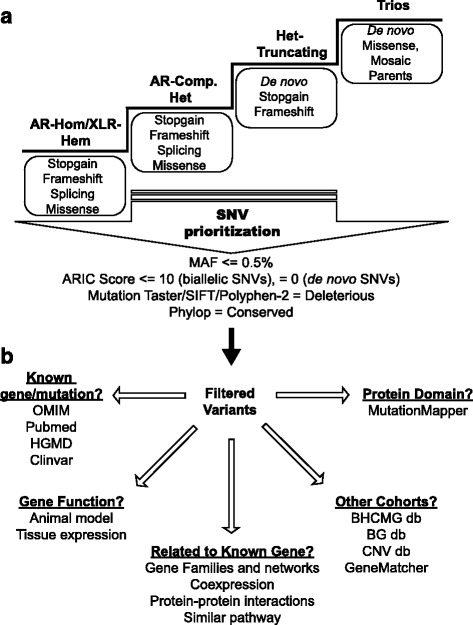
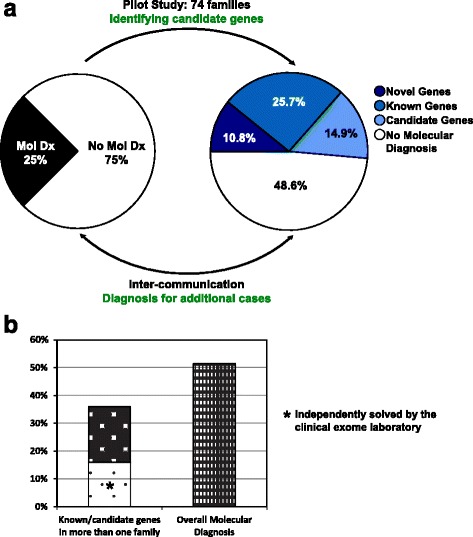
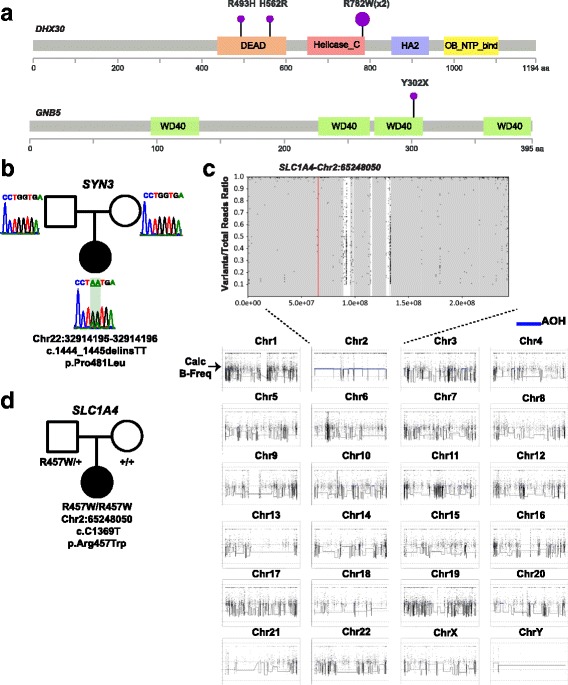
BACKGROUND: Given the rarity of most single-gene Mendelian disorders, concerted efforts of data exchange between clinical and scientific communities are critical to optimize molecular diagnosis and novel disease gene discovery. METHODS: We designed and implemented protocols for the study of cases for which a plausible molecular diagnosis was not achieved in a clinical genomics diagnostic laboratory (i.e. unsolved clinical exomes). Such cases were recruited to a research laboratory for further analyses, in order to potentially: (1) accelerate novel disease gene discovery; (2) increase the molecular diagnostic yield of whole exome sequencing (WES); and (3) gain insight into the genetic mechanisms of disease. Pilot project data included 74 families, consisting mostly of parent-offspring trios. Analyses performed on a research basis employed both WES from additional family members and complementary bioinformatics approaches and protocols. RESULTS: Analysis of all possible modes of Mendelian inheritance, focusing on both single nucleotide variants (SNV) and copy number variant (CNV) alleles, yielded a likely contributory variant in 36% (27/74) of cases. If one includes candidate genes with variants identified within a single family, a potential contributory variant was identified in a total of ~51% (38/74) of cases enrolled in this pilot study. The molecular diagnosis was achieved in 30/63 trios (47.6%). Besides this, the analysis workflow yielded evidence for pathogenic variants in disease-associated genes in 4/6 singleton cases (66.6%), 1/1 multiplex family involving three affected siblings, and 3/4 (75%) quartet families. Both the analytical pipeline and the collaborative efforts between the diagnostic and research laboratories provided insights that allowed recent disease gene discoveries (PURA, TANGO2, EMC1, GNB5, ATAD3A, and MIPEP) and increased the number of novel genes, defined in this study as genes identified in more than one family (DHX30 and EBF3). CONCLUSION: An efficient genomics pipeline in which clinical sequencing in a diagnostic laboratory is followed by the detailed reanalysis of unsolved cases in a research environment, supplemented with WES data from additional family members, and subject to adjuvant bioinformatics analyses including relaxed variant filtering parameters in informatics pipelines, can enhance the molecular diagnostic yield and provide mechanistic insights into Mendelian disorders. Implementing these approaches requires collaborative clinical molecular diagnostic and research efforts.
Overview
The claims and statistics of this paper haven’t been checked yet.
Run the check — free, no account needed. It reads the open-access text and checks the sources it cites.
Integrity signals
Registry
Cites
Statistics
Figures
Verification
Claims the paper makes
The claims and statistics of this paper haven’t been checked yet.
Run the check — free, no account needed. It reads the open-access text and checks the sources it cites.
Claims other papers make about this one
Each is checked against this paper’s own text: does it say what the citing paper says it does?
In the citing paper
“The transition from targeted gene tests to genomic sequencing enables recursive reanalysis, including reinterpretation of individual sequences on the basis of subsequent discoveries regarding causal disease alleles and their phenotypic consequences137.”
From A brief history of human disease genetics (2020) · cites this paper as [137]
Self-check
Percentages, sums and reported differences re-computed from the paper’s own numbers.
The self-check needs the paper’s full text.
Citations
Cites
Richards, S., Aziz, N., Bale, S., Bick, D., Das, S., Gastier-Foster, J., Grody, W. W., Hegde, M., Lyon, E., Spector, E., et al. (2015) · Genetics in Medicine · doi:10.1038/gim.2015.30 · Cited by 32,594
The Genome Analysis Toolkit: A MapReduce framework for analyzing next-generation DNA sequencing data
McKenna, A., Hanna, M., Banks, E., Sivachenko, A., Cibulskis, K., Kernytsky, A., Garimella, K., Altshuler, D., Gabriel, S., Daly, M., et al. (2010) · Genome Research · doi:10.1101/gr.107524.110 · Cited by 27,895
A map of human genome variation from population-scale sequencing.
The 1000 Genomes Project Consortium (2010) · Nature · doi:10.1038/nature09534 · Cited by 7,877
Clinical Whole-Exome Sequencing for the Diagnosis of Mendelian Disorders
Yang, Y., Muzny, D. M., Reid, J. G., Bainbridge, M. N., Willis, A. S., Ward, P. A., Braxton, A. A., Beuten, J., Xia, F., Niu, Z., et al. (2013) · New England Journal of Medicine · doi:10.1056/nejmoa1306555 · Cited by 1,991
Self-citationExome sequencing as a tool for Mendelian disease gene discovery
Bamshad, M. J., Ng, S. B. H., Bigham, A. W., Tabor, H. K., Emond, M. J., Nickerson, D. A., & Shendure, J. (2011) · Nature Reviews Genetics · doi:10.1038/nrg3031 · Cited by 1,744
Zhuchenko, O., Bailey, J. M., Bonnen, P. E., Ashizawa, T., Stockton, D. W., Amos, C. I., Dobyns, W. B., Subramony, S. H., Zoghbi, H. Y., & Lee, C. C. (1997) · Nature Genetics · doi:10.1038/ng0197-62 · Cited by 1,581
Diagnostic exome sequencing in persons with severe intellectual disability
de Ligt, J., Willemsen, M. H., van Bon, B. W. M., Kleefstra, T., Yntema, H. G., Kroes, T., Vulto-van Silfhout, A. T., Koolen, D. A., de Vries, P., Gilissen, C., et al. (2012) · New England Journal of Medicine · doi:10.1056/nejmoa1206524 · Cited by 1,546
GeneMatcher: a matching tool for connecting investigators with an interest in the same gene.
Sobreira, N., Schiettecatte, F., Valle, D., & Hamosh, A. (2015) · Human Mutation · doi:10.1002/humu.22844 · Cited by 1,529
Molecular Findings Among Patients Referred for Clinical Whole-Exome Sequencing
Yang, Y., Muzny, D. M., Xia, F., Niu, Z., Person, R., Ding, Y., Ward, P., Braxton, A., Wang, M., Buhay, C., et al. (2014) · JAMA · doi:10.1001/jama.2014.14601 · Cited by 1,360
Self-citationGenome sequencing identifies major causes of severe intellectual disability
Gilissen, C., Hehir-Kwa, J. Y., Thung, D. T., van de Vorst, M., van Bon, B. W. M., Willemsen, M. H., Kwint, M., Janssen, I. M., Hoischen, A., Schenck, A., et al. (2014) · Nature · doi:10.1038/nature13394 · Cited by 1,125
Cited by
Sorted by citations
A brief history of human disease genetics
Claussnitzer, M., Cho, J. H., Collins, R., Cox, N. J., Dermitzakis, E. T., Hurles, M. E., Kathiresan, S., Kenny, E. E., Lindgren, C. M., MacArthur, D. G., et al. (2020) · Nature · doi:10.1038/s41586-019-1879-7 · Cited by 697
Self-citationClark, M. M., Stark, Z., Farnaes, L., Tan, T. Y., White, S. M., Dimmock, D., & Kingsmore, S. F. (2018) · npj Genomic Medicine · doi:10.1038/s41525-018-0053-8 · Cited by 619
Paediatric genomics: diagnosing rare disease in children
Wright, C. F., FitzPatrick, D. R., & Firth, H. V. (2018) · Nature Reviews Genetics · doi:10.1038/nrg.2017.116 · Cited by 654
A guide for the diagnosis of rare and undiagnosed disease: beyond the exome
Marwaha, S., Knowles, J. W., & Ashley, E. A. (2022) · Genome Medicine · doi:10.1186/s13073-022-01026-w · Cited by 400
Identification of rare-disease genes using blood transcriptome sequencing and large control cohorts
Undiagnosed Diseases Network, Frésard, L., Care4Rare Canada Consortium, Smail, C., Ferraro, N. M., Teran, N. A., Li, X., Smith, K. S., Bonner, D., Kernohan, K. D., et al. (2019) · Nature Medicine · doi:10.1038/s41591-019-0457-8 · Cited by 321
Metadata
- Authors
- Eldomery, M. K., Coban-Akdemir, Z., Harel, T., Rosenfeld, J. A., Gambin, T., Stray-Pedersen, A., Küry, S., Mercier, S., Lessel, D., Denecke, J., Wiszniewski, W., Penney, S., Liu, P., Bi, W., Lalani, S. R., Schaaf, C. P., Wangler, M. F., Bacino, C. A., Lewis, R. A., Potocki, L., Graham, B. H., Belmont, J. W., Scaglia, F., Orange, J. S., Jhangiani, S. N., Chiang, T., Doddapaneni, H., Hu, J., Muzny, D. M., Xia, F., Beaudet, A. L., Boerwinkle, E., Eng, C. M., Plon, S. E., Sutton, V. R., Gibbs, R. A., Posey, J. E., Yang, Y., & Lupski, J. R.
- Affiliations
- Baylor College of Medicine (US)
- Warsaw University of Technology (PL)
- Centre Hospitalier Universitaire de Nantes (FR)
- University Medical Center Hamburg-Eppendorf (DE)
- Corresponding author
- Lupski, James R.
- ORCID
- Eldomery, Mohammad K.
- Harel, Tamar
- Rosenfeld, Jill A.
- Gambin, Tomasz
- Küry, Sébastien
- Mercier, Sandra
- Lessel, Davor
- Denecke, Jonas
- Wiszniewski, Wojciech
- Liu, Pengfei
- Bi, Weimin
- Lalani, Seema R.
- Schaaf, Christian P.
- Wangler, Michael F.
- Bacino, Carlos A.
- Lewis, Richard Alan
- Potocki, Lorraine
- Graham, Brett H.
- Belmont, John W.
- Scaglia, Fernando
- Orange, Jordan S.
- Jhangiani, Shalini N.
- Hu, Jianhong
- Muzny, Donna M.
- Xia, Fan
- Beaudet, Arthur L.
- Boerwinkle, Eric
- Eng, Christine M.
- Plon, Sharon E.
- Sutton, V. Reid
- Gibbs, Richard A.
- Posey, Jennifer E.
- Yang, Yaping
- Lupski, James R.
- Venue
- Genome Medicine
- Published
- 2017-03-21
- Volume
- 9
- Issue
- 1
- Pages
- 26-26
- ISSN
- 1756-994X (ISSN-L)
- PMC
- PMC5361813
- OpenAlex
- W2598900401
- Cited by
- 230
- References
- 111
- Citations by year
- 2026: 7 · 2025: 6 · 2024: 22 · 2023: 22 · 2022: 30 · 2021: 27 · 2020: 33 · 2019: 43 · 2018: 30 · 2017: 10
- FWCI
- 21.00
- Type
- journal article
- Language
- en
- Open access
- gold
- doi.org
- Locations
- Genome Medicine (publishedVersion, cc-by)
- PubMed Central (publishedVersion, cc-by)
- PubMed (publishedVersion)
- IUScholarWorks (Indiana University) (submittedVersion, cc-by-nc-nd)
- Purdue University Indianapolis (Indiana University) (submittedVersion, cc-by-nc-nd)
- Funders
- National Human Genome Research Institute (U54HG006542)
- National Institutes of Health (T32 GM07526, NIH T32 GM07526)
- Genetics Resource Association of Texas
- Topics
- Life Sciences › Biochemistry, Genetics and Molecular Biology › Genetics › Genomics and Rare Diseases
- Life Sciences › Biochemistry, Genetics and Molecular Biology › Genetics › Connective tissue disorders research
- Life Sciences › Biochemistry, Genetics and Molecular Biology › Clinical Biochemistry › Metabolism and Genetic Disorders
- Keywords
- monogenic disorders, disease gene discovery, molecular diagnosis, exome sequencing, parent-offspring trios, copy number variation, single nucleotide variants, clinical research collaboration, multiplex families, PURA, TANGO2, GNB5, ATAD3A, MIPEP, DHX30, EBF3
- MeSH terms
- ATPases Associated with Diverse Cellular Activities, Adenosine Triphosphatases, DNA-Binding Proteins, Female, Humans, Male, Membrane Proteins, Metalloendopeptidases, Pilot Projects, Transcription Factors, Sequence Analysis, DNA, Computational Biology, Polymorphism, Single Nucleotide, Genomics, Mitochondrial Proteins, Genetic Diseases, Inborn, GTP-Binding Protein beta Subunits, DNA Copy Number Variations, Exome
About these checks
Registry, retraction, Cites and statistics results are computed, not judged, with one exception: a printed reference that no index lists is read once by a model before it counts as a citation error. Claims are extracted by a model and kept only when their quote appears verbatim in the text; each cited source is then checked, with a model’s help, for whether it says what the claim relies on. Those verdicts can be wrong — read the claim’s quote and the cited source before relying on one.
Statistics and arithmetic are recomputed, not judged.
Confidence bands are shown only for fields calibrated on our annotated test set. None is calibrated yet, so no band is shown.
What counts as a claim ›How we measure confidence ›How we check this ›
Are you an author, or do you see a problem with this page? Request a review
