

Effects of 24-week jumping exercise on bone mineral density and linear growth in children with short stature: a prospective controlled trial
Open accessThe DOI matches its Crossref record; 28 of the 28 references it cites were found in a registry or an index; none of the 22 sources its claims cite is checked for support yet.
Abstract
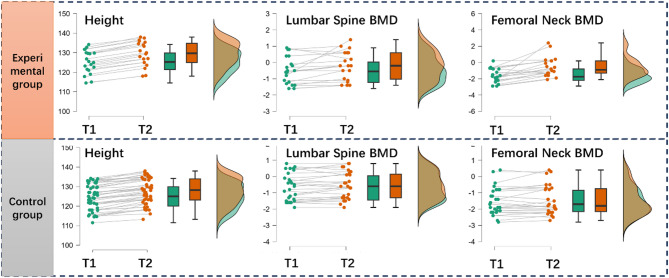
OBJECTIVE: To investigate the effects of structured jumping exercise on femoral neck bone mineral density (BMD) and linear growth in children with short stature. Methods: A prospective controlled trial enrolled 47 prepubertal children (aged 8–11 years; intervention group, n = 20; control group, n = 27). The intervention group completed a 24-week progressive jumping protocol (3 sessions/week, 50 min/session), while controls maintained usual routines. Dual-energy X-ray absorptiometry (DXA) assessed lumbar spine and femoral neck BMD. Height gain and BMD changes were evaluated, with mediation analysis exploring indirect effects. Results: The intervention group showed significant improvement in femoral neck BMD Z-scores (Δ = 1.075, p < 0.001, Cohen’s d = 0.869) and greater height gain (Δ = 4.200 cm vs. 2.478 cm in controls; p = 0.001). Mediation analysis suggested an indirect effect of jumping on height via femoral neck BMD change (β = − 0.442, 95% CI: − 1.474 to − 0.009), with no direct effects observed (p > 0.05). Lumbar spine BMD did not differ between groups (p > 0.05). Conclusions: Jumping exercise appears to preferentially benefit femoral neck BMD; however, further investigation is needed to determine whether this effect is region-specific. These results support structured high-impact activity as a potential adjunctive approach in pediatric growth promotion. TRIAL REGISTRATION: The study protocol, which was predicated on a true experimental design, was registered with ClinicalTrials.gov (postregistration number ChiCTR2500095544).Registration date 20,250,108.
Overview
CoChat Summary
TL;DR
In a 24-week prospective controlled trial of 47 prepubertal children with idiopathic short stature, structured jumping exercise improved femoral neck BMD Z-scores and was associated with greater height gain than usual routines, while lumbar spine BMD did not differ significantly between groups. The authors conclude jumping may preferentially benefit femoral neck BMD and potentially support linear growth, but call for further longitudinal and mechanistic studies.
Key findings
- Femoral neck BMD Z-score change: intervention Δ = 1.075 vs control Δ = 0.067, p < 0.001, Cohen’s d = 0.869 (Table 2); the abstract reports the same intervention Δ = 1.075, p < 0.001, d = 0.869.
- Height gain: Table 2 reports intervention Δ = 4.200 cm vs control Δ = 2.070 cm, p < 0.001, d = 1.705; the abstract reports control Δ = 2.478 cm and p = 0.001.
- Lumbar spine BMD Z-score change: intervention Δ = 0.300 vs control Δ = 0.082, p = 0.083 (Table 2); the abstract states no significant between-group difference (p > 0.05).
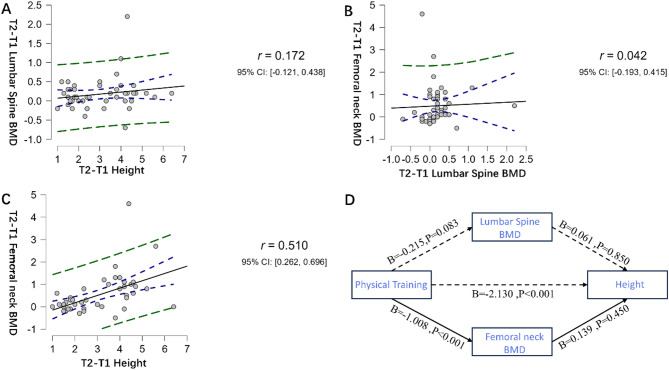
- Correlation/mediation: femoral neck BMD Δ correlated with height gain (r = 0.510, p < 0.001), while lumbar spine BMD change did not (p = 0.247). The abstract reports an indirect effect via femoral neck BMD (β = −0.442, 95% CI: −1.474 to −0.009) with no direct effects (p > 0.05); Results report indirect β = −0.140, 95% CI: −0.515 to −0.118 and direct β = −2.003, p < 0.001, described as partial mediation.
Methods
- Prospective controlled trial of 47 prepubertal children aged 8–11 years with idiopathic short stature; intervention n = 20, control n = 27 (abstract/results; the sample-size section mentions final control n = 26). The intervention was a 24-week progressive jumping protocol, 3 sessions/week, 50 min/session; controls maintained usual routines.
- Dual-energy X-ray absorptiometry assessed lumbar spine (L1–L4) and femoral neck BMD; height and weight were measured, and Z-scores were based on age-, sex-, and ethnicity-matched Chinese pediatric reference data. Analysis used two-way repeated-measures ANOVA, post hoc Bonferroni comparisons, Pearson correlations, and PROCESS Model 4 mediation with 5,000 bootstrap samples.
- Randomization was conducted at the school level rather than individual level; outcome assessors and data analysts were blinded, but participant blinding was not feasible due to the visible nature of the intervention.
Limitations
- Stated: the sample was from a limited geographic region and included only boarding students, limiting generalizability; the 24-week duration may have been insufficient to capture long-term growth trends or pubertal influences; height-adjusted BMD Z-scores were unavailable; and biochemical markers such as serum IGF-1 or osteocalcin were not assessed.
- Evident: the sample was small; randomization was school-level and the control group was recruited through pediatric endocrinologists from a different setting; participants were not blinded; and reported values are inconsistent across the abstract, methods, and results (control n = 26 vs 27; control height gain 2.478 vs 2.070 cm; mediation indirect effect and direct-effect/partial vs full mediation descriptions; the introduction mentions a double-blind, double-dummy design while the methods state participant blinding was not feasible).
Model-written summary. Check it against the paper before relying on it.
Integrity signals
Registry
Cites
Statistics
Figures
Verification
Claims the paper makes
0 Valid · 0 Not valid · 15 Not checked · 44 Own results and interpretations
A result the paper reports from its own data — it cites no other source for it, so there is none to check. The quote shows it is in the paper.
In the paper
“The intervention group showed significant improvement in femoral neck BMD Z-scores (Δ = 1.075, p < 0.001, Cohen’s d = 0.869)”
- Also stated in: § Effects on BMD and height (Group × time Interaction) · hedged
“Post hoc tests indicated that the intervention group had significantly greater increases in femoral neck BMD (ΔZ = 1.075 vs. 0.067, p < 0.001, d = 0.869)”
§ Effects of 24-week jumping exercise on bone mineral density and linear growth in children with short stature: a prospective controlled trial > Abstract > Objective
plainstates a causen = 20- Asserted: passes — The authors put it forward as true.
- Checkable: passes — It can be checked against evidence.
- Load-bearing: passes — The paper’s conclusions depend on it.
- Based: passes — The paper gives a reason why it holds.
- Also stated in: § Effects on BMD and height (Group × time Interaction) · hedged
A result the paper reports from its own data — it cites no other source for it, so there is none to check. The quote shows it is in the paper.
In the paper
“Pearson correlation revealed a significant positive relationship between change in femoral neck BMD Z-score and height gain (r = 0.510, p < 0.001).”
§ Effects of 24-week jumping exercise on bone mineral density and linear growth in children with short stature: a prospective controlled trial > Results > Correlation between BMD and height gain
plainstates an association- Asserted: passes — The authors put it forward as true.
- Checkable: passes — It can be checked against evidence.
- Load-bearing: unclear — It is unclear whether the paper’s conclusions depend on it.
- Based: unclear — It is unclear why the paper says it holds.
A result the paper reports from its own data — it cites no other source for it, so there is none to check. The quote shows it is in the paper.
In the paper
“greater height gain (Δ = 4.200 cm vs. 2.478 cm in controls; p = 0.001)”
§ Effects of 24-week jumping exercise on bone mineral density and linear growth in children with short stature: a prospective controlled trial > Abstract > Objective
plainstates a causen = 20- Asserted: passes — The authors put it forward as true.
- Checkable: passes — It can be checked against evidence.
- Load-bearing: passes — The paper’s conclusions depend on it.
- Based: passes — The paper gives a reason why it holds.
A result the paper reports from its own data — it cites no other source for it, so there is none to check. The quote shows it is in the paper.
In the paper
“the jumping exercise protocol in this study yielded moderate height gains (3.2 cm vs. 2.1 cm in controls over 6 months)”
§ Effects of 24-week jumping exercise on bone mineral density and linear growth in children with short stature: a prospective controlled trial > Discussion
plainstates a cause- Asserted: passes — The authors put it forward as true.
- Checkable: passes — It can be checked against evidence.
- Load-bearing: passes — The paper’s conclusions depend on it.
- Based: passes — The paper gives a reason why it holds.
A result the paper reports from its own data — it cites no other source for it, so there is none to check. The quote shows it is in the paper.
In the paper
“No significant between-group difference was observed in lumbar spine BMD change (p = 0.083).”
§ Effects of 24-week jumping exercise on bone mineral density and linear growth in children with short stature: a prospective controlled trial > Results > Effects on BMD and height (Group × time Interaction)
plain- Asserted: passes — The authors put it forward as true.
- Checkable: passes — It can be checked against evidence.
- Load-bearing: unclear — It is unclear whether the paper’s conclusions depend on it.
- Based: passes — The paper gives a reason why it holds.
22 more claims
Create a free account to see all 59 claims and to verify the 21 references still open.
- Probably not a substantial claim. 21
- It may state two separate claims as one. 18
- The quote only partly states this claim. 1
Claims other papers make about this one
Each is checked against this paper’s own text: does it say what the citing paper says it does?
In the citing paper
“Wang et al. [23] reported greater height gain and increased femoral-neck bone mineral density following a 24-week progressive jumping program in children with short stature, with similar findings reported in another 24-week study [35].”
Self-check
Percentages, sums and reported differences re-computed from the paper’s own numbers.
Each contradiction between two passages listed here was confirmed by an independent check.
Rated major: it would touch a result — a value a result rests on, reported and recomputed p-values on opposite sides of the significance level, two passages that conflict with no sign which is right, or a cited work retracted before this paper was published.
In the paper
§ Effects of 24-week jumping exercise on bone mineral density and linear growth in children with short stature: a prospective controlled trial > Abstract > Objective
“with no direct effects observed (p > 0.05).”
§ Effects of 24-week jumping exercise on bone mineral density and linear growth in children with short stature: a prospective controlled trial > Results > Mediation analysis
“whereas the direct effect was (β = −2.003, p < 0.001).”
Rated major: it would touch a result — a value a result rests on, reported and recomputed p-values on opposite sides of the significance level, two passages that conflict with no sign which is right, or a cited work retracted before this paper was published.
In the paper
§ Effects of 24-week jumping exercise on bone mineral density and linear growth in children with short stature: a prospective controlled trial > Abstract > Objective
“an indirect effect of jumping on height via femoral neck BMD change (β = − 0.442, 95% CI: − 1.474 to − 0.009)”
§ Effects of 24-week jumping exercise on bone mineral density and linear growth in children with short stature: a prospective controlled trial > Results > Mediation analysis
“The indirect effect through femoral neck BMD was also significant (β = −0.140, 95% CI: −0.515 to −0.118)”
Rated major: it would touch a result — a value a result rests on, reported and recomputed p-values on opposite sides of the significance level, two passages that conflict with no sign which is right, or a cited work retracted before this paper was published.
In the paper
§ Effects of 24-week jumping exercise on bone mineral density and linear growth in children with short stature: a prospective controlled trial > Discussion
“the jumping exercise protocol in this study yielded moderate height gains (3.2 cm vs. 2.1 cm in controls over 6 months)”
§ Effects of 24-week jumping exercise on bone mineral density and linear growth in children with short stature: a prospective controlled trial > Results > Effects on BMD and height (Group × time Interaction)
“| Height (cm) | Intervention | 125.27 ± 5.92 | 128.47 ± 5.91 | 4.200 ± 0.381 | < 0.001 | 1.705 |”
Rated major: it would touch a result — a value a result rests on, reported and recomputed p-values on opposite sides of the significance level, two passages that conflict with no sign which is right, or a cited work retracted before this paper was published.
In the paper
“| Height (cm) | Intervention | 125.27 ± 5.92 | 128.47 ± 5.91 | 4.200 ± 0.381 | < 0.001 | 1.705 |”
§ Effects of 24-week jumping exercise on bone mineral density and linear growth in children with short stature: a prospective controlled trial > Results > Effects on BMD and height (Group × time Interaction)
Reported 4.2 · recomputed 3.2
Rated major: it would touch a result — a value a result rests on, reported and recomputed p-values on opposite sides of the significance level, two passages that conflict with no sign which is right, or a cited work retracted before this paper was published.
In the paper
§ Effects of 24-week jumping exercise on bone mineral density and linear growth in children with short stature: a prospective controlled trial > Results > Correlation between BMD and height gain
“Pearson correlation revealed a significant positive relationship between change in femoral neck BMD Z-score and height gain (r = 0.510, p < 0.001). No significant correlation was found between lumbar spine BMD change and height gain (p = 0.247).”
§ Effects of 24-week jumping exercise on bone mineral density and linear growth in children with short stature: a prospective controlled trial > Results > Correlation between BMD and height gain
“| Height Gain – Femoral Neck BMD Δ | 0.172 | 0.247 | −0.121 | 0.438 | 0.174 | | Height Gain – Lumbar Spine BMD Δ | 0.510 | < 0.001 | 0.262 | 0.696 | 0.563 |”
8 more findings
Create a free account to see every finding of this check.
Citations
Cites
Carel, J.-C., Ecosse, E., Landier, F., Meguellati-Hakkas, D., Kaguelidou, F., Rey, G., & Coste, J. (2012) · The Journal of Clinical Endocrinology & Metabolism · doi:10.1210/jc.2011-1995 · Cited by 295
Hokken-Koelega, A. C. S., van der Steen, M., Boguszewski, M. C. S., Cianfarani, S., Dahlgren, J., Horikawa, R., Mericq, V., Rapaport, R., Alherbish, A., Braslavsky, D., et al. (2023) · Endocrine Reviews · doi:10.1210/endrev/bnad002 · Cited by 261
Wnt and the Wnt signaling pathway in bone development and disease
Wang, Y. (2014) · Frontiers in Bioscience · doi:10.2741/4214 · Cited by 248
Winzenberg, T., Powell, S., Shaw, K. A., & Jones, G. (2011) · BMJ · doi:10.1136/bmj.c7254 · Cited by 244
Effect of Growth Hormone Treatment on Adult Height of Children with Idiopathic Short Stature
Hintz, R. L., Attie, K. M., Baptista, J., & Roche, A. (1999) · New England Journal of Medicine · doi:10.1056/nejm199902183400702 · Cited by 161
Deodati, A., & Cianfarani, S. (2011) · BMJ · doi:10.1136/bmj.c7157 · Cited by 140
Vicente-Rodriguez, G., Ara, I., Perez-Gomez, J., Dorado, C., & Calbet, J. A. L. (2005) · British Journal of Sports Medicine · doi:10.1136/bjsm.2004.014431 · Cited by 132
The Effects of Dynamic Axial Loading on the Rat Growth Plate
Ohashi, N., Robling, A. G., Burr, D. B., & Turner, C. H. (2002) · Journal of Bone and Mineral Research · doi:10.1359/jbmr.2002.17.2.284 · Cited by 123
Gari, S., Doig-Acuña, C., Smail, T., Malungo, J. R., Martin-Hilber, A., & Merten, S. (2013) · BMC Health Services Research · doi:10.1186/1472-6963-13-198 · Cited by 94
Huang, T., Yang, R., Hsieh, S. S., & Liu, S. (2002) · Bone · doi:10.1016/s8756-3282(01)00659-7 · Cited by 84
Chen, X., Sun, K., Zhao, S., Geng, T., Fan, X., Sun, S., Zheng, M., & Jin, Q. (2020) · Cytokine · doi:10.1016/j.cyto.2020.155292 · Cited by 67
The Cannabinoids Effect on Bone Formation and Bone Healing
Raphael-Mizrahi, B., & Gabet, Y. (2020) · Current Osteoporosis Reports · doi:10.1007/s11914-020-00607-1 · Cited by 49
Nilsson, M., Ohlsson, C., Mellström, D., & Lorentzon, M. (2013) · Osteoporosis International · doi:10.1007/s00198-012-2142-3 · Cited by 36
Kamp, G. A., Zwinderman, A. H., van Doorn, J., Hackeng, W. H. L., Frölich, M. A., Schönaü, E., & Wit, J. M. (2002) · Clinical Endocrinology · doi:10.1046/j.1365-2265.2002.01575.x · Cited by 36
Ma, J., Pei, T., Dong, F., Dong, Y., Yang, Z., Chen, J., Guo, S., Zhao, Q., Wang, S., Ma, J., et al. (2019) · BMJ Open · doi:10.1136/bmjopen-2018-026634 · Cited by 29
Jafari-Adli, S., Qorbani, M., Heshmat, R., Ranjbar, S. H., Taheri, E., Motlagh, M. E., Norozi, M., Safari, O., Shafiee, G., Rezaei, F. M., et al. (2016) · Journal of Pediatric Endocrinology and Metabolism · doi:10.1515/jpem-2016-0215 · Cited by 25
Callréus, M., McGuigan, F., Ringsberg, K., & Åkesson, K. (2012) · Osteoporosis International · doi:10.1007/s00198-011-1886-5 · Cited by 23
Fang, J., Gao, J., Gong, H., Zhang, T., Zhang, R., & Zhan, B. (2019) · BioMedical Engineering OnLine · doi:10.1186/s12938-019-0654-1 · Cited by 23
Davis, N. L., Tolfrey, K., Jenney, M. E. M., Elson, R., Stewart, C. E., Moss, A. D., Cornish, J., Stevens, M. C. G., & Crowne, E. C. (2020) · Pediatric Blood & Cancer · doi:10.1002/pbc.28687 · Cited by 22
Orso, M., Polistena, B., Granato, S., Novelli, G., Di Virgilio, R., La Torre, D., d’Angela, D., & Spandonaro, F. (2022) · PLOS ONE · doi:10.1371/journal.pone.0264403 · Cited by 21
Rohenkohl, A. C., Sommer, R., Bestges, S., Kahrs, S., Klingebiel, K.-H., Bullinger, M., & Quitmann, J. (2015) · Zeitschrift für Kinder- und Jugendpsychiatrie und Psychotherapie · doi:10.1024/1422-4917/a000385 · Cited by 15
In situ deformation of growth plate chondrocytes in stress-controlled static vs dynamic compression
Zimmermann, E. A., Bouguerra, S., Londoño, I., Moldovan, F., Aubin, C.-É., & Villemure, I. (2017) · Journal of Biomechanics · doi:10.1016/j.jbiomech.2017.03.008 · Cited by 13
Ma, Y., Sheng, J., Wang, L., Zhang, Y., & Liu, L. (2024) · Medicine · doi:10.1097/md.0000000000038350 · Cited by 6
Genomic Effects of Biomechanical Loading in Adolescent Human Growth Plate Cartilage: A Pilot Study
Zhang, Z., Boggavarapu, N. R., Muhr, L. S. A., Garcia-Serrango, A., Aeppli, T. R., Nava, T. S., Zhao, Y., Gutierrez-Farewik, E. M., Kulachenko, A., Sävendahl, L., et al. (2026) · CARTILAGE · doi:10.1177/19476035241302954 · Cited by 5
Lee, B., & Kwon, C.-Y. (2021) · Medicine · doi:10.1097/md.0000000000024871 · Cited by 4
Treadmill exercise promotes bone tissue recovery in rats subjected to high + Gz loads
Gao, L., Chen, R., Lin, X., Liu, J., Liu, J., Tan, Y., Zhang, C., & Zhang, X. (2024) · Journal of Bone and Mineral Metabolism · doi:10.1007/s00774-024-01513-7 · Cited by 3
Peak Loads Associated With High-Impact Physical Activities in Children
Fassett, Z., Jagodinsky, A. E., Thomas, D. Q., & Williams, S. M. (2022) · Pediatric Exercise Science · doi:10.1123/pes.2021-0013 · Cited by 2
(2015) · Europe PMC (PubMed Central)
Cited by
Liu, Z., Cao, Y., Yang, Y., Cheng, J., Zhang, J., Cong, T., Zhang, Q., Cui, L., Cai, F., Duan, Y., et al. (2026) · Frontiers in Microbiology · doi:10.3389/fmicb.2026.1753788 · Cited by 1
Bumrungpanictarworn, A., Suksuwan, C., To-aj, O., Suksataya, S., Suwandee, A., & Tiramongkon, B. (2026) · Children · doi:10.3390/children13101322
“Wang et al. [23] reported greater height gain and increased femoral-neck bone mineral density following a 24-week progressive jumping program in children with short stature, with similar findings reported in another 24-week study [35].”
MACF1 condensates serve as molecular rheostats translating mechanical stress into bone adaptation
Ru, K., Zhao, L., Li, X., Liu, Y., Yan, Q., Yang, H., Zhang, Y., Li, Z., Xing, J., Liu, S., et al. (2026) · Nature Communications · doi:10.1038/s41467-026-78420-0
“Mechanical cues are recognized as contributors to skeletal growth and adaptation, as supported by evidence that a 24-week structured jumping exercise program can improve femoral neck BMD and support linear growth in children with idiopathic short stature 19 .”
Metadata
- Authors
- Wang, H. M., Wang, X., Wu, X., Yu, K., Jia, S., & Jiang, W.
- Affiliations
- Hebei Oriental University (CN)
- East China University of Political Science and Law (CN)
- Shanghai University of Sport (CN)
- Yanching Institute of Technology (CN)
- Corresponding author
- Jiang, Wen
- Venue
- BMC Sports Science, Medicine and Rehabilitation
- Published
- 2025-11-13
- Volume
- 17
- Issue
- 1
- Pages
- 334-334
- ISSN
- 2052-1847 (ISSN-L)
- PMC
- PMC12616931
- OpenAlex
- W4416187160
- Cited by
- 3
- References
- 28
- Citations by year
- 2026: 3
- FWCI
- 1.73
- Type
- journal article
- Language
- en
- Open access
- gold
- doi.org
- Licence
- cc-by-nc-nd
- creativecommons.org/licenses/by-nc-nd/4.0 (tdm)
- creativecommons.org/licenses/by-nc-nd/4.0 (vor)
- Locations
- BMC Sports Science Medicine and Rehabilitation (publishedVersion, cc-by-nc-nd)
- Europe PMC (PubMed Central) (publishedVersion, cc-by-nc-nd)
- PubMed Central (publishedVersion, cc-by-nc-nd)
- PubMed (publishedVersion)
- DOAJ (DOAJ: Directory of Open Access Journals) (submittedVersion)
- Topics
- Health Sciences › Medicine › Orthopedics and Sports Medicine › Bone health and osteoporosis research
- Health Sciences › Medicine › Endocrinology, Diabetes and Metabolism › Growth Hormone and Insulin-like Growth Factors
- Social Sciences › Psychology › Developmental and Educational Psychology › Children's Physical and Motor Development
- Keywords
- jumping exercise, bone mineral density, short stature, linear growth, femoral neck, lumbar spine, prepubertal children, high-impact exercise, mediation analysis
About these checks
Registry, retraction, Cites and statistics results are computed, not judged, with one exception: a printed reference that no index lists is read once by a model before it counts as a citation error. Claims are extracted by a model and kept only when their quote appears verbatim in the text; each cited source is then checked, with a model’s help, for whether it says what the claim relies on. Those verdicts can be wrong — read the claim’s quote and the cited source before relying on one.
A language model drew the claims from the paper on 2026-11-28, under version 3 of the claim definition (model deepseek-v4.1-flash, prompt extract-v3).
A second model labelled each claim on 2026-11-28 (model jev-1.13-20260917, definition revision gold-guideline-v0.2).
Statistics and arithmetic are recomputed, not judged.
Confidence bands are shown only for fields calibrated on our annotated test set. None is calibrated yet, so no band is shown.
What counts as a claim ›How we measure confidence ›How we check this ›
Are you an author, or do you see a problem with this page? Request a review
Data sources
Bibliographic data: Semantic Scholar, OpenAlex, Crossref.
Contains information from the Semantic Scholar Academic Graph Datasets, made available under the ODC Attribution License (ODC-BY 1.0).
Semantic Scholar’s data is described in: Kinney, R., et al. (2023). The Semantic Scholar Open Data Platform. arXiv:2301.10140.
