

Impact of growth hormone therapy on adult height of children with idiopathic short stature: systematic review
Open accessThe DOI matches its Crossref record; 24 of the 24 references it cites were found in a registry or an index; none of the 17 sources its claims cite is checked for support yet.
Abstract
OBJECTIVE: To systematically determine the impact of growth hormone therapy on adult height of children with idiopathic short stature. DESIGN: Systematic review. DATA SOURCES: Cochrane Central Register of Controlled Trials, Medline, and the bibliographic references from retrieved articles of randomised and non-randomised controlled trials from 1985 to April 2010. DATA EXTRACTION: Height in adulthood (standard deviation score) and overall gain in height (SD score) from baseline measurement in childhood. STUDY SELECTION: Randomised and non-randomised controlled trials with height measurements for adults. Inclusion criteria were initial short stature (defined as height >2 SD score below the mean), peak growth hormone responses >10 μg/L, prepubertal stage, no previous growth hormone therapy, and no comorbid conditions that would impair growth. Adult height was considered achieved when growth rate was <1.5 cm/year or bone age was 15 years in females and 16 years in males. RESULTS: Three randomised controlled trials (115 children) met the inclusion criteria. The adult height of the growth hormone treated children exceeded that of the controls by 0.65 SD score (about 4 cm). The mean height gain in treated children was 1.2 SD score compared with 0.34 SD score in untreated children. A slight difference of about 1.2 cm in adult height was observed between the two growth hormone dose regimens. In the seven non-randomised controlled trials the adult height of the growth hormone treated group exceeded that of the controls by 0.45 SD score (about 3 cm). CONCLUSIONS: Growth hormone therapy in children with idiopathic short stature seems to be effective in partially reducing the deficit in height as adults, although the magnitude of effectiveness is on average less than that achieved in other conditions for which growth hormone is licensed. The individual response to therapy is highly variable, and additional studies are needed to identify the responders.
Overview
CoChat Summary
TL;DR
In children with idiopathic short stature, growth hormone therapy increased adult height compared with untreated controls, but the average gain was modest: about 4 cm in randomised controlled trials and about 3 cm in non-randomised controlled trials. The evidence base was limited, no study met criteria for high-quality evidence and strong recommendation, and individual response was highly variable.
Key findings
- Three randomised controlled trials (115 children: 79 treated, 36 controls) met inclusion criteria. Treated children’s adult height exceeded controls by 0.65 SD score (about 4 cm) (95% confidence interval 0.40 to 0.91; P<0.001). Mean height gain was 1.20 SD score (7.2 cm) in treated children versus 0.34 SD score (2.0 cm) in untreated children, a mean difference of 0.79 SD score (4.7 cm) (95% CI 0.50 to 1.09; P<0.001).
- Seven non-randomised controlled trials (477 children: 181 cases, 296 controls) found treated children’s adult height exceeded controls by 0.45 SD score (about 3 cm) (95% CI 0.18 to 0.73; P=0.001). Mean height gain was 1.28 SD score (8 cm) in treated children versus 0.6 SD score (4 cm) in untreated children, a mean difference of 0.71 SD score (5 cm) (95% CI 0.42 to 0.99; P<0.001).
- In two randomised trials reporting mid-parental height, mean adult height corrected for mid-parental height was −0.4 SD score in treated children versus −1.01 SD score in untreated children, a mean difference of 0.87 SD score (95% CI 0.28 to 1.46; P=0.004).
- One randomised trial and one non-randomised trial reported a dose-dependent effect of growth hormone on adult height; only the non-randomised trial showed a difference in adult height between untreated children and children treated with high-dose growth hormone of more than 0.9 SD score. The three randomised trials were of low or moderate quality, and all received a weak recommendation because none achieved the prespecified efficacy goals.
Methods
- Systematic review and meta-analysis of randomised and non-randomised controlled trials published from 1985 to April 2010, identified from the Cochrane Central Register of Controlled Trials, Medline, and bibliographic references of retrieved articles; no language restrictions were applied.
- Inclusion criteria were initial short stature (height more than 2 SD scores below the mean), peak growth hormone responses greater than 10 μg/L, prepubertal stage, no previous growth hormone therapy, and no comorbid conditions that would impair growth. Adult height was considered achieved when growth rate was <1.5 cm/year or bone age was 15 years in females and 16 years in males.
- Primary outcome was the difference in adult height between treated and untreated children; a mean difference of more than 0.9 SD score (about 6 cm) was considered a satisfactory response. Secondary outcomes were height gain from inclusion to adulthood (at least ≥1 SD score) and difference between adult height and mid-parental height (at least ≥1 SD score). Effect sizes were pooled with fixed and random effects models, with I² for heterogeneity, funnel plot assessment for publication bias, and sensitivity analysis; analyses used Review Manager 5.
Limitations
- The paper states potential limitations of pooling heterogeneous populations, the effect of study dropouts on validity, small sample size with a high chance of false positive results, and the “file-drawer” effect whereby negative studies may remain unpublished.
- The paper states that no single high-quality evidence randomised controlled trial has been carried out up to adult height; only one study included a placebo control group, and that trial had high dropout (40% in the growth hormone treated group and 65% in the placebo group, with adult height measured in six treated children and only three placebo children). One trial was classed as low quality because the study population was small (seven treated and six randomised untreated girls), no power calculation was described, and near final height was reported in both groups.
- Evident from the text: the randomised evidence rests on only three trials and 115 children, while the remaining seven included studies were non-randomised, so the pooled estimates are based on a small randomised base with substantial variability in individual response.
Model-written summary. Check it against the paper before relying on it.
Integrity signals
Registry
Cites
Statistics
Figures
Verification
Claims the paper makes
0 Valid · 0 Not valid · 29 Not checked · 51 Own results and interpretations
In the paper
“Occasionally, a dose dependent increase of insulin-like growth factor-I concentrations reaching values above 3 SD score was reported.11”
§ Impact of growth hormone therapy on adult height of children with idiopathic short stature: systematic review > Implications for clinicians and policymakers
What the sources say
- Not matchedcites [11]
The reference list we hold has no entry [11].
hedgedstates an association- Asserted: passes — The authors put it forward as true.
- Checkable: passes — It can be checked against evidence.
- Load-bearing: unclear — It is unclear whether the paper’s conclusions depend on it.
- Based: passes — The paper gives a reason why it holds.
- Not matched
None of the sources cited for this claim have been checked yet.
In the paper
“In one study the mean height gain in treated children was 1.38 SD score (8.28 cm) compared with 0.18 SD score (1.08 cm) in untreated children (fig 2).9”
§ Impact of growth hormone therapy on adult height of children with idiopathic short stature: systematic review > Height gain
plain- Asserted: passes — The authors put it forward as true.
- Checkable: passes — It can be checked against evidence.
- Load-bearing: passes — The paper’s conclusions depend on it.
- Based: passes — The paper gives a reason why it holds.
None of the sources cited for this claim have been checked yet.
In the paper
“In one of the randomised controlled trials, children with a baseline SD score for height of -2.5 and treated for about 6.2 years achieved an average near final height of -1.1 SD score compared with -2.4 SD score in untreated children (fig 2).9”
§ Impact of growth hormone therapy on adult height of children with idiopathic short stature: systematic review > Adult height
plainstates a cause- Asserted: passes — The authors put it forward as true.
- Checkable: passes — It can be checked against evidence.
- Load-bearing: passes — The paper’s conclusions depend on it.
- Based: passes — The paper gives a reason why it holds.
A result the paper reports from its own data — it cites no other source for it, so there is none to check. The quote shows it is in the paper.
In the paper
“In the third study 11 the overall difference was 0.6 SD score (3.6 cm).”
§ Impact of growth hormone therapy on adult height of children with idiopathic short stature: systematic review > Adult height
plain- Asserted: passes — The authors put it forward as true.
- Checkable: passes — It can be checked against evidence.
- Load-bearing: unclear — It is unclear whether the paper’s conclusions depend on it.
- Based: passes — The paper gives a reason why it holds.
In the paper
“This study is, however, affected by the extreme variability of results.”
§ Impact of growth hormone therapy on adult height of children with idiopathic short stature: systematic review > Quality of evidence and strength of recommendation
What the sources say
- Not matchedcites [18]
The reference list we hold has no entry [18].
plain- Asserted: passes — The authors put it forward as true.
- Checkable: passes — It can be checked against evidence.
- Load-bearing: unclear — It is unclear whether the paper’s conclusions depend on it.
- Based: passes — The paper gives a reason why it holds.
- Not matched
39 more claims
Create a free account to see all 80 claims and every source verdict.
- Probably not a substantial claim. 14
- The quote only partly states this claim. 1
- It may state two separate claims as one. 23
Claims other papers make about this one
Each is checked against this paper’s own text: does it say what the citing paper says it does?
In the citing paper
“structured exercise presents a viable adjunct or alternative, particularly for children with limited access to medication or those experiencing suboptimal response.”
From Effects of 24-week jumping exercise on bone mineral density and linear growth in children with short stature: a prospective controlled trial (2025) · cites this paper as [24]
Statistics recomputed
Every reported test result, recomputed from its test statistic and degrees of freedom. A result shows as not adding up only once an independent check has confirmed it.
- Consistentz = 5.06reported p < .001 · recomputed p < .001
“z=5.06,p < .001”
- Consistentz = 5.34reported p < .001 · recomputed p < .001
“z=5.34,p < .001”
- Consistentz = 3.27reported p = .001 · recomputed p = .001
“z=3.27,p = .001”
Self-check
Percentages, sums and reported differences re-computed from the paper’s own numbers.
Each contradiction between two passages listed here was confirmed by an independent check.
Rated minor: it would not touch a result — a value no result rests on, a p-value that stays on the same side of the significance level, or a conflict that is clerical, resolved elsewhere in the paper, or outside its own findings.
In the paper
§ Impact of growth hormone therapy on adult height of children with idiopathic short stature: systematic review > Quality of evidence and strength of recommendation
“the study population was small (seven treated and six randomised untreated girls)”
§ Impact of growth hormone therapy on adult height of children with idiopathic short stature: systematic review > Conclusions
“| Treated | 8 | 6.24 (0.38) | 0.04 | 6.2 (range 5.5-6.5) | -2.52 (0.26) | -1.14 (1.06) | 1.38 (0.7) | 1.23 | |”
Rated minor: it would not touch a result — a value no result rests on, a p-value that stays on the same side of the significance level, or a conflict that is clerical, resolved elsewhere in the paper, or outside its own findings.
In the paper
“The children treated with a daily dose of 0.067 mg/kg achieved a mean adult height of -1.5 SD score compared with -1.7 SD score for children treated with 0.033 mg/kg/day, corresponding to a mean difference of 2 cm.”
§ Impact of growth hormone therapy on adult height of children with idiopathic short stature: systematic review > Adult height
Reported 2 · recomputed 1.2
Citations
Cites
Cohen, P., Rogol, A. D., Deal, C. L., Saenger, P., Reiter, E. O., Ross, J. L., Chernausek, S. D., Savage, M. O., Wit, J. M., & participants, O. B. O. T. 2. I. C. W. (2008) · The Journal of Clinical Endocrinology & Metabolism · doi:10.1210/jc.2008-0509 · Cited by 737
The power of statistical tests in meta-analysis
Hedges, L. V., & Pigott, T. D. (2001) · Psychological Methods · doi:10.1037/1082-989x.6.3.203 · Cited by 716 · cited 1×
“For primary analysis we calculated the effect size for each randomised controlled trial. The effect size was computed as the mean difference (treated minus untreated) and the changes (adult height minus baseline height) for each trial. We present these scores in a paired analysis with their 95% confidence intervals. T…”
MethodSwiglo, B. A., Murad, M. H., Schünemann, H. J., Kunz, R., Vigersky, R. A., Guyatt, G. H., & Montori, V. M. (2008) · The Journal of Clinical Endocrinology & Metabolism · doi:10.1210/jc.2007-1907 · Cited by 302
Towards a Consensus on the Definition of Idiopathic Short Stature
Ranke, M. B. (1996) · Hormone Research · doi:10.1159/000184851 · Cited by 278
Idiopathic short stature: Definition, epidemiology, and diagnostic evaluation
Wit, J. M., Clayton, P. E., Rogol, A. D., Savage, M. O., Saenger, P. H., & Cohen, P. (2008) · Growth Hormone & IGF Research · doi:10.1016/j.ghir.2007.11.004 · Cited by 260 · cited 1×
“According to this definition, most children referred for short stature will be classed as having idiopathic short stature at the end of the diagnostic investigation.”
BackgroundLeschek, E. W., Rose, S. R., Yanovski, J. A., Troendle, J. F., Quigley, C. A., Chipman, J. J., Crowe, B. J., Ross, J. L., Cassorla, F. G., Blum, W. F., et al. (2004) · The Journal of Clinical Endocrinology & Metabolism · doi:10.1210/jc.2003-031457 · Cited by 228 · cited 1×
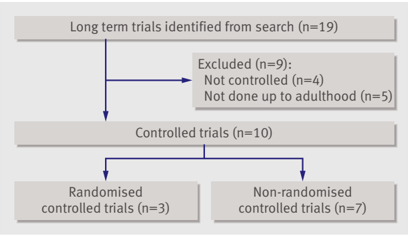
“The search strategy identified 19 long term studies (>3 years). Nine studies were excluded; five were not carried out up to adulthood and four were not controlled trials. Three”
BackgroundFinkelstein, B. S., Imperiale, T. F., Speroff, T., Marrero, U., Radcliffe, D. J., & Cuttler, L. (2002) · Archives of Pediatrics & Adolescent Medicine · doi:10.1001/archpedi.156.3.230 · Cited by 220
Wit, J. M., Rekers-Mombarg, L. T. M., Cutler, G. B., Crowe, B. J., Beck, T., Roberts, K., Gill, A. M., Chaussain, J., Frisch, H., Yturriaga, R., et al. (2005) · The Journal of Pediatrics · doi:10.1016/j.jpeds.2004.08.055 · Cited by 164
Recombinant growth hormone for idiopathic short stature in children and adolescents
Bryant, J., Baxter, L., Cave, C. B., & Milne, R. (2007) · Cochrane Database of Systematic Reviews · doi:10.1002/14651858.cd004440.pub2 · Cited by 161
Final height of short normal children treated with growth hormone
Hindmarsh, P. C., & Brook, C. G. D. (1996) · The Lancet · doi:10.1016/s0140-6736(96)01038-0 · Cited by 151
Research works printed but not linked: 1
- Lopez-Siguero JP, Martinez-Aedo MJ, Moreno-Molina JA. Final height after growth hormone therapy in children with idiopathic short stature and a subnormal growth rate. Acta Pediatr 1996;85:113-47.
Cited by
Grimberg, A., DiVall, S. A., Polychronakos, C., Allen, D. B., Cohen, L. E., Quintos, J. B., Rossi, W. C., Feudtner, C., Murad, M. H., & on behalf of the Drug and Therapeutics Committee and Ethics Committee of the Pediatric Endocrine Society (2016) · Hormone Research in Paediatrics · doi:10.1159/000452150 · Cited by 821
“A systematic review by Deodati et al [199] reported that the mean height gain of GH-treated children in these three RCT exceeded that of control children by 0.”
BackgroundThe Use of Bone Age in Clinical Practice – Part 1
Martin, D. D., Wit, J. M., Hochberg, Z., Sävendahl, L., van Rijn, R. R., Fricke, O., Cameron, N., Caliebe, J., Hertel, T., Kiepe, D., et al. (2011) · Hormone Research in Paediatrics · doi:10.1159/000329372 · Cited by 200
Short Stature in Childhood — Challenges and Choices
Allen, D. B., & Cuttler, L. (2013) · New England Journal of Medicine · doi:10.1056/nejmcp1213178 · Cited by 137
Early Detection, Referral, Investigation, and Diagnosis of Children with Growth Disorders
Savage, M. O., Backeljauw, P. F., Calzada, R., Cianfarani, S., Dunkel, L., Koledova, E. B., Wit, J. M., & Yoo, H. (2016) · Hormone Research in Paediatrics · doi:10.1159/000444525 · Cited by 56
Self-citationSotos, J. F., & Tokar, N. J. (2014) · International Journal of Pediatric Endocrinology · doi:10.1186/1687-9856-2014-15 · Cited by 52
“Nevertheless, the use of growth hormone has remained controversial [17-19], mainly because of the modest benefit [20,21] and high cost [22,23].”
Influential
Metadata
- Authors
- Deodati, A., & Cianfarani, S.
- Affiliations
- University of Rome Tor Vergata (IT)
- Corresponding author
- Cianfarani, S.
- Venue
- BMJ
- Publisher
- BMJ
- Published
- 2011-03-11
- Volume
- 342
- Issue
- mar11 1
- Pages
- c7157-c7157
- ISSN
- 0007-1447 (ISSN-L)
- 0959-8138
- 1468-5833
- OpenAlex
- W2149880057
- Semantic Scholar
- 99e69516a1d652d0434888b3ce52a8e415f600ea
- Cited by
- 140
- References
- 24
- Citations by year
- 2026: 14 · 2025: 10 · 2024: 11 · 2023: 6 · 2022: 14 · 2021: 9 · 2020: 10 · 2019: 8 · 2018: 8 · 2017: 7 · 2016: 8 · 2015: 11 · 2014: 6 · 2013: 4 · 2012: 7
- FWCI
- 0.82
- Type
- journal article
- Language
- en
- Open access
- hybrid
- doi.org
- Licence
- cc-by-nc
- Locations
- BMJ (publishedVersion, cc-by-nc)
- PubMed (publishedVersion)
- Cineca Institutional Research Information System (Tor Vergata University) (submittedVersion)
- Cineca Institutional Research Information System (Tor Vergata University) (submittedVersion, other-oa)
- INFM-OAR (INFN Catania) (submittedVersion, other-oa)
- Topics
- Health Sciences › Medicine › Endocrinology, Diabetes and Metabolism › Growth Hormone and Insulin-like Growth Factors
- Health Sciences › Medicine › Reproductive Medicine › Hypothalamic control of reproductive hormones
- Health Sciences › Medicine › Endocrinology, Diabetes and Metabolism › Pituitary Gland Disorders and Treatments
- Keywords
- growth hormone therapy, idiopathic short stature, adult height, height gain, children, short stature
- MeSH terms
- Adolescent, Adult, Body Height, Child, Dwarfism, Female, Humans, Male, Randomized Controlled Trials as Topic, Treatment Outcome, Human Growth Hormone
About these checks
Registry, retraction, Cites and statistics results are computed, not judged, with one exception: a printed reference that no index lists is read once by a model before it counts as a citation error. Claims are extracted by a model and kept only when their quote appears verbatim in the text; each cited source is then checked, with a model’s help, for whether it says what the claim relies on. Those verdicts can be wrong — read the claim’s quote and the cited source before relying on one.
A language model drew the claims from the paper on 2026-11-28, under version 3 of the claim definition (model deepseek-v4.1-flash, prompt extract-v3).
A second model labelled each claim on 2026-11-28 (model jev-1.13-20260917, definition revision gold-guideline-v0.2).
Statistics and arithmetic are recomputed, not judged.
Confidence bands are shown only for fields calibrated on our annotated test set. None is calibrated yet, so no band is shown.
What counts as a claim ›How we measure confidence ›How we check this ›
Are you an author, or do you see a problem with this page? Request a review
How to cite
Cite CoChat for the checks on this page, and the paper for its own findings.
- This page
- CoChat. (2026). Citation check: Impact of growth hormone therapy on adult height of children with idiopathic short stature: systematic review. https://app.cochat.ai/papers/10.1136/bmj.c7157
- The paper
- Deodati, A., & Cianfarani, S. (2011). Impact of growth hormone therapy on adult height of children with idiopathic short stature: systematic review. BMJ. https://doi.org/10.1136/bmj.c7157
Data sources
Bibliographic data: Semantic Scholar, OpenAlex, Crossref.
Contains information from the Semantic Scholar Academic Graph Datasets, made available under the ODC Attribution License (ODC-BY 1.0).
Semantic Scholar’s data is described in: Kinney, R., et al. (2023). The Semantic Scholar Open Data Platform. arXiv:2301.10140.
