

In vitro quality evaluation of leading brands of ciprofloxacin tablets available in Bangladesh
Open accessThe DOI matches its Crossref record; 33 of the 38 references it cites were found in a registry or an index, and 1 are not checked yet; 2 of the 4 sources its claims cite were checked for support.
Abstract
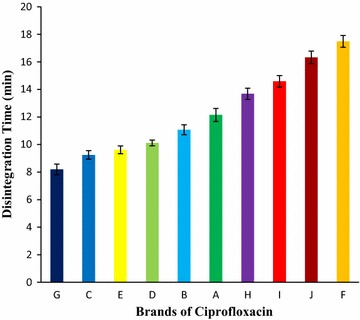
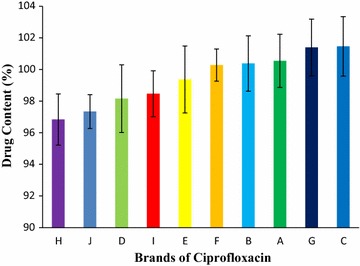
BACKGROUND: Ciprofloxacin is a broad-spectrum antibiotic that acts against a number of bacterial infections. The study was carried out to examine the in vitro quality control tests for ten leading brands of ciprofloxacin hydrochloride 500 mg tablet formulation, registered in Bangladesh by Directorate General of Drug Administration. The quality control parameters of ten different brands of ciprofloxacin hydrochloride 500 mg tablets were determined by weight variation, friability, hardness, disintegration, dissolution and assay tests. All the tablets were evaluated for conformity with United States Pharmacopoeia-National Formulary (USP-NF) and British Pharmacopoeia (BP) standards. RESULTS: ) respectively. The disintegration time for ten brands of ciprofloxacin tablet obtained were in the subsequent order: Brand G (8.19 min) < Brand C (9.25 min) < Brand E (9.61 min) < Brand D (10.11 min) < Brand B (11.07 min) < Brand A (12.15 min) < Brand H (13.68 min) < Brand I (14.59 min) < Brand J (16.32 min) < Brand F (17.49 min). Among ten brands for dissolution test mean percentages of drug release were not less than 80% in 45 min for four tablets (Brand E, 81.52%; Brand D, 86.44%; Brand G, 86.82% and Brand C, 94.12%), consequently they met BP standard and as per USP-NF standard six brands (Brand B, 75.62%; Brand A, 76.18%; Brand E, 81.52%; Brand D, 86.44%; Brand G, 86.82% and Brand C, 94.12%) had released not less than 75% drugs, so they also complied with the standard. The percentages of the drug content of the ten brands of ciprofloxacin tablet were obtained in the following sequence: Brand H (96.84%) < Brand J (97.34%) < Brand D (98.15%) < Brand I (98.47%) < Brand E (99.37%) < Brand F (100.28%) < Brand B (100.38%) < Brand A (100.54%) < Brand G (101.39%) < Brand C (101.46%). All of the brands met the BP and USP-NF specifications for assay. First-order, Higuchi and Korsmeyer-Peppas kinetics model fit for all of the mentioned ten brands. CONCLUSION: The present study revealed that all of the leading brands of this tablet met the quality control parameters as per pharmacopoeial specifications except dissolution test for four brands (Brand J, Brand H, Brand I, and Brand F).
Verified 2026-11-25 · 1 reference not checked yet
Overview
CoChat Summary
## TL;DR
This study tested 10 leading 500 mg ciprofloxacin tablet brands sold in Dhaka, Bangladesh using standard in vitro quality-control assays. All brands met pharmacopoeial limits for weight variation, friability, hardness, disintegration, and assay, but 4 brands failed the dissolution criterion.
## Key findings
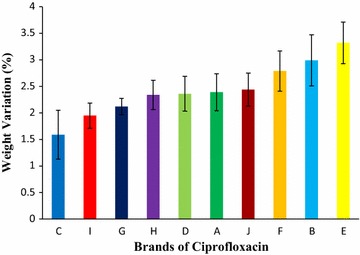
- Weight variation: all 10 brands complied; mean variation ranged from 1.59% (Brand C) to 3.32% (Brand E).
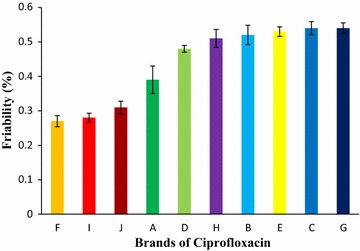
- Friability: all 10 brands were below the 1% limit; mean friability ranged from 0.27% (Brand F) to 0.54% (Brand G and Brand C).
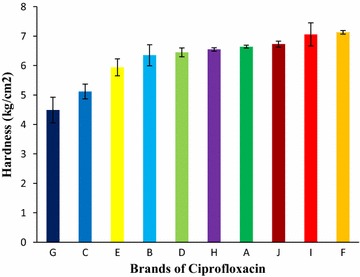
- Hardness and disintegration: hardness ranged from 4.49 kg/cm² (Brand G) to 7.12–7.13 kg/cm² (Brand F); disintegration time ranged from 8.19 min (Brand G) to 17.49 min (Brand F), and all brands met the compendial requirement of disintegrating within 30 min.
- Dissolution and assay: at 45 min, 6/10 brands met the USP-NF dissolution threshold of ≥75% and 4/10 met the BP threshold of ≥80%; the lowest release was 61.87% (Brand F) and the highest was 94.12% (Brand C). All brands met assay specifications, with content ranging from 96.84% (Brand H) to 101.46% (Brand C).
## Methods
- Design/sample: laboratory-based in vitro quality evaluation of 10 commercially available ciprofloxacin hydrochloride 500 mg tablet brands, purchased from retail pharmacies in Dhaka, Bangladesh and blinded as Brands A–J.
- Tests performed: weight variation, friability, hardness, disintegration, dissolution, and assay, using USP-NF/BP specifications as reference standards.
- Analysis: dissolution data were analyzed with one-way ANOVA; drug-release profiles were fitted to zero-order, first-order, Higuchi, and Korsmeyer–Peppas models.
## Limitations
- Not stated in the paper: the authors do not explicitly list study limitations.
- Evidence from the text: the study is based on 10 brands from Dhaka retail pharmacies only, so it may not represent all ciprofloxacin products in Bangladesh.
- Evidence from the text: the assay was done by UV spectrophotometry due to lack of instrumentation, which the paper notes instead of using HPLC.
Model-written summary. Check it against the paper before relying on it.
Integrity signals
Registry
Cites
Statistics
Figures
Verification
Claims the paper makes
1 Valid · 1 Not valid · 2 Not checked · 30 Own results and interpretations
The cited sources that could be checked couldn’t confirm or dispute this claim.
In the paper
“Hardness values did not correlate with friability values [42].”
§ In vitro quality evaluation of leading brands of ciprofloxacin tablets available in Bangladesh > Discussion
What the sources say
- Could not verifycites [42] Merchant HA Shoiab HM Tazeen J Yousuf RI A once daily tablet formulation and in vitro release evaluation of cepfodoxime using hydroxypropyl methylcellulose: a technical note AAPS Pharm Sci Tech. 2006 7 3 78 10.1208/pt070378 PMC2750520 17025258 sourceExperimental — accuracy not yet measured
Our copy of Merchant et al. (2006) is the PMC record, which contains only the title/keywords, the 'Summary and Conclusions' block, and the reference list; the body is flagged as 'The Full Text of this article is available as a PDF (179.8 KB)' and is not indexed. Searches on 'hardness friability correlation', 'friability', and 'hardness values / weight variation / compression force' returned only reference-list and Summary passages. The Summary (p. 1) states merely that 'The formulation showed acceptable pharmacotechnical properties and assay requirements,' which does not address any correlation between hardness and friability, so the decisive results section may be missing from our copy. (LLM, conf=0.62)
plain- Asserted: passes — The authors put it forward as true.
- Checkable: passes — It can be checked against evidence.
- Load-bearing: unclear — It is unclear whether the paper’s conclusions depend on it.
- Based: passes — The paper gives a reason why it holds.
- Could not verify
Every source the paper cites for this claim was checked and supports it.
In the paper
“To identify bioavailability problems dissolution testing serves as an indicator [26].”
§ In vitro quality evaluation of leading brands of ciprofloxacin tablets available in Bangladesh > Background
What the sources say
- Supportedcites [26] Shah V Dissolution: a quality control test vs a bioequivalent test Dissolution Technol. 2001 8 4 1 2 10.14227/DT080401P6 source
The Abstract (p.1) of Shah (2001) states that in quality control the dissolution test 'is used to identify bioavailability (BA) problems and to assess the need for further bioequivalence (BE) studies relative to scale-up and post-approval changes (SUPAC), where it can function as a signal of bioinequivalence' — i.e. it serves as an indicator for BA problems. This is a straightforward paraphrase of that passage; no population or condition qualifier is lost. (LLM, conf=0.92)
plainstates an association- Asserted: passes — The authors put it forward as true.
- Checkable: passes — It can be checked against evidence.
- Load-bearing: passes — The paper’s conclusions depend on it.
- Based: passes — The paper gives a reason why it holds.
- Supported
A result the paper reports from its own data — it cites no other source for it, so there is none to check. The quote shows it is in the paper.
In the paper
“In case of Brand F and Brand G, Higuchi kinetics model was the best fit model.”
§ In vitro quality evaluation of leading brands of ciprofloxacin tablets available in Bangladesh > Discussion
plain- Asserted: passes — The authors put it forward as true.
- Checkable: passes — It can be checked against evidence.
- Load-bearing: unclear — It is unclear whether the paper’s conclusions depend on it.
- Based: passes — The paper gives a reason why it holds.
A result the paper reports from its own data — it cites no other source for it, so there is none to check. The quote shows it is in the paper.
In the paper
“Korsmeyer–Peppas kinetics model was the best fit model for Brand A, Brand B and Brand D among ten brands.”
§ In vitro quality evaluation of leading brands of ciprofloxacin tablets available in Bangladesh > Discussion
plain- Asserted: passes — The authors put it forward as true.
- Checkable: passes — It can be checked against evidence.
- Load-bearing: unclear — It is unclear whether the paper’s conclusions depend on it.
- Based: passes — The paper gives a reason why it holds.
A result the paper reports from its own data — it cites no other source for it, so there is none to check. The quote shows it is in the paper.
In the paper
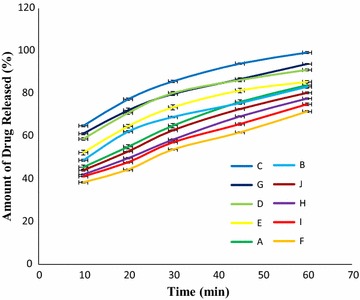
“The percentages of drug release for ten brands of ciprofloxacin tablet in 45 min were in the resulting order: Brand F (61.87%) < Brand I (65.77%) < Brand H (69.36%) < Brand J (72.86%) < Brand B (75.62%) < Brand A (76.18%) < Brand E (81.52%) < Brand D (86.44%) < Brand G (86.82%) < Brand C (94.12%), shown in Fig. 6.”
§ In vitro quality evaluation of leading brands of ciprofloxacin tablets available in Bangladesh > Results
plain- Asserted: passes — The authors put it forward as true.
- Checkable: passes — It can be checked against evidence.
- Load-bearing: unclear — It is unclear whether the paper’s conclusions depend on it.
- Based: passes — The paper gives a reason why it holds.
20 more claims
Create a free account to see all 34 claims and every source verdict.
- The quote only partly states this claim. 2
- It may state two separate claims as one. 7
- Probably not a substantial claim. 1
Citations
Cites
Modeling and comparison of dissolution profiles
Costa, P., & Sousa Lobo, J. M. (2001) · European Journal of Pharmaceutical Sciences · doi:10.1016/s0928-0987(01)00095-1 · Cited by 5,509
The Theory and Practice of Industrial Pharmacy
Lachman, L., Lieberman, H. A., & Kanig, J. L. (1970) · Virtual Defense Library (Ministerio de Defensa) · Cited by 1,838
Encyclopedia of Pharmaceutical Technology
Swarbrick, J. (2013) · CRC Press eBooks · doi:10.1201/b19309 · Cited by 1,794
Encyclopedia of pharmaceutical technology
(2003) · Choice Reviews Online · doi:10.5860/choice.40-6157 · Cited by 1,743
Remington: The science and practice of pharmacy
(1996) · Trends in Pharmacological Sciences · doi:10.1016/s0165-6147(96)90065-6 · Cited by 1,433
Applied Biopharmaceutics and Pharmacokinetics.
(1981) · Annals of Internal Medicine · doi:10.7326/0003-4819-94-6-826_2 · Cited by 1,206
The Theory and Practice of Industrial Pharmacy
Banker, G. S. (1970) · Journal of Pharmaceutical Sciences · doi:10.1002/jps.2600591046 · Cited by 1,179
Aulton's Pharmaceutics : The Design and Manufacture of Medicines
Aulton, M. E., & Taylor, K. M. G. (2013) · Cited by 1,008
THE UNITED STATES PHARMACOPEIAL CONVENTION
Hirschfelder, A. D. (1930) · JAMA: The Journal of the American Medical Association · doi:10.1001/jama.1930.02720030050030 · Cited by 1,006
Pharmaceutical Dosage Forms and Drug Delivery Systems
Ansel, H. C., Allen, L. V., & Popovich, N. G. (1990) · Cited by 701
Ansel's Pharmaceutical Dosage Forms and Drug Delivery Systems
Allen, L. V., Popovich, N. G., & Ansel, H. C. (2004) · Cited by 672
Aulton's pharmaceutics: the design and manufacture of medicines
Me, A., & Taylor, K. (2013) · Churchill Livingstone eBooks · Cited by 576
Substandard medicines in resource‐poor settings: a problem that can no longer be ignored
Caudron, J. ‐., Ford, N., Henkens, M., Macé, C., Kiddle‐Monroe, R., & Pinel, J. (2008) · Tropical Medicine & International Health · doi:10.1111/j.1365-3156.2008.02106.x · Cited by 332
The Global Threat of Counterfeit Drugs: Why Industry and Governments Must Communicate the Dangers
Cockburn, R., Newton, P. N., Agyarko, E. K., Akunyili, D., & White, N. J. (2005) · PLoS Medicine · doi:10.1371/journal.pmed.0020100 · Cited by 330
Substandard and counterfeit medicines: a systematic review of the literature
Almuzaini, T., Choonara, I., & Sammons, H. (2013) · BMJ Open · doi:10.1136/bmjopen-2013-002923 · Cited by 286
Merchant, H. A., Shoaib, H. M., Tazeen, J., & Yousuf, R. I. (2006) · AAPS PharmSciTech · doi:10.1208/pt070378 · Cited by 171
Are there potential problems with generic substitution of antiepileptic drugs?
Crawford, P. M., Feely, M., Guberman, A. H., & Krämer, G. (2006) · Seizure · doi:10.1016/j.seizure.2005.12.010 · Cited by 168
Fatal renal failure caused by diethylene glycol in paracetamol elixir: the Bangladesh epidemic
Hanif, M., Mobarak, M. R., Ronan, A., Rahman, D., Donovan, J. J., & Bennish, M. L. (1995) · BMJ · doi:10.1136/bmj.311.6997.88 · Cited by 162
Handbook of Bioequivalence Testing
Niazi, S. K. (2007) · doi:10.3109/9780849383595 · Cited by 77
(1940) · Nature · doi:10.1038/145196a0 · Cited by 53
Dissolution: A Quality Control Test vs. A Bioequivalence Test
Shah, V. P. (2001) · Dissolution Technologies · doi:10.14227/dt080401p6 · Cited by 40
Khan, A., & Ghilzai, N. M. K. (2007) · Indian Journal of Pharmacology · doi:10.4103/0253-7613.36541 · Cited by 39
Uddin, M., Mamun, A. A., Rashid, M., et al. (2015) · Journal of Pharmaceutical Research International · doi:10.9734/bjpr/2016/22044 · Cited by 27
Self-citationNijhu, R. S., Jhanker, Y. M., & Sutradhar, K. B. (1970) · Stamford Journal of Pharmaceutical Sciences · doi:10.3329/sjps.v4i1.8876 · Cited by 25
(2015) · Journal of chemical and pharmaceutical research · Cited by 23
Self-citationFahmy, S., & Abu-Gharbieh, E. (2014) · BioMed Research International · doi:10.1155/2014/590848 · Cited by 19
Generic Substitution in Malaysia: Recommendations from a Systematic Review
Hassali, M. A. (2012) · Journal of Applied Pharmaceutical Science · doi:10.7324/japs.2012.2827 · Cited by 15
Pharmacopoeial Standards and Specifications for Pharmaceutical Oral Liquid Preparations
Uddin, M. S., Mamun, A., Akter, N., et al. (2016) · Archives of Current Research International · doi:10.9734/acri/2016/22675 · Cited by 13
Self-citationKahsay, G., & Egziabher, A. G. (2010) · Momona Ethiopian Journal of Science · doi:10.4314/mejs.v2i1.49656 · Cited by 11
WHO fights fake pharmaceuticals
Ahmad, K. (2006) · The Lancet Infectious Diseases · doi:10.1016/s1473-3099(06)70427-3 · Cited by 10
Uduma, E. O., Rosemary, C. A., & Opurum Christian, C. (2011) · Cited by 4
Quality Control Parameters Of Parenteral Pharmaceuticals Based On Pharmacopoeias
Sufian, M. A. (2017) · Zenodo (CERN European Organization for Nuclear Research) · doi:10.5281/zenodo.260129 · Cited by 4
Mathematisch-naturwissenschaftlichen Fakultät, I. (2012) · Cited by 1
Shargel, L., & Yu, A. (2002) · Encyclopedia of Clinical Pharmacy (Print) · doi:10.1201/b13789-22
Research works printed but not linked: 13
- Hamam HAB Comparative in vitro evaluation of generic ciprofloxacin hydrochloride tablets World J Pharm Pharm Sci. 2014 3 12 388 390
- Hailu GS Gutema GB Asefaw AA Hussen DA Hadera MG Comparative assessment of the physicochemical and in vitro bioavailability equivalence of cotrimoxazole tablets marketed in Tigray, Ethiopia Int J Pharm Sci Res. 2011 2 12 3210 3218
- Hamilton Richard J Tarascon pharmacopoeia 2014 15 Burlington Jones & Bartlett Publishers
- Akpabio E Jackson C Ugwu C Etim M Udofia M Quality control and in vitro bioequivalence studies on four brands of ciprofloxacin tablets commonly sold in Uyo Metropolis, Nigeria J Chem Pharm Res. 2011 3 3 734 741
- Tangri P Mamgain P Shaffi Verma AML Lakshmayya In process quality control: a review Int J Ind Pharm Bio Sci. 2012 1 1 49 51
- British Pharmacopoeia Commission British pharmacopoeia 2014 8 Great Britain Stationery Office
- Usman S Alam A Suleiman R Awad K Abudeek I Evaluation of dissolution testing for ciprofloxacin (500 mg) tablets: post market surveillance of different brands available in Ras Al Khaimah (UAE) Int J Biopharm. 2014 5 1 65 72
- Shaikh HK Kshirsagar RV Patil SG Mathematical models for drug release characterization: a review World J Pharm Pharm Sci. 2015 4 4 324 338
- Uddin MS Mamun AA Rashid M Asaduzzaman M In-process and finished products quality control tests for pharmaceutical capsules according to pharmacopoeias Br J Pharm Res. 2016 9 2 2 10.9734/BJPR/2016/22044 · DOI
- Uddin MS Quality control of pharmaceuticals: compendial standards and specifications 2017 Germany Scholars’ Press
- Salih H Hamam B Comparative in vitro evaluation of generic ciprofloxacin hydrochloride tablets World J Pharm Pharm Sci. 2014 38 12 388 396
- Uduma EO Ayodeji AA Rosemary CA Ogbonna O Christian CO Bioequivalence studies on some selected brands of ciprofloxacin hydrochloride tablets in the Nigerian market with ciproflox® as innovator brand J App Pharm Sci. 2011 01 06 80 84
- Fereja TH Tufa SB In vitro quality assessment and bioequivalence studies on four brands of Ciprofloxacin tablets, marketed in Ambo, Ethiopia Int J Pharm Sci. 2015 5 2 1007 1012
Cited by
Quality Control Tests for Ophthalmic Pharmaceuticals: Pharmacopoeial Standards and Specifications
Uddin, M. S., Mamun, A. A., Kabir, M. A., et al. (2017) · Journal of Advances in Medical and Pharmaceutical Sciences · doi:10.9734/jamps/2017/33924 · Cited by 40
Self-citationSaleem, Z., Mekonnen, B. A., Orubu, E. S. F., Islam, M. A., Phuong, T. N. T., Ubaka, C. M., Buma, D. C., Do, N. T. T., Sant, Y., Sono, T. M., et al. (2025) · Expert Review of Anti-infective Therapy · doi:10.1080/14787210.2025.2477198 · Cited by 46
Hambisa, S., Belew, S., & Suleman, S. (2019) · Drug Design Development and Therapy · doi:10.2147/dddt.s189524 · Cited by 30
“On the other hand, all the brands passed pharmacopeial specification for friability, which states that the maximum weight loss of not more than 1% of the weight of the tablets is considered generally acceptable,(23) and the result of this finding is similar to the study conducted in Bangladesh on ciprofloxacin hydroch…”
BackgroundResultAbebe, S., Ketema, G., & Kassahun, H. (2020) · Drug Design Development and Therapy · doi:10.2147/dddt.s280203 · Cited by 16
In Vitro Biopharmaceutical Equivalence of Carbamazepine Sodium Tablets Available in Lima, Peru
Alvarado, Á. T., Muñoz, A. M., Bendezú, M. R., et al. (2021) · Dissolution Technologies · doi:10.14227/dt280221pgc2 · Cited by 11
Metadata
- Authors
- Uddin, M. S., Mamun, A. A., Hossain, M. S., Asaduzzaman, M., Sarwar, M. S., Rashid, M., & Herrera-Calderon, O.
- Affiliations
- Southeast University (BD)
- Noakhali Science and Technology University (BD)
- Corresponding author
- Uddin, Md. Sahab
- Venue
- BMC Research Notes
- Published
- 2017-05-30
- Volume
- 10
- Issue
- 1
- Pages
- 185-185
- ISSN
- 1756-0500 (ISSN-L)
- PMC
- PMC5450125
- OpenAlex
- W2619665066
- Cited by
- 31
- References
- 38
- Citations by year
- 2026: 1 · 2025: 3 · 2024: 2 · 2023: 5 · 2022: 4 · 2021: 8 · 2020: 4 · 2019: 1 · 2018: 2 · 2017: 1
- FWCI
- 2.05
- Type
- journal article
- Language
- en
- Open access
- gold
- doi.org
- Licence
- cc-by
- Locations
- BMC Research Notes (publishedVersion, cc-by)
- Europe PMC (PubMed Central) (publishedVersion, other-oa)
- PubMed Central (publishedVersion, cc-by)
- PubMed (publishedVersion)
- DOAJ (DOAJ: Directory of Open Access Journals) (submittedVersion, cc-by-sa)
- Greater South Information System
- Funders
- Southeast University
- Topics
- Health Sciences › Medicine › Public Health, Environmental and Occupational Health › Pharmaceutical Quality and Counterfeiting
- Physical Sciences › Chemistry › Analytical Chemistry › Analytical Methods in Pharmaceuticals
- Social Sciences › Economics, Econometrics and Finance › Economics and Econometrics › Pharmaceutical Economics and Policy
- Keywords
- ciprofloxacin hydrochloride, tablets, pharmaceutical quality control, disintegration time, drug release, dissolution testing, drug content assay, weight variation, friability, tablet hardness, drug quality assessment, generic drugs, drug adulteration
- MeSH terms
- Anti-Bacterial Agents, Bangladesh, Chemistry, Pharmaceutical, Ciprofloxacin, Kinetics, Quality Control, Solubility, Tablets, Therapeutic Equivalency, Drug Liberation
About these checks
Registry, retraction, Cites and statistics results are computed, not judged, with one exception: a printed reference that no index lists is read once by a model before it counts as a citation error. Claims are extracted by a model and kept only when their quote appears verbatim in the text; each cited source is then checked, with a model’s help, for whether it says what the claim relies on. Those verdicts can be wrong — read the claim’s quote and the cited source before relying on one.
The claim verdicts this report counts are experimental: their accuracy is not yet measured.
A language model drew the claims from the paper on 2026-10-10, under version 3 of the claim definition (model deepseek-v4.1-flash, prompt extract-v3).
A second model labelled each claim on 2026-10-10 (model jev-1.13-20260917, definition revision gold-guideline-v0.2).
Cited sources are checked with a language model’s help (qwen3.8-omni-flash).
Statistics and arithmetic are recomputed, not judged.
Confidence bands are shown only for fields calibrated on our annotated test set. None is calibrated yet, so no band is shown.
What counts as a claim ›How we measure confidence ›How we check this ›
Are you an author, or do you see a problem with this page? Request a review
Data sources
Bibliographic data: Semantic Scholar, OpenAlex, Crossref.
Contains information from the Semantic Scholar Academic Graph Datasets, made available under the ODC Attribution License (ODC-BY 1.0).
Semantic Scholar’s data is described in: Kinney, R., et al. (2023). The Semantic Scholar Open Data Platform. arXiv:2301.10140.
