

The DOI matches its Crossref record; 12 of the 12 references it cites were found in a registry or an index.
Bapineuzumab for mild to moderate Alzheimer’s disease in two global, randomized, phase 3 trials
Open accessAbstract
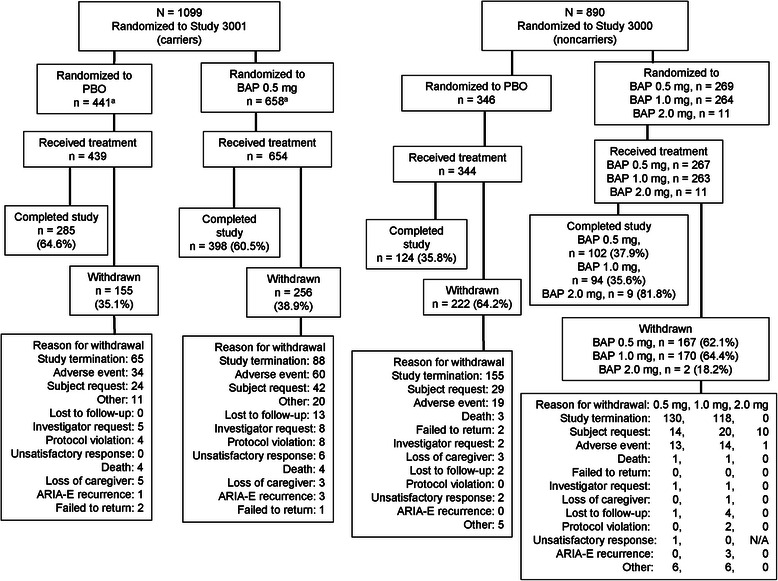
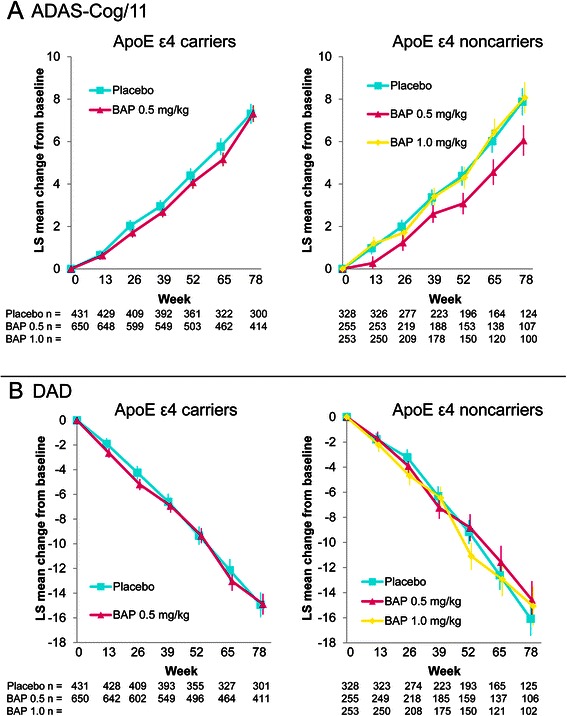
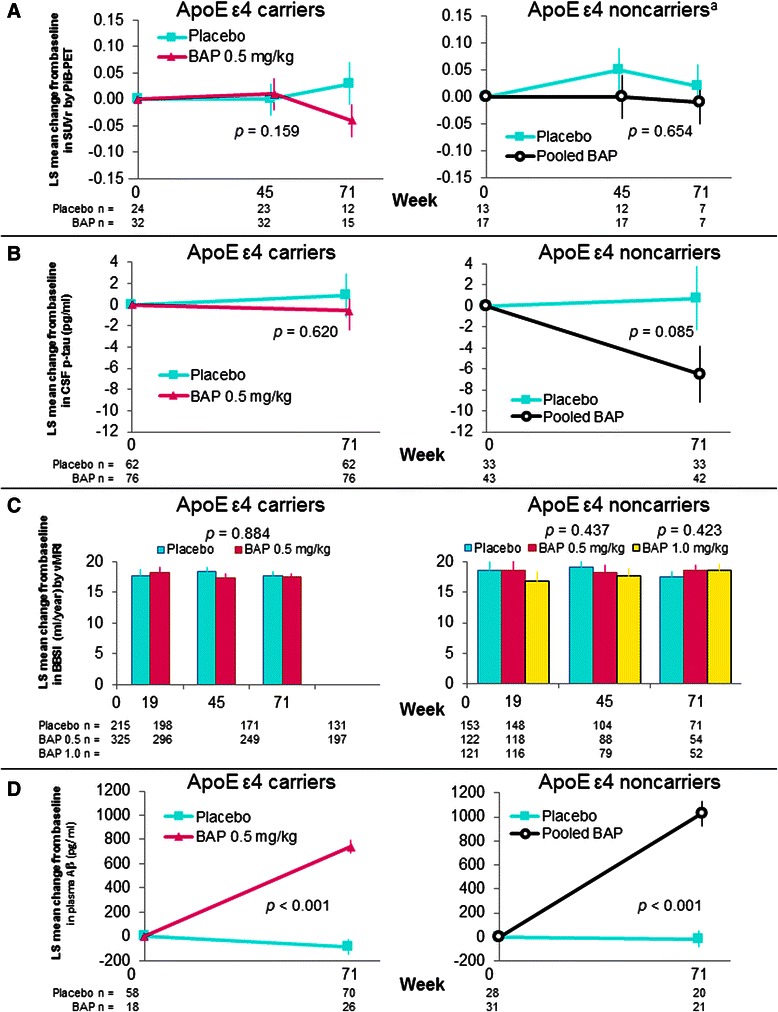
Background: Our objective was to evaluate the efficacy (clinical and biomarker) and safety of intravenous bapineuzumab in patients with mild to moderate Alzheimer’s disease (AD). Methods: Two of four phase 3, multicenter, randomized, double-blind, placebo-controlled, 18-month trials were conducted globally: one in apolipoprotein E ε4 carriers and another in noncarriers. Patients received bapineuzumab 0.5 mg/kg (both trials) or 1.0 mg/kg (noncarrier trial) or placebo every 13 weeks. Coprimary endpoints were change from baseline to week 78 on the 11-item Alzheimer’s Disease Assessment Scale–Cognitive subscale and the Disability Assessment for Dementia. Results: A total of 683 and 329 patients completed the current carrier and noncarrier trials, respectively, which were terminated prematurely owing to lack of efficacy in the two other phase 3 trials of bapineuzumab in AD. The current trials showed no significant difference between bapineuzumab and placebo for the coprimary endpoints and no effect of bapineuzumab on amyloid load or cerebrospinal fluid phosphorylated tau. (Both measures were stable over time in the placebo group.) Amyloid-related imaging abnormalities with edema or effusion were confirmed as the most notable adverse event. Conclusions: These phase 3 global trials confirmed lack of efficacy of bapineuzumab at tested doses on clinical endpoints in patients with mild to moderate AD. Some differences in the biomarker results were seen compared with the other phase 3 bapineuzumab trials. No unexpected adverse events were observed. Trial registration: Noncarriers (3000) ClinicalTrials.gov identifier NCT00667810; registered 24 Apr 2008. Carriers (3001) ClinicalTrials.gov identifier NCT00676143; registered 2 May 2008.
Overview
The claims and statistics of this paper haven’t been checked yet.
Run the check — free, no account needed. It reads the open-access text and checks the sources it cites.
Integrity signals
Registry
Cites
Statistics
Figures
Verification
Claims the paper makes
The claims and statistics of this paper haven’t been checked yet.
Run the check — free, no account needed. It reads the open-access text and checks the sources it cites.
Claims other papers make about this one
Each is checked against this paper’s own text: does it say what the citing paper says it does?
In the citing paper
“The administration of this antibody manifested significant (27%) slower progress in cognitive decline in the patients based on the primary end points, the change from baseline at 19 months in the score on the CDR-SB”
From Current therapeutics for Alzheimer’s disease and clinical trials (2024) · cites this paper as [34]
In the citing paper
“The third generation of human immunoglobulin monoclonal antibody (hmAB; aducanumab, donanemab, and lecanemab) directed against insoluble, modified, N-terminal truncated form of Aβ, targeting Aβ plaque clearance, seems to benefit MCI or AD with mild dementia patients [34, 37].”
From Current therapeutics for Alzheimer’s disease and clinical trials (2024) · cites this paper as [34]
In the citing paper
“these results did not extend to phase III trials, in which bapineuzumab had no effect on tau pathology184”
From Tau-targeting therapies for Alzheimer disease (2018) · cites this paper as [184]
In the citing paper
“Some of the recent failures of anti-amyloid agents in phase 3 clinical trials in patients with early-stage, mild, or mild-to-moderate stage AD were semagacestat,29 bapineuzumab,30 solanezumab31 and in similar trials of β-secretase inhibitors (BACE) lanabecestat,32 verubecestat,33 and atabecestat.34”
From Current and Future Treatments in Alzheimer Disease: An Update (2020) · cites this paper as [30]
Self-check
Percentages, sums and reported differences re-computed from the paper’s own numbers.
The self-check needs the paper’s full text.
Citations
Cites
Two Phase 3 Trials of Bapineuzumab in Mild-to-Moderate Alzheimer's Disease
Salloway, S., Sperling, R., Fox, N. C., Blennow, K., Klunk, W., Raskind, M., Sabbagh, M., Honig, L. S., Porsteinsson, A. P., Ferris, S., et al. (2014) · New England Journal of Medicine · doi:10.1056/nejmoa1304839 · Cited by 1,960
Self-citationPhase 3 Trials of Solanezumab for Mild-to-Moderate Alzheimer's Disease
Doody, R. S., Thomas, R. G., Farlow, M., Iwatsubo, T., Vellas, B., Joffe, S., Kieburtz, K., Raman, R., Sun, X., Aisen, P. S., et al. (2014) · New England Journal of Medicine · doi:10.1056/nejmoa1312889 · Cited by 1,668
Self-citationSperling, R. A., Jack, C. R., Black, S. E., Frosch, M. P., Greenberg, S. M., Hyman, B. T., Scheltens, P., Carrillo, M. C., Thies, W., Bednar, M. M., et al. (2011) · Alzheimer's & Dementia · doi:10.1016/j.jalz.2011.05.2351 · Cited by 857
Self-citationA phase 2 multiple ascending dose trial of bapineuzumab in mild to moderate Alzheimer disease
Salloway, S., Sperling, R., Gilman, S., Fox, N. C., Blennow, K., Raskind, M., Sabbagh, M., Honig, L. S., Doody, R., van Dyck, C. H., et al. (2009) · Neurology · doi:10.1212/wnl.0b013e3181c67808 · Cited by 753
Self-citationRinne, J. O., Brooks, D. J., Rossor, M. N., Fox, N. C., Bullock, R., Klunk, W. E., Mathis, C. A., Blennow, K., Barakos, J., Okello, A. A., et al. (2010) · The Lancet Neurology · doi:10.1016/s1474-4422(10)70043-0 · Cited by 701
Self-citationZetterberg, H. (2012) · Archives of Neurology · doi:10.1001/archneurol.2012.90 · Cited by 234
Immunotherapy for Alzheimer’s disease: hoops and hurdles
Lemere, C. A. (2013) · Molecular Neurodegeneration · doi:10.1186/1750-1326-8-36 · Cited by 196
Amyloid-β 11 C-PiB-PET imaging results from 2 randomized bapineuzumab phase 3 AD trials
Liu, E., Schmidt, M. E., Margolin, R., Sperling, R., Koeppe, R., Mason, N. S., Klunk, W. E., Mathis, C. A., Salloway, S., Fox, N. C., et al. (2015) · Neurology · doi:10.1212/wnl.0000000000001877 · Cited by 151
Self-citationTayeb, H. O., Murray, E. D., Price, B. H., & Tarazi, F. I. (2013) · Expert Opinion on Biological Therapy · doi:10.1517/14712598.2013.789856 · Cited by 119
Passive anti-amyloid immunotherapy in Alzheimer's disease: What are the most promising targets?
Moreth, J., Mavoungou, C., & Schindowski, K. (2013) · Immunity & Ageing · doi:10.1186/1742-4933-10-18 · Cited by 103
Cited by
Sorted by citations
Items 301–303 of 303
Holst, M. A. M., Valiente, A. M. S., & Becerra, C. A. G. (2026) · Neurological Sciences · doi:10.1007/s10072-026-09430-5
Surhan, A., Oad, J., Kumar, B., Memon, S. N., Essrani, C., Muhammad, F., Kashif, S. N., Abbas, S. M. I., Ameen, T. B., Sauleh, A., et al. (2026) · The Egyptian Journal of Neurology Psychiatry and Neurosurgery · doi:10.1186/s41983-026-01263-5
Luo, Z., Manavis, J., Yu, W., & 孙宝飞 (2026) · Human Brain · doi:10.15302/hb.2026.0009
Metadata
- Authors
- Vandenberghe, R., Rinne, J. O., Boada, M., Katayama, S., Scheltens, P., Vellas, B., Tuchman, M., Gass, A., Fiebach, J. B., Hill, D., Lobello, K., Li, D., McRae, T., Lucas, P., Evans, I., Booth, K., Luscan, G., Wyman, B. T., Hua, L., Yang, L., Brashear, H. R., Black, R. S., & for the Bapineuzumab 3000 and 3001 Clinical Study Investigators
- Affiliations
- KU Leuven (BE)
- University of Turku (FI)
- Hiroshima University (JP)
- Amsterdam UMC Location Vrije Universiteit Amsterdam (NL)
- Centre Hospitalier Universitaire de Toulouse (FR)
- Palm Beach Neurological Center (US)
- University Medical Centre Mannheim (DE)
- Center for Stroke Research Berlin (DE)
- Pfizer (United States) (US)
- Pfizer (France) (FR)
- Pfizer (United Kingdom) (GB)
- Janssen Alzheimer Immunotherapy Research & Development (United States) (US)
- Corresponding author
- Vandenberghe, Rik
- ORCID
- Venue
- Alzheimer's Research & Therapy
- Published
- 2016-05-12
- Volume
- 8
- Issue
- 1
- Pages
- 18-18
- ISSN
- 1758-9193 (ISSN-L)
- PMC
- PMC4866415
- OpenAlex
- W2385703614
- Cited by
- 304
- References
- 12
- Citations by year
- 2026: 15 · 2025: 25 · 2024: 36 · 2023: 37 · 2022: 26 · 2021: 35 · 2020: 36 · 2019: 28 · 2018: 44 · 2017: 21 · 2016: 1
- FWCI
- 25.22
- Type
- journal article
- Language
- en
- Open access
- gold
- doi.org
- Locations
- Alzheimer s Research & Therapy (publishedVersion, cc-by)
- PubMed Central (publishedVersion, cc-by)
- PubMed (publishedVersion)
- Amsterdam UMC (VU Amsterdam) - Institutional Repository (publishedVersion)
- Pure Amsterdam UMC (acceptedVersion, other-oa)
- Lirias (KU Leuven) (submittedVersion, other-oa)
- UCL Discovery (University College London) (submittedVersion)
- Refubium (Universitätsbibliothek der Freien Universität Berlin) (submittedVersion, cc-by)
- Data Archiving and Networked Services (DANS) (submittedVersion)
- Funders
- Pfizer Inc.
- Janssen Research and Development
- Topics
- Life Sciences › Neuroscience › Cellular and Molecular Neuroscience › Alzheimer's disease research and treatments
- Health Sciences › Medicine › Psychiatry and Mental health › Dementia and Cognitive Impairment Research
- Life Sciences › Neuroscience › Neurology › Neuroinflammation and Neurodegeneration Mechanisms
- Keywords
- bapineuzumab, Alzheimer's disease, anti-amyloid therapy, amyloid-related imaging abnormalities, amyloid load, phosphorylated tau, cognitive decline, disability, drug safety, treatment efficacy
- MeSH terms
- Aged, Alzheimer Disease, Brain, Female, Humans, Male, Neuropsychological Tests, Severity of Illness Index, Biomarkers, Amyloid beta-Peptides, tau Proteins, Treatment Outcome, Positron-Emission Tomography, Apolipoprotein E4, Antibodies, Monoclonal, Humanized
About these checks
Registry, retraction, Cites and statistics results are computed, not judged, with one exception: a printed reference that no index lists is read once by a model before it counts as a citation error. Claims are extracted by a model and kept only when their quote appears verbatim in the text; each cited source is then checked, with a model’s help, for whether it says what the claim relies on. Those verdicts can be wrong — read the claim’s quote and the cited source before relying on one.
Statistics and arithmetic are recomputed, not judged.
Confidence bands are shown only for fields calibrated on our annotated test set. None is calibrated yet, so no band is shown.
What counts as a claim ›How we measure confidence ›How we check this ›
Are you an author, or do you see a problem with this page? Request a review
