

Brain volumes and cortical thickness on MRI in the Finnish Geriatric Intervention Study to Prevent Cognitive Impairment and Disability (FINGER)
Open accessThe DOI matches its Crossref record; 45 of the 45 references it cites were found in a registry or an index.
Abstract
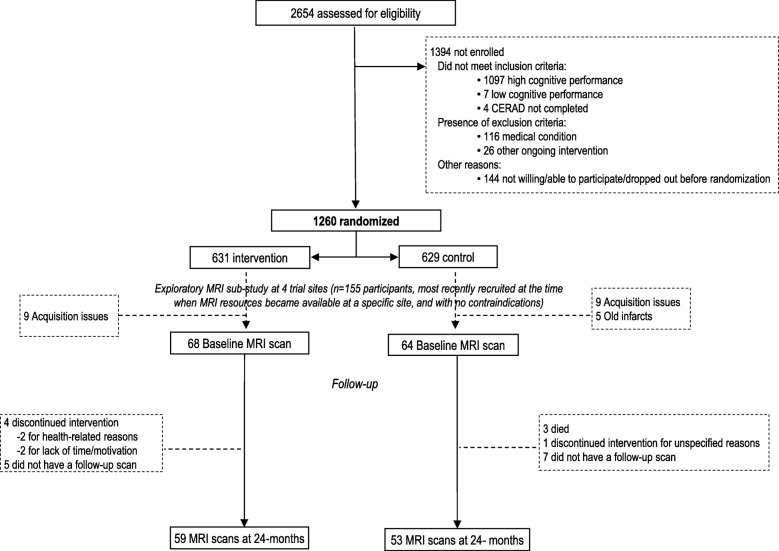
BACKGROUND: The Finnish Geriatric Intervention Study to Prevent Cognitive Impairment and Disability (FINGER) was a multicenter randomized controlled trial that reported beneficial effects on cognition for a 2-year multimodal intervention (diet, exercise, cognitive training, vascular risk monitoring) versus control (general health advice). This study reports exploratory analyses of brain MRI measures. METHODS: FINGER targeted 1260 older individuals from the general Finnish population. Participants were 60-77 years old, at increased risk for dementia but without dementia/substantial cognitive impairment. Brain MRI scans were available for 132 participants (68 intervention, 64 control) at baseline and 112 participants (59 intervention, 53 control) at 2 years. MRI measures included regional brain volumes, cortical thickness, and white matter lesion (WML) volume. Cognition was assessed at baseline and 1- and 2-year visits using a comprehensive neuropsychological test battery. We investigated the (1) differences between the intervention and control groups in change in MRI outcomes (FreeSurfer 5.3) and (2) post hoc sub-group analyses of intervention effects on cognition in participants with more versus less pronounced structural brain changes at baseline (mixed-effects regression models, Stata 12). RESULTS: No significant differences between the intervention and control groups were found on the changes in MRI measures. Beneficial intervention effects on processing speed were more pronounced in individuals with higher baseline cortical thickness in Alzheimer's disease signature areas (composite measure of entorhinal, inferior and middle temporal, and fusiform regions). The randomization group × time × cortical thickness interaction coefficient was 0.198 (p = 0.021). A similar trend was observed for higher hippocampal volume (group × time × hippocampus volume interaction coefficient 0.1149, p = 0.085). CONCLUSIONS: The FINGER MRI exploratory sub-study did not show significant differences between the intervention and control groups on changes in regional brain volumes, regional cortical thicknesses, or WML volume after 2 years in at-risk elderly without substantial impairment. The cognitive benefits on processing speed of the FINGER intervention may be more pronounced in individuals with fewer structural brain changes on MRI at baseline. This suggests that preventive strategies may be more effective if started early, before the occurrence of more pronounced structural brain changes. TRIAL REGISTRATION: ClinicalTrials.gov, NCT01041989 . Registered January 5, 2010.
Overview
The claims and statistics of this paper haven’t been checked yet.
Free: it reads the open-access text and checks the first 5 claims that cite a source we can check. Create a free account to check every claim.
Integrity signals
Registry
Cites
Statistics
Figures
Verification
Claims the paper makes
The claims and statistics of this paper haven’t been checked yet.
Free: it reads the open-access text and checks the first 5 claims that cite a source we can check. Create a free account to check every claim.
Claims other papers make about this one
Each is checked against this paper’s own text: does it say what the citing paper says it does?
The cited source says what the claim attributes to it.
In the citing paper
“However, in a subgroup analysis, greater beneficial effects were observed on processing speed in individuals with higher baseline cortical thickness in Alzheimer's disease areas.156”
From Dementia prevention, intervention, and care: 2020 report of the Lancet Commission (2020) · cites this paper as [156]
The cited source says what the claim attributes to it.
In the citing paper
“however, no significant differences in brain volume or cortical thickness were determined by MRI after two years of intervention [183].”
From Mitochondrial Oxidative and Nitrosative Stress and Alzheimer Disease (2020) · cites this paper as [183]
Self-check
Percentages, sums and reported differences re-computed from the paper’s own numbers.
The self-check needs the paper’s full text.
Citations
Cites
Validity of the Trail Making Test as an Indicator of Organic Brain Damage
Reitan, R. M. (1958) · Perceptual and Motor Skills · doi:10.2466/pms.1958.8.3.271 · Cited by 7,928
Dementia prevention, intervention, and care
Livingston, G., Sommerlad, A., Orgeta, V., Costafreda, S. G., Huntley, J., Ames, D., Ballard, C., Banerjee, S., Burns, A., Cohen-Mansfield, J., et al. (2017) · The Lancet · doi:10.1016/s0140-6736(17)31363-6 · Cited by 6,072
Exercise training increases size of hippocampus and improves memory
Erickson, K. I., Voss, M. W., Prakash, R. S., Basak, C., Szabo, A., Chaddock, L., Kim, J. S., Heo, S., Alves, H., White, S. M., et al. (2011) · Proceedings of the National Academy of Sciences · doi:10.1073/pnas.1015950108 · Cited by 4,855
Overdependence on degraded gist memory in Alzheimer's disease.
Gallo, D. A., Shahid, K. R., Olson, M. A., Solomon, T. M., Schacter, D. L., & Budson, A. E. (2006) · Neuropsychology · doi:10.1037/0894-4105.20.6.625 · Cited by 4,732
Moms, J. C., Heyman, A., Mohs, R. C., Hughes, J. P., van Belle, G., Fillenbaum, G., Mellits, E. D., & Clark, C. (1989) · Neurology · doi:10.1212/wnl.39.9.1159 · Cited by 4,130
Ngandu, T., Lehtisalo, J., Solomon, A., Levälahti, E., Ahtiluoto, S., Antikainen, R., Bäckman, L., Hänninen, T., Jula, A., Laatikainen, T., et al. (2015) · The Lancet · doi:10.1016/s0140-6736(15)60461-5 · Cited by 3,689
Self-citationWithin-subject template estimation for unbiased longitudinal image analysis
Reuter, M., Schmansky, N. J., Rosas, H. D., & Fischl, B. (2012) · NeuroImage · doi:10.1016/j.neuroimage.2012.02.084 · Cited by 2,356
NELSON, M. E., REJESKI, W. J., BLAIR, S. N., DUNCAN, P. W., JUDGE, J. O., KING, A. C., MACERA, C. A., & CASTANEDA-SCEPPA, C. (2007) · Medicine & Science in Sports & Exercise · doi:10.1249/mss.0b013e3180616aa2 · Cited by 2,089
Research works printed but not linked: 4
- Working group appointed by the Finnish Medical Society Duodecim and the Finnish Hypertension Society Hypertension: current care summary 2009
- Working group appointed by the Finnish Medical Society Duodecim and the Medical Advisory Board of the Finnish Diabetes Society Diabetes: current care summary 2007
- Working group set up by the Finnish Medical Society Duodecim and Finnish Society of Internal Medicine Dyslipidaemias: current care summary 2009
- Wechsler D WMS-III—administration and scoring manual 1998 London Psychological Corporation Ltd
Cited by
Dementia prevention, intervention, and care: 2020 report of the Lancet Commission
Livingston, G., Huntley, J., Sommerlad, A., Ames, D., Ballard, C., Banerjee, S., Brayne, C., Burns, A., Cohen-Mansfield, J., Cooper, C., et al. (2020) · The Lancet · doi:10.1016/s0140-6736(20)30367-6 · Cited by 10,430
“156 The Healthy Ageing Through Internet Counselling in the Elderly (HATICE) study recruited 2724 older people (≥65 years) in the Netherlands, Finland, and France with two or more cardiovascular risk factors.”
RetractedFrisoni, G. B., Altomare, D., Ribaldi, F., Villain, N., Brayne, C., Mukadam, N., Abramowicz, M., Barkhof, F., Berthier, M., Bieler-Aeschlimann, M., et al. (2023) · The Lancet Regional Health - Europe · doi:10.1016/j.lanepe.2022.100576 · Cited by 186
“Other fi ndings including greater bene fi t in persons with greater brain cortical thickness, 36 no history of cardiovascular disease 37 or untreated hypertension 37 suggest that there is room to better de fi ne target populations for precision risk reduction.”
BackgroundSelf-citationYassine, H. N., Samieri, C., Livingston, G., Glass, K., Wagner, M., Tangney, C., Plassman, B. L., Ikram, M. A., Voigt, R. M., Gu, Y., et al. (2022) · The Lancet Healthy Longevity · doi:10.1016/s2666-7568(22)00120-9 · Cited by 116
“52 Although diet interventional studies are ideal, observational studies could also provide crucial information.”
Vascular cognitive impairment and dementia: Mechanisms, treatment, and future directions
Mok, V., Cai, Y., & Markus, H. S. (2024) · International Journal of Stroke · doi:10.1177/17474930241279888 · Cited by 135
New Treatment Approaches to Modify the Course of Cerebral Small Vessel Diseases
Smith, E. E., & Markus, H. S. (2019) · Stroke · doi:10.1161/strokeaha.119.024150 · Cited by 112
Solomon, A., Stephen, R., Altomare, D., Carrera, E., Frisoni, G. B., Kulmala, J., Molinuevo, J. L., Nilsson, P. M., Ngandu, T., Ribaldi, F., et al. (2021) · Alzheimer s Research & Therapy · doi:10.1186/s13195-021-00875-8 · Cited by 97
“with higher brain volumes and cortical thickness at baseline [31].”
BackgroundSelf-citationMitochondrial Oxidative and Nitrosative Stress and Alzheimer Disease
Butterfield, D. A., & Boyd-Kimball, D. (2020) · Antioxidants · doi:10.3390/antiox9090818 · Cited by 85
Lammer, L., Beyer, F., Luppa, M., Sander, C., Baber, R., Engel, C., Wirkner, K., Löffler, M., Riedel-Heller, S. G., Villringer, A., et al. (2023) · eLife · doi:10.7554/elife.83660 · Cited by 72
Gu, Y., Beato, J. M., Amarante, E., Chesebro, A. G., Manly, J. J., Schupf, N., Mayeux, R. P., & Brickman, A. M. (2020) · JAMA Network Open · doi:10.1001/jamanetworkopen.2020.26506 · Cited by 61
Risk Factors, Lifestyle Behaviors, and Vascular Brain Health
Gottesman, R. F., & Seshadri, S. S. (2022) · Stroke · doi:10.1161/strokeaha.121.032610 · Cited by 57
Stephen, R., Ngandu, T., Liu, Y., Peltonen, M., Antikaínen, R., Kemppainen, N. M., Laatikainen, T. K., Lötjönen, J. M. P., Rinne, J. O., Strandberg, T. E., et al. (2021) · The Journals of Gerontology Series A · doi:10.1093/gerona/glab130 · Cited by 47
“We have previously reported no significant differences between the intervention and control groups in change in MRI measures during the FINGER trial (24).”
BackgroundSelf-citationFactors associated with cognitive reserve according to education level
Kim, Y., Stern, Y., Seo, S. W., Na, D. L., Jang, J., & Jang, H. (2024) · Alzheimer s & Dementia · doi:10.1002/alz.14236 · Cited by 52
“6 9 To measure CR, the socio-behavioral proxies, including education years, have been widely used.”
Matton, A., Goikolea, J., Björkhem, I., Paternain, L., Kemppainen, N. M., Laatikainen, T. K., Ngandu, T., Rinne, J. O., Soininen, H. S., Cedazo-Mínguez, Á., et al. (2021) · Alzheimer s Research & Therapy · doi:10.1186/s13195-021-00790-y · Cited by 42
“The FINGER population characteristics [34], trial protocol [35], primary findings [31], and neuroimaging sub-study [32, 36] have been previously published.”
BackgroundMethodSelf-citationRaffin, J., Rolland, Y., Aggarwal, G., Nguyen, A. D., Morley, J. E., Li, Y., Bateman, R. J., Vellas, B. J., Barreto, P. D. S., MAPT/DSA Group, et al. (2021) · The Journals of Gerontology Series A · doi:10.1093/gerona/glab094 · Cited by 43
Baumel, B. S., Doraiswamy, P. M., Sabbagh, M. N., & Wurtman, R. J. (2020) · Neurology and Therapy · doi:10.1007/s40120-020-00227-y · Cited by 46
Palta, P., Sharrett, A. R., Gabriel, K. P., Gottesman, R. F., Folsom, A. R., Power, M. C., Evenson, K. R., Jack, C. R., Knopman, D. S., Mosley, T. H., et al. (2021) · Neurology · doi:10.1212/wnl.0000000000011375 · Cited by 35
“no differences in regional brain volumes, cortical thickness, or WM lesions between the intervention and control groups.(6) RCTs of physical activity, in general, have shown mixed results, although most were short (;6 months) and typically enrolled older adults with mild cognitive impairment.”
ResultDuffner, L. A., DeJong, N. R., Jansen, J. F. A., Backes, W. H., de Vugt, M. E., Deckers, K., & Köhler, S. (2023) · Ageing Research Reviews · doi:10.1016/j.arr.2023.101986 · Cited by 39
Pathways of Prevention: A Scoping Review of Dietary and Exercise Interventions for Neurocognition
Smith, P. J. (2019) · Brain Plasticity · doi:10.3233/bpl-190083 · Cited by 42
“These kinds of approaches appear particularly relevant to test the effects of cognitive training in conjunction with lifestyle modification, [413] as cognitive engagement is increasingly recognized as a pillar of prevention [173, 414] and may have contributed to the observed success of the FINGER trial [213, 224, 415].”
BackgroundPani, J., Reitlo, L. S., Evensmoen, H. R., Lydersen, S., Wisløff, U., Stensvold, D., & Haberg, A. K. (2021) · Clinical Interventions in Aging · doi:10.2147/cia.s318679 · Cited by 36
Dounavi, M., Newton, C., Jenkins, N. D., Mak, E., Low, A., Terrera, G. M., Williams, G. B., LAWLOR, B. A., Naçi, L., Malhotra, P., et al. (2022) · Journal of Neurology · doi:10.1007/s00415-022-11061-7 · Cited by 34
“In fact, a randomized multi-domain control trial in the FINGER population (mean age 70 years old) over two years demonstrated that the applied lifestyle and vascular interventions had an impact on cognition, however, brain structure was not influenced potentially due to the fact that macrostructural changes appear to…”
BackgroundDietary and Nutrient Patterns and Brain MRI Biomarkers in Dementia-Free Adults
Drouka, A., Mamalaki, E., Karavasilis, E., Scarmeas, N., & Yannakoulia, M. (2022) · Nutrients · doi:10.3390/nu14112345 · Cited by 34
“It should be noted, that both of them had small sample size (total number of volunteers <40) treated for a short time period, thus caution should be taken when interpreting their findings, as there is a high probability of false-positive results [53,54].”
BackgroundAnatürk, M., Suri, S., Smith, S. M., Ebmeier, K. P., & Sexton, C. E. (2021) · Frontiers in Aging Neuroscience · doi:10.3389/fnagi.2021.734866 · Cited by 31
Vascular cognitive impairment and dementia: An early career researcher perspective
Silva, N. C. B. S., Bracko, O., Nelson, A. R., de Oliveira, F. F., Robison, L. S., Shaaban, C. E., Hainsworth, A. H., & Price, B. R. (2022) · Alzheimer s & Dementia Diagnosis Assessment & Disease Monitoring · doi:10.1002/dad2.12310 · Cited by 38
Smith, P. J., Mabe, S., Sherwood, A., Doraiswamy, P. M., Welsh-Bohmer, K. A., Burke, J. R., Kraus, W. E., Lin, P., Browndyke, J. N., Babyak, M. A., et al. (2020) · Journal of Alzheimer s Disease · doi:10.3233/jad-200374 · Cited by 33
Current and Future Treatments of Vascular Cognitive Impairment
Ip, B. Y. M., Ko, H., Lam, B. Y. K., Au, L. W. C., Lau, A. Y. L., Huang, J., Kwok, A. J., Leng, X., Cai, Y., Leung, T. W. H., et al. (2024) · Stroke · doi:10.1161/strokeaha.123.044174 · Cited by 32
“…Impairment and Disability) and PreDIVA trials failed to show any beneficial effects of the multidomain intervention on the progression of cSVD. 150,151 However, subgroup analysis of the PreDIVA trial showed that progression of WMH (but not incident lacune) was less in those with severe WMH at…”
BackgroundMechanisms underlying cognitive impairment and management strategies in type 2 diabetes
Chen, X., Huang, Y., & Xiong, X. (2025) · Frontiers in Endocrinology · doi:10.3389/fendo.2025.1655768 · Cited by 39
Liu, T., Spector, A. E., Mograbi, D. C., Cheung, G., & Wong, G. H. Y. (2021) · Brain Sciences · doi:10.3390/brainsci11091137 · Cited by 30
“The FINGER study, nevertheless, identified a higher baseline cortical thickness in Alzheimer’s disease signature areas, and possibly a higher hippocampal volume, as predictors for cognitive benefits from the multimodal intervention [56].”
BackgroundJiao, B., Liu, H., Guo, L., Liao, X., Zhou, Y., Weng, L., Xiao, X., Zhou, L., Wang, X., Jiang, Y., et al. (2021) · Frontiers in Aging Neuroscience · doi:10.3389/fnagi.2021.749649 · Cited by 26
Khatri, U., & Kwon, G.-R. (2020) · Computational Intelligence and Neuroscience · doi:10.1155/2020/8015156 · Cited by 23
Raffin, J., Rolland, Y., Fischer, C., Mangin, J., Gabelle, A., Vellas, B. J., & Barreto, P. D. S. (2021) · Journal of sport and health science/Journal of Sport and Health Science · doi:10.1016/j.jshs.2021.01.011 · Cited by 24
Moon, S. Y., Kim, S., Choi, S. H., Hong, C. H., Park, Y. K., Na, H. R., Song, H., Park, H. K., Choi, M., Lee, S. M., et al. (2022) · Neurotherapeutics · doi:10.1007/s13311-022-01276-x · Cited by 23
“However, the FINGER MRI exploratory sub-study did not show significant differences between the intervention and control groups in terms of changes in brain volumes or regional cortical thickness including AD signature regions after 2 years in at-risk elderly individuals without substantial impairment [21].”
BackgroundResultHunt, N. J., Wahl, D., Westwood, L. J., Lockwood, G. P., Couteur, D. G. L., & Cogger, V. C. (2022) · Advanced Drug Delivery Reviews · doi:10.1016/j.addr.2022.114537 · Cited by 22
Mulugeta, A., Navale, S. S., Lumsden, A. L., Llewellyn, D. J., & Hyppönen, E. (2022) · Nutrients · doi:10.3390/nu14193907 · Cited by 24
“However, there are promising data from a 2-year lifestyle intervention study, suggesting improved cognitive performance in the group randomized to the ‘active group’ (n = 631) compared to placebo (n = 629) [12] although a follow up sub-study with complete brain imaging outcomes (n = 132) did not find significant diffe…”
BackgroundChung, C., Lee, W., Chou, K., Lee, P., Peng, L., Wang, P., Lin, C., & Chen, L. (2022) · Archives of Gerontology and Geriatrics · doi:10.1016/j.archger.2022.104754 · Cited by 20
Tingö, L., Bergh, C., Rode, J., Rubio, M., Persson, J., Johnson, L. B., Smit, L. H., & Hutchinson, A. N. (2024) · Advances in Nutrition · doi:10.1016/j.advnut.2024.100291 · Cited by 20
“Assessment of brain structure by MRI [28,43] and diffusion tensor imaging [26] showed no postintervention improvements with 1 exception; diffusion tensor imaging detected a decrease in fractional anisotropy in widespread white matter tracts [29], an observation opposite to the authors expectations.”
BackgroundResultAI-Based Predictive Modelling of the Onset and Progression of Dementia
Hanke, S., Mangialasche, F., Bödenler, M., Neumayer, B., Ngandu, T., Mecocci, P., Untersteiner, H., & Stögmann, E. (2022) · Smart Cities · doi:10.3390/smartcities5020036 · Cited by 22
Self-citationGoikolea, J., Gereñu, G., Daniilidou, M., Mangialasche, F., Mecocci, P., Ngandu, T., Rinne, J. O., Solomon, A., Kivipelto, M., Cedazo-Mínguez, Á., et al. (2022) · Alzheimer s Research & Therapy · doi:10.1186/s13195-022-00979-9 · Cited by 21
Self-citationChung, C., Ihara, M., Hilal, S., & Chen, L. (2023) · Archives of Gerontology and Geriatrics · doi:10.1016/j.archger.2023.104982 · Cited by 19
Pani, J., Marzi, C., Stensvold, D., Wisløff, U., Haberg, A. K., & Diciotti, S. (2022) · NeuroImage · doi:10.1016/j.neuroimage.2022.119226 · Cited by 19
Arild, A., Vangberg, T. R., Nikkels, H., Lydersen, S., Wisløff, U., Stensvold, D., & Haberg, A. K. (2022) · Aging · doi:10.18632/aging.203843 · Cited by 18
Delrieu, J., Voisin, T., Saint‐Aubert, L., Carrié, I., Cantet, C., Vellas, B. J., Payoux, P., & Andrieu, S. (2020) · Alzheimer s Research & Therapy · doi:10.1186/s13195-020-00683-6 · Cited by 20
Reading activities compensate for low education-related cognitive deficits
Wang, Y., Wang, S., Zhu, W., Liang, N., Zhang, C., Pei, Y., Wáng, Q., Li, S., & Shi, J. (2022) · Alzheimer s Research & Therapy · doi:10.1186/s13195-022-01098-1 · Cited by 23
“Although reading activities involve multiple brain areas, subgroup analysis of the FINGER study has shown that the multi-domain intervention has no effects on brain volume, cortical thickness, and white matter lesion [22].”
BackgroundKhadhraoui, E., Nickl‐Jockschat, T., Henkes, H. H., Behme, D., & Müller, S. J. (2024) · Frontiers in Aging Neuroscience · doi:10.3389/fnagi.2024.1459652 · Cited by 21
Sivera, R., Capet, N., Manera, V., Fabre, R., Lorenzi, M., Delingette, H., Pennec, X., Ayache, N., & Robert, P. H. (2020) · Neurobiology of Aging · doi:10.1016/j.neurobiolaging.2019.11.020 · Cited by 22
Mechanisms of interventions targeting modifiable factors for dementia risk reduction
Matton, A., Stephen, R., Daniilidou, M., Barbera, M., Alanko, V., Ballin, M., Ford, J. K., Hemiö, K., Lehtisalo, J., Rocha, S. L., et al. (2025) · Molecular Neurodegeneration · doi:10.1186/s13024-025-00845-w · Cited by 25
Self-citationSakurai, T., Sugimoto, T., & Arai, H. (2025) · Geriatrics and gerontology international/Geriatrics & gerontology international · doi:10.1111/ggi.70088 · Cited by 16
“55,56 Nevertheless, in the PreDIVA, participants in the intervention group with a higher baseline burden of white matter hyperintensities experienced slower lesion progression.”
Fourteau, M., Giudici, K. V., Rolland, Y., Vellas, B. J., & Barreto, P. D. S. (2020) · Journal of Aging Research and Lifestyle · doi:10.14283/jarlife.2020.6 · Cited by 20
Ying, G., Perez-Lao, A. R., Marsiske, M., Levy, S.-A. T., & Smith, G. E. (2024) · Frontiers in Aging Neuroscience · doi:10.3389/fnagi.2024.1390699 · Cited by 19
Chen, Y.-T., Yu, C.-C., Lin, Y., Chan, S.-H., Lin, Y.-Y., Chen, N.-C., & Lin, W.-C. (2022) · BMC Geriatrics · doi:10.1186/s12877-021-02626-8 · Cited by 11
Garnier‐Crussard, A., Desestret, V., Cotton, F., Chételat, G., & Krolak‐Salmon, P. (2020) · La Revue de Médecine Interne · doi:10.1016/j.revmed.2020.02.009 · Cited by 15
Preventing Covert Brain Infarct-Related Cognitive Impairment and Dementia
Durrani, R., Hill, M. D., & Smith, E. E. (2020) · Canadian Journal of Neurological Sciences / Journal Canadien des Sciences Neurologiques · doi:10.1017/cjn.2020.45 · Cited by 13
“The Finnish Geriatric Intervention Study to Prevent Cognitive Impairment and Disability trial showed that nutrition, exercise, cognitive training, and management of vascular risk factors (2-year intervention) improved cognitive function; a small MRI substudy of 112 patients did not find differences in WMH volume betwe…”
BackgroundColey, N., Zetterberg, H., Cantet, C., Guyonnet, S., Ashton, N. J., Vellas, B. J., Blennow, K., Andrieu, S., Vellas, B. J., Guyonnet, S., et al. (2024) · The Lancet Healthy Longevity · doi:10.1016/s2666-7568(23)00255-6 · Cited by 17
Peng, L., Lee, P., Chou, K., Lee, W., Lin, C., Chang, C., Liang, C., Chung, C., Hsiao, F., & Chen, L. (2025) · Journal of Cachexia Sarcopenia and Muscle · doi:10.1002/jcsm.13830 · Cited by 14
Suchy‐Dicey, A. M., Su, Y., Buchwald, D., Manson, S. M., & Reiman, E. M. (2022) · Alzheimer s & Dementia · doi:10.1002/alz.12889 · Cited by 12
Impact of a multidomain lifestyle intervention on regional spontaneous brain activity
Moon, S. Y., Shin, S. A., Jeong, J. H., Hong, C. H., Park, Y. K., Na, H. R., Song, H., Park, H. K., Choi, M., Lee, S. M., et al. (2022) · Frontiers in Aging Neuroscience · doi:10.3389/fnagi.2022.926077 · Cited by 9
“reveal significant differences between the intervention and control groups in changes in regional brain volumes, cortical thickness, and white matter lesion volume after 2 years in at-risk elderly without substantial impairment (Stephen et al., 2019).”
BackgroundPerus, L., Busto, G. U., Mangin, J., Bars, E. L., & Gabelle, A. (2022) · Frontiers in Aging Neuroscience · doi:10.3389/fnagi.2022.1014559 · Cited by 13
“…Finnish population norms for Consortium to Establish a Registry for Alzheimer’s Disease (CERAD) neuropsychological battery (Moms et al., 1989) (n = 2; Stephen et al., 2019, 2020); (4) limitations in one instrumental activity of daily living or slow gait speed or spontaneous memory complaints (n =…”
BackgroundMethodInfluentialJob Demands May Determine Cognitive and Physical Aging After Retirement
Calatayud, E., Lozano‐Berges, G., Peralta, P., Latorre, E., & Gómez‐Soria, I. (2022) · Journal of Applied Gerontology · doi:10.1177/07334648221120080 · Cited by 11
“…active life through physical activity carried out in free time (Loitz et al., 2015), control of cardiovascular risk factors (Lipnicki et al., 2019) and cognitive interventions (Smart et al., 2017), starting early, before more pronounced structural brain changes occur (Stephen et al., 2019).”
BackgroundThe Spectrum of Cerebral Small Vessel Disease
Muir, R. T., & Smith, E. E. (2024) · Neurologic Clinics · doi:10.1016/j.ncl.2024.03.003 · Cited by 9
Deng, F., Dounavi, M., Plini, E. R. G., Ritchie, K. A., Terrera, G. M., Hutchinson, S., Malhotra, P., Ritchie, C. W., LAWLOR, B. A., & Naçi, L. (2024) · Neurobiology of Aging · doi:10.1016/j.neurobiolaging.2024.09.006 · Cited by 10
“In fact, a randomized multi-domain control trial in the FINGER population (mean age 70 years old) over two years demonstrated that the applied lifestyle and vascular interventions had an impact on cognition (Stephen et al., 2019).”
Chien, Y., Chen, Y., Chiu, Y., Tsai, W., & Gau, S. S. (2021) · Journal of Psychiatry and Neuroscience · doi:10.1503/jpn.210022 · Cited by 7
“…intensity normalization; tessellation of grey matter and white matter boundaries; automated topology correction; J Psychiatry Neurosci 2021;46(6) and surface deformation for optimal placement of the borders between grey matter and white matter, and between grey matter and cerebrospinal…”
Zhu, L., Zhao, W., Chen, J., Li, G., & Qu, J. (2022) · Annals of Palliative Medicine · doi:10.21037/apm-21-3916 · Cited by 8
“It is mainly used to evaluate cerebral ischemic focus and collateral circulation clinically, and the gold standard for judging ischemia is cerebral oxygen metabolism rate (6).”
BackgroundReitlo, L. S., Mihailovic, J. M., Stensvold, D., Wisløff, U., Hyder, F., & Haberg, A. K. (2023) · GeroScience · doi:10.1007/s11357-022-00719-9 · Cited by 10
Dai, Y., Hsu, Y.-C., Fernandes, B. S., Zhang, K., Li, X., Enduru, N., Liu, A., Manuel, A. M., Jiang, X., Zhao, Z., et al. (2024) · Journal of Alzheimer s Disease · doi:10.3233/jad-231020 · Cited by 9
Lee, S. M., Kim, S., Jeong, J. H., Hong, C. H., Park, Y. K., Na, H. R., Song, H., Park, H. K., Choi, M., Chun, B., et al. (2023) · Frontiers in Aging Neuroscience · doi:10.3389/fnagi.2023.1242295 · Cited by 8
Park, H. K., Choi, S. H., Kim, S., Park, U., Kang, S. W., Jeong, J. H., Moon, S. Y., Hong, C. H., Song, H., Chun, B., et al. (2022) · Frontiers in Aging Neuroscience · doi:10.3389/fnagi.2022.892590 · Cited by 7
“Furthermore, there were no differences in structural brain imaging between the intervention group and the control group in the FINGER study (Stephen et al., 2019), suggesting that this multidomain intervention program produced no demonstrable biological effects.”
BackgroundPhysical activity and brain health in patients with atrial fibrillation
Herber, E., Aeschbacher, S., Coslovsky, M., Schwendinger, F., Hennings, E., Gasser, A., Valentino, M. D., Rigamonti, E., Reichlin, T., Rodondi, N., et al. (2022) · European Journal of Neurology · doi:10.1111/ene.15660 · Cited by 7
Hsiao, H., Ma, M.-C., Chang, H.-I., Lin, C.-H., Hsu, S., Huang, S., Lee, C., Huang, C., & Chang, C.-C. (2022) · Nutrients · doi:10.3390/nu14245300 · Cited by 7
“Controversies exist in the Finnish Geriatric intervention study, in that cortical thickness or white matter lesions were not significantly different in the intervention and control groups [44].”
BackgroundBrain patterns and risk factors in the FINGER RCT multimodal lifestyle intervention
Lorenzon, G., Marseglia, A., Mohanty, R., Lehtisalo, J., Poulakis, K., Ngandu, T., Solomon, A., Kivipelto, M., & Westman, E. (2025) · The Journal of Prevention of Alzheimer s Disease · doi:10.1016/j.tjpad.2025.100390 · Cited by 7
“Each site used the same imaging protocols at baseline and 2-year follow-up [12].”
InfluentialSelf-citationPace, T., Levenstein, J. M., Anijärv, T. E., Campbell, A. J., Treacy, C., Hermens, D. F., & Andrews, S. C. (2024) · Age and Ageing · doi:10.1093/ageing/afae243 · Cited by 7
“Participants with greater cortical thickness, larger hippocampal volumes and lower white matter lesion burden at baseline exhibited more pronounced cognitive benefits [74], whilst higher baseline LIBRA scores were related to less cognitive improvement over time [75].”
BackgroundTwin studies on the association of physical activity with cognitive and cerebral outcomes
Iso‐Markku, P., Waller, K. L., Hautasaari, P., Kaprio, J. A., Kujala, U. M., & Tarkka, I. M. (2020) · Neuroscience & Biobehavioral Reviews · doi:10.1016/j.neubiorev.2020.04.015 · Cited by 6
Satoh, M., Ogawa, J.-I., Tokita, T., Matsumoto, Y., Nakao, K., Tabei, K., Kato, N., & Tomimoto, H. (2020) · Journal of Alzheimer s Disease · doi:10.3233/jad-200480 · Cited by 9
Sinclair, B., Steward, C., Venkatraman, V. K., Aljondi, R., Cox, K. L., Ellis, K. A., Ames, D. J., Masters, C. L., Phal, P. M., Sharman, M. J., et al. (2021) · Brain Imaging and Behavior · doi:10.1007/s11682-021-00577-7 · Cited by 8
“The Finnish Geriatric Intervention Study (FINGER) trial of 132 older Finns with cognitive impairment found no preservative effect of a 24-month multimodal lifestyle intervention, including a physical activity component, on the region of interest brain volumes or cortical thickness (Stephen et al., 2019).”
BackgroundAblinger, I., Dressel, K., Rott, T., Lauer, A. A., Tiemann, M., Batista, J. P., Taddey, T., Grimm, H. S., & Grimm, M. O. W. (2022) · Biomedicines · doi:10.3390/biomedicines10112922 · Cited by 9
Han, G., Kim, J. S., Park, Y. H., Kang, S. H., Kim, H., Hwangbo, S., Shin, H. Y., Shin, H. Y., Na, D. L., Seo, S. W., et al. (2022) · Alzheimer s Research & Therapy · doi:10.1186/s13195-022-01045-0 · Cited by 4
Biomarker validation of a dementia risk prediction score
Stephen, R., & Soininen, H. S. (2020) · Nature Reviews Neurology · doi:10.1038/s41582-020-0316-8 · Cited by 7
Self-citationLi, X., Ji, W., Chang, H., Yang, C., Zhao, R., & Hao, J. Y. (2021) · Contrast Media & Molecular Imaging · doi:10.1155/2021/6051009 · Cited by 4
Shavitt, R. G., Sheshachala, K., Hezel, D. M., Wall, M. M., Balachander, S., Löchner, C., Narayanaswamy, J. C., Costa, D. L. C., de Mathis, M. A., van Balkom, A. J. L. M., et al. (2023) · Neuropsychology · doi:10.1037/neu0000849 · Cited by 6
Cross-sectional and longitudinal Biomarker extraction and analysis for multicentre FLAIR brain MRI
DiGregorio, J., Gibicar, A., Khosravani, H., Maralani, P. J., Tardif, J., Tyrrell, P. N., Moody, A. R., & Khademi, A. (2022) · Neuroimage Reports · doi:10.1016/j.ynirp.2022.100091 · Cited by 6
“Estimates for MCI cohorts included 6.5%/year (Silbert et al., 2012) and 2.4 mL/year (Silbert et al., 2009), while estimates for AD have exceeded 10%/year (Richard et al., 2010; Stephen et al., 2019).”
InfluentialDeng, F., Dounavi, M., Ritchie, K. A., Terrera, G. M., Malhotra, P., Ritchie, C. W., LAWLOR, B. A., & Naçi, L. (2022) · medRxiv · doi:10.1101/2022.09.02.22279541 · Cited by 4
Beyer, F., Kleine, L., Zülke, A. E., Luppa, M., Mildner, T., Gensichen, J. S., Frese, T., Czock, D., Wiese, B., König, H., et al. (2025) · NeuroImage Clinical · doi:10.1016/j.nicl.2025.103796 · Cited by 6
“However, no effect of the intervention on atrophy or cSVD markers was found, similar to secondary analyses of other multidomain intervention trials (Stephen et al., 2019; Andrieu et al., 2017) or interventions targeting specific risk factors such as hypertension (Nasrallah et al., 2021) and diet…”
Sugimoto, T., Omura, T., Araki, A., Haneda, C., Honda, K., Kishi, M., Takahashi, T., Toyoshima, K., Tsuume, S., Uchida, K., et al. (2025) · Diabetes Obesity and Metabolism · doi:10.1111/dom.16605 · Cited by 5
“43,44 Nevertheless, a secondary analysis of the PreDIVA study reported that participants with a higher baseline WMH volume had more evident benefits in slowing down WMH progression.”
van Loenen, M. R., Remie, L. B., van Trijp, M. P. H., Jansen, M. G., Marques, J. P., Claassen, J. A. H. R., van de Rest, O., Vermeiren, Y., Smidt, N., Sikkes, S. A. M., et al. (2025) · JMIR Research Protocols · doi:10.2196/69814 · Cited by 10
“Within FINGER, no structural (ie, anatomical) differences were found between intervention groups [20], whereas within MAPT, the lifestyle intervention group showed decreased deformation of periventricular areas and temporal lobes, and decreased whole-brain atrophy compared to placebo [19].”
Cognitive Interventions: Symptomatic or Disease-Modifying Treatments in the Brain?
Bellelli, F. (2024) · Journal of Aging Research and Lifestyle · doi:10.14283/jarlife.2024.8 · Cited by 5
“…Study to Prevent Cognitive Impairment and Disability (FINGER), a large-scale trial involving older adults at risk for dementia, found no changes in regional brain volumes or cortical thickness after two years of a multidomain intervention comprising PA, CT, diet, and vascular risk monitoring (31).”
BackgroundTong, J., Shan, C., & Hu, C.-C. (2021) · Contrast Media & Molecular Imaging · doi:10.1155/2021/6951755 · Cited by 3
“[14], so as to indicate that RT-PAA had the best image quality of registration and had higher accuracy and faster speed.”
BackgroundAnatürk, M., Suri, S., Smith, S. M., Ebmeier, K. P., & Sexton, C. E. (2020) · bioRxiv (Cold Spring Harbor Laboratory) · doi:10.1101/2020.04.10.035451 · Cited by 3
Sanchez‐Martinez, J., Solis‐Urra, P., Fernandez‐Gamez, B., Fernández‐Ortega, J., Sánchez‐Aranda, L., Erickson, K. I., Ortega, F. B., & Esteban‐Cornejo, I. (2025) · medRxiv · doi:10.1101/2025.07.23.25332047 · Cited by 3
“14 Similarly, a 12-month, multisite RCT in older adults with amnestic mild cognitive impairment found no effect on the AD signature after either moderate-to-high intensity aerobic training or lower-intensity stretching, balance, and range of motion exercises, compared to a no-intervention group.”
Sanchez‐Martinez, J., Solis‐Urra, P., Fernandez‐Gamez, B., Fernández‐Ortega, J., Sánchez‐Aranda, L., Erickson, K. I., Ortega, F. B., & Esteban‐Cornejo, I. (2026) · Age and Ageing · doi:10.1093/ageing/afag086 · Cited by 6
“A 2-year multimodal intervention that included exercise reported no effect on AD-signature cortical thickness in older adults at increased risk for dementia [8].”
Harrison, T. M., Harvey, D. J., Chadwick, T., Chao, Y., Taggett, J., Maillard, P., Lovato, L., Farias, S. T., Papp, K. V., Lockhart, S. N., et al. (2026) · JAMA Neurology · doi:10.1001/jamaneurol.2026.0832 · Cited by 8
Rydström, A., Stephen, R., Kåreholt, I., Darin‐Mattsson, A., Ngandu, T., Lehtisalo, J., Bäckman, L., Kemppainen, N. M., Rinne, J. O., Sindi, S., et al. (2023) · Gerontology · doi:10.1159/000530688 · Cited by 4
Self-citationIncreased Likelihood of Dementia with Coexisting Atrophy of Multiple Regions of Interest
Kim, R. E. Y., Lee, M., Kang, D. W., Wang, S., Kim, D., & Lim, H. K. (2023) · Journal of Alzheimer s Disease · doi:10.3233/jad-230602 · Cited by 2
van Loenen, M. R., Remie, L. B., van Trijp, M. P. H., Jansen, M. G., Marques, J. P., Claassen, J. A. H. R., van de Rest, O., Vermeiren, Y., Smidt, N., Sikkes, S. A. M., et al. (2024) · doi:10.2196/preprints.69814 · Cited by 2
Ben‐Porat, T., Alberga, A. S., Audet, M., Belleville, S., Cohen, T. R., Garneau, P. Y., Lavoie, K., Marion, P., Mellah, S., Pescarus, R., et al. (2023) · Surgery for Obesity and Related Diseases · doi:10.1016/j.soard.2023.02.022 · Cited by 1
Factors that can influence neurocognitive performance: a case study in a controlled environment
Grezmak, T., & Krishnan, K. (2023) · Neurocase · doi:10.1080/13554794.2024.2348228 · Cited by 1
“Adherence to a healthy diet has been associated with larger brain volumes and cortical thickness (Arjmand et al., 2022; Otsuka et al., 2021; Stephen et al., 2019).”
BackgroundZhang, H., Liu, C., Yuan, X., & Yin, H. (2026) · Frontiers in Nutrition · doi:10.3389/fnut.2026.1818913 · Cited by 2
Perus, L., Mangin, J., Deverdun, J., Gutierrez, L., Gourieux, E., Fischer, C., van Dokkum, L. E. H., Manesco, C., Busto, G. U., Guyonnet, S., et al. (2022) · Frontiers in Aging Neuroscience · doi:10.3389/fnagi.2022.971220 · Cited by 1
“, 2019), multidomain interventions (Stephen et al., 2019), as well as diets and/or effect of nutrition patterns on the brain (Bos et al.”
BackgroundResultInfluentialSpartano, N. L., & Pantoni, L. (2021) · Neurology · doi:10.1212/wnl.0000000000011376 · Cited by 1
Hasan, M. M., Rahman, S., Parmar, H. S., & Chowdhury, S. K. (2024) · bioRxiv (Cold Spring Harbor Laboratory) · doi:10.1101/2024.06.03.597177 · Cited by 2
“The most commonly used MRI features include measuring brain volume, cortical thickness, brain surface area, texture, and white matter lesion (WML) volume, etc.[19, 20].”
MethodBeyer, F., Kleine, L., Zülke, A. E., Luppa, M., Mildner, T., Frese, T., Gensichen, J. S., Czock, D., Wiese, B., König, H., et al. (2024) · Research Square · doi:10.21203/rs.3.rs-5303457/v1 · Cited by 1
Socially Designed: A Prescription for Brain Health
Fridman, D. (2023) · Open Access Victoria University of Wellington | Te Herenga Waka (Figshare) · doi:10.26686/wgtn.23596278
Impact of Multidomain Lifestyle Intervention on Brain MRI Markers Related to Cognitive Reserve
Moon, S. Y. (2023) · Journal of Cognitive Intervention and Digital Health · doi:10.58558/jcd.2023.2.1.10
Metadata
- Authors
- for the FINGER study group, Stephen, R., Liu, Y., Ngandu, T., Antikainen, R., Hulkkonen, J., Koikkalainen, J., Kemppainen, N., Lötjönen, J., Levälahti, E., Parkkola, R., Pippola, P., Rinne, J., Strandberg, T., Tuomilehto, J., Vanninen, R., Kivipelto, M., Soininen, H., & Solomon, A.
- Affiliations
- University of Eastern Finland (FI)
- Oulu University Hospital (FI)
- University of Turku (FI)
- Finnish Institute for Health and Welfare (FI)
- Turku University Hospital (FI)
- University of Helsinki (FI)
- Universität für Weiterbildung Krems (AT)
- Corresponding author
- Liu, Yawu
- ORCID
- Venue
- Alzheimer's Research & Therapy
- Published
- 2019-06-04
- Volume
- 11
- Issue
- 1
- Pages
- 53-53
- ISSN
- 1758-9193 (ISSN-L)
- PMC
- PMC6549301
- OpenAlex
- W2949150659
- Semantic Scholar
- 221920a77571b1ac73071281f4d472bf7e540569
- Cited by
- 116
- References
- 45
- Citations by year
- 2026: 11 · 2025: 10 · 2024: 16 · 2023: 14 · 2022: 32 · 2021: 16 · 2020: 15 · 2019: 2
- FWCI
- 12.95
- Type
- journal article
- Language
- en
- Open access
- gold
- doi.org
- Licence
- cc-by
- creativecommons.org/licenses/by/4.0/ (tdm)
- creativecommons.org/licenses/by/4.0/ (vor)
- Locations
- Alzheimer s Research & Therapy (publishedVersion, cc-by)
- PubMed Central (publishedVersion, cc-by)
- PubMed (publishedVersion)
- UTUPub (University of Turku) (submittedVersion)
- UTUPub (University of Turku) (submittedVersion, cc-by)
- DOAJ (DOAJ: Directory of Open Access Journals) (submittedVersion, cc-by-sa)
- Työväentutkimus Vuosikirja (submittedVersion)
- Spiral (Imperial College London) (submittedVersion, other-oa)
- STM:n Hallinnonalan avoin julkaisuarkisto (Julkari) (submittedVersion)
- WOS
- Funders
- Suomen Kulttuurirahasto
- Karolinska Institutet
- Knut och Alice Wallenbergs Stiftelse
- Kuopion Yliopistollinen Sairaala
- Stockholms Läns Landsting
- Vetenskapsrådet
- Orionin Tutkimussäätiö
- Alzheimerfonden
- Turun Yliopistollinen Keskussairaala
- Pohjois-Savon Rahasto
- Center for Innovative Medicine
- H2020 European Research Council (804371)
- Topics
- Health Sciences › Medicine › Psychiatry and Mental health › Dementia and Cognitive Impairment Research
- Social Sciences › Psychology › Experimental and Cognitive Psychology › Cognitive Abilities and Testing
- Social Sciences › Psychology › Experimental and Cognitive Psychology › Cognitive Functions and Memory
- Keywords
- FINGER trial, dementia prevention, cognitive impairment, brain MRI, cortical thickness, brain volume, white matter lesions, hippocampal volume, processing speed, multimodal intervention, older adults, brain structural changes, FreeSurfer
- MeSH terms
- Aged, Cerebral Cortex, Disability Evaluation, Female, Finland, Humans, Magnetic Resonance Imaging, Male, Middle Aged, Organ Size, Geriatric Assessment, Cognitive Dysfunction
About these checks
Registry, retraction, Cites and statistics results are computed, not judged, with one exception: a printed reference that no index lists is read once by a model before it counts as a citation error. Claims are extracted by a model and kept only when their quote appears verbatim in the text; each cited source is then checked, with a model’s help, for whether it says what the claim relies on. Those verdicts can be wrong — read the claim’s quote and the cited source before relying on one.
Statistics and arithmetic are recomputed, not judged.
Confidence bands are shown only for fields calibrated on our annotated test set. None is calibrated yet, so no band is shown.
What counts as a claim ›How we measure confidence ›How we check this ›
Are you an author, or do you see a problem with this page? Request a review
Data sources
Bibliographic data: Semantic Scholar, OpenAlex, Crossref.
Contains information from the Semantic Scholar Academic Graph Datasets, made available under the ODC Attribution License (ODC-BY 1.0).
Semantic Scholar’s data is described in: Kinney, R., et al. (2023). The Semantic Scholar Open Data Platform. arXiv:2301.10140.
