

Characterization of the selective in vitro and in vivo binding properties of crenezumab to oligomeric Aβ
Open accessThe DOI matches its Crossref record; 61 of the 62 references it cites were found in a registry or an index.
Abstract
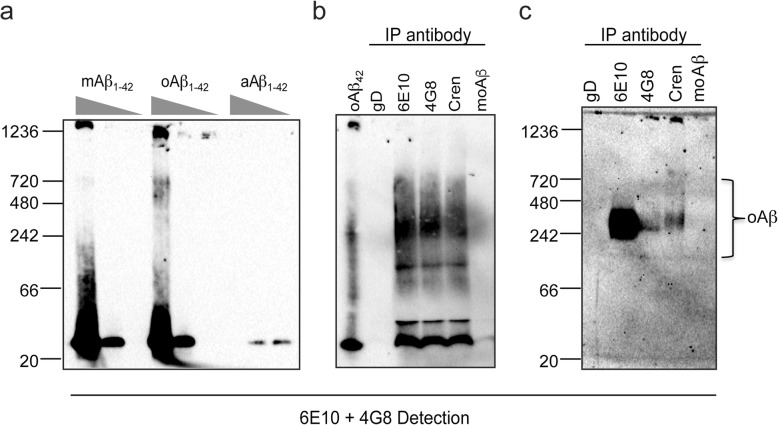
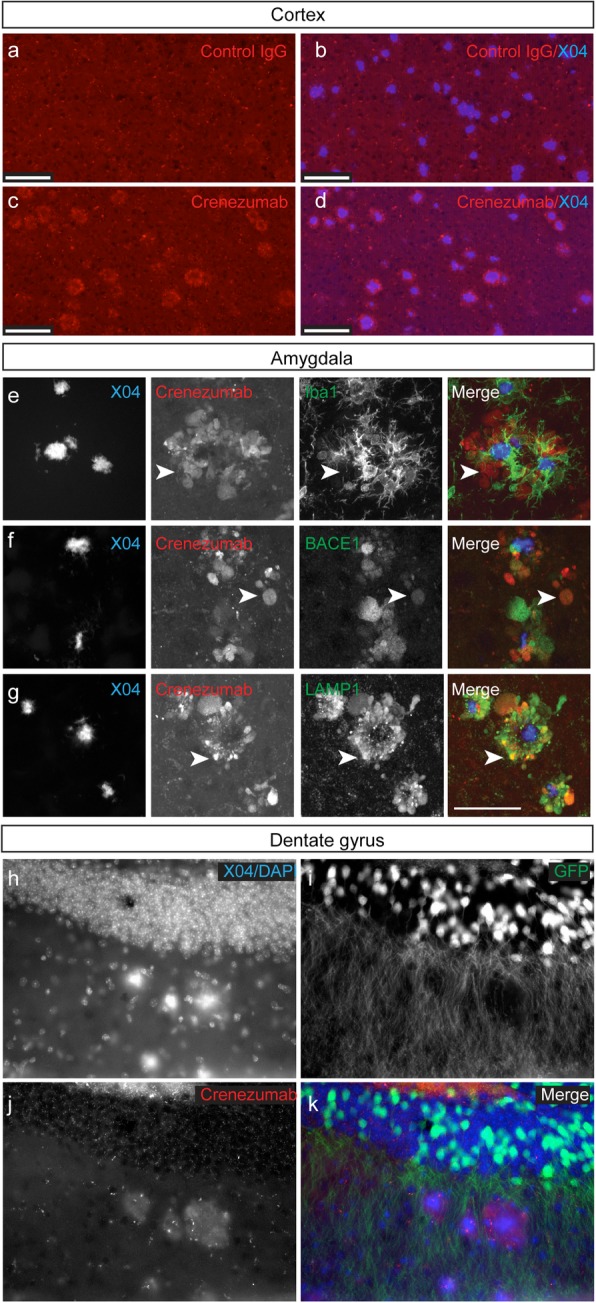
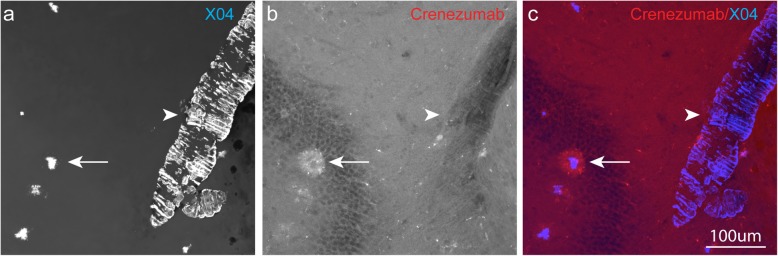
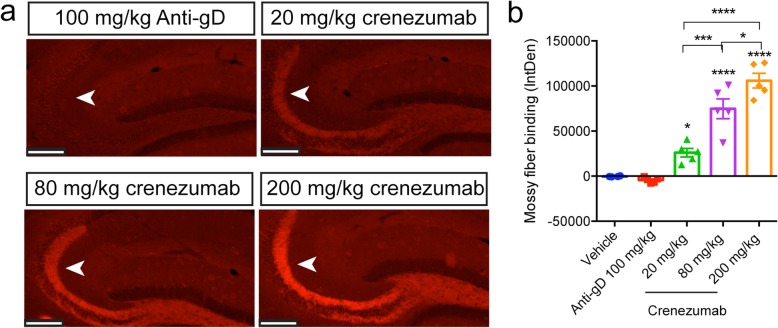
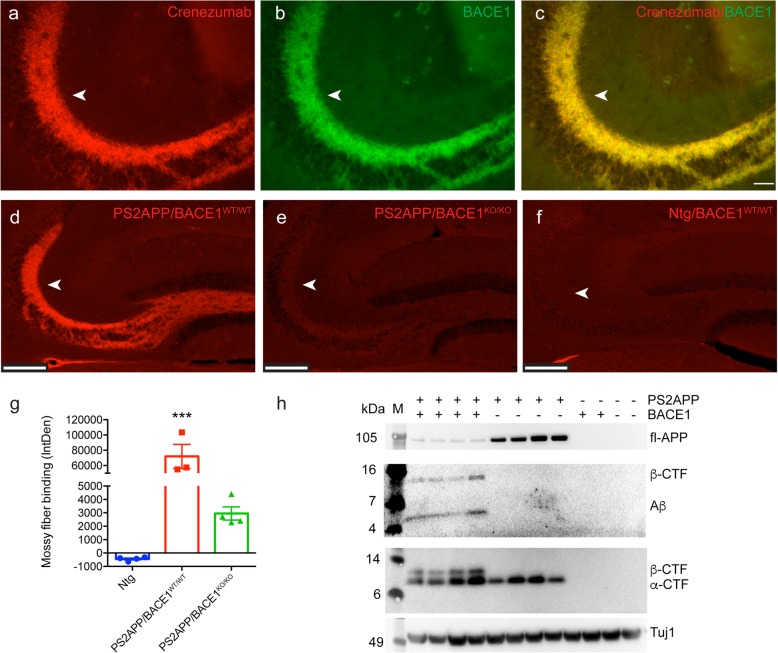
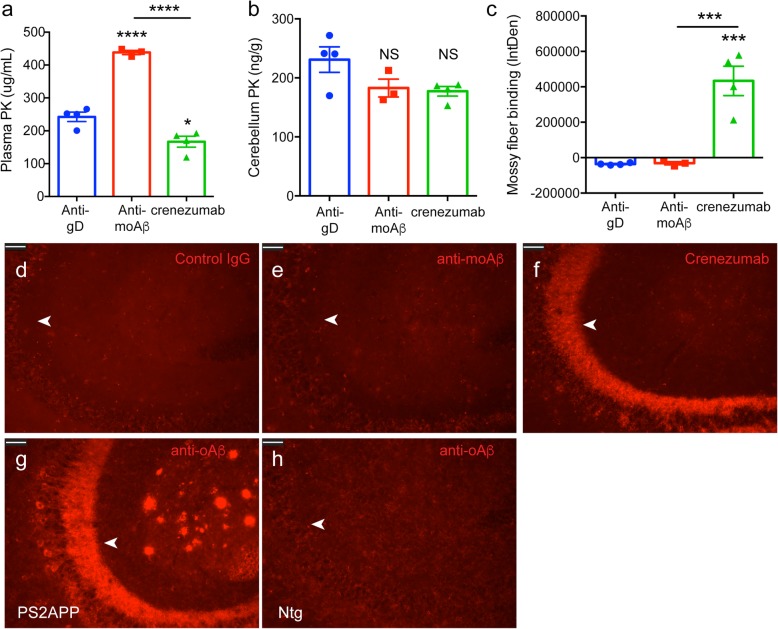
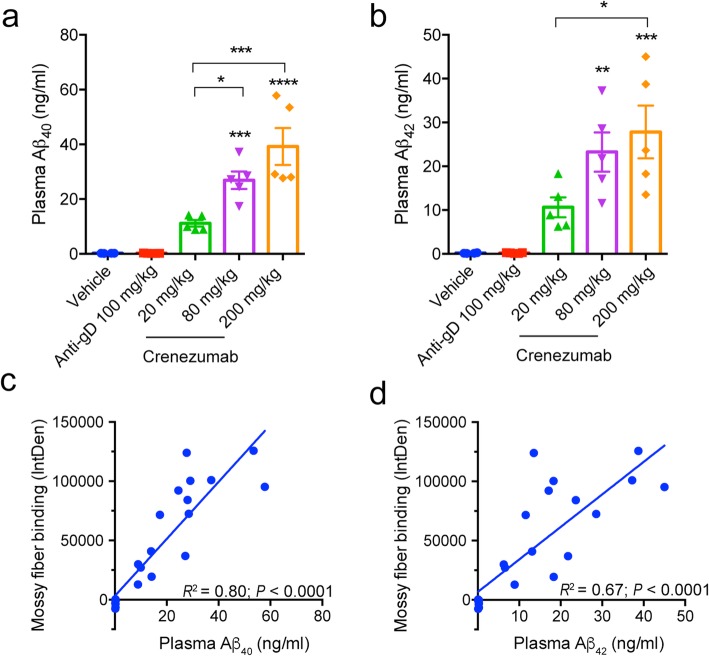
Background: Accumulation of amyloid β (Aβ) in the brain is proposed as a cause of Alzheimer’s disease (AD), with Aβ oligomers hypothesized to be the primary mediators of neurotoxicity. Crenezumab is a humanized immunoglobulin G4 monoclonal antibody that has been shown to bind to synthetic monomeric and aggregated Aβ in vitro; however, less is known about the binding characteristic in vivo. In this study, we evaluated the binding patterns of crenezumab to synthetic and native forms of Aβ both in vitro and in vivo. Methods: Crenezumab was used to immunoprecipitate Aβ from synthetic Aβ preparations or brain homogenates from a PS2APP mouse model of AD to determine the forms of Aβ that crenezumab interacts with. Following systemic dosing in PS2APP or nontransgenic control mice, immunohistochemistry was used to localize crenezumab and assess its relative distribution in the brain, compared with amyloid plaques and markers of neuritic dystrophies (BACE1; LAMP1). Pharmacodynamic correlations were performed to investigate the relationship between peripheral and central target engagement. Results: In vitro, crenezumab immunoprecipitated Aβ oligomers from both synthetic Aβ preparations and endogenous brain homogenates from PS2APP mice. In vivo studies in the PS2APP mouse showed that crenezumab localizes to regions surrounding the periphery of amyloid plaques in addition to the hippocampal mossy fibers. These regions around the plaques are reported to be enriched in oligomeric Aβ, actively incorporate soluble Aβ, and contribute to Aβ-induced neurotoxicity and axonal dystrophy. In addition, crenezumab did not appear to bind to the dense core region of plaques or vascular amyloid. Conclusions: Crenezumab binds to multiple forms of amyloid β (Aβ), particularly oligomeric forms, and localizes to brain areas rich in Aβ oligomers, including the halo around plaques and hippocampal mossy fibers, but not to vascular Aβ. These insights highlight a unique mechanism of action for crenezumab of engaging Aβ oligomers.
Overview
The claims and statistics of this paper haven’t been checked yet.
Free: it reads the open-access text and checks the first 5 claims that cite a source we can check. Create a free account to check every claim.
Integrity signals
Registry
Cites
Statistics
Figures
Verification
Claims the paper makes
The claims and statistics of this paper haven’t been checked yet.
Free: it reads the open-access text and checks the first 5 claims that cite a source we can check. Create a free account to check every claim.
Claims other papers make about this one
Each is checked against this paper’s own text: does it say what the citing paper says it does?
The source backs part of the claim, not all of it — or backs it for a different population, condition or comparison.
In the citing paper
“Similar to gantenerumab, crenezumab also recognizes multiple forms of Aβ aggregates. It has high affinity with the oligomeric and fibril species and amyloid plaques.339,340”
From Amyloid β-based therapy for Alzheimer’s disease: Challenges, successes and future (2023) · cites this paper as [340]
Experimental — accuracy not yet measured
Self-check
Percentages, sums and reported differences re-computed from the paper’s own numbers.
The self-check needs the paper’s full text.
Citations
Cites
1 retracted
RETRACTED ARTICLE: A specific amyloid-β protein assembly in the brain impairs memory
Lesné, S., Koh, M. T., Kotilinek, L., Kayed, R., Glabe, C. G., Yang, A., Gallagher, M., & Ashe, K. H. (2006) · Nature · doi:10.1038/nature04533 · Cited by 2,769
RetractedAmyloid oligomers exacerbate tau pathology in a mouse model of tauopathy
Selenica, M.-L. B., Brownlow, M., Jimenez, J. P., Lee, D. C., Pena, G., Dickey, C. A., Gordon, M. N., & Morgan, D. (2013) · Neurodegenerative Diseases · doi:10.1159/000337230 · Cited by 10,359
The amyloid hypothesis of Alzheimer's disease at 25 years
Selkoe, D. J., & Hardy, J. (2016) · EMBO Molecular Medicine · doi:10.15252/emmm.201606210 · Cited by 6,164
Soluble protein oligomers in neurodegeneration: lessons from the Alzheimer's amyloid β-peptide
Haass, C., & Selkoe, D. J. (2007) · Nature Reviews Molecular Cell Biology · doi:10.1038/nrm2101 · Cited by 4,744
Shankar, G. M., Li, S., Mehta, T. H., Garcia-Munoz, A., Shepardson, N. E., Smith, I., Brett, F. M., Farrell, M. A., Rowan, M. J., Lemere, C. A., et al. (2008) · Nature Medicine · doi:10.1038/nm1782 · Cited by 3,685
The antibody aducanumab reduces Aβ plaques in Alzheimer’s disease
Sevigny, J., Chiao, P., Bussière, T., Weinreb, P. H., Williams, L., Maier, M., Dunstan, R., Salloway, S., Chen, T., Ling, Y., et al. (2016) · Nature · doi:10.1038/nature19323 · Cited by 3,059
Imaging Neuronal Subsets in Transgenic Mice Expressing Multiple Spectral Variants of GFP
Feng, G., Mellor, R. H., Bernstein, M., Keller-Peck, C., Nguyen, Q. T., Wallace, M., Nerbonne, J. M., Lichtman, J. W., & Sanes, J. R. (2000) · Neuron · doi:10.1016/s0896-6273(00)00084-2 · Cited by 3,042
The toxic Aβ oligomer and Alzheimer's disease: an emperor in need of clothes
Benilova, I., Karran, E., & De Strooper, B. (2012) · Nature Neuroscience · doi:10.1038/nn.3028 · Cited by 1,962
Aβ Oligomers – a decade of discovery
Walsh, D. M., & Selkoe, D. J. (2007) · Journal of Neurochemistry · doi:10.1111/j.1471-4159.2006.04426.x · Cited by 1,938
Mucke, L., Masliah, E., Yu, G.-Q., Mallory, M., Rockenstein, E. M., Tatsuno, G., Hu, K., Kholodenko, D., Johnson-Wood, K., & McConlogue, L. (2000) · The Journal of Neuroscience · doi:10.1523/jneurosci.20-11-04050.2000 · Cited by 1,856
Cited by
Amyloid β-based therapy for Alzheimer’s disease: Challenges, successes and future
Zhang, Y., Chen, H., Li, R., Sterling, K., & Song, W. (2023) · Signal Transduction and Targeted Therapy · doi:10.1038/s41392-023-01484-7 · Cited by 988
“It has high affinity with the oligomeric and fibril species and amyloid plaques.(339,340) Crenezumab is being tested in both prevention and treatment paradigms.”
BackgroundThe amyloid hypothesis in Alzheimer disease: new insights from new therapeutics
Karran, E., & De Strooper, B. (2022) · Nature Reviews Drug Discovery · doi:10.1038/s41573-022-00391-w · Cited by 742
“Crenezumab does not bind avidly to amyloid plaques when administered to transgenic PS2APP mice 51 , and therefore we consider that crenezumab’s primary target is monomeric A β .”
Ostrowitzki, S., Bittner, T., Sink, K. M., Mackey, H., Rabe, C., Honig, L. S., Cassetta, E., Woodward, M., Boada, M., van Dyck, C. H., et al. (2022) · JAMA Neurology · doi:10.1001/jamaneurol.2022.2909 · Cited by 229
Meilandt, W. J., Ngu, H., Gogineni, A., Lalehzadeh, G., Lee, S.-H., Srinivasan, K., Imperio, J., Wu, T., Weber, M., Kruse, A. J., et al. (2020) · The Journal of Neuroscience · doi:10.1523/jneurosci.1871-19.2019 · Cited by 210
“As a control, we spotted hippocampal TBS homogenate supernatant from a PS2APP;Bace1 ko animal (Meilandt et al., 2019), in which soluble APP is still produced by -cleavage while -cleavage and thus A production are prevented, and demonstrated that the OC antibody had minimal detection, whereas 6E10…”
MethodSelf-citationSalloway, S., Honigberg, L. A., Cho, W., Ward, M., Friesenhahn, M., Brunstein, F., Quartino, A., Clayton, D., Mortensen, D., Bittner, T., et al. (2018) · Alzheimer's Research & Therapy · doi:10.1186/s13195-018-0424-5 · Cited by 151
Self-citation
Metadata
- Authors
- Meilandt, W. J., Maloney, J. A., Imperio, J., Lalehzadeh, G., Earr, T., Crowell, S., Bainbridge, T. W., Lu, Y., Ernst, J. A., Fuji, R. N., & Atwal, J. K.
- Affiliations
- Genentech (US)
- Corresponding author
- Atwal, Jasvinder K.
- ORCID
- Venue
- Alzheimer's Research & Therapy
- Published
- 2019-12
- Volume
- 11
- Issue
- 1
- Pages
- 97-97
- ISSN
- 1758-9193 (ISSN-L)
- PMC
- PMC6886224
- OpenAlex
- W2990584674
- Cited by
- 45
- References
- 62
- Citations by year
- 2026: 7 · 2025: 8 · 2024: 9 · 2023: 11 · 2022: 5 · 2020: 4
- FWCI
- 1.54
- Type
- journal article
- Language
- en
- Open access
- gold
- doi.org
- Licence
- cc-by
- creativecommons.org/licenses/by/4.0/ (tdm)
- creativecommons.org/licenses/by/4.0/ (vor)
- Locations
- Alzheimer s Research & Therapy (publishedVersion, cc-by)
- PubMed Central (publishedVersion, cc-by)
- PubMed (publishedVersion)
- DOAJ (DOAJ: Directory of Open Access Journals) (submittedVersion)
- Funders
- F. Hoffmann-La Roche (n/a)
- Topics
- Life Sciences › Neuroscience › Cellular and Molecular Neuroscience › Alzheimer's disease research and treatments
- Health Sciences › Medicine › Psychiatry and Mental health › Dementia and Cognitive Impairment Research
- Life Sciences › Neuroscience › Neurology › Neuroinflammation and Neurodegeneration Mechanisms
- Keywords
- crenezumab, amyloid-beta oligomers, Alzheimer's disease, amyloid plaques, monoclonal antibody binding, target engagement, hippocampal mossy fibers, axonal dystrophy, BACE1, LAMP1, vascular amyloid, immunoprecipitation, pharmacodynamics
- MeSH terms
- Alzheimer Disease, Animals, Brain, Mice, Transgenic, Protein Binding, Amyloid beta-Peptides, Mice, Plaque, Amyloid, Antibodies, Monoclonal, Humanized
About these checks
Registry, retraction, Cites and statistics results are computed, not judged, with one exception: a printed reference that no index lists is read once by a model before it counts as a citation error. Claims are extracted by a model and kept only when their quote appears verbatim in the text; each cited source is then checked, with a model’s help, for whether it says what the claim relies on. Those verdicts can be wrong — read the claim’s quote and the cited source before relying on one.
Statistics and arithmetic are recomputed, not judged.
Confidence bands are shown only for fields calibrated on our annotated test set. None is calibrated yet, so no band is shown.
What counts as a claim ›How we measure confidence ›How we check this ›
Are you an author, or do you see a problem with this page? Request a review
How to cite
Cite CoChat for the checks on this page, and the paper for its own findings.
- This page
- CoChat. (2026). Citation check: Characterization of the selective in vitro and in vivo binding properties of crenezumab to oligomeric Aβ. https://app.cochat.ai/papers/10.1186/s13195-019-0553-5
- The paper
- Meilandt, W. J., Maloney, J. A., Imperio, J., Lalehzadeh, G., Earr, T., Crowell, S., Bainbridge, T. W., Lu, Y., Ernst, J. A., Fuji, R. N., & Atwal, J. K. (2019). Characterization of the selective in vitro and in vivo binding properties of crenezumab to oligomeric Aβ. Alzheimer's Research & Therapy. https://doi.org/10.1186/s13195-019-0553-5
Data sources
Bibliographic data: Semantic Scholar, OpenAlex, Crossref.
Contains information from the Semantic Scholar Academic Graph Datasets, made available under the ODC Attribution License (ODC-BY 1.0).
Semantic Scholar’s data is described in: Kinney, R., et al. (2023). The Semantic Scholar Open Data Platform. arXiv:2301.10140.
