

Testing a MultiTEP-based combination vaccine to reduce Aβ and tau pathology in Tau22/5xFAD bigenic mice
Open accessThe DOI matches its Crossref record; 63 of the 63 references it cites were found in a registry or an index.
Abstract
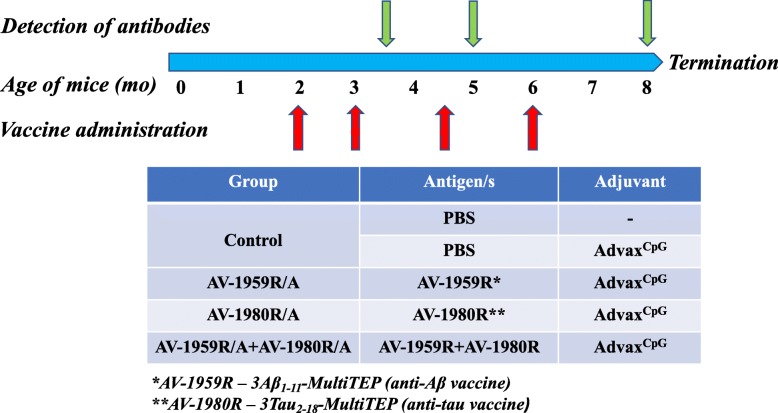
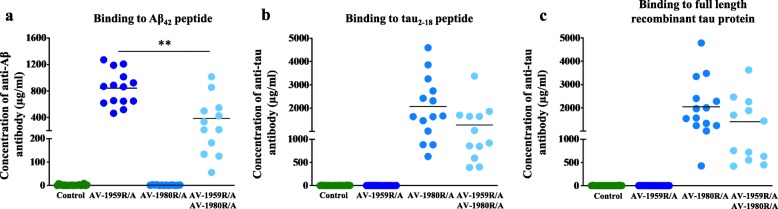
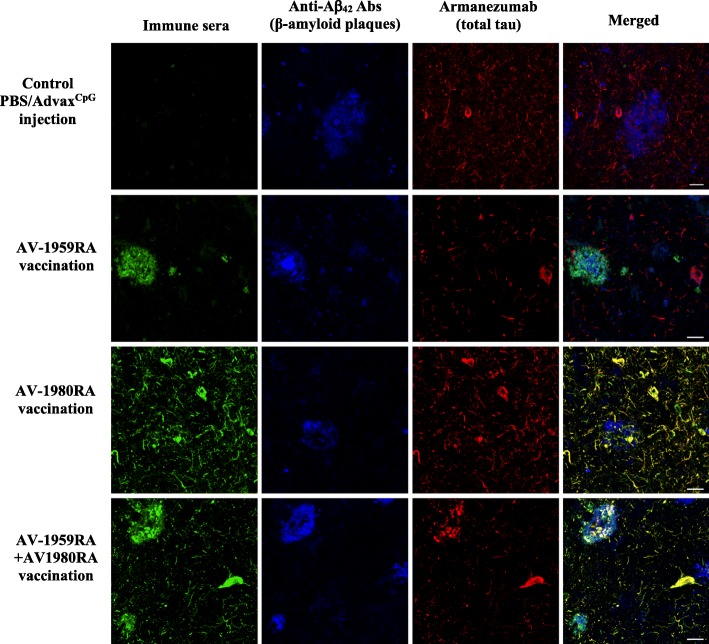
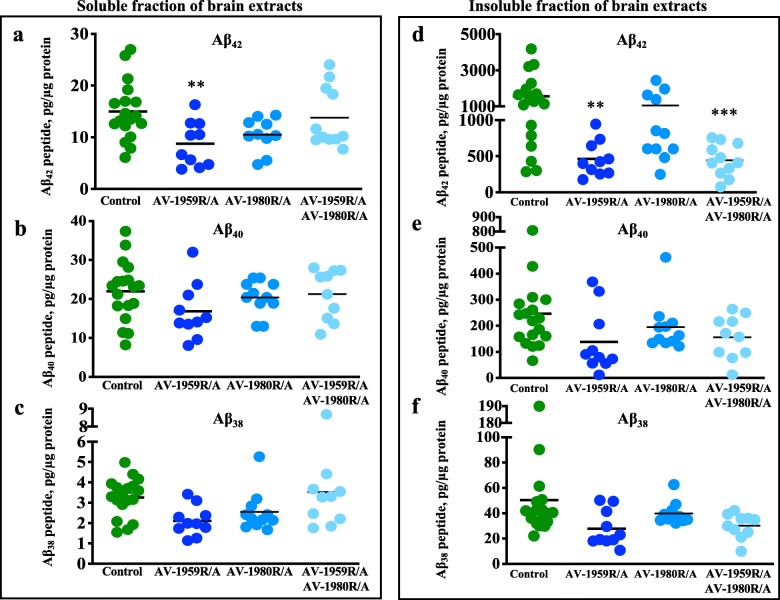
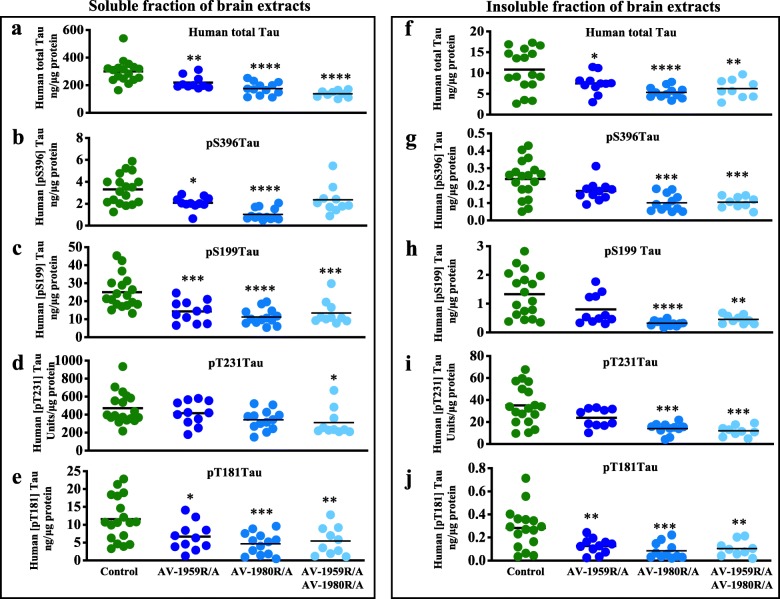
Background: Alzheimer disease (AD) is characterized by the accumulation of beta-amyloid (Aβ) plaques and neurofibrillary tangles composed of hyperphosphorylated tau, which together lead to neurodegeneration and cognitive decline. Current therapeutic approaches have primarily aimed to reduce pathological aggregates of either Aβ or tau, yet phase 3 clinical trials of these approaches have thus far failed to delay disease progression in humans. Strong preclinical evidence indicates that these two abnormally aggregated proteins interact synergistically to drive downstream neurodegeneration. Therefore, combinatorial therapies that concurrently target both Aβ and tau might be needed for effective disease modification. Methods: A combinatorial vaccination approach was designed to concurrently target both Aβ and tau pathologies. Tau22/5xFAD (T5x) bigenic mice that develop both pathological Aβ and tau aggregates were injected intramuscularly with a mixture of two MultiTEP epitope vaccines: AV-1959R and AV-1980R, targeting Aβ and tau, respectively, and formulated in Advax CpG , a potent polysaccharide adjuvant. Antibody responses of vaccinated animals were measured by ELISA, and neuropathological changes were determined in brain homogenates of vaccinated and control mice using ELISA and Meso Scale Discovery (MSD) multiplex assays. Results: T5x mice immunized with a mixture of Aβ- and tau-targeting vaccines generated high Aβ- and tau-specific antibody titers that recognized senile plaques and neurofibrillary tangles/neuropil threads in human AD brain sections. Production of these antibodies in turn led to significant reductions in the levels of soluble and insoluble total tau, and hyperphosphorylated tau as well as insoluble Aβ 42 , within the brains of bigenic T5x mice. Conclusions: AV-1959R and AV-1980R formulated with Advax CpG adjuvant are immunogenic and therapeutically potent vaccines that in combination can effectively reduce both of the hallmark pathologies of AD in bigenic mice. Taken together, these findings warrant further development of this vaccine technology for ultimate testing in human AD.
Overview
The claims and statistics of this paper haven’t been checked yet.
Free: it reads the open-access text and checks the first 5 claims that cite a source we can check. Create a free account to check every claim.
Integrity signals
Registry
Cites
Statistics
Figures
Verification
Claims the paper makes
The claims and statistics of this paper haven’t been checked yet.
Free: it reads the open-access text and checks the first 5 claims that cite a source we can check. Create a free account to check every claim.
Claims other papers make about this one
Each is checked against this paper’s own text: does it say what the citing paper says it does?
In the citing paper
“Passive immunotherapy prevents some issues of the active immunization by using monoclonal antibodies (mAbs) directly targeting different forms of Aβ peptides, including monomers, oligomers and fibrils to inhibit the formation of toxic aggregates.328–331”
From Amyloid β-based therapy for Alzheimer’s disease: Challenges, successes and future (2023) · cites this paper as [329]
Self-check
Percentages, sums and reported differences re-computed from the paper’s own numbers.
The self-check needs the paper’s full text.
Citations
Cites
NIA‐AA Research Framework: Toward a biological definition of Alzheimer's disease
Jack, C. R., Bennett, D. A., Blennow, K., Carrillo, M. C., Dunn, B., Haeberlein, S. B., Holtzman, D. M., Jagust, W., Jessen, F., Karlawish, J., et al. (2018) · Alzheimer's & Dementia · doi:10.1016/j.jalz.2018.02.018 · Cited by 10,537
Pushko, P., Pumpens, P., & Grens, E. (2013) · Intervirology · doi:10.1159/000346773 · Cited by 5,950
Hypothetical model of dynamic biomarkers of the Alzheimer's pathological cascade
Jack, C. R., Knopman, D. S., Jagust, W. J., Shaw, L. M., Aisen, P. S., Weiner, M. W., Petersen, R. C., & Trojanowski, J. Q. (2010) · The Lancet Neurology · doi:10.1016/s1474-4422(09)70299-6 · Cited by 4,806
Jack, C. R., Knopman, D. S., Jagust, W. J., Petersen, R. C., Weiner, M. W., Aisen, P. S., Shaw, L. M., Vemuri, P., Wiste, H. J., Weigand, S. D., et al. (2013) · The Lancet Neurology · doi:10.1016/s1474-4422(12)70291-0 · Cited by 4,396
Triple-Transgenic Model of Alzheimer’s Disease with Plaques and Tangles
Oddo, S., Caccamo, A., Shepherd, J. D., Murphy, M. P., Golde, T. E., Kayed, R., Metherate, R., Mattson, M. P., Akbari, Y., & LaFerla, F. M. (2003) · Neuron · doi:10.1016/s0896-6273(03)00434-3 · Cited by 4,126
Oakley, H., Cole, S. L., Logan, S., Maus, E., Shao, P., Craft, J., Guillozet-Bongaarts, A., Ohno, M., Disterhoft, J., Van Eldik, L., et al. (2006) · The Journal of Neuroscience · doi:10.1523/jneurosci.1202-06.2006 · Cited by 3,530
The antibody aducanumab reduces Aβ plaques in Alzheimer’s disease
Sevigny, J., Chiao, P., Bussière, T., Weinreb, P. H., Williams, L., Maier, M., Dunstan, R., Salloway, S., Chen, T., Ling, Y., et al. (2016) · Nature · doi:10.1038/nature19323 · Cited by 3,059
Nelson, P. T., Alafuzoff, I., Bigio, E. H., Bouras, C., Braak, H., Cairns, N. J., Castellani, R. J., Crain, B. J., Davies, P., Tredici, K. D., et al. (2012) · Journal of Neuropathology & Experimental Neurology · doi:10.1097/nen.0b013e31825018f7 · Cited by 2,050
Single App knock-in mouse models of Alzheimer’s disease
Saito, T., Matsuba, Y., Mihira, N., Takano, J., Nilsson, P., Itohara, S., Iwata, N., & Saido, T. C. (2014) · Nature Neuroscience · doi:10.1038/nn.3697 · Cited by 1,366
Immunosenescence and Inflamm-Aging As Two Sides of the Same Coin: Friends or Foes?
Fulop, T., Larbi, A., Dupuis, G., Le Page, A., Frost, E. H., Cohen, A. A., Witkowski, J. M., & Franceschi, C. (2018) · Frontiers in Immunology · doi:10.3389/fimmu.2017.01960 · Cited by 1,364
Association of Amyloid and Tau With Cognition in Preclinical Alzheimer Disease: A Longitudinal Study
Hanseeuw, B. J., Betensky, R. A., Jacobs, H. I. L., Schultz, A. P., Sepulcre, J., Becker, J. A., Cosio, D. M. O., Farrell, M., Quiroz, Y. T., Mormino, E. C., et al. (2019) · JAMA Neurology · doi:10.1001/jamaneurol.2019.1424 · Cited by 865
Neural stem cells improve cognition via BDNF in a transgenic model of Alzheimer disease
Blurton-Jones, M., Kitazawa, M., Martinez-Coria, H., Castello, N. A., Müller, F.-J., Loring, J. F., Yamasaki, T. R., Poon, W. W., Green, K. N., & LaFerla, F. M. (2009) · Proceedings of the National Academy of Sciences · doi:10.1073/pnas.0901402106 · Cited by 860
Self-citationAPP mouse models for Alzheimer’s disease preclinical studies.
Sasaguri, H., Nilsson, P., Hashimoto, S., Nagata, K., Saito, T., De Strooper, B., Hardy, J., Vassar, R., Winblad, B., & Saido, T. C. (2017) · The EMBO Journal · doi:10.15252/embj.201797397 · Cited by 793
Tau pathology and neurodegeneration contribute to cognitive impairment in Alzheimer’s disease
Bejanin, A., Schonhaut, D. R., La Joie, R., Kramer, J. H., Baker, S. L., Sosa, N., Ayakta, N., Cantwell, A., Janabi, M., Lauriola, M., et al. (2017) · Brain · doi:10.1093/brain/awx243 · Cited by 778
Rinne, J. O., Brooks, D. J., Rossor, M. N., Fox, N. C., Bullock, R., Klunk, W. E., Mathis, C. A., Blennow, K., Barakos, J., Okello, A. A., et al. (2010) · The Lancet Neurology · doi:10.1016/s1474-4422(10)70043-0 · Cited by 701
Kaufman, S. K., Sanders, D. W., Thomas, T. L., Ruchinskas, A. J., Vaquer-Alicea, J., Sharma, A. M., Miller, T. M., & Diamond, M. I. (2016) · Neuron · doi:10.1016/j.neuron.2016.09.055 · Cited by 450
Marsh, S. E., Abud, E. M., Lakatos, A., Karimzadeh, A., Yeung, S. T., Davtyan, H., Fote, G. M., Lau, L., Weinger, J. G., Lane, T. E., et al. (2016) · Proceedings of the National Academy of Sciences · doi:10.1073/pnas.1525466113 · Cited by 411
Self-citationSchindowski, K., Bretteville, A., Leroy, K., Bégard, S., Brion, J.-P., Hamdane, M., & Buée, L. (2006) · The American Journal of Pathology · doi:10.2353/ajpath.2006.060002 · Cited by 395
Parsons, C. G., Danysz, W., Dekundy, A., & Pulte, I. (2013) · Neurotoxicity Research · doi:10.1007/s12640-013-9398-z · Cited by 331
Cognitive deficits in single App knock-in mouse models
Masuda, A., Kobayashi, Y., Kogo, N., Saito, T., Saido, T. C., & Itohara, S. (2016) · Neurobiology of Learning and Memory · doi:10.1016/j.nlm.2016.07.001 · Cited by 248
Saito, T., Mihira, N., Matsuba, Y., Sasaguri, H., Hashimoto, S., Narasimhan, S., Zhang, B., Murayama, S., Higuchi, M., Lee, V. M. Y., et al. (2019) · Journal of Biological Chemistry · doi:10.1074/jbc.ra119.009487 · Cited by 248
Alzheimer disease and aducanumab: adjusting our approach
Selkoe, D. J. (2019) · Nature Reviews Neurology · doi:10.1038/s41582-019-0205-1 · Cited by 208
Wiessner, C., Wiederhold, K.-H., Tissot, A. C., Frey, P., Danner, S., Jacobson, L. H., Jennings, G. T., Luond, R., Ortmann, R., Reichwald, J., et al. (2011) · Journal of Neuroscience · doi:10.1523/jneurosci.0293-11.2011 · Cited by 190
Novel Approaches for the Treatment of Alzheimer’s and Parkinson’s Disease
Van Bulck, M., Sierra-Magro, A., Alarcon-Gil, J., Perez-Castillo, A., & Morales-Garcia, J. A. (2019) · International Journal of Molecular Sciences · doi:10.3390/ijms20030719 · Cited by 178
Local and distant relationships between amyloid, tau and neurodegeneration in Alzheimer's Disease
Iaccarino, L., Tammewar, G., Ayakta, N., Baker, S. L., Bejanin, A., Boxer, A. L., Gorno-Tempini, M. L., Janabi, M., Kramer, J. H., Lazaris, A., et al. (2018) · NeuroImage: Clinical · doi:10.1016/j.nicl.2017.09.016 · Cited by 165
UB‐311, a novel UBITh ® amyloid β peptide vaccine for mild Alzheimer's disease
Wang, C. Y., Wang, P., Chiu, M., Finstad, C. L., Lin, F., Lynn, S., Tai, Y., De Fang, X., Zhao, K., Hung, C., et al. (2017) · Alzheimer's & Dementia: Translational Research & Clinical Interventions · doi:10.1016/j.trci.2017.03.005 · Cited by 150
Petrovsky, N., & Cooper, P. D. (2015) · Vaccine · doi:10.1016/j.vaccine.2015.09.030 · Cited by 141
Self-citationActive Aβ immunotherapy CAD106 in Alzheimer's disease: A phase 2b study
Vandenberghe, R., Riviere, M., Caputo, A., Sovago, J., Maguire, R. P., Farlow, M., Marotta, G., Sanchez‐Valle, R., Scheltens, P., Ryan, J. M., et al. (2017) · Alzheimer's & Dementia: Translational Research & Clinical Interventions · doi:10.1016/j.trci.2016.12.003 · Cited by 141
Webster, S. J., Bachstetter, A. D., & Van Eldik, L. J. (2013) · Alzheimer's Research & Therapy · doi:10.1186/alzrt182 · Cited by 139
Initiative, F. T. A. D. N., Pascoal, T. A., Mathotaarachchi, S., Mohades, S., Benedet, A. L., Chung, C.-O., Shin, M., Wang, S., Beaudry, T., Kang, M. S., et al. (2017) · Molecular Psychiatry · doi:10.1038/mp.2016.37 · Cited by 133
Davtyan, H., Ghochikyan, A., Petrushina, I., Hovakimyan, A., Davtyan, A., Poghosyan, A., Marleau, A. M., Movsesyan, N., Kiyatkin, A., Rasool, S., et al. (2013) · The Journal of Neuroscience · doi:10.1523/jneurosci.4672-12.2013 · Cited by 112
Self-citationRecent therapeutic strategies targeting beta amyloid and tauopathies in Alzheimer's disease
Madav, Y., Wairkar, S., & Prabhakar, B. (2019) · Brain Research Bulletin · doi:10.1016/j.brainresbull.2019.01.004 · Cited by 111
Gordon, D. L., Sajkov, D., Woodman, R. J., Honda-Okubo, Y., Cox, M. M. J., Heinzel, S., & Petrovsky, N. (2012) · Vaccine · doi:10.1016/j.vaccine.2012.06.009 · Cited by 110
Self-citationMovsesyan, N., Ghochikyan, A., Mkrtichyan, M., Petrushina, I., Davtyan, H., Olkhanud, P. B., Head, E., Biragyn, A., Cribbs, D. H., & Agadjanyan, M. G. (2008) · PLoS ONE · doi:10.1371/journal.pone.0002124 · Cited by 101
Self-citationSynergistic interaction between amyloid and tau predicts the progression to dementia
Pascoal, T. A., Mathotaarachchi, S., Shin, M., Benedet, A. L., Mohades, S., Wang, S., Beaudry, T., Kang, M. S., Soucy, J., Labbe, A., et al. (2017) · Alzheimer's & Dementia · doi:10.1016/j.jalz.2016.11.005 · Cited by 101
Frenkel, D., Balass, M., & Solomon, B. (1998) · Journal of Neuroimmunology · doi:10.1016/s0165-5728(98)00098-8 · Cited by 97
Mamikonyan, G., Necula, M., Mkrtichyan, M., Ghochikyan, A., Petrushina, I., Movsesyan, N., Mina, E., Kiyatkin, A., Glabe, C. G., Cribbs, D. H., et al. (2007) · Journal of Biological Chemistry · doi:10.1074/jbc.m700088200 · Cited by 93
Self-citationImmunotherapies for Aging-Related Neurodegenerative Diseases—Emerging Perspectives and New Targets
Kwon, S., Iba, M., Kim, C., & Masliah, E. (2020) · Neurotherapeutics · doi:10.1007/s13311-020-00853-2 · Cited by 93
Petrushina, I., Ghochikyan, A., Mktrichyan, M., Mamikonyan, G., Movsesyan, N., Davtyan, H., Patel, A., Head, E., Cribbs, D. H., & Agadjanyan, M. G. (2007) · The Journal of Neuroscience · doi:10.1523/jneurosci.3201-07.2007 · Cited by 92
Self-citationGordon, D., Kelley, P., Heinzel, S., Cooper, P., & Petrovsky, N. (2014) · Vaccine · doi:10.1016/j.vaccine.2014.09.034 · Cited by 91
Self-citationMo, J., Li, J., Yang, Z., Liu, Z., & Feng, J. (2017) · Annals of Clinical and Translational Neurology · doi:10.1002/acn3.469 · Cited by 90
Cognitive and emotional alterations in App knock-in mouse models of Aβ amyloidosis
Sakakibara, Y., Sekiya, M., Saito, T., Saido, T. C., & Iijima, K. M. (2018) · BMC Neuroscience · doi:10.1186/s12868-018-0446-8 · Cited by 90
Combs, B., Hamel, C., & Kanaan, N. M. (2016) · Neurobiology of Disease · doi:10.1016/j.nbd.2016.05.016 · Cited by 86
Agadjanyan, M. G., Petrovsky, N., & Ghochikyan, A. (2015) · Alzheimer's & Dementia · doi:10.1016/j.jalz.2015.06.1884 · Cited by 64
Self-citationPanza, F., Lozupone, M., Dibello, V., Greco, A., Daniele, A., Seripa, D., Logroscino, G., & Imbimbo, B. P. (2019) · Immunotherapy · doi:10.2217/imt-2018-0119 · Cited by 60
Bapineuzumab: Anti-β-Amyloid Monoclonal Antibodies for the Treatment of Alzheimer‘s Disease
Panza, F., Frisardi, V., Imbimbo, B. P., D‘Onofrio, G., Pietrarossa, G., Seripa, D., Pilotto, A., & Solfrizzi, V. (2010) · Immunotherapy · doi:10.2217/imt.10.80 · Cited by 59
Agadjanyan, M. G., Zagorski, K., Petrushina, I., Davtyan, H., Kazarian, K., Antonenko, M., Davis, J., Bon, C., Blurton-Jones, M., Cribbs, D. H., et al. (2017) · Molecular Neurodegeneration · doi:10.1186/s13024-017-0172-1 · Cited by 53
Self-citationIncreased tauopathy drives microglia-mediated clearance of beta-amyloid
Chen, W., Abud, E. A., Yeung, S. T., Lakatos, A., Nassi, T., Wang, J., Blum, D., Buée, L., Poon, W. W., & Blurton-Jones, M. (2016) · Acta Neuropathologica Communications · doi:10.1186/s40478-016-0336-1 · Cited by 52
Self-citationEpitope‐based DNA vaccine for Alzheimer's disease: Translational study in macaques
Evans, C. F., Davtyan, H., Petrushina, I., Hovakimyan, A., Davtyan, A., Hannaman, D., Cribbs, D. H., Agadjanyan, M. G., & Ghochikyan, A. (2014) · Alzheimer's & Dementia · doi:10.1016/j.jalz.2013.04.505 · Cited by 49
Self-citationDavtyan, H., Zagorski, K., Rajapaksha, H., Hovakimyan, A., Davtyan, A., Petrushina, I., Kazarian, K., Cribbs, D. H., Petrovsky, N., Agadjanyan, M. G., et al. (2016) · Scientific Reports · doi:10.1038/srep28912 · Cited by 47
Self-citationDavtyan, H., Mkrtichyan, M., Movsesyan, N., Petrushina, I., Mamikonyan, G., Cribbs, D. H., Agadjanyan, M. G., & Ghochikyan, A. (2010) · Gene Therapy · doi:10.1038/gt.2009.140 · Cited by 44
Self-citationKokjohn, T., & Roher, A. (2009) · CNS & Neurological Disorders - Drug Targets · doi:10.2174/187152709787847315 · Cited by 42
Tarawneh, R., & Holtzman, D. (2009) · CNS & Neurological Disorders - Drug Targets · doi:10.2174/187152709787847324 · Cited by 40
Davtyan, H., Ghochikyan, A., Petrushina, I., Hovakimyan, A., Davtyan, A., Cribbs, D. H., & Agadjanyan, M. G. (2014) · Alzheimer's & Dementia · doi:10.1016/j.jalz.2013.12.003 · Cited by 36
Self-citationRefinement of a DNA based Alzheimer disease epitope vaccine in rabbits
Ghochikyan, A., Davtyan, H., Petrushina, I., Hovakimyan, A., Movsesyan, N., Davtyan, A., Kiyatkin, A., Cribbs, D. H., & Agadjanyan, M. G. (2013) · Human Vaccines & Immunotherapeutics · doi:10.4161/hv.23875 · Cited by 30
Self-citationDavtyan, H., Chen, W. W., Zagorski, K., Davis, J., Petrushina, I., Kazarian, K., Cribbs, D. H., Agadjanyan, M. G., Blurton-Jones, M., & Ghochikyan, A. (2017) · Vaccine · doi:10.1016/j.vaccine.2017.03.020 · Cited by 30
Self-citationSwanson, C. J., Zhang, Y., Dhadda, S., Wang, J., Kaplow, J., Lai, R. Y., Lannfelt, L., Kramer, L. D., & Luthman, J. (2018) · Alzheimer's & Dementia · doi:10.1016/j.jalz.2018.07.009 · Cited by 28
Synergistic Effect of Amyloid-β and Tau Disrupts Neural Circuits
Tripathi, T., & Kalita, P. (2019) · ACS Chemical Neuroscience · doi:10.1021/acschemneuro.9b00037 · Cited by 26
Petrushina, I., Davtyan, H., Hovakimyan, A., Davtyan, A., Passos, G. F., Cribbs, D. H., Ghochikyan, A., & Agadjanyan, M. G. (2017) · Molecular Therapy · doi:10.1016/j.ymthe.2016.10.002 · Cited by 20
Self-citationImmunotherapy – 2076. A controlled study of delta inulin-adjuvanted honey bee venom immunotherapy
Heddle, R. J., Russo, P., Petrovsky, N., Hanna, R., & Smith, A. (2013) · World Allergy Organization Journal · doi:10.1186/1939-4551-6-s1-p158 · Cited by 17
Self-citationDavtyan, H., Zagorski, K., Petrushina, I., Kazarian, K., Goldberg, N. R. S., Petrosyan, J., Blurton-Jones, M. M., Masliah, E., Cribbs, D. H., Agadjanyan, M. G., et al. (2017) · Neurobiology of Aging · doi:10.1016/j.neurobiolaging.2017.08.006 · Cited by 17
Self-citationAD Vaccines: Conclusions and Future Directions
Wisniewski, T. (2009) · CNS & Neurological Disorders - Drug Targets · doi:10.2174/187152709787847289 · Cited by 14
Davtyan, H., Hovakimyan, A., Zagorski, K., Davtyan, A., Petrushina, I., Agdashian, D., Murthy, V., Cribbs, D. H., Agadjanyan, M. G., & Ghochikyan, A. (2014) · Current Gene Therapy · doi:10.2174/1566523214666140522121427 · Cited by 12
Self-citation
Cited by
Amyloid β-based therapy for Alzheimer’s disease: Challenges, successes and future
Zhang, Y., Chen, H., Li, R., Sterling, K., & Song, W. (2023) · Signal Transduction and Targeted Therapy · doi:10.1038/s41392-023-01484-7 · Cited by 988
Microglial activation states and their implications for Alzheimer's Disease
Valiukas, Z., Tangalakis, K., Apostolopoulos, V., & Feehan, J. (2025) · The Journal of Prevention of Alzheimer s Disease · doi:10.1016/j.tjpad.2024.100013 · Cited by 200
Immunotherapies for Aging-Related Neurodegenerative Diseases—Emerging Perspectives and New Targets
Kwon, S., Iba, M., Kim, C., & Masliah, E. (2020) · Neurotherapeutics · doi:10.1007/s13311-020-00853-2 · Cited by 93
Harnessing human iPSC-microglia for CNS-wide delivery of disease-modifying proteins
Chadarevian, J. P., Davtyan, H., Chadarevian, A. L., Nguyen, J., Capocchi, J. K., Le, L., Escobar, A., Chadarevian, T., Mansour, K., Deynega, E., et al. (2025) · Cell Stem Cell · doi:10.1016/j.stem.2025.03.009 · Cited by 60
Self-citationRecent Developments in Microfluidic Technologies for Central Nervous System Targeted Studies
Teixeira, M. I., Amaral, M. H., Costa, P. C., Lopes, C. M., & Lamprou, D. A. (2020) · Pharmaceutics · doi:10.3390/pharmaceutics12060542 · Cited by 47
Metadata
- Authors
- Davtyan, H., Hovakimyan, A., Kiani Shabestari, S., Antonyan, T., Coburn, M. A., Zagorski, K., Chailyan, G., Petrushina, I., Svystun, O., Danhash, E., Petrovsky, N., Cribbs, D. H., Agadjanyan, M. G., Blurton-Jones, M., & Ghochikyan, A.
- Affiliations
- University of California, Irvine (US)
- Institute for Molecular Medicine (US)
- Flinders University (AU)
- Corresponding author
- Davtyan, Hayk
- ORCID
- Venue
- Alzheimer's Research & Therapy
- Published
- 2019-12
- Volume
- 11
- Issue
- 1
- Pages
- 107-107
- ISSN
- 1758-9193 (ISSN-L)
- PMC
- PMC6918571
- OpenAlex
- W2996673863
- Cited by
- 37
- References
- 63
- Citations by year
- 2026: 4 · 2025: 6 · 2024: 8 · 2023: 2 · 2022: 5 · 2021: 4 · 2020: 8
- FWCI
- 2.91
- Type
- journal article
- Language
- en
- Open access
- gold
- doi.org
- Licence
- cc-by
- creativecommons.org/licenses/by/4.0/ (tdm)
- creativecommons.org/licenses/by/4.0/ (vor, 16 d)
- Locations
- Alzheimer s Research & Therapy (publishedVersion, cc-by)
- Europe PMC (PubMed Central) (publishedVersion, cc-by)
- PubMed Central (publishedVersion, cc-by)
- PubMed (publishedVersion)
- eScholarship (California Digital Library) (submittedVersion, cc-by)
- DOAJ (DOAJ: Directory of Open Access Journals) (submittedVersion)
- Funders
- National Institutes of Health (R01-NS050895, R01-AG020241, U01-AG060965, R21-NS101504, R01-AG061895, RF1-AG048099, R01-AG055524, R01-AG056303, P50-AG016573, U01-AI061142, HHS-N272201400053C, HHS-N272200800039C)
- Topics
- Life Sciences › Neuroscience › Cellular and Molecular Neuroscience › Alzheimer's disease research and treatments
- Life Sciences › Neuroscience › Neurology › Neuroinflammation and Neurodegeneration Mechanisms
- Health Sciences › Medicine › Psychiatry and Mental health › Dementia and Cognitive Impairment Research
- Keywords
- Alzheimer's disease, combined vaccine, amyloid-beta, tau pathology, hyperphosphorylated tau, neurofibrillary tangles, amyloid plaques, anti-amyloid antibodies, anti-tau antibodies, immunotherapy
- MeSH terms
- Alzheimer Disease, Animals, Brain, Disease Models, Animal, Mice, Transgenic, Amyloid beta-Peptides, Neurofibrillary Tangles, tau Proteins, Alzheimer Vaccines, Mice
About these checks
Registry, retraction, Cites and statistics results are computed, not judged, with one exception: a printed reference that no index lists is read once by a model before it counts as a citation error. Claims are extracted by a model and kept only when their quote appears verbatim in the text; each cited source is then checked, with a model’s help, for whether it says what the claim relies on. Those verdicts can be wrong — read the claim’s quote and the cited source before relying on one.
Statistics and arithmetic are recomputed, not judged.
Confidence bands are shown only for fields calibrated on our annotated test set. None is calibrated yet, so no band is shown.
What counts as a claim ›How we measure confidence ›How we check this ›
Are you an author, or do you see a problem with this page? Request a review
Data sources
Bibliographic data: Semantic Scholar, OpenAlex, Crossref.
Contains information from the Semantic Scholar Academic Graph Datasets, made available under the ODC Attribution License (ODC-BY 1.0).
Semantic Scholar’s data is described in: Kinney, R., et al. (2023). The Semantic Scholar Open Data Platform. arXiv:2301.10140.
