

Herpesvirus infections and Alzheimer's disease: a mendelian randomization study
Open accessThe DOI matches its Crossref record; 44 of the 46 references it cites were found in a registry or an index.
Abstract
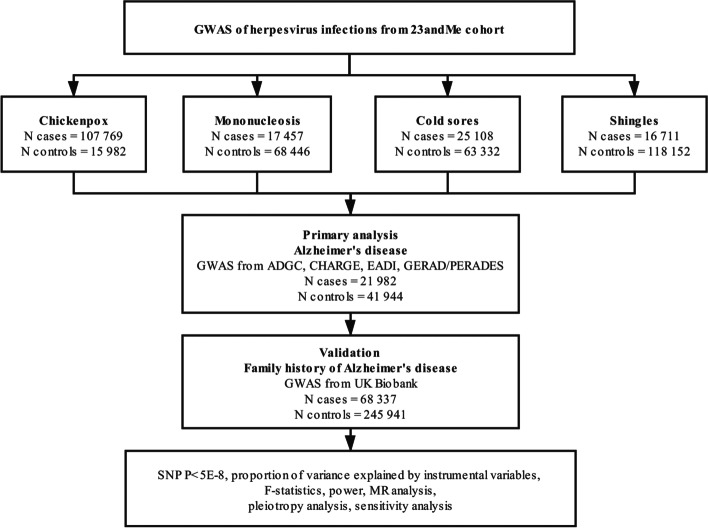
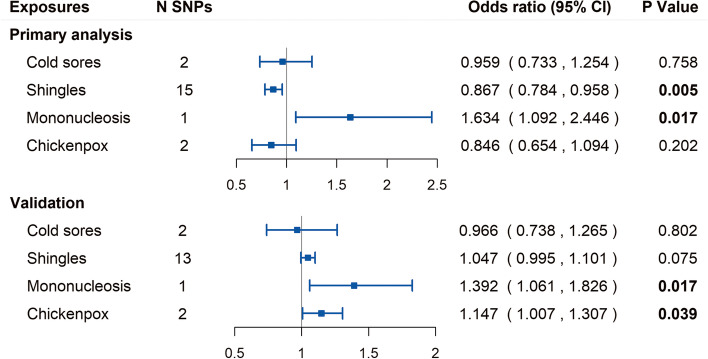
Background: Observational studies have suggested that herpesvirus infection increased the risk of Alzheimer’s disease (AD), but it is unclear whether the association is causal. The aim of the present study is to evaluate the causal relationship between four herpesvirus infections and AD. Methods: We performed a two-sample Mendelian randomization analysis to investigate association of four active herpesvirus infections with AD using summary statistics from genome-wide association studies. The four herpesvirus infections (i.e., chickenpox, shingles, cold sores, mononucleosis) are caused by varicella-zoster virus, herpes simplex virus type 1, and Epstein-Barr virus (EBV), respectively. A large summary statistics data from International Genomics of Alzheimer’s Project was used in primary analysis, including 21,982 AD cases and 41,944 controls. Validation was further performed using family history of AD data from UK Biobank (27,696 cases of maternal AD, 14,338 cases of paternal AD and 272,244 controls). Results: We found evidence of a significant association between mononucleosis (caused by EBV) and risk of AD after false discovery rates (FDR) correction (odds ratio [OR] = 1.634, 95% confidence interval [CI] = 1.092–2.446, P = 0.017, FDR-corrected P = 0.034). It has been verified in validation analysis that mononucleosis is also associated with family history of AD ( OR [95% CI] = 1.392 [1.061, 1.826], P = 0.017). Genetically predicted shingles were associated with AD risk (OR [95% CI] = 0.867 [0.784, 0.958], P = 0.005, FDR-corrected P = 0.020), while genetically predicted chickenpox was suggestively associated with increased family history of AD (OR [95% CI] = 1.147 [1.007, 1.307], P = 0.039). Conclusions: Our findings provided evidence supporting a positive relationship between mononucleosis and AD, indicating a causal link between EBV infection and AD. Further elucidations of this association and underlying mechanisms are likely to identify feasible interventions to promote AD prevention.
Overview
The claims and statistics of this paper haven’t been checked yet.
Free: it reads the open-access text and checks the first 5 claims that cite a source we can check. Create a free account to check every claim.
Integrity signals
Registry
Cites
Statistics
Figures
Verification
Claims the paper makes
The claims and statistics of this paper haven’t been checked yet.
Free: it reads the open-access text and checks the first 5 claims that cite a source we can check. Create a free account to check every claim.
Claims other papers make about this one
Each is checked against this paper’s own text: does it say what the citing paper says it does?
The source backs part of the claim, not all of it — or backs it for a different population, condition or comparison.
In the citing paper
“Several viruses and bacteria were associated with dementia risk and risk was elevated more in those with CNS infections but also with extra-CNS infection. (337, 341, 342) (337)”
From Dementia prevention, intervention, and care: 2024 report of the Lancet standing Commission (2024) · cites this paper as [342]
Experimental — accuracy not yet measured
Self-check
Percentages, sums and reported differences re-computed from the paper’s own numbers.
The self-check needs the paper’s full text.
Citations
Cites
Bowden, J., Davey Smith, G., & Burgess, S. (2015) · International Journal of Epidemiology · doi:10.1093/ije/dyv080 · Cited by 9,816
Bowden, J., Davey Smith, G., Haycock, P. C., & Burgess, S. (2016) · Genetic Epidemiology · doi:10.1002/gepi.21965 · Cited by 8,922
Verbanck, M., Chen, C.-Y., Neale, B., & Do, R. (2018) · Nature Genetics · doi:10.1038/s41588-018-0099-7 · Cited by 8,591
The MR-Base platform supports systematic causal inference across the human phenome
Hemani, G., Zheng, J., Elsworth, B., Wade, K. H., Haberland, V., Baird, D., Laurin, C., Burgess, S., Bowden, J., Langdon, R., et al. (2018) · eLife · doi:10.7554/elife.34408 · Cited by 7,959
Reading Mendelian randomisation studies: a guide, glossary, and checklist for clinicians
Davies, N. M., Holmes, M. V., & Davey Smith, G. (2018) · BMJ · doi:10.1136/bmj.k601 · Cited by 4,404
Emdin, C. A., Khera, A. V., & Kathiresan, S. (2017) · JAMA · doi:10.1001/jama.2017.17219 · Cited by 3,637
Robust inference in summary data Mendelian randomization via the zero modal pleiotropy assumption
Hartwig, F. P., Davey Smith, G., & Bowden, J. (2017) · International Journal of Epidemiology · doi:10.1093/ije/dyx102 · Cited by 3,485
Alzheimer Disease Genetics Consortium (ADGC), Kunkle, B. W., The European Alzheimer’s Disease Initiative (EADI), Cohorts for Heart and Aging Research in Genomic Epidemiology Consortium (CHARGE), Genetic and Environmental Risk in AD/Defining Genetic, P. A. E. R. F. A. D. C. (., Grenier-Boley, B., Sims, R., Bis, J. C., Damotte, V., Naj, A. C., et al. (2019) · Nature Genetics · doi:10.1038/s41588-019-0358-2 · Cited by 2,946
PhenoScanner V2: an expanded tool for searching human genotype–phenotype associations
Kamat, M. A., Blackshaw, J. A., Young, R., Surendran, P., Burgess, S., Danesh, J., Butterworth, A. S., & Staley, J. R. (2019) · Bioinformatics · doi:10.1093/bioinformatics/btz469 · Cited by 2,155
Machiela, M. J., & Chanock, S. J. (2015) · Bioinformatics · doi:10.1093/bioinformatics/btv402 · Cited by 2,069
Cited by
Dementia prevention, intervention, and care: 2024 report of the Lancet standing Commission
Livingston, G., Huntley, J., Liu, K. Y., Costafreda, S. G., Selbæk, G., Alladi, S., Ames, D., Banerjee, S., Burns, A., Brayne, C., et al. (2024) · The Lancet · doi:10.1016/s0140-6736(24)01296-0 · Cited by 3,860
Virus exposure and neurodegenerative disease risk across national biobanks
Levine, K. S., Leonard, H. L., Blauwendraat, C., Iwaki, H., Johnson, N., Bandres-Ciga, S., Ferrucci, L., Faghri, F., Singleton, A. B., & Nalls, M. A. (2023) · Neuron · doi:10.1016/j.neuron.2022.12.029 · Cited by 341
Alzheimer’s disease as a viral disease: Revisiting the infectious hypothesis
Bruno, F., Abondio, P., Bruno, R., Ceraudo, L., Paparazzo, E., Citrigno, L., Luiselli, D., Bruni, A. C., Passarino, G., Colao, R., et al. (2023) · Ageing Research Reviews · doi:10.1016/j.arr.2023.102068 · Cited by 88
The necroptosis cell death pathway drives neurodegeneration in Alzheimer’s disease
Balusu, S., & Strooper, B. D. (2024) · Acta Neuropathologica · doi:10.1007/s00401-024-02747-5 · Cited by 85
“Alzheimer’s disease (AD) may have multiple primary etiologies (genetic, sporadic, environmental, and infection) [15, 68, 90] but is defined by a common characteristic neuropathology and symptomatology, including extracellular deposition of amyloid plaques, intracellular deposition of…”
BackgroundPeripheral and central neuroimmune mechanisms in Alzheimer’s disease pathogenesis
Zhang, S., Gao, Y., Zhao, Y., Huang, T. Y., Zheng, Q., & Wang, X. (2025) · Molecular Neurodegeneration · doi:10.1186/s13024-025-00812-5 · Cited by 78
“Infection with EBV has been proposed to increase the risk of developing AD [21].”
Sausen, D. G., Basith, A., & Muqeemuddin, S. (2023) · Cancers · doi:10.3390/cancers15072133 · Cited by 57
“Beyond malignancies, EBV has been linked with several other pathologic states, including encephalitis [20], oral hairy leukoplakia [21], EBV-associated post-transplant lymphoproliferative disorder [22], Alzheimer’s disease [23], and autoimmune conditions such as Graves’ disease [24], systemic lupus erythematosus, Sjög…”
BackgroundLiu, H., Hu, Y., Zhang, Y., Zhang, H., Gao, S., Wang, L., Wang, T., Han, Z., Sun, B.-L., & Liu, G. (2022) · Alzheimer's Research & Therapy · doi:10.1186/s13195-022-00963-3 · Cited by 51
Ukraintseva, S. V., Yashkin, A. P., Akushevich, I. V., Arbeev, K. G., Duan, H., Gorbunova, G., Stallard, E., & Yashin, A. I. (2024) · Experimental Gerontology · doi:10.1016/j.exger.2024.112411 · Cited by 45
“Several recent studies that explored it for infectious diseases produced mixed results (Huang et al., 2021; Zhang et al., 2021; Kwok and Schooling, 2021; Sun et al., 2023).”
Immunopathology of herpes simplex virus‐associated neuroinflammation: Unveiling the mysteries
Hussain, M. S., Gupta, G., Samuel, V. P., Almalki, W. H., Kazmi, I. A., Alzarea, S. I., Saleem, S., Khan, R., Altwaijry, N., Patel, S. G., et al. (2023) · Reviews in Medical Virology · doi:10.1002/rmv.2491 · Cited by 45
Gusev, E., & Sarapultsev, A. (2024) · International Journal of Molecular Sciences · doi:10.3390/ijms25126389 · Cited by 48
“However, distinguishing the effects of herpesviruses from other infectious and non-infectious risk factors of systemic and local parainflammation necessitates the use of advanced methodologies, including Mendelian randomization [197,198].”
MethodBarber, A. J., del Genio, C. L., Swain, A. B., Pizzi, E. M., Watson, S. C., Tapiavala, V. N., Zanazzi, G. J., & Gaur, A. B. (2024) · Alzheimer's Research & Therapy · doi:10.1186/s13195-024-01492-x · Cited by 41
Lathe, R., Schultek, N. M., Balin, B. J., Ehrlich, G. D., Alberi, L. A., Perry, G. L., Breitschwerdt, E. B., Corry, D. B., Doty, R. L., Rissman, R. A., et al. (2023) · Alzheimer s & Dementia · doi:10.1002/alz.13076 · Cited by 39
Onisiforou, A., & Zanos, P. (2024) · The Journal of Infectious Diseases · doi:10.1093/infdis/jiae242 · Cited by 33
“Herpesviruses, particularly HSV-1, are associated with increased risk in developing AD [6–8, 37, 38].”
BackgroundZheng, Q., Wang, D., Lin, R., Chen, Y., Huang, H., Xu, Z., Zheng, C., & Xu, W. (2023) · Frontiers in Neuroscience · doi:10.3389/fnins.2023.1299122 · Cited by 32
“More than 90% of adults worldwide are chronically infected with EBV (Huang et al., 2021).”
BackgroundAssessing the causal effect of genetically predicted metabolites and metabolic pathways on stroke
Zhang, T., Cao, Y., Zhao, J., Yao, J., & Liu, G. (2023) · Journal of Translational Medicine · doi:10.1186/s12967-023-04677-4 · Cited by 33
“False Discovery Rate (FDR) correction was employed to control for false positives in multiple tests [42].”
MethodThe elusive role of herpesviruses in Alzheimer’s disease: current evidence and future directions
Piotrowski, S. L., Tucker, A., & Jacobson, S. (2023) · NeuroImmune Pharmacology and Therapeutics · doi:10.1515/nipt-2023-0011 · Cited by 24
Peripheral inflammation is a potential etiological factor in Alzheimer’s disease
Li, Z., Wang, H., & Yin, Y. (2023) · Reviews in the Neurosciences · doi:10.1515/revneuro-2023-0049 · Cited by 25
Francesco, M. A. D. (2024) · Viruses · doi:10.3390/v16010133 · Cited by 23
“Among the viral infections, viral encephalitis and varicella zoster are included, supporting the results of previous studies, which found associations between HSV encephalitis and AD [239,240], HSV and MS [241], EBV and dementia [242], and EBV and MS [166].”
ResultZhang, Y., Qu, J., Luo, L., Xu, Z., & Zou, X. (2022) · Frontiers in Genetics · doi:10.3389/fgene.2021.773725 · Cited by 17
Alzheimer's disease and herpes viruses: Current events and perspectives
Pinchera, B., Filippo, I. D., Cuccurullo, F., Salvatore, E., & Gentile, I. (2024) · Reviews in Medical Virology · doi:10.1002/rmv.2550 · Cited by 20
Zhang, W., Wu, P.-F., Yin, R., Sun, M., Zhang, R., Liao, X., Lin, Y., & Lü, H. (2022) · Frontiers in Neuroscience · doi:10.3389/fnins.2022.817067 · Cited by 19
“With the exponential growth in and widespread availability of genotype data, Mendelian randomization (MR) approach as an epidemiologic study designed to establish causality between exposures and outcomes has gained its popularity in the last two decades (Zhuang et al., 2019; Huang et al., 2021; Kwok and Schooling, 202…”
BackgroundLin, Y., Yoo, J. M., Li, D., Heo, Y., Okumura, M., Won, H., Vendruscolo, M., Lim, M. H., & Lee, Y. (2025) · Translational Neurodegeneration · doi:10.1186/s40035-025-00507-3 · Cited by 17
“Previous studies have suggested a possible link between EBV and AD [131, 132].”
Awasthi, P., Kumar, D., & Hasan, S. (2024) · Frontiers in Molecular Biosciences · doi:10.3389/fmolb.2024.1353828 · Cited by 16
Rajendrakumar, A. L., Arbeev, K. G., Bagley, O., Yashin, A. I., Ukraintseva, S. V., & Initiative, A. D. N. (2024) · BMC Neurology · doi:10.1186/s12883-024-03577-4 · Cited by 15
Zhang, Y., Liu, W., & Yang, X. (2024) · Frontiers in Neurology · doi:10.3389/fneur.2024.1471736 · Cited by 16
Zhu, H., Ni, H., Yang, Q., Ni, J., Ji, J., Yang, S., & Peng, F. (2025) · International Journal of Molecular Sciences · doi:10.3390/ijms26083589 · Cited by 15
Patra, P., Rani, A., Sharma, N., Mukherjee, C., & Jha, H. C. (2023) · ACS Chemical Neuroscience · doi:10.1021/acschemneuro.3c00231 · Cited by 16
Wang, L., Zhou, L., ZhangBao, J., Huang, W., Tan, H., Fan, Y., Lü, C., Yu, J. Y., Wang, M., Lu, J., et al. (2023) · European Journal of Neurology · doi:10.1111/ene.16014 · Cited by 15
“Scatter plots, forest plots and leave- one-out plots were constructed to provide visual inspection to assess the presence of horizontal pleiotropy, while funnel plots were used to evaluate the presence of bias [ 33 ].”
MethodSelf-citationTiwari, D., Srivastava, G., Indari, O., Tripathi, V. S., Siddiqi, M. I., & Jha, H. C. (2022) · Journal of Biomolecular Structure and Dynamics · doi:10.1080/07391102.2022.2138978 · Cited by 13
“Interestingly, several population-based studies have suggested that persistent EBV infection and its timely reactivation increase the chances of AD development in individuals at later stages of life (Huang et al., 2021).”
BackgroundWarren‐Gash, C., Cadogan, S. L., Nicholas, J. M., Breuer, J. M., Shah, D., Pearce, N., Shiekh, S., Smeeth, L., Farlow, M. R., Mori, H., et al. (2022) · Annals of Clinical and Translational Neurology · doi:10.1002/acn3.51669 · Cited by 11
“cold sores) thereby excluding reverse causation, also found no association between genetically predicted HSV-1 status and either cognitive function(20) or AD risk.(20,21) While other longitudinal studies have attempted to use HSV-1 phenotypes derived from electronic health records to investigate associations with inci…”
BackgroundWeinmann, S. A., Rawlings, A. M., Koppolu, P., Rosales, A. G., Prado, Y. K., & Schmidt, M. A. (2024) · PLoS ONE · doi:10.1371/journal.pone.0296957 · Cited by 13
Feng, X., Zhang, L., Hou, Y., Ma, W., Ma, J., Chang, X., & Yang, L. (2024) · The Journal of Prevention of Alzheimer s Disease · doi:10.14283/jpad.2024.30 · Cited by 11
“The authors confirmed that mononucleosis and herpes zoster are significantly associated with the risk of AD (61).”
Friends and Foes in Alzheimer’s Disease
Pauwels, E. K. J., & Boer, G. J. (2023) · Medical Principles and Practice · doi:10.1159/000534400 · Cited by 12
“Sait et al. [49] have provided evidence that the herpes simplex virus 1 (HSV1) is a key pathogen contributing to AD, although also other viruses including herpes virus type 6 (HVV6) [50], cytomegalovirus [51], and Epstein-Barr virus [52] may play a role.”
BackgroundZhao, Y., Pang, J., Fang, X., Yan, Z., Yang, H., Deng, Q., Ma, T., Lv, M., Li, Y., Tu, Z., et al. (2024) · Frontiers in Endocrinology · doi:10.3389/fendo.2024.1348368 · Cited by 13
“In the absence of horizontal pleiotropy or balanced horizontal pleiotropy, the IVW method provided an unbiased estimate (32).”
MethodMendelian randomization study on the causal effect of chickenpox on dementia
Zhou, S. Y., Zhu, G., Xu, Y., Gao, R., Zhang, M., Zeng, Q., Su, W., & Wang, R. (2022) · Journal of Medical Virology · doi:10.1002/jmv.28420 · Cited by 10
“In a recent MR study, Huang et al.(14) found that genetically predicted chickenpox showed no association with AD using IVW (OR = 0.”
BackgroundMethodInfluentialBapteste, E. P., Huneman, P., Keller, L., Teulière, J., Lopez, P., Teeling, E. C., Lindner, A. B., Baudisch, A., Ludington, W. B., & Franceschi, C. (2023) · Ageing Research Reviews · doi:10.1016/j.arr.2023.101982 · Cited by 10
m5C RNA methylation: a potential mechanism for infectious Alzheimer’s disease
Teng, S., Han, C., Zhou, J., He, Z., & Qian, W. (2024) · Frontiers in Cell and Developmental Biology · doi:10.3389/fcell.2024.1440143 · Cited by 10
“Additionally, the pivotal role of infections in the etiology of AD is gaining widespread attention and being intensively studied because of increasing relevant evidence (Lim et al., 2015; Eimer et al., 2018; Mancuso et al., 2019; Huang et al., 2021a; Piekut et al., 2022; Baranova et al., 2023).”
BackgroundTrunfio, M., Sacchi, A., Vai, D., Pittaluga, F., Croce, M., Cavallo, R., Imperiale, D., Bonora, S., Perri, G. D., Letendre, S. L., et al. (2023) · AIDS · doi:10.1097/qad.0000000000003775 · Cited by 9
Yan, M., Xiao, L.-Y., Gosau, M., Smeets, R., Feng, H.-C., Burg, S., Fu, L.-L., & Friedrich, R. E. (2024) · Frontiers in Immunology · doi:10.3389/fimmu.2024.1278327 · Cited by 10
Yu, X., Zou, Y., Li, M., Wang, L., Feng, W., Wei, L., Yang, L., He, J.-Y., Bu, H., & Li, Y. (2025) · Neuropsychiatric Disease and Treatment · doi:10.2147/ndt.s483073 · Cited by 8
“22,23 Although EBV infection is usually considered benign, its lethal outcomes are also observed.”
Varicella zoster virus and the central nervous system
Ogunjimi, B., Warren‐Gash, C., Ouwendijk, W. J. D., Breuer, J., Mogensen, T. H., & Koelle, D. M. (2026) · Nature Reviews Microbiology · doi:10.1038/s41579-026-01289-9 · Cited by 8
“One Mendelian randomization study suggests a protective effect of genetic variants associated with herpes zoster on Alzheimer disease 139 .”
White Matter and Alzheimer’s Disease: A Bidirectional Mendelian Randomization Study
Li, Y., Zheng, J., Li, T. X., & Zhang, J. (2022) · Neurology and Therapy · doi:10.1007/s40120-022-00353-9 · Cited by 7
“The strength of instruments was judged by F statistics, with a strong instrument defined as an F statistic greater than 10 [19].”
MethodSensi, S. L., Russo, M., & Tiraboschi, P. (2023) · Handbook of clinical neurology · doi:10.1016/b978-0-323-85538-9.00015-8 · Cited by 7
Untersteiner, H., Wurm, R., Reichardt, B., Goeschl, S., Berger–Sieczkowski, E., König, T., Parvizi, T., Silvaieh, S., & Stögmann, E. (2024) · The Journal of Prevention of Alzheimer s Disease · doi:10.14283/jpad.2024.92 · Cited by 6
From Infection to Inoculation: Expanding the Microbial Hypothesis of Alzheimer’s Disease
Dorszewska, J., Hurła, M., Banaszek, N., Kobylarek, D., Piekut, T., & Kozubski, W. P. (2023) · Current Alzheimer Research · doi:10.2174/1567205020666230202155404 · Cited by 6
Current Status of Plant-Based Bioactive Compounds as Therapeutics in Alzheimer’s Diseases
Chen, D., & Sun, Y. (2025) · Journal of Integrative Neuroscience · doi:10.31083/jin23090 · Cited by 6
“Recent studies have also confirmed that viral infections [33], mitochondrial dysfunction [34], abnormalities in insulin signaling [35], imbalance in intestinal flora [36], excitotoxicity from amino acids [37], and deficits in cholinergic function [ 38] are closely associated with the progression of…”
Kordi, R., Andrews, T. J., & Hicar, M. D. (2025) · Virology · doi:10.1016/j.virol.2025.110523 · Cited by 7
Wu, Y., Deng, Q., Yi, X., Xiao, S., Wu, Y., Zhang, X., Lin, G., Chen, Z., He, B., & Chen, F. (2022) · European Archives of Oto-Rhino-Laryngology · doi:10.1007/s00405-022-07671-6 · Cited by 6
“05 but not surviving the FDR correction were considered as suggestive of a potential association [15].”
BackgroundHumblet‐Baron, S., Feng, Y., Veiga, R., Neumann, J., Prezzemolo, T., Pasciuto, E., Vandenberghe, R., Yshii, L., & Liston, A. (2025) · Alzheimer's & Dementia · doi:10.1002/alz.70952 · Cited by 5
“21”
Exploring genetic links between blood metabolites and gout susceptibility
Zeng, W., Hu, M., Zhou, L., Cun, D., Ma, L., Zhang, J., Huang, F., & Jiang, Z. (2024) · Clinical Rheumatology · doi:10.1007/s10067-024-07215-9 · Cited by 6
“The FDR method was used for multiple testing correction, considering associations with an FDR value 0.05 for the estimated causal effect as statistically significant [31].”
InfluentialChen, J., Xie, J., Deng, F., Cai, J., Chen, S., Song, X., Xia, S., Shen, Q., Guo, X., & Tang, Y. (2024) · Genomics · doi:10.1016/j.ygeno.2024.110976 · Cited by 5
Self-citationRisk of developing Alzheimer disease in relation to common infections
Camacho‐Soto, A., Faust, I. M., Laurido-Soto, O., Killion, J. A., Senini, N., Krzyzanowski, B., & Racette, B. A. (2025) · Neurodegenerative Diseases · doi:10.1159/000546589 · Cited by 6
James, L. M., Stratigopoulos, G., & Georgopoulos, A. P. (2025) · Scientific Reports · doi:10.1038/s41598-025-10102-1 · Cited by 5
Yan, H., Zhu, C., Jin, X., & Feng, G. (2023) · PLoS ONE · doi:10.1371/journal.pone.0295082 · Cited by 6
Schreiner, T. G., Romanescu, C., Schreiner, O., & Nhambasora, F. (2024) · Experimental and Therapeutic Medicine · doi:10.3892/etm.2024.12702 · Cited by 5
“The EBV‑AD association was demonstrated more recently in larger cohorts, such as a previous Mendelian randomisa‑ tion study by Huang et al (30).”
BackgroundResultInfluentialJi, Q., Lian, W., Liu, W., Tang, L., Hu, Z., Li, L., Wang, Y., Tao, E., & Zhan, Y. (2025) · Neuroepidemiology · doi:10.1159/000548365 · Cited by 5
“However, HSV-1 seroprevalence is comparable between AD cases and controls [12], and Mendelian randomization analyses have not confirmed a causal effect, although gene-environment interactions such as APOE ε4 remain plausible [12, 73].”
Sex-dependent interferon signaling contributes to female-biased vulnerability in Alzheimer’s disease
López-López, V., Iniesta, G., Galán-Ganga, M., Exposito-Coca, A., Durán-Laforet, V., Bhojwani-Cabrera, A. M., Navarrón, C. M., Guillot-Fernández, M., Venero, J. L., Sanchez-Mut, J. V., et al. (2026) · Journal of Neuroinflammation · doi:10.1186/s12974-026-03840-0 · Cited by 4
Jin, T., Huang, W., Cao, F., Yu, X., Ying, Z., Guo, S., Cheng, Y., & Xu, C. (2022) · Frontiers in Neurology · doi:10.3389/fneur.2022.1038975 · Cited by 4
“Some examples include causal associations between alcohol consumption and AD (26), herpesvirus infections and AD (27), and tea intake and Parkinson’s disease (28).”
BackgroundWang, Y., Tang, Y., Liu, T., Shao, L., Li, C., Wang, Y., & Tan, P. (2024) · Molecular Neurobiology · doi:10.1007/s12035-023-03903-w · Cited by 6
“In previous studies, Huang et al. [35] and Kwok et al. [36] performed MR analysis and reported that the herpes simplex virus had no significant causal effect on AD.”
The hologenome in brain health and disease
Dooling, S. W., & Costa‐Mattioli, M. (2025) · Neuron · doi:10.1016/j.neuron.2025.10.039 · Cited by 2
Cervical cancer and risk of dementia: real-world insights from a nationwide cohort study in Taiwan
Lee, S., Lee, Y., Chung, C., Chien, W., Li, S.-T., Yao, C.-Y., & Tzeng, N. (2024) · International Journal of Gynecological Cancer · doi:10.1136/ijgc-2024-005408 · Cited by 2
Air pollution and breast cancer risk: a Mendelian randomization study
Cao, K., Wang, J., & Hou, W. (2025) · International Journal of Environmental Health Research · doi:10.1080/09603123.2025.2451622 · Cited by 2
“However, these results may suggest a potential correlation between them (Huang et al. 2021; Wang et al. 2023).”
Krishnan, D., Babu, S., Raju, R., Veettil, M. V., Prasad, T. S. K., & Abhinand, C. S. (2024) · OMICS A Journal of Integrative Biology · doi:10.1089/omi.2023.0241 · Cited by 2
“…and the development of nervous system diseases, such as Alzheimer’s disease, Parkinson’s disease, multiple sclerosis, acute cerebellar ataxia, meningitis, acute disseminated encephalomyelitis, and brain tumors (Houen et al., 2020; Huang et al., 2021; Leta et al., 2022; Zhang et al., 2021).”
Zhang, M., Du, M., Zhang, W., Huang, R., Li, W., Li, T., Bai, J., Zhang, N., Chen, J., Zhou, J., et al. (2026) · iMetaMed · doi:10.1002/imm3.70033 · Cited by 2
Qiu, X., Ma, T., Zhao, S., & Zheng, Z. (2024) · Frontiers in Immunology · doi:10.3389/fimmu.2024.1411771 · Cited by 1
Shao, D., Li, Y., Xie, S., Niu, P., Wu, J., Tang, H., Li, K., Li, Q., Zhang, B., & Jiang, Z. (2023) · Research Square · doi:10.21203/rs.3.rs-3474573/v1
Analysis of transporter activity in an Alzheimer’s disease blood-brain barrier cell model
Chaves, J. (2024) · Queensland University of Technology · doi:10.5204/thesis.eprints.248279
From a focal skin issue to a systemic disease: the multifaceted nature of cold sores, novel findings
Akhoundi, N., Noorbakhsh, M., Siami, A., Naseri, Z., Hazara, S., & Hazara, K. (2024) · VirusDisease · doi:10.1007/s13337-024-00877-8
“The herpes simplex virus enters the body and replicates within the epithelial cells of the skin or mucous membranes, leading to inflammation and the formation of small, painful blisters filled with clear or yellowish fluid [3, 4, 17, 18, 24].”
Yang, S., Zhao, Y., Liu, J., Song, J., Long, Q., & Cheng, S. (2024) · Skin Research and Technology · doi:10.1111/srt.70006
RetractedAmanatidou, D., Tsolaki, M., Fouskas, V., Gavriilidis, I., Myriouni, M., Anastasiou, A., Papageorgiou, E., Porfyriadou, D., Parcharidi, Z., Papasavva, E., et al. (2025) · Biomolecules · doi:10.3390/biom15081085
“…at middle age, 10–15 years before the onset of the symptoms of the disease, has also been related to AD onset [32], while the role of infectious factors, such as viruses [33], intestinal parasites [34], and intestinal microbiome [35], have recently garnered significant scientific interest.”
Muselman, A., Kongara, S., Hsu, N., Aggarwal, A., Yu, J., Rajadas, J., & Engleman, E. G. (2025) · Journal of Neuroinflammation · doi:10.1186/s12974-025-03547-8
“In particular, immune changes induced by persistent EBV infection have been implicated in the development of not only MS, but also Alzheimer’s and Parkinson’s disease [121, 122].”
Self-citationBarber, A. J., del Genio, C. L., Swain, A. B., Pizzi, E. M., Watson, S. C., Tapiavala, V. N., Zanazzi, G. J., & Gaur, A. B. (2024) · Figshare · doi:10.6084/m9.figshare.26085212
Barber, A. J., del Genio, C. L., Swain, A. B., Pizzi, E. M., Watson, S. C., Tapiavala, V. N., Zanazzi, G. J., & Gaur, A. B. (2024) · Figshare · doi:10.6084/m9.figshare.26737959
Zhang, T., Cao, Y., Zhao, J., Yao, J., & Liu, G. (2024) · Figshare · doi:10.6084/m9.figshare.26641378
Barber, A. J., del Genio, C. L., Swain, A. B., Pizzi, E. M., Watson, S. C., Tapiavala, V. N., Zanazzi, G. J., & Gaur, A. B. (2024) · Figshare · doi:10.6084/m9.figshare.26737980
Barber, A. J., del Genio, C. L., Swain, A. B., Pizzi, E. M., Watson, S. C., Tapiavala, V. N., Zanazzi, G. J., & Gaur, A. B. (2024) · Figshare · doi:10.6084/m9.figshare.26737965
Zhang, T., Cao, Y., Zhao, J., Yao, J., & Liu, G. (2024) · Figshare · doi:10.6084/m9.figshare.26641390
Barber, A. J., del Genio, C. L., Swain, A. B., Pizzi, E. M., Watson, S. C., Tapiavala, V. N., Zanazzi, G. J., & Gaur, A. B. (2024) · Figshare · doi:10.6084/m9.figshare.26737977
Barber, A. J., del Genio, C. L., Swain, A. B., Pizzi, E. M., Watson, S. C., Tapiavala, V. N., Zanazzi, G. J., & Gaur, A. B. (2024) · Figshare · doi:10.6084/m9.figshare.26737971
Zhang, T., Cao, Y., Zhao, J., Yao, J., & Liu, G. (2024) · Figshare · doi:10.6084/m9.figshare.26641372
Zhang, T., Cao, Y., Zhao, J., Yao, J., & Liu, G. (2024) · Figshare · doi:10.6084/m9.figshare.26641387
The impact of chronic and latent viral infections on aging in people living with HIV
Yang, Y. (2023) · cIRcle (University of British Columbia) · doi:10.14288/1.0435532 · Cited by 1
Self-citationBarber, A. J., del Genio, C. L., Swain, A. B., Pizzi, E. M., Watson, S. C., Tapiavala, V. N., Zanazzi, G. J., & Gaur, A. B. (2024) · Figshare · doi:10.6084/m9.figshare.26737962
Barber, A. J., del Genio, C. L., Swain, A. B., Pizzi, E. M., Watson, S. C., Tapiavala, V. N., Zanazzi, G. J., & Gaur, A. B. (2024) · Figshare · doi:10.6084/m9.figshare.26085125
Barber, A. J., del Genio, C. L., Swain, A. B., Pizzi, E. M., Watson, S. C., Tapiavala, V. N., Zanazzi, G. J., & Gaur, A. B. (2024) · Figshare · doi:10.6084/m9.figshare.26737974
Zhang, T., Cao, Y., Zhao, J., Yao, J., & Liu, G. (2024) · Figshare · doi:10.6084/m9.figshare.26641384
Barber, A. J., del Genio, C. L., Swain, A. B., Pizzi, E. M., Watson, S. C., Tapiavala, V. N., Zanazzi, G. J., & Gaur, A. B. (2024) · Figshare · doi:10.6084/m9.figshare.26737983
Barber, A. J., del Genio, C. L., Swain, A. B., Pizzi, E. M., Watson, S. C., Tapiavala, V. N., Zanazzi, G. J., & Gaur, A. B. (2024) · Figshare · doi:10.6084/m9.figshare.26737956
Zhang, T., Cao, Y., Zhao, J., Yao, J., & Liu, G. (2024) · Figshare · doi:10.6084/m9.figshare.26641393
Barber, A. J., del Genio, C. L., Swain, A. B., Pizzi, E. M., Watson, S. C., Tapiavala, V. N., Zanazzi, G. J., & Gaur, A. B. (2024) · Figshare · doi:10.6084/m9.figshare.26737968
Barber, A. J., del Genio, C. L., Swain, A. B., Pizzi, E. M., Watson, S. C., Tapiavala, V. N., Zanazzi, G. J., & Gaur, A. B. (2024) · Figshare · doi:10.6084/m9.figshare.26737986
Zhang, T., Cao, Y., Zhao, J., Yao, J., & Liu, G. (2024) · Figshare · doi:10.6084/m9.figshare.26641375
Shriram, J., Nathan, U., Decourt, B., & Sabbagh, M. N. (2026) · Alzheimer s & Dementia Translational Research & Clinical Interventions · doi:10.1002/trc2.70235
Zhang, M., Liu, H., Cao, W., & Fan, L. (2026) · Respiratory Medicine · doi:10.1016/j.rmed.2026.108785
COVID-19 and neurodegeneration: Perspectives on the impact of viruses on the brain
Luna-Tenorio, E., Torres-Mendoza, J. N., Franco-Colín, M., Álvarez‐González, I., de la Cruz‐López, F., Garcés‐Ramírez, L., & Luna‐Muñoz, J. (2026) · Journal of Alzheimer s Disease · doi:10.1177/13872877261434258
Plantone, D., Manco, C., Righi, D., Lago, S., Sangiorgio, A. R., Schino, V., Pardini, M., Stufano, A., & Lucchese, G. (2026) · Neurology International · doi:10.3390/neurolint18070125
“With the same method, Huang et al. provided evidence supporting a causal link between EBV infection and AD [48].”
Natural Products as Effective Treatment Approach for Alzheimer's Disease: In silico Justification
Khamkat, P., Chatterjee, B. K., Barık, V., Sahu, S., & Mukherjee, S. (2026) · BENTHAM SCIENCE PUBLISHERS eBooks · doi:10.2174/9798898815646126010015
Viral infection and dementia risk: A systematic bidirectional Mendelian randomization analysis
Huang, J., Wang, Y., Zheng, W.-H., Cui, Q., Gao, S., & Guo, Y. (2026) · Virus Research · doi:10.1016/j.virusres.2026.199794
“Some MR investigations have investigated the correlation between particular viruses and dementia; nevertheless, the current research has numerous limitations (Huang et al., 2021).”
Peripheral Immune Alterations and T Cell Clonal Dynamics Across the Parkinson’s Disease SpectrumPreprint
Rosen, M. R., Majos, J. O. N., Mattei, D., Mejia, E., Mandry, C. P., Jang, B., Kailash, B. P., Naito, T., Allan, A., Khashan, T., et al. (2026) · medRxiv · doi:10.64898/2026.09.23.26363800
“Viral infection has been linked to neurological diseases such as Alzheimer’s 19,64 and Parkinson’s, 65,66 with the potential for cross reactive epitopes between a virus and endogenous proteins.”
Metadata
- Authors
- Huang, S.-Y., Yang, Y.-X., Kuo, K., Li, H.-Q., Shen, X.-N., Chen, S.-D., Cui, M., Tan, L., Dong, Q., & Yu, J.-T.
- Affiliations
- Shanghai Medical College of Fudan University (CN)
- Qingdao University (CN)
- Corresponding author
- Yu, Jin-Tai
- Venue
- Alzheimer's Research & Therapy
- Published
- 2021-09-24
- Volume
- 13
- Issue
- 1
- Pages
- 158-158
- ISSN
- 1758-9193 (ISSN-L)
- PMC
- PMC8464096
- OpenAlex
- W3135989020
- Cited by
- 82
- References
- 45
- Citations by year
- 2026: 8 · 2025: 14 · 2024: 33 · 2023: 18 · 2022: 9
- FWCI
- 11.63
- Type
- journal article
- Language
- en
- Open access
- gold
- doi.org
- Licence
- cc-by
- creativecommons.org/licenses/by/4.0 (tdm)
- creativecommons.org/licenses/by/4.0 (vor)
- Locations
- Alzheimer s Research & Therapy (publishedVersion, cc-by)
- Europe PMC (PubMed Central) (publishedVersion, other-oa)
- PubMed Central (publishedVersion, cc-by)
- PubMed (publishedVersion)
- DOAJ (DOAJ: Directory of Open Access Journals) (submittedVersion, cc-by-sa)
- Funders
- National Natural Science Foundation of China (91849126)
- the National Key R&D Program of China (2018YFC1314702)
- Shanghai Municipal Science and Technology Major Project (2018SHZDZX01)
- ZHANGJIANG LAB
- Tianqiao and Chrissy Chen Institute
- the State Key Laboratory of Neurobiology and Frontiers Center for Brain Science of Ministry of Education, Fudan University
- Topics
- Life Sciences › Neuroscience › Cellular and Molecular Neuroscience › Alzheimer's disease research and treatments
- Health Sciences › Medicine › Psychiatry and Mental health › Dementia and Cognitive Impairment Research
- Life Sciences › Biochemistry, Genetics and Molecular Biology › Genetics › Genetic Associations and Epidemiology
- Keywords
- Alzheimer's disease, herpesvirus infection, Epstein-Barr virus, mononucleosis, varicella-zoster virus, herpes simplex virus type 1, varicella, herpes zoster, cold sores, family history of Alzheimer's disease, causal relationship, genetic risk factors, UK Biobank
- MeSH terms
- Alzheimer Disease, Herpesvirus 4, Human, Humans, Epstein-Barr Virus Infections, Polymorphism, Single Nucleotide, Genome-Wide Association Study, Mendelian Randomization Analysis
About these checks
Registry, retraction, Cites and statistics results are computed, not judged, with one exception: a printed reference that no index lists is read once by a model before it counts as a citation error. Claims are extracted by a model and kept only when their quote appears verbatim in the text; each cited source is then checked, with a model’s help, for whether it says what the claim relies on. Those verdicts can be wrong — read the claim’s quote and the cited source before relying on one.
Statistics and arithmetic are recomputed, not judged.
Confidence bands are shown only for fields calibrated on our annotated test set. None is calibrated yet, so no band is shown.
What counts as a claim ›How we measure confidence ›How we check this ›
Are you an author, or do you see a problem with this page? Request a review
Data sources
Bibliographic data: Semantic Scholar, OpenAlex, Crossref.
Contains information from the Semantic Scholar Academic Graph Datasets, made available under the ODC Attribution License (ODC-BY 1.0).
Semantic Scholar’s data is described in: Kinney, R., et al. (2023). The Semantic Scholar Open Data Platform. arXiv:2301.10140.
