

Herpesvirus infections and Alzheimer's disease: a mendelian randomization study
Open accessThe DOI matches its Crossref record; 44 of the 46 references it cites were found in a registry or an index.
Abstract
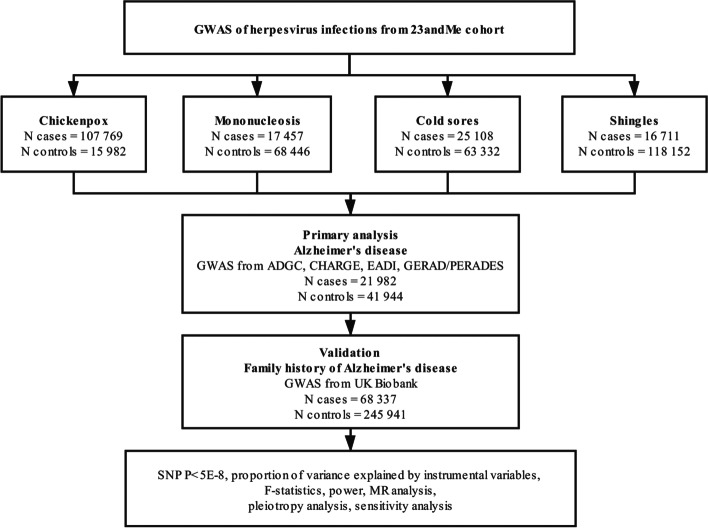
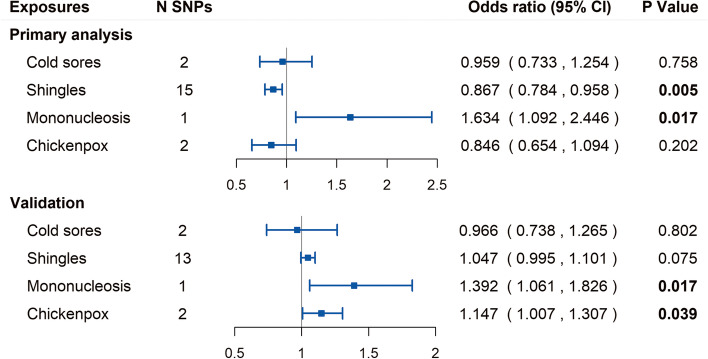
Background: Observational studies have suggested that herpesvirus infection increased the risk of Alzheimer’s disease (AD), but it is unclear whether the association is causal. The aim of the present study is to evaluate the causal relationship between four herpesvirus infections and AD. Methods: We performed a two-sample Mendelian randomization analysis to investigate association of four active herpesvirus infections with AD using summary statistics from genome-wide association studies. The four herpesvirus infections (i.e., chickenpox, shingles, cold sores, mononucleosis) are caused by varicella-zoster virus, herpes simplex virus type 1, and Epstein-Barr virus (EBV), respectively. A large summary statistics data from International Genomics of Alzheimer’s Project was used in primary analysis, including 21,982 AD cases and 41,944 controls. Validation was further performed using family history of AD data from UK Biobank (27,696 cases of maternal AD, 14,338 cases of paternal AD and 272,244 controls). Results: We found evidence of a significant association between mononucleosis (caused by EBV) and risk of AD after false discovery rates (FDR) correction (odds ratio [OR] = 1.634, 95% confidence interval [CI] = 1.092–2.446, P = 0.017, FDR-corrected P = 0.034). It has been verified in validation analysis that mononucleosis is also associated with family history of AD ( OR [95% CI] = 1.392 [1.061, 1.826], P = 0.017). Genetically predicted shingles were associated with AD risk (OR [95% CI] = 0.867 [0.784, 0.958], P = 0.005, FDR-corrected P = 0.020), while genetically predicted chickenpox was suggestively associated with increased family history of AD (OR [95% CI] = 1.147 [1.007, 1.307], P = 0.039). Conclusions: Our findings provided evidence supporting a positive relationship between mononucleosis and AD, indicating a causal link between EBV infection and AD. Further elucidations of this association and underlying mechanisms are likely to identify feasible interventions to promote AD prevention.
Overview
The claims and statistics of this paper haven’t been checked yet.
Free: it reads the open-access text and checks the first 5 claims that cite a source we can check. Create a free account to check every claim.
Integrity signals
Registry
Cites
Statistics
Figures
Verification
Claims the paper makes
The claims and statistics of this paper haven’t been checked yet.
Free: it reads the open-access text and checks the first 5 claims that cite a source we can check. Create a free account to check every claim.
Claims other papers make about this one
Each is checked against this paper’s own text: does it say what the citing paper says it does?
The source backs part of the claim, not all of it — or backs it for a different population, condition or comparison.
In the citing paper
“Several viruses and bacteria were associated with dementia risk and risk was elevated more in those with CNS infections but also with extra-CNS infection. (337, 341, 342) (337)”
From Dementia prevention, intervention, and care: 2024 report of the Lancet standing Commission (2024) · cites this paper as [342]
Experimental — accuracy not yet measured
Self-check
Percentages, sums and reported differences re-computed from the paper’s own numbers.
The self-check needs the paper’s full text.
Citations
Cites
Bowden, J., Davey Smith, G., & Burgess, S. (2015) · International Journal of Epidemiology · doi:10.1093/ije/dyv080 · Cited by 9,816
Bowden, J., Davey Smith, G., Haycock, P. C., & Burgess, S. (2016) · Genetic Epidemiology · doi:10.1002/gepi.21965 · Cited by 8,922
Verbanck, M., Chen, C.-Y., Neale, B., & Do, R. (2018) · Nature Genetics · doi:10.1038/s41588-018-0099-7 · Cited by 8,591
The MR-Base platform supports systematic causal inference across the human phenome
Hemani, G., Zheng, J., Elsworth, B., Wade, K. H., Haberland, V., Baird, D., Laurin, C., Burgess, S., Bowden, J., Langdon, R., et al. (2018) · eLife · doi:10.7554/elife.34408 · Cited by 7,959
Reading Mendelian randomisation studies: a guide, glossary, and checklist for clinicians
Davies, N. M., Holmes, M. V., & Davey Smith, G. (2018) · BMJ · doi:10.1136/bmj.k601 · Cited by 4,404
Emdin, C. A., Khera, A. V., & Kathiresan, S. (2017) · JAMA · doi:10.1001/jama.2017.17219 · Cited by 3,637
Robust inference in summary data Mendelian randomization via the zero modal pleiotropy assumption
Hartwig, F. P., Davey Smith, G., & Bowden, J. (2017) · International Journal of Epidemiology · doi:10.1093/ije/dyx102 · Cited by 3,485
Alzheimer Disease Genetics Consortium (ADGC), Kunkle, B. W., The European Alzheimer’s Disease Initiative (EADI), Cohorts for Heart and Aging Research in Genomic Epidemiology Consortium (CHARGE), Genetic and Environmental Risk in AD/Defining Genetic, P. A. E. R. F. A. D. C. (., Grenier-Boley, B., Sims, R., Bis, J. C., Damotte, V., Naj, A. C., et al. (2019) · Nature Genetics · doi:10.1038/s41588-019-0358-2 · Cited by 2,946
PhenoScanner V2: an expanded tool for searching human genotype–phenotype associations
Kamat, M. A., Blackshaw, J. A., Young, R., Surendran, P., Burgess, S., Danesh, J., Butterworth, A. S., & Staley, J. R. (2019) · Bioinformatics · doi:10.1093/bioinformatics/btz469 · Cited by 2,155
Machiela, M. J., & Chanock, S. J. (2015) · Bioinformatics · doi:10.1093/bioinformatics/btv402 · Cited by 2,069
A framework for the investigation of pleiotropy in two‐sample summary data Mendelian randomization
Bowden, J., Del Greco M, F., Minelli, C., Davey Smith, G., Sheehan, N., & Thompson, J. (2017) · Statistics in Medicine · doi:10.1002/sim.7221 · Cited by 1,887
Pierce, B. L., Ahsan, H., & VanderWeele, T. J. (2011) · International Journal of Epidemiology · doi:10.1093/ije/dyq151 · Cited by 1,836
Bowden, J., Del Greco M., F., Minelli, C., Davey Smith, G., Sheehan, N. A., & Thompson, J. R. (2016) · International Journal of Epidemiology · doi:10.1093/ije/dyw220 · Cited by 1,565
PhenoScanner: a database of human genotype-phenotype associations.
Staley, J. R., Blackshaw, J., Kamat, M. A., Ellis, S., Surendran, P., Sun, B. B., Paul, D. S., Freitag, D., Burgess, S., Danesh, J., et al. (2016) · Bioinformatics · doi:10.1093/bioinformatics/btw373 · Cited by 1,479
Clonally expanded CD8 T cells patrol the cerebrospinal fluid in Alzheimer’s disease
Gate, D., Saligrama, N., Leventhal, O., Yang, A. C., Unger, M. S., Middeldorp, J., Chen, K., Lehallier, B., Channappa, D., De Los Santos, M. B., et al. (2020) · Nature · doi:10.1038/s41586-019-1895-7 · Cited by 992
Commentary: Two-sample Mendelian randomization: opportunities and challenges
Lawlor, D. A. (2016) · International Journal of Epidemiology · doi:10.1093/ije/dyw127 · Cited by 810
Eimer, W. A., Vijaya Kumar, D. K., Navalpur Shanmugam, N. K., Rodriguez, A. S., Mitchell, T., Washicosky, K. J., György, B., Breakefield, X. O., Tanzi, R. E., & Moir, R. D. (2018) · Neuron · doi:10.1016/j.neuron.2018.06.030 · Cited by 674
Herpes simplex virus type 1 in brain and risk of Alzheimer's disease
Itzhaki, R. F., Lin, W.-R., Shang, D., Wilcock, G. K., Faragher, B., & Jamieson, G. A. (1997) · The Lancet · doi:10.1016/s0140-6736(96)10149-5 · Cited by 669
Burgess, S. (2014) · International Journal of Epidemiology · doi:10.1093/ije/dyu005 · Cited by 636
GWAS on family history of Alzheimer’s disease
Marioni, R. E., Harris, S. E., Zhang, Q., McRae, A. F., Hagenaars, S. P., Hill, W. D., Davies, G., Ritchie, C. W., Gale, C. R., Starr, J. M., et al. (2018) · Translational Psychiatry · doi:10.1038/s41398-018-0150-6 · Cited by 564
Lawlor, D. A., Smith, G. D., Bruckdorfer, K. R., Kundu, D., & Ebrahim, S. (2004) · The Lancet · doi:10.1016/s0140-6736(04)16260-0 · Cited by 438
Myers, T. A., Chanock, S. J., & Machiela, M. J. (2020) · Frontiers in Genetics · doi:10.3389/fgene.2020.00157 · Cited by 429
Tian, C., Hromatka, B. S., Kiefer, A. K., Eriksson, N., Noble, S. M., Tung, J. Y., & Hinds, D. A. (2017) · Nature Communications · doi:10.1038/s41467-017-00257-5 · Cited by 411
Diagnostic Evaluation of Mononucleosis-Like Illnesses
Hurt, C., & Tammaro, D. (2007) · The American Journal of Medicine · doi:10.1016/j.amjmed.2006.12.011 · Cited by 227 · cited 2×
“When primary EBV infection occurs later in life, it often results in mononucleosis [13].”
BackgroundEpidemiology—is it time to call it a day?
Smith, G. D., & Ebrahim, S. (2001) · International Journal of Epidemiology · doi:10.1093/ije/30.1.1 · Cited by 215
Herpes virus in Alzheimer's disease: relation to progression of the disease
Carbone, I., Lazzarotto, T., Ianni, M., Porcellini, E., Forti, P., Masliah, E., Gabrielli, L., & Licastro, F. (2014) · Neurobiology of Aging · doi:10.1016/j.neurobiolaging.2013.06.024 · Cited by 211
Reactivated herpes simplex infection increases the risk of Alzheimer's disease
Lövheim, H., Gilthorpe, J., Adolfsson, R., Nilsson, L.-G., & Elgh, F. (2015) · Alzheimer's & Dementia · doi:10.1016/j.jalz.2014.04.522 · Cited by 202
Response to Hartwig and Davies
Bowden, J., Burgess, S., & Davey Smith, G. (2016) · International Journal of Epidemiology · doi:10.1093/ije/dyw252 · Cited by 174
Herpes Viruses Increase the Risk of Alzheimer’s Disease: A Meta-Analysis
Steel, A. J., & Eslick, G. D. (2015) · Journal of Alzheimer's Disease · doi:10.3233/jad-140822 · Cited by 154
Interaction between APOE4 and herpes simplex virus type 1 in Alzheimer's disease
Linard, M., Letenneur, L., Garrigue, I., Doize, A., Dartigues, J., & Helmer, C. (2020) · Alzheimer's & Dementia · doi:10.1002/alz.12008 · Cited by 152
Herpesviruses in brains in Alzheimer's and Parkinson's diseases
Hemling, N., Röyttä, M., Rinne, J., Pöllänen, P., Broberg, E., Tapio, V., Vahlberg, T., & Hukkanen, V. (2003) · Annals of Neurology · doi:10.1002/ana.10662 · Cited by 142
Herpes Zoster and Dementia: A Nationwide Population-Based Cohort Study
Chen, V. C.-H., Wu, S.-I., Huang, K.-Y., Yang, Y.-H., Kuo, T.-Y., Liang, H.-Y., Huang, K.-L., & Gossop, M. (2018) · The Journal of Clinical Psychiatry · doi:10.4088/jcp.16m11312 · Cited by 142 · cited 1×
“In particular, recent cohort studies have reported that the use of antiviral agents in herpes zoster patients was associated with lower risks of dementia [38, 39], adding weight to the potential association between VZV infection and dementia.”
Self-citationHerpes simplex infection and the risk of Alzheimer’s disease: A nested case-control study
Lövheim, H., Gilthorpe, J., Johansson, A., Eriksson, S., Hallmans, G., & Elgh, F. (2015) · Alzheimer's & Dementia · doi:10.1016/j.jalz.2014.07.157 · Cited by 136 · cited 2×
“Although HSV have been reported to be associated with AD in many epidemiological studies [2, 9], Kwok et al.”
BackgroundResultRasooly, D., & Patel, C. J. (2019) · Current Protocols in Human Genetics · doi:10.1002/cphg.82 · Cited by 128
Bae, S., Yun, S.-C., Kim, M.-C., Yoon, W., Lim, J. S., Lee, S.-O., Choi, S.-H., Kim, Y. S., Woo, J. H., Kim, S. Y., et al. (2021) · European Archives of Psychiatry and Clinical Neuroscience · doi:10.1007/s00406-020-01157-4 · Cited by 94
Thomassen, J. Q., Tolstrup, J. S., Benn, M., & Frikke‐Schmidt, R. (2020) · Epidemiology and Psychiatric Sciences · doi:10.1017/s2045796020000347 · Cited by 92
Lövheim, H., Norman, T., Weidung, B., Olsson, J., Josefsson, M., Adolfsson, R., Nyberg, L., & Elgh, F. (2019) · Journal of Alzheimer's Disease · doi:10.3233/jad-171162 · Cited by 73
Lopatko Lindman, K., Weidung, B., Olsson, J., Josefsson, M., Kok, E., Johansson, A., Eriksson, S., Hallmans, G., Elgh, F., & Lövheim, H. (2019) · Alzheimer's & Dementia: Translational Research & Clinical Interventions · doi:10.1016/j.trci.2019.09.014 · Cited by 60 · cited 1×
“Accumulating evidence suggest HSV-1 alone does not confer an elevated risk of AD [35, 38, 39], but together with the carriage of APOE-ε4 allele increases AD risk [2, 40, 41].”
BackgroundAntibodies to viral antigens, xenoantigens, and autoantigens in Alzheimer’s disease
Ounanian, A., Seigneurin, J. ‐., Guilbert, B., Avrameas, S., & Renverez, J. ‐. (1990) · Journal of Clinical Laboratory Analysis · doi:10.1002/jcla.1860040510 · Cited by 58
Associations of Infectious Agents with Alzheimer’s Disease: A Systematic Review and Meta-Analysis
Ou, Y., Zhu, J., Hou, X., Shen, X., Xu, W., Dong, Q., Tan, L., & Yu, J. (2020) · Journal of Alzheimer s Disease · doi:10.3233/jad-191337 · Cited by 56 · cited 4×
“We focused on four infections (chickenpox, shingles, cold sores, mononucleosis) all caused by members of the human herpesvirus that were discussed in association with AD [1, 2].”
BackgroundInfluentialSelf-citationHerpes simplex virus and Alzheimer’s disease: a Mendelian randomization study
Kwok, M. K., & Schooling, C. M. (2021) · Neurobiology of Aging · doi:10.1016/j.neurobiolaging.2020.09.025 · Cited by 55
Lin, W. R., Casas, I., Wilcock, G. K., & Itzhaki, R. F. (1997) · Journal of Neurology, Neurosurgery & Psychiatry · doi:10.1136/jnnp.62.6.586 · Cited by 53
Impact of glucose on risk of dementia: Mendelian randomisation studies in 115,875 individuals
Benn, M., Nordestgaard, B. G., Tybjærg‐Hansen, A., & Frikke‐Schmidt, R. (2020) · Diabetologia · doi:10.1007/s00125-020-05124-5 · Cited by 47
Controversial role of herpesviruses in Alzheimer’s disease
Rizzo, R. (2020) · PLOS Pathogens · doi:10.1371/journal.ppat.1008575 · Cited by 45
Chronic Epstein Barr virus infection leading to classical Hodgkin lymphoma
Sarwari, N., Khoury, J. D., & Hernandez, C. M. R. (2016) · BMC Hematology · doi:10.1186/s12878-016-0059-3 · Cited by 41
Kunkle, B., Grenier-Boley, B., Sims, R., Bis, J., Naj, A., Boland, A., Vronskaya, M., van der Lee, S., Amlie-Wolf, A., Bellenguez, C., et al. (2018) · doi:10.1101/294629 · Cited by 35
Cited by
Dementia prevention, intervention, and care: 2024 report of the Lancet standing Commission
Livingston, G., Huntley, J., Liu, K. Y., Costafreda, S. G., Selbæk, G., Alladi, S., Ames, D., Banerjee, S., Burns, A., Brayne, C., et al. (2024) · The Lancet · doi:10.1016/s0140-6736(24)01296-0 · Cited by 3,860
Virus exposure and neurodegenerative disease risk across national biobanks
Levine, K. S., Leonard, H. L., Blauwendraat, C., Iwaki, H., Johnson, N., Bandres-Ciga, S., Ferrucci, L., Faghri, F., Singleton, A. B., & Nalls, M. A. (2023) · Neuron · doi:10.1016/j.neuron.2022.12.029 · Cited by 341
Alzheimer’s disease as a viral disease: Revisiting the infectious hypothesis
Bruno, F., Abondio, P., Bruno, R., Ceraudo, L., Paparazzo, E., Citrigno, L., Luiselli, D., Bruni, A. C., Passarino, G., Colao, R., et al. (2023) · Ageing Research Reviews · doi:10.1016/j.arr.2023.102068 · Cited by 88
The necroptosis cell death pathway drives neurodegeneration in Alzheimer’s disease
Balusu, S., & Strooper, B. D. (2024) · Acta Neuropathologica · doi:10.1007/s00401-024-02747-5 · Cited by 85
“Alzheimer’s disease (AD) may have multiple primary etiologies (genetic, sporadic, environmental, and infection) [15, 68, 90] but is defined by a common characteristic neuropathology and symptomatology, including extracellular deposition of amyloid plaques, intracellular deposition of…”
BackgroundPeripheral and central neuroimmune mechanisms in Alzheimer’s disease pathogenesis
Zhang, S., Gao, Y., Zhao, Y., Huang, T. Y., Zheng, Q., & Wang, X. (2025) · Molecular Neurodegeneration · doi:10.1186/s13024-025-00812-5 · Cited by 78
“Infection with EBV has been proposed to increase the risk of developing AD [21].”
Metadata
- Authors
- Huang, S.-Y., Yang, Y.-X., Kuo, K., Li, H.-Q., Shen, X.-N., Chen, S.-D., Cui, M., Tan, L., Dong, Q., & Yu, J.-T.
- Affiliations
- Shanghai Medical College of Fudan University (CN)
- Qingdao University (CN)
- Corresponding author
- Yu, Jin-Tai
- Venue
- Alzheimer's Research & Therapy
- Published
- 2021-09-24
- Volume
- 13
- Issue
- 1
- Pages
- 158-158
- ISSN
- 1758-9193 (ISSN-L)
- PMC
- PMC8464096
- OpenAlex
- W3135989020
- Cited by
- 82
- References
- 45
- Citations by year
- 2026: 8 · 2025: 14 · 2024: 33 · 2023: 18 · 2022: 9
- FWCI
- 11.63
- Type
- journal article
- Language
- en
- Open access
- gold
- doi.org
- Licence
- cc-by
- creativecommons.org/licenses/by/4.0 (tdm)
- creativecommons.org/licenses/by/4.0 (vor)
- Locations
- Alzheimer s Research & Therapy (publishedVersion, cc-by)
- Europe PMC (PubMed Central) (publishedVersion, other-oa)
- PubMed Central (publishedVersion, cc-by)
- PubMed (publishedVersion)
- DOAJ (DOAJ: Directory of Open Access Journals) (submittedVersion, cc-by-sa)
- Funders
- National Natural Science Foundation of China (91849126)
- the National Key R&D Program of China (2018YFC1314702)
- Shanghai Municipal Science and Technology Major Project (2018SHZDZX01)
- ZHANGJIANG LAB
- Tianqiao and Chrissy Chen Institute
- the State Key Laboratory of Neurobiology and Frontiers Center for Brain Science of Ministry of Education, Fudan University
- Topics
- Life Sciences › Neuroscience › Cellular and Molecular Neuroscience › Alzheimer's disease research and treatments
- Health Sciences › Medicine › Psychiatry and Mental health › Dementia and Cognitive Impairment Research
- Life Sciences › Biochemistry, Genetics and Molecular Biology › Genetics › Genetic Associations and Epidemiology
- Keywords
- Alzheimer's disease, herpesvirus infection, Epstein-Barr virus, mononucleosis, varicella-zoster virus, herpes simplex virus type 1, varicella, herpes zoster, cold sores, family history of Alzheimer's disease, causal relationship, genetic risk factors, UK Biobank
- MeSH terms
- Alzheimer Disease, Herpesvirus 4, Human, Humans, Epstein-Barr Virus Infections, Polymorphism, Single Nucleotide, Genome-Wide Association Study, Mendelian Randomization Analysis
About these checks
Registry, retraction, Cites and statistics results are computed, not judged, with one exception: a printed reference that no index lists is read once by a model before it counts as a citation error. Claims are extracted by a model and kept only when their quote appears verbatim in the text; each cited source is then checked, with a model’s help, for whether it says what the claim relies on. Those verdicts can be wrong — read the claim’s quote and the cited source before relying on one.
Statistics and arithmetic are recomputed, not judged.
Confidence bands are shown only for fields calibrated on our annotated test set. None is calibrated yet, so no band is shown.
What counts as a claim ›How we measure confidence ›How we check this ›
Are you an author, or do you see a problem with this page? Request a review
Data sources
Bibliographic data: Semantic Scholar, OpenAlex, Crossref.
Contains information from the Semantic Scholar Academic Graph Datasets, made available under the ODC Attribution License (ODC-BY 1.0).
Semantic Scholar’s data is described in: Kinney, R., et al. (2023). The Semantic Scholar Open Data Platform. arXiv:2301.10140.
