

The DOI matches its Crossref record; 39 of the 39 references it cites were found in a registry or an index.
Gantenerumab: an anti-amyloid monoclonal antibody with potential disease-modifying effects in early Alzheimer’s disease
Open accessAbstract
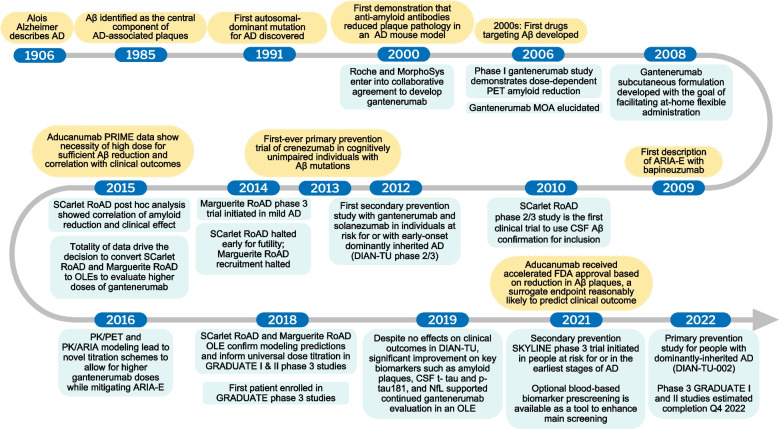
BACKGROUND: This review describes the research and development process of gantenerumab, a fully human anti-amyloid monoclonal antibody in development to treat early symptomatic and asymptomatic Alzheimer's disease (AD). Anti-amyloid monoclonal antibodies can substantially reverse amyloid plaque pathology and may modify the course of the disease by slowing or stopping its clinical progression. Several molecules targeting amyloid have failed in clinical development due to drug-related factors (e.g., treatment-limiting adverse events, low potency, poor brain penetration), study design/methodological issues (e.g., disease stage, lack of AD pathology confirmation), and other factors. The US Food and Drug Administration's approval of aducanumab, an anti-amyloid monoclonal antibody as the first potential disease-modifying therapy for AD, signaled the value of more than 20 years of drug development, adding to the available therapies the first nominal success since cholinesterase inhibitors and memantine were approved. BODY: Here, we review over 2 decades of gantenerumab development in the context of scientific discoveries in the broader AD field. Key learnings from the field were incorporated into the gantenerumab phase 3 program, including confirmed amyloid positivity as an entry criterion, an enriched clinical trial population to ensure measurable clinical decline, data-driven exposure-response models to inform a safe and efficacious dosing regimen, and the use of several blood-based biomarkers. Subcutaneous formulation for more pragmatic implementation was prioritized as a key feature from the beginning of the gantenerumab development program. CONCLUSION: The results from the gantenerumab phase 3 programs are expected by the end of 2022 and will add critical information to the collective knowledge on the search for effective AD treatments.
Overview
The claims and statistics of this paper haven’t been checked yet.
Run the check — free, no account needed. It reads the open-access text and checks the sources it cites.
Integrity signals
Registry
Cites
Statistics
Figures
Verification
Claims the paper makes
The claims and statistics of this paper haven’t been checked yet.
Run the check — free, no account needed. It reads the open-access text and checks the sources it cites.
Claims other papers make about this one
Each is checked against this paper’s own text: does it say what the citing paper says it does?
The cited source says what the claim attributes to it.
In the citing paper
“This antibody can disassemble and degrade amyloid plaques by recruiting microglia and activating phagocytosis [71,72].”
From Treatment of Alzheimer’s Disease: Beyond Symptomatic Therapies (2023) · cites this paper as [71]
Self-check
Percentages, sums and reported differences re-computed from the paper’s own numbers.
The self-check needs the paper’s full text.
Citations
Cites
McKhann, G., Drachman, D., Folstein, M., Katzman, R., Price, D., & Stadlan, E. M. (1984) · Neurology · doi:10.1212/wnl.34.7.939 · Cited by 27,915
The amyloid hypothesis of Alzheimer's disease at 25 years
Selkoe, D. J., & Hardy, J. (2016) · EMBO Molecular Medicine · doi:10.15252/emmm.201606210 · Cited by 6,164
Goate, A., Chartier-Harlin, M.-C., Mullan, M., Brown, J., Crawford, F., Fidani, L., Giuffra, L., Haynes, A., Irving, N., James, L., et al. (1991) · Nature · doi:10.1038/349704a0 · Cited by 4,659
Amyloid plaque core protein in Alzheimer disease and Down syndrome.
Masters, C. L., Simms, G., Weinman, N. A., Multhaup, G., McDonald, B. L., & Beyreuther, K. (1985) · Proceedings of the National Academy of Sciences · doi:10.1073/pnas.82.12.4245 · Cited by 4,431
Clinical and biomarker changes in dominantly inherited Alzheimer's disease
Bateman, R. J., Xiong, C., Benzinger, T. L. S., Fagan, A. M., Goate, A., Fox, N. C., Marcus, D. S., Cairns, N. J., Xie, X., Blazey, T. M., et al. (2012) · New England Journal of Medicine · doi:10.1056/nejmoa1202753 · Cited by 3,814
Self-citationThe antibody aducanumab reduces Aβ plaques in Alzheimer’s disease
Sevigny, J., Chiao, P., Bussière, T., Weinreb, P. H., Williams, L., Maier, M., Dunstan, R., Salloway, S., Chen, T., Ling, Y., et al. (2016) · Nature · doi:10.1038/nature19323 · Cited by 3,059
Self-citationAmyloid deposition as the central event in the aetiology of Alzheimer’s disease
Hardy, J., & Allsop, D. (1991) · Trends in Pharmacological Sciences · doi:10.1016/0165-6147(91)90609-v · Cited by 2,538
Two Phase 3 Trials of Bapineuzumab in Mild-to-Moderate Alzheimer's Disease
Salloway, S., Sperling, R., Fox, N. C., Blennow, K., Klunk, W., Raskind, M., Sabbagh, M., Honig, L. S., Porsteinsson, A. P., Ferris, S., et al. (2014) · New England Journal of Medicine · doi:10.1056/nejmoa1304839 · Cited by 1,960
Self-citationPhase 3 Trials of Solanezumab for Mild-to-Moderate Alzheimer's Disease
Doody, R. S., Thomas, R. G., Farlow, M., Iwatsubo, T., Vellas, B., Joffe, S., Kieburtz, K., Raman, R., Sun, X., Aisen, P. S., et al. (2014) · New England Journal of Medicine · doi:10.1056/nejmoa1312889 · Cited by 1,668
Self-citationThe Centiloid Project: standardizing quantitative amyloid plaque estimation by PET
Klunk, W. E., Koeppe, R. A., Price, J. C., Benzinger, T. L., Devous, M. D., Jagust, W. J., Johnson, K. A., Mathis, C. A., Minhas, D., Pontecorvo, M. J., et al. (2015) · Alzheimer's & Dementia · doi:10.1016/j.jalz.2014.07.003 · Cited by 1,348
Research works printed but not linked: 3
- Bateman RJ, Smith J, Fox NC, Black SE, Shij Turner RS, et al. The clinical development history of gantenerumab, a subcutaneous anti-Aβ monoclonal antibody for early Alzheimer’s disease: building on lessons from the past and paving a path for the future. San Diego: Presented at: Alzheimer’s Association International Conference Annual Meeting; 2022.
- Lane C, Bullain S, Thanasopoulou A, Delmar P, Searle A, Boada M, et al. ROC12- baseline characteristics of the GRADUATE studies: phase III randomized, placebo-controlled studies investigating subcutaneous gantenerumab in participants with early Alzheimer’s disease. J Prev Alzheimers Dis. 2021;8:S1-72.
- Sink K, Djakovic S, Smith JW, Smith J, Hu N, Mackey H, et al. FCSRT inclusion criteria support recruitment of a population with early Alzheimer’s disease likely to progress over 24 months: results from the CREAD trial. J Prev Alzheimers Dis. 2019;6:S19–20.
Cited by
Sorted by citations
Items 101–109 of 109
Recent Advances in Drug Development for the Management of Alzheimer’s Disease
Upadhyay, A., Singh, A. K., Jayaswal, N., Jaiswal, P., Singh, S. N., & Tewari, S. (2026) · BENTHAM SCIENCE PUBLISHERS eBooks · doi:10.2174/9798898814953126010014
The clinical value of multimodal neuroimaging in monoclonal antibody therapy for Alzheimer's disease
Wang, Y., Li, H., Zhou, J., Zhao, S., Yang, A., & Li, Z. (2026) · Frontiers in Neurology · doi:10.3389/fneur.2026.1761380
Functional connectome metrics reveal distinct prognostic subtypes in two Phase 3 gantenerumab trials
Gobbi, S., Silvestri, E., Tonietto, M., Klein, G., van den Heuvel, M. P., & Magon, S. (2026) · Alzheimer s & Dementia Translational Research & Clinical Interventions · doi:10.1002/trc2.70259
Self-citationSustaining Drug Discovery Amid the Limits of Alzheimer's Disease Immunotherapies
McDiarmid, A. (2026) · eNeuro · doi:10.1523/eneuro.0112-26.2026
Saffour, S., Gül, T. S., & Gul, H. I. (2026) · Future Medicinal Chemistry · doi:10.1080/17568919.2026.2714022
Targeting amyloid and Tau: Antibody therapies for Alzheimer’s disease
Upadhyay, R., Sangitha, & Sevanan, M. (2026) · International review of neurobiology · doi:10.1016/bs.irn.2026.08.011
Marimuthu, A., Singh, M. T., Balasubramanian, S., & Krishnamurthy, P. T. (2026) · Molecular Neurobiology · doi:10.1007/s12035-026-06203-1
Poonam, Rana, R., Thakur, M., Sharma, A., Pannu, S., Sharma, S., Naman, S., Rani, S., Devi, D., Kumar, V., et al. (2026) · Frontiers in Oncology · doi:10.3389/fonc.2026.1908830
Metadata
- Authors
- Bateman, R. J., Cummings, J., Schobel, S., Salloway, S., Vellas, B., Boada, M., Black, S. E., Blennow, K., Fontoura, P., Klein, G., Assunção, S. S., Smith, J., & Doody, R. S.
- Affiliations
- Washington University in St. Louis (US)
- University of Nevada, Las Vegas (US)
- F. Hoffmann-La Roche AG (CH)
- Brown University (US)
- Université Toulouse III - Paul Sabatier (FR)
- Sunnybrook Health Science Centre (CA)
- Sahlgrenska University Hospital (SE)
- Roche (United States) (US)
- Roche (United Kingdom) (GB)
- Corresponding author
- Bateman, Randall J.
- ORCID
- Venue
- Alzheimer's Research & Therapy
- Published
- 2022-11-29
- Volume
- 14
- Issue
- 1
- Pages
- 178-178
- ISSN
- 1758-9193 (ISSN-L)
- PMC
- PMC9707418
- OpenAlex
- W4310985942
- Cited by
- 109
- References
- 39
- Citations by year
- 2026: 20 · 2025: 19 · 2024: 40 · 2023: 29
- FWCI
- 3.03
- Type
- journal article
- Language
- en
- Open access
- gold
- doi.org
- Locations
- Alzheimer s Research & Therapy (publishedVersion, cc-by)
- PubMed Central (publishedVersion, cc-by)
- PubMed (publishedVersion)
- HAL (submittedVersion, cc-by)
- Digital Commons@Becker (Washington University School of Medicine) (submittedVersion, cc-by)
- DOAJ (DOAJ: Directory of Open Access Journals) (submittedVersion, cc-by-sa)
- Funders
- Alzheimer's Association
- F. Hoffmann-La Roche
- Genentech
- National Institute on Aging (R21AG067559, R01AG053798, P20AG068053, U01AG042791, U19AG032438, R01AG046179, RF1AG061900, R01AG053267, U01AG059798, P30AG072959, R35AG071476, R01AG068319)
- National Institute of General Medical Sciences (P20GM109025)
- National Institute of Neurological Disorders and Stroke (R01NS095773, U01NS093334)
- Topics
- Life Sciences › Neuroscience › Cellular and Molecular Neuroscience › Alzheimer's disease research and treatments
- Health Sciences › Medicine › Psychiatry and Mental health › Dementia and Cognitive Impairment Research
- Health Sciences › Medicine › Pharmacology (medical) › Cholinesterase and Neurodegenerative Diseases
- Keywords
- gantenerumab, Alzheimer's disease, anti-amyloid monoclonal antibodies, amyloid plaques, disease-modifying therapy, aducanumab, amyloid positivity, exposure-response modeling, blood-based biomarkers, subcutaneous formulation, drug development
- MeSH terms
- Alzheimer Disease, Amyloidosis, Humans, United States, Asymptomatic Diseases, Plaque, Amyloid, Amyloidogenic Proteins, Antibodies, Monoclonal, Humanized
About these checks
Registry, retraction, Cites and statistics results are computed, not judged, with one exception: a printed reference that no index lists is read once by a model before it counts as a citation error. Claims are extracted by a model and kept only when their quote appears verbatim in the text; each cited source is then checked, with a model’s help, for whether it says what the claim relies on. Those verdicts can be wrong — read the claim’s quote and the cited source before relying on one.
Statistics and arithmetic are recomputed, not judged.
Confidence bands are shown only for fields calibrated on our annotated test set. None is calibrated yet, so no band is shown.
What counts as a claim ›How we measure confidence ›How we check this ›
Are you an author, or do you see a problem with this page? Request a review
