

Clinical validation of controlled grass pollen challenge in the Environmental Exposure Unit (EEU)
Open accessThe DOI matches its Crossref record; 20 of the 21 references it cites were found in a registry or an index.
Abstract
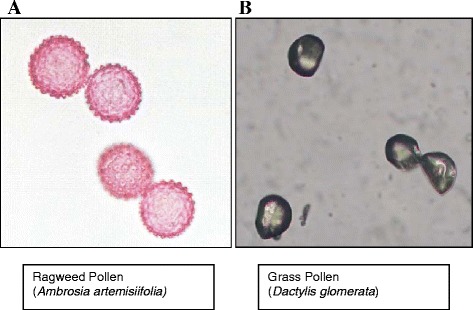
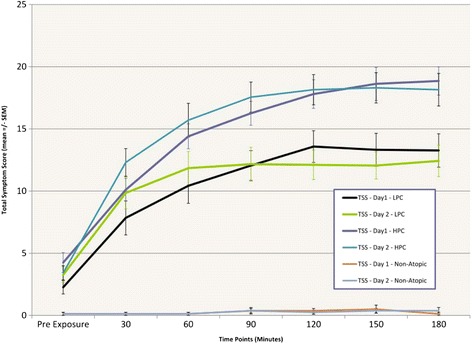
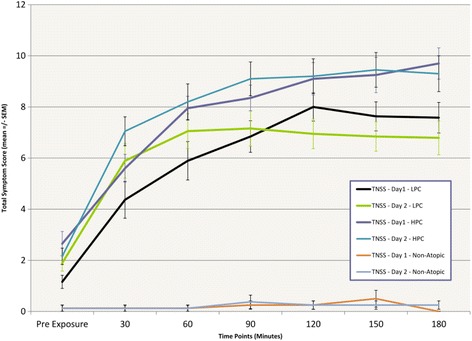
RATIONALE: The Environmental Exposure Unit (EEU), a controlled allergen exposure model of allergic rhinitis (AR), has traditionally utilized ragweed pollen. We sought to clinically validate the use of grass pollen in the EEU. METHODS: Healthy volunteers with a history of AR symptoms during grass pollen season and supportive skin test responses attended the EEU for 3 hrs of rye grass pollen exposure (Lolium Perenne). Non-atopic controls were also recruited. Participants assessed individual rhinoconjunctivitis symptoms to generate Total Nasal Symptom Score (TNSS; max 12) and Total Symptom Score (TSS; max 24) and recorded Peak Nasal Inspiratory Flow (PNIF) q30min while in the EEU. Participants returned the following day for an additional 3 hrs of pollen exposure. Two separate groups allowed for the exploration of lower vs. higher pollen concentrations and subsequent effects on symptoms. RESULTS: 78 participants were screened, of whom 39 were eligible and attended the 2x3h EEU visits, plus 8 non-atopic controls. Mean TSS, TNSS and PNIF values amongst participants in the higher pollen concentration group (target 3500 grains/m3) after the first 3 hr exposure were 18.9, 9.7 and 68 L/min, respectively. In comparison, mean TSS, TNSS and PNIF values in the lower pollen concentration (2500 grains/m3) group were only 13.3, 7.6, and 82 L/min, respectively. The subsequent day of pollen exposure did not appreciably alter the maximal TSS/TNSSs, but rather resulted in a more rapid onset of symptomatology, with higher mean scores at the 30 min, 60 min and 90 min timepoints. The non-atopic controls remained asymptomatic. CONCLUSIONS: This study provides clinical validation of the ability to generate allergic rhinoconjunctivitis symptoms amongst grass-allergic individuals in the EEU.
Overview
The claims and statistics of this paper haven’t been checked yet.
Free: it reads the open-access text and checks the first 5 claims that cite a source we can check. Create a free account to check every claim.
Integrity signals
Registry
Cites
Statistics
Figures
Verification
Claims the paper makes
The claims and statistics of this paper haven’t been checked yet.
Free: it reads the open-access text and checks the first 5 claims that cite a source we can check. Create a free account to check every claim.
Claims other papers make about this one
Each is checked against this paper’s own text: does it say what the citing paper says it does?
The source backs part of the claim, not all of it — or backs it for a different population, condition or comparison.
In the citing paper
“Many ACCs have been intensively validated regarding specificity and dose-dependency of symptom induction as well as technical aspects such as temporal stability and spatial homogeneity of the allergen exposure.1029-1037”
From International Consensus Statement on Allergy and Rhinology: Allergic Rhinitis (2018) · cites this paper as [1029]
Experimental — accuracy not yet measured
Self-check
Percentages, sums and reported differences re-computed from the paper’s own numbers.
The self-check needs the paper’s full text.
Citations
Cites
Harrison's Principles of Internal Medicine
Verghese, A. (1994) · JAMA: The Journal of the American Medical Association · doi:10.1001/jama.1994.03520080084052 · Cited by 1,361
Day, J. H., Briscoe, M. P., Welsh, A., Smith, J. N., Clark, A., Ellis, A. K., & Mason, J. (1997) · Annals of Allergy Asthma & Immunology · doi:10.1016/s1081-1206(10)63062-1 · Cited by 86 · cited 1×
“ating various aspects of seasonal allergic rhinitis and its treatments [4-17].”
BackgroundSelf-citationDay, J. H., Briscoe, M. P., Clark, R. H., Ellis, A. K., & Gervais, P. (1997) · Annals of Allergy Asthma & Immunology · doi:10.1016/s1081-1206(10)63104-3 · Cited by 73 · cited 1×
“ating various aspects of seasonal allergic rhinitis and its treatments [4-17].”
BackgroundSelf-citationDay, J. H., Briscoe, M. P., Rafeiro, E., Ellis, A. K., Pettersson, E., & Åkerlund, A. (2000) · Journal of Allergy and Clinical Immunology · doi:10.1067/mai.2000.104550 · Cited by 72 · cited 1×
“ating various aspects of seasonal allergic rhinitis and its treatments [4-17].”
BackgroundSelf-citationWilken, J. A., Kane, R. L., Ellis, A. K., Rafeiro, E., Briscoe, M. P., Sullivan, C. L., & Day, J. H. (2003) · Annals of Allergy Asthma & Immunology · doi:10.1016/s1081-1206(10)61685-7 · Cited by 64 · cited 1×
“ating various aspects of seasonal allergic rhinitis and its treatments [4-17].”
BackgroundSelf-citationEllis, A. K., North, M. L., Walker, T., & Steacy, L. M. (2013) · Annals of Allergy Asthma & Immunology · doi:10.1016/j.anai.2013.07.019 · Cited by 53 · cited 1×
“ating various aspects of seasonal allergic rhinitis and its treatments [4-17].”
BackgroundSelf-citationEnvironmental exposure unit: a system to test anti-allergic treatment
Day, J. H., & Briscoe, M. P. (1999) · Annals of Allergy Asthma & Immunology · doi:10.1016/s1081-1206(10)62616-6 · Cited by 53 · cited 2×
“AR, as well as to assess the efficacy and onset of action of various anti-allergic medications [2].”
BackgroundFactors that affect the allergic rhinitis response to ragweed allergen exposure
Ellis, A. K., Ratz, J. D., Day, A. G., & Day, J. H. (2010) · Annals of Allergy Asthma & Immunology · doi:10.1016/j.anai.2010.01.012 · Cited by 45
Self-citationExperimental models for the evaluation of treatment of allergic rhinitis
Day, J. H., Ellis, A. K., Rafeiro, E., Ratz, J. D., & Briscoe, M. P. (2006) · Annals of Allergy Asthma & Immunology · doi:10.1016/s1081-1206(10)61235-5 · Cited by 43 · cited 1×
“ating various aspects of seasonal allergic rhinitis and its treatments [4-17].”
BackgroundSelf-citationEllis, A. K., Zhu, Y., Steacy, L. M., Walker, T., & Day, J. H. (2013) · Allergy Asthma and Clinical Immunology · doi:10.1186/1710-1492-9-16 · Cited by 38 · cited 1×
“ating various aspects of seasonal allergic rhinitis and its treatments [4-17].”
BackgroundSelf-citation
Research works printed but not linked: 1
- Walker TJ Ellis AK Controlled Grass Pollen Dispersal in the Environmental Exposure Unit (EEU): validation of the dispersal system Ann Allergy Asthma Immunol 2011 107 5 A9 PMC4316395 25653682
Cited by
International Consensus Statement on Allergy and Rhinology: Allergic Rhinitis
Wise, S. K., Lin, S. Y., Toskala, E., Orlandi, R. R., Akdis, C. A., Alt, J. A., Azar, A., Baroody, F. M., Bachert, C., Canonica, G. W., et al. (2018) · International Forum of Allergy & Rhinology · doi:10.1002/alr.22073 · Cited by 557
International consensus statement on allergy and rhinology: Allergic rhinitis – 2023
Wise, S. K., Damask, C., Roland, L. T., Ebert, C., Levy, J. M., Lin, S., Luong, A., Rodriguez, K., Sedaghat, A. R., Toskala, E., et al. (2023) · International Forum of Allergy & Rhinology · doi:10.1002/alr.23090 · Cited by 507
Self-citationPfaar, O., Calderon, M. A., Andrews, C. P., Angjeli, E., Bergmann, K. C., Bønløkke, J. H., de Blay, F., Devillier, P., Ellis, A. K., Gerth van Wijk, R., et al. (2017) · Allergy · doi:10.1111/all.13133 · Cited by 100
Self-citationNorth, M. L., Jones, M. J., MacIsaac, J. L., Morin, A. M., Steacy, L. M., Gregor, A., Kobor, M. S., & Ellis, A. K. (2017) · Allergy · doi:10.1111/all.13263 · Cited by 67
“Exclusion criteria and medication washouts were detailed previously.(13)”
BackgroundMethodSelf-citationBadorrek, P., Müller, M., Koch, W., Hohlfeld, J. M., & Krug, N. (2017) · Annals of Allergy Asthma & Immunology · doi:10.1016/j.anai.2017.01.018 · Cited by 51
Metadata
- Authors
- Ellis, A. K., Steacy, L. M., Hobsbawn, B., Conway, C. E., & Walker, T. J.
- Affiliations
- Queen's University (CA)
- Kingston General Hospital (CA)
- Corresponding author
- Ellis, Anne K
- Venue
- Allergy, Asthma & Clinical Immunology
- Published
- 2015-01-27
- Volume
- 11
- Issue
- 1
- Pages
- 5-5
- ISSN
- 1710-1484 (ISSN-L)
- 1710-1492
- PMC
- PMC4316395
- OpenAlex
- W2147096523
- Cited by
- 39
- References
- 21
- Citations by year
- 2025: 2 · 2024: 5 · 2023: 3 · 2022: 3 · 2021: 9 · 2020: 1 · 2019: 3 · 2018: 2 · 2017: 5 · 2016: 4 · 2015: 1
- FWCI
- 3.53
- Type
- journal article
- Language
- en
- Open access
- gold
- doi.org
- Locations
- Allergy Asthma and Clinical Immunology (publishedVersion, cc-by)
- Europe PMC (PubMed Central) (publishedVersion, cc-by)
- PubMed Central (publishedVersion, cc-by)
- PubMed (publishedVersion)
- Funders
- Queen's University
- Topics
- Health Sciences › Medicine › Immunology and Allergy › Allergic Rhinitis and Sensitization
- Health Sciences › Medicine › Pulmonary and Respiratory Medicine › Asthma and respiratory diseases
- Health Sciences › Medicine › Immunology and Allergy › Food Allergy and Anaphylaxis Research
- Keywords
- allergic rhinitis, rye grass pollen, perennial ryegrass, environmental exposure unit, Total Nasal Symptom Score, total symptom score, peak nasal inspiratory flow, pollen concentration, symptom onset
About these checks
Registry, retraction, Cites and statistics results are computed, not judged, with one exception: a printed reference that no index lists is read once by a model before it counts as a citation error. Claims are extracted by a model and kept only when their quote appears verbatim in the text; each cited source is then checked, with a model’s help, for whether it says what the claim relies on. Those verdicts can be wrong — read the claim’s quote and the cited source before relying on one.
Statistics and arithmetic are recomputed, not judged.
Confidence bands are shown only for fields calibrated on our annotated test set. None is calibrated yet, so no band is shown.
What counts as a claim ›How we measure confidence ›How we check this ›
Are you an author, or do you see a problem with this page? Request a review
How to cite
Cite CoChat for the checks on this page, and the paper for its own findings.
- This page
- CoChat. (2026). Citation check: Clinical validation of controlled grass pollen challenge in the Environmental Exposure Unit (EEU). https://app.cochat.ai/papers/10.1186/s13223-015-0071-3
- The paper
- Ellis, A. K., Steacy, L. M., Hobsbawn, B., Conway, C. E., & Walker, T. J. (2015). Clinical validation of controlled grass pollen challenge in the Environmental Exposure Unit (EEU). Allergy, Asthma & Clinical Immunology. https://doi.org/10.1186/s13223-015-0071-3
Data sources
Bibliographic data: Semantic Scholar, OpenAlex, Crossref.
Contains information from the Semantic Scholar Academic Graph Datasets, made available under the ODC Attribution License (ODC-BY 1.0).
Semantic Scholar’s data is described in: Kinney, R., et al. (2023). The Semantic Scholar Open Data Platform. arXiv:2301.10140.
