

Clinical validation of controlled exposure to birch pollen in the Environmental Exposure Unit (EEU)
Open accessThe DOI matches its Crossref record; 26 of the 27 references it cites were found in a registry or an index.
Abstract
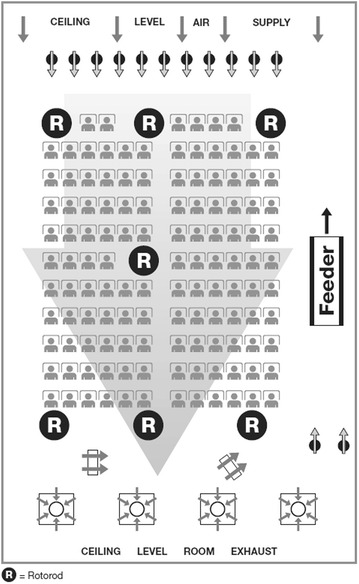
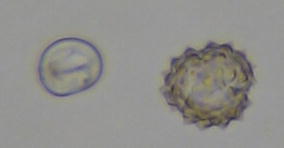
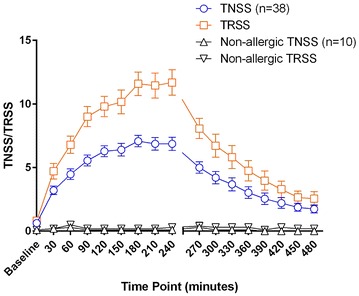
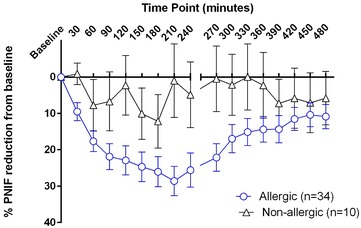
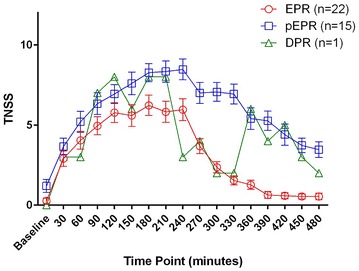
The Environmental Exposure Unit (EEU) in Kingston, Ontario, Canada is a controlled allergen challenge facility (CACF) that has been previously clinically validated for the use of ragweed and grass pollen in clinical studies. In this study we aim to validate the use of birch pollen to challenge allergic participants. A total of 59 volunteers were screened and 38 birch allergic participants and ten non-allergics completed the study, outside of tree pollen season. Participants had to have a minimum of 2-year history of allergic rhinoconjunctivitis during the typical tree pollen season and have a positive skin prick test to birch allergen ≥5 mm from the control. Qualified participants were exposed to birch (Betula pendula) pollen for 4 h in the EEU and recorded their symptoms of sneezing, rhinorrhea, nasal congestion, nasal itch which comprised the total nasal symptom score (TNSS), as well as itchy/watery eyes, red/burning eyes and itching of ears/palate/throat which along with the TNSS comprised the total rhinoconjunctival symptom score (TRSS) along with Peak Nasal Inspiratory Flow (PNIF) at baseline and at 30 min intervals for the duration of exposure, then hourly for up to 12 h from the start of exposure. Allergic participants reported a gradual rise in TNSS and TRSS, reaching a mean and standard error of the mean of 7.08 ± 0.45 and 11.58 ± 0.93 respectively by 180 min from the start of exposure. Symptoms gradually declined to near baseline values following departing from the unit, reaching 1.9 and 2.7 by 450 min. Allergic participants reported significantly higher TNSS than non-allergics starting from 30 min (p < 0.01, two-way ANOVA with Bonferroni corrections), maintaining maximum significance from 60 to 300 min (p < 0.0001) and losing significance by 420 min. TRSS and PNIF followed similar trends as those seen with TNSS. Participants were phenotyped using previously published definitions using the TNSS into Early Phase Responders (EPR, 57.8 %), protracted EPR (pEPR, 39.5 %), and Dual Phase Responders (DPR, 2.7 %). The EEU can competently challenge birch allergic participants and achieve statistically significant changes in symptoms and nasal airflow, while such changes are not reported in non-allergic controls. Trial registration NCT02351830 clinicaltrials.gov
Overview
The claims and statistics of this paper haven’t been checked yet.
Free: it reads the open-access text and checks the first 5 claims that cite a source we can check. Create a free account to check every claim.
Integrity signals
Registry
Cites
Statistics
Figures
Verification
Claims the paper makes
The claims and statistics of this paper haven’t been checked yet.
Free: it reads the open-access text and checks the first 5 claims that cite a source we can check. Create a free account to check every claim.
Claims other papers make about this one
Each is checked against this paper’s own text: does it say what the citing paper says it does?
The source backs part of the claim, not all of it — or backs it for a different population, condition or comparison.
In the citing paper
“Many ACCs have been intensively validated regarding specificity and dose-dependency of symptom induction as well as technical aspects such as temporal stability and spatial homogeneity of the allergen exposure.1029-1037”
From International Consensus Statement on Allergy and Rhinology: Allergic Rhinitis (2018) · cites this paper as [1030]
Experimental — accuracy not yet measured
Self-check
Percentages, sums and reported differences re-computed from the paper’s own numbers.
The self-check needs the paper’s full text.
Citations
Cites
Quantitative intranasal pollen challenges
Connell, J. T. (1969) · Journal of Allergy · doi:10.1016/0021-8707(69)90018-5 · Cited by 286
Ellis, A. K., Soliman, M., Steacy, L., Boulay, M.-È., Boulet, L.-P., Keith, P. K., Vliagoftis, H., Waserman, S., & Neighbour, H. (2015) · Allergy, Asthma & Clinical Immunology · doi:10.1186/s13223-015-0082-0 · Cited by 116
Self-citationHabbick, B. F., Pizzichini, M. M. M., Taylor, B., Rennie, D., Senthilselvan, A., & Sears, M. R. (1999) · Europe PMC (PubMed Central) · Cited by 103
Scadding, G. W., Calderon, M. A., Bellido, V., Koed, G. K., Nielsen, N.-C., Lund, K., Togias, A., Phippard, D., Turka, L. A., Hansel, T. T., et al. (2012) · Journal of Immunological Methods · doi:10.1016/j.jim.2012.06.013 · Cited by 101
Amoxicillin rash in patients with infectious mononucleosis: evidence of true drug sensitization
Ónodi‐Nagy, K., Kinyó, Á., Meszes, A., Garaczi, E., Kemény, L. V., & Bata‐Csörgõ, Z. (2015) · Allergy Asthma and Clinical Immunology · doi:10.1186/1710-1492-11-1 · Cited by 101
Day, J. H., Briscoe, M. P., Welsh, A., Smith, J. N., Clark, A., Ellis, A. K., & Mason, J. (1997) · Annals of Allergy Asthma & Immunology · doi:10.1016/s1081-1206(10)63062-1 · Cited by 86
Self-citationDay, J. H., Briscoe, M. P., Rafeiro, E., Ellis, A. K., Pettersson, E., & Åkerlund, A. (2000) · Journal of Allergy and Clinical Immunology · doi:10.1067/mai.2000.104550 · Cited by 72
Self-citationHohlfeld, J. M., Holland‐Letz, T., Larbig, M., Lavae‐Mokhtari, M., Wierenga, E., Kapsenberg, M., Van Ree, R., Krug, N., & Bufe, A. (2010) · Clinical & Experimental Allergy · doi:10.1111/j.1365-2222.2010.03498.x · Cited by 69
Ellis, A. K., North, M. L., Walker, T., & Steacy, L. M. (2013) · Annals of Allergy Asthma & Immunology · doi:10.1016/j.anai.2013.07.019 · Cited by 53
Self-citationEnvironmental exposure unit: a system to test anti-allergic treatment
Day, J. H., & Briscoe, M. P. (1999) · Annals of Allergy Asthma & Immunology · doi:10.1016/s1081-1206(10)62616-6 · Cited by 53
Research works printed but not linked: 3
- Horak K Jager S The Vienna challenge chamber—a new method for allergen exposition tests Wien Klin Wochenschr 1987 99 14 509 510
- Walker TJ Steacy LM Hobsbawn B Ellis AK A qualitative analysis of a new rotorod system utilizing microcontrollers and optical sensor technology in the Environmental Exposure Unit (EEU) Ann Allergy Asthma Immunol 2014 113 5 A34
- Ellis AK. Environmental Exposure Units for specific immunotherapy trials. In: Proceedings of the 13th international paul ehrlich seminar on allergen products for diagnosis and therapy: regulation and science. Arbeiten Au Dem Paul-Ehrlich-Institut. Washington DC: Springer-Verlagg; 2012.
Cited by
International Consensus Statement on Allergy and Rhinology: Allergic Rhinitis
Wise, S. K., Lin, S. Y., Toskala, E., Orlandi, R. R., Akdis, C. A., Alt, J. A., Azar, A., Baroody, F. M., Bachert, C., Canonica, G. W., et al. (2018) · International Forum of Allergy & Rhinology · doi:10.1002/alr.22073 · Cited by 557
International consensus statement on allergy and rhinology: Allergic rhinitis – 2023
Wise, S. K., Damask, C., Roland, L. T., Ebert, C., Levy, J. M., Lin, S., Luong, A., Rodriguez, K., Sedaghat, A. R., Toskala, E., et al. (2023) · International Forum of Allergy & Rhinology · doi:10.1002/alr.23090 · Cited by 507
Self-citationPerspectives in allergen immunotherapy: 2017 and beyond
Pfaar, O., Bonini, S., Cardona, V., Demoly, P. M., Jakob, T., Jutel, M., Kleine‐Tebbe, J., Klimek, L., Klysner, S. S., Kopp, M., et al. (2018) · Allergy · doi:10.1111/all.13355 · Cited by 117
Gevaert, P., Craemer, J. D., Ruyck, N. D., Rottey, S., Hoon, J. N. J. M. D., Hellings, P. W., Volckaert, B., Lesneuck, K., Orengo, J. M., Atanasio, A., et al. (2021) · Journal of Allergy and Clinical Immunology · doi:10.1016/j.jaci.2021.05.039 · Cited by 85
Defining the Efficacy of Omalizumab in Nasal Polyposis: A POLYP 1 and POLYP 2 Subgroup Analysis
Damask, C. C., Chen, M., Holweg, C. T. J., Yoo, B., Millette, L. A., & Franzese, C. B. (2021) · American Journal of Rhinology and Allergy · doi:10.1177/19458924211030486 · Cited by 64
“23–26 TNSS examines nasal congestion, sneezing, nasal itching, and rhinorrhea, whereas NCS represents only the nasal congestion component.(24) SNOT-22 includes assessment of sleep, facial pain, and emotional well-being,(25) and UPSIT assesses a patient’s sense of smell.”
Background
Metadata
- Authors
- Ellis, A. K., Soliman, M., Steacy, L. M., Adams, D. E., Hobsbawn, B., & Walker, T. J. B.
- Affiliations
- Queen's University (CA)
- Kingston General Hospital (CA)
- Corresponding author
- Ellis, Anne K.
- Venue
- Allergy, Asthma & Clinical Immunology
- Published
- 2016-10-19
- Volume
- 12
- Issue
- 1
- Pages
- 53-53
- ISSN
- 1710-1484 (ISSN-L)
- 1710-1492
- PMC
- PMC5069953
- OpenAlex
- W2538445032
- Cited by
- 23
- References
- 27
- Citations by year
- 2026: 1 · 2025: 3 · 2024: 4 · 2023: 2 · 2022: 2 · 2021: 6 · 2019: 1 · 2018: 1 · 2017: 2 · 2016: 1
- FWCI
- 1.58
- Type
- journal article
- Language
- en
- Open access
- gold
- doi.org
- Licence
- cc-by
- Locations
- Allergy Asthma and Clinical Immunology (publishedVersion, cc-by)
- PubMed Central (publishedVersion, cc-by)
- PubMed (publishedVersion)
- Topics
- Health Sciences › Medicine › Immunology and Allergy › Allergic Rhinitis and Sensitization
- Health Sciences › Medicine › Pulmonary and Respiratory Medicine › Asthma and respiratory diseases
- Health Sciences › Medicine › Immunology and Allergy › Food Allergy and Anaphylaxis Research
- Keywords
- birch pollen, Betula pendula, allergic rhinoconjunctivitis, environmental exposure unit, nasal symptom score, peak nasal inspiratory flow, allergic rhinitis, clinical validation, allergen immunotherapy, allergen desensitization
About these checks
Registry, retraction, Cites and statistics results are computed, not judged, with one exception: a printed reference that no index lists is read once by a model before it counts as a citation error. Claims are extracted by a model and kept only when their quote appears verbatim in the text; each cited source is then checked, with a model’s help, for whether it says what the claim relies on. Those verdicts can be wrong — read the claim’s quote and the cited source before relying on one.
Statistics and arithmetic are recomputed, not judged.
Confidence bands are shown only for fields calibrated on our annotated test set. None is calibrated yet, so no band is shown.
What counts as a claim ›How we measure confidence ›How we check this ›
Are you an author, or do you see a problem with this page? Request a review
How to cite
Cite CoChat for the checks on this page, and the paper for its own findings.
- This page
- CoChat. (2026). Citation check: Clinical validation of controlled exposure to birch pollen in the Environmental Exposure Unit (EEU). https://app.cochat.ai/papers/10.1186/s13223-016-0156-7
- The paper
- Ellis, A. K., Soliman, M., Steacy, L. M., Adams, D. E., Hobsbawn, B., & Walker, T. J. B. (2016). Clinical validation of controlled exposure to birch pollen in the Environmental Exposure Unit (EEU). Allergy, Asthma & Clinical Immunology. https://doi.org/10.1186/s13223-016-0156-7
Data sources
Bibliographic data: Semantic Scholar, OpenAlex, Crossref.
Contains information from the Semantic Scholar Academic Graph Datasets, made available under the ODC Attribution License (ODC-BY 1.0).
Semantic Scholar’s data is described in: Kinney, R., et al. (2023). The Semantic Scholar Open Data Platform. arXiv:2301.10140.
