

The DOI matches its Crossref record; 72 of the 73 references it cites were found in a registry or an index.
Emotional decision-making in autism spectrum disorder: the roles of interoception and alexithymia
Open accessAbstract
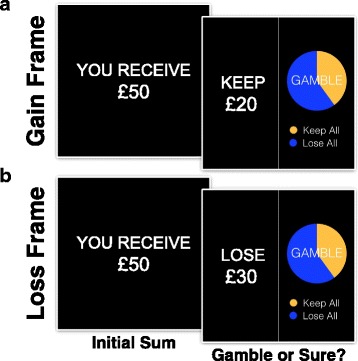
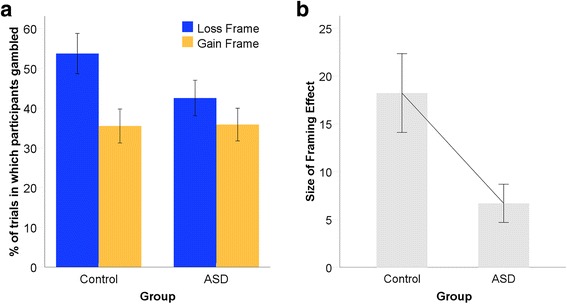
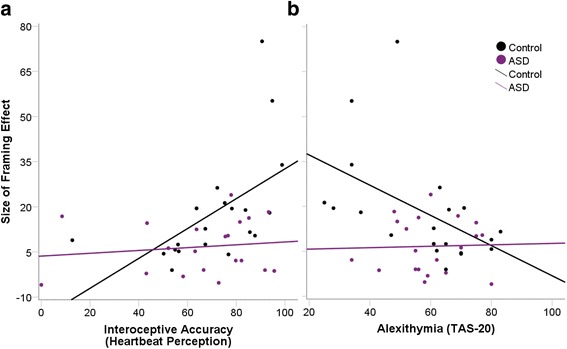
The way choices are framed influences decision-making. These "framing effects" emerge through the integration of emotional responses into decision-making under uncertainty. It was previously reported that susceptibility to the framing effect was reduced in individuals with autism spectrum disorder (ASD) due to a reduced tendency to incorporate emotional information into the decision-making process. However, recent research indicates that, where observed, emotional processing impairments in ASD may be due to co-occurring alexithymia. Alexithymia is thought to arise due to impaired interoception (the ability to perceive the internal state of one's body), raising the possibility that emotional signals are not perceived and thus not integrated into decision-making in those with alexithymia and that therefore reduced framing effects in ASD are a product of co-occurring alexithymia rather than ASD per se. Accordingly, the present study compared framing effects in autistic individuals with neurotypical controls matched for alexithymia. Results showed a marked deviation between groups. The framing effect was, in line with previous data, significantly smaller in autistic individuals, and there was no relationship between alexithymia or interoception and decision-making in the ASD group. In the neurotypical group, however, the size of the framing effect was associated with alexithymia and interoception, even after controlling for autistic traits. These results demonstrate that although framing effects are associated with interoception and alexithymia in the neurotypical population, emotional and interoceptive signals have less impact upon the decision-making process in ASD.
Overview
The claims and statistics of this paper haven’t been checked yet.
Run the check — free, no account needed. It reads the open-access text and checks the sources it cites.
Integrity signals
Registry
Cites
Statistics
Figures
Verification
Claims the paper makes
The claims and statistics of this paper haven’t been checked yet.
Run the check — free, no account needed. It reads the open-access text and checks the sources it cites.
Claims other papers make about this one
Each is checked against this paper’s own text: does it say what the citing paper says it does?
The source backs part of the claim, not all of it — or backs it for a different population, condition or comparison.
In the citing paper
“A growing literature has highlighted the importance of diagnosing comorbid alexithymia, which may explain some of the socioemotional and communicative deficits of autism and be worthy of targeted intervention [78–83].”
From A 'choice', an 'addiction', a way 'out of the lost': Exploring self-injury in autistic people without intellectual disability (2019) · cites this paper as [80]
Experimental — accuracy not yet measuredThe cited source says what the claim attributes to it.
In the citing paper
“Another instance is the TAS-20, which despite being robustly used in autism research (see, for instance, [80, 82, 141]), has never undergone a thorough examination (e.g. [118, 119]) as to whether autistic individuals understand items in the same way as non-autistic people”
From A 'choice', an 'addiction', a way 'out of the lost': Exploring self-injury in autistic people without intellectual disability (2019) · cites this paper as [80]
Self-check
Percentages, sums and reported differences re-computed from the paper’s own numbers.
The self-check needs the paper’s full text.
Citations
Cites
Faul, F., Erdfelder, E., Lang, A.-G., & Buchner, A. (2007) · Behavior Research Methods · doi:10.3758/bf03193146 · Cited by 65,971
(1970) · Cited by 24,983
The Framing of Decisions and the Psychology of Choice
Tversky, A., & Kahneman, D. (1981) · Science · doi:10.1126/science.7455683 · Cited by 18,497
Lord, C., Risi, S., Lambrecht, L., Cook, E. H., Leventhal, B. L., DiLavore, P. C., Pickles, A., & Rutter, M. (2000) · Journal of Autism and Developmental Disorders · doi:10.1023/a:1005592401947 · Cited by 7,520
Baron-Cohen, S., Wheelwright, S., Skinner, R., Martin, J., & Clubley, E. (2001) · Journal of Autism and Developmental Disorders · doi:10.1023/a:1005653411471 · Cited by 6,450
Bagby, R. M., Parker, J. D. A., & Taylor, G. J. (1994) · Journal of Psychosomatic Research · doi:10.1016/0022-3999(94)90005-1 · Cited by 5,293
PsychoPy—Psychophysics software in Python
Peirce, J. W. (2007) · Journal of Neuroscience Methods · doi:10.1016/j.jneumeth.2006.11.017 · Cited by 4,728
Neural systems supporting interoceptive awareness
Critchley, H. D., Wiens, S., Rotshtein, P., Öhman, A., & Dolan, R. J. (2004) · Nature Neuroscience · doi:10.1038/nn1176 · Cited by 3,406 · cited 1×
“The question is especially pertinent when one considers alexithymia to be a general impairment of interoception because interoceptive ability, driven by insula activity [34], has been demonstrated to moderate the effects of emotion on decision-making (e.”
BackgroundEnhanced Perceptual Functioning in Autism: An Update, and Eight Principles of Autistic Perception
Mottron, L., Dawson, M., Soulières, I., Hubert, B., & Burack, J. (2006) · Journal of Autism and Developmental Disorders · doi:10.1007/s10803-005-0040-7 · Cited by 1,957
Which terms should be used to describe autism? Perspectives from the UK autism community
Kenny, L., Hattersley, C., Molins, B., Buckley, C., Povey, C., & Pellicano, E. (2016) · Autism · doi:10.1177/1362361315588200 · Cited by 1,941
Research works printed but not linked: 2
- Wechsler D. Wechsler adult intelligence scale—third edition. Administration and scoring manual. San Antonio: Psychol. Corp; 1997.
- Wechsler D. WASI-II: Wechsler abbreviated scale of intelligence—second edition. San Antonio: Psychol. Corp; 2013.
Cited by
Sorted by citations
Compensatory strategies below the behavioural surface in autism: a qualitative study
Livingston, L. A., Shah, P., & Happe, F. G. E. (2019) · The Lancet Psychiatry · doi:10.1016/s2215-0366(19)30224-x · Cited by 358
Self-citationA capabilities approach to understanding and supporting autistic adulthood
Pellicano, E., Fatima, U., Hall, G., Heyworth, M., Lawson, W., Lilley, R., Mahony, J., & Stears, M. (2022) · Nature Reviews Psychology · doi:10.1038/s44159-022-00099-z · Cited by 237
Atypical interoception as a common risk factor for psychopathology: A review
Brewer, R., Murphy, J., & Bird, G. (2021) · Neuroscience & Biobehavioral Reviews · doi:10.1016/j.neubiorev.2021.07.036 · Cited by 180
Self-citationThe feeling of Me feeling for you: interoception, alexithymia and empathy in autism
Mul, C.-L., Stagg, S. D., Herbelin, B., & Aspell, J. E. (2018) · Journal of Autism and Developmental Disorders · doi:10.1007/s10803-018-3564-3 · Cited by 180
Desmedt, O., Corneille, O., Luminet, O., Murphy, J., Bird, G., & Maurage, P. (2020) · Biological Psychology · doi:10.1016/j.biopsycho.2020.107904 · Cited by 168
Self-citation
Metadata
- Authors
- Shah, P., Catmur, C., & Bird, G.
- Affiliations
- University of London (GB)
- King's College London (GB)
- Corresponding author
- Shah, Punit
- Venue
- Molecular Autism
- Published
- 2016-10-13
- Volume
- 7
- Issue
- 1
- Pages
- 43-43
- ISSN
- 2040-2392 (ISSN-L)
- PMC
- PMC5062918
- OpenAlex
- W2529479083
- Cited by
- 113
- References
- 73
- Citations by year
- 2026: 4 · 2025: 11 · 2024: 14 · 2023: 16 · 2022: 13 · 2021: 14 · 2020: 8 · 2019: 12 · 2018: 14 · 2017: 7
- FWCI
- 6.93
- Type
- journal article
- Language
- en
- Open access
- gold
- doi.org
- Licence
- cc-by
- Locations
- Molecular Autism (publishedVersion, cc-by)
- Europe PMC (PubMed Central) (publishedVersion, cc-by)
- PubMed Central (publishedVersion, cc-by)
- PubMed (publishedVersion)
- Research Portal (King's College London) (publishedVersion, cc-by)
- University of Birmingham Research Portal (University of Birmingham) (submittedVersion)
- Funders
- Medical Research Council
- Baily Thomas Charitable Fund
- Topics
- Life Sciences › Neuroscience › Cognitive Neuroscience › Autism Spectrum Disorder Research
- Social Sciences › Decision Sciences › General Decision Sciences › Decision-Making and Behavioral Economics
- Health Sciences › Medicine › Psychiatry and Mental health › Psychosomatic Disorders and Their Treatments
- Keywords
- autism spectrum disorder, emotional decision-making, framing effects, interoception, alexithymia, decision making under uncertainty, emotional processing, autistic traits, neurotypical comparison
- MeSH terms
- Autism Spectrum Disorder, Adult, Affective Symptoms, Decision Making, Female, Frustration, Happiness, Humans, Intelligence Tests, Male, Case-Control Studies, Interoception
About these checks
Registry, retraction, Cites and statistics results are computed, not judged, with one exception: a printed reference that no index lists is read once by a model before it counts as a citation error. Claims are extracted by a model and kept only when their quote appears verbatim in the text; each cited source is then checked, with a model’s help, for whether it says what the claim relies on. Those verdicts can be wrong — read the claim’s quote and the cited source before relying on one.
Statistics and arithmetic are recomputed, not judged.
Confidence bands are shown only for fields calibrated on our annotated test set. None is calibrated yet, so no band is shown.
What counts as a claim ›How we measure confidence ›How we check this ›
Are you an author, or do you see a problem with this page? Request a review
