

The DOI matches its Crossref record; 40 of the 40 references it cites were found in a registry or an index.
Inherited and multiple de novo mutations in autism/developmental delay risk genes suggest a multifactorial model
Open accessAbstract
Background: We previously performed targeted sequencing of autism risk genes in probands from the Autism Clinical and Genetic Resources in China (ACGC) (phase I). Here, we expand this analysis to a larger cohort of patients (ACGC phase II) to better understand the prevalence, inheritance, and genotype-phenotype correlations of likely gene-disrupting (LGD) mutations for autism candidate genes originally identified in cohorts of European descent. Methods: We sequenced 187 autism candidate genes in an additional 784 probands and 85 genes in 599 probands using single-molecule molecular inversion probes. We tested the inheritance of potentially pathogenic mutations, performed a meta-analysis of phase I and phase II data and combined our results with existing exome sequence data to investigate the phenotypes of carrier parents and patients with multiple hits in different autism risk genes. Results: ). We identified the transmission of private LGD mutations in genes predominantly associated with DNMs and showed that parental carriers tended to share milder autism-related phenotypes. Patients that carried DNMs in two or more candidate genes show more severe phenotypes. Conclusions: We identify new risk genes and transmission of deleterious mutations in genes primarily associated with DNMs. The fact that parental carriers show milder phenotypes and patients with multiple hits are more severe supports a multifactorial model of risk.
Overview
The claims and statistics of this paper haven’t been checked yet.
Run the check — free, no account needed. It reads the open-access text and checks the sources it cites.
Integrity signals
Registry
Cites
Statistics
Figures
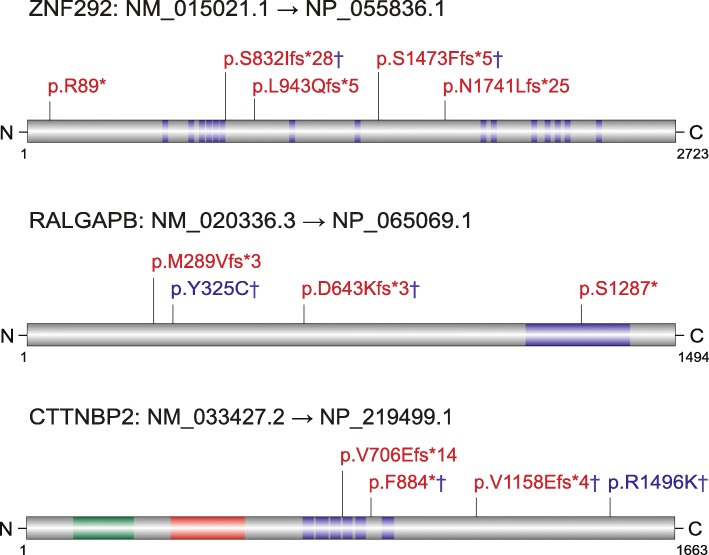
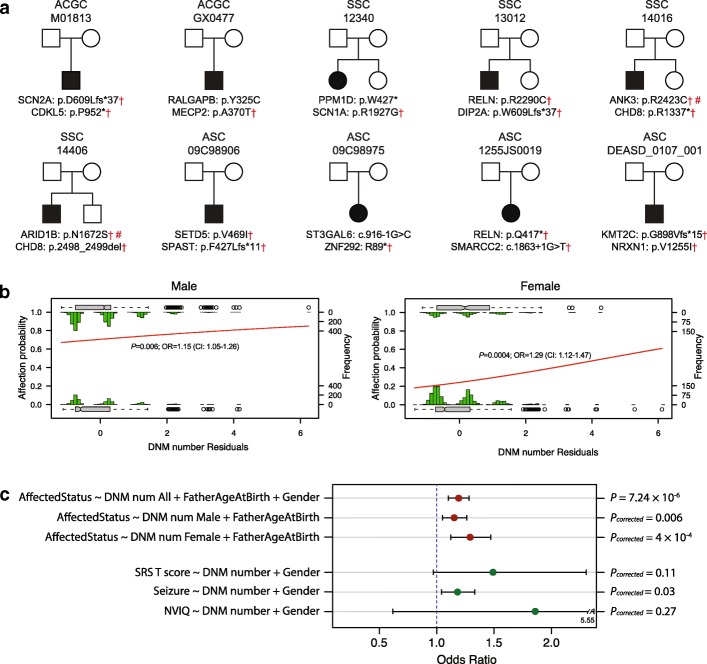
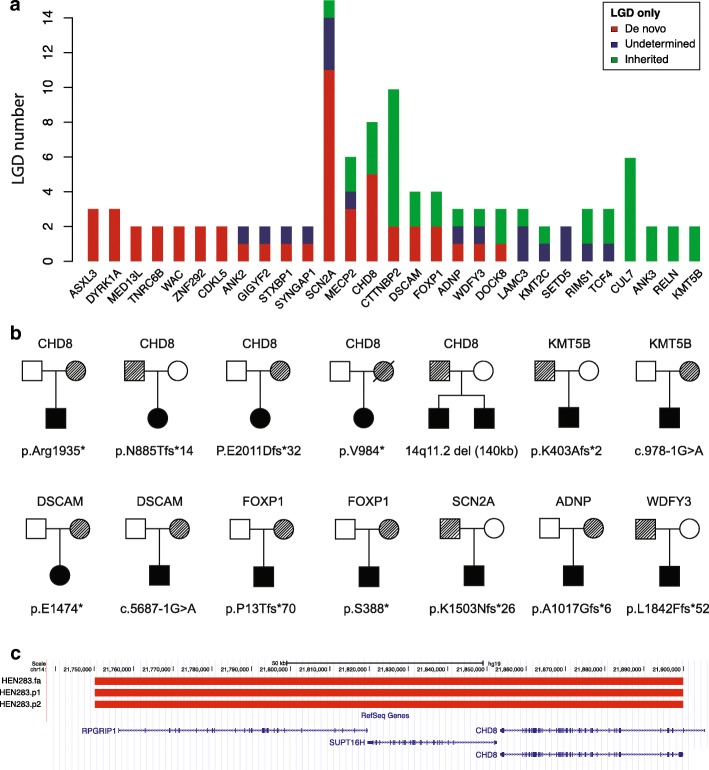
Verification
Claims the paper makes
The claims and statistics of this paper haven’t been checked yet.
Run the check — free, no account needed. It reads the open-access text and checks the sources it cites.
Claims other papers make about this one
Each is checked against this paper’s own text: does it say what the citing paper says it does?
In the citing paper
“For example, Guo et al. 25 assessed three families in which likely gene-disrupting CHD8 mutations were transmitted from parents with full-scale IQ scores between 80 and 87 (verbal IQ 88–-95, nonverbal IQ 75–79), establishing the possibility of relative sparing of cognition.”
From Insufficient Evidence for “Autism-Specific” Genes (2020) · cites this paper as [25]
Self-check
Percentages, sums and reported differences re-computed from the paper’s own numbers.
The self-check needs the paper’s full text.
Citations
Cites
Fast and accurate short read alignment with Burrows-Wheeler transform
Li, H., & Durbin, R. (2009) · Bioinformatics · doi:10.1093/bioinformatics/btp324 · Cited by 58,607
Self-citation(1943) · The Nervous child · Cited by 8,870
Synaptic, transcriptional and chromatin genes disrupted in autism
Study, T. D., De Rubeis, S., Autism, H. M. C. F., UK10K Consortium, The Autism Sequencing Consortium, He, X., Goldberg, A. P., Poultney, C. S., Samocha, K., Ercument Cicek, A., et al. (2014) · Nature · doi:10.1038/nature13772 · Cited by 2,746
Global Prevalence of Autism and Other Pervasive Developmental Disorders
Elsabbagh, M., Divan, G., Koh, Y., Kim, Y. S., Kauchali, S., Marcín, C., Montiel‐Nava, C., Patel, V., Paula, C. S., Wang, C., et al. (2012) · Autism Research · doi:10.1002/aur.239 · Cited by 2,636
The contribution of de novo coding mutations to autism spectrum disorder
Iossifov, I., O’Roak, B. J., Sanders, S. J., Ronemus, M., Krumm, N., Levy, D., Stessman, H. A., Witherspoon, K. T., Vives, L., Patterson, K. E., et al. (2014) · Nature · doi:10.1038/nature13908 · Cited by 2,585
Self-citationAutistic disturbances of affective contact.
Kanner, L. (1968) · PubMed · Cited by 2,282
Targeted capture and massively parallel sequencing of 12 human exomes
Ng, S. B., Turner, E. H., Robertson, P. D., Flygare, S. D., Bigham, A. W., Lee, C., Shaffer, T., Wong, M., Bhattacharjee, A., Eichler, E. E., et al. (2009) · Nature · doi:10.1038/nature08250 · Cited by 2,030
Self-citationChristensen, D. L., Baio, J., Braun, K. V. N., Bilder, D., Charles, J., Constantino, J. N., Daniels, J., Durkin, M. S., Fitzgerald, R. T., Kurzius-Spencer, M., et al. (2016) · MMWR. Surveillance Summaries · doi:10.15585/mmwr.ss6503a1 · Cited by 1,964
Diagnostic exome sequencing in persons with severe intellectual disability
de Ligt, J., Willemsen, M. H., van Bon, B. W. M., Kleefstra, T., Yntema, H. G., Kroes, T., Vulto-van Silfhout, A. T., Koolen, D. A., de Vries, P., Gilissen, C., et al. (2012) · New England Journal of Medicine · doi:10.1056/nejmoa1206524 · Cited by 1,546
Prevalence of Autism Spectrum Disorders in a Total Population Sample
Kim, Y. S., Leventhal, B. L., Koh, Y.-J., Fombonne, E., Laska, E., Lim, E.-C., Cheon, K.-A., Kim, S.-J., Kim, Y.-K., Lee, H., et al. (2011) · American Journal of Psychiatry · doi:10.1176/appi.ajp.2011.10101532 · Cited by 1,524
Research works printed but not linked: 1
- Constantino JN, Gruber CP. Social responsiveness scale (SRS). Los Angeles: Western Psychological Services; 2005.
Cited by
Sorted by citations
Items 101–158 of 158
Shen, L., Li, P., Zheng, T., Luo, M., Zhang, S., Huang, Y., Hu, Y., & Li, H. (2021) · Molecular Medicine Reports · doi:10.3892/mmr.2021.12336 · Cited by 3
Self-citationA family study implicates GBE1 in the etiology of autism spectrum disorder
Fanjul‐Fernández, M., Brown, N. J., Hickey, P. F., Diakumis, P., Rafehi, H., Bozaoglu, K., Green, C. C., Rattray, A., Young, S., Alhuzaimi, D. E., et al. (2021) · Human Mutation · doi:10.1002/humu.24289 · Cited by 3
Self-citationLai, W., Zhao, Y., Chen, Y., Dai, Z., Chen, R., Niu, Y., Chen, X., Chen, S., Huang, G., Shan, Z., et al. (2024) · Molecular Psychiatry · doi:10.1038/s41380-024-02578-6 · Cited by 4
Self-citationHaddad, S., Hessenberger, M., Ablinger, C., Eibl, C., Stanika, R. I., Campiglio, M., & Obermair, G. J. (2024) · Pharmaceuticals · doi:10.3390/ph17121608 · Cited by 3
Cross-Disorder Analysis of De Novo Mutations in Neuropsychiatric Disorders
Li, K., Fang, Z., Zhao, G., Li, B., Chen, C., Xia, L., Wang, L., Luo, T., Wang, X., Wang, Z., et al. (2021) · Journal of Autism and Developmental Disorders · doi:10.1007/s10803-021-05031-7 · Cited by 4
Self-citationExcess of RALGAPB de novo variants in neurodevelopmental disorders
Shah, A. A., Zhang, G., Li, K., Liu, C., Kanhar, A. A., Wang, M., Quan, Y., Wu, H., Shen, L., Khan, R., et al. (2020) · European Journal of Medical Genetics · doi:10.1016/j.ejmg.2020.104041 · Cited by 3
Self-citationNoncoding de novo mutations contribute to autism spectrum disorder via chromatin interactionsPreprint
Kim, I. B., Lee, T., Lee, J., Kim, J., Lee, H., Kim, W. K., Ju, Y. S., Cho, Y., Yu, S. J., Kim, S. A., et al. (2019) · bioRxiv (Cold Spring Harbor Laboratory) · doi:10.1101/2019.12.15.877324 · Cited by 3
Cheon, S. H., Culver, A. M., Bagnell, A. M., Ritchie, F. D., Clytus, J. M., McCord, M. M., Papendorp, C. M., Chukwurah, E., Smith, A. J., Cowen, M. H., et al. (2020) · bioRxiv (Cold Spring Harbor Laboratory) · doi:10.1101/2020.02.18.954586 · Cited by 3
Harripaul, R., Rabia, A., Vasli, N., Mikhailov, A., Rodrigues, A., Pastore, S. F., Muhammad, T., Madanagopal, T. T., Hashmi, A. N., Tran, C., et al. (2021) · medRxiv · doi:10.1101/2021.12.24.21268340 · Cited by 3
Blachier, F. (2023) · Springer eBooks · doi:10.1007/978-3-031-26322-4_5 · Cited by 2
McIntyre, C. L., Boucher, T. Q., Scheerer, N. E., Gurm, M., & Iarocci, G. (2022) · Journal of Autism and Developmental Disorders · doi:10.1007/s10803-022-05494-2 · Cited by 2
Murthy, A. S. N., Balakrishnan, S. T., & Ramachandra, N. B. (2022) · Network Modeling Analysis in Health Informatics and Bioinformatics · doi:10.1007/s13721-022-00377-z · Cited by 3
Cross-Disorder Analysis of De Novo Variants Increases the Power of Prioritising Candidate Genes
Li, K., Ling, Z., Luo, T., Zhao, G., Zhou, Q., Wang, X., Xia, K., Li, J., & Li, B. (2021) · Life · doi:10.3390/life11030233 · Cited by 2
Self-citationRegulation of Calcium Channels and Synaptic Function by Auxiliary α2δ Subunits
DOLPHIN, A. C., & Obermair, G. J. (2022) · Springer eBooks · doi:10.1007/978-3-031-08881-0_5 · Cited by 2
Analysis of eEF1Bγ interactome in the nuclear fraction of A549 human lung adenocarcinoma cells
Kapustian, L. M., Lysetsky, I. L., Bondarchuk, T., Novosylna, O. V., & Negrutskii, B. S. (2019) · Biopolymers and Cell · doi:10.7124/bc.000a0a · Cited by 2
Influence of De novo mutation in autism
Arumugam, V., Sanjeev, A. M. A., Kathirvel, B., & Kaviya, M. (2020) · Biomedical and Biotechnology Research Journal (BBRJ) · doi:10.4103/bbrj.bbrj_63_20 · Cited by 1
Salemi, M., Mandarà, L., Salluzzo, M. G., Schillaci, F. A., Castiglione, R., Cordella, A., Iorio, R., Perrotta, C. S., Ferri, R., & Romano, C. (2023) · Molecular Biology Reports · doi:10.1007/s11033-023-08764-z · Cited by 1
Garg, P., Jamal, F., & Srivastava, P. (2024) · Heliyon · doi:10.1016/j.heliyon.2024.e30755 · Cited by 1
Mudassir, B. U., Mudassir, M., Williams, J. B., & Agha, Z. (2024) · Biomedicines · doi:10.3390/biomedicines12122736 · Cited by 1
Li, D., Ruen, Y., Ying, Y., Chen, L., Jie, W., Chunjiao, L., Li, W., Rikun, C., & Cuiyun, L. (2025) · Clinical Case Reports · doi:10.1002/ccr3.70747 · Cited by 1
Structural interactions of ankyrin B with NrCAM and β2 spectrin
Chirasani, V. R., Haberman, V. A., Oldre, E. N., Webb, B. D., Pereira, E. B., Yang, W., & Maness, P. F. (2025) · Journal of Biological Chemistry · doi:10.1016/j.jbc.2025.110872 · Cited by 2
Narayan, P. R., Sabir, S., Jayvas, D., Doan, R. N., Li, Q., Anderson, K., Chen, S., Felker, M. V., Frigeni, M., Giummo, C. A., et al. (2026) · American Journal of Medical Genetics Part A · doi:10.1002/ajmg.a.70264 · Cited by 1
The Presynaptic α2δ Protein Family and Their Therapeutic Potential
Ablinger, C., Eibl, C., Roznovcova, M., Cottrell, G. S., Stephens, G. J., & Obermair, G. J. (2024) · Springer eBooks · doi:10.1007/978-3-031-52197-3_3 · Cited by 1
Paracentric inversion disrupting the SHANK2 gene
Huyghebaert, J., Christiaenssen, B., Rademaeker, M. D., van den Ende, J., Vandeweyer, G., Kooy, R. F., Mateiu, L. M., & Annear, D. J. (2025) · European Journal of Medical Genetics · doi:10.1016/j.ejmg.2025.105009 · Cited by 1
Caracterização genótipo-fenótipo em novas síndromes associadas ao Transtorno do Espectro Autista
Branco, E. V. (2020) · Digital Library of Theses and Dissertations (Universidade de São Paulo) · doi:10.11606/d.41.2020.tde-20012020-101726 · Cited by 1
Ashitha, S. N. M., Balakrishnan, S., & Ramachandra, N. B. (2020) · doi:10.22541/au.159672670.04988762 · Cited by 1
Yuan, B., Wang, M., Wu, X., Cheng, P., Zhang, R., Zhang, R., Yu, S., Zhang, J., Du, Y., Wang, X., et al. (2021) · Research Square · doi:10.21203/rs.3.rs-729083/v1 · Cited by 1
Yuan, B., Wang, M., Wu, X., Cheng, P., Zhang, R., Zhang, R., Yu, S., Zhang, J., Du, Y., Wang, X., et al. (2021) · medRxiv · doi:10.1101/2021.07.14.21260545 · Cited by 1
Yuan, B., Wang, M., Wu, X., Cheng, P., Zhang, R., Zhang, R., Yu, S., Du, Y., Zhang, J., Wang, X., et al. (2022) · Research Square · doi:10.21203/rs.3.rs-729083/v2 · Cited by 1
Non-syndromic autism SCN2A variants selectively exert dominant-negative effects on Na v 1.2 channelsPreprint
Cestèle, S., Guerrini, R., Difhallah, S., Mei, D., Leroudier, N., Ricci, M., Balestrini, S., & Mantegazza, M. (2026) · bioRxiv (Cold Spring Harbor Laboratory) · doi:10.64898/2026.02.24.707547 · Cited by 1
Estudo dos componentes de vulnerabilidade genética no transtorno do espectro autista
Reis, V. N. D. S. (2019) · Digital Library of Theses and Dissertations (Universidade de São Paulo) · doi:10.11606/t.5.2019.tde-23082019-163447
Davis, K., Bilancia, C. G., Martin, M. M., Vanzo, R. J., Rimmasch, M., Hom, Y., Uddin, M. J., & Serrano, M. A. (2021) · bioRxiv (Cold Spring Harbor Laboratory) · doi:10.1101/2021.02.04.429640
Dominant and sporadic de novo disorders
Gonzaga-Jauregui, C. G., Hayek, L. E., & Chahrour, M. H. (2021) · Elsevier eBooks · doi:10.1016/b978-0-12-820140-4.00010-7
seGMM: a new tool to infer sex from massively parallel sequencing dataPreprint
Liu, S., Zeng, Y., Chen, M., Zhang, Q., Wang, L., Wang, C., Lu, Y., Guo, H., & Bu, F. (2021) · bioRxiv (Cold Spring Harbor Laboratory) · doi:10.1101/2021.12.16.472877
Self-citationMaharjan, D. T., Song, W., Liu, Z., Wang, W., Cai, W., Chen, J., Xu, F., Ying, W., & Lin, G. N. (2022) · Biomolecules · doi:10.3390/biom12111643
Self-citationHoffmann, M. W., Cywes, R., Childers, A. M., Kossoff, M. M., Kossoff, E. H., Perlmutter, D., Phillips, M. C. L., Edes, G., Berger, A., Stanton, A. A., et al. (2023) · Elsevier eBooks · doi:10.1016/b978-0-12-821617-0.00006-1
Evidence for a Pathogenic Role of CSMD1 in Childhood Apraxia of Speech
Formicola, D., Podda, I., Pantaleo, M., Andreucci, E., Lopergolo, D., Giglio, S., Santorelli, F. M., & Chilosi, A. M. (2023) · Neuropediatrics · doi:10.1055/s-0043-1771033
Sheth, F. J., Shah, J., Jain, D. K., Shah, S. N., Patel, H., Patel, K., Solanki, D., Iyer, A. S., Menghani, B., Mhatre, P., et al. (2023) · Figshare · doi:10.6084/m9.figshare.23896141
Sheth, F. J., Shah, J., Jain, D. K., Shah, S. N., Patel, H., Patel, K., Solanki, D., Iyer, A. S., Menghani, B., Mhatre, P., et al. (2023) · Figshare · doi:10.6084/m9.figshare.23896150
Sheth, F. J., Shah, J., Jain, D. K., Shah, S. N., Patel, H., Patel, K., Solanki, D., Iyer, A. S., Menghani, B., Mhatre, P., et al. (2023) · Figshare · doi:10.6084/m9.figshare.23896153
Souza, E. M. S. M. M. (2020) · Digital Library of Theses and Dissertations (Universidade de São Paulo) · doi:10.11606/t.41.2020.tde-09112020-112756
Erkan, D. D., Soğukpınar, M., Demir, G. Ü., Ütine, G. E., & Şimşek‐Kiper, P. Ö. (2024) · Molecular Syndromology · doi:10.1159/000541941
Psychological Theories of Autism
Austin, A., & Vivanti, G. (2024) · Autism and child psychopathology series · doi:10.1007/978-3-031-64499-3_7 · Cited by 1
Wang, L., Zhang, Y., Li, K., Wang, Z., Wang, X., Li, B., Zhao, G., Fang, Z., Ling, Z., Luo, T., et al. (2020) · Figshare · doi:10.6084/m9.figshare.13059481
Self-citationRegev, O., Shil, A., Bronshtein, T., Hadar, A., Meiri, G., Zigdon, D., Michaelovski, A., Hershkovitz, R., & Menashe, I. (2024) · Figshare · doi:10.6084/m9.figshare.27140782
Regev, O., Shil, A., Bronshtein, T., Hadar, A., Meiri, G., Zigdon, D., Michaelovski, A., Hershkovitz, R., & Menashe, I. (2024) · Figshare · doi:10.6084/m9.figshare.27140785
Regev, O., Shil, A., Bronshtein, T., Hadar, A., Meiri, G., Zigdon, D., Michaelovski, A., Hershkovitz, R., & Menashe, I. (2024) · Figshare · doi:10.6084/m9.figshare.27140779
Sheth, F., Shah, J., Jain, D. K., Shah, S., Patel, H., Patel, K. S., Solanki, D. I., Iyer, A. S., Menghani, B., Mhatre, P., et al. (2023) · Figshare · doi:10.6084/m9.figshare.23896156
Additional file 1 of WDFY3 mutation alters laminar position and morphology of cortical neurons
Schaaf, Z. A., Tat, L., Cannizzaro, N., Green, R., Rülicke, T., Hippenmeyer, S., & Zarbalis, K. S. (2022) · Figshare · doi:10.6084/m9.figshare.20131009
Regev, O., Shil, A., Bronshtein, T., Hadar, A., Meiri, G., Zigdon, D., Michaelovski, A., Hershkovitz, R., & Menashe, I. (2024) · Figshare · doi:10.6084/m9.figshare.27140776
Sheth, F., Shah, J., Jain, D., Shah, S., Patel, H., Patel, K., Solanki, D. I., Iyer, A. S., Menghani, B., Mhatre, P., et al. (2023) · Figshare · doi:10.6084/m9.figshare.23896144
Young, B. P., Robinson, I., Schmitt, J., Wu, B. T. F., Liu, J., Chao, J. T., Rogić, S., Pavlidis, P., Allan, D. W., & Loewen, C. J. R. (2026) · bioRxiv (Cold Spring Harbor Laboratory) · doi:10.64898/2026.01.15.699751
Cirnigliaro, L., Saccuzzo, L., Marzà, V., Randazzo, M., Perdichizzi, M., Romano, C., Fichera, M., Rizzo, R., & Barone, R. M. E. (2026) · Frontiers in Psychiatry · doi:10.3389/fpsyt.2026.1754241
Harripaul, R., Rabia, A., Vasli, N., Mikhailov, A., Rodrigues, A., Pastore, S. F., Muhammad, T., Madanagopal, T. T., Hashmi, A. N., Tran, C., et al. (2026) · Scientific Reports · doi:10.1038/s41598-026-44288-9 · Cited by 4
Introduction to Neurogenetic Disability
Malviya, R., & Rajput, S. (2026) · SpringerBriefs in modern perspectives on disability research. · doi:10.1007/978-981-95-9223-4_1
Assessing vision and autism spectrum disorder-relevant social interaction phenotypes in Dscam mice
Tadenev, A. L. D., Pratt, S. L., Lopez, G., Mexicotte, A., Wray, A. D., & Burgess, R. W. (2026) · Behavioural Brain Research · doi:10.1016/j.bbr.2026.116271
Shen, Y., Pan, R., Liu, C., Zheng, J., & Yang, X. (2026) · Genes · doi:10.3390/genes17080950
Self-citation
Metadata
- Authors
- Guo, H., Wang, T., Wu, H., Long, M., Coe, B. P., Li, H., Xun, G., Ou, J., Chen, B., Duan, G., Bai, T., Zhao, N., Shen, Y., Li, Y., Wang, Y., Zhang, Y., Baker, C., Liu, Y., Pang, N., Huang, L., Han, L., Jia, X., Liu, C., Ni, H., Yang, X., Xia, L., Chen, J., Shen, L., Li, Y., Zhao, R., Zhao, W., Peng, J., Pan, Q., Long, Z., Su, W., Tan, J., Du, X., Ke, X., Yao, M., Hu, Z., Zou, X., Zhao, J., Bernier, R. A., Eichler, E. E., & Xia, K.
- Affiliations
- Central South University (CN)
- University of Washington (US)
- Liuzhou Maternal and Child Health Hospital (CN)
- Shandong Mental Health Center (CN)
- Third Affiliated Hospital of Sun Yat-sen University (CN)
- Third Affiliated Hospital of Zhengzhou University (CN)
- Nanjing Brain Hospital (CN)
- Howard Hughes Medical Institute (US)
- Corresponding author
- Guo, Hui
- Eichler, Evan E.
- Xia, Kun
- ORCID
- Guo, Hui
- Wang, Tianyun
- Coe, Bradley P.
- Li, Honghui
- Xun, Guanglei
- Ou, Jianjun
- Chen, Biyuan
- Bai, Ting
- Shen, Yidong
- Li, Yun
- Wang, Yazhe
- Zhang, Yu
- Liu, Yanling
- Pang, Nan
- Huang, Lian
- Han, Lin
- Jia, Xiangbin
- Liu, Cenying
- Yang, Xinyi
- Xia, Lu
- Chen, Jingjing
- Shen, Lu
- Li, Ying
- Zhao, Rongjuan
- Zhao, Wenjing
- Peng, Jing
- Pan, Qian
- Su, Wei
- Tan, Jieqiong
- Du, Xiaogang
- Ke, Xiaoyan
- Hu, Zhengmao
- Zou, Xiaobing
- Zhao, Jingping
- Bernier, Raphael A.
- Eichler, Evan E.
- Xia, Kun
- Venue
- Molecular Autism
- Published
- 2018-12
- Volume
- 9
- Issue
- 1
- Pages
- 64-64
- ISSN
- 2040-2392 (ISSN-L)
- PMC
- PMC6293633
- OpenAlex
- W2904691870
- Cited by
- 154
- References
- 40
- Citations by year
- 2026: 8 · 2025: 7 · 2024: 22 · 2023: 21 · 2022: 31 · 2021: 26 · 2020: 27 · 2019: 12
- FWCI
- 9.66
- Type
- journal article
- Language
- en
- Open access
- gold
- doi.org
- Licence
- Locations
- Molecular Autism (publishedVersion, cc-by)
- Europe PMC (PubMed Central) (publishedVersion, other-oa)
- PubMed Central (publishedVersion, cc-by)
- PubMed (publishedVersion)
- DOAJ (DOAJ: Directory of Open Access Journals) (submittedVersion)
- Funders
- National Natural Science Foundation of China (81330027, 81525007, 31671114, 31400919, 81601197, 81460500)
- Simons Foundation (SFARI 303241)
- National Institutes of Health (R01MH101221, R01MH100047)
- Howard Hughes Medical Institute (N/A)
- Topics
- Life Sciences › Neuroscience › Cognitive Neuroscience › Autism Spectrum Disorder Research
- Life Sciences › Biochemistry, Genetics and Molecular Biology › Genetics › Genetics and Neurodevelopmental Disorders
- Life Sciences › Biochemistry, Genetics and Molecular Biology › Genetics › Genomics and Rare Diseases
- Keywords
- autism spectrum disorder, developmental delay, autism risk genes, de novo mutations, inherited mutations, multi-factor models, genotype-phenotype correlation, autism candidate genes
- MeSH terms
- Autism Spectrum Disorder, Adult, Child, Female, Humans, Male, Models, Genetic, Mutation, Pedigree, Multifactorial Inheritance, Quantitative Trait Loci
About these checks
Registry, retraction, Cites and statistics results are computed, not judged, with one exception: a printed reference that no index lists is read once by a model before it counts as a citation error. Claims are extracted by a model and kept only when their quote appears verbatim in the text; each cited source is then checked, with a model’s help, for whether it says what the claim relies on. Those verdicts can be wrong — read the claim’s quote and the cited source before relying on one.
Statistics and arithmetic are recomputed, not judged.
Confidence bands are shown only for fields calibrated on our annotated test set. None is calibrated yet, so no band is shown.
What counts as a claim ›How we measure confidence ›How we check this ›
Are you an author, or do you see a problem with this page? Request a review
