

Prevalence and cumulative incidence of autism spectrum disorders and the patterns of co-occurring neurodevelopmental disorders in a total population sample of 5-year-old children
Open accessThe DOI matches its Crossref record; 29 of the 29 references it cites were found in a registry or an index.
Abstract
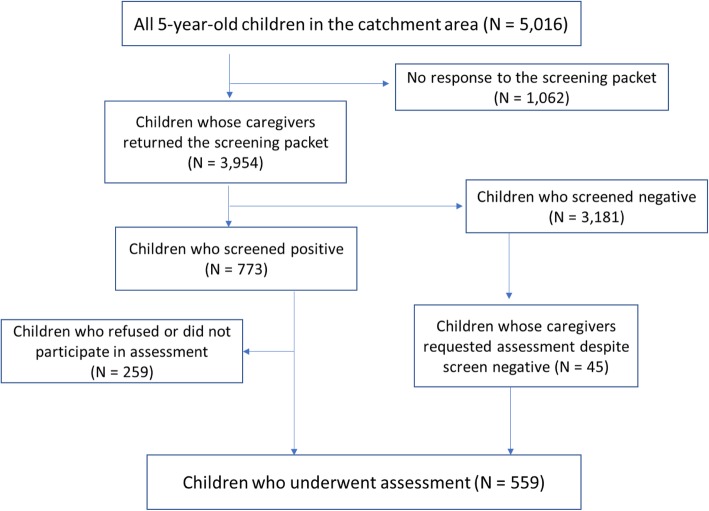
BACKGROUNDS: Whether there is a true increase in autism spectrum disorder (ASD) frequency or not remains unclear. Additionally, the rates of co-existing neurodevelopmental disorders (NDD) in a total population sample has not been fully examined before. Therefore, using a total population sample in Japan, we aimed to estimate the prevalence and cumulative incidence of autism spectrum disorder (ASD) annually, to determine whether there is a true increase in ASD prevalence by estimating the cumulative incidence of ASD annually, and to examine the rates of co-existing neurodevelopmental disorders (NDD). METHOD: In this cross-sectional sequential design study, all 5-year-old children in the catchment area underwent the screening annually from the year 2013-2016. Screen-positive children were invited to participate in a comprehensive assessment, including child and parent interview, behavioral observation, and cognitive and motor function testing. All cases were reviewed by a multidisciplinary research team. RESULTS: Caregivers of 3954 children returned the screening, among which 559 children underwent the assessment with 87 children receiving an ASD diagnosis. Adjusted ASD prevalence was 3.22% (95% confidence interval (CI) 2.66-3.76%). The male to female ratio of the crude prevalence was 2.2:1. The cumulative incidence of ASD up to 5 years of age for the total study years was 1.31% (95% CI 1.00-1.62%). A generalized linear model revealed no significant linear trends in 5-year cumulative incidence over the study years. Only 11.5% of children had ASD alone; the remaining 88.5% were found to have at least one co-existing NDD. LIMITATIONS: Modest sample size for a total population study. CONCLUSIONS: Our findings demonstrate the stability of the 5-year cumulative incidence of ASD, implying no true rise in ASD incident cases over the 4-year study period in the study catchment area. High rates of co-existing NDDs reflect the importance of investigating broad developmental challenges in children with ASD.
Overview
The claims and statistics of this paper haven’t been checked yet.
Free: it reads the open-access text and checks the first 5 claims that cite a source we can check. Create a free account to check every claim.
Integrity signals
Registry
Cites
Statistics
Figures
Verification
Claims the paper makes
The claims and statistics of this paper haven’t been checked yet.
Free: it reads the open-access text and checks the first 5 claims that cite a source we can check. Create a free account to check every claim.
Claims other papers make about this one
Each is checked against this paper’s own text: does it say what the citing paper says it does?
The source backs part of the claim, not all of it — or backs it for a different population, condition or comparison.
In the citing paper
“The high prevalence in high-income Asia Pacific was driven by high-quality data from South Korea and Japan indicating high prevalence in this region.12, 13, 28, 29”
From The global epidemiology and health burden of the autism spectrum: findings from the Global Burden of Disease Study 2021. (2025) · cites this paper as [13]
Experimental — accuracy not yet measuredThe source backs part of the claim, not all of it — or backs it for a different population, condition or comparison.
In the citing paper
“which was relatively low compared with the prevalence of autism spectrum disorder from active case-finding methods (in which prevalence is estimated using a diagnostic instrument in a general population survey supplemented by a search in case registries or special education facilities).11, 12, 13”
From The global epidemiology and health burden of the autism spectrum: findings from the Global Burden of Disease Study 2021. (2025) · cites this paper as [13]
Experimental — accuracy not yet measuredThe source backs part of the claim, not all of it — or backs it for a different population, condition or comparison.
In the citing paper
“The large increase in the estimated prevalence of the autism spectrum reflects necessary improvements in its epidemiological modelling and aligns global estimates with estimates derived from high-quality epidemiological surveys.11, 12, 13”
From The global epidemiology and health burden of the autism spectrum: findings from the Global Burden of Disease Study 2021. (2025) · cites this paper as [13]
Experimental — accuracy not yet measured
Self-check
Percentages, sums and reported differences re-computed from the paper’s own numbers.
The self-check needs the paper’s full text.
Citations
Cites
Baio, J., Wiggins, L., Christensen, D. L., Maenner, M. J., Daniels, J., Warren, Z., Kurzius-Spencer, M., Zahorodny, W., Robinson, C., Rosenberg, et al. (2018) · MMWR. Surveillance Summaries · doi:10.15585/mmwr.ss6706a1 · Cited by 6,078
What Is the Male-to-Female Ratio in Autism Spectrum Disorder? A Systematic Review and Meta-Analysis
Loomes, R., Hull, L., & Mandy, W. P. L. (2017) · Journal of the American Academy of Child & Adolescent Psychiatry · doi:10.1016/j.jaac.2017.03.013 · Cited by 2,804
Autism Diagnostic Observation Schedule
Lord, C., Rutter, M., Goode, S., Heemsbergen, J., Jordan, H., Mawhood, L., & Schopler, E. (2016) · PsycTESTS Dataset · doi:10.1037/t54175-000 · Cited by 1,678
Movement Assessment Battery for Children-2
Henderson, S. E., Sugden, D., & Barnett, A. L. (2019) · PsycTESTS Dataset · doi:10.1037/t55281-000 · Cited by 1,619
Prevalence of Autism Spectrum Disorders in a Total Population Sample
Kim, Y. S., Leventhal, B. L., Koh, Y.-J., Fombonne, E., Laska, E., Lim, E.-C., Cheon, K.-A., Kim, S.-J., Kim, Y.-K., Lee, H., et al. (2011) · American Journal of Psychiatry · doi:10.1176/appi.ajp.2011.10101532 · Cited by 1,524
Self-citationNaarden Braun, K. V., Lopez, M., White, T., et al. (2023) · Carolina Digital Repository (University of North Carolina at Chapel Hill) · doi:10.17615/y3kk-5x30 · Cited by 1,381
Competing risks in epidemiology: possibilities and pitfalls
Andersen, P. K., Geskus, R. B., de Witte, T., & Putter, H. (2012) · International Journal of Epidemiology · doi:10.1093/ije/dyr213 · Cited by 985
Pervasive Developmental Disorders in Preschool Children: Confirmation of High Prevalence
Chakrabarti, S., & Fombonne, E. (2005) · American Journal of Psychiatry · doi:10.1176/appi.ajp.162.6.1133 · Cited by 791
The Epidemiology of Asperger Syndrome: A Total Population Study
Ehlers, S., & Gillberg, C. (1993) · Journal of Child Psychology and Psychiatry · doi:10.1111/j.1469-7610.1993.tb02094.x · Cited by 720
Research works printed but not linked: 1
- Wechsler D Japanese WISC-IV Publication Committee. Japanese version of the Wechsler intelligence scale for children-fourth edition 2010 Nihon Bunka Kagakusha Tokyo, Japan
Cited by
Items 101–162 of 162
Kawaguchi, C., Ishikuro, M., Saito, R., Murakami, K., Noda, A., Shinoda, G., Aizawa, M., Ohseto, H., Iwama, N., Orui, M., et al. (2025) · The Journal of Clinical Endocrinology & Metabolism · doi:10.1210/clinem/dgae825 · Cited by 2
Co-design of the neurodevelopment assessment scale
Wong, T. Y., Azim, S. I., Lam‐Cassettari, C., Lin, P., Diaz, A. M., Montgomery, A. K., Masi, A., Mallitt, K., Whitehouse, A., Dadds, M. R., et al. (2025) · Frontiers in Child and Adolescent Psychiatry · doi:10.3389/frcha.2025.1497632 · Cited by 3
Pussino, S., & Darchen, F. (2025) · Frontiers in Child and Adolescent Psychiatry · doi:10.3389/frcha.2025.1451559 · Cited by 2
Rivees, S., Gupta, R., Mahajan, R., Gupta, R., & Sharma, M. (2025) · Annals of Indian Psychiatry · doi:10.4103/aip.aip_50_24 · Cited by 2
Carey, R. G., Linklater, J. P., & Connery, A. (2025) · Advances in Communication and Swallowing · doi:10.1177/27725383251368772 · Cited by 2
“…3% and 7.6%, which is notably higher than other widely known neuro-developmental conditions such as autism spectrum disorder (ASD) and attention de fi cit hyperactivity disorder (ADHD) (Bishop et al., 2017; Curry et al., 2017; Kim et al., 2022; Kuva ˇ c Kraljevi´c et al., 2022; Saito et al., 2020).”
InfluentialUsami, M., Mizumoto, Y., Itagaki, K., Yamamoto, K., Ohcho, K., Fukuda, M., Taniguchi, A., Okuno, M., Tsujii, N., Harada, Y., et al. (2025) · Frontiers in Psychiatry · doi:10.3389/fpsyt.2025.1679862 · Cited by 1
Xie, Y., Shao, Y., Li, Y., Liu, H. Y., Zhang, B., Wu, J., Jiang, C., & Wu, H. (2025) · International Journal of Developmental Disabilities · doi:10.1080/20473869.2025.2581660 · Cited by 4
Terui, A., Saito, M., Kuki, A., Shimoyama, S., Sakamoto, Y., Yoshida, K., Osato‐Kaneda, A., & Nakamura, K. (2026) · Psychiatry and Clinical Neurosciences Reports · doi:10.1002/pcn5.70294 · Cited by 1
Self-citationMussina, K., Syssoyev, D., Gaipov, A., Poddighe, D., Almabayeva, D., & Galiyeva, D. (2026) · Scientific Reports · doi:10.1038/s41598-026-46715-3 · Cited by 2
Rahaman, K. S., Mills, C., Berhe, R., John, J. R., Subramanium, M., Ekanayake, K., Eapen, V., & Arora, A. (2026) · Review Journal of Autism and Developmental Disorders · doi:10.1007/s40489-026-00571-z · Cited by 1
Association between autistic tendency and mental health for studying abroad
Takeuchi, J., & Sakagami, Y. (2022) · Pediatrics International · doi:10.1111/ped.14724 · Cited by 1
Borgi, M., Chiarotti, F., Aresu, G., Gitti, F., Fazzi, E. M., Pierini, A., Sebastiani, T., Marcelli, M., Scifo, R., Stagi, P., et al. (2022) · Brain Sciences · doi:10.3390/brainsci12020263 · Cited by 2
永田, 武., 久嶋, 史., & 池邉, 顕. (2022) · Orthopedics & Traumatology · doi:10.5035/nishiseisai.71.672 · Cited by 1
Lu, M., Pang, F., Wang, R., Peng, T., Liang, D. C., & Liu, Y. (2023) · International Journal of Developmental Disabilities · doi:10.1080/20473869.2023.2168732 · Cited by 5
Controversial Themes and Issues Surrounding Autism: A Chronological Timeline Analysis
Venkatesan, S., & Gopalkrishnan, I. K. (2022) · Indian Journal of Mental Health(IJMH) · doi:10.30877/ijmh.9.3.2022.214-226 · Cited by 3
“Which type of incidence (cumulative or incidence proportion and rates) is unclear and leaves them incomparable [15, 16].”
Fujii, H. (2021) · Annals of Physiotherapy & Occupational Therapy · doi:10.23880/aphot-16000214 · Cited by 1
Sadik, A., Lundberg, M., Khandaker, G. M., Pardiñas, A. F., Lee, B. K., Madley‐Dowd, P., Magnusson, C., & Rai, D. (2026) · BMJ Mental Health · doi:10.64898/2026.05.20.26353486 · Cited by 3
Yoshida, T., Eguchi, E., Mashiko, H., & Ohira, T. (2021) · The Tohoku Journal of Experimental Medicine · doi:10.1620/tjem.253.113
“Some medications can relieve symptoms (Biederman and Spencer 1999; Newcorn et al. 2005; Cheng et al. 2007; Sallee et al. 2009), as can cognitive behavioral therapy, which is a talking therapy that can manage problems of developmental disorders by changing the way their thinking and behaviors.”
Background自閉スペクトラム症 (ASD) 児の鎮静に際して必要な理解や配慮
Kurokami, T., & 加恵子, 小. (2021) · 脳と発達 · doi:10.11251/ojjscn.53.105 · Cited by 1
...Y la danza se hizo cuerpo: entrevista a Ryotaro Fujima
Lucas, F. C. (2014) · ADE teatro: Revista de la Asociación de Directores de Escena de España
Early Signs of Autism and It’s Relation with Gestational Factors: An Urban Based Study in Bangladesh
Sharmin, S., Halim, K. S., Sultan, Z., & Haque, K. M. (2022) · Bangladesh Medical Journal · doi:10.3329/bmj.v50i2.61172 · Cited by 1
Fujii, H. (2022) · Annals of Physiotherapy & Occupational Therapy · doi:10.23880/aphot-16000218
Pickard-Hengstenberg, H. (2022) · Cronfa (Swansea University) · doi:10.23889/suthesis.62109 · Cited by 1
Maternal Thyroid Autoimmunity Affects the Emotional and Behavioral Development of the Offspring
Francis, G. L. (2022) · Clinical Thyroidology · doi:10.1089/ct.2022;34.521-525
“The author has no relevant conflicts of interest.”
Understanding the relationship between cerebellar structure and social abilitiesPreprint
Elandaloussi, Y., Floris, D. L., Pierrick Coupé, A., Duchesnay, É., Mihailov, A., Grigis, A., Bègue, I., Victor, J., Frouin, V., Leboyer, M., et al. (2023) · Research Square · doi:10.21203/rs.3.rs-2418409/v1
Intolerance of Uncertainty and Challenges in Decision-making in Adults with High-Functioning Autism
Kozunova, G. L., Novikov, A. Y., Stroganova, T. A., & Chernyshev, B. (2022) · Clinical Psychology and Special Education · doi:10.17759/cpse.2022110402
Autism spectrum disorder pathogenesis – a cross-sectional literature reviewPreprint
Horecka-Lewitowicz, A., Adamczyk-Gruszka, O. K., Kozieł, D., Lim, H., Lewitowicz, W., & Lewitowicz, P. (2023) · Preprints.org · doi:10.20944/preprints202306.0960.v1
Kuranami, T., Saito, M., Gemba, K., & Oda, T. (2023) · International Journal of Life Science and Pharma Research · doi:10.22376/ijlpr.2023.13.5.l408-l417
Self-citationNAKANE, S., SUGIMOTO, K., & ISHIKURA, K. (2024) · Rigakuryoho Kagaku · doi:10.1589/rika.39.60
People with higher systemizing traits have wider right hands
Chen, N., Hidaka, S., Ishii, N., & Wada, M. (2024) · Frontiers in Psychiatry · doi:10.3389/fpsyt.2024.1404559
Yamasaki, S., & Kawasaki, H. (2024) · Cureus · doi:10.7759/cureus.74369
Psychiatric comorbidity in eating disorders: The urgency of an integrated approach
Saputra, R., Lidyawati, Y., Badriyah, R. U. D., Datuti, S., & Suhardita, K. (2024) · General Hospital Psychiatry · doi:10.1016/j.genhosppsych.2024.12.020
Wang, Y., Egert, A., Schenke, M., Smirnova, L., & Kincaid, B. (2025) · Elsevier eBooks · doi:10.1016/b978-0-323-95488-4.00187-x
Gill, C. S., Dailey, S. F., Karl, S. L., & Minton, C. A. B. (2025) · Wiley eBooks · doi:10.1002/9781394346684.part4a
BEPPU, S., Miyamoto, M., & BEPPU, E. (2025) · Research in Autism · doi:10.1016/j.reia.2025.202539
Vicente, M. R. M., Reboiras, L. V., Mayo, M. J. S., & Santos, M. D. D. (2025) · Revista de Psiquiatría Infanto-Juvenil · doi:10.31766/revpsij.v42n1a3
Playfulness of Preschool-Aged Children With Autism in a Sensory Integration Room
Kars, S., & Akı, E. (2025) · Clinical Pediatrics · doi:10.1177/00099228251345199
Kato, Y., Nakayama, Y., Kawahara, T., Kato, Y., Fujita, A., & Yamazaki, A. (2025) · Psychiatry and Clinical Neurosciences Reports · doi:10.1002/pcn5.70144
Effect of Computerized Training in Logical Thinking on Autistic Children: A Pilot Study
Kotegawa, K., Megumi, A., MATSUMOTO, K., Morozumi, A., Sakamoto, K., & Yasumura, A. (2025) · Asian Journal of Occupational Therapy · doi:10.11596/asiajot.21.64 · Cited by 1
Maeshige, M., Iida, T., & Morikawa, A. (2025) · Cureus · doi:10.7759/cureus.95706
“2% have coexisting DCD, and 50.6% also present with ADHD [2].”
InfluentialMori, H., Takahashi, M., Monden, R., Adachi, M., Hirota, T., Shinkawa, H., Osada, M., Adachi, M., & Nakamura, K. (2025) · Scientific Reports · doi:10.1038/s41598-025-26430-1
“While ADHD and autism traits often co-occur 36,37 , the current results highlight the independent contribution of ADHD traits to student outcomes, emphasizing the need for tailored support strategies that address both overlapping and distinct profiles of neurodevelopmental risk.”
Self-citationEarly intervention for psychiatry itself: the invisible hands for future psychiatry
Chen, E. Y. H., Wong, S. M. Y., Lee, J., Killackey, E. J., Nelson, B., Yim, B. H. Y., Arunachaleeswaran, P., Ramachandran, P., Raghavan, V., Li, Y., et al. (2025) · International Review of Psychiatry · doi:10.1080/09540261.2025.2564155
“For example, over the last few decades, has there been an increase in mental disorders, against the background increase in neurodevelopmental disorders and in substance use disorders (Saito et al., 2020; Segev et al., 2019)?”
Amaral, J. Z., Kallur, A., Dolan, L. A., Nguyen, A. Q., Schultz, R. J., Martin, B. M., Coello, P., Scioscia, J. P., Chhabra, B. N., Hanson, D. S., et al. (2025) · Journal of Bone and Joint Surgery · doi:10.2106/jbjs.25.00668
Furukawa, M., Wada‐Hiraike, O., Enomoto, Y., Tsuchimochi, S., Iriyama, T., Sasabuchi, Y., Yasunaga, H., Hirota, Y., & Osuga, Y. (2025) · BMC Pregnancy and Childbirth · doi:10.1186/s12884-025-08454-7
“The prevalence of ASD and ADHD is 1.0%–1.5% [56–58] and approximately 5% [59], respectively.”
InfluentialFrancés, L., Quintero, J., Fernández, A., Ruiz, A., Caules, J., Fillon, G., Hervas, A., & Soler, C. V. (2022) · Figshare · doi:10.6084/m9.figshare.19498024
Elandaloussi, Y., Floris, D. L., Coupé, P., Duchesnay, É., Mihailov, A., Grigis, A., Bègue, I., Victor, J., Frouin, V., Leboyer, M., et al. (2023) · Figshare · doi:10.6084/m9.figshare.22826874
Tasaka, S., Nishiura, Y., Sano, M., & Hamaguchi, T. (2025) · Cureus · doi:10.7759/cureus.99921
“A population-based study in Hirosaki City reported an adjusted prevalence of ASD among five-year-old children to be at 3.22% (95% confidence interval (CI): 2.66-3.76%), with a male-to-female ratio of 2.2:1 [7].”
InfluentialNishigori, H., Nishigori, T., Kyozuka, H., Omoto, T., Fukuda, T., Murata, T., Ogata, Y., Satô, A., Kuraya, H., Yasumura, S., et al. (2026) · Scientific Reports · doi:10.1038/s41598-026-37212-8
Self-citationNoto, K., Shirata, T., Saito, Y., Muraosa, H., Nomura, K., Kawai, S., Obata, T., Aboshi, G., & Suzuki, A. (2026) · Australasian Psychiatry · doi:10.1177/10398562261431157
Bettencourt, C. (2023) · theses.fr (ABES) · doi:10.70675/4c3f585ezadf5z4d15zaff3z38e3e9392607 · Cited by 1
Nakamura, H., Tateyama, K., Nakaoka, K., & Kato, T. (2026) · Children · doi:10.3390/children13040569
“The prevalence of ASD has been reported to be 2.76% among 8-year-old children in the United States [4] and 3.22% among 5-year-old children in Japan [5], highlighting the importance of providing appropriate support for individuals with ASD in Japan.”
InfluentialTateno, Y., Monden, R., Kumagai, K., & Tateno, M. (2026) · Psychiatry and Clinical Neurosciences Reports · doi:10.1002/pcn5.70340
“2,3 This estimate is consistent with findings from a multi ‐ site study conducted across 11 states in the United States, supporting the notion that the current prevalence of ASD is around 3% globally.”
Mental health experiences in East Asian transgender and gender diverse people: A scoping review
Zhang, Y. B., Lukasik, C., Lu, Y., Park, B., Okazaki, L., & Lam, J. S. H. (2026) · The Journal of LGBTQ+ Mental Health · doi:10.1080/30678935.2026.2672963
Miyashita, S., Hirosawa, T., Yoshimura, Y., Hasegawa, C., Tanaka, S., Miyagishi, Y., Naito, N., & Kikuchi, M. (2026) · bioRxiv (Cold Spring Harbor Laboratory) · doi:10.64898/2026.05.24.727542
Nyamradnaa, B., Izumoto, M., Iwatani, Y., Yoshimoto, S., Ezure, K., Ono, A., Kato, Y., Makita, K., Hirata, I., Tachibana, M., et al. (2026) · Neuroimage Reports · doi:10.1016/j.ynirp.2026.100384
“Although male predominance is expected in ASD and ADHD, the male-to-female ratios in this cohort, particularly in the ASD + ADHD subgroup, appeared higher than those reported in Japanese epidemiological data (Saito et al., 2020; Okada et al., 2024).”
Shoji, S., Iitsuka, A., Fana, M., Kumagai, K., & Yaeda, J. (2026) · Advances in Autism · doi:10.1108/aia-11-2025-0119
Troubles neurodéveloppementaux : apports de l’oculomotricité dans le dépistage précoce
Cheviet, A. (2026) · Revue Francophone d Orthoptie · doi:10.1016/j.rfo.2026.06.008
Niazi, Y., Farooq, S. M. Y., Moazzam, M., Yousaf, S., Bilal, S., Asif, M. F., & Arshad, S. (2026) · Health Policy in Asia · doi:10.1016/j.hpasia.2026.100002
Jha, P., Sarin, J., Shegal, S., Kaushal, R., & Sharma, R. (2026) · International Journal of Community Medicine and Public Health · doi:10.18203/2394-6040.ijcmph20262726
Coffman, M. C., Scheer, A., Engelhard, M., Franz, L., Maslow, G., Dawson, G., Goldstein, B. A., & Huang, W. A. (2026) · Autism Research · doi:10.1002/aur.70365
Trends in Autism Spectrum Disorder Cumulative Incidence and Incidence Density: A Systematic Review
Kim, Y. S., Cho, Y. J., Choi, Y., & LEVENTHAL, B. L. (2026) · Biological Psychiatry · doi:10.1016/j.biopsych.2026.10.022 · Cited by 1
Self-citation
Metadata
- Authors
- Saito, M., Hirota, T., Sakamoto, Y., Adachi, M., Takahashi, M., Osato-Kaneda, A., Kim, Y. S., Leventhal, B., Shui, A., Kato, S., & Nakamura, K.
- Affiliations
- Hirosaki University (JP)
- University of California, San Francisco (US)
- Corresponding author
- Nakamura, Kazuhiko
- ORCID
- Venue
- Molecular Autism
- Published
- 2020-05-14
- Volume
- 11
- Issue
- 1
- Pages
- 35-35
- ISSN
- 2040-2392 (ISSN-L)
- PMC
- PMC7227343
- OpenAlex
- W3026298612
- Cited by
- 161
- References
- 28
- Citations by year
- 2026: 18 · 2025: 36 · 2024: 19 · 2023: 28 · 2022: 30 · 2021: 20 · 2020: 8
- FWCI
- 11.56
- Type
- journal article
- Language
- en
- Open access
- gold
- doi.org
- Licence
- cc-by
- creativecommons.org/licenses/by/4.0 (tdm)
- creativecommons.org/licenses/by/4.0 (vor)
- Locations
- Molecular Autism (publishedVersion, cc-by)
- PubMed Central (publishedVersion, cc-by)
- PubMed (publishedVersion)
- DOAJ (DOAJ: Directory of Open Access Journals) (submittedVersion, cc-by-sa)
- eScholarship (California Digital Library) (submittedVersion)
- eScholarship (California Digital Library) (submittedVersion, cc-by)
- Funders
- Grants-in-Aid for Scientific Research (JP16K10239, JP15H04889)
- Topics
- Life Sciences › Neuroscience › Cognitive Neuroscience › Autism Spectrum Disorder Research
- Health Sciences › Medicine › Psychiatry and Mental health › Child Nutrition and Feeding Issues
- Life Sciences › Biochemistry, Genetics and Molecular Biology › Genetics › Genetics and Neurodevelopmental Disorders
- Keywords
- autism spectrum disorder, prevalence, cumulative incidence, 5-year-old children, sex ratio, developmental screening
- MeSH terms
- Autism Spectrum Disorder, Child, Preschool, Cross-Sectional Studies, Female, Humans, Infant, Japan, Male, Population Surveillance, Risk Factors, Socioeconomic Factors, Comorbidity, Incidence, Prevalence, Risk Assessment, Neurodevelopmental Disorders
About these checks
Registry, retraction, Cites and statistics results are computed, not judged, with one exception: a printed reference that no index lists is read once by a model before it counts as a citation error. Claims are extracted by a model and kept only when their quote appears verbatim in the text; each cited source is then checked, with a model’s help, for whether it says what the claim relies on. Those verdicts can be wrong — read the claim’s quote and the cited source before relying on one.
Statistics and arithmetic are recomputed, not judged.
Confidence bands are shown only for fields calibrated on our annotated test set. None is calibrated yet, so no band is shown.
What counts as a claim ›How we measure confidence ›How we check this ›
Are you an author, or do you see a problem with this page? Request a review
Data sources
Bibliographic data: Semantic Scholar, OpenAlex, Crossref.
Contains information from the Semantic Scholar Academic Graph Datasets, made available under the ODC Attribution License (ODC-BY 1.0).
Semantic Scholar’s data is described in: Kinney, R., et al. (2023). The Semantic Scholar Open Data Platform. arXiv:2301.10140.
