

Deep phenotyping reveals movement phenotypes in mouse neurodevelopmental models
Open accessPublished version of a preprint
The DOI matches its Crossref record; 56 of the 57 references it cites were found in a registry or an index.
Abstract
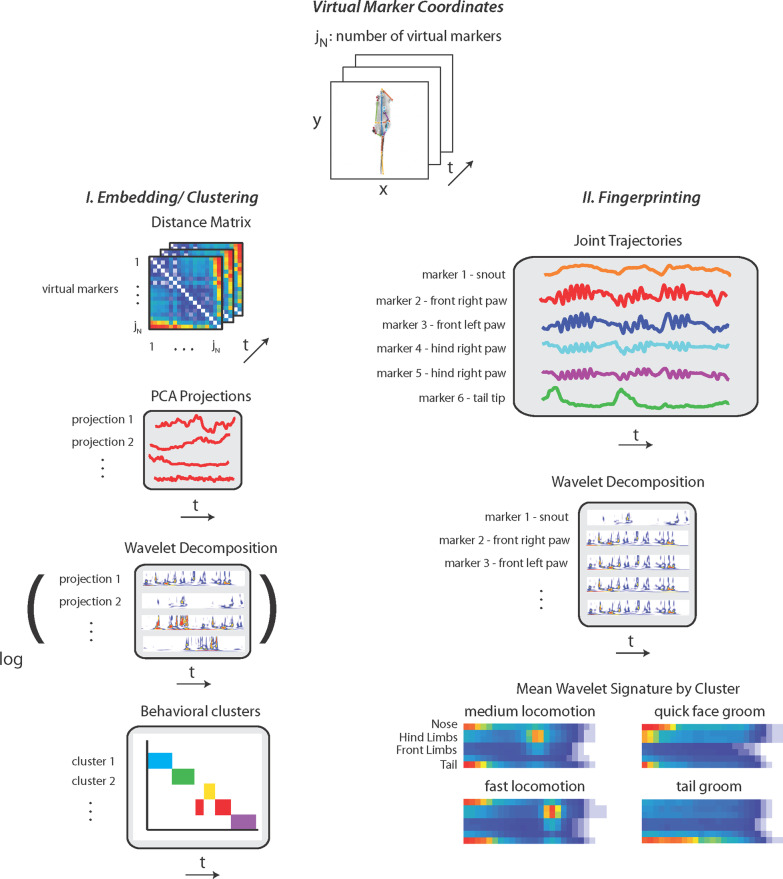
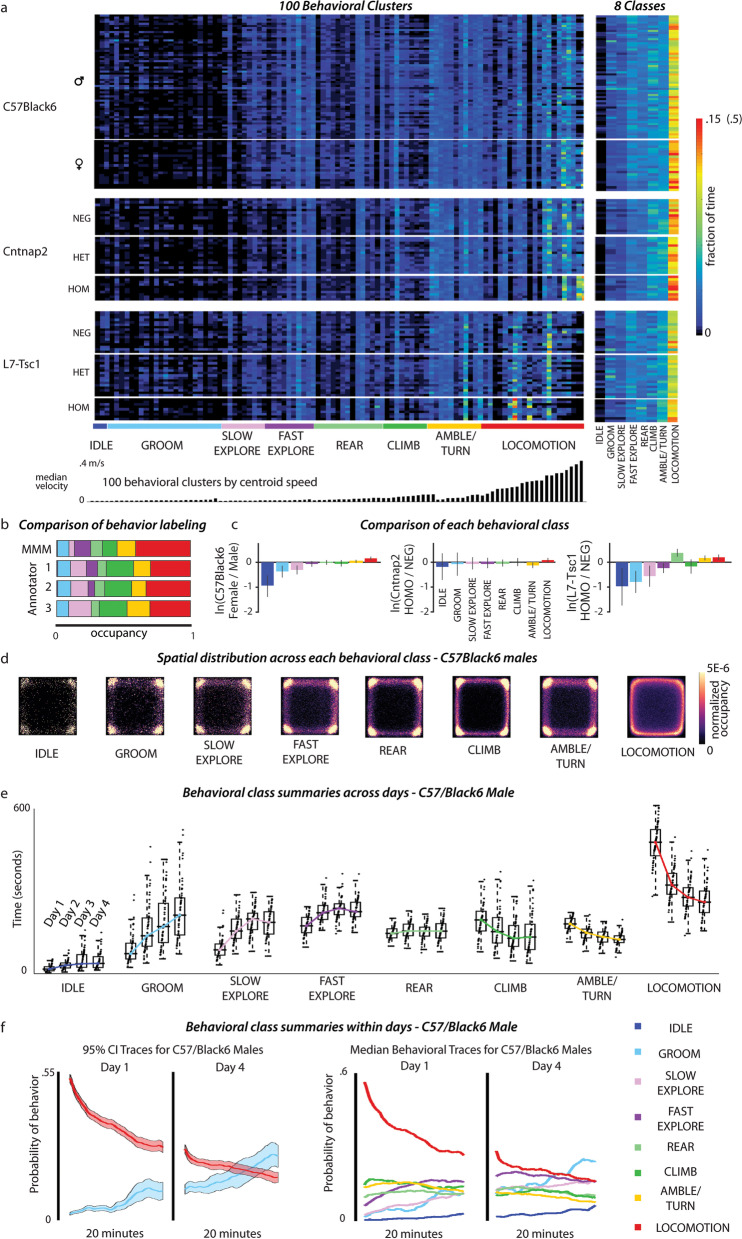
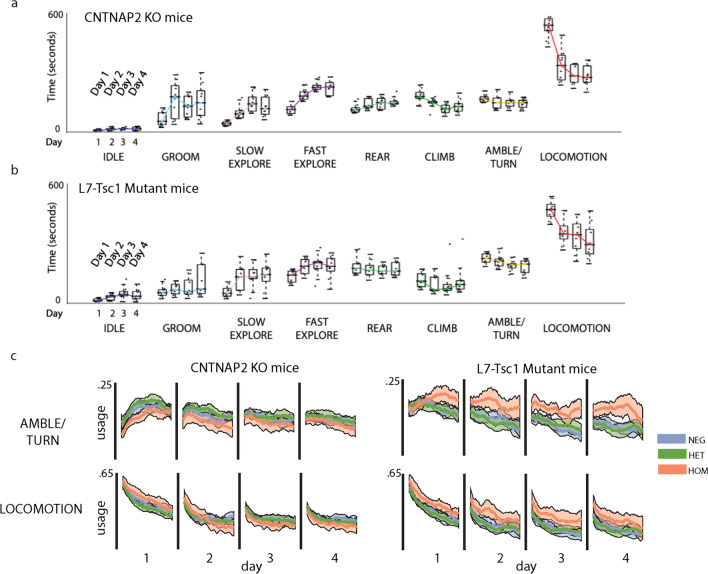
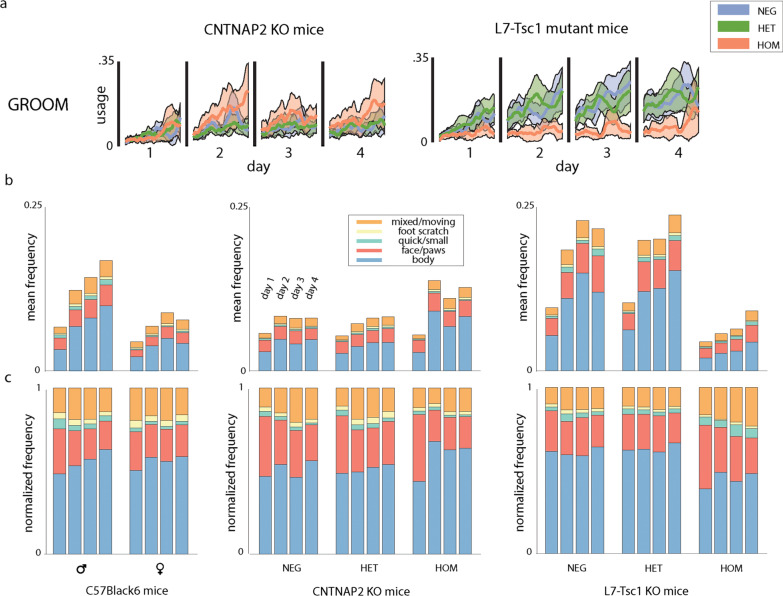
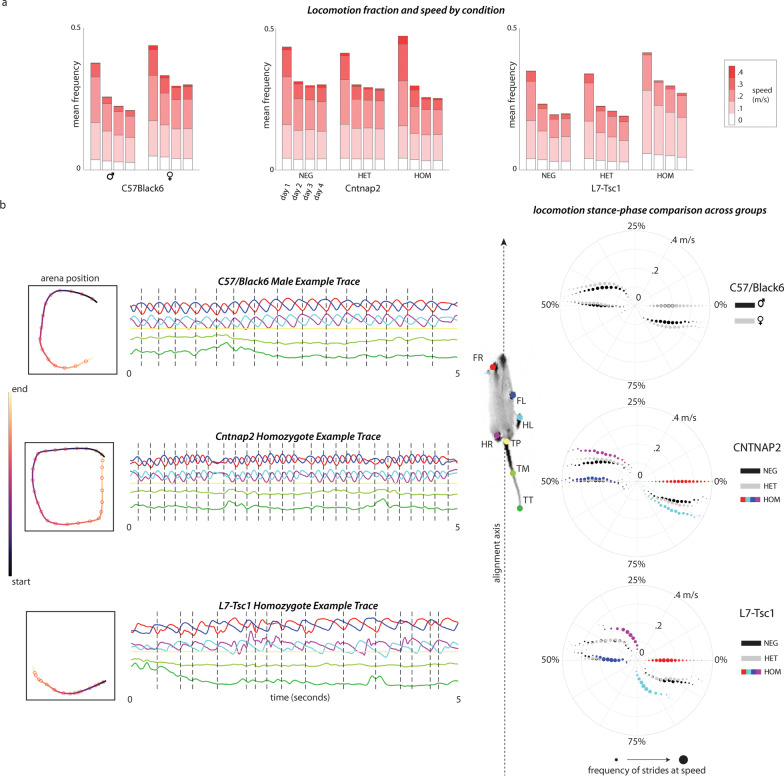
Background: Repetitive action, resistance to environmental change and fine motor disruptions are hallmarks of autism spectrum disorder (ASD) and other neurodevelopmental disorders, and vary considerably from individual to individual. In animal models, conventional behavioral phenotyping captures such fine-scale variations incompletely. Here we observed male and female C57BL/6J mice to methodically catalog adaptive movement over multiple days and examined two rodent models of developmental disorders against this dynamic baseline. We then investigated the behavioral consequences of a cerebellum-specific deletion in Tsc1 protein and a whole-brain knockout in Cntnap2 protein in mice. Both of these mutations are found in clinical conditions and have been associated with ASD. Methods: We used advances in computer vision and deep learning, namely a generalized form of high-dimensional statistical analysis, to develop a framework for characterizing mouse movement on multiple timescales using a single popular behavioral assay, the open-field test. The pipeline takes virtual markers from pose estimation to find behavior clusters and generate wavelet signatures of behavior classes. We measured spatial and temporal habituation to a new environment across minutes and days, different types of self-grooming, locomotion and gait. Results: Both Cntnap2 knockouts and L7-Tsc1 mutants showed forelimb lag during gait. L7-Tsc1 mutants and Cntnap2 knockouts showed complex defects in multi-day adaptation, lacking the tendency of wild-type mice to spend progressively more time in corners of the arena. In L7-Tsc1 mutant mice, failure to adapt took the form of maintained ambling, turning and locomotion, and an overall decrease in grooming. However, adaptation in these traits was similar between wild-type mice and Cntnap2 knockouts. L7-Tsc1 mutant and Cntnap2 knockout mouse models showed different patterns of behavioral state occupancy. Limitations: Genetic risk factors for autism are numerous, and we tested only two. Our pipeline was only done under conditions of free behavior. Testing under task or social conditions would reveal more information about behavioral dynamics and variability. Conclusions: Our automated pipeline for deep phenotyping successfully captures model-specific deviations in adaptation and movement as well as differences in the detailed structure of behavioral dynamics. The reported deficits indicate that deep phenotyping constitutes a robust set of ASD symptoms that may be considered for implementation in clinical settings as quantitative diagnosis criteria.
Overview
The claims and statistics of this paper haven’t been checked yet.
Free: it reads the open-access text and checks the first 5 claims that cite a source we can check. Create a free account to check every claim.
Integrity signals
Registry
Cites
Statistics
Figures
Verification
Claims the paper makes
The claims and statistics of this paper haven’t been checked yet.
Free: it reads the open-access text and checks the first 5 claims that cite a source we can check. Create a free account to check every claim.
Claims other papers make about this one
Each is checked against this paper’s own text: does it say what the citing paper says it does?
The check wasn’t confident either way, so it gives no verdict — never disputed.
In the citing paper
“The distributions resemble previous reports in rats during spontaneous behavior 42.”
From A virtual rodent predicts the structure of neural activity across behaviours (2024) · cites this paper as [42]
Experimental — accuracy not yet measured
Self-check
Percentages, sums and reported differences re-computed from the paper’s own numbers.
The self-check needs the paper’s full text.
Citations
Cites
Diagnostic and Statistical Manual of Mental Disorders
American Psychiatric Association (2013) · doi:10.1176/appi.books.9780890425596 · Cited by 116,369
The Proceedings of the National Academy of Sciences
Richards, J. W. (1915) · Science · doi:10.1126/science.42.1074.161 · Cited by 13,983
The open-field test: A critical review.
WALSH, R. N., & Cummins, R. A. (1976) · Psychological Bulletin · doi:10.1037//0033-2909.83.3.482 · Cited by 2,506 · cited 1×
“Such characterization omits both finer details of movement and higher-order complex behavioral motifs [12].”
BackgroundAnimal models of neuropsychiatric disorders
Nestler, E. J., & Hyman, S. E. (2010) · Nature Neuroscience · doi:10.1038/nn.2647 · Cited by 2,023 · cited 1×
“Mouse models of autism and other disorders have been designed to reflect known risk factors and causes in humans (construct validity) [8, 9].”
BackgroundCrawley, J. N., Belknap, J. K., Collins, A., Crabbe, J. C., Frankel, W., Henderson, N., Hitzemann, R. J., Maxson, S. C., Miner, L. L., Silva, A. J., et al. (1997) · Psychopharmacology · doi:10.1007/s002130050327 · Cited by 1,372
Journal of Autism and Developmental Disorders
(2013) · Journal of Autism and Developmental Disorders · doi:10.1007/10803.1573-3432 · Cited by 1,361
Motor coordination in autism spectrum disorders: A synthesis and meta-analysis
Fournier, K. A., Hass, C. J., Naik, S. K., Lodha, N., & Cauraugh, J. H. (2010) · Journal of Autism and Developmental Disorders · doi:10.1007/s10803-010-0981-3 · Cited by 1,271 · cited 2×
“autism [42, 43], despite the fact that movement is not considered part of the classic”
BackgroundPeñagarikano, O., Abrahams, B. S., Herman, E. I., Winden, K. D., Gdalyahu, A., Dong, H., Sonnenblick, L. I., Gruver, R., Almajano, J., Bragin, A., et al. (2011) · Cell · doi:10.1016/j.cell.2011.08.040 · Cited by 1,075 · cited 4×
“KO mice have been reported as hyperactive and have been shown to display a mild change in gait, along with reduced time spent with a novel partner in social behavior assays [27, 28].”
BackgroundInfluentialAutistic-like behaviour and cerebellar dysfunction in Purkinje cell Tsc1 mutant mice
Tsai, P. T., Hull, C., Chu, Y., Greene-Colozzi, E., Sadowski, A. R., Leech, J. M., Steinberg, J., Crawley, J. N., Regehr, W. G., & Sahin, M. (2012) · Nature · doi:10.1038/nature11310 · Cited by 888 · cited 2×
“Previous reports have limited quantification to 10 minutes of observation and have not distinguished different types of self-grooming or reported sex differences [29, 40, 41].”
BackgroundMethodThe Cerebellum, Sensitive Periods, and Autism
Wang, S. S.-H., Kloth, A. D., & Badura, A. (2014) · Neuron · doi:10.1016/j.neuron.2014.07.016 · Cited by 838 · cited 1×
“higher-level behavioral capacity [51]).”
Self-citation
Research works printed but not linked: 2
- Martín-Fernández J-A D-i-E Josep Glòria M-F On the interpretation of differences between groups for compositional data SORT 2015 39 2 231 252
- Van der Maaten L Hinton G Visualizing data using t-sne J Mach Learn Res 2008 9 11 2579 2605
Cited by
Keypoint-MoSeq: parsing behavior by linking point tracking to pose dynamics
Weinreb, C., Pearl, J. E., Lin, S., Osman, M. A. M., Zhang, L., Annapragada, S., Conlin, E., Hoffmann, R., Makowska, S., Gillis, W. F., et al. (2024) · Nature Methods · doi:10.1038/s41592-024-02318-2 · Cited by 228
A-SOiD, an active-learning platform for expert-guided, data-efficient discovery of behavior
Tillmann, J. F., Hsu, A. I., Schwarz, M. K., & Yttri, E. A. (2024) · Nature Methods · doi:10.1038/s41592-024-02200-1 · Cited by 83
“2), a high-dimensional representation of all points in the feature space or its low-dimensional embedding (Uniform Manifold Approximation and Projection (UMAP)) should provide distinct clusters that map onto each group (for example, all examples of ‘attack’ in the same area (high speed and low distance), whereas ‘moun…”
The what, how, and why of naturalistic behavior
Kennedy, A. (2022) · Current Opinion in Neurobiology · doi:10.1016/j.conb.2022.102549 · Cited by 77
A virtual rodent predicts the structure of neural activity across behaviours
Aldarondo, D., Merel, J., Marshall, J. D., Hasenclever, L., Klibaite, U., Gellis, A., Tassa, Y., Wayne, G., Botvinick, M., & Ölveczky, B. P. (2024) · Nature · doi:10.1038/s41586-024-07633-4 · Cited by 70
Self-citationElephants and algorithms: a review of the current and future role of AI in elephant monitoring
Brickson, L. L., Zhang, L., Vollrath, F. W., Douglas‐Hamilton, I., & Titus, A. (2023) · Journal of The Royal Society Interface · doi:10.1098/rsif.2023.0367 · Cited by 59
“…expedited the automated annotation of video data in behavioural assays [85, 86, 87] and social interactions [88, 89, 90], used to discover the structure and dynamics of expressed behaviour [91, 92, 93] and reveal previously undescribed movement phenotypes in neurodevelopmental models [92, 94].”
BackgroundMapping the landscape of social behavior
Klibaite, U., Li, T., Aldarondo, D. E., Akoad, J. F., Ölveczky, B. P., & Dunn, T. (2025) · Cell · doi:10.1016/j.cell.2025.01.044 · Cited by 59
“We used methods described in several previous works 36,37 and altered preprocessing, feature selection, and clustering metrics for better performance on the specific data used.”
Self-citationNeural mechanisms underlying the temporal organization of naturalistic animal behavior
Mazzucato, L. (2022) · eLife · doi:10.7554/elife.76577 · Cited by 54
Cerebellar contributions to a brainwide network for flexible behavior in mice
Verpeut, J. L., Bergeler, S., Kislin, M., Townes, F. W., Klibaite, U., Dhanerawala, Z. M., Hoag, A., Janarthanan, S. R., Jung, C., Lee, J., et al. (2023) · Communications Biology · doi:10.1038/s42003-023-04920-0 · Cited by 41
Self-citationAsynchronous excitatory neuron development in an isogenic cortical spheroid model of Down syndrome
Li, Z., Klein, J. A., Rampam, S., Kurzion, R., Campbell, N. B., Patel, Y., Haydar, T. F., & Zeldich, E. (2022) · Frontiers in Neuroscience · doi:10.3389/fnins.2022.932384 · Cited by 24
MABe22: A Multi-Species Multi-Task Benchmark for Learned Representations of BehaviorPreprint
Sun, J. J., Marks, M., Ulmer, A., Chakraborty, D., Geuther, B. Q., Hayes, E., Jia, H., Kumar, V., Oleszko, S., Partridge, Z., et al. (2022) · arXiv (Cornell University) · doi:10.48550/arxiv.2207.10553 · Cited by 21
“We also included two tasks to predict the day of the trajectory relative to the start of recording (animal behavior changes across days as they habituate to a new environment [41]), and the time of day of the trajectory (animal behavior changes over the course of a day, driven by circadian rhythms.)”
MethodNAPS : Integrating pose estimation and tag‐based tracking
Wolf, S., Ruttenberg, D. M., Knapp, D. Y., Webb, A. E., Traniello, I. M., McKenzie‐Smith, G. C., Leheny, S. A., Shaevitz, J. W., & Kocher, S. D. (2023) · Methods in Ecology and Evolution · doi:10.1111/2041-210x.14201 · Cited by 19
Self-citationChou, M.-Y., Ho, J., Huang, M., Chen, Y., Yang, M., Lin, L.-H., Chi, C.-H., Yeh, C.-H., Tsao, T.-Y., Tzeng, J. K., et al. (2022) · Frontiers in Nutrition · doi:10.3389/fnut.2022.977287 · Cited by 19
Experiment protocols for brain-body imaging of locomotion: A systematic review
Korivand, S., Jalili, N., & Gong, J. (2023) · Frontiers in Neuroscience · doi:10.3389/fnins.2023.1051500 · Cited by 15
“These various techniques enable us access to the movement phenotypes, such as brain structures (Chenausky and Tager-Flusberg, 2022), the functional substrates (Magrinelli et al., 2021), and motion signatures (Klibaite et al., 2022), in locomotion control during different experimental settings.”
BackgroundNon-uniform temporal scaling of developmental processes in the mammalian cortex
Paolino, A., Haines, E., Bailey, E., Black, D. A., Moey, C., García‐Moreno, F., Richards, L. J., Suárez, R., & Fenlon, L. R. (2023) · Nature Communications · doi:10.1038/s41467-023-41652-5 · Cited by 13
“If assumptions were met, data were analyzed by MANOVA; otherwise a non-parametric method for the analysis of multivariate samples, npmv , was used 88,89 .”
Ye, J., Xu, Y., Huang, K., Wang, X., Wang, L., & Wang, F. (2025) · Cell Reports · doi:10.1016/j.celrep.2025.115239 · Cited by 12
Cerebellar acceleration of learning in an evidence-accumulation task
Oostland, M., Kislin, M., Chen, Y., Chen, T., Venditto, S. J. C., Deverett, B., & Wang, S. S. ‐. (2026) · Cell Reports · doi:10.1016/j.celrep.2026.117262 · Cited by 10
Self-citationWang, X., Zhao, Z., Guo, J., Mei, D., Duan, Y., Zhang, Y., & Gou, L. (2023) · Brain Research Bulletin · doi:10.1016/j.brainresbull.2023.110755 · Cited by 9
Wahl, L. F., Serra, I., & Badura, A. (2023) · Current Opinion in Behavioral Sciences · doi:10.1016/j.cobeha.2023.101330 · Cited by 9
Wang, X., Zhang, Y., Luo, S., Zhao, K., Gao, C., Mei, D., Duan, Y., & Hu, S. (2024) · Molecular Neurobiology · doi:10.1007/s12035-024-03997-w · Cited by 9
“Many lines of evidence have shown that VPA-treated mice exhibited the increase in self-grooming and marble-burying [23, 24].”
Hardcastle, K., Marshall, J. D., Gellis, A., Klibaite, U., Bhatia, C., Wang, W. L., Chalyshkan, S., & Ölveczky, B. P. (2025) · Nature Neuroscience · doi:10.1038/s41593-025-02026-w · Cited by 10
Self-citationFoot placement control underlies stable locomotion across species
Comite, A. D., & Seethapathi, N. (2025) · Proceedings of the National Academy of Sciences · doi:10.1073/pnas.2413958122 · Cited by 8
Accurate Tracking of Locomotory Kinematics in Mice Moving Freely in Three-Dimensional Environments
Ignatowska-Jankowska, B. M., Swaminathan, L., Turkki, T., Sakharuk, D., Özer, A. G., Kuck, A., & Uusisaari, M. Y. (2025) · eNeuro · doi:10.1523/eneuro.0045-25.2025 · Cited by 7
“…analysis could uncover more subtle patterns than those detectable with existing methods (Cook, 2016; Velí š ková and Velí š ek, 2017; Streng et al., 2021; Klibaite et al., 2022; Snell et al., 2022; Gray et al., 2023; Gschwind et al., 2023; van der Heijden et al., 2024; Washburn et al., 2024).”
Mykins, M., Bridges, B., Jo, A., & Krishnan, K. (2024) · Journal of Neuroscience · doi:10.1523/jneurosci.1078-23.2023 · Cited by 8
Simon, T. B., Sierra, J., Williams, A., Wright, G., Rhee, A., Horn, J., Lou, J., Sharafeddin, F., Ontiveros‐Ángel, P., & Figueroa, J. D. (2024) · Frontiers in Behavioral Neuroscience · doi:10.3389/fnbeh.2024.1519558 · Cited by 5
Low-Cost Approaches in Neuroscience to Teach Machine Learning Using a Cockroach Model
Truong, V., Moore, J. E., Ricoy, U. M., & Verpeut, J. L. (2024) · eNeuro · doi:10.1523/eneuro.0173-24.2024 · Cited by 4
“SLEAP allows for automated tracking of animal movement and poses for an unlimited number of videos (Klibaite et al., 2022; Verpeut et al., 2023).”
Self-citationDoes advancement in marker-less pose-estimation mean more quality research? A systematic review
Bhola, S., Kim, H., Kim, H. S., Gu, B., & Yoo, J. (2025) · Frontiers in Behavioral Neuroscience · doi:10.3389/fnbeh.2025.1663089 · Cited by 4
High-throughput unsupervised quantification of patterns in the natural behavior of marmosetsPreprint
Menegas, W., Corbett, E., Beliard, K., Xu, H., Parmar, S., Desimone, R., & Feng, G. (2024) · eLife · doi:10.7554/elife.103586.1 · Cited by 3
Szechtman, H., Dvorkin‐Gheva, A., & Gómez-Marín, À. (2022) · GigaScience · doi:10.1093/gigascience/giac092 · Cited by 2
High-throughput unsupervised quantification of patterns in the natural behavior of marmosetsPreprint
Menegas, W., Corbett, E., Beliard, K., Xu, H., Parmar, S., Desimone, R., & Feng, G. (2024) · eLife · doi:10.7554/elife.103586 · Cited by 2
Miedema, J., Lutz, B., Gerber, S., Kovlyagina, I., & Todorov, H. (2025) · Translational Psychiatry · doi:10.1038/s41398-025-03546-6 · Cited by 1
Shen, Q., Ling, Z., Jiajia, Z., Guangfu, C., & Huang, T. (2026) · PubMed · doi:10.13702/j.1000-0607.20260558 · Cited by 1
Hidden Markov models reveal behavioral state dynamics in depth-related locomotion in mice
Shuto, H., Maeda, T., Koike, C., Takahashi, M., Mandai, M., & Matsuyama, T. (2025) · PLoS ONE · doi:10.1371/journal.pone.0329367 · Cited by 2
“This cornering behavior reduces the likelihood of exploring near the cliff edge, potentially confounding results [38].”
Investigating the pathogenicity of an autism-related CNTNAP2 missense variant in a novel mouse model
Manett, T. D. (2023) · theses.fr (ABES) · doi:10.70675/63f32ccbz3dfbz46faz9141z87c12fcfe9cd · Cited by 1
Acute Intermittent Hypoxia Therapy alters cognitive behavioral parameters in wistar albino rats
Roshan, S. A., Gunaseelan, D., Benazsir, S., Pandian, N., Jayachandran, S. K., Kandasamy, M., & Muthusamy, A. (2023) · International Journal of Pharmaceutical Sciences and Drug Research · doi:10.25004/ijpsdr.2023.150512
Menegas, W., Corbett, E., Beliard, K., Xu, H., Parmar, S., Desimone, R., & Feng, G. (2024) · eLife · doi:10.7554/elife.103586.1.sa0
A Fine Motor Task to Study Joint Kinematics in a Preclinical Model of Neurodegenerative Disease
Melick, A., Lukacik, D., Chawla, S., Schaefer, S. Y., Beeman, S. C., & Verpeut, J. L. (2025) · Journal of Visualized Experiments · doi:10.3791/68128
Self-citationVQ-MAP: a flexible, versatile framework for animal behavior understandingPreprint
Li, T., Klibaite, U., Akoad, J. F., Wu, J. H., & Dunn, T. (2025) · bioRxiv (Cold Spring Harbor Laboratory) · doi:10.64898/2025.12.04.692429
“…motif mapping, we directly compared the ‘ethograms’ for RatDataset23, which were directly produced using inferred CB1 mappings without post hoc annotation and grouping, with those produced by two common motif identification approaches, Keypoint-MoSeq (KPMS) 26 and MotionMapper (MM) 18,25,29 ( Fig.”
Self-citationCerebellar nuclei output pathways regulate motor and non-motor behaviors through forebrain circuits
Lee, A. S., & Joyner, A. L. (2026) · Current topics in developmental biology/Current Topics in Developmental Biology · doi:10.1016/bs.ctdb.2026.01.009
Hidayat, E. Y., Firdausillah, F., Dewi, I. N., Udayanti, E. D., Nugraha, A., Luthfiarta, A., Hidayat, N. N., Karima, A., & Muda, A. K. (2026) · Applied Soft Computing · doi:10.1016/j.asoc.2026.115352
Developing whisker movement protocols for the study of rodent models of neurological disease
Simanaviciute, U. (2026) · e-space (Manchester Metropolitan University) · doi:10.83056/mmu.32483382
Spontaneous oxycodone withdrawal alters behavior and oligodendrocyte-related gene expression in mice
Law, O., Gewirtz, J. C., & Verpeut, J. L. (2026) · Pharmacology Biochemistry and Behavior · doi:10.1016/j.pbb.2026.174229
Self-citationMoskalik, A., & Gu, B. (2026) · Experimental Neurology · doi:10.1016/j.expneurol.2026.116096
Metadata
- Authors
- Klibaite, U., Kislin, M., Verpeut, J. L., Bergeler, S., Sun, X., Shaevitz, J. W., & Wang, S. S.-H.
- Affiliations
- Harvard University (US)
- Princeton University (US)
- Corresponding author
- Klibaite, Ugne
- Shaevitz, Joshua W.
- Wang, Samuel S.-H.
- ORCID
- Venue
- Molecular Autism
- Published
- 2022-03-12
- Volume
- 13
- Issue
- 1
- Pages
- 12-12
- ISSN
- 2040-2392 (ISSN-L)
- PMC
- PMC8917660
- OpenAlex
- W4220670661
- Semantic Scholar
- c86f2d0bc8e00d0ea669aa576d468f2b4a4eec89
- Cited by
- 41
- References
- 57
- Citations by year
- 2026: 5 · 2025: 10 · 2024: 10 · 2023: 10 · 2022: 5
- FWCI
- 4.51
- Type
- journal article
- Language
- en
- Open access
- gold
- doi.org
- Licence
- cc-by
- creativecommons.org/licenses/by/4.0 (tdm)
- creativecommons.org/licenses/by/4.0 (vor)
- Locations
- Molecular Autism (publishedVersion, cc-by)
- Research Square (acceptedVersion, cc-by)
- PubMed Central (publishedVersion, cc-by)
- PubMed (publishedVersion)
- DOAJ (DOAJ: Directory of Open Access Journals) (submittedVersion, cc-by-sa)
- Funders
- National Institute of Neurological Disorders and Stroke (R01 NS045193, U19 NS104648)
- National Institute of Mental Health (R01 MH115750)
- National Science Foundation (PHY-1734030)
- Topics
- Life Sciences › Neuroscience › Cognitive Neuroscience › Autism Spectrum Disorder Research
- Life Sciences › Biochemistry, Genetics and Molecular Biology › Genetics › Genetics and Neurodevelopmental Disorders
- Life Sciences › Neuroscience › Cellular and Molecular Neuroscience › Neuroscience and Neuropharmacology Research
- Keywords
- autism spectrum disorder, neurodevelopmental disorders, mouse model, deep phenotyping, open field test, TSC1, CNTNAP2, cerebellum, habituation, locomotion, gait, grooming, pose estimation, behavioral dynamics, automated behavioral analysis
- MeSH terms
- Autism Spectrum Disorder, Tuberous Sclerosis Complex 1 Protein, Animals, Disease Models, Animal, Female, Male, Membrane Proteins, Mice, Inbred C57BL, Nerve Tissue Proteins, Phenotype, Mice, Knockout, Mice
About these checks
Registry, retraction, Cites and statistics results are computed, not judged, with one exception: a printed reference that no index lists is read once by a model before it counts as a citation error. Claims are extracted by a model and kept only when their quote appears verbatim in the text; each cited source is then checked, with a model’s help, for whether it says what the claim relies on. Those verdicts can be wrong — read the claim’s quote and the cited source before relying on one.
Statistics and arithmetic are recomputed, not judged.
Confidence bands are shown only for fields calibrated on our annotated test set. None is calibrated yet, so no band is shown.
What counts as a claim ›How we measure confidence ›How we check this ›
Are you an author, or do you see a problem with this page? Request a review
Data sources
Bibliographic data: Semantic Scholar, OpenAlex, Crossref.
Contains information from the Semantic Scholar Academic Graph Datasets, made available under the ODC Attribution License (ODC-BY 1.0).
Semantic Scholar’s data is described in: Kinney, R., et al. (2023). The Semantic Scholar Open Data Platform. arXiv:2301.10140.
