

The DOI matches its Crossref record; 99 of the 99 references it cites were found in a registry or an index.
DTiGEMS+: drug–target interaction prediction using graph embedding, graph mining, and similarity-based techniques
Open accessAbstract
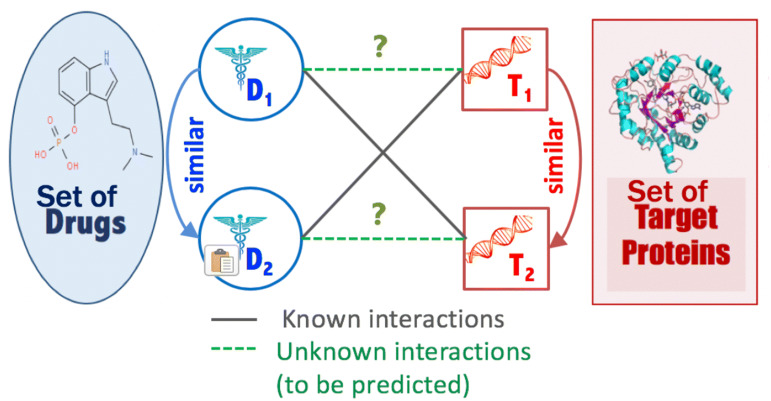
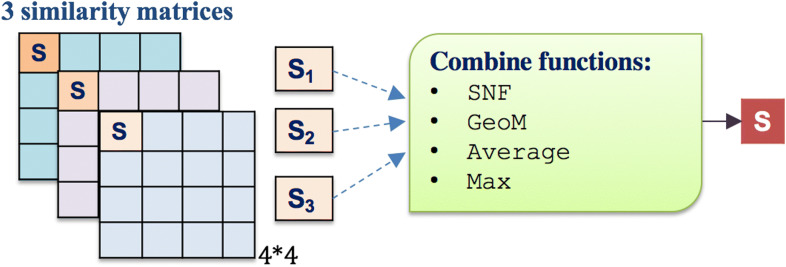
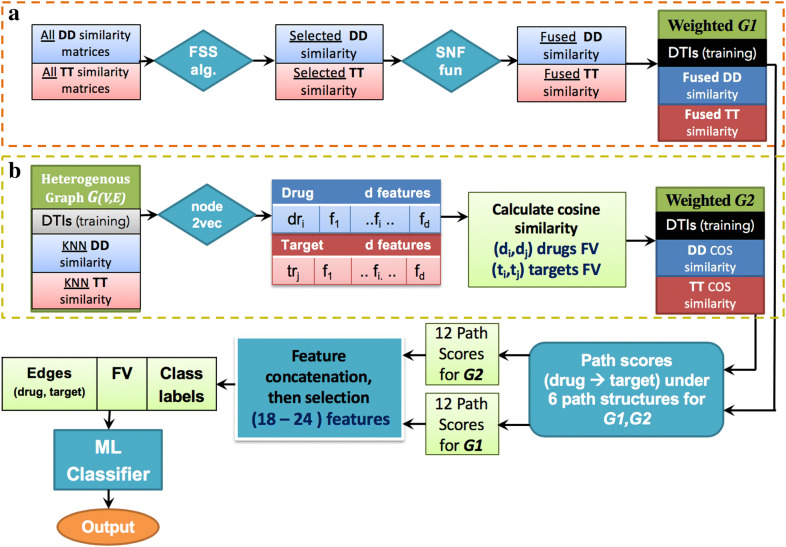
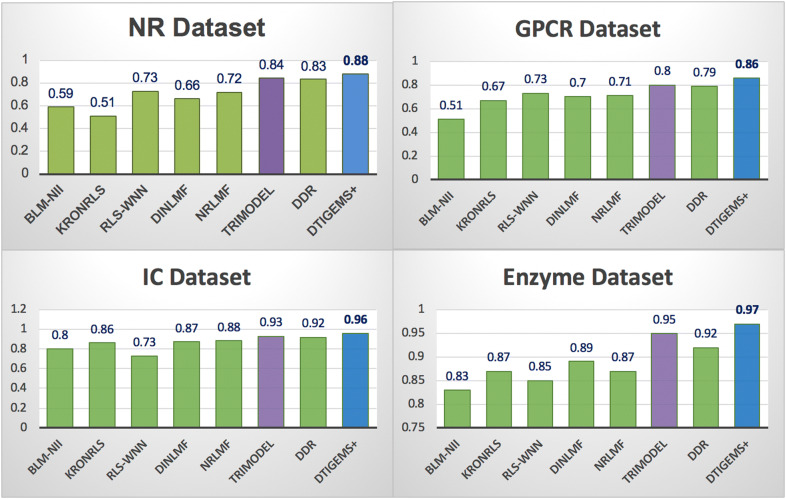
In silico prediction of drug–target interactions is a critical phase in the sustainable drug development process, especially when the research focus is to capitalize on the repositioning of existing drugs. However, developing such computational methods is not an easy task, but is much needed, as current methods that predict potential drug–target interactions suffer from high false-positive rates. Here we introduce DTiGEMS+, a computational method that predicts D rug–T arget i nteractions using G raph E mbedding, graph M ining, and S imilarity-based techniques. DTiGEMS+ combines similarity-based as well as feature-based approaches, and models the identification of novel drug–target interactions as a link prediction problem in a heterogeneous network. DTiGEMS+ constructs the heterogeneous network by augmenting the known drug–target interactions graph with two other complementary graphs namely: drug–drug similarity, target–target similarity. DTiGEMS+ combines different computational techniques to provide the final drug target prediction, these techniques include graph embeddings, graph mining, and machine learning. DTiGEMS+ integrates multiple drug–drug similarities and target–target similarities into the final heterogeneous graph construction after applying a similarity selection procedure as well as a similarity fusion algorithm. Using four benchmark datasets, we show DTiGEMS+ substantially improves prediction performance compared to other state-of-the-art in silico methods developed to predict of drug-target interactions by achieving the highest average AUPR across all datasets (0.92), which reduces the error rate by 33.3% relative to the second-best performing model in the state-of-the-art methods comparison.
Overview
The claims and statistics of this paper haven’t been checked yet.
Run the check — free, no account needed. It reads the open-access text and checks the sources it cites.
Integrity signals
Registry
Cites
Statistics
Figures
Verification
Claims the paper makes
The claims and statistics of this paper haven’t been checked yet.
Run the check — free, no account needed. It reads the open-access text and checks the sources it cites.
Claims other papers make about this one
Each is checked against this paper’s own text: does it say what the citing paper says it does?
In the citing paper
“Cell similarity graphs have also been created using autoencoders by first embedding gene expression readouts and then connecting genes based on how similar their embeddings are [157].”
From Graph representation learning in biomedicine and healthcare (2022) · cites this paper as [157]
In the citing paper
“Applied to such networks, graph representation learning can impute scRNA-seq data [156, 157], predict cell clusters [157, 158], etc.”
From Graph representation learning in biomedicine and healthcare (2022) · cites this paper as [157]
Self-check
Percentages, sums and reported differences re-computed from the paper’s own numbers.
The self-check needs the paper’s full text.
Citations
Cites
Scikit-learn: Machine Learning in Python
Pedregosa, F., Varoquaux, G., Gramfort, A., Michel, V., Thirion, B., Grisel, O., Blondel, M., Müller, A., Nothman, J., Louppe, G., et al. (2012) · arXiv · doi:10.48550/arxiv.1201.0490 · Cited by 71,016
A decision-theoretic generalization of on-line learning and an application to boosting
Freund, Y., & Schapire, R. E. (1997) · Journal of Computer and System Sciences · doi:10.1006/jcss.1997.1504 · Cited by 20,466
Proceedings of the 24th international conference on Machine learning
(2007) · doi:10.1145/1273496 · Cited by 11,869
node2vec: Scalable Feature Learning for Networks
Grover, A., & Leskovec, J. (2016) · Proceedings of the 22nd ACM SIGKDD International Conference on Knowledge Discovery and Data Mining · doi:10.1145/2939672.2939754 · Cited by 10,926
KEGG: new perspectives on genomes, pathways, diseases and drugs
Kanehisa, M., Furumichi, M., Tanabe, M., Sato, Y., & Morishima, K. (2017) · Nucleic Acids Research · doi:10.1093/nar/gkw1092 · Cited by 8,865
DrugBank 5.0: a major update to the DrugBank database for 2018
Wishart, D. S., Feunang, Y. D., Guo, A. C., Lo, E. J., Marcu, A., Grant, J. R., Sajed, T., Johnson, D., Li, C., Sayeeda, Z., et al. (2018) · Nucleic Acids Research · doi:10.1093/nar/gkx1037 · Cited by 8,404
Extended-Connectivity Fingerprints
Rogers, D. O. W., & Hahn, M. (2010) · Journal of Chemical Information and Modeling · doi:10.1021/ci100050t · Cited by 7,925
The relationship between Precision-Recall and ROC curves
Davis, J., & Goadrich, M. (2006) · Proceedings of the 23rd international conference on Machine learning - ICML '06 · doi:10.1145/1143844.1143874 · Cited by 6,559
Evaluation: from precision, recall and F-measure to ROC, informedness, markedness and correlation
Powers, D. M. W. (2020) · arXiv · doi:10.48550/arxiv.2010.16061 · Cited by 5,440
PubChem Substance and Compound databases
Kim, S., Thiessen, P. A., Bolton, E. E., Chen, J., Fu, G., Gindulyte, A., Han, L., He, J., He, S., Shoemaker, B. A., et al. (2016) · Nucleic Acids Research · doi:10.1093/nar/gkv951 · Cited by 5,436
Research works printed but not linked: 2
- Tenenbaum D (2019) KEGGREST: client-side REST access to KEGG. R Package Version 1.24.0. Fred Hutchinson Cancer Research Center, Seattle, WA, USA
- Kam HT (1995) Random decision forest. In: Proceedings of the 3rd international conference on document analysis and recognition, vol 1416, pp 278–282
Cited by
Sorted by citations
Sabe, V. T., Ntombela, T., Jhamba, L. A., Maguire, G. E. M., Govender, T., Naicker, T., & Kruger, H. G. (2021) · European Journal of Medicinal Chemistry · doi:10.1016/j.ejmech.2021.113705 · Cited by 665
Deep learning in drug discovery: an integrative review and future challenges
Askr, H., Elgeldawi, E., Ella, H. A., Elshaier, Y. A. M. M., Gomaa, M. M., & Hassanien, A. E. (2022) · Artificial Intelligence Review · doi:10.1007/s10462-022-10306-1 · Cited by 428
Graph representation learning in biomedicine and healthcare
Li, M. M., Huang, K., & Zitnik, M. (2022) · Nature Biomedical Engineering · doi:10.1038/s41551-022-00942-x · Cited by 294
DeepDDS: deep graph neural network with attention mechanism to predict synergistic drug combinations
Wang, J., Liu, X., Shen, S., Deng, L., & Liu, H. (2021) · Briefings in Bioinformatics · doi:10.1093/bib/bbab390 · Cited by 273
Ye, Q., Hsieh, C.-Y., Yang, Z., Kang, Y., Chen, J., Cao, D., He, S., & Hou, T. (2021) · Nature Communications · doi:10.1038/s41467-021-27137-3 · Cited by 261
Toward better drug discovery with knowledge graph
Zeng, X., Tu, X., Liu, Y., Fu, X., & Su, Y. (2022) · Current Opinion in Structural Biology · doi:10.1016/j.sbi.2021.09.003 · Cited by 229
Artificial intelligence, machine learning, and drug repurposing in cancer
Tanoli, Z., Vähä-Koskela, M. J. V., & Aittokallio, T. A. (2021) · Expert Opinion on Drug Discovery · doi:10.1080/17460441.2021.1883585 · Cited by 229
Graph representation learning in bioinformatics: trends, methods and applications
Yi, H.-C., You, Z., Huang, D.-S., & Kwoh, C. K. (2021) · Briefings in Bioinformatics · doi:10.1093/bib/bbab340 · Cited by 239
A review on machine learning algorithms for the ionic liquid chemical space
Koutsoukos, S., Philippi, F., Malaret, F., & Welton, T. (2021) · Chemical Science · doi:10.1039/d1sc01000j · Cited by 203
Han, R., Yoon, H., Kim, G., Lee, H., & Lee, Y. (2023) · Pharmaceuticals · doi:10.3390/ph16091259 · Cited by 198
Staszak, M., Staszak, K., Wieszczycka, K., Bajek, A., Roszkowski, K., & Tylkowski, B. (2021) · Wiley Interdisciplinary Reviews Computational Molecular Science · doi:10.1002/wcms.1568 · Cited by 160
Comprehensive Survey of Recent Drug Discovery Using Deep Learning
Kim, J., Park, S., Min, D., & Kim, W. (2021) · International Journal of Molecular Sciences · doi:10.3390/ijms22189983 · Cited by 147
Deep drug-target binding affinity prediction with multiple attention blocks
Zeng, Y., Chen, X., Luo, Y., Li, X., & Peng, D. (2021) · Briefings in Bioinformatics · doi:10.1093/bib/bbab117 · Cited by 111
Chen, C., Han, S., Jiang, Z., Salhi, A., Chen, R., Cui, X., & Yu, B. (2021) · Computers in Biology and Medicine · doi:10.1016/j.compbiomed.2021.104676 · Cited by 103
DrugMAP: molecular atlas and pharma-information of all drugs
Li, F., Yin, J., Lu, M., Mou, M., Li, Z., Zeng, Z., Tan, Y. C., Wang, S., Chu, X., Dai, H., et al. (2022) · Nucleic Acids Research · doi:10.1093/nar/gkac813 · Cited by 89
Thafar, M. A., Alshahrani, M., Albaradei, S., Gojobori, T., Essack, M., & Gao, X. (2022) · Scientific Reports · doi:10.1038/s41598-022-08787-9 · Cited by 95
Self-citationBiomedical Big Data Technologies, Applications, and Challenges for Precision Medicine: A Review
Yang, X., Huang, K., Yang, D., Zhao, W., & Zhou, X. (2023) · Global Challenges · doi:10.1002/gch2.202300163 · Cited by 99
Mahmud, S., Chen, W., Liu, Y., Awal, M. A., Ahmed, K., Rahman, M. H., & Moni, M. A. (2021) · Briefings in Bioinformatics · doi:10.1093/bib/bbab046 · Cited by 73
DTi2Vec: Drug–target interaction prediction using network embedding and ensemble learning
Thafar, M. A., Olayan, R. S., Albaradei, S., Bajic, V. B., Gojobori, T., Essack, M., & Gao, X. (2021) · Journal of Cheminformatics · doi:10.1186/s13321-021-00552-w · Cited by 70
Self-citationZeroBind: a protein-specific zero-shot predictor with subgraph matching for drug-target interactions
Wang, Y., Xia, Y., Yan, J., Yuan, Y., Shen, H., & Pan, X. (2023) · Nature Communications · doi:10.1038/s41467-023-43597-1 · Cited by 70
Wang, H., Huang, F. F., Xiong, Z., & Zhang, W. (2022) · Briefings in Bioinformatics · doi:10.1093/bib/bbac184 · Cited by 68
DTI-LM: language model powered drug–target interaction prediction
Ahmed, K. T., Ansari, M. I., & Zhang, W. (2024) · Bioinformatics · doi:10.1093/bioinformatics/btae533 · Cited by 65
Application and evaluation of knowledge graph embeddings in biomedical data
Alshahrani, M., Thafar, M. A., & Essack, M. (2021) · PeerJ Computer Science · doi:10.7717/peerj-cs.341 · Cited by 58
Self-citationA review of machine learning-based methods for predicting drug–target interactions
Shi, W., Yang, H. T., Xie, L., Yin, X.-X., & Zhang, Y. (2024) · Health Information Science and Systems · doi:10.1007/s13755-024-00287-6 · Cited by 50
Das, J. K., Tradigo, G., Veltri, P., Guzzi, P. H., & Roy, S. (2020) · Briefings in Bioinformatics · doi:10.1093/bib/bbaa420 · Cited by 44
Jung, Y.-S., Kim, Y., & Cho, Y. (2021) · Methods · doi:10.1016/j.ymeth.2021.10.007 · Cited by 43
Drug–target interaction prediction based on protein features, using wrapper feature selection
Mesrabadi, H. A., Karim Faez, A., & Pirgazi, J. (2023) · Scientific Reports · doi:10.1038/s41598-023-30026-y · Cited by 39
Yang, Y., & He, S. (2021) · BMC Bioinformatics · doi:10.1186/s12859-021-04327-w · Cited by 39
Djeddi, W. E., Hermi, K., Yahia, S. B., & Diallo, G. (2023) · BMC Bioinformatics · doi:10.1186/s12859-023-05593-6 · Cited by 37
Zhang, Y., Jiang, Z., Chen, C., Wei, Q., Gu, H., & Yu, B. (2021) · Interdisciplinary Sciences Computational Life Sciences · doi:10.1007/s12539-021-00488-7 · Cited by 37
Using BERT to identify drug-target interactions from whole PubMed
Aldahdooh, J., Vähä-Koskela, M. J. V., Tang, J. P., & Tanoli, Z. (2022) · BMC Bioinformatics · doi:10.1186/s12859-022-04768-x · Cited by 36
A survey on graph embedding techniques for biomedical data: Methods and applications
Wu, Y., Chen, Y., Yin, Z., Ding, W., & King, I. (2023) · Information Fusion · doi:10.1016/j.inffus.2023.101909 · Cited by 33
Hu, J., Li, Z., Rao, B., Thafar, M. A., & Arif, M. (2024) · Analytical Biochemistry · doi:10.1016/j.ab.2024.115550 · Cited by 34
Self-citationLiu, B., Pliakos, K., Vens, C., & Tsoumakas, G. (2021) · Applied Intelligence · doi:10.1007/s10489-021-02495-z · Cited by 32
Artificial Intelligence and Machine Learning for Lead-to-Candidate Decision-Making and Beyond
McNair, D. (2022) · The Annual Review of Pharmacology and Toxicology · doi:10.1146/annurev-pharmtox-051921-023255 · Cited by 35
Drug repurposing and prediction of multiple interaction types via graph embedding
Souri, E. A., Chenoweth, A. M., Karagiannis, S. N., & Tsoka, S. (2023) · BMC Bioinformatics · doi:10.1186/s12859-023-05317-w · Cited by 30
Explainable drug repurposing via path based knowledge graph completion
Jiménez, A., Merino, M. J., Parras, J., & Zazo, S. (2024) · Scientific Reports · doi:10.1038/s41598-024-67163-x · Cited by 30
Zhang, Q., Zuo, L., Ren, Y., Wang, S., Wang, W., Ma, L., Zhang, J., & Xia, B. (2024) · Bioinformatics · doi:10.1093/bioinformatics/btae347 · Cited by 28
Toward Unified AI Drug Discovery with Multimodal Knowledge
Luo, Y., Liu, X. Y., Yang, K., Huang, K., Hong, M., Zhang, J., Wu, Y., & Nie, Z. (2024) · Health Data Science · doi:10.34133/hds.0113 · Cited by 35
Hinnerichs, T., & Hoehndorf, R. (2021) · Bioinformatics · doi:10.1093/bioinformatics/btab548 · Cited by 28
Lian, M., Wang, X., & Du, W. (2023) · Neurocomputing · doi:10.1016/j.neucom.2023.126509 · Cited by 25
Novel drug-target interactions via link prediction and network embedding
Souri, E. A., Laddach, R., Karagiannis, S. N., Papageorgiou, L. G., & Tsoka, S. (2022) · BMC Bioinformatics · doi:10.1186/s12859-022-04650-w · Cited by 23
Ojo, O. A., Adegboyega, A. E., Johnson, G. I., Umedum, N. L., Onuh, K., Adeduro, M. N., Nwobodo, V. O. G., Elekan, A. O., Alemika, T. E., & Johnson, T. O. (2021) · Informatics in Medicine Unlocked · doi:10.1016/j.imu.2021.100719 · Cited by 23
Khojasteh, H., Pirgazi, J., & Sorkhi, A. G. (2023) · PLoS ONE · doi:10.1371/journal.pone.0288173 · Cited by 21
AI-Based Computational Methods in Early Drug Discovery and Post Market Drug Assessment: A Survey
Rajaei, F., Minoccheri, C., Wittrup, E. M., Wilson, R. C., Athey, B. D., Omenn, G. S., & Najarian, K. (2024) · IEEE Transactions on Computational Biology and Bioinformatics · doi:10.1109/tcbb.2024.3492708 · Cited by 24
Mustali, J., Yasuda, I., Hirano, Y., Yasuoka, K., Gautieri, A., & Arai, N. (2023) · RSC Advances · doi:10.1039/d3ra06375e · Cited by 19
Pavel, A., Saarimäki, L. A., Möbus, L., Federico, A., Serra, A., & Greco, D. (2022) · Computational and Structural Biotechnology Journal · doi:10.1016/j.csbj.2022.08.061 · Cited by 19
Collaborative Matrix Factorization with Soft Regularization for Drug-Target Interaction Prediction
Gao, L.-G., Yang, M., & Wang, J. (2021) · Journal of Computer Science and Technology · doi:10.1007/s11390-021-0844-8 · Cited by 19
Udrescu, M., Ardelean, S. M., & Udrescu, L. (2022) · GigaScience · doi:10.1093/gigascience/giad011 · Cited by 18
Bai, T., Yan, K., & Liu, B. (2023) · Briefings in Bioinformatics · doi:10.1093/bib/bbad212 · Cited by 18
Comprehensive Review on Drug-target Interaction Prediction - Latest Developments and Overview
Raheem, A. K. A., & Dhannoon, B. N. (2023) · Current Drug Discovery Technologies · doi:10.2174/1570163820666230901160043 · Cited by 18
Towards a more inductive world for drug repurposing approaches
de la Fuente, J., Serrano, G., Veleiro, U., Casals, M., Vera, L., Pizurica, M., Gómez-Cebrián, N., Puchades‐Carrasco, L., Pineda‐Lucena, A., Ochoa, I., et al. (2025) · Nature Machine Intelligence · doi:10.1038/s42256-025-00987-y · Cited by 16
Lu, Y., Chen, J., Fan, N., Song, W., Sheng, H., Yang, Y., & Wang, J. (2026) · npj Digital Medicine · doi:10.1038/s41746-026-02400-3 · Cited by 23
Drug‐Target Interaction Prediction Based on Adversarial Bayesian Personalized Ranking
Ye, Y., Wen, Y., Zhang, Z., He, S., & Bo, X. (2021) · BioMed Research International · doi:10.1155/2021/6690154 · Cited by 16
Wang, X.-R., Cao, T.-T., Jia, C. M., Tian, X.-M., & Wang, Y. (2021) · BMC Bioinformatics · doi:10.1186/s12859-021-04389-w · Cited by 14
Lian, M., Wang, X., & Du, W. (2022) · Neurocomputing · doi:10.1016/j.neucom.2022.04.104 · Cited by 15
Xuan, P., Hu, K., Cui, H., Zhang, T., & Nakaguchi, T. (2021) · IEEE Journal of Biomedical and Health Informatics · doi:10.1109/jbhi.2021.3121798 · Cited by 15
Alshahrani, M., Almansour, A., Alkhaldi, A., Thafar, M. A., Uludağ, M., Essack, M., & Hoehndorf, R. (2022) · PeerJ · doi:10.7717/peerj.13061 · Cited by 13
Self-citationDrug–target interaction prediction using knowledge graph embedding
Li, N., Yang, Z., Wang, J., & Lin, H. (2024) · iScience · doi:10.1016/j.isci.2024.109393 · Cited by 14
Deep Learning Based Methods for Molecular Similarity Searching: A Systematic Review
Nasser, M., Yusof, U. K., & Salim, N. B. (2023) · Processes · doi:10.3390/pr11051340 · Cited by 15
QKDTI A quantum kernel based machine learning model for drug target interaction prediction
Pallavi, G., Altalbe, A. A., & Kumar, R. P. (2025) · Scientific Reports · doi:10.1038/s41598-025-07303-z · Cited by 13
Sun, D., Macedonia, C. R., Chen, Z., Chandrasekaran, S., Najarian, K., Zhou, S. Y., Cernak, T., Ellingrod, V. L., Jagadish, H. V., Marini, B. L., et al. (2024) · Journal of Medicinal Chemistry · doi:10.1021/acs.jmedchem.4c01684 · Cited by 14
A Multi-graph Deep Learning Model for Predicting Drug-Disease Associations
Zhao, B.-W., You, Z., Hu, L., Wong, L., Ji, B., & Zhang, P. (2021) · Lecture notes in computer science · doi:10.1007/978-3-030-84532-2_52 · Cited by 12
Kandagalla, S., Novak, J., Shekarappa, S. B., Grishina, M., Potemkin, V., & Kumbar, B. (2021) · Journal of Biomolecular Structure and Dynamics · doi:10.1080/07391102.2021.1990131 · Cited by 12
Zhang, B., Niu, D., Zhang, L., Zhang, Q., & Li, Z. (2024) · BMC Bioinformatics · doi:10.1186/s12859-024-05904-5 · Cited by 11
Sorkhi, A. G., Abbasi, Z., Mobarakeh, M. I., & Pirgazi, J. (2021) · BMC Bioinformatics · doi:10.1186/s12859-021-04464-2 · Cited by 11
AΙ-Driven Drug Repurposing: Applications and Challenges
Keramida, P., Syrigos, N. K., Kouvela, M., Poulakou, G., Charpidou, A. G., & Fiste, O. (2025) · Medicines · doi:10.3390/medicines12040028 · Cited by 12
Wang, W., Yu, M., Sun, B., Li, J., Liu, D., Zhang, H., Wang, X., & Zhou, Y. (2023) · IEEE Transactions on Computational Biology and Bioinformatics · doi:10.1109/tcbb.2023.3339645 · Cited by 10
Drug-Target Interaction Prediction Based on Multisource Information Weighted Fusion
Liu, S., An, J., Zhao, J., Zhao, S., Lv, H., & Wang, S. (2021) · Contrast Media & Molecular Imaging · doi:10.1155/2021/6044256 · Cited by 10
Thafar, M. A., Albaradei, S., Uludağ, M., Alshahrani, M., Gojobori, T., Essack, M., & Gao, X. (2023) · Frontiers in Genetics · doi:10.3389/fgene.2023.1139626 · Cited by 11
Self-citationTransforming drug discovery: the impact of AI and molecular simulation on R&D efficiency
Iwata, H. (2024) · Bioanalysis · doi:10.1080/17576180.2024.2437283 · Cited by 9
Talib, A. M., Al-Hgaish, A. M., Atan, R. B., Alshammari, A., Alomary, F. O., Yaakob, R., Alsahli, A., & Osman, M. H. (2025) · IEEE Access · doi:10.1109/access.2025.3546925 · Cited by 10
Fine-grained selective similarity integration for drug–target interaction prediction
Liu, B., Wang, J., Sun, K., & Tsoumakas, G. (2023) · Briefings in Bioinformatics · doi:10.1093/bib/bbad085 · Cited by 9
DTKGIN: Predicting drug-target interactions based on knowledge graph and intent graph
Luo, Y., Duan, G., Zhao, Q., Bi, X., & Wang, J. (2024) · Methods · doi:10.1016/j.ymeth.2024.04.010 · Cited by 9
Bylaska, E. J., Song, D., Ilton, E. S., O’Leary, S. P., Torralba–Sanchez, T. L., & Tratnyek, P. G. (2021) · Annual reports in computational chemistry · doi:10.1016/bs.arcc.2021.09.003 · Cited by 9
Hao, Y., Li, B., Huang, D., Wu, S., Wang, T., Fu, L., & Liu, X. (2024) · International Journal of Molecular Sciences · doi:10.3390/ijms25158239 · Cited by 8
Knowledge Enhanced Representation Learning for Drug Discovery
Hoang, T. L., Sbodio, M. L., Galindo, M. M., Zayats, M., Fernández-Díaz, R., Valls, V., Picco, G., Berrospi, C., & López, V. (2024) · Proceedings of the AAAI Conference on Artificial Intelligence · doi:10.1609/aaai.v38i9.28924 · Cited by 9
In Silico Strategies for Cancer Model Development and Anticancer Drug Testing
Shyam, P. (2025) · Springer eBooks · doi:10.1007/978-981-97-5742-8_7 · Cited by 8
Chemogenomic Approaches for Revealing Drug Target Interactions in Drug Discovery
Bhargava, H., Sharma, A., & Suravajhala, P. (2021) · Current Genomics · doi:10.2174/1389202922666210920125800 · Cited by 7
Tangmanussukum, P., Kawichai, T., Suratanee, A., & Plaimas, K. (2022) · PeerJ Computer Science · doi:10.7717/peerj-cs.1124 · Cited by 7
DCGAT-DTI: dynamic cross-graph attention network for drug–target interaction prediction
Abir, A. R., Alif, M. N., Zhang, W. C., Ahmed, K. T., & Zhang, W. (2025) · Bioinformatics Advances · doi:10.1093/bioadv/vbaf306 · Cited by 6
Hyperbolic hierarchical knowledge graph embeddings for biological entities
Li, N., Yang, Z., Yang, Y., Wang, J., & Lin, H. (2023) · Journal of Biomedical Informatics · doi:10.1016/j.jbi.2023.104503 · Cited by 6
Abdollahi, S., Schaub, D. P., Barroso, M., Laubach, N. C., Hutwelker, W., Panzer, U., Gersting, S. W., & Bonn, S. (2024) · Journal of Cheminformatics · doi:10.1186/s13321-024-00913-1 · Cited by 6
Muniyappan, S., Rayan, A. X. A., & Varrieth, G. T. (2023) · Mathematical Biosciences & Engineering · doi:10.3934/mbe.2023419 · Cited by 6
Cross-Modal Method Based on Self-Attention Neural Networks for Drug-Target Prediction
Zhang, L., Yang, C., He, C., & Zhang, H. (2023) · Lecture notes in computer science · doi:10.1007/978-981-99-8070-3_1 · Cited by 6
Improving Compound–Protein Interaction Prediction by Self-Training with Augmenting Negative Samples
Koyama, T., Matsumoto, S., Iwata, H., Kojima, R., & Okuno, Y. (2023) · Journal of Chemical Information and Modeling · doi:10.1021/acs.jcim.3c00269 · Cited by 7
A comprehensive survey of drug–target interaction analysis in allopathy and siddha medicine
Uma, E., Mala, T., Geetha, A. V., & Priyanka, D. (2024) · Artificial Intelligence in Medicine · doi:10.1016/j.artmed.2024.102986 · Cited by 6
Research progress on Drug-Target Interactions in the last five years
Zuo, Y., Wu, X., Ge, F., Yan, H., Fei, S., Liang, J., & Deng, Z. (2024) · Analytical Biochemistry · doi:10.1016/j.ab.2024.115691 · Cited by 5
Alkobaisi, S., Safdar, M. F., Pałka, P., & Abuali, N. A. (2025) · Applied Sciences · doi:10.3390/app15073609 · Cited by 6
Luo, H., Yang, H., Zhang, G., Wang, J., Luo, J., & Yan, C. (2025) · Frontiers in Pharmacology · doi:10.3389/fphar.2025.1525029 · Cited by 4
Liad, B., Berman, E., Jagodnik, K. M., & Bartal, A. (2025) · IEEE Journal of Biomedical and Health Informatics · doi:10.1109/jbhi.2025.3565553 · Cited by 4
Peng, L., Liao, W., Li, Z., Liu, X., Mao, J., & Cao, B. (2025) · Journal of Chemical Information and Modeling · doi:10.1021/acs.jcim.5c01250 · Cited by 4
Drug–target interactions prediction based on similarity graph features extraction and deep learning
Torkey, H., El-Behery, H., Attia, A.-F. A., & El-Fishawy, N. A. (2024) · Neural Computing and Applications · doi:10.1007/s00521-024-10714-0 · Cited by 4
Koptelov, M., Zimmermann, A., Crémilleux, B., & Soualmia, L. F. (2021) · Applied Network Science · doi:10.1007/s41109-021-00415-1 · Cited by 4
KG-DTA: A knowledge graph-based meta-path learning framework to predict drug-target binding affinity
Ranjan, A., Bess, A., Sajol, M. S. I., Rajasekaran, M., Alvin, C., & Mukhopadhyay, S. (2024) · International Conference on AI-ML Systems (AIMLSystems) · doi:10.1145/3703412.3703426 · Cited by 3
Wen, Y., Yan, S., Chen, M., Moatadid, M. A., & Yang, J. (2025) · Journal of Chemical Information and Modeling · doi:10.1021/acs.jcim.5c02364 · Cited by 3
Artificial Intelligence Across the Drug Development Lifecycle
Demyashkin, G. A., Алексеевич, П. М., Zyryanov, S., Yavorskiy, A., Shegai, P., & Kaprin, A. (2026) · Medical Sciences · doi:10.3390/medsci14020248 · Cited by 4
Liu, B., & Tsoumakas, G. (2024) · IEEE Transactions on Computational Biology and Bioinformatics · doi:10.1109/tcbb.2024.3453499 · Cited by 3
Drug–Target Interaction Prediction Based on Graph Neural Network and Recommendation System
Lei, P., Yuan, C., Wu, H., & Zhao, X. (2022) · Lecture notes in computer science · doi:10.1007/978-3-031-13829-4_6 · Cited by 3
Mythili, R., & Parthiban, N. (2025) · Molecular Diversity · doi:10.1007/s11030-025-11290-8 · Cited by 2
Metadata
- Authors
- Thafar, M. A., Olayan, R. S., Ashoor, H., Albaradei, S., Bajic, V. B., Gao, X., Gojobori, T., & Essack, M.
- Affiliations
- Taif University (SA)
- The Jackson Laboratory for Genomic Medicine (US)
- King Abdulaziz University (SA)
- King Abdullah University of Science and Technology (SA)
- Corresponding author
- Essack, Magbubah
- ORCID
- Venue
- Journal of Cheminformatics
- Published
- 2020-06-29
- Volume
- 12
- Issue
- 1
- Pages
- 44-44
- ISSN
- 1758-2946 (ISSN-L)
- PMC
- PMC7325230
- OpenAlex
- W3039465695
- Cited by
- 143
- References
- 97
- Citations by year
- 2026: 12 · 2025: 18 · 2024: 28 · 2023: 24 · 2022: 15 · 2021: 44 · 2020: 2
- FWCI
- 10.68
- Type
- journal article
- Language
- en
- Open access
- gold
- doi.org
- Locations
- Journal of Cheminformatics (publishedVersion, cc-by)
- PubMed Central (publishedVersion, cc-by)
- PubMed (publishedVersion)
- DOAJ (DOAJ: Directory of Open Access Journals) (submittedVersion, cc-by-sa)
- The Mouseion at the JAXlibrary (Jackson Laboratory) (submittedVersion)
- King Abdullah University of Science and Technology Repository (King Abdullah University of Science and Technology) (submittedVersion, cc-by)
- Funders
- King Abdullah University of Science and Technology (BAS/1/1606-01-01, BAS/1/1059-01-01, BAS/1/1624-01-01, FCC/1/1976-26-01, FCC/1/1976-17-01)
- Topics
- Life Sciences › Pharmacology, Toxicology and Pharmaceutics › Drug Discovery › Computational Drug Discovery Methods
- Life Sciences › Biochemistry, Genetics and Molecular Biology › Molecular Biology › Bioinformatics and Genomic Networks
- Physical Sciences › Computer Science › Information Systems › Recommender Systems and Techniques
- Keywords
- drug-target interaction prediction, graph embedding, graph mining, similarity-based prediction, heterogeneous networks, link prediction, drug-drug similarity, similarity fusion, drug repurposing, false positive reduction
About these checks
Registry, retraction, Cites and statistics results are computed, not judged, with one exception: a printed reference that no index lists is read once by a model before it counts as a citation error. Claims are extracted by a model and kept only when their quote appears verbatim in the text; each cited source is then checked, with a model’s help, for whether it says what the claim relies on. Those verdicts can be wrong — read the claim’s quote and the cited source before relying on one.
Statistics and arithmetic are recomputed, not judged.
Confidence bands are shown only for fields calibrated on our annotated test set. None is calibrated yet, so no band is shown.
What counts as a claim ›How we measure confidence ›How we check this ›
Are you an author, or do you see a problem with this page? Request a review
