

MeSH Now: automatic MeSH indexing at PubMed scale via learning to rank
Open accessThe DOI matches its Crossref record; 75 of the 80 references it cites were found in a registry or an index.
Abstract
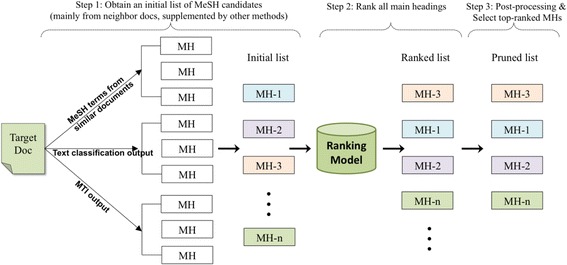
Background: MeSH indexing is the task of assigning relevant MeSH terms based on a manual reading of scholarly publications by human indexers. The task is highly important for improving literature retrieval and many other scientific investigations in biomedical research. Unfortunately, given its manual nature, the process of MeSH indexing is both time-consuming (new articles are not immediately indexed until 2 or 3 months later) and costly (approximately ten dollars per article). In response, automatic indexing by computers has been previously proposed and attempted but remains challenging. In order to advance the state of the art in automatic MeSH indexing, a community-wide shared task called BioASQ was recently organized. Methods: We propose MeSH Now, an integrated approach that first uses multiple strategies to generate a combined list of candidate MeSH terms for a target article. Through a novel learning-to-rank framework, MeSH Now then ranks the list of candidate terms based on their relevance to the target article. Finally, MeSH Now selects the highest-ranked MeSH terms via a post-processing module. Results: We assessed MeSH Now on two separate benchmarking datasets using traditional precision, recall and F 1 -score metrics. In both evaluations, MeSH Now consistently achieved over 0.60 in F-score, ranging from 0.610 to 0.612. Furthermore, additional experiments show that MeSH Now can be optimized by parallel computing in order to process MEDLINE documents on a large scale. Conclusions: We conclude that MeSH Now is a robust approach with state-of-the-art performance for automatic MeSH indexing and that MeSH Now is capable of processing PubMed scale documents within a reasonable time frame. Availability: http://www.ncbi.nlm.nih.gov/CBBresearch/Lu/Demo/MeSHNow/ .
Overview
The claims and statistics of this paper haven’t been checked yet.
Free: it reads the open-access text and checks the first 5 claims that cite a source we can check. Create a free account to check every claim.
Integrity signals
Registry
Cites
Statistics
Figures
Verification
Claims the paper makes
The claims and statistics of this paper haven’t been checked yet.
Free: it reads the open-access text and checks the first 5 claims that cite a source we can check. Create a free account to check every claim.
Claims other papers make about this one
Each is checked against this paper’s own text: does it say what the citing paper says it does?
The source backs part of the claim, not all of it — or backs it for a different population, condition or comparison.
In the citing paper
“However, it may not provide keywords according to Medical Subject Headings, which is a criterion of the majority of the journal for better indexing of their articles.[24]”
From ChatGPT in academic writing: Maximizing its benefits and minimizing the risks (2023) · cites this paper as [24]
Experimental — accuracy not yet measured
Self-check
Percentages, sums and reported differences re-computed from the paper’s own numbers.
The self-check needs the paper’s full text.
Citations
Cites
Greedy function approximation: A gradient boosting machine
Friedman, J. H. (2001) · The Annals of Statistics · doi:10.1214/aos/1013203451 · Cited by 30,731 · cited 2×
“LambdaMART [67] is a combination of MART and LambdaRank, where the MART algorithm can be viewed as generalizations of logistic regression [63] and LambdaRank is a method for learning arbitrary information retrieval measures [68].”
MethodRobust estimation of a location parameter
Huber, P. J. (1964) · The Annals of Mathematical Statistics · doi:10.1214/aoms/1177703732 · Cited by 7,228
The mathematics of statistical machine translation: parameter estimation
Brown, P. F., Pietra, V. J. D., Pietra, S. A. D., & Mercer, R. L. (1993) · Cited by 3,973
Learning to rank using gradient descent
Burges, C., Shaked, T., Renshaw, E., Lazier, A., Deeds, M., Hamilton, N., & Hullender, G. (2005) · Proceedings of the 22nd international conference on Machine learning - ICML '05 · doi:10.1145/1102351.1102363 · Cited by 2,836 · cited 1×
“In this work we evaluated several other learning-to-rank algorithms [43] on the BioASQ test dataset, including MART [63], RankNet [64], Coord-inate Ascent [65], AdaRank [66], and LambdaMART, which are available in RankLib v2.”
MethodLearning to rank: from pairwise approach to listwise approach
Cao, Z., Qin, T., Liu, T.-Y., Tsai, M.-F., & Li, H. (2007) · Proceedings of the 24th international conference on Machine learning · doi:10.1145/1273496.1273513 · Cited by 1,960 · cited 1×
“In our previous work, we trained the ranking function with ListNet [62], which sorts the results based on a list of scores.”
MethodLearning to rank for information retrieval
Liu, T.-Y. (2010) · Proceedings of the 33rd international ACM SIGIR conference on Research and development in information retrieval · doi:10.1145/1835449.1835676 · Cited by 1,856
Learning to Rank for Information Retrieval
Liu, T.-Y. (2009) · Foundations and Trends® in Information Retrieval · doi:10.1561/1500000016 · Cited by 1,568
AdaRank: a boosting algorithm for information retrieval
Xu, J., & Li, H. (2007) · Proceedings of the 30th annual international ACM SIGIR conference on Research and development in information retrieval · doi:10.1145/1277741.1277809 · Cited by 775 · cited 1×
“In this work we evaluated several other learning-to-rank algorithms [43] on the BioASQ test dataset, including MART [63], RankNet [64], Coord-inate Ascent [65], AdaRank [66], and LambdaMART, which are available in RankLib v2.”
Method(2006) · doi:10.7551/mitpress/7503.003.0029 · Cited by 753
Information Retrieval as Statistical Translation
Berger, A., & Lafferty, J. (2017) · ACM SIGIR Forum · doi:10.1145/3130348.3130371 · Cited by 621
Research works printed but not linked: 5
- Mao Y Wei C-H Lu Z NCBI at the 2014 BioASQ challenge task: large-scale biomedical semantic indexing and question answering Proceedings of Question Answering Lab at CLEF 2014
- Liu K Wu J Peng S Zhai C Zhu S The Fudan-UIUC participation in the BioASQ Challenge Task 2a: The Antinomyra system Risk 2014 129816 100
- Mork JG Demner-Fushman D Schmidt SC Aronson AR Recent enhancements to the NLM medical text indexer Working Notes for CLEF 2014 Conference, Sheffield, UK 2014 1328 36
- Quoc C Le V Learning to rank with nonsmooth cost functions NIPS’07 2007 193
- Robertson SE, Walker S, Jones S, Hancock-Beaulieu MM, Gatford M. Okapi at TREC-3. Gaithersburg: NIST Special Publication; 1995. pp. 109–126 · doi:10.6028/nist.sp.500-225.adhoc-city
Cited by
Best Match: New relevance search for PubMed
Fiorini, N., Canese, K., Starchenko, G., Kireev, E., Kim, W., Miller, V., Osipov, M., Kholodov, M., Ismagilov, R., Mohan, S., et al. (2018) · PLOS Biology · doi:10.1371/journal.pbio.2005343 · Cited by 175
Self-citationDeep neural network for hierarchical extreme multi-label text classification
Gargiulo, F., Silvestri, S., Ciampi, M., & Pietro, G. D. (2019) · Applied Soft Computing · doi:10.1016/j.asoc.2019.03.041 · Cited by 174
ML-Net: multi-label classification of biomedical texts with deep neural networks
Du, J., Chen, Q., Peng, Y., Xiang, Y., Tao, C., & Lu, Z. (2019) · Journal of the American Medical Informatics Association · doi:10.1093/jamia/ocz085 · Cited by 133
“We used the pre-trained PubMed word2vec (dimension: 200) [31] to map the tokens in the documents to high dimensional vectors.”
BackgroundMethodInfluentialSelf-citationRecent advances in biomedical literature mining
Zhao, S., Su, C., Lu, Z., & Wang, F. (2021) · Briefings in Bioinformatics · doi:10.1093/bib/bbaa057 · Cited by 134
“Zhang et al. [82] provided a literature review on multi-label classification,and many models therein have been applied in this context, such as k-nearest neighbor (KNN) [83], Naive Bayes [84], SVM [85], learning to rank approaches [79, 86–88], etc.”
BackgroundMethodSelf-citationA Review of Cancer Genetics and Genomics Studies in Africa
Rotimi, S. O., Rotimi, O. A., & Salhia, B. (2021) · Frontiers in Oncology · doi:10.3389/fonc.2020.606400 · Cited by 97
“Since PubMed Medical Subject Heading (MeSH) terms involve synonym control, it yields more precise and inclusive search results (16).”
BackgroundKPTimes: A Large-Scale Dataset for Keyphrase Generation on News Documents
Gallina, Y., Boudin, F., & Daille, B. (2019) · International Conference on Natural Language Generation · doi:10.18653/v1/w19-8617 · Cited by 95
“As gold annotated data is expensive and difficult to obtain (Mao and Lu, 2017), previous works focused on readily available scientific abstracts and used authorassigned keyphrases as a proxy for expert annotations.”
BackgroundChatGPT in academic writing: Maximizing its benefits and minimizing the risks
Mondal, H., & Mondal, S. (2023) · Indian Journal of Ophthalmology · doi:10.4103/ijo.ijo_718_23 · Cited by 80
“[24] Introduction: The background of the study constitutes the base of the study.”
BackgroundGHS-NET a generic hybridized shallow neural network for multi-label biomedical text classification
Ibrahim, M. A., Khan, M. U. G., Mehmood, F., Asim, M. N., & Mahmood, W. (2021) · Journal of Biomedical Informatics · doi:10.1016/j.jbi.2021.103699 · Cited by 69
You, R., Liu, Y., Mamitsuka, H., & Zhu, S. (2020) · Bioinformatics · doi:10.1093/bioinformatics/btaa837 · Cited by 60
FullMeSH: improving large-scale MeSH indexing with full text
Dai, S., You, R., Lu, Z.-Y., Huang, X., Mamitsuka, H., & Zhu, S. (2019) · Bioinform. · doi:10.1093/bioinformatics/btz756 · Cited by 46
Self-citationA Census of Disease Ontologies
Haendel, M. A., McMurry, J. A., Relevo, R., Mungall, C. J., Robinson, P. N., & Chute, C. G. (2018) · Annual Review of Biomedical Data Science · doi:10.1146/annurev-biodatasci-080917-013459 · Cited by 49
“Information retrieval within and across a large number of resources such as research registries and EHRs can also benefit from integration with common ontologies to annotate and index each resource (67–69).”
BackgroundiGRLCDA: identifying circRNA–disease association based on graph representation learning
Zhang, H.-Y., Wang, L., You, Z., Hu, L., Zhao, B.-W., Li, Z., & Li, Y. (2022) · Briefings in Bioinformatics · doi:10.1093/bib/bbac083 · Cited by 45
Mai, F., Galke, L. P. A., & Scherp, A. (2018) · ACM/IEEE Joint Conference on Digital Libraries · doi:10.1145/3197026.3197039 · Cited by 42
What’s next? Forecasting scientific research trends
Ofer, D., Kaufman, H., & Linial, M. (2024) · Heliyon · doi:10.1016/j.heliyon.2023.e23781 · Cited by 22
“, the medical subject headings system, MeSH [5]).”
BackgroundScientometrics analysis of research activity and collaboration patterns in Chagas cardiomyopathy
González‐Alcaide, G., Salinas, A., & Ramos, J. M. (2018) · PLoS neglected tropical diseases · doi:10.1371/journal.pntd.0006602 · Cited by 37
Ramos, J. M., Pinargote‐Celorio, H., Belinchón, I., & González‐Alcaide, G. (2019) · BMC Medical Research Methodology · doi:10.1186/s12874-019-0819-4 · Cited by 27
“The thesaurus employs both a human team of specialist indexers to analyze each article and assign medical subject headings to it, plus automated processes to improve indexing; the result is a highly consistent system of classification for research topics [14] [15] [16] .”
BackgroundE-Synthesis: A Bayesian Framework for Causal Assessment in Pharmacosurveillance
Pretis, F. D., Landes, J., & Osimani, B. (2019) · Frontiers in Pharmacology · doi:10.3389/fphar.2019.01317 · Cited by 28
Large-Scale Evaluation of Keyphrase Extraction Models
Gallina, Y., Boudin, F., & Daille, B. (2020) · ACM/IEEE Joint Conference on Digital Libraries · doi:10.1145/3383583.3398517 · Cited by 27
“Still, most documents do not have assigned keyphrases, and manual annotation is simply not a feasible option [31].”
BackgroundUsing Titles vs. Full-text as Source for Automated Semantic Document Annotation
Galke, L. P. A., Mai, F., Schelten, A., Brunsch, D., & Scherp, A. (2017) · International Conference on Knowledge Capture · doi:10.1145/3148011.3148039 · Cited by 26
“There are also approaches that use Learning to Rank along with dynamic cut-off techniques [16].”
NamedKeys: Unsupervised Keyphrase Extraction for Biomedical Documents
Gero, Z., & Ho, J. C. (2019) · ACM International Conference on Bioinformatics, Computational Biology, and Health Informatics (ACM-BCB) · doi:10.1145/3307339.3342147 · Cited by 20
“…terms make it easier to search for a document and cluster similar documents, generating MeSH terms for every document is expensive and time-consuming; new articles are not immediately indexed until 2 or 3 months later and approximately ten dollars per article is spent for the manual indexing [28].”
BackgroundA comparative evaluation of biomedical similar article recommendation
Zhang, L., Lu, W. P., Chen, H., Huang, Y., & Cheng, Q. (2022) · Journal of Biomedical Informatics · doi:10.1016/j.jbi.2022.104106 · Cited by 19
Thesaurus-based word embeddings for automated biomedical literature classification
Koutsomitropoulos, D. A., & Andriopoulos, A. D. (2021) · Neural Computing and Applications · doi:10.1007/s00521-021-06053-z · Cited by 17
“When MeSH headings are considered, classification scores range between 0.61-0.69 (e.g. [17], [33]).”
BackgroundInfluentialTackling Research Inefficiency in Degenerative Cervical Myelopathy: Illustrative Review
Khan, D. Z., Khan, M. S., Kotter, M., & Davies, B. M. (2020) · JMIR Research Protocols · doi:10.2196/15922 · Cited by 17
“Employing such technology should motivate us to aim for a fully indexed body of DCM literature [27,39].”
BackgroundApplication of learning to rank in bioinformatics tasks
Ru, X., Ye, X., Sakurai, T., & Zou, Q. (2020) · Briefings in Bioinformatics · doi:10.1093/bib/bbaa394 · Cited by 16
Ontology-based categorization of clinical studies by their conditions
Liu, H., Carini, S., Chen, Z., Hey, S. P., Sim, I., & Weng, C. (2022) · Journal of Biomedical Informatics · doi:10.1016/j.jbi.2022.104235 · Cited by 15
Biomedical semantic indexing by deep neural network with multi-task learning
Du, Y., Pan, Y., Wang, C., & Ji, J. (2018) · BMC Bioinformatics · doi:10.1186/s12859-018-2534-2 · Cited by 15
“It out-performed the MTI of the day and got the best performance in 2014 BioASQ challenge Task A. Yuqing Mao and Zhiyong Lu [12] proposed “ MeSH Now ” which obtains an initial list of MeSH candidates from similar documents found by k-NN.”
MethodArtificial intelligence in endodontics: relevant trends and practical perspectives
Goncharuk-Khomyn, M., Noenko, I., Cavalcanti, A. L., Adıgüzel, Ö., & Dubnov, A. (2023) · Ukrainian Dental Journal · doi:10.56569/udj.2.1.2023.96-101 · Cited by 14
How to catch trends using MeSH terms analysis?
Ilgisonis, E. V., Pyatnitskiy, M. A., Tarbeeva, S. N., Aldushin, A. A., & Ponomarenko, E. A. (2022) · Scientometrics · doi:10.1007/s11192-022-04292-y · Cited by 14
“The hierarchy of MeSH terms comprises 16 top-level categories (Mao & Lu, 2017).”
BackgroundMethodAmar‐Zifkin, A., Ekmekjian, T., Paquet, V., & Landry, T. (2025) · Journal of the Medical Library Association JMLA · doi:10.5195/jmla.2025.1936 · Cited by 14
“The movement to automation aims to reduce time-to-indexing and cost, identified in Mao and Lu [11] as 2-3 months and $10 per publication, respectively, and must be considered in the context of the ever-increasing volume of biomedical literature.”
NewsMeSH: A new classifier designed to annotate health news with MeSH headings
Costa, J. P., Rei, L., Stopar, L., Fuart, F., Grobelnik, M., Mladenić, D., Novalija, I., Staines, A. S., Pääkkönen, J., Konttila, J., et al. (2021) · Artificial Intelligence in Medicine · doi:10.1016/j.artmed.2021.102053 · Cited by 13
Yang, J., Lei, X., & Pan, Y. (2024) · Chinese Journal of Electronics · doi:10.23919/cje.2023.00.344 · Cited by 13
Genomic landscapes of breast cancer in African populations: a systematic review
Mugo, N. R., & Contino, G. (2025) · npj Breast Cancer · doi:10.1038/s41523-025-00809-9 · Cited by 11
“PubMed Medical Subject Headings (MeSH) terms were utilised as they provide more accurate and relevant search results while overcoming synonymy and polysemy 43 (Supplementary S1).”
Chemical identification and indexing in PubMed full-text articles using deep learning and heuristics
Almeida, T., Antunes, R., Silva, J. F., Almeida, J. R., & Matos, S. (2022) · Database J. Biol. Databases Curation · doi:10.1093/database/baac047 · Cited by 7
A Study of Explainability Features to Scrutinize Faceted Filtering Results
Qu, J., Arguello, J., & Wang, Y. (2021) · ACM International Conference on Information and Knowledge Management (CIKM) · doi:10.1145/3459637.3482409 · Cited by 9
“Prior research has aimed to automate this process by using unsupervised algorithms to cluster search results into topics [6, 22] or by using supervised learning algorithms to associate documents with facet-values from pre-defined schema [18, 28, 36, 38, 41].”
BackgroundMethodAutomatically Cataloging Scholarly Articles using Library of Congress Subject Headings
Kazi, N., Lane, N., & Kahanda, I. (2021) · Conference of the European Chapter of the Association for Computational Linguistics: Student Research Workshop (EACL SRW) · doi:10.18653/v1/2021.eacl-srw.7 · Cited by 9
“…Medical Subject Headings (MeSH) for biomedical literature using machine learning and deep learning techniques has seen significant recent interest (Mao and Lu, 2017; Jin et al., 2018; Kehoe et al., 2017; Rios and Kavuluru, 2015; Kosmopoulos et al., 2015; Yan et al., 2016) thanks to the BioASQ…”
BackgroundKoutsomitropoulos, D. A., Andriopoulos, A. D., & LIKOTHANASSIS, S. D. (2020) · Cybernetics and Information Technologies · doi:10.2478/cait-2020-0043 · Cited by 9
LabelCoRank: Revolutionizing Long Tail Multi-Label Classification with Co-Occurrence Reranking
Yan, Y., Liu, J., & Zhang, B.-W. (2025) · Journal of Artificial Intelligence Research · doi:10.1613/jair.1.16968 · Cited by 10
Valiev, A., & Tutubalina, E. V. (2024) · Clinical Natural Language Processing Workshop (ClinicalNLP) · doi:10.18653/v1/2024.clinicalnlp-1.47 · Cited by 8
“MeSH is a hierarchically organized and concept-based vocabulary produced by the National Library of Medicine (NLM) (Mao and Lu, 2017).”
BackgroundValle, J. E. P., García−Bermúdez, R., Rojas, F., Torres-Morán, C. R., & Simón-Cuevas, A. (2020) · Lecture notes in computer science · doi:10.1007/978-3-030-45385-5_57 · Cited by 8
Bhasuran, B., & Natarajan, J. (2023) · Knowledge and Information Systems · doi:10.1007/s10115-023-01862-1 · Cited by 8
“However, in recent years statistical signifies measures are getting more attention and are increasingly using in finding indirect associations [36, 54].”
BackgroundHe, X., Shang, J., Ge, D., Li, F., & Liu, J. (2025) · IEEE Transactions on Computational Biology and Bioinformatics · doi:10.1109/tcbbio.2024.3506615 · Cited by 7
“The discovery and naming of diseases is obtained based on their clinical properties, so the semantic of diseases is of great importance in medical knowledge discovery, and the similarity network constructed from it is widely used [27], [28].”
Zero-Shot and Few-Shot Classification of Biomedical Articles in Context of the COVID-19 PandemicPreprint
Lupart, S., Favre, B., Nikoulina, V., & Aït-Mokhtar, S. (2022) · arXiv (Cornell University) · doi:10.48550/arxiv.2201.03017 · Cited by 7
Using deep learning to identify translational research in genomic medicine beyond bench to bedside
Hsu, Y.-Y., Clyne, M., Wei, C.-H., Khoury, M. J., & Lu, Z. (2019) · Database · doi:10.1093/database/baz010 · Cited by 6
“Second, their method made use of the medical subject headings (MeSH) indexing terms as a feature, but MeSH terms, generally speaking, are not immediately available upon article publication (10).”
MethodSelf-citationYeh, C., Chien, T., Lin, J.-C. J., & Chou, P. (2022) · Medicine · doi:10.1097/md.0000000000031441 · Cited by 6
“With the aid of MeSH terms in PubMed that utilize MeSH terms, a controlled vocabulary of biomedical terms allows the indexing of papers and other documents to improve its search algorithm.[20] MEDLINE experts manually indexed each article with 10 to 15 MeSH terms.”
MethodAutomated MeSH Indexing of Biomedical Literature Using Contextualized Word Representations
Koutsomitropoulos, D. A., & Andriopoulos, A. D. (2020) · IFIP advances in information and communication technology · doi:10.1007/978-3-030-49161-1_29 · Cited by 6
NeuroBridge: a prototype platform for discovery of the long-tail neuroimaging data
Wang, L., Ambite, J. L., Appaji, A., Bijsterbosch, J. D., Dockès, J., Herrick, R., Kogan, A., Lander, H., Marcus, D., Moore, S., et al. (2023) · Frontiers in Neuroinformatics · doi:10.3389/fninf.2023.1215261 · Cited by 6
“, 2015), or multi-label text classification (Mao and Lu, 2017).”
Perrin, C., Bediang, G., Randriambelonoro, M., & Geissbühler, A. (2019) · Frontiers in Public Health · doi:10.3389/fpubh.2019.00188 · Cited by 6
“MESH Now (34) is an integrated approach using multiple strategies to generate a combined list of candidateMeSH terms for a target article.”
MethodThe Perspective on Secondary Research Practices: A Cross-Sectional Analysis
Ratajczak, P., Oziewicz, K., Sommer, I., Kopciuch, D., Paczkowska, A., Zaprutko, T., & Kus, K. (2025) · Healthcare · doi:10.3390/healthcare13080927 · Cited by 5
“Creating a query and entering it into a search engine allows for precisely searching publications based on specific criteria [10,11].”
Automatic Classification and Visualization of Text Data on Rare Diseases
Rei, L., Costa, J. P., & Draksler, T. Z. (2024) · Journal of Personalized Medicine · doi:10.3390/jpm14050545 · Cited by 5
“When considering the more general classification of scientific articles with MeSH classes, the main references include MeSH Now [8], with its learning-to-rank framework; the MeSHLabeler [9], combining predictions from MeSH classifiers, KNN and pattern matching; and BERTMeSH [10], a pretrained deep…”
MethodSaha, S. (2022) · PLoS ONE · doi:10.1371/journal.pone.0270196 · Cited by 5
“The second search string used words and phrases instead of the MeSH terms as their manual tagging with the newly indexed articles in the PubMed database requires some time [24].”
MethodMilchakov, K. S. (2022) · Safety and Risk of Pharmacotherapy · doi:10.30895/2312-7821-2022-10-3-218-229 · Cited by 5
Automatic Recognition of Chemical Entity Mentions in Texts of Scientific Publications
Biziukova, N. Y., Tarasova, O. A., Rudik, A. V., Filimonov, D. A., & Poroikov, V. (2020) · Automatic Documentation and Mathematical Linguistics · doi:10.3103/s0005105520060023 · Cited by 5
AI Ethics Knowledge Among Chinese Teachers: An Empirical AssessmentPreprint
Zhang, J., & Rhee, G. S. (2025) · Research Square · doi:10.21203/rs.3.rs-7042877/v1 · Cited by 5
Bachelet, V. C., Navarrete, M. S., Barrera-Riquelme, C., Carrasco, V. A., Dallaserra, M., Díaz, R. A., Ibarra, Á. A., Lizana, F. J., Meza‐Ducaud, N., Saavedra, M. G., et al. (2021) · BMC Medical Research Methodology · doi:10.1186/s12874-021-01337-3 · Cited by 6
Multi-probe attention neural network for COVID-19 semantic indexing
Gu, J., Xiang, R., Wang, X., Li, J., Li, W., Qian, L., Zhou, G., & Huang, C. (2022) · BMC Bioinformatics · doi:10.1186/s12859-022-04803-x · Cited by 4
“MeSHNow [24] proposed another hybrid machine learning approach, which combined multi-label classification, KNN, and MTI, to generate the set of candidate MeSH terms for each article.”
MethodImproving Large-Scale k-Nearest Neighbor Text Categorization with Label Autoencoders
Ribadas, F. J., Cao, S., & Bilbao, V. M. D. (2022) · Mathematics · doi:10.3390/math10162867 · Cited by 4
“Some relevant recent developments in MeSH indexing are MeSHLabeler [31], DeepMeSH [32], MeSH Now [33], AttentionMeSH [34], MeSHProbeNet [35], FullMeSH [26], BERTMeSH [36] and k -NN methods using ElasticSearch and MTI such as [37].”
MethodA pipeline for medical literature search and its evaluation
Zafar, I., Wali, A., Kunwar, M. A., Afzal, N., & Raza, M. (2023) · Journal of Information Science · doi:10.1177/01655515231161557 · Cited by 3
“The data-base commonly used by clinicians is PubMed [2], which has over 33 million articles [3].”
Whats next? Forecasting scientific research trendsPreprint
Ofer, D., & Linial, M. (2023) · arXiv (Cornell University) · doi:10.48550/arxiv.2305.04133 · Cited by 3
“, the medical subject headings system, MeSH [5]).”
BackgroundBi-term association based on fuzzy logic
Liu, W., Wan, J., Lv, N., & Zhou, X. (2026) · Array · doi:10.1016/j.array.2026.100704 · Cited by 2
Wood, N. (2024) · Archival Science · doi:10.1007/s10502-024-09469-3 · Cited by 2
“However, supervised deep learning shows promising potential for predicting appropriate indexation for medical subject headings (MeSH) and should be explored for archival materials digitized with full-text search functionality (Heryawan and Bukhori, 2022; Mao and Lu 2017).”
Large Scale Semantic Indexing with Deep Level-wise Extreme Multi-label Learning
Li, D.-C., Zhang, J., & Li, P. (2019) · The Web Conference · doi:10.1145/3308558.3313636 · Cited by 2
“In this section, we further compare with five state-of-the-art approaches to demonstrate the effectiveness of the pointer generation model, including MTIDEF [12], MeSH Now [22], MeSHLabeler, MeSHRanker [21] and Deep Mesh [28] for MeSH results.”
MethodYang, X., Shen, Y., Chen, H., & Chen, D. (2024) · Medicine · doi:10.1097/md.0000000000038873 · Cited by 2
“[22] The Medical Dictionary for Regulatory Activities (MedDRA, version 26.0) [23] were utilized for further supplementing the name of Sevoflurane.”
MethodInfluentialAnnotating and indexing scientific articles with rare diseases
Azarbonyad, H., Afzal, Z., Iping, R., Dumoulin, M., Nederveen, I., Yu, J.-T., & Tsatsaronis, G. (2026) · Journal of Biomedical Semantics · doi:10.1186/s13326-025-00346-1 · Cited by 2
“The idea is further extended by using more advance learning to rank models which instead of a similarity metric (or a classifier) try to directly learn a function that can rank labels given a document [30].”
Investigating text power in predicting semantic similarity
Yousefi, Z., Sotudeh, H., Mirzabeigi, M., Fakhrahmad, S. M., Nikseresht, A., & Mohammadi, M. (2019) · DOAJ (DOAJ: Directory of Open Access Journals) · Cited by 2
CureSCi Metadata Catalog–Making sickle cell studies findable
Pan, H. H., Ives, C. L., Mandal, M., Qin, Y., Hendershot, T. P., Popovic, J. R., Brambilla, D. J., Stratford, J. K., Treadwell, M. J., Wu, X., et al. (2022) · PLoS ONE · doi:10.1371/journal.pone.0256248 · Cited by 2
“The hierarchical structure and terminology were adopted and reused in our development when applicable and becomes the backbone of our conceptual framework [23].”
BackgroundMethodAnnotating PubMed Abstracts with MeSH Headings using Graph Neural Network
Mustafa, F. E., Boutalbi, R., & Iurshina, A. (2023) · Workshop on Insights from Negative Results in NLP (Insights) · doi:10.18653/v1/2023.insights-1.9 · Cited by 2
“The second category consists of models like DeepMesh (Peng et al., 2016) and MeSH Now (Mao and Lu, 2017) which rely on the widely used Information Retrieval technique named Learning to Rank in order to obtain the most relevant MeSH headings.”
MethodGalke, L. P. A., Mai, F., Schelten, A., Brunsch, D., & Scherp, A. (2017) · arXiv (Cornell University) · Cited by 2
Automated Text Mining of Experimental Methodologies from Biomedical LiteraturePreprint
Guo, Z. (2024) · arXiv (Cornell University) · doi:10.48550/arxiv.2404.13779 · Cited by 2
“MeSHLabeler’s ”learning-to-rank” architecture, which incorporates various evidence generated from the new semantic representation and achieves a micro-F measurement of 0.6323, solves the MeSH term side difficulty [32].”
BackgroundMethodInfluentialAssessment of terminological density in scientific publications on physical culture
Єрмаков, С., Korobeynikov, G., & Curby, D. G. (2025) · Physical Culture Recreation and Rehabilitation · doi:10.15561/physcult.2025.0203 · Cited by 1
Advancement in cell and gene therapy research: A 35-year bibliometric perspective
Kitahara, Y., Koda, H., Kataoka, J., Tatsumi, K., Nishino, R., Yoshioka-Kobayashi, T., & Nagai, S. (2026) · Cytotherapy · doi:10.1016/j.jcyt.2026.102056 · Cited by 1
Systematic Analysis of the Factors Contributing to the Variation and Change of the Microbiome
Aiello, K. D. (2018) · Cited by 1
Biomedical articles share annotations with their citation neighbors
Rodriguez‐Esteban, R. (2021) · BMC Bioinformatics · doi:10.1186/s12859-021-04044-4 · Cited by 1
The DELICES project: Indexing scientific literature through semantic expansion
Boudin, F., Daille, B., Jacquey, É., & Nie, J. (2020) · HAL · Cited by 1
Comparison of Machine Learning and Deep Learning model for Medical Subject Headings Indexation
Heryawan, L., & Bukhori, A. (2022) · International Conference on Computer, Control, Informatics and its Applications · doi:10.1145/3575882.3575938 · Cited by 1
Symptom-based diagnosis of diseases for primary health check-ups using biomedical text mining
Rakesh, B., & Nayak, S. (2023) · Elsevier eBooks · doi:10.1016/b978-0-443-19413-9.00023-0 · Cited by 1
Nonato, N. D. S., Nunes, L. S., Martins, A. W. S., Pinhal, D., Domingues, W. B., Bellido-Quispe, D. K., Remião, M. H., & Campos, V. F. (2024) · Plasmid · doi:10.1016/j.plasmid.2024.102731 · Cited by 1
Pech, G., Mreła, A., Osińska, V., & Sokołov, O. (2025) · Journal of Informetrics · doi:10.1016/j.joi.2025.101648 · Cited by 1
Duplication in biological databases: definitions, impacts and methods
Chen, Q. (2017) · Minerva Access (University of Melbourne) · Cited by 1
The DELICES project: Indexing scientific literature through semantic expansionPreprint
Boudin, F., Daille, B., Jacquey, É., & Nie, J. (2021) · arXiv (Cornell University) · doi:10.48550/arxiv.2106.14731 · Cited by 1
The Fourth Workshop on Insights from Negative Results in NLP
Tafreshi, S., Akula, A., Sedoc, J., Валентинович, Д. А., Rogers, A., & Rumshisky, A. (2023) · doi:10.18653/v1/2023.insights-1 · Cited by 1
Systematic Analysis of the Factors Contributing to the Variation and Change of the Microbiome
(2018) · Arizona State University Library Digital Repository (Arizona State University) · Cited by 1
She, M., Yang, L., Jaramillo, A. M., & Espín-Noboa, L. (2026) · arXiv (Cornell University) · doi:10.48550/arxiv.2604.03776 · Cited by 1
Mining Related Articles for Automatic Journal Cataloging
Mao, Y., & Lu, Z. (2016) · Journal of Data and Information Science · doi:10.20309/jdis.201613
Self-citationResnick, M. (2018) · Digital Commons-TMC (Texas Medical Center)
Dual Triggered Correspondence Topic (DTCT)model for MeSH annotation
Kim, S.-H., & Yoon, J. (2020) · IEEE Transactions on Computational Biology and Bioinformatics · doi:10.1109/tcbb.2020.3016355
“In another attempt, simple pruning methods or semantic rules related to specific MHs or word terms were applied [28], [29].”
BackgroundMethodResultInfluentialRawat, R. (2020) · arXiv (Cornell University) · doi:10.48550/arxiv.2009.13294
“MeSH Now [10] is the state of the art used to index the article automatically.”
BackgroundАвтоматическое распознавание названий химических соединений в текстах научных публикаций
Бизюкова, Н. Ю., Tarasova, O. A., Rudik, A. V., Filimonov, D. A., & Poroikov, V. (2020) · Научно-техническая информация Серия 2 Информационные процессы и системы · doi:10.36535/0548-0027-2020-11-5
Heryawan, L., & Subiantoro, A. (2021) · International Conference on Computer, Control, Informatics and its Applications · doi:10.1145/3489088.3489096
“MeSH indexing is a time-consuming manual process in which human indexers who are specialists in the subject matter read the full articles, identify important topics, determine subject content, and assign appropriate MeSH headings [13].”
BackgroundDiagnostic criteria for odontogenic sinusitis: narrative review of relevant literature data
Popov, R. V., Rozumnyi, V., Sydorenko, A. Y., Kurylekh, L., & Logvynenko, O. I. (2023) · Ukrainian Dental Journal · doi:10.56569/udj.2.2.2023.114-122
СВЯЗЫВАНИЕ ТЕРМИНОВ ИЗ НАУЧНЫХ ТЕКСТОВ С СУЩНОСТЯМИ БАЗ ЗНАНИЙ
Кузовлев, Д. Д., Batura, T. V., & Старцев, П. А. (2025) · System Informatics · doi:10.31144/si.2307-6410.2025.n26.p53-76
Survival Analysis in Cancer Research: A Bibliometric Study (2005–2024)
Kshtriya, P., Prajapati, A., Chakraborty, M., & Ganguly, P. (2025) · SN Comprehensive Clinical Medicine · doi:10.1007/s42399-025-02046-4
“[27] Moreover, they provide a consistent way to retrieve information by capturing specific aspects of a concept.”
Navarro Palacios, K. M., & Navarro Palacios, K. M. (2024) · Repositorio Institucional USAT (Universidad Católica Santo Toribio de Mogrovejo)
Génération de mots-clés absents pour l’indexation d’articles scientifiques
Houbre, M. (2025) · theses.fr (ABES) · doi:10.70675/9310d932ze354z44bez9bd9zf69ec2c09e56
Kshtriya, P., Prajapati, A., Chakraborty, M., & Ganguly, P. (2026) · The International Information & Library Review · doi:10.1080/10572317.2026.2631197
“Moreover, they provide a consistent way to retrieve information, by capturing specific aspects of a concept (Islamaj Dogan et al., 2009; Mao & Lu, 2017).”
Das, P., Schneider, J., Mayo‐Wilson, E., Kilicoglu, H., Menke, J. D., Nam, D., Ninan, K., Oberste, J.-P., Troy, A. M., Ying, X., et al. (2026) · JAMIA Open · doi:10.1093/jamiaopen/ooag197
Producción científica de la Revista Médica del IMSS en PubMed (2005-2025): análisis bibliométrico
Chávez-Martínez, O., Villaseñor-Aguirre, M., & Cano-Román, F. (2026) · PubMed Central · doi:10.5281/zenodo.19101745
Okeoma, O. I., Adediran, A. O., Adeoti, D. O., & Matthew, C. O. (2026) · International Journal of Evidence-Based Medicine · doi:10.63946/jebm/18966
“The PubMed search used Medical Subject Headings (MeSH) and free-text terms because MeSH-based searching improves retrieval of relevant biomedical literature and reduces irrelevant search results [16].”
Medical eponyms: Ambiguity in search terms and the failure of contemporary databases
Wiggins, L., McCann, C., McCreadie, K. A., Gill, C. I. R., & Davis, J. (2026) · Journal of Information Science · doi:10.1177/01655515261475282
Okoe-Mensah, S. M. (2026) · arXiv (Cornell University) · doi:10.48550/arxiv.2607.21685
“Existing work treats expert MeSH as ground truth and auto-MeSH prediction as an algorithmic problem in its own right (Mao and Lu, 2017; Jin and Szolovits, 2018).”
INDUS-SDE: A Language Model for Scientific Content Curation and Discovery
Pantha, N., Awale, S., Kuruvanthodi, V., Simran, K. C., Ramasubramanian, M., Davis, C., Praveen, B., Foshee, E., Bhattacharjee, B., Bugbee, K., et al. (2026) · ACM SIGKDD Conference on Knowledge Discovery and Data Mining (KDD) · doi:10.1145/3770855.3818847
Metadata
- Authors
- Mao, Y., & Lu, Z.
- Affiliations
- Nanjing University of Chinese Medicine (CN)
- National Center for Biotechnology Information (US)
- Corresponding author
- Lu, Zhiyong
- Venue
- Journal of Biomedical Semantics
- Published
- 2017-04-17
- Volume
- 8
- Issue
- 1
- Pages
- 15-15
- ISSN
- 2041-1480 (ISSN-L)
- PMC
- PMC5392968
- OpenAlex
- W2606900069
- Cited by
- 87
- References
- 80
- Citations by year
- 2026: 8 · 2025: 9 · 2024: 5 · 2023: 10 · 2022: 12 · 2021: 10 · 2020: 12 · 2019: 12 · 2018: 7 · 2017: 1
- FWCI
- 3.57
- Type
- journal article
- Language
- en
- Open access
- gold
- doi.org
- Licence
- cc-by
- creativecommons.org/licenses/by/4.0 (tdm)
- creativecommons.org/licenses/by/4.0 (vor)
- Locations
- Journal of Biomedical Semantics (publishedVersion, cc-by)
- PubMed Central (publishedVersion, cc-by)
- PubMed (publishedVersion)
- DOAJ (DOAJ: Directory of Open Access Journals) (submittedVersion, cc-by-sa)
- Funders
- National Natural Science Foundation of China (81674099, 81603498)
- Government of Jiangsu Province
- Six Talent Peaks Project in Jiangsu Province
- Priority Academic Program Development of Jiangsu Higher Education Institutions
- Qinglan Project of Jiangsu Province of China
- National Institutes of Health
- U.S. National Library of Medicine
- Topics
- Health Sciences › Medicine › Health Informatics › Biomedical Text Mining and Ontologies
- Physical Sciences › Computer Science › Artificial Intelligence › Advanced Text Analysis Techniques
- Physical Sciences › Computer Science › Artificial Intelligence › Text and Document Classification Technologies
- Keywords
- MeSH indexing, automatic indexing, learning to rank, term ranking, post-processing, MEDLINE, PubMed, biomedical literature retrieval, parallel computing
- MeSH terms
- Abstracting and Indexing, Machine Learning, Automation, Benchmarking, PubMed, Medical Subject Headings
About these checks
Registry, retraction, Cites and statistics results are computed, not judged, with one exception: a printed reference that no index lists is read once by a model before it counts as a citation error. Claims are extracted by a model and kept only when their quote appears verbatim in the text; each cited source is then checked, with a model’s help, for whether it says what the claim relies on. Those verdicts can be wrong — read the claim’s quote and the cited source before relying on one.
Statistics and arithmetic are recomputed, not judged.
Confidence bands are shown only for fields calibrated on our annotated test set. None is calibrated yet, so no band is shown.
What counts as a claim ›How we measure confidence ›How we check this ›
Are you an author, or do you see a problem with this page? Request a review
Data sources
Bibliographic data: Semantic Scholar, OpenAlex, Crossref.
Contains information from the Semantic Scholar Academic Graph Datasets, made available under the ODC Attribution License (ODC-BY 1.0).
Semantic Scholar’s data is described in: Kinney, R., et al. (2023). The Semantic Scholar Open Data Platform. arXiv:2301.10140.
