

Geochemical investigation of the mixed Máriahalom vertebrate fauna at the Paleogene–Neogene boundary in the Central Paratethys: environmental conditions and age constrain
Open accessThe DOI matches its Crossref record; 124 of the 126 references it cites were found in a registry or an index, and 1 are not checked yet; none of the 133 sources its claims cite is checked for support yet.
Abstract
The fossil vertebrate fauna of Máriahalom contains remains from a wide range of ecologies including terrestrial and aquatic mammals, crocodiles, sharks, and rays among others. All these were found mixed in mollusc-rich, shallow water, coastal deposits. The aim of the study is to trace the origin of the fossils using their rare earth element (REE) content and their respective ecology with stable oxygen isotopic compositions. In addition, marine vertebrates and calcareous marine fossils were analysed for their Sr isotope composition to provide a new age estimate for the locality. The REE content and their distribution in the fossils indicate similar early diagenetic environments and possible contemporaneous fossilization for the entire vertebrate assemblage. Reworked fossils of significantly different age can be excluded. The enamel/enameloid-derived phosphate oxygen isotope composition of selected fossil taxa fit well with previously inferred habitats that include marine, brackish, and terrestrial environments. Notably, the stem-pinniped Potamotherium valletoni is best interpreted as freshwater dweller instead of marine, consistent with the sedimentology of other occurrences. Our novel 87 Sr/ 86 Sr data suggest an Aquitanian age (21.4 ± 0.5 Ma) for the Máriahalom site that is younger than the previously proposed Late Oligocene age based on biostratigraphy (MP28–30 European Mammal Paleogene Reference Levels). An Aquitanian age raises the possibility that the index fossil taxon, the anthracothere mammal Microbunodon minimum , may have vanished earlier in Western Europe than in the Central Paratethys region.
Checked 2026-11-23 · 1 reference not checked yet
Overview
CoChat Summary
TL;DR
Geochemical analyses of rare earth elements, phosphate oxygen isotopes, and strontium isotopes from the mixed Máriahalom vertebrate fauna indicate a common early diagenetic history, habitats spanning marine to freshwater/terrestrial, and an Aquitanian age of 21.4 ± 0.5 Ma. The new age is younger than the previously proposed Late Oligocene biostratigraphic age and implies that *Microbunodon minimum* may have persisted in the Central Paratethys after its Western European disappearance.
Key findings
- REE data from 16 vertebrate specimens (41 laser spots; 29 final data points) show total REE contents of 1.3–10,045 ppm (mean 1997 ppm; median 1062 ppm), with MREE-enriched and LREE-depleted PAAS-normalized patterns; no taxonomic differences among terrestrial, freshwater, and marine groups, suggesting similar early diagenetic environments and contemporaneous fossilization, excluding significantly older reworked fossils.
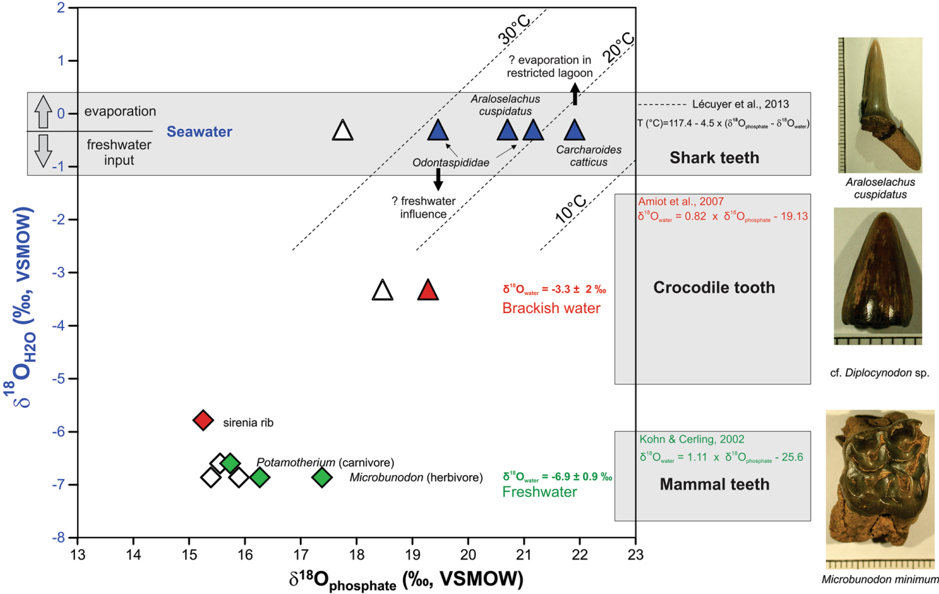
- δ18O PO4 values: shark enameloid 19.5–21.9‰ (n = 4), crocodilian enamel 19.3‰ vs dentine 18.5‰, *Microbunodon* enamel 17.4 and 16.3‰ vs dentine 15.9 and 15.4‰, *Potamotherium* enamel 15.7‰ and dentine 15.6‰, seacow rib 15.3‰; these fit marine, brackish, and terrestrial habitats, with *Potamotherium valletoni* best interpreted as a freshwater rather than marine dweller.
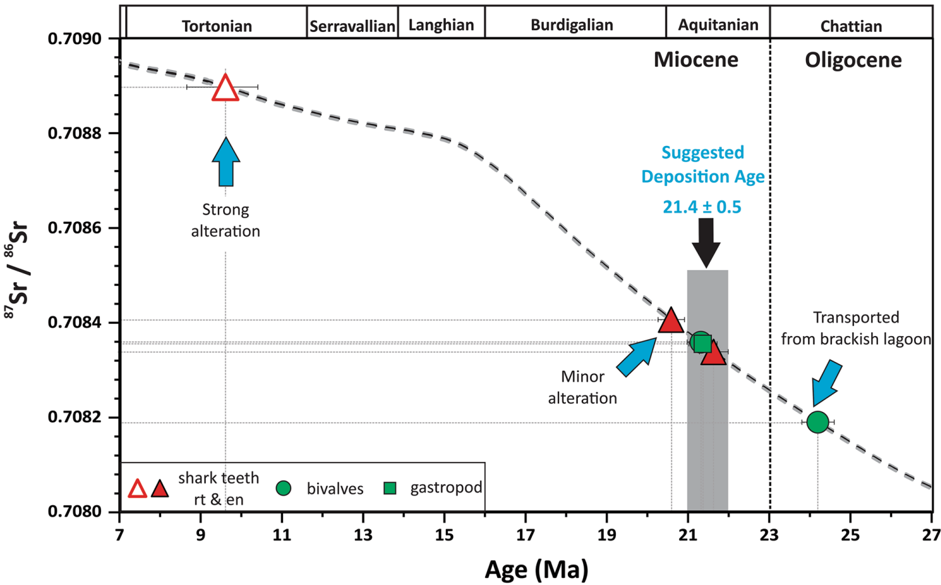
- 87Sr/86Sr from six samples ranges 0.708189–0.708898; three well-preserved samples (two aragonitic molluscs and one shark enameloid) give an average 0.708350 ± 0.00022 and an Aquitanian SIS age of 21.4 ± 0.5 Ma, younger than the previous MP28–30 Late Oligocene age. An oyster shell gave 24.2 Ma (Chattian) and a shark tooth root gave a false 9.6 Ma (Tortonian), attributed to alteration or possible reworking/brackish Sr.
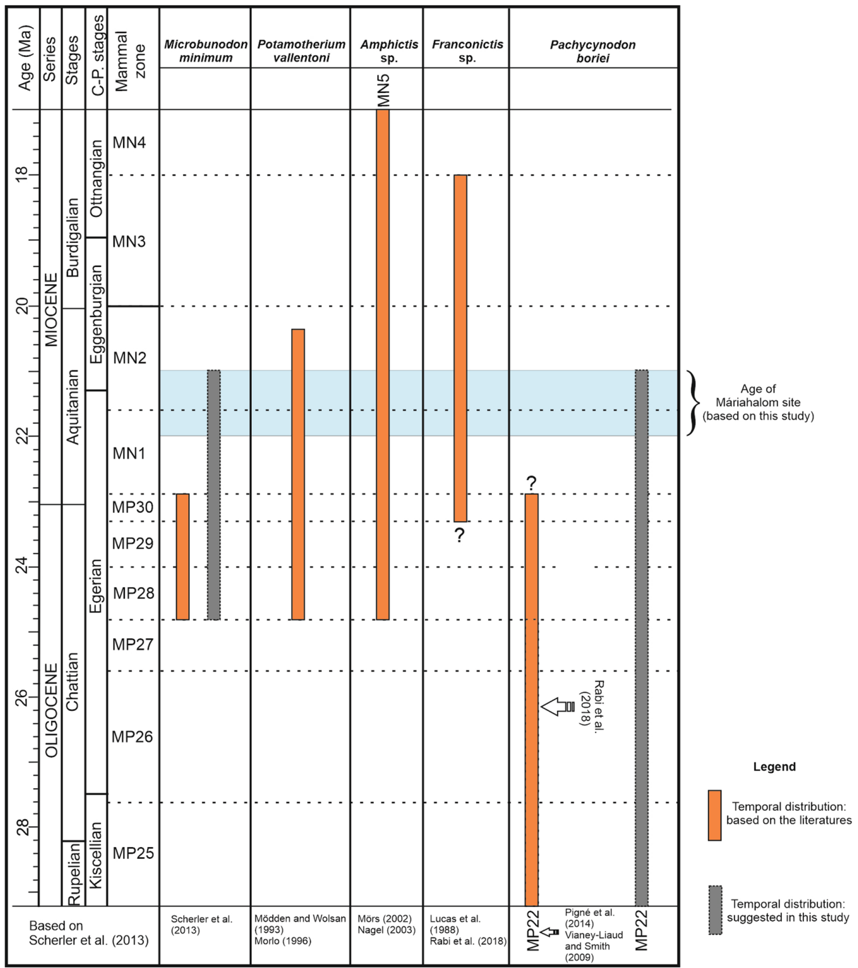
- The Aquitanian age raises the possibility that *Microbunodon minimum* vanished earlier in Western Europe than in Central Paratethys, potentially surviving to MN1–2 and extending its temporal range by at least 1–1.5 million years; *Pachycynodon boriei* may also have survived after the Oligocene–Miocene boundary.
Methods
- LA-ICP-MS trace element analyses on 16 bone/tooth chips from terrestrial, freshwater, and marine vertebrates; 100 μm spots, 1–4 ablations per specimen, NIST612 external and 42Ca internal standardization, CaO 54/50 wt%, reproducibility generally better than ±5% SE; PAAS-normalized REE patterns.
- Stable isotope analyses on selected shark teeth, a crocodilian tooth, a seacow rib, *Potamotherium*, and *Microbunodon* teeth; enameloid/enamel/dentine/bone powders leached in acetic acid buffered to pH 4.5; phosphate oxygen via Ag3PO4 TC/EA, triplicates, VSMOW, NIST SRM 120c = 21.5 ± 0.2‰ (n = 4); calcareous shells via Gasbench II–Delta Plus XL, precision ±0.1‰, VPDB.
- Sr isotope analyses on two shark enameloids, one shark root, two aragonitic molluscs, and one calcite oyster; XRD for mineralogy, ICP-OES for Mg/Sr/Mn/Fe, cation exchange, MC-ICPMS Neptune; normalized to 86Sr/88Sr = 0.1194; NIST SRM 987 external reproducibility 18 ppm (2SD, n = 14); ages from McArthur et al. (2020) with 95% confidence limits.
Limitations
- The paper states that protracted REE uptake may hinder palaeoenvironmental interpretation; dentine and bone (including the sirenian rib) have lower δ18O PO4 interpreted as at least partial diagenetic alteration, and the proportions of original versus secondary apatite are difficult to assess.
- The Sr isotope age relies on three specimens (G1, N1, SE1); one shark enameloid yielded a younger 20.6 Ma, a shark root gave a false Tortonian age, and the oyster gave a Chattian age, which the authors explain by alteration, possible reworking, or brackish/freshwater Sr sources. They also note that the upper MP30 age limit may not be precisely constrained.
- Evident from the text: some isotopic comparisons rest on very small numbers (e.g., single dentine analyses, one crocodilian tooth, one seacow rib, two *Microbunodon* teeth), and the age estimate depends on the Sr isotope curve and external reproducibility rather than an independent radiometric date.
Model-written summary. Check it against the paper before relying on it.
Integrity signals
Registry
Cites
Statistics
Figures
Verification
Claims the paper makes
0 Valid · 2 Not valid · 70 Not checked · 87 Own results and interpretations
A result the paper reports from its own data — it cites no other source for it, so there is none to check. The quote shows it is in the paper.
In the paper
“The enamel/enameloid-derived phosphate oxygen isotope composition of selected fossil taxa fit well with previously inferred habitats that include marine, brackish, and terrestrial environments.”
§ Geochemical investigation of the mixed Máriahalom vertebrate fauna at the Paleogene-Neogene boundary in the Central Paratethys: environmental conditions and age constrain > Abstract
boostedstates an association- Asserted: passes — The authors put it forward as true.
- Checkable: passes — It can be checked against evidence.
- Load-bearing: passes — The paper’s conclusions depend on it.
- Based: passes — The paper gives a reason why it holds.
A result the paper reports from its own data — it cites no other source for it, so there is none to check. The quote shows it is in the paper.
In the paper
“The lowest δ 18 O PO4 value comes from the seacow ribs with a value of 15.3 ‰.”
§ Geochemical investigation of the mixed Máriahalom vertebrate fauna at the Paleogene-Neogene boundary in the Central Paratethys: environmental conditions and age constrain > Stable isotope compositions
plainSingle case- Asserted: passes — The authors put it forward as true.
- Checkable: passes — It can be checked against evidence.
- Load-bearing: unclear — It is unclear whether the paper’s conclusions depend on it.
- Based: passes — The paper gives a reason why it holds.
A result the paper reports from its own data — it cites no other source for it, so there is none to check. The quote shows it is in the paper.
In the paper
“The suggested Sr isotope age of 21.4 ± 0.5 Ma for the Máriahalom site is based on the two aragonitic shells (G1 and N1), and the shark enameloid (SE1) (see Table 2)”
- Also stated in: § Conclusions · plain
“The suggested Sr isotope age of 21.4 ± 0.5 Ma for the Máriahalom site is based on the two aragonitic shells (G1 and N1), and the shark enameloid (SE1) (see Table2) marked by a grey rectangle”
§ Geochemical investigation of the mixed Máriahalom vertebrate fauna at the Paleogene-Neogene boundary in the Central Paratethys: environmental conditions and age constrain > Rare earth element taphonomy
plainstates a cause- Asserted: passes — The authors put it forward as true.
- Checkable: passes — It can be checked against evidence.
- Load-bearing: passes — The paper’s conclusions depend on it.
- Based: passes — The paper gives a reason why it holds.
- Rests on an assumption not shown here.
- Also stated in: § Conclusions · plain
A result the paper reports from its own data — it cites no other source for it, so there is none to check. The quote shows it is in the paper.
In the paper
“The single dentine analysis from the Araloselachus tooth shows a much lower value of 17.8 ‰ compared to the enameloid.”
§ Geochemical investigation of the mixed Máriahalom vertebrate fauna at the Paleogene-Neogene boundary in the Central Paratethys: environmental conditions and age constrain > Stable isotope compositions
plainSingle case- Asserted: passes — The authors put it forward as true.
- Checkable: passes — It can be checked against evidence.
- Load-bearing: unclear — It is unclear whether the paper’s conclusions depend on it.
- Based: passes — The paper gives a reason why it holds.
A result the paper reports from its own data — it cites no other source for it, so there is none to check. The quote shows it is in the paper.
In the paper
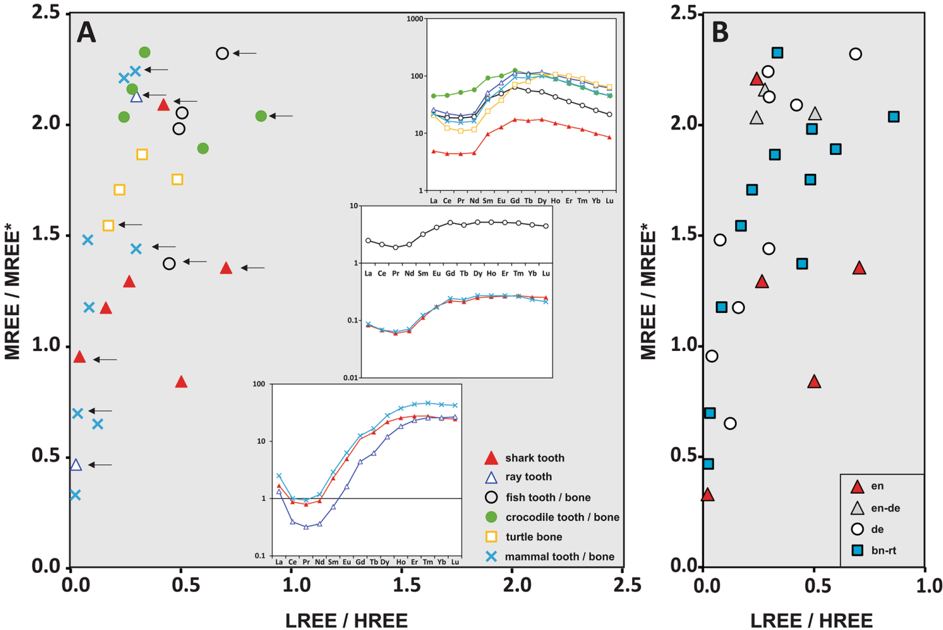
“The PAAS-normalized REE patterns and REE ratios (Fig. 3) show a trend between a middle REE-enriched and light REE-depleted patterns.”
§ Geochemical investigation of the mixed Máriahalom vertebrate fauna at the Paleogene-Neogene boundary in the Central Paratethys: environmental conditions and age constrain > Rare earth element taphonomy
plainstates an association- Asserted: passes — The authors put it forward as true.
- Checkable: passes — It can be checked against evidence.
- Load-bearing: passes — The paper’s conclusions depend on it.
- Based: passes — The paper gives a reason why it holds.
72 more claims
Create a free account to see all 159 claims and to verify the 111 references still open.
- It may state two separate claims as one. 65
- Probably not a substantial claim. 24
- The quote only partly states this claim. 1
Self-check
Percentages, sums and reported differences re-computed from the paper’s own numbers.
Each contradiction between two passages listed here was confirmed by an independent check.
Rated minor: it would not touch a result — a value no result rests on, a p-value that stays on the same side of the significance level, or a conflict that is clerical, resolved elsewhere in the paper, or outside its own findings.
In the paper
§ Geochemical investigation of the mixed Máriahalom vertebrate fauna at the Paleogene-Neogene boundary in the Central Paratethys: environmental conditions and age constrain > Rare earth element taphonomy
“The PAAS-normalized REE patterns and REE ratios (Fig. 3) show a trend between a middle REE-enriched and light REE-depleted patterns.”
§ Geochemical investigation of the mixed Máriahalom vertebrate fauna at the Paleogene-Neogene boundary in the Central Paratethys: environmental conditions and age constrain > Strontium isotope ratios and related screening methods
“Fig. 3 Oxygen isotope composition of select vertebrate fossils from the Máriahalom site as a function of water isotopic composition.”
Rated minor: it would not touch a result — a value no result rests on, a p-value that stays on the same side of the significance level, or a conflict that is clerical, resolved elsewhere in the paper, or outside its own findings.
In the paper
§ Geochemical investigation of the mixed Máriahalom vertebrate fauna at the Paleogene-Neogene boundary in the Central Paratethys: environmental conditions and age constrain > Age of the Máriahalom site
“Another shark enameloid yielded somewhat higher Sr isotope ratios (i.e.younger age of 20.6 Ma-Fig.5), that may reflect minor alteration of its 87 Sr/ 86 Sr ratio.”
§ Geochemical investigation of the mixed Máriahalom vertebrate fauna at the Paleogene-Neogene boundary in the Central Paratethys: environmental conditions and age constrain > Conclusions
“Fig. 5 Temporal range of different mammalian taxa discovered from the Máriahalom site based on the literature and the new data mentioned in this study.”
Citations
Cites
Trends, Rhythms, and Aberrations in Global Climate 65 Ma to Present
Zachos, J., Pagani, M., Sloan, L., Thomas, E., & Billups, K. (2001) · Science · doi:10.1126/science.1059412 · Cited by 10,458
Stable isotopes in precipitation
Dansgaard, W. (1964) · Tellus · doi:10.1111/j.2153-3490.1964.tb00181.x · Cited by 8,369
Proceedings of the Biological Society of Washington
(2019) · Proceedings of the Biological Society of Washington · doi:10.2988/pbsw · Cited by 3,702
Variation of seawater 87Sr/86Sr throughout Phanerozoic time
Burke, W. H., Denison, R. E., Hetherington, E. A., Koepnick, R. B., Nelson, H. F., & Otto, J. B. (1982) · Geology · doi:10.1130/0091-7613(1982)10<516:vosstp>2.0.co;2 · Cited by 1,542
McArthur, J. M., Howarth, R. J., & Bailey, T. R. (2001) · The Journal of Geology · doi:10.1086/319243 · Cited by 1,485
Zoological Journal of the Linnean Society
(2017) · Zoological Journal of the Linnean Society · doi:10.1111/(issn)1096-3642 · Cited by 1,417
Cenozoic Deep-Sea Temperatures and Global Ice Volumes from Mg/Ca in Benthic Foraminiferal Calcite
Lear, C. H., Elderfield, H., & Wilson, P. A. (2000) · Science · doi:10.1126/science.287.5451.269 · Cited by 1,098
Elderfield, H., Upstill-Goddard, R., & Sholkovitz, E. R. (1990) · Geochimica et Cosmochimica Acta · doi:10.1016/0016-7037(90)90432-k · Cited by 1,080
Longinelli, A. (1984) · Geochimica et Cosmochimica Acta · doi:10.1016/0016-7037(84)90259-x · Cited by 1,041
LITHOLOGICAL -PALEOGEOGRAPHIC MAPS OF PARATETHYS
Попов, С. В., Rögl, F., Rozanov, A. Y., Steininger, F. F., Shcherba, I. G., & Kováč, M. (2004) · Cited by 930
Research works printed but not linked: 21
- Báld, T. (1967). A Mány-Zsámbéki-Medence Felsőoligocén Makrofaunája. Földtani Közlöny, 97, 437-446.
- Báldi, T., Less, G., & Mandic, O. (1999). Some new aspects of the lower boundary of the Egerian stage (Oligocene, chonostratigraphic scale of Parateth- yan area). Abhandlungen Der Geologischen Bundesanstalt, 56, 653-668.
- Compagno, L. J. V., Dando, M., & Fowler, S. (2005). Sharks of the world. Harper Collins Publishers.
- Gradstein, F. M., Ogg, J. G., Schmitz, M. D., & Ogg, G. M. (2020). A geologic time scale 2020. Elsevier B.V.
- Gradstein, F. M., Ogg, J. G., Schmitz, M. D., & Ogg, G. M. (2020). A geologic time scale 2020. Elsevier B.V. Hably, L. (1988). Egerian fossils flora from Kesztölc, NW Hungary. Studia Botanica Hungarica, 22, 3-78.
- Hably, L. (1994). Egerian plant fossils from Pomáz, Hungary. Fragmenta Mineral- ogica Et Palaeontologica, 17, 5-70.
- Janssen, A. W. (1982). Late Oligocene molluscs from a sand-pit near Máriaha- lom (Hungary). A preliminary study. Annales Universitatis Scientiarum Sectio Geologica, 14, 109-150.
- Kirby, M. X. (2001). Differences in growth rate and environment between tertiary and quaternary Crassostrea oysters. Paleobiology, 27(1), 84-103. · doi:10.1666/0094-8373(2001)027<0084:digrae>2.0.co;2
- Koenigswald, W. v., (2020). Construction and wear of mammalian teeth in terms of heterochrony. In T. Martin & W. v. Koenigswald (Eds.), Mam- malian Teeth -Form and Function (pp. 171-186). München, Verlag Dr. Friedrich Pfeil. -https:// doi. org/ 10. 23788/ mammt eeth. 09 · doi:10.23788/mammteeth.09
- Lihoreau, F., & Ducrocq, S. (2007). Family anthtacothere. In D. R. Prothero & S. E. Foss (Eds.), The evolution of artiodactyls (pp. 89-105). Johns Hopkins University Press.
- Mödden, C., & Wolsan, M. (1993). Potamotherium valletoni (Mammalia: Car- nivora) aus dem Untermiozän von Wiesbaden-Amöneburg im Mainzer Becken. Mainzer Naturwissenschaftlicher Archiv, 31, 215-221.
- Nagel, D. (2003). Carnivora from the middle Miocene hominoid locality of Çandir (Turkey). Courier Forschungsinstitut Senckenberg, 240, 113-131.
- Nagymarosy, A. (2012). Paratethys evolution and its consequences for the Paleogene-neogene Chronostratigrapic framework. In J. Haas (Ed.), Geology of Hungary (pp. 81-99). Springer.
- Nagymarosy, A., & Gyalog, L. (1997). Mány formation. In G. Császár (Ed.), Basic litostratigraphic units of Hungary (pp. 14-15). The Geological Institute of Hungary.
- Törökbálinti Formáció. In Babinszki et al. (Eds.), Magyarország litosztratigráfiai egy- ségeinek leírása II. Kainozoos képződmények. (Lithostratigraphic units of Hungary II. -Cenozoic) (pp. 40), Budapest, SZTFH.
- O'Neil, J. R., Roe, L. J., Reinhard, E., & Blake, R. E. (1994). A rapid and precise method of oxygen isotope analysis of biogenic phosphate. Israel Jour- nal of Earth Sciences, 43, 203-212.
- Rögl, F. (1998). Paleogeographic consideration for Mediterranean and Para- tethys seaways (Oligocene to Miocene). Annalen Des Naturhistorischen Museums in Wien, 99A, 279-310.
- Sabău, I., Venczel, M., Codrea, V. A., & Bordeianu, M. (2021). Diplocynodon: A salt water Eocene crocodile from Transylvania? North-Western Journal of Zoology, 17(1), 117-121.
- Sztanó, O., Magyari, Á., & Nagymarosy, A. (1998). High-resolution stratigraphy in the Esztergom Basin, northeastern Transdanubia, Hungary: II. Oligocene sequences and their interpretation. Földtani Közlöny, 128, 455-486.
- Telegdi-Roth, K. (1927). Spuren einer infraoligozanen denudation am nord- westlichen range des Transdanubischen Mittelgebirge. Földtani Közlöny, 57, 117-128.
- Tütken, T. (2003). Die Bedeutung der Knochenfrühdiagenese für die Erhaltungs- fähigkeitin vivo erworbener Element-und Isotopen zusammensetzungen in fossilen Knochen. (Ph.D.-thesis). Naturwissenschaften der Geowissen- schaftlichen Fakultätder Eberhard-Karls-Universität Tübingen, Germany.
Cited by
Walter, J., Massonne, T., Paiva, A. L. S., Martin, J. E., Delfino, M., & Rabi, M. (2025) · Communications Biology · doi:10.1038/s42003-025-07653-4 · Cited by 14
Self-citationGórka, M., Březina, J., Chroust, M., Kowalski, R., López‐Torres, S., & Tałanda, M. (2025) · Acta Palaeontologica Polonica · doi:10.4202/app.01194.2024 · Cited by 11
Ullmann, P. V., Caputo, C., Snyder, K., Chadwick, A. V., & Ash, R. D. (2024) · Chemical Geology · doi:10.1016/j.chemgeo.2024.122501 · Cited by 5
New records of fossil bird bones from the Neogene in Hungary
Horváth, I. (2025) · Zootaxa · doi:10.11646/zootaxa.5627.2.5 · Cited by 2
Sanyal, A., & Ray, S. (2025) · Gondwana Research · doi:10.1016/j.gr.2025.11.020 · Cited by 1
Metadata
- Authors
- Kocsis, L., Rabi, M., Ulianov, A., Cipriani, A., Farkas, I. M., & Botfalvai, G.
- Affiliations
- University of Lausanne (CH)
- Martin Luther University Halle-Wittenberg (DE)
- University of Modena and Reggio Emilia (IT)
- MOL Group (Hungary) (HU)
- Eötvös Loránd University (HU)
- Corresponding author
- Kocsis, László
- Venue
- Swiss Journal of Palaeontology
- Publisher
- Pensoft Publishers
- Published
- 2023-08-23
- Volume
- 142
- Issue
- 1
- Pages
- 17
- ISSN
- 1664-2376 (ISSN-L)
- 1664-2384
- OpenAlex
- W4386099813
- Cited by
- 6
- References
- 126
- Citations by year
- 2026: 1 · 2025: 4 · 2024: 1
- FWCI
- 0.93
- Type
- journal article
- Language
- en
- Open access
- gold
- doi.org
- Licence
- cc-by
- creativecommons.org/licenses/by/4.0 (tdm)
- creativecommons.org/licenses/by/4.0 (vor)
- Locations
- Swiss Journal of Palaeontology (publishedVersion, cc-by)
- SERVAL (Université de Lausanne) (publishedVersion, cc-by)
- Repository of the Academy's Library (Library of the Hungarian Academy of Sciences) (acceptedVersion, other-oa)
- IRIS UNIMORE (University of Modena and Reggio Emilia) (submittedVersion, cc-by)
- DOAJ (DOAJ: Directory of Open Access Journals) (submittedVersion)
- IRIS (submittedVersion, cc-by)
- Zenodo (CERN European Organization for Nuclear Research) (submittedVersion, cc-by)
- Funders
- Hungarian National Research, Development and Innovation Office (NKFIH/OTKA PD 131557)
- University of Lausanne
- Topics
- Physical Sciences › Earth and Planetary Sciences › Paleontology › Paleontology and Stratigraphy of Fossils
- Physical Sciences › Earth and Planetary Sciences › Paleontology › Evolution and Paleontology Studies
- Physical Sciences › Earth and Planetary Sciences › Paleontology › Paleontology and Evolutionary Biology
- Keywords
- Central Paratethys, rare earth elements, fossil provenance, early diagenesis, stable oxygen isotopes, phosphate oxygen isotopes, strontium isotope dating, anthracotheres, Aquitanian, fossil reworking, fossilization, fossil mammals, crocodiles, elasmobranchs
About these checks
Registry, retraction, Cites and statistics results are computed, not judged, with one exception: a printed reference that no index lists is read once by a model before it counts as a citation error. Claims are extracted by a model and kept only when their quote appears verbatim in the text; each cited source is then checked, with a model’s help, for whether it says what the claim relies on. Those verdicts can be wrong — read the claim’s quote and the cited source before relying on one.
A language model drew the claims from the paper on 2026-11-23, under version 3 of the claim definition (model deepseek-v4.1-flash, prompt extract-v3).
A second model labelled each claim on 2026-11-23 (model jev-1.13-20260917, definition revision gold-guideline-v0.2).
Statistics and arithmetic are recomputed, not judged.
Confidence bands are shown only for fields calibrated on our annotated test set. None is calibrated yet, so no band is shown.
What counts as a claim ›How we measure confidence ›How we check this ›
Are you an author, or do you see a problem with this page? Request a review
How to cite
Cite CoChat for the checks on this page, and the paper for its own findings.
- This page
- CoChat. (2026). Citation check: Geochemical investigation of the mixed Máriahalom vertebrate fauna at the Paleogene–Neogene boundary in the Central Paratethys: environmental conditions and age constrain. https://app.cochat.ai/papers/10.1186/s13358-023-00281-7
- The paper
- Kocsis, L., Rabi, M., Ulianov, A., Cipriani, A., Farkas, I. M., & Botfalvai, G. (2023). Geochemical investigation of the mixed Máriahalom vertebrate fauna at the Paleogene–Neogene boundary in the Central Paratethys: environmental conditions and age constrain. Swiss Journal of Palaeontology. https://doi.org/10.1186/s13358-023-00281-7
Data sources
Bibliographic data: Semantic Scholar, OpenAlex, Crossref.
Contains information from the Semantic Scholar Academic Graph Datasets, made available under the ODC Attribution License (ODC-BY 1.0).
Semantic Scholar’s data is described in: Kinney, R., et al. (2023). The Semantic Scholar Open Data Platform. arXiv:2301.10140.
