

Zinc uptake system ZnuACB is essential for maintaining pathogenic phenotype of F4ac+ enterotoxigenic E. coli (ETEC) under a zinc restricted environment
Open accessThe DOI matches its Crossref record; 39 of the 39 references it cites were found in a registry or an index.
Abstract
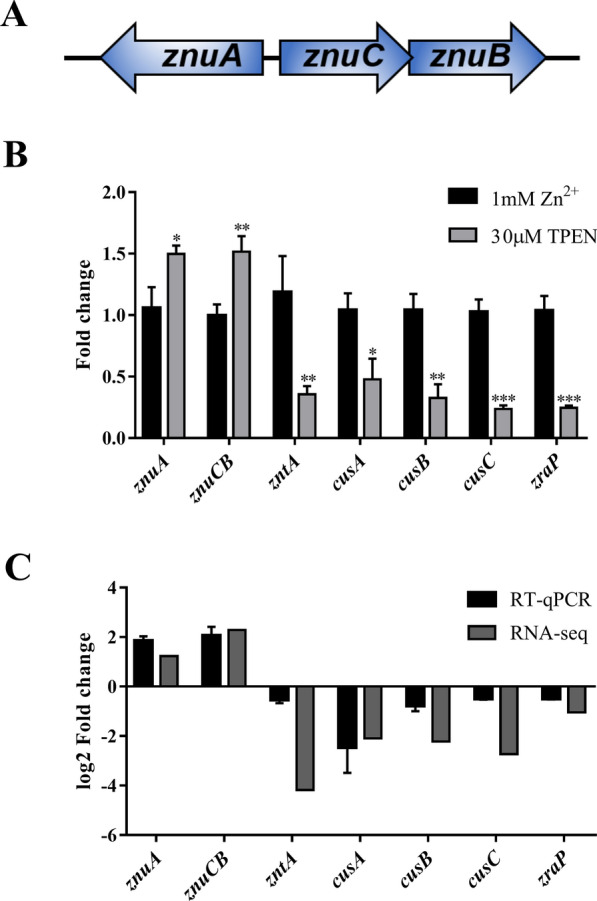
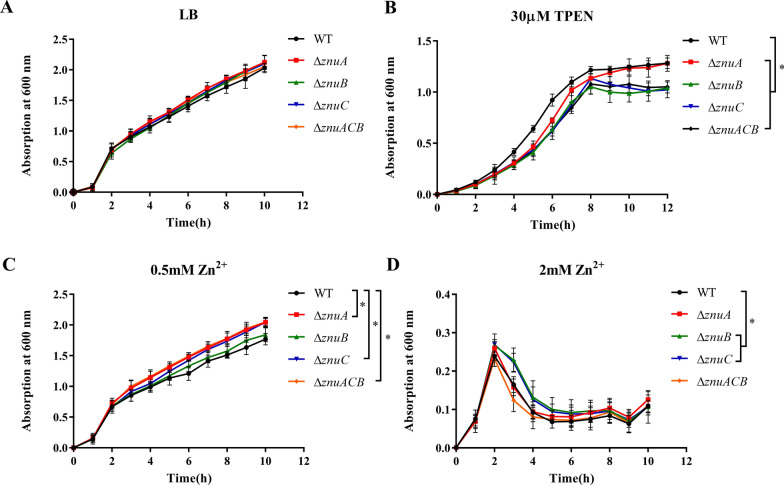
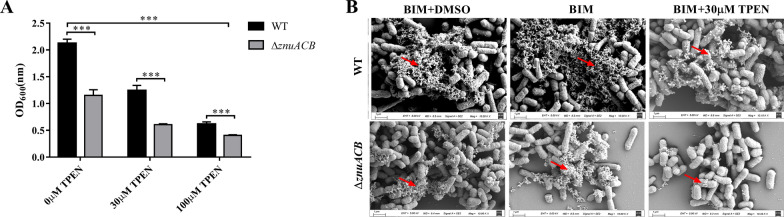
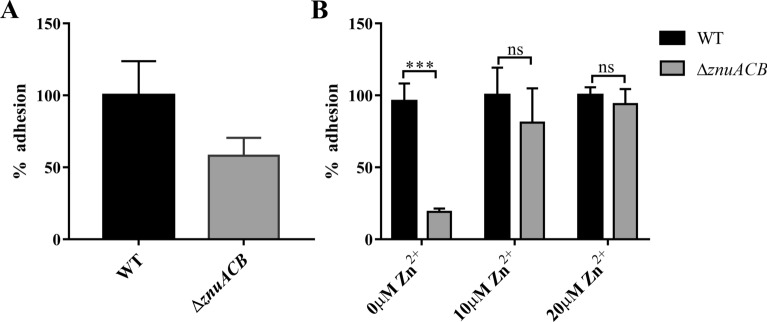
Zinc is the second trace element of living organisms after iron. Given its crucial importance, mammalian hosts restrict the bioavailability of Zinc ions (Zn 2+) to bacterial pathogens. As a countermeasure, pathogens utilize high affinity Zn 2+ transporters, such as ZnuACB to compete with the host for zinc. It is essential for bacteria to maintain zinc homeostasis and thus maintain their physiology and pathogenesis. In an attempt to uncover the zinc transporter in F4+ enterotoxigenic E. coli (ETEC) C83902, we analyzed two RNA-seq data sets of bacteria samples when different zinc treatments (restriction or abundance) were applied. Considering data revealing that the high affinity zinc uptake system ZnuACB acts as the main transporter in ETEC C83902 to resist zinc deficiency, we deleted znuACB genes to study the role of them in ETEC C83902. The deletion of znuACB genes results in growth perturbation and a sharp decrease in the ability of biofilm formation and adhesion of bacteria in vitro. Taking the data together, this study demonstrates that the ZnuACB system is required for ETEC C83902 to acquire zinc, which highly contributes to ETEC pathogenicity as well.
Overview
The claims and statistics of this paper haven’t been checked yet.
Free: it reads the open-access text and checks the first 5 claims that cite a source we can check. Create a free account to check every claim.
Integrity signals
Registry
Cites
Statistics
Figures
Verification
Claims the paper makes
The claims and statistics of this paper haven’t been checked yet.
Free: it reads the open-access text and checks the first 5 claims that cite a source we can check. Create a free account to check every claim.
Self-check
Percentages, sums and reported differences re-computed from the paper’s own numbers.
The self-check needs the paper’s full text.
Citations
Cites
Nutritional immunity: transition metals at the pathogen–host interface
Hood, M. I., & Skaar, E. P. (2012) · Nature Reviews Microbiology · doi:10.1038/nrmicro2836 · Cited by 1,535
Metal Chelation and Inhibition of Bacterial Growth in Tissue Abscesses
Corbin, B. D., Seeley, E. H., Raab, A., Feldmann, J., Miller, M. R., Torres, V. J., Anderson, K. L., Dattilo, B. M., Dunman, P. M., Gerads, R., et al. (2008) · Science · doi:10.1126/science.1152449 · Cited by 857
Zinc and its role in immunity and inflammation
Bonaventura, P., Benedetti, G., Albarède, F., & Miossec, P. (2015) · Autoimmunity Reviews · doi:10.1016/j.autrev.2014.11.008 · Cited by 798
Antimicrobial psoriasin (S100A7) protects human skin from Escherichia coli infection
Gläser, R., Harder, J., Lange, H., Bartels, J., Christophers, E., & Schröder, J.-M. (2005) · Nature Immunology · doi:10.1038/ni1142 · Cited by 651
Molecular Analysis of the Copper-Transporting Efflux System CusCFBA of Escherichia coli
Franke, S., Grass, G., Rensing, C., & Nies, D. H. (2003) · Journal of Bacteriology · doi:10.1128/jb.185.13.3804-3812.2003 · Cited by 538
Dufner-Beattie, J., Wang, F., Kuo, Y.-M., Gitschier, J., Eide, D., & Andrews, G. K. (2003) · Journal of Biological Chemistry · doi:10.1074/jbc.m305000200 · Cited by 302
Zamharir, M. G., Mardi, M., Alavi, S. M., Hasanzadeh, N., Nekouei, M. K., Zamanizadeh, H. R., Alizadeh, A., & Salekdeh, G. H. (2011) · BMC Microbiology · doi:10.1186/1471-2180-11-1 · Cited by 274
Ammendola, S., Pasquali, P., Pistoia, C., Petrucci, P., Petrarca, P., Rotilio, G., & Battistoni, A. (2007) · Infection and Immunity · doi:10.1128/iai.00559-07 · Cited by 235
Bacterial zinc transporters and regulators
Hantke, K. (2001) · Biometals · doi:10.1023/a:1012984713391 · Cited by 187
Bacterial Strategies to Maintain Zinc Metallostasis at the Host-Pathogen Interface
Capdevila, D. A., Wang, J., & Giedroc, D. P. (2016) · Journal of Biological Chemistry · doi:10.1074/jbc.r116.742023 · Cited by 181
The Role of Zinc and Zinc Homeostasis in Macrophage Function
Gao, H., Dai, W., Zhao, L., Min, J., & Wang, F. (2018) · Journal of Immunology Research · doi:10.1155/2018/6872621 · Cited by 169
Achouiti, A., Vogl, T., Urban, C. F., Röhm, M., Hommes, T. J., van Zoelen, M. A. D., Florquin, S., Roth, J., van 't Veer, C., de Vos, A. F., et al. (2012) · PLoS Pathogens · doi:10.1371/journal.ppat.1002987 · Cited by 135
Sabri, M., Houle, S., & Dozois, C. M. (2009) · Infection and Immunity · doi:10.1128/iai.01082-08 · Cited by 118
Davis, L. M., Kakuda, T., & DiRita, V. J. (2009) · Journal of Bacteriology · doi:10.1128/jb.01394-08 · Cited by 118
Influence of ZIP14 (slc39A14) on intestinal zinc processing and barrier function
Guthrie, G. J., Aydemir, T. B., Troche, C., Martin, A. B., Chang, S.-M., & Cousins, R. J. (2015) · American Journal of Physiology-Gastrointestinal and Liver Physiology · doi:10.1152/ajpgi.00021.2014 · Cited by 115
ZntR-mediated transcription of zntA responds to nanomolar intracellular free zinc
Wang, D., Hosteen, O., & Fierke, C. A. (2012) · Journal of Inorganic Biochemistry · doi:10.1016/j.jinorgbio.2012.02.008 · Cited by 113
Gabbianelli, R., Scotti, R., Ammendola, S., Petrarca, P., Nicolini, L., & Battistoni, A. (2011) · BMC Microbiology · doi:10.1186/1471-2180-11-36 · Cited by 102
Zinc Transporter SLC39A7/ZIP7 Promotes Intestinal Epithelial Self-Renewal by Resolving ER Stress
Ohashi, W., Kimura, S., Iwanaga, T., Furusawa, Y., Irié, T., Izumi, H., Watanabe, T., Hijikata, A., Hara, T., Ohara, O., et al. (2016) · PLOS Genetics · doi:10.1371/journal.pgen.1006349 · Cited by 100
A P-type ATPase importer that discriminates between essential and toxic transition metals
Lewinson, O., Lee, A. T., & Rees, D. C. (2009) · Proceedings of the National Academy of Sciences · doi:10.1073/pnas.0900666106 · Cited by 98
Mastropasqua, M. C., D'Orazio, M., Cerasi, M., Pacello, F., Gismondi, A., Canini, A., Canuti, L., Consalvo, A., Ciavardelli, D., Chirullo, B., et al. (2017) · Molecular Microbiology · doi:10.1111/mmi.13834 · Cited by 94
Yang, X., Becker, T., Walters, N., & Pascual, D. W. (2006) · Infection and Immunity · doi:10.1128/iai.01957-05 · Cited by 90
Zinc Homeostasis at the Bacteria/Host Interface—From Coordination Chemistry to Nutritional Immunity
Wątły, J., Potocki, S., & Rowińska‐Żyrek, M. (2016) · Chemistry – A European Journal · doi:10.1002/chem.201602376 · Cited by 82
Duan, Q., Zhou, M., Zhu, X., Bao, W., Wu, S., Ruan, X., Zhang, W., Yang, Y., Zhu, J., & Zhu, G. (2012) · Veterinary Microbiology · doi:10.1016/j.vetmic.2012.05.015 · Cited by 63
Self-citationS100A12 in Digestive Diseases and Health: A Scoping Review
Carvalho, A., Lu, J., Francis, J. D., Moore, R. E., Haley, K. P., Doster, R. S., Townsend, S. D., Johnson, J. G., Damo, S. M., & Gaddy, J. A. (2020) · Gastroenterology Research and Practice · doi:10.1155/2020/2868373 · Cited by 54
Dual Zinc Transporter Systems in Vibrio cholerae Promote Competitive Advantages over Gut Microbiome
Sheng, Y., Fan, F., Jensen, O., Zhong, Z., Kan, B., Wang, H., & Zhu, J. (2015) · Infection and Immunity · doi:10.1128/iai.00447-15 · Cited by 49
Zhou, M., Duan, Q., Zhu, X., Guo, Z., Li, Y., Hardwidge, P. R., & Zhu, G. (2013) · Veterinary Research · doi:10.1186/1297-9716-44-30 · Cited by 48
Self-citationZhou, M., Guo, Z., Yang, Y., Duan, Q., Zhang, Q., Yao, F., Zhu, J., Zhang, X., Hardwidge, P. R., & Zhu, G. (2013) · Veterinary Microbiology · doi:10.1016/j.vetmic.2013.10.014 · Cited by 46
Self-citationCoordinated Zinc Homeostasis Is Essential for the Wild-Type Virulence of Brucella abortus
Sheehan, L. M., Budnick, J. A., Roop, R. M., & Caswell, C. C. (2015) · Journal of Bacteriology · doi:10.1128/jb.02543-14 · Cited by 39
Mastropasqua, M. C., Lamont, I., Martin, L. W., Reid, D. W., D’Orazio, M., & Battistoni, A. (2018) · Journal of Trace Elements in Medicine and Biology · doi:10.1016/j.jtemb.2018.03.009 · Cited by 38
Fitzsimmons, L. F., Liu, L., Porwollik, S., Chakraborty, S., Desai, P., Tapscott, T., Henard, C. A., McClelland, M., & Vázquez‐Torres, A. (2018) · PLoS Pathogens · doi:10.1371/journal.ppat.1007388 · Cited by 38
Receptor for the F4 fimbriae of enterotoxigenic Escherichia coli (ETEC)
Xia, P., Zou, Y., Wang, Y., Song, Y., Liu, W., Francis, D. H., & Zhu, G. (2015) · Applied Microbiology and Biotechnology · doi:10.1007/s00253-015-6643-9 · Cited by 34
Self-citationAmmendola, S., D'Amico, Y., Chirullo, B., Drumo, R., Ciavardelli, D., Pasquali, P., & Battistoni, A. (2016) · Metallomics · doi:10.1039/c6mt00108d · Cited by 33
Gunasekera, T. S., Herre, A. H., & Crowder, M. W. (2009) · FEMS Microbiology Letters · doi:10.1111/j.1574-6968.2009.01762.x · Cited by 26
Porcine aminopeptidase N binds to F4+ enterotoxigenic Escherichia coli fimbriae
Xia, P., Wang, Y., Zhu, C., Zou, Y., Yang, Y., Liu, W., Hardwidge, P. R., & Zhu, G. (2016) · Veterinary Research · doi:10.1186/s13567-016-0313-5 · Cited by 22
Self-citationvan der Weel, L., As, K., Dekker, W. J. C., van den Eijnden, L., van Helmond, W., Schiphorst, C., Hagen, W. R., & Hagedoorn, P. (2018) · Journal of Inorganic Biochemistry · doi:10.1016/j.jinorgbio.2018.12.013 · Cited by 17
Xia, P., Quan, G., Yang, Y., Zhao, J., Wang, Y., Zhou, M., Hardwidge, P. R., Zhu, J., Liu, S., & Zhu, G. (2018) · Veterinary Research · doi:10.1186/s13567-018-0519-9 · Cited by 14
Self-citationCrystal structure of E. coli ZinT with one zinc-binding mode and complexed with citrate
Chen, J., Wang, L., Shang, F., Dong, Y., Ha, N., Nam, K. H., Quan, C., & Xu, Y. (2018) · Biochemical and Biophysical Research Communications · doi:10.1016/j.bbrc.2018.03.192 · Cited by 12
Oropeza-Moe, M., Grøntvedt, C. A., Phythian, C. J., Sørum, H. R., Fauske, A. K., & Framstad, T. (2017) · Porcine Health Management · doi:10.1186/s40813-017-0060-7 · Cited by 8
Roop, R. M. (2017) · Journal of Bacteriology · doi:10.1128/jb.00694-17 · Cited by 1 · cited 2×
“ZupT is the primary zinc acquisition transporter in environmental Francisella, however, it is not zupT but ZnuA that plays a crucial role in zinc uptake in virulent Francisella [34].”
Background
Cited by
Nutritional immunity: the battle for nutrient metals at the host–pathogen interface
Murdoch, C. C., & Skaar, E. P. (2022) · Nature Reviews Microbiology · doi:10.1038/s41579-022-00745-6 · Cited by 701
Zinc is an important inter-kingdom signal between the host and microbe
Xia, P., Lian, S., Wu, Y., Yan, L., Quan, G., & Zhu, G. (2021) · Veterinary Research · doi:10.1186/s13567-021-00913-1 · Cited by 69
“coli (ETEC) F4ac plays an important role in maintaining the formation of biofilms and adherence to porcine small intestinal epithelial cells in vitro under zinc deficiency [31].”
BackgroundSelf-citationExpanding the genomic encyclopedia of Actinobacteria with 824 isolate reference genomes
Seshadri, R., Roux, S., Huber, K. J., Wu, D., Yu, S., Udwary, D., Call, L., Nayfach, S., Hahnke, R. L., Pukall, R., et al. (2022) · Cell Genomics · doi:10.1016/j.xgen.2022.100213 · Cited by 75
Adhikary, S., Saha, J., Dutta, P., & Pal, A. (2024) · Geomicrobiology Journal · doi:10.1080/01490451.2024.2340517 · Cited by 57
Rebalancing the unbalanced aged immune system – A special focus on zinc
Baarz, B. R., & Rink, L. (2021) · Ageing Research Reviews · doi:10.1016/j.arr.2021.101541 · Cited by 41
Metadata
- Authors
- Quan, G., Xia, P., Lian, S., Wu, Y., & Zhu, G.
- Affiliations
- Yangzhou University (CN)
- Corresponding author
- Xia, Pengpeng
- Zhu, Guoqiang
- Venue
- Veterinary Research
- Published
- 2020-10-07
- Volume
- 51
- Issue
- 1
- Pages
- 127-127
- ISSN
- 0928-4249 (ISSN-L)
- 1297-9716
- PMC
- PMC7539401
- OpenAlex
- W3091845297
- Cited by
- 22
- References
- 39
- Citations by year
- 2026: 4 · 2025: 5 · 2024: 2 · 2023: 2 · 2022: 6 · 2021: 3
- FWCI
- 1.70
- Type
- journal article
- Language
- en
- Open access
- gold
- doi.org
- Licence
- cc-by
- creativecommons.org/licenses/by/4.0 (tdm)
- creativecommons.org/licenses/by/4.0 (vor)
- Locations
- Veterinary Research (publishedVersion, cc-by)
- PubMed Central (publishedVersion, cc-by)
- PubMed (publishedVersion)
- HAL (submittedVersion, other-oa)
- DOAJ (DOAJ: Directory of Open Access Journals) (submittedVersion, cc-by-sa)
- Funders
- National Natural Science Foundation of China (31702242, 31672579, 30571374, 30771603, 31072136, 31270171)
- National Key Research and Development Program of China (2017YFD0500105, 2016YFD0500905, 2017YFD0500203)
- Postgraduate Research &Practice Innovation Program of Jiangsu Province (XKYCX18_105)
- Topics
- Life Sciences › Immunology and Microbiology › Microbiology › Escherichia coli research studies
- Life Sciences › Biochemistry, Genetics and Molecular Biology › Genetics › Bacterial Genetics and Biotechnology
- Health Sciences › Nursing › Nutrition and Dietetics › Trace Elements in Health
- Keywords
- zinc uptake, enterotoxigenic Escherichia coli, zinc homeostasis, zinc deficiency, bacterial pathogenicity, biofilm formation, bacterial adhesion
- MeSH terms
- Escherichia coli Infections, Phenotype, Zinc, Enterotoxigenic Escherichia coli
About these checks
Registry, retraction, Cites and statistics results are computed, not judged, with one exception: a printed reference that no index lists is read once by a model before it counts as a citation error. Claims are extracted by a model and kept only when their quote appears verbatim in the text; each cited source is then checked, with a model’s help, for whether it says what the claim relies on. Those verdicts can be wrong — read the claim’s quote and the cited source before relying on one.
Statistics and arithmetic are recomputed, not judged.
Confidence bands are shown only for fields calibrated on our annotated test set. None is calibrated yet, so no band is shown.
What counts as a claim ›How we measure confidence ›How we check this ›
Are you an author, or do you see a problem with this page? Request a review
Data sources
Bibliographic data: Semantic Scholar, OpenAlex, Crossref.
Contains information from the Semantic Scholar Academic Graph Datasets, made available under the ODC Attribution License (ODC-BY 1.0).
Semantic Scholar’s data is described in: Kinney, R., et al. (2023). The Semantic Scholar Open Data Platform. arXiv:2301.10140.
