

The DOI matches its Crossref record; 47 of the 49 references it cites were found in a registry or an index; none of the 109 sources its claims cite is checked for support yet.
Household preparedness motivation in lahar hazard zones: assessing the adoption of preparedness behaviors among laypeople and response professionals in communities downstream from Mount Baker and Glacier Peak (USA) volcanoes
Open accessAbstract
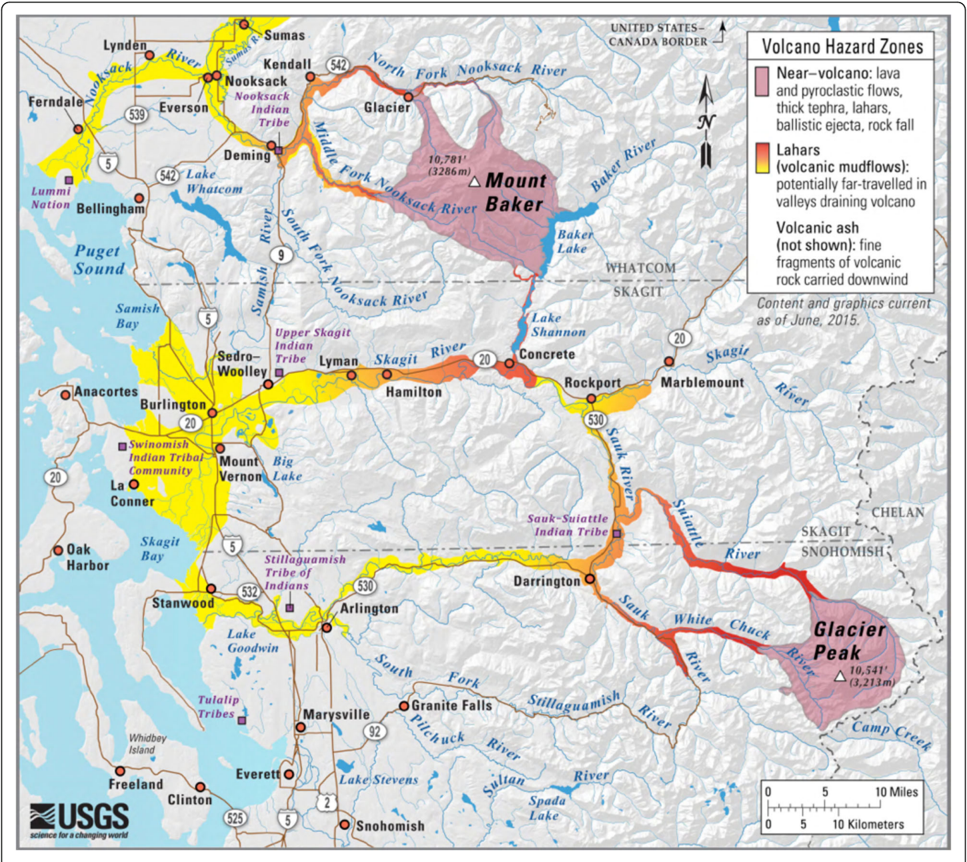
As the number of people living at risk from volcanic hazards in the U.S. Pacific Northwest grows, more detailed studies of household preparedness in at-risk communities are needed to develop effective mitigation, response, and recovery plans. This study examines two aspects of preparedness behavior motivation in the Skagit Valley (WA), which is at risk from Mount Baker and Glacier Peak lahars. First, we examine the influence of perceived response-efficacy, protective response costs, self-efficacy, and ascription of responsibility on preparedness. Results indicate few respondents believe high perceived protective response costs, low perceived response-efficacy, or low perceived protection responsibility prevent them from adopting frequently recommended preparedness behaviors. Correlations with preparedness suggest perceived self-efficacy and ascription of responsibility play a more dominant role in determining preparedness behaviors, albeit a less readily recognized role. Second, we investigate how participation in hazard management at a professional level (e.g., working as a first responder or leader within the local city government, hospitals, school districts, Red Cross, or utilities, transportation, or water companies) influences knowledge, risk perception, and household preparedness. Results show that professional participation minimally influences household preparedness, but successfully improves perceived self-efficacy, confidence in officials, and information seeking behavior. Given these results, we argue (1) for inclusion of ascription of responsibility variables in studies of preparedness behavior motivation and (2) that specific types of participation in response-related activities (e.g., public, professional, specific training programs) may affect household preparedness differently, whereas self-efficacy and confidence in officials may improve regardless of participation type because of increased interaction with emergency officials.
Overview
CoChat Summary
Written by AI from the paper’s full text.
TL;DR
This survey of Skagit Valley residents and response professionals finds that perceived self-efficacy and ascription of responsibility, rather than perceived response-efficacy or protective response costs, correlate with household lahar preparedness. Professional hazard-management participation improves self-efficacy, confidence in officials, and information seeking but minimally improves household preparedness or hazard-map knowledge.
Key findings
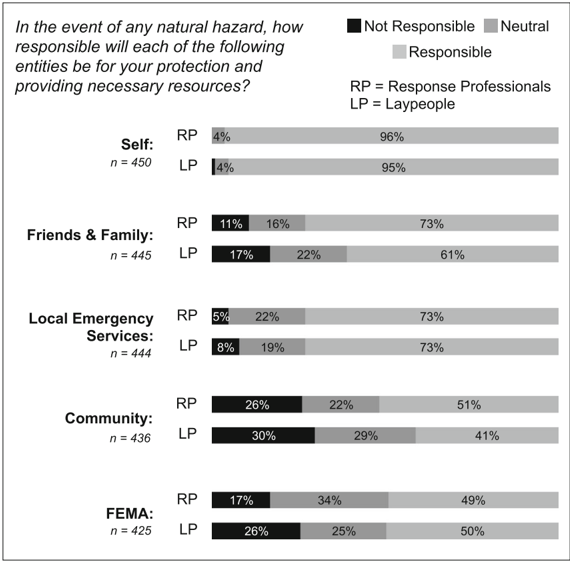
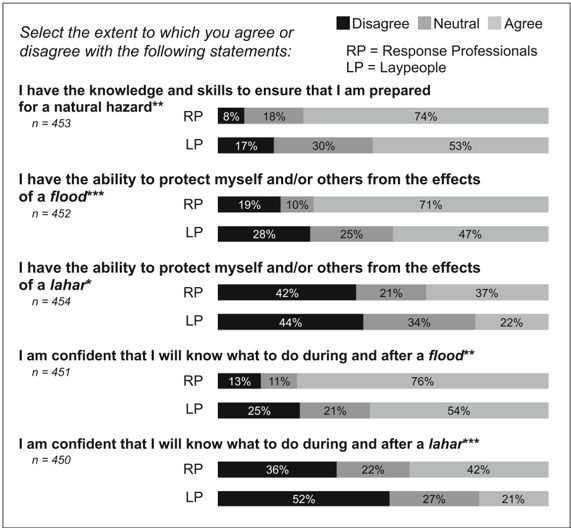
- Few respondents endorsed proposed barriers: lack of hazard knowledge 35%, lack of preparedness knowledge 28%, cost 26%, time 23%; low response-efficacy (“items will not help me protect myself”) 7%, reliance on neighbors/community members 6%, reliance on emergency services 3%. Self-efficacy and responsibility correlated with preparedness: self responsibility ρ = 0.19*, local emergency services ρ = −0.14, FEMA ρ = −0.14, and “knowledge and skills to ensure that I am prepared for a natural hazard” ρ = 0.43*.
- Response professionals (n = 73) had higher average composite preparedness (CP) scores than laypeople (n = 383): 0.17 vs −0.03 (p = 0.036), driven by the action indicator (0.21 vs −0.03, p = 0.042); planning and supplies indicator differences were not statistically significant. More professionals had a family member who learned first aid (+26%), knew vulnerable community members (+26%), sought local volcanic hazard information (+21%), identified a non-local emergency contact (+13%), and installed a smoke detector (+12%).
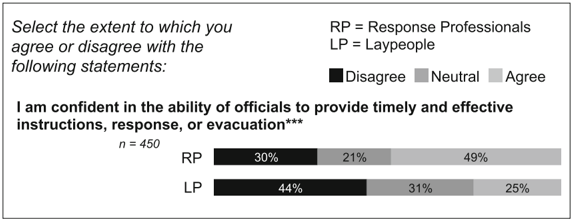
- Only 37% of response professionals and 45% of laypeople correctly identified only lahars as impacting the Skagit Valley (not statistically significant); about 60% of both groups correctly said the lahar hazard decreases downstream. Response professionals expressed greater confidence in officials and higher self-efficacy, with agreement on self-efficacy statements increasing by an average of 21% (range 15–24%) among professionals.
- Overall, respondents had prepared eight to nine recommended items on average; the most commonly prepared items were first aid kit (81%), non-electric can opener (78%), blanket or sleeping bag (75%), smoke detector (74%), and flashlight with extra batteries (71%). For planning and information seeking, 40% had a family contact plan, 46% had an out-of-area emergency contact, 63% had someone in the family who knows first aid, and only 25% had sought local volcanic hazard information, while over three-quarters were interested in learning more.
Methods
- An anonymous, voluntary online questionnaire was administered between August and December 2014 using non-random convenience sampling; 507 individuals living or working in the Skagit Valley participated. Recruitment included postcards, phone calls and emails, a newspaper article, and social media posts.
- The questionnaire assessed hazard knowledge, risk perception, preparedness behaviors, barriers, ascription of responsibility, and self-efficacy. Preparedness was measured from six activities and fourteen items grouped into supplies, planning, and action indicators; raw scores were standardized to z-scores and averaged into an equally weighted composite preparedness (CP) score.
- Data were analyzed in R version 3.3.2 using chi-square tests, t-tests, and Spearman’s rho correlations. Likert-type responses used a 5-point scale, with 1–2 and 4–5 rankings combined for chi-square tests.
Limitations
- Stated in the paper: the convenience sample lacks randomness, may suffer selection bias, and cannot yield a response rate; the questionnaire was English-only, likely underrepresenting Spanish-speaking residents (5.1% of adults in Skagit County speak Spanish or Spanish Creole at home); the online platform limited participation by those without computer access or literacy, including elderly and lower-socioeconomic-status residents; respondents with household incomes below $50,000 were underrepresented by 7%.
- Stated in the paper: the “response professionals” category combines varied occupations, limiting subgroup conclusions; demographic data on response professionals in the Skagit Valley were lacking; convenience sampling may overestimate participation effects because more engaged individuals may respond. The study also did not distinguish perceived from actual barriers and used a coarse grouping of preparedness measures.
- Evident in the text: the design is cross-sectional and self-report, with no independent verification of preparedness behaviors; findings come from one valley and two volcanoes, and the professional subgroup is small (n = 73), limiting detailed occupational comparisons.
Model-written summary. Check it against the paper before relying on it.
Integrity signals
Registry
Cites
Statistics
Figures
Verification
Claims the paper makes
74 Own result · 53 Own interpretation · 30 Sources not found · 28 No full text of the sources · 15 Own method · 10 Check pending · 8 Not checked yet · 5 No basis given
In the paper
“For the majority of respondents (77-62%), however, these four, frequently-cited barriers do not prevent further preparedness.”
§ Household preparedness motivation in lahar hazard zones: assessing the adoption of preparedness behaviors among laypeople and response professionals in communities downstream from Mount Baker and Glacier Peak (USA) volcanoes > Barriers to preparedness behaviors
What the sources say
- Not matchedcites Table 2
Couldn’t be matched to a paper in Crossref, so it can’t be checked.
plain- Asserted: passes — The authors put it forward as true.
- Checkable: passes — It can be checked against evidence.
- Load-bearing: unclear — It is unclear whether the paper’s conclusions depend on it.
- Based: passes — The paper gives a reason why it holds.
- Not matched
A result the paper reports from its own data — it cites no other source for it, so there is none to check. The quote shows it is in the paper.
In the paper
“Response professionals express greater confidence in officials' abilities to provide timely and effective instructions, response, and evacuation during a hazard than do laypeople (Fig. 2).”
§ Household preparedness motivation in lahar hazard zones: assessing the adoption of preparedness behaviors among laypeople and response professionals in communities downstream from Mount Baker and Glacier Peak (USA) volcanoes > Confidence in officials
plainstates an association- Asserted: passes — The authors put it forward as true.
- Checkable: passes — It can be checked against evidence.
- Load-bearing: unclear — It is unclear whether the paper’s conclusions depend on it.
- Based: passes — The paper gives a reason why it holds.
A result the paper reports from its own data — it cites no other source for it, so there is none to check. The quote shows it is in the paper.
In the paper
“All other variations in preparedness of individual measures are minor or not significant.”
§ Household preparedness motivation in lahar hazard zones: assessing the adoption of preparedness behaviors among laypeople and response professionals in communities downstream from Mount Baker and Glacier Peak (USA) volcanoes > Professional participation's influence on household preparedness & personal beliefs
plain- Asserted: passes — The authors put it forward as true.
- Checkable: passes — It can be checked against evidence.
- Load-bearing: passes — The paper’s conclusions depend on it.
- Based: passes — The paper gives a reason why it holds.
In the paper
“However, the average action indicator score is significantly greater for response professionals, which results in an average CP score for response professionals that is higher than the score for laypeople.”
§ Household preparedness motivation in lahar hazard zones: assessing the adoption of preparedness behaviors among laypeople and response professionals in communities downstream from Mount Baker and Glacier Peak (USA) volcanoes > Preparedness levels
What the sources say
- Not matchedcites Table 5
Couldn’t be matched to a paper in Crossref, so it can’t be checked.
plain- Asserted: passes — The authors put it forward as true.
- Checkable: passes — It can be checked against evidence.
- Load-bearing: passes — The paper’s conclusions depend on it.
- Based: passes — The paper gives a reason why it holds.
- Not matched
A result the paper reports from its own data — it cites no other source for it, so there is none to check. The quote shows it is in the paper.
In the paper
“The vast majority (71%) of respondents disagree with the idea that low perceived efficacy associated with these items prevents them from preparing.”
§ Household preparedness motivation in lahar hazard zones: assessing the adoption of preparedness behaviors among laypeople and response professionals in communities downstream from Mount Baker and Glacier Peak (USA) volcanoes > Perceived response-efficacy and protective response costs
plain- Asserted: passes — The authors put it forward as true.
- Checkable: passes — It can be checked against evidence.
- Load-bearing: passes — The paper’s conclusions depend on it.
- Based: passes — The paper gives a reason why it holds.
- Rests on 2 assumptions not shown here.
- Probably not a substantial claim. 74
- It may state two separate claims as one. 49
- The quote only partly states this claim. 3
Create a free account to see these claims.
Create a free account to see these assumptions.
118 more claims
Create a free account to see all 223 claims and to verify the 14 references still open.
Self-check
Percentages, sums and reported differences re-computed from the paper’s own numbers.
Each contradiction between two passages listed here was confirmed by an independent check.
Rated minor: it would not touch a result — a value no result rests on, a p-value that stays on the same side of the significance level, or a conflict that is clerical, resolved elsewhere in the paper, or outside its own findings.
In the paper
§ Household preparedness motivation in lahar hazard zones: assessing the adoption of preparedness behaviors among laypeople and response professionals in communities downstream from Mount Baker and Glacier Peak (USA) volcanoes > Ascription of responsibility
“Results indicate that ascription of responsibility to self correlates with higher preparedness levels, whereas ascription of responsibility to others correlates with lower preparedness levels.”
§ Household preparedness motivation in lahar hazard zones: assessing the adoption of preparedness behaviors among laypeople and response professionals in communities downstream from Mount Baker and Glacier Peak (USA) volcanoes > Conclusions
“Friends & Family | 0.13 ** [0.03, |”
Citations
Cites
R: A Language and Environment for Statistical Computing
R Core Team (2000) · doi:10.32614/r.manuals · Cited by 355,987
The theory of planned behavior
Ajzen, I. (1991) · Organizational Behavior and Human Decision Processes · doi:10.1016/0749-5978(91)90020-t · Cited by 90,587
Self-efficacy: The exercise of control
Bandura, A., Freeman, W. H., & Lightsey, R. (1999) · Journal of Cognitive Psychotherapy · doi:10.1891/0889-8391.13.2.158 · Cited by 46,835
Efficacy of the Theory of Planned Behaviour: A meta‐analytic review
Armitage, C. J., & Conner, M. (2001) · British Journal of Social Psychology · doi:10.1348/014466601164939 · Cited by 9,970
New Environmental Theories: Toward a Coherent Theory of Environmentally Significant Behavior
Stern, P. C. (2000) · Journal of Social Issues · doi:10.1111/0022-4537.00175 · Cited by 8,682
(1999) · Western CEDAR (Western Washington University) · Cited by 3,944
The Theory of Planned Behavior: A Review of its Applications to Health-Related Behaviors
Godin, G., & Kok, G. (1996) · American Journal of Health Promotion · doi:10.4278/0890-1171-11.2.87 · Cited by 3,185
Rogers, R. W., & Rogers, R. W. (1983) · Medical Entomology and Zoology · Cited by 2,577
A Meta‐Analysis of Research on Protection Motivation Theory
Floyd, D. L., Prentice‐Dunn, S., & Rogers, R. W. (2000) · Journal of Applied Social Psychology · doi:10.1111/j.1559-1816.2000.tb02323.x · Cited by 2,527
Protection motivation and self-efficacy: A revised theory of fear appeals and attitude change
Maddux, J. E., & Rogers, R. W. (1983) · Journal of Experimental Social Psychology · doi:10.1016/0022-1031(83)90023-9 · Cited by 2,342
Research works printed but not linked: 8
- Davis M, Johnston D, Becker J, Leonard G, Coomer M, Gregg C. Risk perceptions and preparedness: Mt Rainier 2006 community assessment tabulated results. GNS Science Report. 2006.
- Dragovich JD, McKay DTJ. Holocene Glacier Peak lahar deposits in the lower Skagit River Valley, Washington. Wash Geol. 2000;28(1/2):19–21.
- Gardner CA, Scott KM, Miller CD, Myers B, Hildreth W, Pringle PT. Potential Volcanic Hazards from Future Activity of Mount Baker. Washington: Geological Survey Open File Report; 1995. p. 95–498.
- Johnston D, Ronan K, Becker J, Gregg C, Davis M. Children’s risk perceptions and preparedness: Mt Rainier 2005 hazard education assessment tabulated results. GNS Science Report, 2005/029. 2005.
- Johnston DM, Orchiston C, Becker JS. Eastern Washington resident perceptions of natural hazard risks. GNS Science Report. 2012.
- Rodolfo KS. The hazard from lahars and jökulhlaups. In: Sigurdssson H, Houghton B, McNutt S, Rymer H, Stix J (eds) Encyclopedia of volcanoes. San Diego: Academic Press; 2000. p. 973–995.
- Vallance JW. Lahars. In Sigurdssson H, Houghton B, McNutt S, Rymer H, Stix J (eds), Encyclopedia of volcanoes. San Diego: Academic Press; 2000. p. 601–616.
- Washington Military Department, Washington State Department of Health. Emergency resource guide: Information to help you plan and prepare. 2008. DOH Pub #821-001. http://www.skagitcounty.net/EmergencyManagement/Documents/2008Emergency_Resource_Guide.pdf . Accessed 2 Jan 2016.
Cited by
Chen, C., Xu, W., Dai, Y.-J., Xu, W., Liu, C., Wu, Q., Gao, L., Kang, Z., Hao, Y., & Ning, N. (2019) · BMJ Open · doi:10.1136/bmjopen-2019-032462 · Cited by 63
Canlas, I. P., Karpudewan, M., & Khan, N. S. M. A. (2022) · Interdisciplinary Journal of Environmental and Science Education · doi:10.21601/ijese/11801 · Cited by 56
Trust and confidence in authorities, responsibility attribution, and natural hazards risk perception
Han, Z., Liu, J., & Wu, W. (2021) · Risk Hazards & Crisis in Public Policy · doi:10.1002/rhc3.12234 · Cited by 44
The influence of expertise on perceived and actual household disaster preparedness
Brown, G., Largey, A., & McMullan, C. (2021) · Progress in Disaster Science · doi:10.1016/j.pdisas.2021.100150 · Cited by 26
Nikkanen, M., Malinen, S. K., & Laurikainen, H. (2023) · Risk Hazards & Crisis in Public Policy · doi:10.1002/rhc3.12263 · Cited by 26
Metadata
- Authors
- Corwin, K. A., Brand, B. D., Hubbard, M. L., & Johnston, D. M.
- Affiliations
- Boise State University (US)
- GNS Science (NZ)
- Corresponding author
- Corwin, Kimberley A.
- Venue
- Journal of Applied Volcanology
- Published
- 2017-02-01
- Volume
- 6
- Issue
- 1
- ISSN
- 2191-5040 (ISSN-L)
- OpenAlex
- W2583153425
- Cited by
- 31
- References
- 49
- Citations by year
- 2026: 5 · 2025: 2 · 2024: 4 · 2023: 4 · 2022: 4 · 2021: 6 · 2020: 1 · 2019: 3 · 2018: 2
- FWCI
- 3.15
- Type
- journal article
- Language
- en
- Open access
- gold
- doi.org
- Licence
- Locations
- Journal of Applied Volcanology (publishedVersion, cc-by)
- Scholar Works (Boise State University) (submittedVersion, cc-by)
- Funders
- Boise State University
- Topics
- Social Sciences › Sociology and Political Science › Disaster Management and Resilience
- Social Sciences › Communication › Public Relations and Crisis Communication
- Social Sciences › Sociology and Political Science › Risk Perception and Management
- Keywords
- household preparedness, Mount Baker, Glacier Peak, self-efficacy, ascription of responsibility, perceived response efficacy, risk perception, emergency management, volcanic hazards, information seeking
About these checks
Registry, retraction, Cites and statistics results are computed, not judged, with one exception: a printed reference that no index lists is read once by a model before it counts as a citation error. Claims are extracted by a model and kept only when their quote appears verbatim in the text; each cited source is then checked, with a model’s help, for whether it says what the claim relies on. Those verdicts can be wrong — read the claim’s quote and the cited source before relying on one.
A language model drew the claims from the paper on 2026-11-12, under version 3 of the claim definition (model deepseek-v4.1-flash, prompt extract-v3).
A second model labelled each claim on 2026-11-12 (model jev-1.13-20260917, definition revision gold-guideline-v0.2).
Statistics and arithmetic are recomputed, not judged.
Confidence bands are shown only for fields calibrated on our annotated test set. None is calibrated yet, so no band is shown.
What counts as a claim ›How we measure confidence ›How we check this ›
Are you an author, or do you see a problem with this page? Request a review
How to cite
Cite CoChat for the checks on this page, and the paper for its own findings.
- This page
- CoChat. (2026). Citation check: Household preparedness motivation in lahar hazard zones: assessing the adoption of preparedness behaviors among laypeople and response professionals in communities downstream from Mount Baker and Glacier Peak (USA) volcanoes. https://app.cochat.ai/papers/10.1186/s13617-017-0055-8
- The paper
- Corwin, K. A., Brand, B. D., Hubbard, M. L., & Johnston, D. M. (2017). Household preparedness motivation in lahar hazard zones: assessing the adoption of preparedness behaviors among laypeople and response professionals in communities downstream from Mount Baker and Glacier Peak (USA) volcanoes. Journal of Applied Volcanology. https://doi.org/10.1186/s13617-017-0055-8
