

Making progress with the automation of systematic reviews: principles of the International Collaboration for the Automation of Systematic Reviews (ICASR)
Open accessThe DOI matches its Crossref record; 23 of the 24 references it cites were found in a registry or an index; 6 of the 20 sources its claims cite were checked for support.
Abstract
Systematic reviews (SR) are vital to health care, but have become complicated and time-consuming, due to the rapid expansion of evidence to be synthesised. Fortunately, many tasks of systematic reviews have the potential to be automated or may be assisted by automation. Recent advances in natural language processing, text mining and machine learning have produced new algorithms that can accurately mimic human endeavour in systematic review activity, faster and more cheaply. Automation tools need to be able to work together, to exchange data and results. Therefore, we initiated the International Collaboration for the Automation of Systematic Reviews (ICASR), to successfully put all the parts of automation of systematic review production together. The first meeting was held in Vienna in October 2015. We established a set of principles to enable tools to be developed and integrated into toolkits.This paper sets out the principles devised at that meeting, which cover the need for improvement in efficiency of SR tasks, automation across the spectrum of SR tasks, continuous improvement, adherence to high quality standards, flexibility of use and combining components, the need for a collaboration and varied skills, the desire for open source, shared code and evaluation, and a requirement for replicability through rigorous and open evaluation.Automation has a great potential to improve the speed of systematic reviews. Considerable work is already being done on many of the steps involved in a review. The 'Vienna Principles' set out in this paper aim to guide a more coordinated effort which will allow the integration of work by separate teams and build on the experience, code and evaluations done by the many teams working across the globe.
Overview
CoChat Summary
TL;DR
This paper reports the “Vienna Principles” from the first meeting of the International Collaboration for the Automation of Systematic Reviews (ICASR), arguing that systematic review tasks are amenable to automation and that tools should be interoperable, openly shared, and rigorously evaluated. It is a consensus/meeting report rather than an empirical evaluation of automation tools.
Key findings
- The paper identifies four main systematic review tasks amenable to automation—retrieving evidence, evaluating studies, synthesising evidence, and publishing the review—which have been broken down into 15 distinct tasks; automation should cover all tasks from scoping reviews to dissemination.
- It notes that most systematic reviews are outdated on publication (median age of 8 months since last search; Cochrane recommends the last search within 6 months), and that a typical systematic review takes 6 months to 2 years or more, while rapid reviews take around half the time.
- The Vienna Principles comprise eight principles: improve every SR task; automate across the spectrum of SR tasks; continuously improve processes; adhere to high standards such as PRISMA and Cochrane MECIR; allow flexible combining of components; require collaboration across varied expertise; share code, evaluation data, and corpora, preferably open source; and evaluate all tools with replicable methods and reported data.
- The first meeting showcased tools including Covidence, RevMan HAL, eSuRFr, Rayyan, EPPI-Reviewer, Evidence Pipeline, Systematic Review Accelerator, and Systematic Review Toolbox; ICASR is developing a repository of test data sets and testing results.
Methods
- Before the meeting, a focused literature search was conducted to identify potential topics for principles; these were incorporated into a discussion document circulated in advance.
- The first meeting was by invitation in Vienna in October 2015, attended by 24 people, ran for a full day adjacent to the Cochrane Colloquium, and had no sponsor; topics were presented, small groups self-selected by expertise refined principles and drafted wording, and the wider group debated and agreed on them.
- Subsequent ICASR meetings were held in Philadelphia in 2016 and London in 2017, focusing on technical aspects of testing automation tools, test data sets, and interoperability; those results are reported elsewhere.
Limitations
- The paper states that the principles do not address some technical aspects: the need to manually review and manipulate results between tools, audit trails of tools used and data changes, handling large datasets, and use of web-based/stand-alone versions or large commercial data services.
- The paper states that the principles do not address integration of systematic reviews into knowledge translation, such as GRADE assessment and automated production of clinical practice guidelines.
- The paper states tensions remain between commercial and non-commercial development, individual academic credit and the common good, and different approaches to the overall problem; the principles attempt to address but do not completely resolve these.
- Evident from the text: this is a consensus/meeting report based on one initial meeting and subsequent discussions, with no empirical evaluation of automation tool effectiveness or impact reported here.
Model-written summary. Check it against the paper before relying on it.
Integrity signals
Registry
Cites
Statistics
Figures
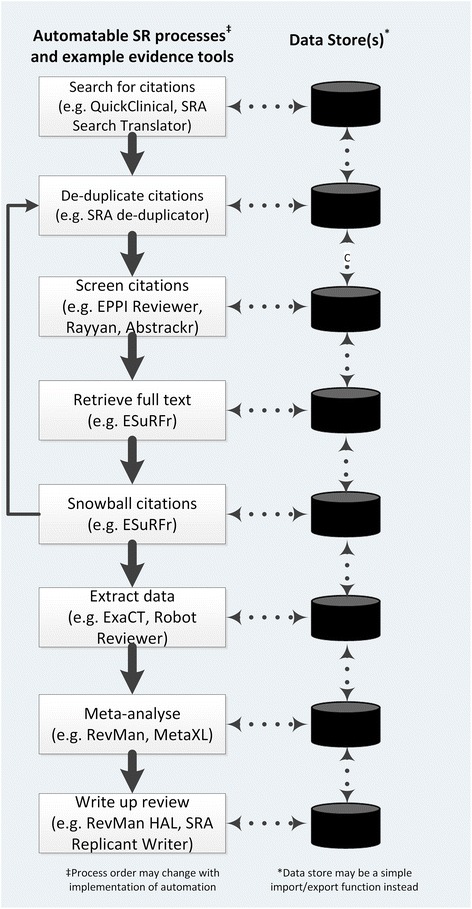
Verification
Claims the paper makes
5 Valid · 0 Not valid · 9 Not checked · 12 Own results and interpretations
The cited sources support only part of this claim — read each source’s verdict below.
In the paper
“With a median age of 8 months since last search, most systematic reviews are already outdated on publication [2].”
§ Making progress with the automation of systematic reviews: principles of the International Collaboration for the Automation of Systematic Reviews (ICASR) > Background
What the sources say
- Partly supportedcites [2] 2. Beller EM, Chen JK, Wang UL, Glasziou PP. Are systematic review up-to-date at the time of publication? Syst Rev. 2013;2:36. doi: 10.1186/2046-4053-2-36. sourceExperimental — accuracy not yet measured
Beller et al. (2013) do report the median figure: the Discussion (and Results, 'Time from search to publication'; Abstract) states that of the 90% of 300 reviews giving a search date, the median time from last search to first publication was 8.0 months (95% CI 7.3-8.7). However, the paper nowhere says that MOST reviews are already outdated at publication; its own Conclusions say only that 'some reviews have a considerable delay between search and publication', and it reports (crediting a separate analysis of 100 reviews, its reference [8]) that only 7% of reviews were out of date on the day of publication, with a 5.5-year half-life of conclusions. The 'most ... already outdated' portion of the citing sentence is therefore not supported by this source. (LLM, conf=0.75)
plain- Asserted: passes — The authors put it forward as true.
- Checkable: passes — It can be checked against evidence.
- Load-bearing: passes — The paper’s conclusions depend on it.
- Based: passes — The paper gives a reason why it holds.
- Partly supported
The cited sources support only part of this claim — read each source’s verdict below.
In the paper
“Recent advances in natural language processing, text mining and machine learning have produced new algorithms that can accurately mimic human endeavour in systematic review activity, faster and more cheaply [5–8].”
§ Making progress with the automation of systematic reviews: principles of the International Collaboration for the Automation of Systematic Reviews (ICASR) > Background
What the sources say
- Not checked yetcites [5] 5. Michelson JD, Pariseau JS, Paganelli WC. Assessing surgical site infection risk factors using electronic medical records and text mining. Am J Infect Control. 2014;42(3):333–336. doi: 10.1016/j.ajic.2013.09.007. source
- Partly supportedcites [6] 6. O'Mara-Eves A, Thomas J, McNaught J, Miwa M, Ananiadou S. Using text mining for study identification in systematic reviews: a systematic review of current approaches. Systematic reviews. 2015;4:5. doi: 10.1186/2046-4053-4-5. sourceExperimental — accuracy not yet measured
The Results sections on reducing screening workload and using text mining as a second screener report substantial workload reductions and good agreement between classifiers and human reviewers. The Background says these methods may make reviews quicker and more cost-efficient. The claim overstates that qualified potential as an established result and extends evidence about study screening to systematic-review activity generally. No page numbers are available in our copy. (LLM, conf=0.85)
- Partly supportedcites [7] 7. Marshall IJ, Kuiper J, Wallace BC. RobotReviewer: evaluation of a system for automatically assessing bias in clinical trials. J Am Med Inform Assoc. 2016;23(1):193–201. doi: 10.1093/jamia/ocv044. sourceExperimental — accuracy not yet measured
The Abstract and Discussion (pages not provided) describe a machine-learning system that automates one systematic-review task—risk-of-bias assessment—with reasonable accuracy and could reduce workload and expedite reviews. But the Discussion says its judgments lagged human accuracy by about 7%, and the paper does not establish that the work is cheaper; the claim overstates both its human equivalence and its demonstrated cost advantage. (LLM, conf=0.88)
- Not checked yetcites [8] 8. Olofsson H, Brolund A, Hellberg C, Silverstein R, Stenstrom K, Osterberg M, Dagerhamn J. Can abstract screening workload be reduced using text mining? User experiences of the tool Rayyan. Research Synthesis Methods. 2017;8(3):275–280. doi: 10.1002/jrsm.1237. source
plainstates a cause- Asserted: passes — The authors put it forward as true.
- Checkable: passes — It can be checked against evidence.
- Load-bearing: passes — The paper’s conclusions depend on it.
- Based: passes — The paper gives a reason why it holds.
The cited sources support only part of this claim — read each source’s verdict below.
In the paper
“However, such reviews have become ever more complicated, due to the complexity of interventions being studied and the amount of evidence being published which needs to be incorporated [1].”
- Also stated in: § Abstract · plain
“Systematic reviews (SR) are vital to health care, but have become complicated and time-consuming, due to the rapid expansion of evidence to be synthesised.”
§ Making progress with the automation of systematic reviews: principles of the International Collaboration for the Automation of Systematic Reviews (ICASR) > Background
What the sources say
- Partly supportedcites [1] 1. Bastian H, Glasziou P, Chalmers I. Seventy-five trials and eleven systematic reviews a day: how will we ever keep up? PLoS Med. 2010;7(9):e1000326. doi: 10.1371/journal.pmed.1000326. sourceExperimental — accuracy not yet measured
The volume half of the claim is well supported: 'Where Are We Now?' states 'the task keeps increasing in size and complexity', 'How Close Are We to Archie Cochrane's Goal?' (p. n/a) cites 'the triple constraint posed by the growth in trials, the increasing complexity of review methods, and current resources' plus a rising workload and median of six to sixteen trials per review, and 'Where to Now?' notes the growing expectation that reviews include study types other than randomised trials, which 'would unquestionably increase the time and resource requirement for reviews'. However, the paper attributes the increasing complication to the complexity of review METHODS and expanding methodological/reporting standards (reviews running to several hundred pages), not to the complexity of the interventions being studied — no passage in our copy says interventions have grown more complex, so that causal element of the citing sentence is unsupported by this source. (LLM, conf=0.72)
plainstates a cause- Asserted: passes — The authors put it forward as true.
- Checkable: passes — It can be checked against evidence.
- Load-bearing: passes — The paper’s conclusions depend on it.
- Based: passes — The paper gives a reason why it holds.
- Also stated in: § Abstract · plain
Every source the paper cites for this claim was checked and supports it.
In the paper
“Combining the skills and knowledge of all these experts will improve the ability of automation techniques and tools, in much the same way that multidisciplinary teams in healthcare improve patient outcomes [21].”
§ Making progress with the automation of systematic reviews: principles of the International Collaboration for the Automation of Systematic Reviews (ICASR) > The Vienna Principles
What the sources say
- Supportedcites [21] 21. Epstein NE. Multidisciplinary in-hospital teams improve patient outcomes: a review. Surg Neurol Int. 2014;5(Suppl 7):S295–S303. doi: 10.4103/2152-7806.139612. source
The citation is attached to the analogy clause only — that multidisciplinary teams in healthcare improve patient outcomes — while the automation claim is the citing authors' own extension. Epstein's INTRODUCTION states that cohesive multidisciplinary teams 'limits adverse events (AE)... improves patient outcomes, decreases patient length of stay (LOS), and increases patient satisfaction,' and the Abstract Results (p.1) repeat that cohesive teamwork 'improved communication between different levels of healthcare workers, and limited adverse events, improved outcomes.' The Conclusion frames hospital care as a 'team sport' across staff levels, matching the citing sentence's characterization of combining experts' skills and knowledge. (LLM, conf=0.88)
plainstates a cause- Asserted: passes — The authors put it forward as true.
- Checkable: unclear — It is unclear whether it could be checked against evidence.
- Load-bearing: passes — The paper’s conclusions depend on it.
- Based: passes — The paper gives a reason why it holds.
- Supported
Every source the paper cites for this claim was checked and supports it.
In the paper
“A typical SR takes from 6 months to 2 years or more to write [12].”
§ Making progress with the automation of systematic reviews: principles of the International Collaboration for the Automation of Systematic Reviews (ICASR) > The Vienna Principles
What the sources say
- Supportedcites [12] 12. Tsertsvadze A, Chen YF, Moher D, Sutcliffe P, McCarthy N. How to conduct systematic reviews more expeditiously? Syst Rev. 2015;4:160. doi: 10.1186/s13643-015-0147-7. source
The Background section 'Problems of timeliness and cost' states that conducting SRs 'may take on average from 6 months to several years [4–6]', which is the substance the citing sentence paraphrases as a typical SR taking '6 months to 2 years or more'. The Abstract repeats the same characterisation ('time-consuming and resource-intensive task'), and the paper uses it as its own framing of the field's timeliness problem, so the attribution holds; the only difference is wording ('several years' vs '2 years or more', and 'conduct' vs 'write'), not content. (LLM, conf=0.82)
plain- Asserted: passes — The authors put it forward as true.
- Checkable: passes — It can be checked against evidence.
- Load-bearing: passes — The paper’s conclusions depend on it.
- Based: passes — The paper gives a reason why it holds.
- Supported
5 more claims
Create a free account to see all 26 claims and to verify the 14 references still open.
- It may state two separate claims as one. 8
- Probably not a substantial claim. 12
Claims other papers make about this one
Each is checked against this paper’s own text: does it say what the citing paper says it does?
The source backs part of the claim, not all of it — or backs it for a different population, condition or comparison.
In the citing paper
“However, developing automatic screening tools based on combined ML techniques seems feasible; plenty of research and developments have been done in this field in recent years [26, 39, 41, 46, 52].”
From Machine learning computational tools to assist the performance of systematic reviews: A mapping review. (2022) · cites this paper as [26]
Experimental — accuracy not yet measuredThe source backs part of the claim, not all of it — or backs it for a different population, condition or comparison.
In the citing paper
“In total, we have found 5 studies that reported text mining techniques and tools to automate a -part of -the systematic review process [12,17 -20].”
From Automation of systematic literature reviews: A systematic literature review (2021) · cites this paper as [19]
Experimental — accuracy not yet measuredThe cited source says what the claim attributes to it.
In the citing paper
“Title and abstract screening is a review step that may be particularly amenable to automation or semi-automation [2–4].”
From Performance and usability of machine learning for screening in systematic reviews: a comparative evaluation of three tools (2019) · cites this paper as [4]
The cited source says what the claim attributes to it.
In the citing paper
“Besides, [12,17 -20] studied tools to automate a -part of -the systematic review process, not always the full process.”
From Automation of systematic literature reviews: A systematic literature review (2021) · cites this paper as [19]
The cited source says what the claim attributes to it.
In the citing paper
“Many of the tasks involved in SLRs are amenable to automation using artificial intelligence (AI) (Beller et al., 2018; Bolaños et al., 2024; Michelson and Reuter, 2019; Shemilt et al., 2016; Tsertsvadze et al., 2015).”
From Analysis of article screening and data extraction performance by an AI systematic literature review platform (2025) · cites this paper as Beller et al., 2018
1 more claim about this paper
Create a free account to see every claim other papers make about this one.
Citations
Cites
Preferred Reporting Items for Systematic Reviews and Meta-Analyses: the PRISMA statement
Moher, D., Liberati, A., Tetzlaff, J., Altman, D. G., & for the PRISMA Group (2009) · BMJ · doi:10.1136/bmj.b2535 · Cited by 83,823
Preferred Reporting Items for Systematic Reviews and Meta-Analyses: The PRISMA Statement
Moher, D., Liberati, A., Tetzlaff, J., Altman, D. G., & The PRISMA Group (2009) · PLoS Medicine · doi:10.1371/journal.pmed.1000097 · Cited by 64,042 · cited 1×
“In developing and testing new tools, it must be ensured that standards are kept high and new production approaches adhere to current SR guidelines such as the PRISMA Statement [18] and the Cochrane Standards for conduct and reporting of reviews [19].”
MethodPreferred reporting items for systematic reviews and meta-analyses: the PRISMA Statement.
(2009) · PubMed Central · Cited by 44,859
Scoping studies: towards a methodological framework
Arksey, H., & O'Malley, L. (2005) · International Journal of Social Research Methodology · doi:10.1080/1364557032000119616 · Cited by 36,742 · cited 1×
“This extended production process has led to the proliferation of ‘ rapid techniques ’ such as writing rapid reviews [13] or conducting scoping studies [14] rather than conducting a SR which aims to identify the complete scope of the literature.”
MethodWang, G., Ma, R., Qiao, G., Wada, K., Aizawa, Y., & Satoh, T. (2015) · Integrative Medicine International · doi:10.1159/000368408 · Cited by 18,657
Information bias in health research: definition, pitfalls, and adjustment methods
Althubaiti, A. (2016) · Journal of Multidisciplinary Healthcare · doi:10.2147/jmdh.s104807 · Cited by 3,018 · cited 1×
“This will prevent the potential bias that self-evaluation can bring [23] as well as provide outside users with confidence in the tools that are created [24].”
BackgroundSeventy-five trials and eleven systematic reviews a day: how will we ever keep up?
Bastian, H., Glasziou, P., & Chalmers, I. (2010) · PLoS Medicine · doi:10.1371/journal.pmed.1000326 · Cited by 1,188 · cited 1×
“However, such reviews have become ever more complicated, due to the complexity of interventions being studied and the amount of evidence being published which needs to be incorporated [1].”
BackgroundSelf-citationO’Mara-Eves, A., Thomas, J., McNaught, J., Miwa, M., & Ananiadou, S. (2015) · Systematic Reviews · doi:10.1186/2046-4053-4-5 · Cited by 681
Self-citationSystematic review automation technologies
Tsafnat, G., Glasziou, P., Choong, M. K., Dunn, A., Galgani, F., & Coiera, E. (2014) · Systematic Reviews · doi:10.1186/2046-4053-3-74 · Cited by 472 · cited 2×
“Fortunately, many of the tasks in a systematic review are amenable to automation: screening of titles and abstracts, sourcing full texts of included studies, data extraction and even collation of meta-analysis results are all fertile areas for automation [4].”
BackgroundSelf-citationMultidisciplinary in-hospital teams improve patient outcomes: A review
Epstein, N. (2014) · Surgical Neurology International · doi:10.4103/2152-7806.139612 · Cited by 388 · cited 1×
“…researchers from many different disciplines who are involved in the preparation of SRs. Combining the skills and knowledge of all these experts will improve the ability of automation techniques and tools, in much the same way that multidisciplinary teams in healthcare improve patient outcomes [21].”
Background
Research works printed but not linked: 2
- 11. Cockburn A. Using both incremental and iterative development. STSC CrossTalk. 2008;21(5):27–30.
- 20. Fielding RT. Architectural styles and the design of network-based software architectures (dissertation). University of California, Irvine. https://www.ics.uci.edu/~fielding/pubs/dissertation/top.htm. Accessed 18 Apr 2017.
Cited by
Items 101–200 of 203
Al-Marridi, A. Z., Said, A. B., Ulde, S. M., & Khwaileh, T. (2025) · Systematic Reviews · doi:10.1186/s13643-025-02895-z · Cited by 8
“To mitigate this, the Cochrane Hand-book for Systematic Reviews recommends conducting final searches within 6 months of publication to maintain the relevance of the review [1].”
Bannach‐Brown, A., Rackoll, T., Macleod, M. R., & McCann, S. (2025) · BMC Medical Research Methodology · doi:10.1186/s12874-025-02524-2 · Cited by 8
“Working within and across communities has been critical to the success of open science initiatives [71], and we believe will be equally important in evidence synthesis to ensure solutions meet diverse needs [72–74].”
Blümmel, T., Rehn, J., Mereu, C., Graf, F., Kneuer, C., Wittkowski, P., Sonnenburg, A., Moore, A., Bech, K., van der Lugt, B., et al. (2023) · EFSA Supporting Publications · doi:10.2903/sp.efsa.2022.en-7815 · Cited by 7
Large-Scale Simulation Study of Active Learning Models for Systematic Reviews
Teijema, J. J., de Bruin, J., Bagheri, A., & van de Schoot, R. (2023) · doi:10.31234/osf.io/2w3rm · Cited by 8
Nieto González, D. M. (2022) · doi:10.11144/javeriana.10554.58492 · Cited by 6
“[68] [90] [91] [68] [92] [93] [94] [95] [96]”
BackgroundInfluentialCassell, K., Ologunowa, A., Rastegar-Mojarad, M., Chun, B., Huang, Y.-L., Wang, D., & Cossrow, N. (2025) · Frontiers in Artificial Intelligence · doi:10.3389/frai.2025.1662202 · Cited by 15
Sujau, M., Wada, M., Vallée, É., Hillis, N., & Sušnjak, T. (2025) · Machine Learning and Knowledge Extraction · doi:10.3390/make7020028 · Cited by 9
Atkinson, C. F. (2024) · MethodsX · doi:10.1016/j.mex.2024.103129 · Cited by 6
“The overwhelming pace at which scholarly publications are produced has outstripped the capabilities of traditional literature review methods, often rendering such reviews outdated and incomplete [ 6–8 ].”
Synthesizing evidence from clinical trials with dynamic interactive argument trees
Sanchez-Graillet, O., Witte, C., Grimm, F., Grautoff, S., Ell, B., & Cimiano, P. (2022) · Journal of Biomedical Semantics · doi:10.1186/s13326-022-00270-8 · Cited by 6
“The creation of systematic reviews is a long-term process requiring substantial personnel and efforts [24], and keeping them up-to-date represents a significant challenge [25, 26].”
BackgroundLi, X., Zhang, A., Al-Zaidy, R. A., Rao, A., Baral, S., Bao, L., & Giles, C. L. (2022) · PLoS ONE · doi:10.1371/journal.pone.0270034 · Cited by 6
Vivekanantha, P., Son, H., Bernardini, L., Bouchard, M. D., Ayeni, O. R., & Kay, J. (2025) · Current Reviews in Musculoskeletal Medicine · doi:10.1007/s12178-025-10001-y · Cited by 6
Shokraneh, F. (2019) · Journal of Clinical Epidemiology · doi:10.1016/j.jclinepi.2019.04.008 · Cited by 6
“But how do we know if what has been said in the systematic review has actually been done? We usually trust the researchers but using the existing online semi-automated platforms that documents the steps of the systematic reviews [8-12] could help the transparency if the team share the process, methods, and results in…”
MethodOvercoming the challenges of using automated technologies for public health evidence synthesis
Hocking, L., Parkinson, S., Adams, A., Nielsen, E. M., Ang, C., & Gomes, H. D. C. (2023) · Eurosurveillance · doi:10.2807/1560-7917.es.2023.28.45.2300183 · Cited by 6
“This has been a long-standing problem, and the challenge only grows as the volume of literature expands and the pace of publications increases [5,6].”
BackgroundCan Systematic Reviews Be Automated?
Laynor, G. (2022) · Journal of Electronic Resources in Medical Libraries · doi:10.1080/15424065.2022.2113350 · Cited by 5
Towards Automated Meta-Analysis of Clinical Trials: An Overview
Christopoulou, S. C. (2023) · BioMedInformatics · doi:10.3390/biomedinformatics3010009 · Cited by 5
Sutton, A., O’Keefe, H., Johnson, E. E., & Marshall, C. (2023) · Research Synthesis Methods · doi:10.1002/jrsm.1665 · Cited by 5
Liu, S., Bourgeois, F. T., Narang, C., & Dunn, A. G. (2023) · Research Synthesis Methods · doi:10.1002/jrsm.1672 · Cited by 7
Cloud Manufacturing: An Automated Literature Review
Ellwein, C., Neff, S., & Verl, A. W. (2019) · Procedia CIRP · doi:10.1016/j.procir.2020.01.006 · Cited by 5
Macleod, G., Dozier, M., Marvell, R., Matthews‐Smith, G., Macleod, M. R., & Liao, J. (2023) · Oxford Review of Education · doi:10.1080/03054985.2023.2203376 · Cited by 5
“The use of ML to help reduce the volume of human effort in traditional systematic reviews is becoming more common in medical research (Beller et al., 2018; Currie et al., 2019; Noel-Storr et al., 2020).”
BackgroundSystematic review automation methods
Norman, C. R. (2020) · theses.fr (ABES) · doi:10.70675/044ffa34z5c9bz433az99c8z64697dcd28a2 · Cited by 8
Rogers, K., Miller, A., Girgis, A., Clark, E., Neil‐Sztramko, S., & Dobbins, M. (2025) · Journal of Medical Internet Research · doi:10.2196/69700 · Cited by 6
“The use of AI to semiautomate the screening of studies for relevance within the systematic review process has been described as promising [19-21].”
Ethical challenges for Health Technology Assessment (HTA) in the evolving evidence landscape
Refolo, P., Duthie, K., Hofmann, B., Stanak, M., Bertelsen, N., Bloemen, B., Bidino, R. D., Oortwijn, W., Raimondi, C., Sacchini, D., et al. (2024) · International Journal of Technology Assessment in Health Care · doi:10.1017/s0266462324000394 · Cited by 6
“In fact, recent advances in natural language processing, text mining, and ML are producing algorithms that can accurately mimic human effort in systematic review activity in a faster and cheaper manner (25).”
Tu, J., Nacke, L. E., & Rogers, K. (2025) · Interacting with Computers · doi:10.1093/iwc/iwaf001 · Cited by 4
Maintaining Curated Document Databases Using a Learning to Rank Model: The ORRCA Experience
Muhammad, I., Bollegala, D., Coenen, F., Gamble, C. L., Kearney, A., & Williamson, P. R. (2020) · Lecture notes in computer science · doi:10.1007/978-3-030-63799-6_26 · Cited by 4
Caviedes-Olmos, M., & Roco-Videla, Á. (2022) · Nutrición Hospitalaria · doi:10.20960/nh.04336 · Cited by 7
Human DNA/RNA motif mining using deep-learning methods: a scoping review
Chaurasia, R., & Ghose, U. (2023) · Network Modeling Analysis in Health Informatics and Bioinformatics · doi:10.1007/s13721-023-00414-5 · Cited by 6
“Automation tools help in speeding up systematic reviews and also aid in providing accuracy (Beller et al. 2018; Scott et al. 2021; Harrison et al. 2020), and tools such as LitSuggest (Allot et al. 2021), Abstrackr (Wallace et al. 2012), and Col-andr (Cheng et al. 2018) were used for various…”
MethodMilella, F., Oltolini, M., & Bandini, S. (2024) · International Conference on PErvasive Technologies Related to Assistive Environments (PETRA) · doi:10.1145/3652037.3652046 · Cited by 4
Queiros, L., Mearns, E. S., Mccarvil, M., Alarcão, J., Garcia, M. J., & Abògúnr̀in, Ṣ. (2023) · Research Square · doi:10.21203/rs.3.rs-3119345/v1 · Cited by 4
CTrO-Editor: A Web-based Tool to Capture Clinical Trial Data for Aggregation and Pooling
Sanchez-Graillet, O., Kramer-Sunderbrink, A., & Cimiano, P. (2021) · Proceedings of the 11th Knowledge Capture Conference · doi:10.1145/3460210.3493576 · Cited by 3
Maleki, F., & Karami, M. (2024) · Journal of Evidence-Based Medicine · doi:10.1111/jebm.12665 · Cited by 4
Mau‐Them, F. T., Overs, A., Bruel, A., Duquet, R., Thareau, M., Denommé‐Pichon, A., Vitobello, A., Sorlin, A., Safraou, H., Nambot, S., et al. (2023) · Frontiers in Genetics · doi:10.3389/fgene.2023.1122985 · Cited by 3
“This strategy requires the selection of appropriate journals and subsequent filtering of manuscripts of interest from these journals (Dubuque, 2011; Beller et al., 2018; Marshall and Wallace, 2019).”
Yu, T., Yang, X., Clark, J. M., Lin, L., Furuya‐Kanamori, L., & Xu, C. (2024) · BMC Medical Research Methodology · doi:10.1186/s12874-024-02225-2 · Cited by 4
“The first approach involves leveraging automation tools or software equipped with machine learning or deep learning algorithms to aid in evidence synthesis tasks such as screening and data extraction [10].”
MethodSelf-citationTeperikidis, E., Karakasis, P., Patoulias, D., Boulmpou, A., & Kouzoukas, D. E. (2024) · European Journal of Internal Medicine · doi:10.1016/j.ejim.2024.10.017 · Cited by 3
Comparison of Artificial Intelligence with a Conventional Search in Dermatology
Kaul, S., Jakhar, D., & Sinha, S. (2022) · Indian Dermatology Online Journal · doi:10.4103/idoj.idoj_264_21 · Cited by 3
“277 © 2022 Indian Dermatology Online Journal | Published by Wolters Kluwer - Medknow Dear Editor, Systematic reviews and meta‐analyses play an invaluable role in the practice of evidence‐based medicine.[1] Unfortunately, the process is time‐consuming, on average requiring 67 weeks to sift through all available literat…”
BackgroundMethodInfluentialAbògúnr̀in, Ṣ., Queiros, L., Bednarski, M., Sumner, M., Baehrens, D., & Witzmann, A. (2021) · bioRxiv (Cold Spring Harbor Laboratory) · doi:10.1101/2021.09.30.462652 · Cited by 3
“This is why several articles have 60 been investigating how automation can be implemented in the SLR process [8, 9].”
BackgroundLee, K., Datta, S., Paek, H., Rastegar-Mojarad, M., Huang, L., He, L., Wang, S., Wang, J., & Wang, X. (2024) · medRxiv · doi:10.1101/2024.07.03.24309897 · Cited by 6
“Automation has shown great potential to enhance SLRs 8 , with various initiatives aiming to automate these processes 13–16 .”
BackgroundMozgai, S., Kaurloto, C., Winn, J. G., Leeds, A., Beland, S., Sookiassian, A., & Hartholt, A. (2024) · CHI Conference Extended Abstracts on Human Factors in Computing Systems (CHI EA) · doi:10.1145/3613905.3637110 · Cited by 2
“A review of the literature of evidence synthesis techniques revealed that currently there is a body of research focused on automating the tedious aspects of literature reviews [3, 16, 30].”
BackgroundYadav, V., Trushna, T., Mandal, U. K., Singh, M., Goel, A. D., Bairwa, M. L., Dabar, D., & Sabde, Y. (2025) · Medical Reference Services Quarterly · doi:10.1080/02763869.2025.2595567 · Cited by 3
Carou‐Senra, P., Rodríguez‐Pombo, L., Alvarez‐Lorenzo, C., & Goyanes, Á. (2026) · International Journal of Pharmaceutics · doi:10.1016/j.ijpharm.2026.126587 · Cited by 3
Kolesnyk, S., Souza, J. D. P., Bearth, A., Aicher, L., Wilks, M., Mosig, A., & Fritsche, E. (2026) · Toxicology · doi:10.1016/j.tox.2026.154439 · Cited by 3
Challenges in teaching systematic reviews to non-clinicians
Pieper, D., Müller, D., & Stock, S. (2019) · Zeitschrift für Evidenz Fortbildung und Qualität im Gesundheitswesen · doi:10.1016/j.zefq.2019.10.004 · Cited by 3
Haddaway, N., & Westgate, M. J. (2020) · Environmental Evidence · doi:10.1186/s13750-020-00212-w · Cited by 3
Systematic Searching in a Post-Pandemic World: New Directions for Methods, Technology, and People
Levay, P., & Craven, J. (2023) · Evidence Based Library and Information Practice · doi:10.18438/eblip30415 · Cited by 2
Koh, Z. H., Zarnegar, A., Skues, J., & Murray, G. (2026) · BMC Research Notes · doi:10.1186/s13104-026-07651-7 · Cited by 2
“Automation tools can reduce the screening effort in systematic reviews, a task previously deemed time-consuming [1–3], by 30%−50% with only a marginal precision loss (up to 5”
Automation in Healthcare Systematic Review
Ruiz, R. L., & Duffy, V. G. (2021) · Lecture notes in computer science · doi:10.1007/978-3-030-90966-6_9 · Cited by 9
How Artificial Intelligence Can Augment the Collection of Scientific Literature
Mokeddem, A. (2020) · European Journal of Formal Sciences and Engineering · doi:10.26417/772udo89i · Cited by 1
Martinou, E., & Angelidi, A. M. (2022) · F1000Research · doi:10.12688/f1000research.127179.1 · Cited by 1
“Additionally, the benefits of the implementation of AI methods in SRs remain unclear and AI platforms still need to undergo validation and refinement.(60) Nevertheless, AI tools are increasingly becoming incorporated into some of the steps of evidence synthesis until a fully automated process might be possible in the…”
MethodInfluentialSystematic reviews of animal studies – Report of an international symposium
Fausak, E. D., Funaro, M. C., Kepsel, A. C., Eldermire, E., Foster, M., Norton, H., Mears, K., Crews, M. E., Brennan, M. L., Currie, G. L., et al. (2023) · Veterinary Evidence · doi:10.18849/ve.v8i3.653 · Cited by 2
“With this in mind, a network of organisations, the International Collaboration for the Automation of Systematic Reviews (ICASR), works to create open tools for automating evidence synthesis (Beller et al., 2018).”
Virendrakumar, B., Waddington, H. S., Scheelbeek, P., Jolley, E., & Schmidt, E. (2026) · Systematic Reviews · doi:10.1186/s13643-026-03101-4 · Cited by 1
“With evolving algorithms, AI has the potential to quickly mimic human performance in systematic review processes [10, 16], including searching and importing documents, screening, data extraction, and presentation of review outputs.”
search-query: An open source Python library for academic search queries
Eckhardt, P., Ernst, K. M., Fleischmann, T., Geßler, A., Schnickmann, K., Thurner, L., & Wagner, G. (2026) · The Journal of Open Source Software · doi:10.21105/joss.08775 · Cited by 1
“…Singh & Singh, 2017), (3) query improvement, i.e., manipulation of query objects to understand and enhance performance (e.g., Scells et al., 2020), and (4) automation, i.e., offering programmatic or API access to integrate with existing workflows (e.g., Beller et al., 2018; O’Connor et al., 2018).”
History of evidence-based research
Lund, H., & Robinson, K. A. (2026) · Journal of the Royal Society of Medicine · doi:10.1177/01410768261433038 · Cited by 1
Self-citationEvaluating the accuracy and speed of eight deduplication tools: A comparative study
Bateup, S., Fulbright, H., Moberg, K., Hair, K., Peterson, E., Stansfield, C., Qureshi, R., & Clark, J. M. (2026) · Research Synthesis Methods · doi:10.1017/rsm.2026.10100 · Cited by 1
Self-citationKitchenham, B., Pizard, S., Madeyski, L., Santos, R. D. S., Shepperd, M., & Budgen, D. (2026) · arXiv (Cornell University) · doi:10.48550/arxiv.2607.24991 · Cited by 1
“In their first paper (Beller et al., 2018), they argued that automation for SLRs should support and improve tasks across the full evidence-synthesis workflow, be developed through continuous, user-informed refinement (starting with key bottlenecks), and maintain rigorous review standards (for…”
Rohner, E., Bohlius, J., da Costa, B. R., & Trelle, S. (2022) · Wiley eBooks · doi:10.1002/9781119099369.ch6 · Cited by 1
Saxena, A., Saxena, A., & Saxena, A. (2022) · Advances in computational intelligence and robotics book series · doi:10.4018/978-1-6684-2443-8.ch003 · Cited by 1
Evaluating and optimizing the search process for systematic reviews
Mathisen, M. (2021) · NVA (Nasjonalt vitenarkiv) · Cited by 5
Fisch-Romito, V. (2021) · theses.fr (ABES) · doi:10.70675/f9490d2az81ddz4fe4z94c1zaa45d50d7353 · Cited by 3
Shokraneh, F. (2020) · Nottingham ePrints (University of Nottingham)
Alvarez, M. C. Z., Barreneche, J. G., & Aristizabal, J. K. N. (2021) · Communications in computer and information science · doi:10.1007/978-3-030-86702-7_17
Pandey, N. N., & Sharma, S. (2021) · Current Medical Research and Opinion · doi:10.1080/03007995.2021.2015160
Farquhar-Smith, P. W., & Gordon-Williams, R. (2020) · Faculty Opinions – Post-Publication Peer Review of the Biomedical Literature · doi:10.3410/f.735799554.793571725
Muller, A. E., Ames, H. M. R., Borge, T. C., Hestevik, C. H., Meneses-Echavez, J. F., & Rose, C. J. (2022) · Research Square · doi:10.21203/rs.3.rs-1644531/v1
The applicability and utilization of systematic reviews for clinical practice
Lindsley, K. B. (2022) · Utrecht University Repository (Utrecht University) · doi:10.33540/1513
Chiu, S.-U. F., Huang, R., & Chiu, C. (2023) · International Journal of Surgery · doi:10.1097/js9.0000000000000800
“Fortunately, many burdens while performing a systematic review are docile to automation empowered by arti fi cial intelligence [5] , such as reviewing the article content, for example, title, abstract, entire content of studies included, extracting data, and collating the results of a meta-analysis.”
BackgroundEscaldelai, F. M. D. (2022) · Digital Library of Theses and Dissertations (Universidade de São Paulo) · doi:10.11606/t.6.2022.tde-04042024-101557
Advanced Topics in Systematic Reviews and Meta-Analysis
Purssell, E., & McCrae, N. (2024) · Springer eBooks · doi:10.1007/978-3-031-71159-6_12
Sonnenfeld, N. A., Niacaris, L., Alfaro, G. D., Nguyen, B., Daniliv, V., Newton, O. B., Jentsch, F. G., & Fiore, S. M. (2024) · Proceedings of the Human Factors and Ergonomics Society Annual Meeting · doi:10.1177/10711813241275508
“We used systematic review automation (SRA) tools where feasible and appropriate (Beller et al., 2018), as such tools have been found to reduce the time to complete SLR tasks while maintaining methodological quality (Clark et al., 2020; Scott et al., 2021) and are consistent with accepted SLR…”
M-PreSS: A Model Pre-training Approach for Study Screening in Systematic ReviewsPreprint
Xu, Z., Davies, P., Millard, L. A. C., Teng, L., Markozannes, G., Erola, P., Seleiro, E. A. P., Higgins, J. P. T., Martin, R. M., Sobczyk-Barad, M., et al. (2025) · medRxiv · doi:10.1101/2025.04.08.25325463 · Cited by 1
Gates, A., Gates, M., DaRosa, D., Elliott, S. A., Pillay, J., Rahman, S., Vandermeer, B., & Hartling, L. (2020) · Figshare · doi:10.6084/m9.figshare.13294975
Büchter, R. B., Weise, A., & Pieper, D. (2020) · Figshare · doi:10.6084/m9.figshare.13114752
Büchter, R. B., Weise, A., & Pieper, D. (2020) · Figshare · doi:10.6084/m9.figshare.13114746
Yu, T., Yang, X., Clark, J. M., Lin, L., Furuya‐Kanamori, L., & Xu, C. (2024) · Figshare · doi:10.6084/m9.figshare.26409865
Self-citationGalea, D. (2019) · Spiral (Imperial College London) · doi:10.25560/83109
Gates, A., Gates, M., DaRosa, D., Elliott, S. A., Pillay, J., Rahman, S., Vandermeer, B., & Hartling, L. (2020) · Figshare · doi:10.6084/m9.figshare.13294978
Gates, A., Gates, M., DaRosa, D., Elliott, S. A., Pillay, J., Rahman, S., Vandermeer, B., & Hartling, L. (2020) · Figshare · doi:10.6084/m9.figshare.13294969
Gates, A., Gates, M., DaRosa, D., Elliott, S. A., Pillay, J., Rahman, S., Vandermeer, B., & Hartling, L. (2020) · Figshare · doi:10.6084/m9.figshare.13294966
Büchter, R. B., Weise, A., & Pieper, D. (2021) · Figshare · doi:10.6084/m9.figshare.16944440
Büchter, R. B., Weise, A., & Pieper, D. (2020) · Figshare · doi:10.6084/m9.figshare.13114743
Arevalo-Rodriguez, I., Steingart, K. R., Tricco, A. C., Nußbaumer-Streit, B., Kaunelis, D., Alonso‐Coello, P., Baxter, S., Bossuyt, P. M., Emparanza, J. I., & Zamora, J. (2020) · Figshare · doi:10.6084/m9.figshare.12299495
Büchter, R. B., Weise, A., & Pieper, D. (2021) · Figshare · doi:10.6084/m9.figshare.16944449
Büchter, R. B., Weise, A., & Pieper, D. (2021) · Figshare · doi:10.6084/m9.figshare.16944452
Büchter, R. B., Weise, A., & Pieper, D. (2021) · Figshare · doi:10.6084/m9.figshare.16944458
Automated Eligibility Screening and its Evaluation in the Medical Domain
Kusa, W. (2024) · reposiTUm (TU Wien) · doi:10.34726/hss.2024.124620
Büchter, R. B., Weise, A., & Pieper, D. (2020) · Figshare · doi:10.6084/m9.figshare.13114749
Gates, A., Gates, M., DaRosa, D., Elliott, S. A., Pillay, J., Rahman, S., Vandermeer, B., & Hartling, L. (2020) · Figshare · doi:10.6084/m9.figshare.13294972
Büchter, R. B., Weise, A., & Pieper, D. (2021) · Figshare · doi:10.6084/m9.figshare.16944455
Jiménez, R. C., Lee, T., Rosillo, N., Córdova, R., Cree, I. A., González, Á., & Indave Ruiz, B. I. (2023) · Figshare · doi:10.6084/m9.figshare.22609363
Büchter, R. B., Weise, A., & Pieper, D. (2020) · Figshare · doi:10.6084/m9.figshare.13114755
Enhancing Efficiency in Systematic Reviews: Automating Study Selection with GPT-4o Model
Mustalahti, J. (2025) · Jyväskylä University Digital Archive (University of Jyväskylä)
Fingertip blood samples present innovative way to assess lymphocyte diurnal variation
Bushell, D., Smith, J., Tan, J. K. H., & Moro, C. (2021) · Bond University Research Portal (Bond University)
Evidence synthesis methods to enhance climate policy evaluation for IPCC assessments
Döbbeling-Hildebrandt, N. (2024) · White Rose eTheses Online (University of Leeds, The University of Sheffield, University of York) · Cited by 1
Ahn, S., Kim, S., & Valdes, J. (2026) · Springer international handbooks of education · doi:10.1007/978-3-031-88898-4_24-1
Reporting software tools and automation in the protocols of evidence syntheses: meta-research study
Jemioło, P., Storman, D., Sousa‐Pinto, B., Marques‐Cruz, M., Robinson, K. A., & Bała, M. M. (2026) · Journal of Clinical Epidemiology · doi:10.1016/j.jclinepi.2026.112275
Self-citationGiang, T. T. H., Nguyen, T.-T., Do, L. T. H., Nguyen, H. T., Thuong, D. T. K., & Nguyen, D. (2026) · Asian Education and Development Studies · doi:10.1108/aeds-11-2025-0610
Qi, R., Lyu, H., Li, W., Chen, S., & Guo, X. (2026) · PeerJ Computer Science · doi:10.7717/peerj-cs.3882
LLM-Enhanced Rapid Review (LLMEn-RR): a methodology proposal
Irace, M. B., Simões, J. L., Argôlo, M., Barbosa, C. E., Nóbrega, L., Martinez, L. F., & de Souza, J. M. (2026) · International Conference on Computer Supported Cooperative Work in Design (CSCWD) · doi:10.1109/cscwd68734.2026.11582469
“…in time, scalability, and consistency – building on recent advances in RR automation and the demonstrated potential of LLMs for tasks such as screening and data extraction [3]–[6], the framework positions LLMs as intelligent assistants that augment human expertise rather than replace it.”
Bituin, R. C., & Bokani, A. (2026) · bioRxiv (Cold Spring Harbor Laboratory) · doi:10.64898/2026.07.06.736558
“Technology-assisted review methods can reduce manual screening burden by ranking or classifying candidate records before full reviewer assessment [9], [14], [17].”
Barragán, A. M., Bonett, S. E. O., Rodríguez-Grande, E.-I., Orjuela-Cañón, Á. D., Perdómo, O., & Sánchez, G. (2026) · Cochrane Evidence Synthesis and Methods · doi:10.1002/cesm.70098
“Our group thus conducted a scoping review to address this gap, following Joanna Briggs Institute's (JBI) methodology [20]; the concept was defined as the use of AI resources for title and abstract screening, the context as the characteristics of the algorithms used and the outcomes as the…”
InfluentialSánchez‐Piedra, C., Heyerdahl-Viau, I., Garcia-Carpintero, E.-E., Martínez-Núñez, J. M., & Prado-Galbarro, F. J. (2026) · Medical Sciences · doi:10.3390/medsci14050533
“However, they are resource-intensive, time-consuming, and vulnerable to delays that may reduce their relevance in fast-evolving areas [7].”
Xia, J. (2023) · Nottingham ePrints (University of Nottingham)
Self-citation
Metadata
- Authors
- On behalf of the founding members of the ICASR group, Beller, E., Clark, J., Tsafnat, G., Adams, C., Diehl, H., Lund, H., Ouzzani, M., Thayer, K., Thomas, J., Turner, T., Xia, J., Robinson, K., & Glasziou, P.
- Affiliations
- Bond University (AU)
- University of Nottingham (GB)
- Western Norway University of Applied Sciences (NO)
- Pennsylvania State University (US)
- University College London (GB)
- Corresponding author
- Beller, Elaine
- ORCID
- Venue
- Systematic Reviews
- Published
- 2018-05-19
- Volume
- 7
- Issue
- 1
- Pages
- 77-77
- ISSN
- 2046-4053 (ISSN-L)
- PMC
- PMC5960503
- OpenAlex
- W2805303998
- Semantic Scholar
- ff976d928c130b6f50522a93d940f617d99a2bbd
- Cited by
- 191
- References
- 24
- Citations by year
- 2026: 14 · 2025: 17 · 2024: 30 · 2023: 34 · 2022: 17 · 2021: 26 · 2020: 35 · 2019: 15 · 2018: 3
- FWCI
- 3.89
- Type
- journal article
- Language
- en
- Open access
- gold
- doi.org
- Licence
- cc-by
- creativecommons.org/licenses/by/4.0/ (tdm)
- Locations
- Systematic Reviews (publishedVersion, cc-by)
- Europe PMC (PubMed Central) (publishedVersion, other-oa)
- PubMed Central (publishedVersion, cc-by)
- PubMed (publishedVersion)
- Repository@Nottingham (University of Nottingham) (publishedVersion, cc-by)
- Monash University Research Portal (Monash University) (submittedVersion, other-oa)
- Repository@Nottingham (University of Nottingham) (submittedVersion, cc-by)
- Bond University Research Portal (Bond University) (submittedVersion, cc-by)
- NORA - Norwegian Open Research Archives (submittedVersion, cc-by)
- DOAJ (DOAJ: Directory of Open Access Journals) (submittedVersion, cc-by-sa)
- Nottingham ePrints (University of Nottingham) (submittedVersion, cc-by)
- UCL Discovery (University College London) (submittedVersion)
- Figshare (submittedVersion, cc-by)
- Topics
- Social Sciences › Decision Sciences › Statistics, Probability and Uncertainty › Meta-analysis and systematic reviews
- Social Sciences › General Social Sciences › Computational and Text Analysis Methods
- Health Sciences › Medicine › Health Informatics › Biomedical Text Mining and Ontologies
- Keywords
- systematic review automation, natural language processing, text mining, machine learning, tool integration, open source software, open evaluation, replicability, research collaboration, evidence synthesis
- MeSH terms
- Data Accuracy, Machine Learning, Systematic Reviews as Topic, Algorithms, Automation, Cooperative Behavior, Humans, Natural Language Processing, Data Mining
About these checks
Registry, retraction, Cites and statistics results are computed, not judged, with one exception: a printed reference that no index lists is read once by a model before it counts as a citation error. Claims are extracted by a model and kept only when their quote appears verbatim in the text; each cited source is then checked, with a model’s help, for whether it says what the claim relies on. Those verdicts can be wrong — read the claim’s quote and the cited source before relying on one.
The claim verdicts this report counts are experimental: their accuracy is not yet measured.
A language model drew the claims from the paper on 2026-10-04, under version 3 of the claim definition (model deepseek-v4.1-flash, prompt extract-v3).
A second model labelled each claim on 2026-10-04 (model jev-1.13-20260917, definition revision gold-guideline-v0.2).
Cited sources are checked with a language model’s help (qwen3.8-omni-flash and gpt-6-sol).
Statistics and arithmetic are recomputed, not judged.
Confidence bands are shown only for fields calibrated on our annotated test set. None is calibrated yet, so no band is shown.
What counts as a claim ›How we measure confidence ›How we check this ›
Are you an author, or do you see a problem with this page? Request a review
Data sources
Bibliographic data: Semantic Scholar, OpenAlex, Crossref.
Contains information from the Semantic Scholar Academic Graph Datasets, made available under the ODC Attribution License (ODC-BY 1.0).
Semantic Scholar’s data is described in: Kinney, R., et al. (2023). The Semantic Scholar Open Data Platform. arXiv:2301.10140.
