

Clarifying differences between reviews within evidence ecosystems
Open accessThe DOI matches its Crossref record; 45 of the 46 references it cites were found in a registry or an index.
Abstract
This paper builds on a 2012 paper by the same authors which argued that the types and brands of systematic review do not sufficiently differentiate between the many dimensions of different review questions and review methods (Gough et al., Syst Rev 1:28, 2012). The current paper extends this argument by considering the dynamic contexts, or 'evidence ecosystems', within which reviews are undertaken; the fact that these ecosystems are constantly changing; and the relevance of this broader context for understanding 'dimensions of difference' in the unfolding development and refinement of review methods.The concept of an evidence ecosystem is used to consider particular issues within the three key dimensions of difference outlined in the 2012 paper of (1) review aims and approach, (2) structure and components of reviews, and (3) breadth, depth, and 'work done' by reviews.
Overview
The claims and statistics of this paper haven’t been checked yet.
Free: it reads the open-access text and checks the first 5 claims that cite a source we can check. Create a free account to check every claim.
Integrity signals
Registry
Cites
Statistics
Figures
Verification
Claims the paper makes
The claims and statistics of this paper haven’t been checked yet.
Free: it reads the open-access text and checks the first 5 claims that cite a source we can check. Create a free account to check every claim.
Self-check
Percentages, sums and reported differences re-computed from the paper’s own numbers.
The self-check needs the paper’s full text.
Citations
Cites
Preferred Reporting Items for Systematic Reviews and Meta-Analyses: the PRISMA statement
Moher, D., Liberati, A., Tetzlaff, J., Altman, D. G., & for the PRISMA Group (2009) · BMJ · doi:10.1136/bmj.b2535 · Cited by 83,823
Wang, G., Ma, R., Qiao, G., Wada, K., Aizawa, Y., & Satoh, T. (2015) · Integrative Medicine International · doi:10.1159/000368408 · Cited by 18,657
Shea, B. J., Reeves, B. C., Wells, G., Thuku, M., Hamel, C., Moran, J., Moher, D., Tugwell, P., Welch, V., Kristjansson, E., et al. (2017) · BMJ · doi:10.1136/bmj.j4008 · Cited by 10,636
ROBIS: A new tool to assess risk of bias in systematic reviews was developed
Whiting, P., Savović, J., Higgins, J. P. T., Caldwell, D. M., Reeves, B. C., Shea, B., Davies, P., Kleijnen, J., & Churchill, R. (2016) · Journal of Clinical Epidemiology · doi:10.1016/j.jclinepi.2015.06.005 · Cited by 2,272
The Many Meanings of Research Utilization
Weiss, C. H. (1979) · Public Administration Review · doi:10.2307/3109916 · Cited by 2,222 · cited 3×
“The research available being driven by academic interests (a ‘push’ production model) and not being relevant in the topic or focus for potential users of research (with a ‘pull’ demand and problem-solving model) [10]”
BackgroundAvoidable waste in the production and reporting of research evidence
Chalmers, I., & Glasziou, P. (2009) · The Lancet · doi:10.1016/s0140-6736(09)60329-9 · Cited by 2,208
Grading quality of evidence and strength of recommendations for diagnostic tests and strategies
Schünemann, H. J., Oxman, A. D., Brozek, J., Glasziou, P., Jaeschke, R., Vist, G. E., Williams, J. W., Kunz, R., Craig, J., Montori, V. M., et al. (2008) · BMJ · doi:10.1136/bmj.39500.677199.ae · Cited by 1,782
An Enquiry concerning Human Understanding
Hume, D. (1748) · The Clarendon Edition of the Works of David Hume: An Enquiry concerning Human Understanding · doi:10.1093/oseo/instance.00032980 · Cited by 1,595
RAMESES publication standards: realist syntheses
Wong, G., Greenhalgh, T., Westhorp, G., Buckingham, J., & Pawson, R. (2013) · BMC Medicine · doi:10.1186/1741-7015-11-21 · Cited by 1,374
Alonso-Coello, P., Schünemann, H. J., Moberg, J., Brignardello-Petersen, R., Akl, E. A., Davoli, M., Treweek, S., Mustafa, R. A., Rada, G., Rosenbaum, S., et al. (2016) · BMJ · doi:10.1136/bmj.i2016 · Cited by 1,317
Research works printed but not linked: 3
- Langer L Tripney J Gough D The science of using science: researching the use of sesearch evidence in decision-making 2016 London EPPI-Centre, Social Science Research Unit, UCL Institute of Education, University College London 2016
- Gough D Kenny C Vigurs C Stansfield C Rosen R Taylor T Social values related to the development of health and care guidance: literature review for NICE by its Research Support Unit. Report of the Research Support Unit for the National Institute for Health and Care Excellence 2014 London EPPI-Centre, Social Science Research Unit, Institute of Education, University of London
- Peersman G (1996) A descriptive mapping of health promotion studies in young people, EPPI Research Report 1996 London EPPI-Centre, Social Science Research Unit, Institute of Education, University of London
Cited by
Items 101–114 of 114
The applicability and utilization of systematic reviews for clinical practice
Lindsley, K. B. (2022) · Utrecht University Repository (Utrecht University) · doi:10.33540/1513
Agyemang, C. M., Subramanyam, T., & Boison, D. K. (2024) · International Journal of Religion · doi:10.61707/929rn906
“The adoption of PRISMA checklists serves to mitigate reporting biases and unilateral decision-making throughout the review process, as emphasized by Gurevitch et al. (2018) and Gough, Thomas, and Oliver (2019).”
MethodA Systematic Review About Cross-Cultural Science Education Through Comparative Lenses
Lathouris, D. (2025) · IGI Global eBooks · doi:10.4018/979-8-3693-5743-9.ch008
Evidenzbasierte Forschungsintegritätspolitik
Redman, B. K. (2025) · Springer eBooks · doi:10.1007/978-3-031-92469-9_3
Page, M. J., McKenzie, J. E., Bossuyt, P. M., Boutron, I., Hoffmann, T., Mulrow, C. D., Shamseer, L., Tetzlaff, J., Akl, E. A., Brennan, S. E., et al. (2021) · Figshare · doi:10.6084/m9.figshare.14431751
Self-citationPage, M. J., McKenzie, J. E., Bossuyt, P. M., Boutron, I., Hoffmann, T., Mulrow, C. D., Shamseer, L., Tetzlaff, J., Akl, E. A., Brennan, S. E., et al. (2021) · Figshare · doi:10.6084/m9.figshare.14431754
Self-citationSiregar, F. A., & Aminuddin, F. A. (2025) · Journal of Legal Affairs and Dispute Resolution in Engineering and Construction · doi:10.1061/jladah.ladr-1413
Anthropogenic impacts on carbon accumulation capacity within saltmarsh sediments
Pérez, A., Aponte, H., Sanders, C. J., & Machado, W. (2026) · Journal of Soils and Sediments · doi:10.1007/s11368-025-04224-2
Revisión sistemática y progreso científico: un argumento desde la concepción noética
Santos, O. E. M. D. L., & Pérez, E. H. C. (2026) · Mutatis Mutandis Revista Internacional de Filosofía · doi:10.69967/07194773.v13i.597
Factores socioeconómicos que determinan las decisiones de ahorro para el retiro en jóvenes de México
García, A. A. C., Báez, C. Y. E., & Sánchez, I. N. Á. (2026) · Revista Científica Integración · doi:10.36881/ri.v10i1.1286
LitPilot: A Human-Centered Platform for Transparent and Interactive Systematic Literature Reviews
Pei, B., Sun, X., Guo, R., & Zhang, Z. (2026) · International Journal of Human-Computer Interaction · doi:10.1080/10447318.2026.2646419
Boeren, E. (2026) · Zeitschrift für Weiterbildungsforschung · doi:10.1007/s40955-026-00346-3
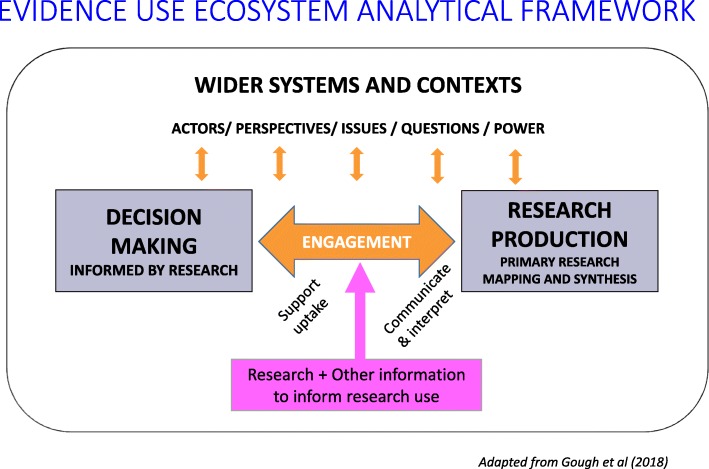
“Gough et al. (2018) similarly argue for strengthened engagement between the different actors as a precondition to understand variation in each other’s perspectives and research needs.”
Redundancy in Evidence Synthesis: Overlap, Waste, and Distortion in the Secondary Evidence Ecosystem
Chengxun, C., Yao, J., & Yi, Z. H. O. U. (2026) · JMIR Metascience and Research Integrity · doi:10.2196/preprints.104150
Ichana, C., Boulanger, C., Blanchard, C., Charuel, É., Ménini, T., Vaillant-Roussel, H., & Boussageon, R. (2026) · French Academic Journal of Primary Care · doi:10.46298/fajpc.18899
Metadata
- Authors
- Gough, D., Thomas, J., & Oliver, S.
- Affiliations
- University College London (GB)
- University of Johannesburg (ZA)
- Corresponding author
- Gough, David
- Venue
- Systematic Reviews
- Published
- 2019-07-15
- Volume
- 8
- Issue
- 1
- Pages
- 170-170
- ISSN
- 2046-4053 (ISSN-L)
- PMC
- PMC6631872
- OpenAlex
- W2961682569
- Cited by
- 115
- References
- 46
- Citations by year
- 2026: 13 · 2025: 14 · 2024: 14 · 2023: 10 · 2022: 28 · 2021: 24 · 2020: 11 · 2019: 1
- FWCI
- 10.69
- Type
- journal article
- Language
- en
- Open access
- gold
- doi.org
- Licence
- cc-by
- creativecommons.org/licenses/by/4.0/ (tdm)
- creativecommons.org/licenses/by/4.0/ (vor)
- Locations
- Systematic Reviews (publishedVersion, cc-by)
- PubMed Central (publishedVersion, cc-by)
- PubMed (publishedVersion)
- DOAJ (DOAJ: Directory of Open Access Journals) (submittedVersion, cc-by-sa)
- UCL Discovery (University College London) (submittedVersion)
- Funders
- World Health Organization
- Department of Health and Social Care
- Department for International Development
- Alliance for Health Policy and Systems Research
- Economic and Social Research Council
- Topics
- Social Sciences › Decision Sciences › Statistics, Probability and Uncertainty › Meta-analysis and systematic reviews
- Social Sciences › Sociology and Political Science › Delphi Technique in Research
- Health Sciences › Medicine › Public Health, Environmental and Occupational Health › Clinical practice guidelines implementation
- Keywords
- evidence ecosystem, review methodology
- MeSH terms
- Systematic Reviews as Topic, Humans, Research Design, Ecosystem
About these checks
Registry, retraction, Cites and statistics results are computed, not judged, with one exception: a printed reference that no index lists is read once by a model before it counts as a citation error. Claims are extracted by a model and kept only when their quote appears verbatim in the text; each cited source is then checked, with a model’s help, for whether it says what the claim relies on. Those verdicts can be wrong — read the claim’s quote and the cited source before relying on one.
Statistics and arithmetic are recomputed, not judged.
Confidence bands are shown only for fields calibrated on our annotated test set. None is calibrated yet, so no band is shown.
What counts as a claim ›How we measure confidence ›How we check this ›
Are you an author, or do you see a problem with this page? Request a review
Data sources
Bibliographic data: Semantic Scholar, OpenAlex, Crossref.
Contains information from the Semantic Scholar Academic Graph Datasets, made available under the ODC Attribution License (ODC-BY 1.0).
Semantic Scholar’s data is described in: Kinney, R., et al. (2023). The Semantic Scholar Open Data Platform. arXiv:2301.10140.
