

Research Screener: a machine learning tool to semi-automate abstract screening for systematic reviews
Open accessThe DOI matches its Crossref record; 56 of the 57 references it cites were found in a registry or an index.
Abstract
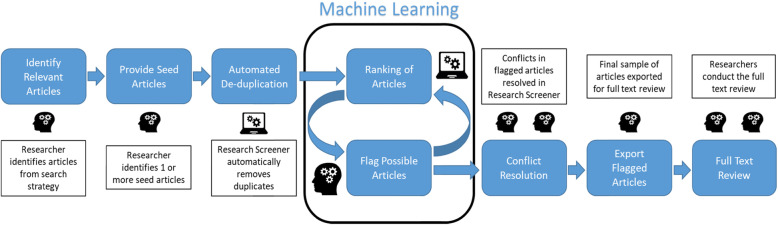
Background: Systematic reviews and meta-analyses provide the highest level of evidence to help inform policy and practice, yet their rigorous nature is associated with significant time and economic demands. The screening of titles and abstracts is the most time consuming part of the review process with analysts required review thousands of articles manually, taking on average 33 days. New technologies aimed at streamlining the screening process have provided initial promising findings, yet there are limitations with current approaches and barriers to the widespread use of these tools. In this paper, we introduce and report initial evidence on the utility of Research Screener, a semi-automated machine learning tool to facilitate abstract screening. Methods: Three sets of analyses (simulation, interactive and sensitivity) were conducted to provide evidence of the utility of the tool through both simulated and real-world examples. Results: Research Screener delivered a workload saving of between 60 and 96% across nine systematic reviews and two scoping reviews. Findings from the real-world interactive analysis demonstrated a time saving of 12.53 days compared to the manual screening, which equates to a financial saving of USD 2444. Conservatively, our results suggest that analysts who scan 50% of the total pool of articles identified via a systematic search are highly likely to have identified 100% of eligible papers. Conclusions: In light of these findings, Research Screener is able to reduce the burden for researchers wishing to conduct a comprehensive systematic review without reducing the scientific rigour for which they strive to achieve.
Overview
The claims and statistics of this paper haven’t been checked yet.
Free: it reads the open-access text and checks the first 5 claims that cite a source we can check. Create a free account to check every claim.
Integrity signals
Registry
Cites
Statistics
Figures
Verification
Claims the paper makes
The claims and statistics of this paper haven’t been checked yet.
Free: it reads the open-access text and checks the first 5 claims that cite a source we can check. Create a free account to check every claim.
Claims other papers make about this one
Each is checked against this paper’s own text: does it say what the citing paper says it does?
The source backs part of the claim, not all of it — or backs it for a different population, condition or comparison.
In the citing paper
“However, these tools, sometimes referred to as discriminative artificial intelligence (AI) technologies, generally require human researchers providing large amount of sufficiently diverse data for training and active learning [1, 3, 5, 6].”
From Testing the utility of GPT for title and abstract screening in environmental systematic evidence synthesis (2025) · cites this paper as [5]
Experimental — accuracy not yet measuredThe source backs part of the claim, not all of it — or backs it for a different population, condition or comparison.
In the citing paper
“In summary, ML-assisted systematic reviews can significantly reduce workload and have proven accurate across various fields and review topics.”
From Machine Learning-Assisted Systematic Review: A Case Study in Learning Analytics (2025) · cites this paper as Chai et al. (2021)
Experimental — accuracy not yet measuredThe source backs part of the claim, not all of it — or backs it for a different population, condition or comparison.
In the citing paper
“Traditional systematic reviews, despite their high-quality evidence, are labor-intensive and error-prone, especially during the abstract screening phase.”
From Machine Learning-Assisted Systematic Review: A Case Study in Learning Analytics (2025) · cites this paper as Chai et al., 2021
Experimental — accuracy not yet measuredThe cited source says what the claim attributes to it.
In the citing paper
“Screening titles and abstracts is a critical component of the review process (Chai et al., 2021).”
From Screening Smarter, Not Harder: A Comparative Analysis of Machine Learning Screening Algorithms and Heuristic Stopping Criteria for Systematic Reviews in Educational Research (2024) · cites this paper as Chai et al., 2021
The cited source says what the claim attributes to it.
In the citing paper
“However, these tools are still evolving, and their performance may vary across domains and even within the same domain (Burgard & Bittermann, 2023; Chai et al., 2021; van de Schoot et al., 2021).”
From Screening Smarter, Not Harder: A Comparative Analysis of Machine Learning Screening Algorithms and Heuristic Stopping Criteria for Systematic Reviews in Educational Research (2024) · cites this paper as Chai et al., 2021
3 more claims about this paper
Create a free account to see every claim other papers make about this one.
Self-check
Percentages, sums and reported differences re-computed from the paper’s own numbers.
The self-check needs the paper’s full text.
Citations
Cites
Vaswani, A., Shazeer, N., Parmar, N., Uszkoreit, J., Jones, L., Gomez, A. N., Kaiser, L., & Polosukhin, I. (2017) · arXiv · doi:10.48550/arxiv.1706.03762 · Cited by 120,404
BERT: Pre-training of Deep Bidirectional Transformers for Language Understanding
Devlin, J., Chang, M.-W., Lee, K., & Toutanova, K. (2019) · Proceedings of the 2019 Conference of the North American Chapter of the Association for Computational Linguistics: Human Language Technologies, Volume 1 (Long and Short Papers) · doi:10.18653/v1/n19-1423 · Cited by 54,325
Glove: Global Vectors for Word Representation
Pennington, J., Socher, R., & Manning, C. (2014) · Proceedings of the 2014 Conference on Empirical Methods in Natural Language Processing (EMNLP) · doi:10.3115/v1/d14-1162 · Cited by 34,071
PRISMA-P Group, Moher, D., Shamseer, L., Clarke, M., Ghersi, D., Liberati, A., Petticrew, M., Shekelle, P., & Stewart, L. A. (2015) · Systematic Reviews · doi:10.1186/2046-4053-4-1 · Cited by 26,223
Rayyan-a web and mobile app for systematic reviews.
Ouzzani, M., Hammady, H., Fedorowicz, Z., & Elmagarmid, A. (2016) · Systematic Reviews · doi:10.1186/s13643-016-0384-4 · Cited by 26,092
Advances in neural information processing systems 7
Cios, K., & Shields, M. (1997) · Neurocomputing · doi:10.1016/s0925-2312(97)90018-7 · Cited by 22,059
Distributed Representations of Sentences and Documents
Le, Q. V., & Mikolov, T. (2014) · arXiv (Cornell University) · doi:10.48550/arxiv.1405.4053 · Cited by 4,934
De-duplication of database search results for systematic reviews in EndNote
Bramer, W. M., Giustini, D., de Jonge, G. B., Holland, L., & Bekhuis, T. (2016) · Journal of the Medical Library Association : JMLA · doi:10.3163/1536-5050.104.3.014 · Cited by 2,103 · cited 1×
“Using a traditional manual approach [6], the de-duplication took approximately 7 h to complete, though with Research Screener this process was completed in a matter of seconds.”
MethodSeventy-five trials and eleven systematic reviews a day: how will we ever keep up?
Bastian, H., Glasziou, P., & Chalmers, I. (2010) · PLoS Medicine · doi:10.1371/journal.pmed.1000326 · Cited by 1,188 · cited 2×
“As a research methodology, systematic reviews first appeared around the 1970s, and since that time their appeal has grown exponentially (e.g. by 2007 there were 11 systematic reviews published every day [4]).”
BackgroundMethodAn open source machine learning framework for efficient and transparent systematic reviews
van de Schoot, R., de Bruin, J., Schram, R., Zahedi, P., de Boer, J., Weijdema, F., Kramer, B., Huijts, M., Hoogerwerf, M., Ferdinands, G., et al. (2021) · Nature Machine Intelligence · doi:10.1038/s42256-020-00287-7 · Cited by 1,157
Cited by
Items 101–192 of 192
Ramchandani, R., Guo, E., Rakab, E., Rathod, J., Strain, J., Klement, W., Shorr, R., Williams, E., Jones, D., & Gilbert, S. (2025) · PeerJ Computer Science · doi:10.7717/peerj-cs.2822 · Cited by 8
Rumsa, S., Afsharnejad, B., Lee, E. A. L., Bölte, S., Tan, T., & Girdler, S. J. (2025) · Autism · doi:10.1177/13623613251346336 · Cited by 8
“Titles were then screened by the primary researcher to delete any highly irrelevant articles, before uploading all remaining articles into the screening software, Research Screener (Chai et al., 2021).”
Riddell, H., Sedikides, C., Sivaramakrishnan, H., Wan, P., Maltagliati, S., Jackson, B., Thøgersen‐Ntoumani, C., Gucciardi, D. F., & Ntoumanis, N. (2025) · Nature Human Behaviour · doi:10.1038/s41562-025-02312-4 · Cited by 9
“Systematic reviewers are highly likely to identify all eligible articles by screening 5–35% of the total pool using Research Screener.”
InfluentialSelf-citationKönig, L., Zitzmann, S., & Hecht, M. (2025) · Research Synthesis Methods · doi:10.1017/rsm.2025.10053 · Cited by 5
“In contrast, the RF + TFIDF algorithm showed the worst performance (SC = 48.85% [36.48, 63.60]).”
InfluentialPerfectionism and compulsive exercise: a systematic review and preliminary meta-analysis
Bills, E., Muir, S., Stackpole, R., & Egan, S. J. (2025) · Eating and Weight Disorders - Studies on Anorexia Bulimia and Obesity · doi:10.1007/s40519-024-01704-1 · Cited by 7
Houston, J. L., Boyd, K. P., Gittings, P. M., & Cavalheri, V. (2025) · Supportive Care in Cancer · doi:10.1007/s00520-025-09612-5 · Cited by 4
“Duplicate articles were removed using End-Note and subsequently the EndNote database was uploaded into Research Screener [8], a machine learning Web application used to semi-automate article screening.”
Wunderlich, M. F., & Møller, A.-K. L. (2025) · Human Resource Management · doi:10.1002/hrm.70029 · Cited by 7
Fok, R., Siu, A. F., & Weld, D. S. (2025) · CHI Conference on Human Factors in Computing Systems · doi:10.1145/3706598.3714047 · Cited by 10
“…automatically scaffold (e.g., [13, 26]) and generate review sections (e.g., [2, 20, 38]), and proposed interactive methods to support relevant processes such as literature discovery (e.g., [17, 41]) and appraisal (e.g., [4, 18]), comprehension (e.g., [10, 21]), and synthesis (e.g., [14, 15, 37]).”
Kritz, M., Riddell, H., Olsen, D., Harden, S. M., Burke, S. M., Ntoumanis, N., & Thøgersen‐Ntoumani, C. (2026) · Nature Human Behaviour · doi:10.1038/s41562-026-02429-0 · Cited by 8
“The Research Screener software 53,54 , a validated machine learning tool 53 trained on eligible studies, was used to assist with the initial screening process by auto-mating the exclusion of irrelevant studies.”
Quadflieg, K., Grigoletto, I., Haesevoets, S., Cops, D., Ramos, E. M. C., Spruit, M. A., Cavalheri, V., & Burtin, C. (2023) · Archives of Physical Medicine and Rehabilitation · doi:10.1016/j.apmr.2023.04.013 · Cited by 5
Tu, J., Nacke, L. E., & Rogers, K. (2025) · Interacting with Computers · doi:10.1093/iwc/iwaf001 · Cited by 4
Nordmann, K., Schaller, M., Sauter, S., & Fischer, F. (2026) · JAMIA Open · doi:10.1093/jamiaopen/ooaf098 · Cited by 4
“12,14 Imbalanced datasets can bias algorithms towards exclusion.”
InfluentialVitamin D status in healthy populations worldwide: a systematic review protocol
Dunlop, E., Pham, N. M., Hoang, D. V., Kalmpourtzidou, Α., & Black, L. J. (2023) · JBI Evidence Synthesis · doi:10.11124/jbies-22-00354 · Cited by 5
Lim, A. M. L., Tourneau, C. L., Hurt, C. N., Laskar, S. G., Steuer, C. E., Chow, V. L. Y., Szturz, P., Henson, C. E., Day, A. T., Bates, J. E., et al. (2024) · The Lancet Oncology · doi:10.1016/s1470-2045(24)00068-8 · Cited by 4
Straker, L. M., Beynon, A. M., Smith, S. S., Johnson, D. M., Wyeth, P. A., Sefton‐Green, J., & Kervin, L. K. (2022) · OSF Preprints (OSF Preprints) · doi:10.31219/osf.io/7krjv · Cited by 4
The TARCiS statement: Guidance on terminology, application, and reporting of citation searchingPreprint
Hirt, J., Nordhausen, T., Fürst, T., Ewald, H., TARCiS study group, & Appenzeller‐Herzog, C. (2023) · medRxiv · doi:10.1101/2023.10.25.23297543 · Cited by 5
Zhang, Q., Pellegrini, M., Marsili, F., & Neitzel, A. J. (2024) · Frontiers in Research Metrics and Analytics · doi:10.3389/frma.2024.1430355 · Cited by 3
Holland, C., Oakes, D. B., Sarna, M. K., Chai, K. E. K., Ng, L., & Moore, H. C. (2025) · BMC Medical Research Methodology · doi:10.1186/s12874-025-02511-7 · Cited by 3
“RS has previously been validated and reported time savings of up to 96% of manual abstract screening time [4].”
InfluentialSelf-citationKonzett, V., Laskou, F., Smolen, J. S., Edwards, C. J., Aletaha, D., van der Heijde, D. M. F. M., Winthrop, K. L., Takeuchi, T., Caporali, R. F., Verschueren, P., et al. (2026) · Annals of the Rheumatic Diseases · doi:10.1016/j.ard.2026.05.006 · Cited by 5
AI in Literature Reviews: a survey of current and emerging methods
Saied, M., Mokhtar, N., Badr, A., Adel, M., Boles, P., & Khoriba, G. A. (2024) · International Mobile, Intelligent, and Ubiquitous Computing Conference (MIUCC) · doi:10.1109/miucc62295.2024.10783597 · Cited by 8
“Research Screener [2] uses paragraph embeddings for text representation.”
Hay, R. E., Zorko, D. J., O’Hearn, K., McQuaid, C., Pont‐Thibodeau, G. D., Guerra, G. G., Olivier, J., Ducharme‐Crevier, L., Lee, L. A., Bel, M. J. D., et al. (2025) · Pediatric Critical Care Medicine · doi:10.1097/pcc.0000000000003780 · Cited by 4
The Evolution of a Mediated Systematic Review Search Service
Russell, F., Grbin, L., Beard, F., Higgins, J., & Kelly, B. (2022) · Journal of the Australian Library and Information Association · doi:10.1080/24750158.2022.2029143 · Cited by 9
The Evolution of Diagnostic Techniques in the Paleopathology of Tuberculosis: A Scoping Review
Papa, V., Galassi, F. M., Varotto, E., Gori, A., & Vaccarezza, M. (2023) · Pathogens and Immunity · doi:10.20411/pai.v8i1.597 · Cited by 8
“The inclusion of records in the qualitative synthesis was performed using the online Research Screener machine learning tool for systematic reviews [50].”
MethodBooth, L., Miller, M., & Pettigrew, S. (2023) · Drug and Alcohol Review · doi:10.1111/dar.13769 · Cited by 4
Silva, D. T. N. D., Moore, B. R., Strunk, T., Petrovski, M., Varis, V., Chai, K. E. K., Ng, L., & Batty, K. T. (2024) · Pharmacology Research & Perspectives · doi:10.1002/prp2.1170 · Cited by 4
Self-citationMachine learning based system for the automation of systematic literature reviews
Pytlak, R., Bukhvalova, B. A., Cichosz, P., Fajdek, B., Grahek‐Ogden, D., Jastrzębski, B., Khan, M., Postupolski, J., Yazidi, A., & Waszkowski, R. (2023) · IEEE International Conference on Bioinformatics and Biomedicine (BIBM) · doi:10.1109/bibm58861.2023.10385372 · Cited by 4
“Recently three semi-automated tools for SLRs have been proposed: ASReview ( [17]), Research Screener ( [18]) and Symbals ( [19]).”
MethodThe use of discrete choice experiments in evaluating telehealth: a systematic review
Savira, F., Frith, M., Nguyen, D., Norman, R., Senyel, D., Boyd, J., & Robinson, S. (2025) · Health Policy · doi:10.1016/j.healthpol.2025.105421 · Cited by 4
Gao, L., Das, N., Mudiyanselage, S. B., Winter, N., Cowdery, S., White, V., & Livingston, P. M. (2026) · Cancer Medicine · doi:10.1002/cam4.71657 · Cited by 2
O'Leary, K. T., Mollison, J., Olson, R. E., Anemaat, L., Riba, M., & Foster, N. E. (2026) · Journal of Interprofessional Care · doi:10.1080/13561820.2026.2676646 · Cited by 2
Qudisa, M., & Fraz, M. M. (2024) · International Conference on Digital Futures and Transformative Technologies (ICoDT2) · doi:10.1109/icodt262145.2024.10740208 · Cited by 5
“Analysts typically spend an average of 33 days screening titles and abstracts, reviewing thousands of articles [7], a process increasingly impractical with the growing volume of publications.”
BackgroundTóth, B., Berek, L., Gulàcsi, L., Péntek, M., & Zrubka, Z. (2023) · Research Square · doi:10.21203/rs.3.rs-3425312/v1 · Cited by 2
Study screening for meta-research: An overview of AI toolsPreprint
Quan, Y., & Hui, B. (2023) · doi:10.31219/osf.io/bd6fj · Cited by 2
Papa, V., Vaccarezza, M., Galassi, F. M., & Varotto, E. (2023) · Italian Journal of Anatomy and Embryology · doi:10.36253/ijae-14549 · Cited by 1
“Finally, the enrolment of records in the qualitative synthesis was made using the online Research Screener machine learning tool for systematic reviews (Chai et al., 2021).”
MethodPalliative care for infants with life-limiting conditions: integrative review
Iten, R., O’Connor, M., & Gill, F. J. (2023) · BMJ Supportive & Palliative Care · doi:10.1136/spcare-2023-004435 · Cited by 1
A Systematic Literature Review on the Integration of ICT in Teaching Poetry in English Classrooms
Ning, G. K., & Ismail, H. H. (2024) · International Journal of Academic Research in Business and Social Sciences · doi:10.6007/ijarbss/v14-i6/21811 · Cited by 1
“This systematic filtering is essential in producing explicit and precise methodological syntheses of the research (Chai et al., 2021).”
MethodScoping review of communication impairment management in adults with brain tumours
Coleman, M., Brogan, E., & D’Souza, S. (2025) · International Journal of Speech-Language Pathology · doi:10.1080/17549507.2025.2510231 · Cited by 1
“Search results were imported into the validated literature search software tool Research Screener (Chai et al., 2021).”
InfluentialRasmussen, C. L., Au, I. P. H., Hendry, D., Beynon, A. M., Stearne, S., Thomas, G., Mannell, K., Kervin, L. K., Edwards, S., Harris, C. J., et al. (2026) · JMIR Pediatrics and Parenting · doi:10.2196/84712 · Cited by 2
Artificial Intelligence and Machine Learning for Climate Disaster Management
Kumar, D., & Bassill, N. P. (2025) · Disaster Resilience and Green Growth · doi:10.1007/978-981-95-1588-2_1 · Cited by 1
Holland, C., Oakes, D. B., Sarna, M. K., Chai, K. E. K., Ng, L., & Moore, H. C. (2025) · BMJ Open · doi:10.1136/bmjopen-2025-100476 · Cited by 1
Self-citationNordmann, K., & Fischer, F. (2025) · BMC Health Services Research · doi:10.1186/s12913-025-13901-4 · Cited by 3
Ellery, C. S., Avila, A. N., Papini, M. G., Fitzgerald, M., & Hellewell, S. C. (2026) · NeuroImage Clinical · doi:10.1016/j.nicl.2026.103956 · Cited by 3
“After screening one-quarter of the extracted articles, it became clear that a) there were many irrelevant articles, suggesting that the initial search strategy needed further refinement; and b) that Research Screener ™ was not able to resolve and rank the broad nature of the included literature, indicating that every…”
InfluentialGarcia, A. D., Mullan, B. A., Hill, K., Breen, L. J., & Maxwell‐Smith, C. (2026) · Breast Cancer · doi:10.1007/s12282-026-01859-y · Cited by 2
“Abstracts were screened by ADG using Research Screener [18], which presents articles in ranked “blocks” of 50 based on relevance; screening ceased after two consecutive blocks contained no eligible articles.”
Fütterer, T., König, L., Campos, D., Scherer, R., Zitzmann, S., & Hecht, M. (2026) · Advances in Methods and Practices in Psychological Science · doi:10.1177/25152459261442150 · Cited by 2
“However, despite the availability of AI tools, many researchers remain unfamiliar with them and unsure how to operate or integrate them into their research work-flows (e.g., Chai et al., 2021; Scott et al., 2021).”
Mongeon, J. G., Ouadfel, S., Thullier, F., Gaboury, S., & Arsenault‐Lapierre, G. (2026) · International Journal of Social Research Methodology · doi:10.1080/13645579.2026.2668099 · Cited by 1
Zou, Y., Kim, I., Gao, N., Li, M., Kim, M., & Ge, J. (2026) · npj gut and liver. · doi:10.1038/s44355-026-00068-w · Cited by 1
“UsingthePRISMA2020checklistmetrics(SupplementaryMaterial 6), items, and elements, we generated speci fi c prompts for each evaluation metric and asked the LLM “ judge ” to grade the appropriate section of the “ synthetic ” manuscript.”
InfluentialTomlin, L., Budden, T., Simpson, A., Kingdon, T., Gucciardi, D. F., Jeftic, I., Dimmock, J. A., Norsworthy, C., Borelli, J. L., Brophy‐Herb, H. E., et al. (2026) · Teaching and Teacher Education · doi:10.1016/j.tate.2026.105810 · Cited by 2
Self-citationComparing artificial intelligence versus human screening in systematic reviews
Gorici, M., Espin, A. T., & Oremus, M. (2026) · Health and Quality of Life Outcomes · doi:10.1186/s12955-026-02642-5 · Cited by 1
Ahmad, A. F., Galassi, F. M., Burlakoti, A., Vaccarezza, M., & Papa, V. (2024) · Heliyon · doi:10.1016/j.heliyon.2024.e32648 · Cited by 1
“” The inclusion of records in the qualitative synthesis was performed using the online Research Screener machine learning tool for systematic reviews [76].”
MethodProtocol of a Scoping Review on the Use of Transactional Data for Early Diagnosis (TRADED-ScR)
Araz, K., Jacob, B. M., Flanagan, J. M., & Redmond, P. (2025) · HRB Open Research · doi:10.12688/hrbopenres.14015.1
It is Feasible for 3 to 5‐Year‐Old Children to Use Smartwatch Activity Trackers: A Systematic Review
Davey, R. J., Zabatiero, J. G., Beynon, A. M., Wood, G., Sy, S., Rasmussen, C. L., Hendry, D., Stearne, S., Harris, C. J., Straker, L. M., et al. (2025) · Acta Paediatrica · doi:10.1111/apa.70137 · Cited by 2
Sharma, A., Huddy, V. C., & Williamson, E. (2025) · British Journal of Health Psychology · doi:10.1111/bjhp.70001 · Cited by 1
Pinna, M., Castle, E. M., Cavalheri, V., & Hill, K. (2025) · Journal of physiotherapy · doi:10.1016/j.jphys.2025.09.004 · Cited by 2
Knafou, J., Haas, Q., Borissov, N., Counotte, M. J., Low, N. N., Imeri, H., Ipekci, A. M., Buitrago‐García, D., Heron, L., Amini, P., et al. (2023) · bioRxiv (Cold Spring Harbor Laboratory) · doi:10.1101/2023.01.18.524571 · Cited by 1
Collaborative large language models (LLMs) are all you need for screening in systematic reviewsPreprint
Parmar, M., Naqvi, S. A. A., Warraich, K., Saeidi, A., Rawal, S. C., Faisal, K. S., Kazmi, S. Z., Fatima, M., He, H., Safdar, M., et al. (2026) · medRxiv · doi:10.64898/2026.02.07.26345640 · Cited by 2
Machine Learning-Assisted Systematic Review: A Case Study in Learning Analytics
Xu, Z., Zhuang, X., & Ma, S. (2025) · Education Sciences · doi:10.3390/educsci15111488 · Cited by 2
Michaelchuk, W. W., Quach, S., Benoit, A., Maybank, A., Oliveira, A., Goldstein, R. S., & Brooks, D. (2023) · doi:10.2196/preprints.46387
Critical Role of HR Professionals in the Adoption and Integration of AI in HRM
Aftab, A., & Khalid, K. (2023) · Advances in human resources management and organizational development book series · doi:10.4018/979-8-3693-0039-8.ch004 · Cited by 2
Boettcher-Hunt, E., Boyd, R. N., & Gibson, N. (2024) · Brain Injury · doi:10.1080/02699052.2024.2350049
“References from the database searches were prepared in EndNote TM 20 reference management software and then uploaded to the online Research Screener machine learning tool (28).”
ASReview LAB v2: Open-Source Text Screening with Multiple Agents and OraclesPreprint
Bruin, J. D., Lombaers, P., Kaandorp, C., Teijema, J. J., van der Kuil, T., Yazan, B., Dong, A., & van de Schoot, R. (2025) · SSRN Electronic Journal · doi:10.2139/ssrn.5136987
Zanela, M., Carvalho, D. R., & Mendes, R. (2025) · Saúde Coletiva (Barueri) · doi:10.36489/saudecoletiva.2025v15i93p14751-14770
Coronavirus research topics, tracking twenty years of research
Aryani, A., Wang, J. B., Salvador‐Carulla, L., Woo, J., Cheung, C., Wu, Z., Yin, H., Xiao, J., Lambert, É., Howitt, J. A., et al. (2025) · Scientific Data · doi:10.1038/s41597-025-04992-z
“Currently, a web application that uses natural language processing has been used to semi-automate systematic reviews and meta-analyses to reduce the time spent retrieving relevant articles to synthesise the results of research on one topic at one point in time (Chai et al ., 2022 33 ).”
Self-citationArtificial intelligence tools for automating evidence synthesis: A scoping review (Preprint)Preprint
Harasgama, S., Pearce, H., Appel, C., Loftus, L., Painter, H., Kuhn, I. L., Karpusheff, J., Ceesay, A., & Ford, J. A. (2025) · doi:10.2196/preprints.81597
Motahari-Nezhad, H., & CheshmehSohrabi, M. (2025) · Research Square · doi:10.21203/rs.3.rs-7265470/v1 · Cited by 1
Im, E., Kim, B. Y., Kang, S., & Kim, H. (2025) · JCO Clinical Cancer Informatics · doi:10.1200/cci-25-00233
User experience and adoption of automation and AI for evidence synthesis: a scoping review protocol
Valenzuela, C., Stern, C., & Aromataris, E. (2025) · JBI Evidence Synthesis · doi:10.11124/jbies-25-00236
Boetje, J., & van de Schoot, R. (2024) · Figshare · doi:10.6084/m9.figshare.26687522
Valizadeh, A., Moassefi, M., Nakhostin-Ansari, A., Hosseini-Asl, S. H., Saghab Torbati, M., Aghajani, R., Ghorbani, Z. M., & Faghani, S. (2022) · Figshare · doi:10.6084/m9.figshare.19980459
Speech and Language Disorders: A systematic review of corpora and future directions
Al-Marridi, A. Z., Ulde, S. M., Said, A. B., & Khwaileh, T. (2026) · Applied Corpus Linguistics · doi:10.1016/j.acorp.2025.100186 · Cited by 2
Bolhan, N. S., & Ismail, H. H. (2025) · International Journal of Education Psychology and Counseling · doi:10.35631/ijepc.1061028
Frith, M., Angeles, M. R., Savira, F., Randall, S. M., Lee, C., Huxley, R., & Robinson, S. (2026) · BMC Health Services Research · doi:10.1186/s12913-026-14192-z · Cited by 1
“Screening was conducted using Research Screener, a cloud-based web platform that uses an algorithm to semi-automate abstract screening for reviews [18].”
Ye, R., Sibia, N., Bernuy, A. Z., Zhu, T., Nobre, C., Pammer‐Schindler, V., & Liut, M. (2026) · ACM International Conference on Intelligent User Interfaces (IUI) · doi:10.1145/3742413.3789079 · Cited by 2
“Researchers face a fragmented landscape of “point solutions” that handle discrete tasks, such as citation chasing [25] or abstract screening [11], but lack integration.”
Surrogacy birth care practices in the hospital setting: a scoping review protocol
Attawet, J., Qiu, Y., Ng, L., Ojabo, M., Kendal, E. S., Jefford, S., & Peters, M. D. (2026) · JBI Evidence Synthesis · doi:10.11124/jbies-25-00222
Self-citationHenley-Martin, S. R., Brade, C. J., Thompson, S. L., Ramos, J. A. P., Marsh, C. E., Collis, J. J., Naylor, L. H., & Spence, A. L. (2026) · American Journal of Physiology-Heart and Circulatory Physiology · doi:10.1152/ajpheart.00897.2025
Cartography of risks related to drug exposure during pregnancy
Ajiji, P. (2022) · theses.fr (ABES) · doi:10.70675/59762305ze937z47b1z94a5z1a103a1c89af
Derdouri, A., Oyama, T., Murayama, Y., & Masago, Y. (2026) · Research Square · doi:10.21203/rs.3.rs-9582053/v1
Thomas, G., Alley, S., Browne, M., Baumann, H., Duncan, M. J., Vandelanotte, C., & Gilson, N. D. (2026) · Digital Health · doi:10.1177/20552076261455158
Attractive Things Do Work Better: A Meta-Analysis on Visual Aesthetics and User Performance
Schlamann, M., Nestler, S., & Thielsch, M. T. (2026) · International Journal of Human-Computer Interaction · doi:10.1080/10447318.2026.2664081 · Cited by 1
Mena, N. B., Awange, J. L., & Mi, X. (2026) · Journal of Hydrology Regional Studies · doi:10.1016/j.ejrh.2026.103678
Liu, Y., Yang, R., Liew, J. C. K., Yin, Z., Foote, H. P., Lindsell, C. J., & Hong, C. (2026) · Journal of Healthcare Informatics Research · doi:10.1007/s41666-026-00246-8 · Cited by 5
“Subsequent studies directly leveraged word embedding techniques to convert abstracts into embedding vectors and classify relevant studies [8].”
Munguía‐Realpozo, P., Ramírez‐Lara, E., Pinto, C. M., Etchegaray‐Morales, I., Solís-Poblano, J. C., Trinidad-González, M. A., Ayón-Aguilar, J., García-Flores, M. A., & Montiel-Jarquín, Á. J. (2026) · Digital Health · doi:10.1177/20552076261467480
Michaelchuk, W. W., Quach, S., Newman, A. N. L., Benoit, A., Maybank, A., Oliveira, A., Goldstein, R., & Brooks, D. (2026) · Applied Clinical Informatics · doi:10.1055/a-2897-2572
Shankar, R., Goh, Z., & Xu, Q. (2026) · Campbell Systematic Reviews · doi:10.1177/18911803261469813
“For instance, Chai et al. (Chai et al., 2021) worked with a relatively small corpus of 306 articles, while Hamel et al. (Hamel et al., 2020) utilized much larger datasets comprising 69,663 articles.”
InfluentialWhat Changed Since 1994: Educator Attitudes Toward Gifted Education
Ozkan, F., Oğurlu, Ü., & Özbey, A. (2026) · Journal of Advanced Academics · doi:10.1177/1932202x261474545
Barragán, A. M., Bonett, S. E. O., Rodríguez-Grande, E.-I., Orjuela-Cañón, Á. D., Perdómo, O., & Sánchez, G. (2026) · Cochrane Evidence Synthesis and Methods · doi:10.1002/cesm.70098
“Six articles [9, 43, 58, 82, 132, 156] also used two comparators: a concurrent comparison with human reviewers using the traditional process, and a retrospective comparison with the same type of reviewers.”
InfluentialWanless, R., Claessen, M., Gucciardi, D. F., & Smart, S. J. (2026) · International Journal of Speech-Language Pathology · doi:10.1080/17549507.2026.2713492
Self-citationFrom Literature Overload to Knowledge Graph: An Automated Pipeline for Literature Reviews
Van, O. L., Dardouillet, P., & Boutalbi, K. (2026) · IEEE Annual International Computer Software and Applications Conference (COMPSAC) · doi:10.1109/compsac69091.2026.00267
Костюк, І. А. (2026) · Farmatsevtychnyi zhurnal · doi:10.32352/0367-3057.4.26.05
Kertész, G., Czere, J. T., Zrubka, Z., Gulàcsi, L., & Péntek, M. (2026) · JMIR Formative Research · doi:10.2196/86647 · Cited by 4
“Overall, the SLR screening literature [55] provides strong evidence that ML can effectively support the process of study selection, particularly through prioritization and human-in-the-loop workflows.”
Perceived Barriers and Facilitators to Physical Activity Among Autistic Adults: A Scoping Review
Duong, V. N., Quested, E., McVeigh, J. A., Wan, P., & Thompson, C. (2026) · Journal of Physical Activity and Health · doi:10.1123/jpah.2026-0200
Shatskiy, A. S., Deigheidy, E. M., Masyutina, S. E., & Mamalyga, M. L. (2026) · Complex Issues of Cardiovascular Diseases · doi:10.17802/2306-1278-2026-15-4-153-163
Flourishing Childhood Frameworks: A Scoping Review
Davis, J. A., Talati, Z., Gibson, L. Y., Kennare, J., Bethell, C., Hinton, C., Block, H., DSilva, T., Silva, D. T., & Prescott, S. L. (2026) · PEDIATRICS · doi:10.1542/peds.2025-075582
Adam, G. P., Davies, M. C., Caputo, E. L., Mai, H. J., Coppola, E. L., Holmer, H. K., Kuhn, E., Balk, E. M., Trikalinos, T. A., Ivlev, I., et al. (2026) · Research Synthesis Methods · doi:10.1017/rsm.2026.10118
Metadata
- Authors
- Chai, K. E. K., Lines, R. L. J., Gucciardi, D. F., & Ng, L.
- Affiliations
- Curtin University (AU)
- Corresponding author
- Ng, Leo
- Venue
- Systematic Reviews
- Published
- 2021-04-01
- Volume
- 10
- Issue
- 1
- Pages
- 93-93
- ISSN
- 2046-4053 (ISSN-L)
- PMC
- PMC8017894
- OpenAlex
- W3143985904
- Cited by
- 190
- References
- 57
- Citations by year
- 2026: 38 · 2025: 50 · 2024: 43 · 2023: 40 · 2022: 13 · 2021: 6
- FWCI
- 1.06
- Type
- journal article
- Language
- en
- Open access
- gold
- doi.org
- Licence
- cc-by
- creativecommons.org/licenses/by/4.0/ (tdm)
- creativecommons.org/licenses/by/4.0/ (vor)
- Locations
- Systematic Reviews (publishedVersion, cc-by)
- PubMed Central (publishedVersion, cc-by)
- PubMed (publishedVersion)
- DOAJ (DOAJ: Directory of Open Access Journals) (submittedVersion, cc-by-sa)
- Topics
- Social Sciences › Decision Sciences › Statistics, Probability and Uncertainty › Meta-analysis and systematic reviews
- Social Sciences › General Social Sciences › Computational and Text Analysis Methods
- Physical Sciences › Computer Science › Information Systems › Information Retrieval and Search Behavior
- Keywords
- abstract screening, machine learning, semi-automated screening, scoping review, workload reduction, eligibility screening
- MeSH terms
- Machine Learning, Systematic Reviews as Topic, Humans, Mass Screening, Research, Workload
About these checks
Registry, retraction, Cites and statistics results are computed, not judged, with one exception: a printed reference that no index lists is read once by a model before it counts as a citation error. Claims are extracted by a model and kept only when their quote appears verbatim in the text; each cited source is then checked, with a model’s help, for whether it says what the claim relies on. Those verdicts can be wrong — read the claim’s quote and the cited source before relying on one.
Statistics and arithmetic are recomputed, not judged.
Confidence bands are shown only for fields calibrated on our annotated test set. None is calibrated yet, so no band is shown.
What counts as a claim ›How we measure confidence ›How we check this ›
Are you an author, or do you see a problem with this page? Request a review
Data sources
Bibliographic data: Semantic Scholar, OpenAlex, Crossref.
Contains information from the Semantic Scholar Academic Graph Datasets, made available under the ODC Attribution License (ODC-BY 1.0).
Semantic Scholar’s data is described in: Kinney, R., et al. (2023). The Semantic Scholar Open Data Platform. arXiv:2301.10140.
