

The DOI matches its Crossref record; 3 of the 3 references it cites were found in a registry or an index.
Gluten in pharmaceutical products: a scoping review
Open accessAbstract
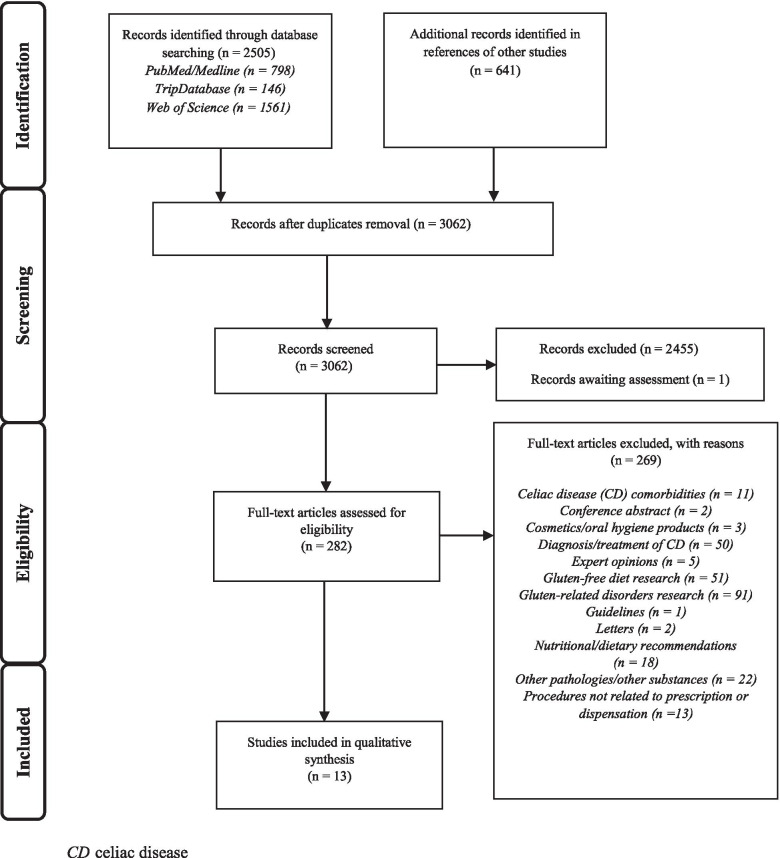
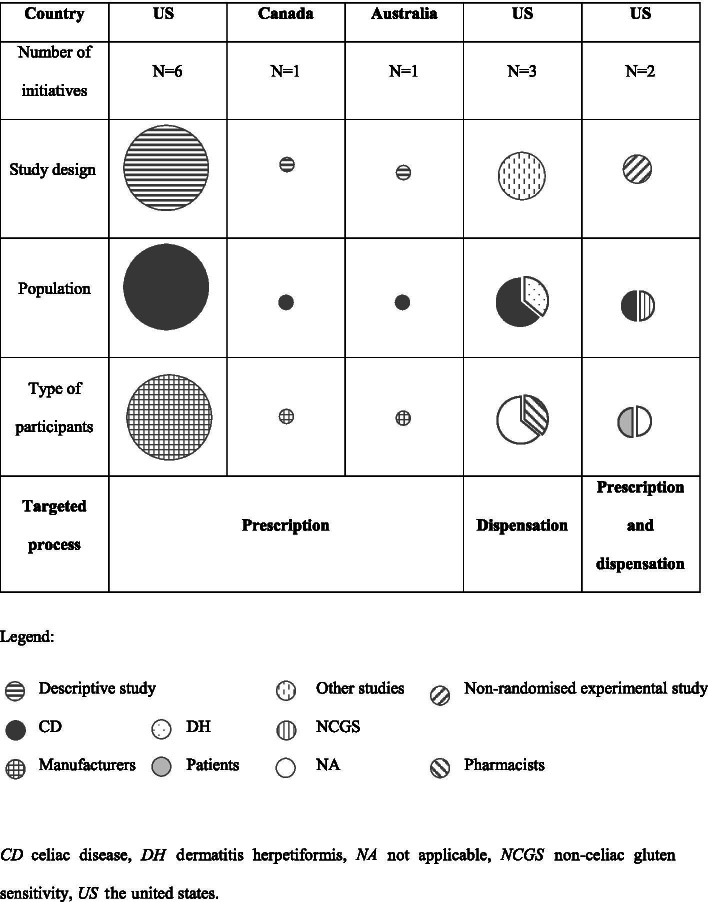
Background: Celiac disease (CD) is one of the most common gluten-related disorders. Although the only effective treatment is a strict gluten-free diet, doubts remain as to whether healthcare professionals take this restriction into consideration when prescribing and dispensing medicines to susceptible patients. This scoping review aimed to find out the current evidence for initiatives that either describe the gluten content of medicines or intend to raise awareness about the risk of prescribing and dispensing gluten-containing medicines in patients with CD and other gluten-related disorders. Methods: A scoping review was conducted using three search strategies in PubMed/MEDLINE, TripDatabase and Web of Science in April 2021, following the PRISMA extension for scoping reviews (PRISMA-ScR). References from included articles were also examined. Two researchers screened the articles and results were classified according to their main characteristics and outcomes, which were grouped according to the PCC (Population, Concept and Context) framework. The initiatives described were classified into three targeted processes related to gluten-containing medicines: prescription, dispensation and both prescription and dispensation. Results: We identified a total of 3146 records. After the elimination of duplicates, 3062 articles remained and ultimately 13 full texts were included in the narrative synthesis. Most studies were conducted in the US, followed by Canada and Australia, which each published one article. Most strategies were focused on increasing health professional’s knowledge of gluten-containing/gluten-free medications (n = 8), which were basically based on database development from manufacturer data. A wide variability between countries on provided information and labelling of gluten-containing medicines was found. Conclusion: Initiatives regarding the presence of gluten in medicines, including, among others, support for prescribers, the definition of the role of pharmacists, and patients’ adherence problems due to incomplete labelling of the medicines, have been continuously developed and adapted to the different needs of patients. However, information is still scarce, and some aspects have not yet been considered, such as effectiveness for the practical use of solutions to support healthcare professionals.
Overview
The claims and statistics of this paper haven’t been checked yet.
Run the check — free, no account needed. It reads the open-access text and checks the sources it cites.
Integrity signals
Registry
Cites
Statistics
Figures
Verification
Claims the paper makes
The claims and statistics of this paper haven’t been checked yet.
Run the check — free, no account needed. It reads the open-access text and checks the sources it cites.
Claims other papers make about this one
Each is checked against this paper’s own text: does it say what the citing paper says it does?
The source backs part of the claim, not all of it — or backs it for a different population, condition or comparison.
In the citing paper
“Most likely, the amounts are minimal considered the low amounts of wheat starch used in medical drugs resulting in a low daily dose of gluten (80,81).”
From Gluten-free diet for pediatric patients with coeliac disease: A position paper from the ESPGHAN gastroenterology committee, special interest group in coeliac disease. (2024) · cites this paper as [80]
Experimental — accuracy not yet measured
Self-check
Percentages, sums and reported differences re-computed from the paper’s own numbers.
The self-check needs the paper’s full text.
Citations
Cites
PRISMA Extension for Scoping Reviews (PRISMA-ScR): Checklist and Explanation
Tricco, A. C., Lillie, E., Zarin, W., O'Brien, K. K., Colquhoun, H., Levac, D., Moher, D., Peters, M. D. J., Horsley, T., Weeks, L., et al. (2018) · Annals of Internal Medicine · doi:10.7326/m18-0850 · Cited by 43,565
Global Prevalence of Celiac Disease: Systematic Review and Meta-analysis
Singh, P., Arora, A., Strand, T. A., Leffler, D. A., Catassi, C., Green, P. H., Kelly, C. P., Ahuja, V., & Makharia, G. K. (2018) · Clinical Gastroenterology and Hepatology · doi:10.1016/j.cgh.2017.06.037 · Cited by 1,743
Lebwohl, B., Sanders, D. S., & Green, P. H. R. (2018) · The Lancet · doi:10.1016/s0140-6736(17)31796-8 · Cited by 1,065
Research works printed but not linked: 19
- Ludvigsson JF, Leffler DA, Bai JC, et al. The Oslo definitions for coeliac disease and related terms. Gut. 2013;62:43–52. · DOI · Paper page
- Catassi C, Gatti S, Lionetti E. World perspective and celiac disease epidemiology. Dig Dis. 2015;33:141–6. · DOI
- Elli L, Villalta D, Roncoroni L, et al. Nomenclature and diagnosis of gluten-related disorders: a position statement by the Italian Association of Hospital Gastroenterologists and Endoscopists (AIGO). Dig Liver Dis. 2017;49:138–46. · DOI
- Mearns ES, Taylor A, Boulanger T, et al. Systematic literature review of the economic burden of celiac disease. Pharmacoeconomics. 2019;37:45–61. · DOI
- Mangione RA, Patel PN. Caring for patients with celiac disease: the role of the pharmacist. J Am Pharm Assoc. 2008;48:e125–35. · DOI
- Patel DG, Krogh CM, Thompson WG. Gluten in pills: a hazard for patients with celiac disease. Can Med Assoc J. 1985;133:114–5.
- Challen RG, O’Shannassy RM. Gluten content of Australian pharmaceutical products. Med J Aust. 1987;146:91–3. · DOI
- King AR. The Impact of celiac sprue on patients’ medication choices. Hosp Pharm. 2009;44:105–6. · DOI
- King AR. Gluten content of the top 200 medications of 2008: A follow-up to the impact of celiac sprue on patients’ medication choices. Hosp Pharm. 2009;44:984–92. · DOI
- King AR. Gluten content of the top 200 medications: follow-up to the influence of gluten on a patient’s medication choices. Hosp Pharm. 2013;48:736–43. · DOI
- Cruz JE, Cocchio C, Lai PT, et al. Gluten content of medications. Am J Health Syst Pharm. 2015;72:54–60. · DOI
- King AR. The influence of gluten on a patient’s medication choices. Hosp Pharm. 2010;45(11):841–3. · DOI
- Crowe JP, Falini NP. Gluten in pharmaceutical products. Am J Health Syst Pharm. 2001;58:396–401. · DOI
- Mangione RA, Patel PN. Pharmaceutical care of celiac disease. US Pharm. 2011;36:30–3.
- Avena-Woods C, Mangione RA, Wu WK. Exploring the community pharmacist’s knowledge of celiac disease. Am J Pharm Educ. 2018;82:100–5. · DOI
- Miletic ID, Miletic VD, Sattely-Miller EA, Schiffman SS. Identification of gliadin presence in pharmaceutical products. J Pediatr Gastroenterol Nutr. 1994;19:27–33. · DOI
- Urwin H, Wright D, Twigg M, et al. Early recognition of coeliac disease through community pharmacies: a proof of concept study. Int J Clin Pharm. 2016;38(5):1294–300. · DOI
- Plogsted S. Medications and celiac disease - tips from a pharmacist. Pract Gastroenterol. 2007;31:58–64.
- Esteban S, Podder N, Cruciani R. Celiac disease: not all medications are contaminated with gliadin. J Pain Symptom Manage. 2006;31:195–6. · DOI
Cited by
Sorted by citations
Luque, V., Crespo‐Escobar, P., Hård af Segerstad, E. M., Koltai, T., Norsa, L., Roman, E., Vreugdenhil, A., Fueyo‐Díaz, R., & Ribes‐Koninckx, C. (2024) · Journal of Pediatric Gastroenterology and Nutrition · doi:10.1002/jpn3.12079 · Cited by 44
Metadata
- Authors
- Lizano-Díez, I., Mariño, E. L., & Modamio, P.
- Affiliations
- Universitat de Barcelona (ES)
- Corresponding author
- Modamio, Pilar
- Venue
- Systematic Reviews
- Published
- 2021-08-07
- Volume
- 10
- Issue
- 1
- Pages
- 218-218
- ISSN
- 2046-4053 (ISSN-L)
- PMC
- PMC8349483
- OpenAlex
- W3190780165
- Cited by
- 12
- References
- 3
- Citations by year
- 2026: 1 · 2025: 5 · 2024: 3 · 2023: 3
- FWCI
- 1.37
- Type
- journal article
- Language
- en
- Open access
- gold
- doi.org
- Locations
- Systematic Reviews (publishedVersion, cc-by)
- PubMed Central (publishedVersion, cc-by)
- PubMed (publishedVersion)
- Dipòsit Digital de la Universitat de Barcelona (Universitat de Barcelona) (publishedVersion, cc-by-nc-nd)
- DOAJ (DOAJ: Directory of Open Access Journals) (submittedVersion, cc-by-sa)
- Topics
- Health Sciences › Medicine › Gastroenterology › Celiac Disease Research and Management
- Health Sciences › Health Professions › Pharmacy › Pharmacy and Medical Practices
- Life Sciences › Pharmacology, Toxicology and Pharmaceutics › Toxicology › Pharmacovigilance and Adverse Drug Reactions
- Keywords
- gluten, pharmaceutical products, celiac disease, gluten-related disorders, drug labeling, drug prescribing, dispensing, pharmacist role, health professionals' knowledge, medication adherence
- MeSH terms
- Celiac Disease, Pharmaceutical Preparations, Glutens, Humans, Pharmacists, Diet, Gluten-Free
About these checks
Registry, retraction, Cites and statistics results are computed, not judged, with one exception: a printed reference that no index lists is read once by a model before it counts as a citation error. Claims are extracted by a model and kept only when their quote appears verbatim in the text; each cited source is then checked, with a model’s help, for whether it says what the claim relies on. Those verdicts can be wrong — read the claim’s quote and the cited source before relying on one.
Statistics and arithmetic are recomputed, not judged.
Confidence bands are shown only for fields calibrated on our annotated test set. None is calibrated yet, so no band is shown.
What counts as a claim ›How we measure confidence ›How we check this ›
Are you an author, or do you see a problem with this page? Request a review
