

A systematic review of the purposes of Blockchain and fog computing integration: classification and open issues
Open accessThe DOI matches its Crossref record; 212 of the 212 references it cites were found in a registry or an index.
Abstract
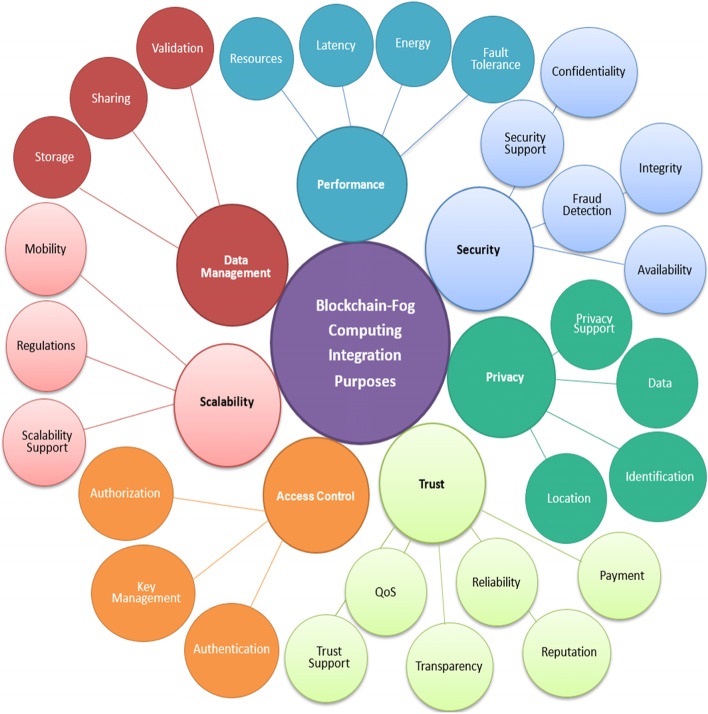
The fog computing concept was proposed to help cloud computing for the data processing of Internet of Things (IoT) applications. However, fog computing faces several challenges such as security, privacy, and storage. One way to address these challenges is to integrate blockchain with fog computing. There are several applications of blockchain-fog computing integration that have been proposed, recently, due to their lucrative benefits such as enhancing security and privacy. There is a need to systematically review and synthesize the literature on this topic of blockchain-fog computing integration. The purposes of integrating blockchain and fog computing were determined using a systematic literature review approach and tailored search criteria established from the research questions. In this research, 181 relevant papers were found and reviewed. The results showed that the authors proposed the combination of blockchain and fog computing for several purposes such as security, privacy, access control, and trust management. A lack of standards and laws may make it difficult for blockchain and fog computing to be integrated in the future, particularly in light of newly developed technologies like quantum computing and artificial intelligence. The findings of this paper serve as a resource for researchers and practitioners of blockchain-fog computing integration for future research and designs.
Overview
The claims and statistics of this paper haven’t been checked yet.
Free: it reads the open-access text and checks the first 5 claims that cite a source we can check. Create a free account to check every claim.
Integrity signals
Registry
Cites
Statistics
Figures
Verification
Claims the paper makes
The claims and statistics of this paper haven’t been checked yet.
Free: it reads the open-access text and checks the first 5 claims that cite a source we can check. Create a free account to check every claim.
Claims other papers make about this one
Each is checked against this paper’s own text: does it say what the citing paper says it does?
The source backs part of the claim, not all of it — or backs it for a different population, condition or comparison.
In the citing paper
“Current literature [16-18], reveals critical gaps in IoT security, particularly in the scalability of cryptographic solutions, the integration of blockchain technology, the privacy implications of machine learning, and the security measures within fog/edge computing environments.”
From Privacy-preserving security of IoT networks: A comparative analysis of methods and applications (2025) · cites this paper as [17]
Experimental — accuracy not yet measuredThe source backs part of the claim, not all of it — or backs it for a different population, condition or comparison.
In the citing paper
“Current literature [16-18], reveals critical gaps in IoT security, particularly in the scalability of cryptographic solutions, the integration of blockchain technology, the privacy implications of machine learning, and the security measures within fog/edge computing environments.”
From Privacy-preserving security of IoT networks: A comparative analysis of methods and applications (2025) · cites this paper as [17]
Experimental — accuracy not yet measuredThe cited source says what the claim attributes to it.
In the citing paper
“Current literature [16-18], reveals critical gaps in IoT security, particularly in the scalability of cryptographic solutions, the integration of blockchain technology, the privacy implications of machine learning, and the security measures within fog/edge computing environments.”
From Privacy-preserving security of IoT networks: A comparative analysis of methods and applications (2025) · cites this paper as [17]
Self-check
Percentages, sums and reported differences re-computed from the paper’s own numbers.
The self-check needs the paper’s full text.
Citations
Cites
1 retracted
Items 201–212 of 212
Fog Computing and Blockchain for Massive IoT Deployment
Baouya, A., Chehida, S., Bensalem, S., & Bozga, M. D. (2020) · Mediterranean Conference on Embedded Computing (MECO) · doi:10.1109/meco49872.2020.9134098 · Cited by 12 · cited 3×
“[140] proposed a BC-based architecture for IoT device control that is scalable.”
BackgroundMethodSimpson, G., & Kester, Q.-A. (2019) · International Conference on Cyber Security and Internet of Things (ICSIoT) · doi:10.1109/icsiot47925.2019.00006 · Cited by 12 · cited 3×
“Simpson and Quist-Aphetsi [142] suggested a framework that makes it simple to ensure that a patient’s medical information is accessible across multiple healthcare institutions.”
BackgroundMethodPushing Software-Defined Blockchain Components onto Edge Hosts
Samaniego, M., & Deters, R. (2019) · Hawaii International Conference on System Sciences (HICSS) · doi:10.24251/hicss.2019.849 · Cited by 11 · cited 1×
“While trusted parties or centralized authorities may misbehave and can be compromised, disrupted, or hacked, transactions in the public ledger of BC are validated by a majority consensus of miner nodes involved in the validation process [33].”
BackgroundBlockchain as a Platform for Fog Computing
Podsevalov, I., Iakushkin, O., Kurbangaliev, R., & Korkhov, V. V. (2019) · Lecture notes in computer science · doi:10.1007/978-3-030-24296-1_48 · Cited by 11 · cited 2×
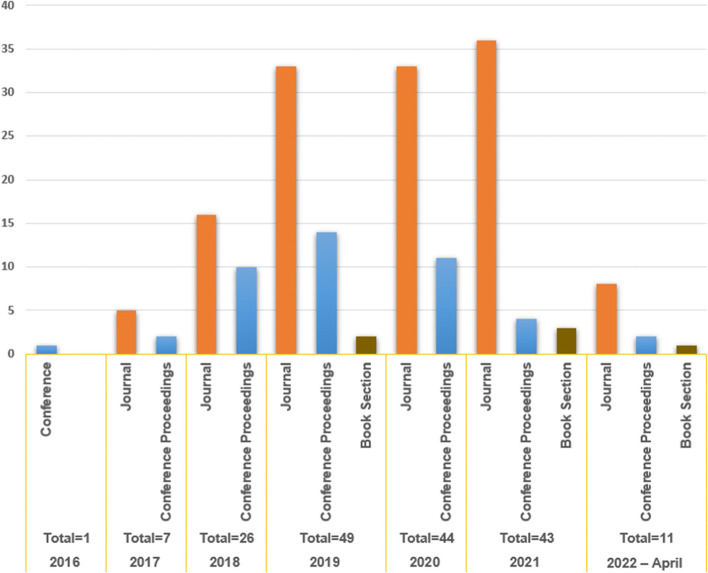
“Twenty two papers were literature review includes one paper published in 2016 ([125]), one paper in 2017 ([57]), two papers in 2018 ([63, 185]), seven papers in 2019 ([27, 109, 164, 194, 207, 210, 228]), three papers in 2020 ([85, 86, 195]), five papers in 2021 ([60, 191, 192, 200, 211]), and three papers up to April…”
BackgroundSecurity and Device Control Method for Fog Computer using Blockchain
Jeong, J. W., Kim, B. Y., & Jang, J. W. (2018) · International Conference on Information Science and Systems (ICISS) · doi:10.1145/3209914.3209917 · Cited by 10 · cited 2×
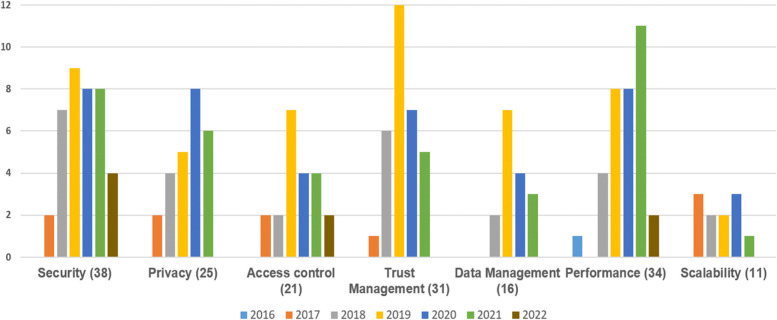
“…architectural designs to support security in FC environment ([81, 84, 104, 120, 139]): to protect against frauds ([73, 147, 149, 164, 168, 181, 221–223]), to enhance and achieve data confidentiality ([48, 123, 192, 229]), to enhance and achieve data integrity ([32, 58, 61, 87, 94, 127, 193,…”
BackgroundMutual Authentication and Authorized Data Access Between Fog and User Based on Blockchain Technology
Arun, M. R., Balamurali, S., Rawal, B. S., Duan, Q., Ramasamy, L. K., & Balusamy, B. (2020) · IEEE Conference on Computer Communications Workshops (INFOCOM WKSHPS) · doi:10.1109/infocomwkshps50562.2020.9162915 · Cited by 10 · cited 3×
“Authors provides several mechanisms to ensures and enhance authentication ([52, 75, 121, 130, 171, 183, 199]), to enable and enhance authorization ([93, 96, 135, 182, 216]), and provide key management ([56, 112, 122, 144, 164, 189]).”
BackgroundMethodA Novel Blockchain Identity Authentication Scheme Implemented in Fog Computing
Wang, H., & Jiang, Y. (2020) · Wireless Communications and Mobile Computing · doi:10.1155/2020/8849363 · Cited by 9 · cited 5×
“…also revealed including FC-PoW approach [45], higher education applications [207], FC-resource brokerage platform [134], FC-authentication scheme [218], agricultural supply chain [156], multi-party contract signing [217], video streaming [99], consensus for edge-centric IoT [57], intelligent and…”
BackgroundMethodInfluentialEdge IoT-cloud Framework based on Blockchain
Ismail, S., Almayouf, R., Chehab, S., Alghamdi, S., Almutairi, A. A., Alasmari, B., & Altherwy, R. (2020) · doi:10.1109/iccis49240.2020.9257647 · Cited by 7 · cited 3×
“Ismail et al. [145] proposed a framework to enhance data sharing by employing BC methods and data operations to prevent data from altering.”
BackgroundBlockchain-enabled Access Control with Fog Nodes for Independent IoTs
Khaydaraliev, M., Rhie, M.-H., & Kim, K. (2022) · International Conference on Information Networking · doi:10.1109/icoin53446.2022.9687249 · Cited by 4 · cited 2×
“Authors provides several mechanisms to ensures and enhance authentication ([52, 75, 121, 130, 171, 183, 199]), to enable and enhance authorization ([93, 96, 135, 182, 216]), and provide key management ([56, 112, 122, 144, 164, 189]).”
BackgroundBlockchain-Based Multi-fogcloud Authentication System
Kwon, J. H., Kim, Y. K., Temir, A., Artykbayev, K., Demirci, M. F., & Kim, M. H. (2021) · Lecture notes in electrical engineering · doi:10.1007/978-981-15-9343-7_73 · Cited by 4 · cited 3×
“By unifying dispersed multi-fog/cloud throughout the BC network, it increases authentication times [199].”
BackgroundMethodSecuring IoT Network using Lightweight MultiFog (LMF) Blockchain Model
Saputro, M. Y. A. (2019) · Proceeding of the Electrical Engineering Computer Science and Informatics · doi:10.11591/eecsi.v6.1974 · Cited by 4
Trusted Fog Computing for Privacy Smart Contract Blockchain
Wu, Y., Lu, G., Jin, N., Fu, L., & Zhao, J. (2021) · IEEE International Conference on Signal and Image Processing (ICSIP) · doi:10.1109/icsip52628.2021.9688746 · Cited by 3 · cited 2×
“Authors proposed several architectural designs to support security in FC environment ([81, 84, 104, 120, 139]): to protect against frauds ([73, 147, 149, 164, 168, 181, 221–223]), to enhance and achieve data confidentiality ([48, 123, 192, 229]), to enhance and achieve data integrity ([32, 58, 61, 87, 94, 127, 193, 22…”
BackgroundMethod
Research works printed but not linked: 28
- Francis T Madhiajagan M A comparison of cloud execution mechanisms: fog, edge and clone cloud computing Electr Eng Comput Sci and Infor 2017 4 446 450
- Alzoubi YI Al-Ahmad A Jaradat A Fog computing security and privacy issues, open challenges, and blockchain solution: an overview Int. J. Electr. Comput. Eng. 2021 11 5081 5088
- Ma Y Sun Y Lei Y Qin N Lu J A survey of blockchain technology on security, privacy, and trust in crowdsourcing services WWW 2020 23 393 419
- Ashi Z Al-Fawa’reh M Al-Fayoumi M Fog computing: security challenges and countermeasures Int. J. Comput. Appl 2020 175 30 36
- Nakamoto S (2008) Bitcoin: A peer-to-peer electronic cash system. In Decentralized Business Review. https://bitcoin.org/bitcoin.pdf. Accessed 20 Mar 2021
- Lu Y Blockchain and the related issues: a review of current research topics J. Manag. Anal. 2018 5 231 255
- de Leon DC Stalick AQ Jillepalli AA Haney MA Sheldon FT Blockchain: properties and misconceptions Asian J. Innov. Entrep 2017 11 286 300
- Alzoubi YI Al-Ahmad A Jaradat A Osmanaj V Fog computing architecture, benefits, security, and privacy, for the internet of thing applications: an overview J Theor Appl Inf Technol 2021 99 436 451
- Kitchenham B Charters S Guidelines for performing systematic literature reviews in software engineering 2007 ed EBSE Technical Report
- Wang Y A blockchain system with lightweight full node based on dew computing IoT 2020 11 100184
- Ceccarelli A, Cinque M, Esposito C, Foschini L, Giannelli C, Lollini P (2020) FUSION—fog computing and blockchain for trusted industrial internet of things. IEEE Trans Eng Manag
- Holste B Stankovski V Kochovski P Puliafito A Massonet P Blockchain based variability management solutions for fog native open source software Proceedings of the 2019 XXVII International Conference on Information, Communication and Automation Technologies (ICAT) 2019 1 6
- Eddine MS Ferrag MA Friha O Maglaras L EASBF: an efficient authentication scheme over blockchain for fog computing-enabled internet of vehicles J. Inf. Secur. Appl. 2021 59 102802
- Jung MY Kim W-S Chung S-H Jang JW A blockchain-based ID/IP mapping and user-friendly fog computing for hyper-connected IoT architecture Int. j. inf. commun. technol. digit. 2017 2 12 19
- Nadeem S Rizwan M Ahmad F Manzoor J Securing cognitive radio vehicular ad hoc network with fog node based distributed blockchain cloud architecture Int J Adv Comput Sci Appl. 2019 10 288 295
- Alam T IoT-fog: a communication framework using blockchain in the internet of things Int J Recent Technol Eng. 2019 7 1 5
- Davcev D Kocarev L Carbone A Stankovski V Mitresk K Blockchain-based distributed cloud/fog platform for IoT supply chain management Proceedings of the 8th International Conference on Advances in Computing, Electronics and Electrical Technology (CEET) 2018 51 58
- Pahl C El Ioini N Helmer S A decision framework for blockchain platforms for IoT and edge computing Proceedings of the 3rd International Conference on Internet of Things, Big Data and Security (IoTBDS) 2018 105 113
- Ou W Deng M Luo E Wang X Gao H Iqbal M Min G A decentralized and anonymous data transaction scheme based on blockchain and zero-knowledge proof in vehicle networking (workshop paper) Collaborative Computing: Networking, Applications and Worksharing. CollaborateCom 2019 Lecture Notes of the Institute for Computer Sciences, Social Informatics and Telecommunications Engineering 2019 ed Cham Springer 712 726
- Shukla S Thakur S Hussain S Breslin JG Prieto J Partida A Leitão P Pinto A A blockchain-enabled fog computing model for peer-to-peer energy trading in smart grid Blockchain and Applications BLOCKCHAIN 2021 Lecture Notes in Networks and Systems 2021 ed Cham Springer 14 23
- Venkadeshan R Jegatha M Gururaj HL Kumar VR Goundar S Elngar AA Swathi BH Blockchain-based fog computing model (BFCM) for IoT smart cities Convergence of Internet of Things and Blockchain Technologies EAI/Springer Innovations in Communication and Computing 2022 ed Cham Springer 77 92
- Li M Zhu L Lin X Chen S Choo K Fu X Lou W Mohaisen A CoRide: A privacy-preserving collaborative-ride hailing service using blockchain-assisted vehicular fog computing Security and Privacy in Communication Networks SecureComm 2019 Lecture Notes of the Institute for Computer Sciences, Social Informatics and Telecommunications Engineering 2019 ed Cham Springer 408 422
- Fernández-Caramés TM Fraga-Lamas P Design of a fog computing, blockchain and IoT-based continuous glucose monitoring system for crowdsourcing mHealth Proceedings 2019 4 37 PMC6696348 31357725
- Liang H Wu J Zheng X Zhang M Li J Jolfaei A Fog-based secure service discovery for internet of multimedia things: a cross-blockchain approach ACM Transactions on Multimedia Computing, Communications, and Applications (TOMM) 2020 1 23
- Farhadi M, Miorandi D, Pierre G (2019) Blockchain enabled fog structure to provide data security in IoT applications. In: Proceedings of the Middleware’18. ACM, Rennes, pp 1–2
- Khalid ZM Askar S Resistant Blockchain cryptography to quantum computing attacks Int J of Science and Business 2021 5 116 125
- Bhavin M Tanwar S Sharma N Tyagi S Kumar N Blockchain and quantum blind signature-based hybrid scheme for healthcare 5.0 applications J. Inf. Secur. Appl. 2021 56 102673
- Gill SS Quantum and blockchain based Serverless edge computing: A vision, model, new trends and future directions Internet Technol Letters 2021 275 1 6
Cited by
Green artificial intelligence initiatives: Potentials and challenges
Alzoubi, Y. I., & Mishra, A. (2024) · Journal of Cleaner Production · doi:10.1016/j.jclepro.2024.143090 · Cited by 206
Self-citationGreen blockchain – A move towards sustainability
Alzoubi, Y. I., & Mishra, A. (2023) · Journal of Cleaner Production · doi:10.1016/j.jclepro.2023.139541 · Cited by 134
Self-citationA systematic review on blockchain-based access control systems in cloud environment
Punia, A., Gulia, P., Gill, N. S., Ibeke, E., Iwendi, C., & Shukla, P. K. (2024) · Journal of Cloud Computing Advances Systems and Applications · doi:10.1186/s13677-024-00697-7 · Cited by 184
“This methodology will closely adhere to the framework laid down by [38] to make the process of review more rigorous and exhaustive.”
MethodResearch trends in deep learning and machine learning for cloud computing security
Alzoubi, Y. I., Mishra, A., & Topcu, A. E. (2024) · Artificial Intelligence Review · doi:10.1007/s10462-024-10776-5 · Cited by 131
“Systematic sampling has the advantages of being reasonably simple to apply and lowering the likelihood of sample bias since every k th member is chosen, guaranteeing a reasonably equitable representation of the population (Alzoubi et al. 2022a).”
Self-citationVamshi Krishna, B., Reddy, P. C. S., Kumar, K. A., Jagadish, R. M., Sharma, S., Prasad, M. L., Sucharitha, Y., Tayubi, I. A., & Thakur, G. K. (2025) · Artificial Intelligence Review · doi:10.1007/s10462-025-11381-w · Cited by 54
“Neverthe - less, healthcare providers are anticipating that QC may provide answers to issues that are now intractable for computers (Alzoubi et al. 2022 ).”
Metadata
- Authors
- Alzoubi, Y. I., Gill, A., & Mishra, A.
- Affiliations
- American University of the Middle East (KW)
- University of Technology Sydney (AU)
- Molde University College (NO)
- Corresponding author
- Mishra, Alok
- Venue
- Journal of Cloud Computing
- Published
- 2022-11-19
- Volume
- 11
- Issue
- 1
- Pages
- 80-80
- ISSN
- 2192-113X (ISSN-L)
- PMC
- PMC9676739
- OpenAlex
- W4309561660
- Semantic Scholar
- 7111296c81ca7824c4652cded145dc9a8836d62e
- Cited by
- 60
- References
- 212
- Citations by year
- 2026: 6 · 2025: 22 · 2024: 23 · 2023: 9
- FWCI
- 1.70
- Type
- journal article
- Language
- en
- Open access
- gold
- doi.org
- Licence
- cc-by
- creativecommons.org/licenses/by/4.0 (tdm)
- creativecommons.org/licenses/by/4.0 (vor)
- Locations
- Journal of Cloud Computing Advances Systems and Applications (publishedVersion, cc-by)
- PubMed Central (publishedVersion, cc-by)
- PubMed (publishedVersion)
- DOAJ (DOAJ: Directory of Open Access Journals) (submittedVersion, cc-by-sa)
- NORA - Norwegian Open Research Archives (submittedVersion, cc-by)
- Topics
- Physical Sciences › Computer Science › Information Systems › Blockchain Technology Applications and Security
- Physical Sciences › Computer Science › Computer Networks and Communications › IoT and Edge/Fog Computing
- Physical Sciences › Computer Science › Information Systems › Blockchain Technology in Education and Learning
- Keywords
- blockchain, fog computing, Internet of Things, security (computing), privacy, access control, trust management, standards and regulations, quantum computing, artificial intelligence
About these checks
Registry, retraction, Cites and statistics results are computed, not judged, with one exception: a printed reference that no index lists is read once by a model before it counts as a citation error. Claims are extracted by a model and kept only when their quote appears verbatim in the text; each cited source is then checked, with a model’s help, for whether it says what the claim relies on. Those verdicts can be wrong — read the claim’s quote and the cited source before relying on one.
Statistics and arithmetic are recomputed, not judged.
Confidence bands are shown only for fields calibrated on our annotated test set. None is calibrated yet, so no band is shown.
What counts as a claim ›How we measure confidence ›How we check this ›
Are you an author, or do you see a problem with this page? Request a review
Data sources
Bibliographic data: Semantic Scholar, OpenAlex, Crossref.
Contains information from the Semantic Scholar Academic Graph Datasets, made available under the ODC Attribution License (ODC-BY 1.0).
Semantic Scholar’s data is described in: Kinney, R., et al. (2023). The Semantic Scholar Open Data Platform. arXiv:2301.10140.
