

The DOI matches its Crossref record; 2 of the 2 references it cites were found in a registry or an index.
What are the impacts of reindeer/caribou (Rangifer tarandus L.) on arctic and alpine vegetation? A systematic review
Abstract
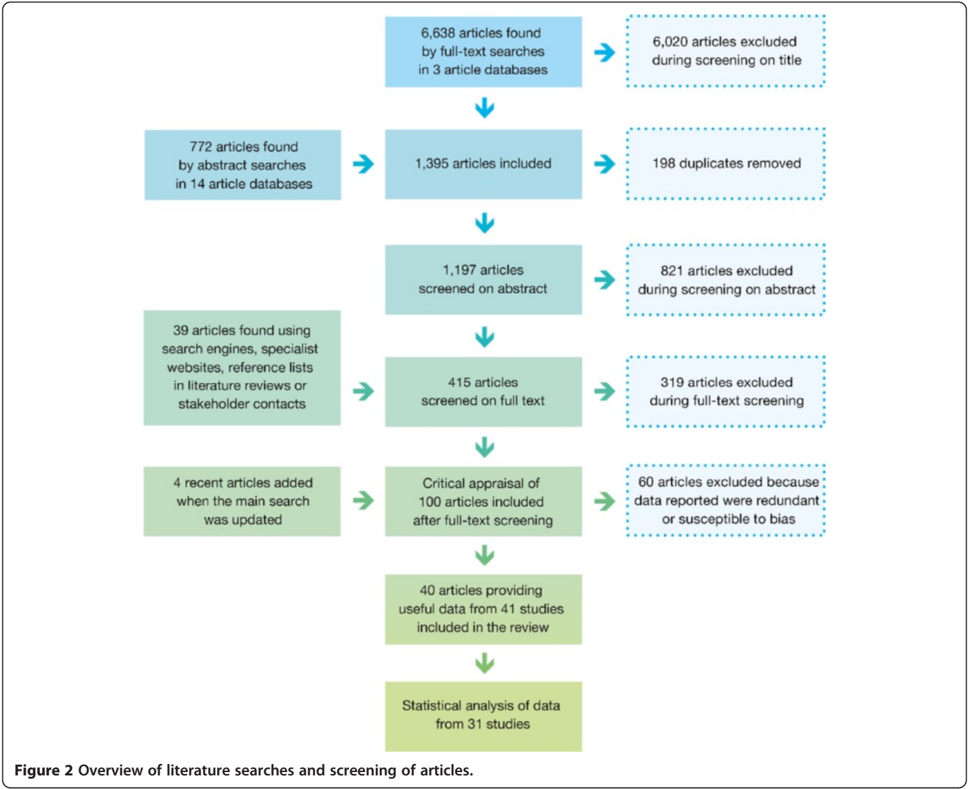
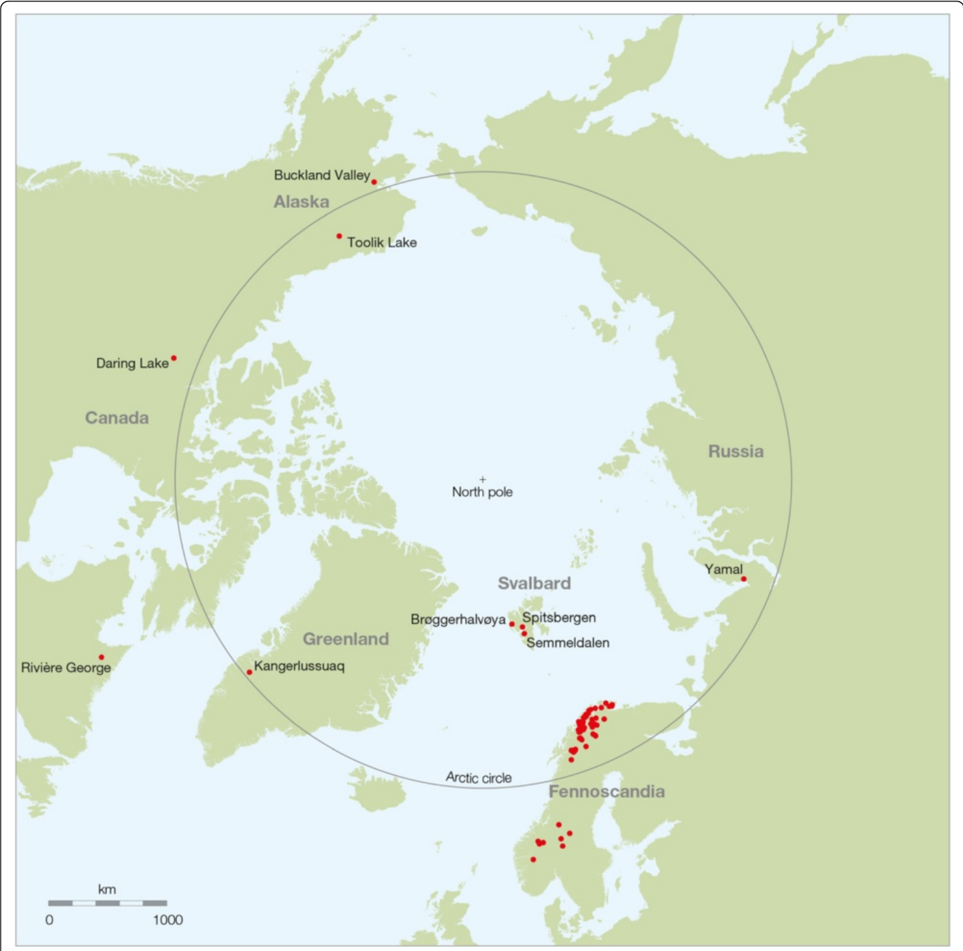
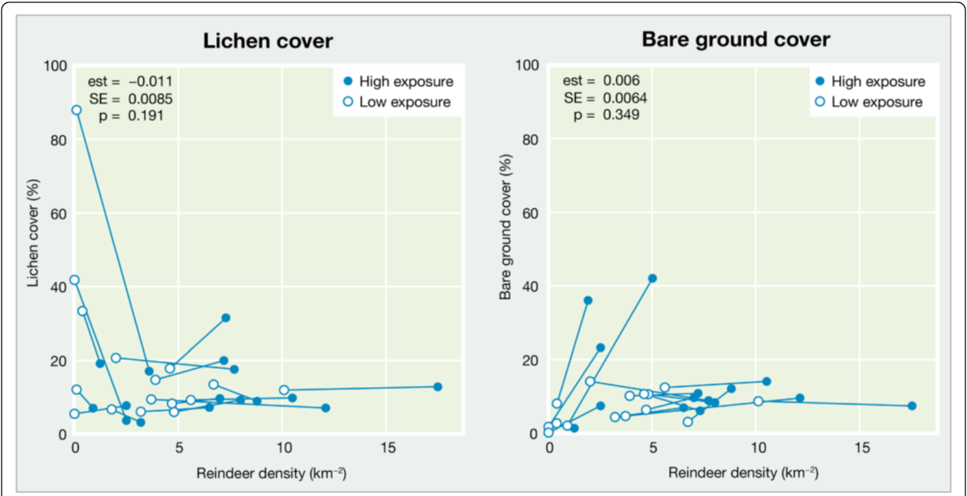
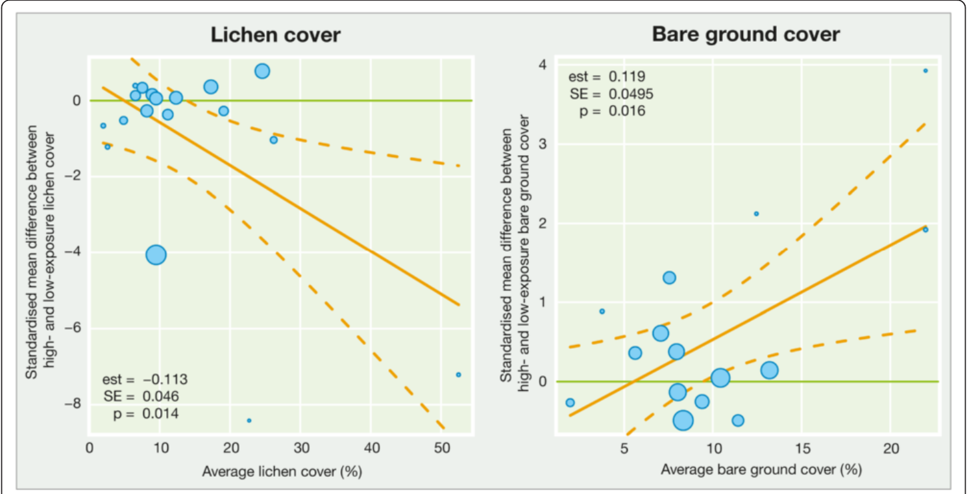
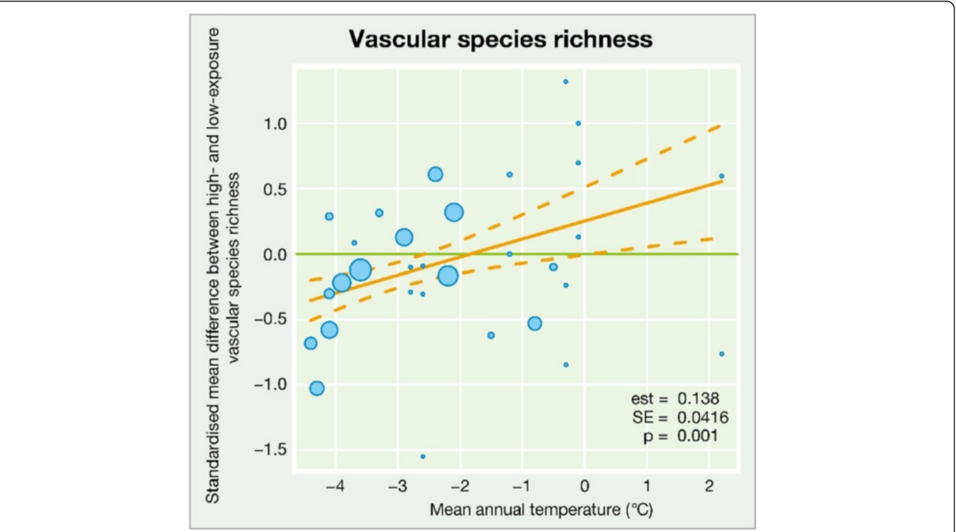
Background: The reindeer (or caribou, Rangifer tarandus L.) has a natural range extending over much of Eurasia’s and North America’s arctic, alpine and boreal zones, yet its impact on vegetation is still unclear. This lack of a common understanding hampers both the management of wild and semi-domesticated reindeer populations and the preservation of biodiversity. To achieve a common platform, we have undertaken a systematic review of published studies that compare vegetation at sites with different reindeer densities. Besides biodiversity, we focused on effects on major plant growth forms. Methods: Searches for literature were made using online publication databases, search engines, specialist websites and bibliographies of literature reviews. Search terms were developed in English, Finnish, Norwegian, Russian and Swedish. Identified articles were screened for relevance based on titles, abstracts and full text using inclusion criteria set out in an a priori protocol. Relevant articles were then subject to critical appraisal of susceptibility to bias. Data on outcomes such as abundance, biomass, cover and species richness of vegetation were extracted together with metadata on site properties and other potential effect modifiers. Results: Our searches identified more than 6,000 articles. After screening for relevance, 100 of them remained. Critical appraisal excluded 60 articles, leaving 40 articles with 41 independent studies. Almost two thirds of these studies had been conducted in Fennoscandia. Meta-analysis could be made of data from 31 of the studies. Overall, effects of reindeer on species richness of vascular plants depended on temperature, ranging from negative at low temperature to positive at high temperature. Effects on forbs, graminoids, woody species, and bryophytes were weak or non-significant, whereas the effect on lichens was negative. However, many individual studies showed clear positive or negative effects, but the available information was insufficient to explain this context dependence. Conclusions: We see two pressing matters emerging from our study. First, there is a lack of research with which to build a circumpolar understanding of grazing effects, which calls for more studies using a common protocol to quantify reindeer impacts. Secondly, the highly context-dependent outcomes suggest that research and management have to consider local conditions. For instance, predictions of what a management decision would mean for the effects of reindeer on vegetation will have to take the variation of vegetation types and dominant growth forms, productivity, and grazing history into account. Policy and management have to go hand-in-hand with research in individual cases if the dynamics between plants, animals, and humans are to be sufficiently understood.
Overview
The claims and statistics of this paper haven’t been checked yet.
Run the check — free, no account needed. It reads the open-access text and checks the sources it cites.
Integrity signals
Registry
Cites
Statistics
Figures
Verification
Claims the paper makes
The claims and statistics of this paper haven’t been checked yet.
Run the check — free, no account needed. It reads the open-access text and checks the sources it cites.
Claims other papers make about this one
Each is checked against this paper’s own text: does it say what the citing paper says it does?
In the citing paper
“However, a significant proportion of studies in one review [31] were not found at all using Google Scholar (31.5%).”
From The role of google scholar in evidence reviews and its applicability to grey literature searching (2015) · cites this paper as [31]
In the citing paper
“Only one review had an included article list that was fully covered by Google Scholar, the review with the smallest evidence base of only 37 studies [31].”
From The role of google scholar in evidence reviews and its applicability to grey literature searching (2015) · cites this paper as [31]
Self-check
Percentages, sums and reported differences re-computed from the paper’s own numbers.
The self-check needs the paper’s full text.
Citations
Cites
Effects of herbivores on grassland plant diversity
Olff, H., & Ritchie, M. E. (1998) · Trends in Ecology & Evolution · doi:10.1016/s0169-5347(98)01364-0 · Cited by 1,528
Eurasian Arctic greening reveals teleconnections and the potential for structurally novel ecosystems
Macias-Fauria, M., Forbes, B. C., Zetterberg, P., & Kumpula, T. (2012) · Nature Climate Change · doi:10.1038/nclimate1558 · Cited by 253
Self-citation
Research works printed but not linked: 87
- Moen J, Andersen R, Illius AW. Living in a seasonal environment. In: Danell K, Bergström R, Duncan P, Pastor J, editors. Large Herbivore Ecology, Ecosystem Dynamics and Conservation. Cambridge: Cambridge University Press; 2006. p. 50–70. · DOI
- Helle TP, Jaakkola LM. Transitions in herd management of semi-domesticated reindeer in northern Finland. Ann Zool Fennici. 2008;45:81–101. · DOI
- Renbetesmarksutredningen. Renbetesmarkerna. Stockholm: SOU 12; 1966.
- Tømmervik H, Riseth JÅ. Historiske tamreintall i Norge fra 1800-tallet fram til i dag. Tromsø: NINA; 2011. Rapport 672.
- Kortesalmi JJ. Poronhoidon synty ja kehitys Suomessa. Tampere: Tammer-Paino Oy; 2007.
- Ims RA, Ehrich D, Forbes BC, Huntley B, Walker DA, Wookey PA, et al. Terrestrial Ecosystems. In: Meltofte H, editor. Arctic Biodiversity Assessment. Status and Trends in Arctic Biodiversity. Akureyri: Conservation of Arctic Flora and Fauna; 2013. p. 385–440.
- McNaughton SJ, Oesterheld M, Frank DA, Williams KJ. Ecosystem-level patterns of primary productivity and herbivory in terrestrial habitats. Nature. 1989;341:142–4. · DOI
- Walker DA, Raynolds MK, Daniels FJA, Einarsson E, Elvebakk A, Gould WA, et al. The circumpolar arctic vegetation map. J Vegetation Sci. 2005;16:267–82. · DOI
- Storeheier PV, Mathiesen SD, Tyler NJC, Olsen MA. Nutritive value of terricolous lichens for reindeer in winter. Lichenologist. 2002;34:247–57. · DOI
- Sørmo W, Haga ØE, Gaare E, Langvatn R, Mathiesen SD. Forage chemistry and fermentation chambers in Svalbard reindeer (Rangifer tarandus platyrhynchus). J Zool. 1999;247:247–56. · DOI
- van der Wal R. Do herbivores cause habitat degradation or vegetation state transition? Evidence from the tundra. Oikos. 2006;114:177–86. · DOI
- Dahlberg A, Bültmann H. Fungi. In: Meltofte H, editor. Arctic Biodiversity Assessment. Status and Trends in Arctic Biodiversity. Akureyri: Conservation of Arctic Flora and Fauna; 2013. p. 354–71.
- Nieminen M, Heiskari U. Diets of freely grazing and captive reindeer during summer and winter. Rangifer. 1989;9:17–34. · DOI
- Jefferies RL, Klein DR, Shaver GR. Vertebrate herbivores and northern plant communities. Reciprocal influences and responses. Oikos. 1994;71:193–206. · DOI
- Iversen M, Fauchald P, Langeland K, Ims RA, Yoccoz NG, Bråthen KA. Phenology and cover of plant growth forms predict herbivore habitat selection in a high latitude ecosystem. PLoS One. 2014;9(6):e100780. · DOI
- Chapin FS, BretHarte MS, Hobbie SE, Zhong HL. Plant functional types as predictors of transient responses of arctic vegetation to global change. J Vegetation Sci. 1996;7:347–58. · DOI
- Wookey PA, Aerts R, Bardgett RD, Baptist F, Bråthen KA, Cornelissen JHC, et al. Ecosystem feedbacks and cascade processes: understanding their role in the responses of Arctic and alpine ecosystems to environmental change. Glob Chang Biol. 2009;15:1153–72. · DOI
- Mårell A, Hofgaard A, Danell K. Nutrient dynamics of reindeer forage species along snowmelt gradients at different ecological scales. Basic and Appl Ecol. 2006;7:13–30. · DOI
- Iversen M, Bråthen KA, Yoccoz NG, Ims RA. Predictors of plant phenology in a diverse high-latitude alpine landscape: growth forms and topography. J Vegetation Sci. 2009;20:903–15. · DOI
- van der Wal R, Brooker RW. Mosses mediate grazer impacts on grass abundance in arctic ecosystems. Function Ecol. 2004;18:77–86. · DOI
- Olofsson J, Kitti H, Rautiainen P, Stark S, Oksanen L. Effects of summer grazing by reindeer on composition of vegetation, productivity and nitrogen cycling. Ecography. 2001;24:13–24. · DOI
- Olofsson J, Stark S, Oksanen L. Reindeer influence on ecosystem processes in the tundra. Oikos. 2004;105:386–96. · DOI
- Bråthen KA, Ims RA, Yoccoz NG, Fauchald P, Tveraa T, Hausner V. Induced shift in ecosystem productivity? Extensive scale effects of abundant large herbivores. Ecosystems. 2007;10:773–89. · DOI
- Ravolainen V, Yoccoz N, Bråthen KA, Ims RA, Iversen M, Gonzalez V. Additive partitioning of diversity reveals no scale-dependent impacts of large ungulates on the structure of tundra plant communities. Ecosystems. 2010;13:157–70. · DOI
- Cairns DM, Moen J. Herbivory influences tree lines. J Ecol. 2004;92:1019–24. · DOI
- Olofsson J, Oksanen L, Callaghan T, Hulme PE, Oksanen T, Suominen O. Herbivores inhibit climate-driven shrub expansion on the tundra. Global Change Biol. 2009;15:2681–93. · DOI
- Ravolainen VT, Bråthen KA, Yoccoz NG, Nguyen JK, Ims RA. Complementary impacts of small rodents and semi‐domesticated ungulates limit tall shrub expansion in the tundra. J Appl Ecol. 2014;51:234–41. · DOI
- Ims RA, Henden JA. Collapse of an arctic bird community resulting from ungulate-induced loss of erect shrubs. Biol Conserv. 2012;149:2–5. · DOI
- Milchunas D, Sala O, Lauenroth WK. A generalized model of the effects of grazing by large herbivores on grassland community structure. Am Nat. 1988;132:87–106. · DOI
- Forbes BC, Kumpula T. The ecological role and geography of reindeer (Rangifer tarandus) in northern Eurasia. Geography Compass. 2009;3/4:1356–80. · DOI
- Forbes BC, Stammler F, Kumpula T, Meschtyb N, Pajunen A, Kaarlejärvi E. High resilience in the Yamal-Nenets social-ecological system, West Siberian Arctic, Russia. PNAS. 2009;106:22041–8. · DOI
- Tveraa T, Ballesteros M, Bårdsen BJ, Fauchald P, Lagergren M, Langeland K, et al. Rovvilt og reindrift – Kunnskapsstatus i Finnmark. Tromsø: NINA; 2012. Rapport 821.
- Swedish EPA. Förslag till en strategi för miljökvalitetsmålet Storslagen fjällmiljö. Naturvårdsverket, Stockholm: Naturvårdsverket; 2014.
- Larsen JN, Anisimov OA, Constable A, Hollowed A, Maynard N, Prestrud P, et al. Polar regions. In: Climate Change 2014: Impacts, Adaptation, and Vulnerability. Working Group II contribution to Intergovernmental Panel on Climate Change – 5th Assessment Report. Geneva: WMO/UNEP; 2014. Chapter 28.
- ACIA. Arctic Climate Impact Assessment. Cambridge: Cambridge University Press; 2005.
- Verbyla D. The greening and browning of Alaska based on 1982–2003 satellite data. Global Ecol Biogeogr. 2008;17:547–55. · DOI
- Xu L, Myneni RB, Chapin III FS, Callaghan TV, Pinzon JE, Tucker CJ, et al. Temperature and vegetation seasonality diminishment over northern lands. Nat Clim Chang. 2013;3:581–6. · DOI
- Moen J. Climate change: effects on the ecological basis for reindeer husbandry in Sweden. Ambio. 2008;37:304–11. · DOI
- Cohen J, Pullianen J, Menard CB, Johansen B, Oksanen L, Luojos K, et al. Effect of reindeer grazing on snowmelt, albedo and energy balance based on satellite data analyses. Remote Sens Environ. 2013;135:107–17. · DOI
- Moen J, Danell Ö. Reindeer in the Swedish mountains: An assessment of grazing impacts. Ambio. 2003;32:397–402. · DOI
- Swedish Ministry of the Environment. Hållbar utveckling i landet fjällområden. Stockholm: Government Bill 1995/96:226; 1996.
- Johansen B, Tømmervik H. Finnmarksvidda – vegetasjonskartlegging. Tromsø: FORUT; 1992.
- Käyhkö J, Pellikka P. Remote sensing of the impact of reindeer grazing on vegetation in northern Fennoscandia using SPOT XS data. Polar Res. 1994;13:115–24. · DOI
- Tømmervik H, Bjerke JW, Gaare E, Johansen B, Thannheiser D. Rapid recovery of recently overexploited winter grazing pastures for reindeer in northern Norway. Fungal Ecol. 2012;5:3–15. · DOI
- Swedish Ministry of the Environment. Svenska miljömål. Miljöpolitik för ett hållbart Sverige. Stockholm: Government Bill 1997/98:145; 1998.
- Olofsson J, Oksanen L. Effects of reindeer density on vascular plant diversity on North Scandinavian mountains. Rangifer. 2005;25:5–18. · DOI
- Bernes C, Bråthen KA, Forbes BC, Hofgaard A, Moen J, Speed JDM. What are the impacts of reindeer/caribou (Rangifer tarandus L.) on arctic and alpine vegetation? A systematic review protocol. Environ Evidence. 2013;2:6. · DOI
- Collaboration for Environmental Evidence: Guidelines for systematic review and evidence synthesis in environmental management. Version 4.2, p. 37. Environmental Evidence: www.environmentalevidence.org/Documents/Guidelines/Guidelines4.2.pdf; 2013.
- Mysterud A. The concept of overgrazing and its role in management of large herbivores. Wildl Biol. 2006;12:129–41. · DOI
- Suominen O, Olofsson J. Impacts of semi-domesticated reindeer on structure of tundra and forest communities in Fennoscandia: A review. Ann Zool Fennici. 2000;37:233–49.
- Landis JR, Koch GG. The measurement of observer agreement for categorical data. Biometrics. 1977;33:159–74. · DOI · Paper page
- Hijmans RJ, Cameron SE, Parra JL, Jones PG, Jarvis A. Very high resolution interpolated climate surfaces for global land areas. Int J Climatol. 2005;25:1965–78. · DOI
- Viechtbauer W. Conducting meta-analyses in R with the metafor package. J Stat Softw. 2010;36:1–48. · DOI · Paper page
- Johansen B, Karlsen SR. Monitoring vegetation changes on Finnmarksvidda, Northern Norway, using Landsat MSS and Landsat TM/ETM+ satellite images. Phytocoenologia. 2005;35:969–84. · DOI
- Gaare E, Tømmervik H, Bjerke JW, Thannheiser D. Overvåking av vinterbeiter i Vest-Finnmark og Karasjok: Ny beskrivelse av fastrutene. Trondheim and Tromsø: Norsk institutt for naturforskning; 2006. Rapport 204.
- Hansen BB, Henriksen S, Aanes R, Sæther B-E. Ungulate impact on vegetation in a two-level trophic system. Polar Biol. 2007;30:549–58. · DOI
- Eriksson O, Niva M, Caruso A. Use and abuse of reindeer range. Acta Phytogeogr Suecica. 2007;87:1–88.
- Moen J, Boogerd C, Skarin A. Variations in mountain vegetation use by reindeer (Rangifer tarandus) affects dry heath but not grass heath. J Veg Sci. 2009;20:805–13. · DOI
- Ravolainen VT, Bråthen KA, Ims RA, Yoccoz NG, Henden JA, Killengreen ST. Rapid, landscape scale responses in riparian tundra vegetation to exclusion of small and large mammalian herbivores. Basic Appl Ecol. 2011;12:643–53. · DOI
- Zamin TJ, Grogan P. Caribou exclusion during a population low increases deciduous and evergreen shrub species biomass and nitrogen pools in low Arctic tundra. J Ecol. 2013;101:671–83. · DOI
- Kitti H, Forbes BC, Oksanen J. Long- and short-term effects of reindeer grazing on tundra wetland vegetation. Polar Biol. 2009;32:253–61. · DOI
- Olofsson J. Short- and long-term effects of changes in reindeer grazing pressure on tundra heath vegetation. J Ecol. 2006;94:431–40. · DOI
- Cahoon SMP, Sullivan PF, Post E, Welker JM. Large herbivores limit CO2 uptake and suppress carbon cycle responses to warming in West Greenland. Global Change Biol. 2012;18:469–79. · DOI
- Gonzalez VT, Bråthen KA, Ravolainen VT, Iversen M, Hagen SB. Large-scale grazing history effects on Arctic-alpine germinable seed banks. Plant Ecol. 2010;207:321–31. · DOI
- Post E, Pedersen C. Opposing plant community responses to warming with and without herbivores. PNAS. 2008;105:12353–8. · DOI · Paper page
- Proulx M, Mazumder A. Reversal of grazing impact on plant species richness in nutrient-poor vs. nutrient-rich ecosystems. Ecology. 1998;79:2581–92. · DOI
- Illius AW, O’Connor TG. Resource heterogeneity and ungulate population dynamics. Oikos. 2000;89:283–94. · DOI
- Bråthen KA, Oksanen J. Reindeer reduce biomass of preferred plant species. J Veg Sci. 2001;12:473–80. · DOI
- den Herder M, Virtanen R, Roininen H. Effects of reindeer browsing on tundra willow and its associated insect herbivores. J Appl Ecol. 2004;41:870–9. · DOI
- Dormann CF, Skarpe C. Flowering, growth and defence in the two sexes: Consequences of herbivore exclusion for Salix polaris. Funct Ecol. 2002;16:649–56. · DOI
- Eskelinen A, Oksanen J. Changes in the abundance, composition and species richness of mountain vegetation in relation to summer grazing by reindeer. J Veg Sci. 2006;17:245–54. · DOI
- Gough L, Shrestha K, Johnson DR, Moon B. Long-term mammalian herbivory and nutrient addition alter lichen community structure in Alaskan dry heath tundra. Arct Antarct Alp Res. 2008;40:65–73. · DOI
- Grellmann D. Plant responses to fertilization and exclusion of grazers on an arctic tundra heath. Oikos. 2002;98:190–204. · DOI
- Lehtonen J, Heikkinen RK. On the recovery of mountain birch after Epirrita damage in Finnish Lapland, with a particular emphasis on reindeer grazing. Ecoscience. 1995;2:349–56. · DOI
- Manseau M, Huot J, Crête M. Effects of summer grazing by caribou on composition and productivity of vegetation: Community and landscape level. J Ecol. 1996;84:503–13. · DOI
- Nellemann C, Jordhøy P, Støen OG, Strand O. Cumulative impacts of tourist resorts on wild reindeer (Rangifer tarandus tarandus) during winter. Arctic. 2000;53:9–17. · DOI
- Nellemann C, Vistnes I, Jordhøy P, Strand O. Winter distribution of wild reindeer in relation to power lines, roads and resorts. Biol Conservation. 2001;101:351–60. · DOI
- Olofsson J, Strengbom J. Response of galling invertebrates on Salix lanata to reindeer herbivory. Oikos. 2000;91:493–8. · DOI
- Olofsson J, Hulme PE, Oksanen L, Suominen O. Importance of large and small mammalian herbivores for the plant community structure in the forest tundra ecotone. Oikos. 2004;106:324–34. · DOI
- Olofsson J, te Beest M, Ericson L. Complex biotic interactions drive longterm vegetation dynamics in a subarctic ecosystem. Phil Trans Roy Soc B. 2013;368:20120486. · DOI
- Pajunen AM. Environmental and biotic determinants of growth and height of arctic willow shrubs along a latitudinal gradient. Arct Antarct Alp Res. 2009;41:478–85. · DOI
- Pedersen C, Post E. Interactions between herbivory and warming in aboveground biomass production of arctic vegetation. BMC Ecol. 2008;8:17. · DOI
- Post E. Erosion of community diversity and stability by herbivore removal under warming. Proc Roy Soc B. 2013;280:20122722. · DOI
- Tømmervik H, Johansen B, Riseth JÅ, Karlsen SR, Solberg B, Høgda KA. Above ground biomass changes in the mountain birch forests and mountain heaths of Finnmarksvidda, northern Norway, in the period 1957–2006. Forest Ecol Manage. 2009;257:244–57. · DOI
- van der Wal R, Brooker R, Cooper E, Langvatn R. Differential effects of reindeer on high Arctic lichens. J Veg Sci. 2001;12:705–10. · DOI
- Vistnes I, Nellemann C, Jordhøy P, Strand O. Effects of infrastructure on migration and range use of wild reindeer. J Wildlife Manage. 2004;68:101–8. · DOI
- Zamin TJ, Grogan P. Birch shrub growth in the low Arctic: The relative importance of experimental warming, enhanced nutrient availability, snow depth and caribou exclusion. Environ Res Lett. 2012;7:034027. · DOI
Cited by
Sorted by citations
The role of google scholar in evidence reviews and its applicability to grey literature searching
Haddaway, N. R., Collins, A. M., Coughlin, D., & Kirk, S. (2015) · PLOS ONE · doi:10.1371/journal.pone.0138237 · Cited by 2,387
The changing face of the Arctic: four decades of greening and implications for tundra ecosystems
Frost, G. V., Bhatt, U. S., Macander, M. J., Berner, L. T., Walker, D. A., Raynolds, M. K., Magnússon, R. Í., Bartsch, A., Bjerke, J. W., Epstein, H. E., et al. (2025) · Frontiers in Environmental Science · doi:10.3389/fenvs.2025.1525574 · Cited by 51
Self-citation
Metadata
- Authors
- Bernes, C., Bråthen, K. A., Forbes, B. C., Speed, J. D., & Moen, J.
- Venue
- Environmental Evidence
- Published
- 2015-02-23
- Volume
- 4
- Issue
- 1
- ISSN
- 2047-2382
- Cited by
- 103
- References
- 2
- Language
- en
About these checks
Registry, retraction, Cites and statistics results are computed, not judged, with one exception: a printed reference that no index lists is read once by a model before it counts as a citation error. Claims are extracted by a model and kept only when their quote appears verbatim in the text; each cited source is then checked, with a model’s help, for whether it says what the claim relies on. Those verdicts can be wrong — read the claim’s quote and the cited source before relying on one.
Statistics and arithmetic are recomputed, not judged.
Confidence bands are shown only for fields calibrated on our annotated test set. None is calibrated yet, so no band is shown.
What counts as a claim ›How we measure confidence ›How we check this ›
Are you an author, or do you see a problem with this page? Request a review
How to cite
Cite CoChat for the checks on this page, and the paper for its own findings.
- This page
- CoChat. (2026). Citation check: What are the impacts of reindeer/caribou (Rangifer tarandus L.) on arctic and alpine vegetation? A systematic review. https://app.cochat.ai/papers/10.1186/s13750-014-0030-3
- The paper
- Bernes, C., Bråthen, K. A., Forbes, B. C., Speed, J. D., & Moen, J. (2015). What are the impacts of reindeer/caribou (Rangifer tarandus L.) on arctic and alpine vegetation? A systematic review. Environmental Evidence. https://doi.org/10.1186/s13750-014-0030-3
