

Surface area wiped, product type, and target strain impact bactericidal efficacy of ready-to-use disinfectant Towelettes
Open accessThe DOI matches its Crossref record; 17 of the 17 references it cites were found in a registry or an index.
Abstract
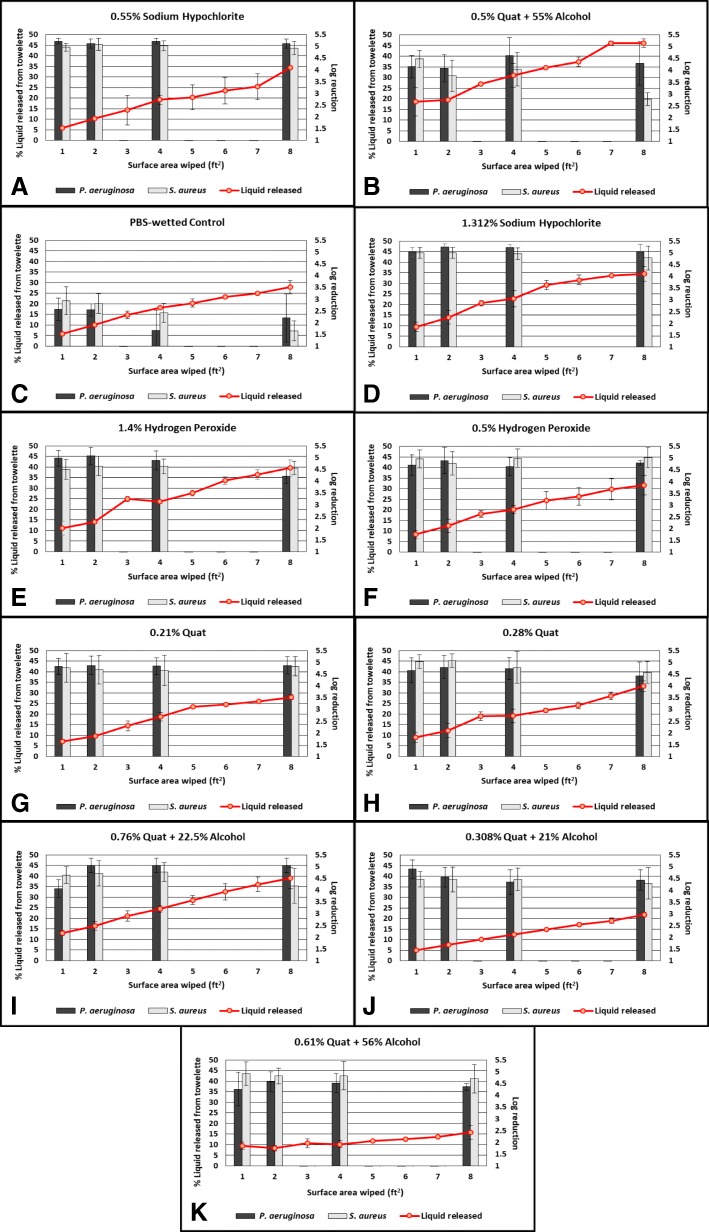
Background: Disinfectant products are often used on environmental surfaces (e.g. countertops, patient beds) and patient care equipment in healthcare facilities to help prevent the transmission of healthcare-associated infections. Ready-to-use (RTU) disinfectants in the form of pre-wetted towelettes are increasingly popular among healthcare facilities. Currently, the EPA does not require disinfectant manufacturers to include a recommended maximum surface area per towelette on their product labels. The objective of this study was to investigate the efficacy of disinfectant towelette products on a hard non-porous surface across different coverage areas using a quantitative EPA method. We hypothesized that there would be significant differences in the efficacy of disinfectant towelette products, and that the greater surface area(s) wiped would result in reduced bactericidal efficacy. Methods: This study tested ten disinfectant towelette products against Staphylococcus aureus strain ATCC CRM-6538 and Pseudomonas aeruginosa strain ATCC 15442 on Formica surfaces. Defined surface areas were wiped and the towelette weighed before and after wiping to determine the amount of liquid released. Bactericidal efficacy testing was also performed after wiping following standard EPA protocols. Results: We found that disinfectant product, area of surface wiped, and strain impacted the bactericidal efficacy achieved. Disinfectant product type and area of surface wiped significantly impacted the percent of liquid released per ft 2 from the towelette. Conclusion: Overall, bactericidal efficacy varied by towelette product, surface area wiped, and strain. This study also found that wiping larger surface areas may lead to decreased bactericidal efficacy. Further research is needed to test its implication.
Overview
The claims and statistics of this paper haven’t been checked yet.
Free: it reads the open-access text and checks the first 5 claims that cite a source we can check. Create a free account to check every claim.
Integrity signals
Registry
Cites
Statistics
Figures
Verification
Claims the paper makes
The claims and statistics of this paper haven’t been checked yet.
Free: it reads the open-access text and checks the first 5 claims that cite a source we can check. Create a free account to check every claim.
Claims other papers make about this one
Each is checked against this paper’s own text: does it say what the citing paper says it does?
The cited source says what the claim attributes to it.
In the citing paper
“The result implicates a larger wiping surface area may lead to decreased bactericidal efficacy.”
From Efficacy of disinfectant-impregnated wipes used for surface disinfection in hospitals: a review (2019) · cites this paper as [74]
The cited source says what the claim attributes to it.
In the citing paper
“Some research shows RTUDW’s bactericidal efficacy decreases on wiped larger surface areas [74].”
From Efficacy of disinfectant-impregnated wipes used for surface disinfection in hospitals: a review (2019) · cites this paper as [74]
Self-check
Percentages, sums and reported differences re-computed from the paper’s own numbers.
The self-check needs the paper’s full text.
Citations
Cites
Multistate point-prevalence survey of health care-associated infections
Magill, S. S., Edwards, J. R., Bamberg, W., Beldavs, Z. G., Dumyati, G., Kainer, M. A., Lynfield, R., Maloney, M., McAllister-Hollod, L., Nadle, J., et al. (2014) · New England Journal of Medicine · doi:10.1056/nejmoa1306801 · Cited by 3,931 · cited 5×
“Healthcare-associated pathogens can colonize a vast array of environmental surfaces and patient care equipment in healthcare facilities and transmission from these surfaces to patients can lead to HAIs [3, 4].”
BackgroundInfluentialGuideline for disinfection and sterilization in healthcare facilities, 2008
Rutala, W. A., & Weber, D. J. (2008) · Infection Control and Hospital Epidemiology · Cited by 2,147
Quaternary Ammonium Biocides: Efficacy in Application
Gerba, C. P. (2015) · Applied and Environmental Microbiology · doi:10.1128/aem.02633-14 · Cited by 561
McBain, A. J., Ledder, R. G., Moore, L. E., Catrenich, C. E., & Gilbert, P. (2004) · Applied and Environmental Microbiology · doi:10.1128/aem.70.6.3449-3456.2004 · Cited by 186
Alcohols as Surface Disinfectants in Healthcare Settings
Boyce, J. M. (2018) · Infection Control and Hospital Epidemiology · doi:10.1017/ice.2017.301 · Cited by 135
Selection of the Ideal Disinfectant
Rutala, W. A., & Weber, D. J. (2014) · Infection Control and Hospital Epidemiology · doi:10.1086/676877 · Cited by 125
Havill, N. L. (2013) · American Journal of Infection Control · doi:10.1016/j.ajic.2012.10.028 · Cited by 95
Hacek, D. M., Ogle, A. M., Fisher, A. G., Robicsek, A. A., & Peterson, L. R. (2010) · American Journal of Infection Control · doi:10.1016/j.ajic.2009.11.003 · Cited by 95
Moore, L. E., Ledder, R. G., Gilbert, P., & McBain, A. J. (2008) · Applied and Environmental Microbiology · doi:10.1128/aem.00573-08 · Cited by 90
Rutala, W. A., Gergen, M. F., & Weber, D. J. (2012) · Infection Control and Hospital Epidemiology · doi:10.1086/668434 · Cited by 79
Research works printed but not linked: 9
- Center for Disease Control Healthcare associated infection progress report. CDC 2014
- Dvorak G Disinfection 101 Iowa State University: Center for Food Security and Public Health website 2008
- Environmental Protection Agency Standard operating procedure for AOAC use dilution method for testing disinfectants: MB-05-14. EPA 2016
- Environmental Protection Agency Product performance test guidelines- OCSPP 810.2100: Sterilants-efficacy data recommendations. EPA 2018
- Environmental Protection Agency Standard operating procedure for quantitative petri plate method for determining the effectiveness of antimicrobial towelettes against vegetative bacteria on inanimate, hard, non-porous surfaces: MB-33-00. EPA 2014
- World Health Organization Infection prevention and control of epidemic- and pandemic- prone acute respiratory infections in health care 2014 24983124
- Environmental Protection Agency Product performance test guidelines-OCSPP 810.2200: Disinfectants for use on environmental surfaces, guidelines for efficacy testing. EPA 2018
- Environmental Protection Agency Product performance test guidelines- OCSPP 810.2200: Disinfectants for use on environmental surfaces, guidance for efficacy testing. EPA 2018
- Center for Disease Control Guideline for disinfection and sterilization in healthcare facilities. CDC 2008
Cited by
Efficacy of disinfectant-impregnated wipes used for surface disinfection in hospitals: a review
Song, X., Vossebein, L., & Zille, A. (2019) · Antimicrobial Resistance & Infection Control · doi:10.1186/s13756-019-0595-2 · Cited by 132
“tested the 270 bactericidal efficacy of ten ready-to-use disinfectants in the form of pre-wetted towelettes [74].”
Disinfection and Sterilization in Health Care Facilities
Rutala, W. A., & Weber, D. J. (2021) · Infectious Disease Clinics of North America · doi:10.1016/j.idc.2021.04.004 · Cited by 119
Disinfection, sterilization and antisepsis: An overview
Rutala, W. A., Boyce, J. M., & Weber, D. J. (2023) · American Journal of Infection Control · doi:10.1016/j.ajic.2023.01.001 · Cited by 102
Four steps to clean hospitals: LOOK, PLAN, CLEAN and DRY
Dancer, S. J., & Krämer, A. (2018) · Journal of Hospital Infection · doi:10.1016/j.jhin.2018.12.015 · Cited by 65
A review of wipes used to disinfect hard surfaces in health care facilities
Boyce, J. M. (2020) · American Journal of Infection Control · doi:10.1016/j.ajic.2020.06.183 · Cited by 46
Metadata
- Authors
- West, A. M., Nkemngong, C. A., Voorn, M. G., Wu, T., Li, X., Teska, P. J., & Oliver, H. F.
- Affiliations
- Purdue University West Lafayette (US)
- Corresponding author
- Oliver, Haley F
- Venue
- Antimicrobial Resistance & Infection Control
- Published
- 2018-10-11
- Volume
- 7
- Issue
- 1
- Pages
- 122-122
- ISSN
- 2047-2994 (ISSN-L)
- PMC
- PMC6180426
- OpenAlex
- W2896220340
- Semantic Scholar
- 0a84e51bb35e33ea03044f4c5c69fca6e1a2726f
- Cited by
- 25
- References
- 17
- Citations by year
- 2026: 2 · 2025: 3 · 2024: 2 · 2023: 3 · 2022: 2 · 2021: 3 · 2020: 5 · 2019: 4 · 2018: 1
- FWCI
- 2.45
- Type
- journal article
- Language
- en
- Open access
- gold
- doi.org
- Licence
- cc-by
- creativecommons.org/licenses/by/4.0 (tdm)
- creativecommons.org/licenses/by/4.0 (vor)
- Locations
- Antimicrobial Resistance and Infection Control (publishedVersion, cc-by)
- Europe PMC (PubMed Central) (publishedVersion, cc-by)
- PubMed Central (publishedVersion, cc-by)
- PubMed (publishedVersion)
- DOAJ (DOAJ: Directory of Open Access Journals) (submittedVersion, cc-by-sa)
- Funders
- Diversey Inc
- Topics
- Health Sciences › Medicine › Infectious Diseases › Infection Control in Healthcare
- Life Sciences › Immunology and Microbiology › Microbiology › Medical Device Sterilization and Disinfection
- Health Sciences › Medicine › Pulmonary and Respiratory Medicine › Infection Control and Ventilation
- Keywords
- bactericidal efficacy, Staphylococcus aureus, Pseudomonas aeruginosa, nosocomial infections, environmental surface disinfection, liquid release
- MeSH terms
- Anti-Bacterial Agents, Cross Infection, Disinfectants, Disinfection, Humans, Pseudomonas aeruginosa, Staphylococcus aureus, Sterilization
About these checks
Registry, retraction, Cites and statistics results are computed, not judged, with one exception: a printed reference that no index lists is read once by a model before it counts as a citation error. Claims are extracted by a model and kept only when their quote appears verbatim in the text; each cited source is then checked, with a model’s help, for whether it says what the claim relies on. Those verdicts can be wrong — read the claim’s quote and the cited source before relying on one.
Statistics and arithmetic are recomputed, not judged.
Confidence bands are shown only for fields calibrated on our annotated test set. None is calibrated yet, so no band is shown.
What counts as a claim ›How we measure confidence ›How we check this ›
Are you an author, or do you see a problem with this page? Request a review
Data sources
Bibliographic data: Semantic Scholar, OpenAlex, Crossref.
Contains information from the Semantic Scholar Academic Graph Datasets, made available under the ODC Attribution License (ODC-BY 1.0).
Semantic Scholar’s data is described in: Kinney, R., et al. (2023). The Semantic Scholar Open Data Platform. arXiv:2301.10140.
