

Removal of phosphates using eggshells and calcined eggshells in high phosphate solutions
Open accessThe DOI matches its Crossref record; 44 of the 44 references it cites were found in a registry or an index.
Abstract
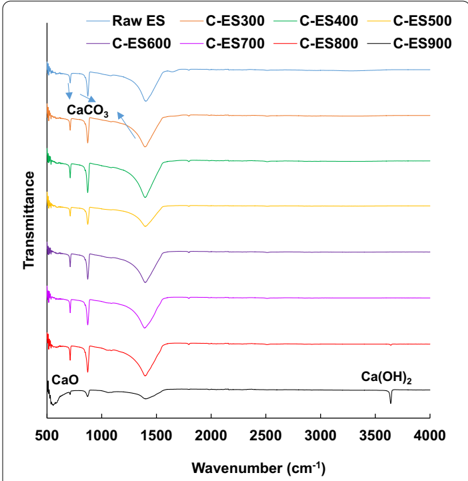
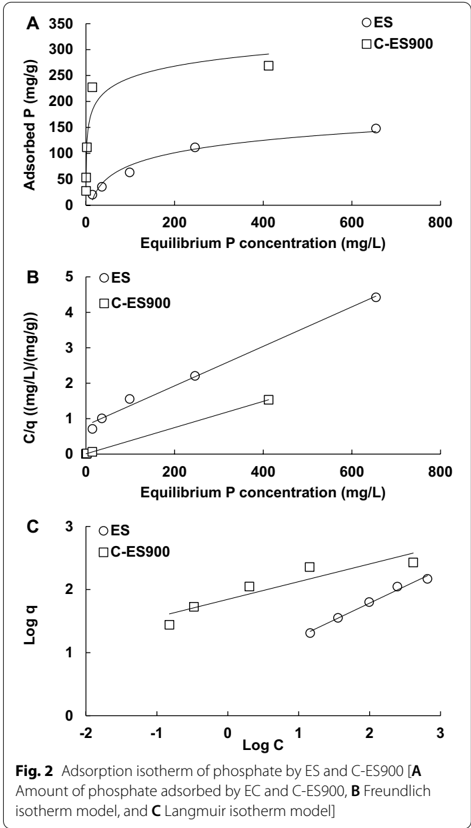
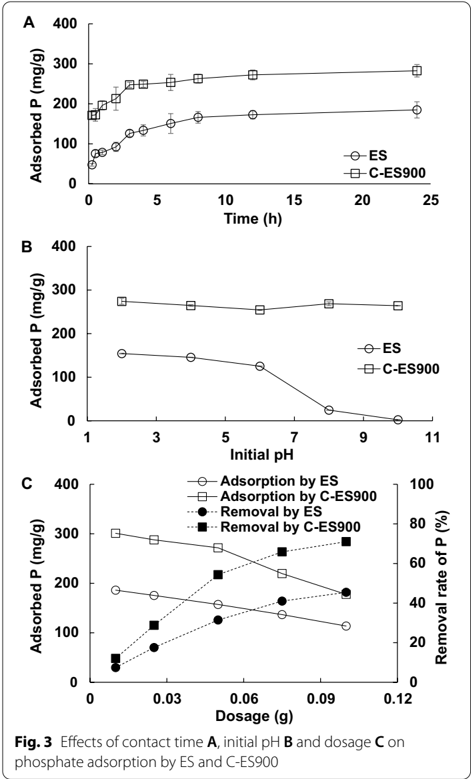
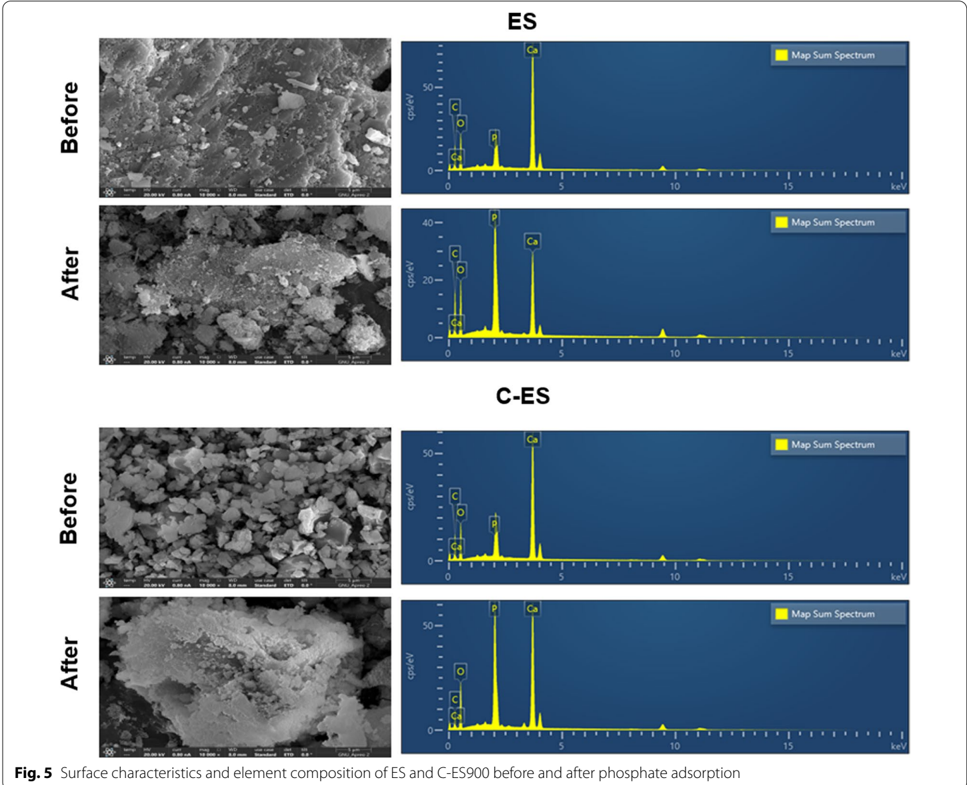
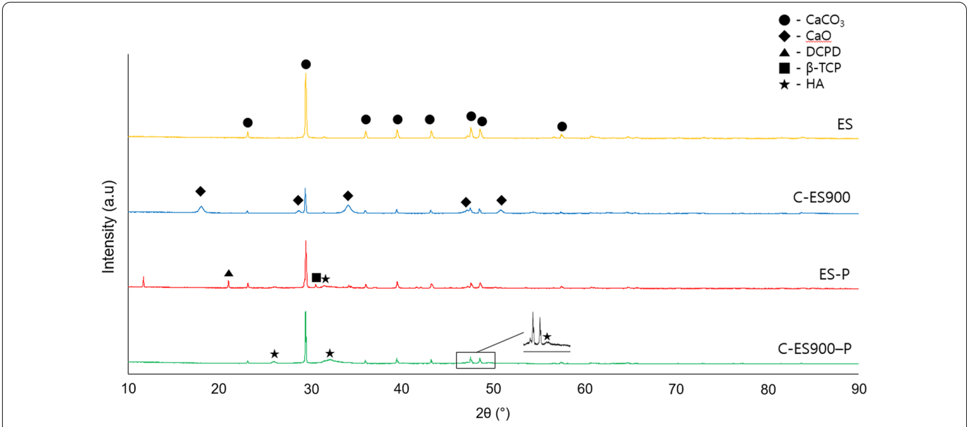
This study was conducted to evaluate the phosphate sorption properties of eggshell (ES) and calcined ESs (C-ESs) in a high-concentration phosphate solution. The C-ESs yield decreased rapidly at 900 °C, indicating that the CaCO 3 constituting the ES was converted to CaO by the high calcination temperature. The optimum calcination temperature for phosphate removal using C-ES was 900 °C. The actual sorption amount of phosphate by ES and C-ES900 was in agreement with the Langmuir isothermal sorption equation, and the maximum sorption capacities derived from this equation were 178.6 and 270.3 mg/g, respectively. The sorption rate of phosphate by ES and C-ES900 was divided into two stages: an initial fast sorption stage, followed by a slow sorption stage. The sorption of phosphate by ES was dominantly influenced by the initial pH and salt concentration, whereas C-ES900 exhibited a constant sorption capacity regardless of environmental changes. The SEM–EDS and XRD results demonstrated that phosphate was successfully adsorbed on the ES and C-SE900 surfaces. In this study, it was found that the sorption of phosphate by ES occurred via ion exchange and precipitation reactions and that the sorption of phosphate by C-ES900 was dominantly affected by precipitation. Above all, C-ES can be applied as an effective adsorbent for removing high concentrations of phosphate under a wide range of environmental conditions.
Overview
The claims and statistics of this paper haven’t been checked yet.
Free: it reads the open-access text and checks the first 5 claims that cite a source we can check. Create a free account to check every claim.
Integrity signals
Registry
Cites
Statistics
Figures
Verification
Claims the paper makes
The claims and statistics of this paper haven’t been checked yet.
Free: it reads the open-access text and checks the first 5 claims that cite a source we can check. Create a free account to check every claim.
Claims other papers make about this one
Each is checked against this paper’s own text: does it say what the citing paper says it does?
The source backs part of the claim, not all of it — or backs it for a different population, condition or comparison.
In the citing paper
“Additionally, eggshells have the potential to be a source of calcium for the creation of Ca-modified biochar since they have the ability to absorb phosphorus and then be used as a phosphate fertilizer [23,24].”
From Adsorption Removal of Phosphate from Rural Domestic Sewage by Ca-Modified Biochar Derived from Waste Eggshell and Sawdust (2023) · cites this paper as [23]
Experimental — accuracy not yet measured
Self-check
Percentages, sums and reported differences re-computed from the paper’s own numbers.
The self-check needs the paper’s full text.
Citations
Cites
1 retracted
Awual, M. R. (2019) · Journal of Cleaner Production · doi:10.1016/j.jclepro.2019.04.325 · Cited by 473
RetractedPeng, H., & Guo, J. (2020) · Environmental Chemistry Letters · doi:10.1007/s10311-020-01058-x · Cited by 617 · cited 1×
“The ion exchange resin method, biological denitrification, chemical reduction, reverse osmosis method, electrodialysis method, and chemical precipitation method are common techniques to remove phosphorus from wastewater [6, 7].”
MethodKinetics and thermodynamic study of phosphate adsorption on iron hydroxide-eggshell waste
Mezenner, N. Y., & Bensmaili, A. (2009) · Chemical Engineering Journal · doi:10.1016/j.cej.2008.06.024 · Cited by 492
Yang, Q., Wang, X., Luo, W., Sun, J., Xu, Q., Chen, F., Zhao, J., Wang, S., Yao, F., Wang, D., et al. (2018) · Bioresource Technology · doi:10.1016/j.biortech.2017.09.136 · Cited by 445
Removal of phosphate species from solution by adsorption onto calcite used as natural adsorbent
Karageorgiou, K., Paschalis, M., & Anastassakis, G. N. (2007) · Journal of Hazardous Materials · doi:10.1016/j.jhazmat.2006.02.038 · Cited by 428 · cited 1×
“Similar results were also observed for calcite and crawfish shells, which are composed primarily of CaCO3 [21, 31].”
ResultZhu, F., Zheng, Y.-M., Zhang, B.-G., & Dai, Y.-R. (2021) · Journal of Hazardous Materials · doi:10.1016/j.jhazmat.2020.123608 · Cited by 361 · cited 1×
“Over the past few decades, adsorption has become a promising and economical phosphorus treatment technology to overcome these problems [9, 10].”
BackgroundXia, Y., Zhang, M., Tsang, D. C. W., Geng, N., Lu, D., Zhu, L., Igalavithana, A. D., Dissanayake, P. D., Rinklebe, J., Yang, X., et al. (2020) · Applied Biological Chemistry · doi:10.1186/s13765-020-0493-6 · Cited by 339 · cited 1×
“In particular, excessive phosphate in rivers and lakes is known to promote phytoplankton growth and cause eutrophication [2, 3].”
BackgroundMitrogiannis, D., Psychoyou, M., Baziotis, I., Inglezakis, V. J., Koukouzas, N., Tsoukalas, N., Palles, D., Kamitsos, E., Oikonomou, G., & Markou, G. (2017) · Chemical Engineering Journal · doi:10.1016/j.cej.2017.03.063 · Cited by 292 · cited 1×
“[35] reported that as the ES dose increased, the amount of adsorbed pollutants decreased because of the formation of aggregates between the ES particles.”
BackgroundLiu, X., Shen, F., & Qi, X. (2019) · Science of The Total Environment · doi:10.1016/j.scitotenv.2019.02.227 · Cited by 278 · cited 2×
“The main component of ES is calcium carbonate (CaCO3), which has been studied extensively as a material capable of effectively adsorbing/precipitating phosphate via ion exchange and complex formation in aqueous solutions [18].”
BackgroundRemoval of phosphate from aqueous solutions by electro-coagulation
Bektas, N. (2004) · Journal of Hazardous Materials · doi:10.1016/j.jhazmat.2003.10.002 · Cited by 223
Cited by
Deng, L., & Dhar, B. R. (2023) · Chemosphere · doi:10.1016/j.chemosphere.2023.138685 · Cited by 168
Valorization of Eggshell as Renewable Materials for Sustainable Biocomposite Adsorbents—An Overview
Babalola, B. M., & Wilson, L. D. (2024) · Journal of Composites Science · doi:10.3390/jcs8100414 · Cited by 54
“[39,41,42,44,53,54,56,57,59,60,62, 67,69] Surface charge analysis ( Zeta potential; mV ): Ca-bentonite: − 12.56 mV; ESP: − 17.48 mV; BEP: − 16.41 mV; CES: 800 ◦ C = 0.1 mV; 900 ◦ C = 18.1 mV [39,60] Raman Spectroscopy : Spectral evidence of graphitic and amorphous or disordered carbon in the…”
InfluentialChou, M.-Y., Lee, T., Lin, Y.-S., Hsu, S.-Y., Wang, M.-F., Li, P., Huang, P., Lu, W., & Ho, J. (2023) · Scientific Reports · doi:10.1038/s41598-023-27682-5 · Cited by 36
Ospina-Montoya, V., Pérez, S., Muñoz-Saldaña, J., Forgionny, A., Flórez, E., & Acelas, N. (2024) · Journal of Environmental Management · doi:10.1016/j.jenvman.2024.120029 · Cited by 27
Manyatshe, A., & Sibali, L. L. (2025) · Heliyon · doi:10.1016/j.heliyon.2025.e42278 · Cited by 30
Sudhakaran, S., Mahadevan, H., Linsha Fathima, S., & Krishnan, K. A. (2023) · Groundwater for Sustainable Development · doi:10.1016/j.gsd.2023.100960 · Cited by 21
Enhanced phenol removal from wastewater via sulfuric acid activated eggshell derived carbon
El-Gawad, H. A., Hussein, M. H., Zahran, H. A., & Kadry, G. A. (2025) · Scientific Reports · doi:10.1038/s41598-025-04615-y · Cited by 17
Irfan, I., Inam, M. A., & Iftikhar, R. (2024) · Journal of Water Process Engineering · doi:10.1016/j.jwpe.2024.106110 · Cited by 14
Xu, C., Liu, R., Tang, Q., Hou, Y., Chen, L., & Wang, Q. (2023) · Water · doi:10.3390/w15173087 · Cited by 15
Karasa, J., Ozola-Davidāne, R., Gruškeviča, K., Ozoliņa, K. A., Mikosa, L. I., & Kostjukovs, J. (2024) · The Science of The Total Environment · doi:10.1016/j.scitotenv.2024.177227 · Cited by 15
Eggshell waste as a promising adsorbent for phosphorus recovery from wastewater: A review
Sarker, P., Liu, X., Rahaman, M. S., & Maruo, M. (2024) · Water Biology and Security · doi:10.1016/j.watbs.2024.100319 · Cited by 15
Islam, M. R., Wang, Q., Sharmin, S., & Wang, W. (2024) · Chemical Papers · doi:10.1007/s11696-024-03687-w · Cited by 6
“…(Katha et al. 2021), As (V) (Akram et al. 2022), Ni (II) (Kristianto et al. 2019), Cu (Ahmad et al. 2012), phosphorus (Sun et al. 2022), phosphate (Park et al. 2022; He et al. 2020), dyes and metallic ions (de Oliveira Zonato et al. 2022), monoethylene glycol (Kumi et al. 2020), toluene and…”
Kaur, M., Rohilla, D., Chauhan, M., Kumar, V., & Singh, K. (2024) · Cleaner Engineering and Technology · doi:10.1016/j.clet.2024.100854 · Cited by 4
Raw and Calcined Eggshells as P-Reactive Materials in a Circular Economy Approach
Bus, A., Budzanowska, K., Karczmarczyk, A., & Baryła, A. (2025) · Sustainability · doi:10.3390/su17031191 · Cited by 4
Geske, M., Kim, M., Davari, N., Schöbel, L., Roether, J. A., Boccaccini, A. R., & Ghorbani, F. (2026) · International Journal of Biological Macromolecules · doi:10.1016/j.ijbiomac.2026.151301 · Cited by 3
Ozola-Davidāne, R., Gruškeviča, K., Purmalis, O., Kostjukova, S., Karasa, J., Zekker, I., Ozolina-Grinevica, S., & Krauklis, A. E. (2026) · Journal of Sustainability Research · doi:10.20900/jsr20260043 · Cited by 3
“After pyrolysis at ≤700 °C Ca is in the form of calcite (CaCO 3 ); at 800 °C lime (CaO), portlandite (Ca(OH) 2 ), and calcite; at 900 °C CaO and Ca(OH) 2 [71,75].”
Production of calcined eggshell: Process description and economic analysis
Lim, J. J., Sethupathi, S., & Ismail, N. I. M. (2025) · E3S Web of Conferences · doi:10.1051/e3sconf/202560301010 · Cited by 1
Gubernat, S., Czarnota, J., Masłoń, A. A., & Koszelnik, P. (2023) · Journal of Ecological Engineering · doi:10.12911/22998993/161201 · Cited by 1
“…given to: biochars [Almanassra et al., 2021; Luo et al., 2022], silica nanoparticles prepared from rice husk ash [Nguyen 2022], cockle shell powder [Nayeem et al., 2023], eggshells and calcined eggshells [Park et al., 2022] agnetite/zirconium-comodified attapulgite (Fe/ZrATP) [Deng et al., 2023].”
BackgroundOspina-Montoya, V., Pérez, S., Muñoz‐Saldaña, J., Forgionny, A., Madison, I., Sozzani, R., Thota, R. C., Nino, J. C., Cano, N., Flórez, E., et al. (2026) · Journal of environmental chemical engineering · doi:10.1016/j.jece.2026.123060
Metadata
- Authors
- Park, J.-H., Choi, A.-Y., Lee, S.-L., Lee, J.-H., Rho, J.-S., Kim, S.-H., & Seo, D.-C.
- Affiliations
- Dong-A University (KR)
- Gyeongsang National University (KR)
- Rural Development Administration (KR)
- Corresponding author
- Seo, Dong-Cheol
- Venue
- Applied Biological Chemistry
- Published
- 2022-11-15
- Volume
- 65
- Issue
- 1
- ISSN
- 0368-2897 (ISSN-L)
- 2468-0834
- 2468-0842
- OpenAlex
- W4309617884
- Cited by
- 19
- References
- 44
- Citations by year
- 2026: 3 · 2025: 4 · 2024: 7 · 2023: 5
- FWCI
- 2.25
- Type
- journal article
- Language
- en
- Open access
- gold
- doi.org
- Licence
- cc-by
- creativecommons.org/licenses/by/4.0 (tdm)
- creativecommons.org/licenses/by/4.0 (vor)
- Locations
- Applied Biological Chemistry (publishedVersion, cc-by)
- Funders
- National Research Foundation
- Ministry of Environment
- Ministry of Agriculture, Food and Rural Affairs (121034-03, 821007-03)
- National Research Foundation of Korea
- Ministry of Science and ICT, South Korea
- Korea Institute of Planning and Evaluation for Technology in Food, Agriculture and Forestry
- Topics
- Physical Sciences › Environmental Science › Waste Management and Disposal › Phosphorus and nutrient management
- Physical Sciences › Environmental Science › Water Science and Technology › Adsorption and biosorption for pollutant removal
- Health Sciences › Medicine › Nephrology › Parathyroid Disorders and Treatments
- Keywords
- phosphate removal, eggshell, calcined eggshell, phosphate adsorption, calcination temperature, Langmuir isotherm, sorption kinetics, ion exchange, precipitation chemistry, adsorbents, wastewater treatment
About these checks
Registry, retraction, Cites and statistics results are computed, not judged, with one exception: a printed reference that no index lists is read once by a model before it counts as a citation error. Claims are extracted by a model and kept only when their quote appears verbatim in the text; each cited source is then checked, with a model’s help, for whether it says what the claim relies on. Those verdicts can be wrong — read the claim’s quote and the cited source before relying on one.
Statistics and arithmetic are recomputed, not judged.
Confidence bands are shown only for fields calibrated on our annotated test set. None is calibrated yet, so no band is shown.
What counts as a claim ›How we measure confidence ›How we check this ›
Are you an author, or do you see a problem with this page? Request a review
Data sources
Bibliographic data: Semantic Scholar, OpenAlex, Crossref.
Contains information from the Semantic Scholar Academic Graph Datasets, made available under the ODC Attribution License (ODC-BY 1.0).
Semantic Scholar’s data is described in: Kinney, R., et al. (2023). The Semantic Scholar Open Data Platform. arXiv:2301.10140.
