

Rest tremor revisited: Parkinson’s disease and other disorders
Open accessThe DOI matches its Crossref record; 71 of the 71 references it cites were found in a registry or an index.
Abstract
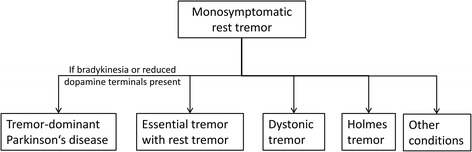
Tremor is the most common movement disorder characterized by a rhythmical, involuntary oscillatory movement of a body part. Since distinct diseases can cause similar tremor manifestations and vice-versa, it is challenging to make an accurate diagnosis. This applies particularly for tremor at rest. This entity was only rarely studied in the past, although a multitude of clinical studies on prevalence and clinical features of tremor in Parkinson's disease (PD), essential tremor and dystonia, have been carried out. Monosymptomatic rest tremor has been further separated from tremor-dominated PD. Rest tremor is also found in dystonic tremor, essential tremor with a rest component, Holmes tremor and a few even rarer conditions. Dopamine transporter imaging and several electrophysiological methods provide additional clues for tremor differential diagnosis. New evidence from neuroimaging and electrophysiological studies has broadened our knowledge on the pathophysiology of Parkinsonian and non-Parkinsonian tremor. Large cohort studies are warranted in future to explore the nature course and biological basis of tremor in common tremor related disorders.
Overview
The claims and statistics of this paper haven’t been checked yet.
Free: it reads the open-access text and checks the first 5 claims that cite a source we can check. Create a free account to check every claim.
Integrity signals
Registry
Cites
Statistics
Figures
Verification
Claims the paper makes
The claims and statistics of this paper haven’t been checked yet.
Free: it reads the open-access text and checks the first 5 claims that cite a source we can check. Create a free account to check every claim.
Claims other papers make about this one
Each is checked against this paper’s own text: does it say what the citing paper says it does?
The source backs part of the claim, not all of it — or backs it for a different population, condition or comparison.
In the citing paper
“In Fig. 7, a dominant activity at around 5 Hz is observed in the spectral domain of input signals (“red” color), which verifies the reported characteristics of the PHT in the literature, i.e., the PHT in PD and ET patients commonly occurs in 4–6 Hz and 4–8 Hz17,70, respectively, which results in accumulation of power in frequencies around 5 Hz.”
From PHTNet: Characterization and Deep Mining of Involuntary Pathological Hand Tremor using Recurrent Neural Network Models (2020) · cites this paper as [70]
Experimental — accuracy not yet measuredThe cited source says what the claim attributes to it.
In the citing paper
“However, due to the similarities in tremor characteristics for PD vs. ET, distinguishing some of these features without electronic aids can be difficult (Chen et al., 2017; Jain, Lo & Louis, 2006; Thenganatt & Louis, 2012).”
From Combined accelerometer and genetic analysis to differentiate essential tremor from Parkinson’s disease (2018) · cites this paper as Chen et al., 2017
In the citing paper
“The most common and classical PD tremor is a four to six Hz resting limb tremor, whereas the most common ET tremor is a four to eight Hz postural or kinetic tremor (Chen et al., 2017).”
From Combined accelerometer and genetic analysis to differentiate essential tremor from Parkinson’s disease (2018) · cites this paper as Chen et al., 2017
In the citing paper
“Interestingly, all ET subjects reported experiencing a rest tremor during this study, which is a higher rate than expected given the cardinal signs of PD vs ET differ in tremor type (Chen et al., 2017).”
From Combined accelerometer and genetic analysis to differentiate essential tremor from Parkinson’s disease (2018) · cites this paper as Chen et al., 2017
Self-check
Percentages, sums and reported differences re-computed from the paper’s own numbers.
The self-check needs the paper’s full text.
Citations
Cites
Staging of brain pathology related to sporadic Parkinson’s disease
Braak, H., Tredici, K. D., Rüb, U., de Vos, R. A. I., Jansen Steur, E. N. H., & Braak, E. (2003) · Neurobiology of Aging · doi:10.1016/s0197-4580(02)00065-9 · Cited by 10,777 · cited 1×
“mortem gold standard for histopathological confirmation of the diagnosis, as it is in PD [61].”
BackgroundConsensus Statement of the Movement Disorder Society on Tremor
Deuschl, G., Bain, P., & Brin, M. (2008) · Movement Disorders · doi:10.1002/mds.870131303 · Cited by 1,981 · cited 5×
“According to MDS consensus statement on tremor in 1998, ‘monosymptomatic rest tremor’(mRT) was used if these patients had a tremor duration of at least 2 years [1].”
BackgroundMethodInfluentialSelf-citationVariable expression of Parkinson's disease: A base‐line analysis of the DAT ATOP cohort
Jankovic, J., McDermott, M., Carter, J., Gauthier, S., Goetz, C., Golbe, L., Huber, S., Koller, W., Olanow, C., Shoulson, I., et al. (1990) · Neurology · doi:10.1212/wnl.40.10.1529 · Cited by 1,285
A Clinicopathologic Study of 100 Cases of Parkinson's Disease
Hughes, A. J., Daniel, S. E., Blankson, S., & Lees, A. J. (1993) · Archives of Neurology · doi:10.1001/archneur.1993.00540020018011 · Cited by 956 · cited 1×
“A case series of 100 pathologically proven PD revealed tremor in 68% of cases at disease onset, in 75% during the course of the disease, and in 9%, tremor disappeared late in the course of the illness [4].”
BackgroundNeuropathological changes in essential tremor: 33 cases compared with 21 controls
Louis, E. D., Faust, P. L., Vonsattel, J.-P. G., Honig, L. S., Rajput, A., Robinson, C. A., Rajput, A., Pahwa, R., Lyons, K. E., Ross, G. W., et al. (2007) · Brain · doi:10.1093/brain/awm266 · Cited by 562 · cited 2×
“Limited pathological and neurochemical studies point to cerebellum and brainstem abnormalities in ET, including cerebellar Purkinje cell loss, axonal swellings (torpedoes) [62], as well as GABAergic dysfunction of the dentate nucleus in the cerebellum [63] and locus coeruleus in the brainstem [64].”
BackgroundMethodA clinico-pathological study of subtypes in Parkinson's disease
Selikhova, M., Williams, D. R., Kempster, P. A., Holton, J. L., Revesz, T., & Lees, A. J. (2009) · Brain · doi:10.1093/brain/awp234 · Cited by 461 · cited 1×
“However, at later stages of the condition the course is similar for the akinetic-rigid variant and the tremor-dominant variant [16].”
BackgroundLouis, E. D., Ottman, R., & Allen Hauser, W. (1998) · Movement Disorders · doi:10.1002/mds.870130105 · Cited by 424 · cited 1×
“The prevalence of ET ranges from 1% in the total population to 5% for those beyond the age of 60 years [17].”
BackgroundPallidal dysfunction drives a cerebellothalamic circuit into Parkinson tremor
Helmich, R. C., Janssen, M. J. R., Oyen, W. J. G., Bloem, B. R., & Toni, I. (2011) · Annals of Neurology · doi:10.1002/ana.22361 · Cited by 417 · cited 1×
“amplitude is regulated within the cerebello-thalamocortical circuit [59].”
BackgroundEssential tremor and cerebellar dysfunction Clinical and kinematic analysis of intention tremor
Deuschl, G. (2000) · Brain · doi:10.1093/brain/123.8.1568 · Cited by 365
Self-citationMutations in GNAL cause primary torsion dystonia
Fuchs, T., Saunders-Pullman, R., Masuho, I., Luciano, M. S., Raymond, D., Factor, S., Lang, A. E., Liang, T.-W., Trosch, R. M., White, S., et al. (2013) · Nature Genetics · doi:10.1038/ng.2496 · Cited by 320 · cited 1×
“Head tremor was also noted in DYT25 patients with guanine nucleotide-binding protein(GNAL) mutation [39].”
Background
Research works printed but not linked: 1
- Marsden C Obeso J Rothwell J Yahr MD Benign essential tremor is not a single entity Curr. Concepts park. Dis. Relat. Disord 1983 Amsterdam Excerpta Medica 31 46
Cited by
Music Therapy in the Treatment of Dementia: A Systematic Review and Meta-Analysis
Moreno-Morales, C., Calero, R., Moreno-Morales, P., & Pintado, C. (2020) · Frontiers in Medicine · doi:10.3389/fmed.2020.00160 · Cited by 229
Tremor Syndromes: An Updated Review
Lenka, A., & Jankovic, J. (2021) · Frontiers in Neurology · doi:10.3389/fneur.2021.684835 · Cited by 132
“These patients should be followed closely because many subsequently develop additional signs of PD in the future (36).”
BackgroundMethodPost-translational modifications: Regulators of neurodegenerative proteinopathies
Gupta, R. V., Sahu, M., Srivastava, D., Tiwari, S., Ambasta, R. K., & Kumar, P. (2021) · Ageing Research Reviews · doi:10.1016/j.arr.2021.101336 · Cited by 134
Neurodegenerative diseases: a hotbed for splicing defects and the potential therapies
Li, D., McIntosh, C. S., Mastaglia, F. L., Wilton, S. D., & Aung-Htut, M. T. (2021) · Translational Neurodegeneration · doi:10.1186/s40035-021-00240-7 · Cited by 99
Deep Learning Identifies Digital Biomarkers for Self-Reported Parkinson's Disease
Zhang, H., Deng, K., Li, H., Albin, R. L., & Guan, Y. (2020) · Patterns · doi:10.1016/j.patter.2020.100042 · Cited by 84
Metadata
- Authors
- Chen, W., Hopfner, F., Becktepe, J. S., & Deuschl, G.
- Affiliations
- Shanghai Jiao Tong University (CN)
- Christian-Albrechts-Universität zu Kiel (DE)
- Corresponding author
- Deuschl, Günther
- Venue
- Translational Neurodegeneration
- Published
- 2017-06-16
- Volume
- 6
- Issue
- 1
- Pages
- 16-16
- ISSN
- 2047-9158 (ISSN-L)
- PMC
- PMC5472969
- OpenAlex
- W2621445036
- Cited by
- 66
- References
- 71
- Citations by year
- 2026: 6 · 2025: 5 · 2024: 8 · 2023: 6 · 2022: 4 · 2021: 15 · 2020: 12 · 2019: 3 · 2018: 5 · 2017: 2
- FWCI
- 0.81
- Type
- journal article
- Language
- en
- Open access
- gold
- doi.org
- Licence
- cc-by
- Locations
- Translational Neurodegeneration (publishedVersion, cc-by)
- Europe PMC (PubMed Central) (publishedVersion, cc-by)
- PubMed Central (publishedVersion, cc-by)
- PubMed (publishedVersion)
- DOAJ (DOAJ: Directory of Open Access Journals) (submittedVersion, cc-by-sa)
- Funders
- National Natural Science Fund of China (81401039)
- German Research Council (/)
- International Essential Tremor Foundation (/)
- German Ministry of Education and Health (/)
- K.C.Wong Medical Fund of Shanghai Jiao Tong University (/)
- Youth Fund of Shanghai Ninth People’s Hospital (/)
- Topics
- Health Sciences › Medicine › Clinical Neurology › Deep Brain Stimulation and Movement Disorders
- Health Sciences › Medicine › Clinical Neurology › Parkinson's Disease Mechanisms and Treatments
- Health Sciences › Medicine › Clinical Neurology › Neurological and metabolic disorders
- Keywords
- resting tremor, Parkinson's disease, essential tremor, dystonia, Holmes tremor, tremor differential diagnosis, dopamine transporter imaging, tremor pathophysiology
About these checks
Registry, retraction, Cites and statistics results are computed, not judged, with one exception: a printed reference that no index lists is read once by a model before it counts as a citation error. Claims are extracted by a model and kept only when their quote appears verbatim in the text; each cited source is then checked, with a model’s help, for whether it says what the claim relies on. Those verdicts can be wrong — read the claim’s quote and the cited source before relying on one.
Statistics and arithmetic are recomputed, not judged.
Confidence bands are shown only for fields calibrated on our annotated test set. None is calibrated yet, so no band is shown.
What counts as a claim ›How we measure confidence ›How we check this ›
Are you an author, or do you see a problem with this page? Request a review
Data sources
Bibliographic data: Semantic Scholar, OpenAlex, Crossref.
Contains information from the Semantic Scholar Academic Graph Datasets, made available under the ODC Attribution License (ODC-BY 1.0).
Semantic Scholar’s data is described in: Kinney, R., et al. (2023). The Semantic Scholar Open Data Platform. arXiv:2301.10140.
