

The DOI matches its Crossref record; 204 of the 204 references it cites were found in a registry or an index.
TLR2 and TLR4 in Parkinson’s disease pathogenesis: the environment takes a toll on the gut
Open accessAbstract
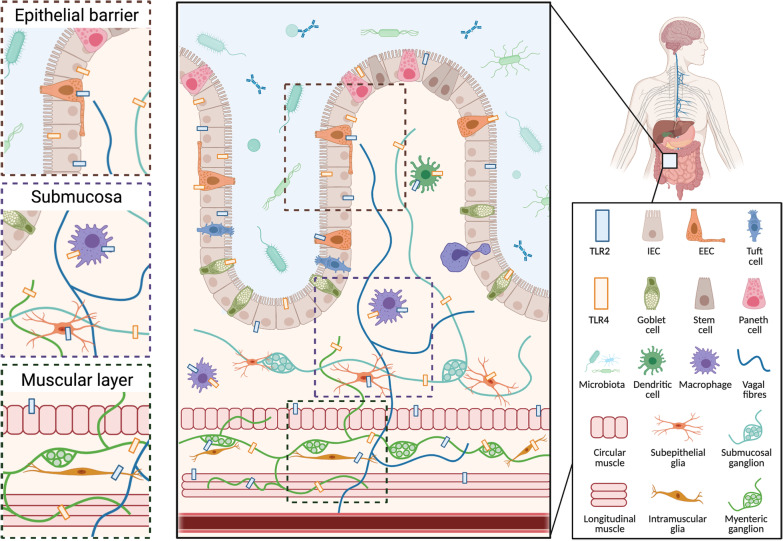
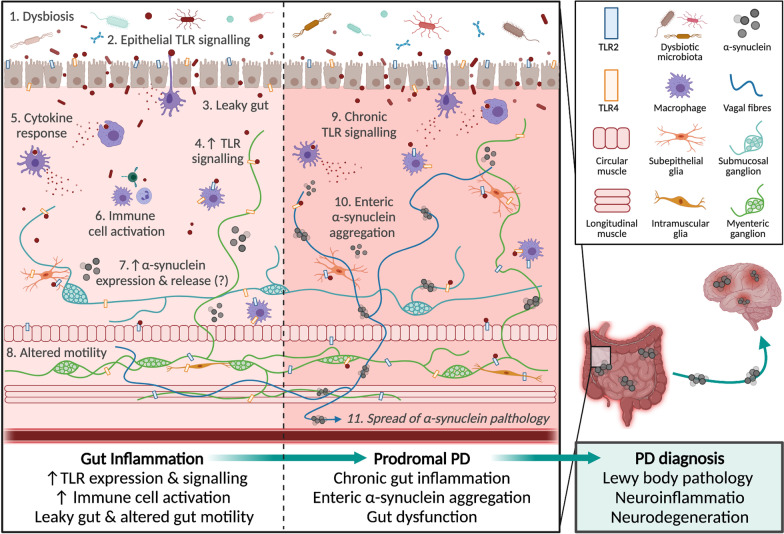
Parkinson’s disease (PD) is an incurable, devastating disorder that is characterized by pathological protein aggregation and neurodegeneration in the substantia nigra. In recent years, growing evidence has implicated the gut environment and the gut-brain axis in the pathogenesis and progression of PD, especially in a subset of people who exhibit prodromal gastrointestinal dysfunction. Specifically, perturbations of gut homeostasis are hypothesized to contribute to α-synuclein aggregation in enteric neurons, which may spread to the brain over decades and eventually result in the characteristic central nervous system manifestations of PD, including neurodegeneration and motor impairments. However, the mechanisms linking gut disturbances and α-synuclein aggregation are still unclear. A plethora of research indicates that toll-like receptors (TLRs), especially TLR2 and TLR4, are critical mediators of gut homeostasis. Alongside their established role in innate immunity throughout the body, studies are increasingly demonstrating that TLR2 and TLR4 signalling shapes the development and function of the gut and the enteric nervous system. Notably, TLR2 and TLR4 are dysregulated in patients with PD, and may thus be central to early gut dysfunction in PD. To better understand the putative contribution of intestinal TLR2 and TLR4 dysfunction to early α-synuclein aggregation and PD, we critically discuss the role of TLR2 and TLR4 in normal gut function as well as evidence for altered TLR2 and TLR4 signalling in PD, by reviewing clinical, animal model and in vitro research. Growing evidence on the immunological aetiology of α-synuclein aggregation is also discussed, with a focus on the interactions of α-synuclein with TLR2 and TLR4. We propose a conceptual model of PD pathogenesis in which microbial dysbiosis alters the permeability of the intestinal barrier as well as TLR2 and TLR4 signalling, ultimately leading to a positive feedback loop of chronic gut dysfunction promoting α-synuclein aggregation in enteric and vagal neurons. In turn, α-synuclein aggregates may then migrate to the brain via peripheral nerves, such as the vagal nerve, to contribute to neuroinflammation and neurodegeneration typically associated with PD.
Overview
The claims and statistics of this paper haven’t been checked yet.
Run the check — free, no account needed. It reads the open-access text and checks the sources it cites.
Integrity signals
Registry
Cites
Statistics
Figures
Verification
Claims the paper makes
The claims and statistics of this paper haven’t been checked yet.
Run the check — free, no account needed. It reads the open-access text and checks the sources it cites.
Claims other papers make about this one
Each is checked against this paper’s own text: does it say what the citing paper says it does?
The cited source says what the claim attributes to it.
In the citing paper
“Several studies have confirmed that Toll-like receptors, specifically TLR4, play an instrumental role in intestinal homeostasis [65].”
From Neuroprotective Effects of Sodium Butyrate by Restoring Gut Microbiota and Inhibiting TLR4 Signaling in Mice with MPTP-Induced Parkinson’s Disease (2023) · cites this paper as [65]
The cited source says what the claim attributes to it.
In the citing paper
“In addition, gut microbial dysbiosis was suggested to alter TLR2 and TLR4 signaling, promoting α-synuclein aggregation in enteric and vagal neurons, which in turn migrates to the brain via peripheral nerves and contributes to neurodegeneration.307”
From Role of neuroinflammation in neurodegeneration development (2023) · cites this paper as [307]
Self-check
Percentages, sums and reported differences re-computed from the paper’s own numbers.
The self-check needs the paper’s full text.
Citations
Cites
1 retracted
Items 201–204 of 204
Kunze, T., Hunold, A., Haueisen, J., et al. (2015) · BMC Neuroscience · doi:10.1186/1471-2202-16-s1-o13 · Cited by 6
Jones, J. M., Korczak, R., Peña, R. J., & Braun, H. J. (2017) · Cereal Foods World · doi:10.1094/cfw-62-3-0104 · Cited by 5
Al–Sadi, R., Nighot, P. K., Nighot, M., et al. (2019) · Gastroenterology · doi:10.1053/j.gastro.2019.01.199 · Cited by 3
Sian-Hulsmann, J., & Riederer, P. (2020) · Journal of Experimental Neurology · doi:10.33696/neurol.1.022 · Cited by 1
Research works printed but not linked: 1
- Zhang F, Gao XD, Wu WW, Gao Y, Zhang YW, Wang SP. Polymorphisms in toll-like receptors 2, 4 and 5 are associated with Legionella pneumophila infection. Infection. 2013;41(5):941–8. · DOI
Cited by
Sorted by citations
Role of neuroinflammation in neurodegeneration development
Zhang, W., Xiao, D., Mao, Q., & Xia, H. (2023) · Signal Transduction and Targeted Therapy · doi:10.1038/s41392-023-01486-5 · Cited by 1,668
“In addition, gut microbial dysbiosis was suggested to alter TLR2 and TLR4 signaling, promoting αsynuclein aggregation in enteric and vagal neurons, which in turn migrates to the brain via peripheral nerves and contributes to neurodegeneration.(307) These results provide a strong evidence for the involvement of gut mic…”
BackgroundGuo, T.-T., Zhang, Z., Sun, Y., Zhu, R.-Y., Wang, F.-X., Ma, L.-J., Jiang, L., & Liu, H.-D. (2023) · Nutrients · doi:10.3390/nu15040930 · Cited by 82
Hong, D., Zhang, C., Wu, W., Lu, X., & Zhang, L. (2023) · Frontiers in Neurology · doi:10.3389/fneur.2023.1133546 · Cited by 38
Metadata
- Authors
- Gorecki, A. M., Anyaegbu, C. C., & Anderton, R. S.
- Affiliations
- The University of Western Australia (AU)
- Curtin University (AU)
- The University of Notre Dame Australia (AU)
- Corresponding author
- Gorecki, Anastazja M.
- Venue
- Translational Neurodegeneration
- Published
- 2021-11-17
- Volume
- 10
- Issue
- 1
- Pages
- 47-47
- ISSN
- 2047-9158 (ISSN-L)
- PMC
- PMC8609261
- OpenAlex
- W3215959508
- Cited by
- 103
- References
- 204
- Citations by year
- 2026: 13 · 2025: 26 · 2024: 28 · 2023: 28 · 2022: 7 · 2021: 1
- FWCI
- 2.05
- Type
- journal article
- Language
- en
- Open access
- gold
- doi.org
- Locations
- Translational Neurodegeneration (publishedVersion, cc-by)
- PubMed Central (publishedVersion, cc-by)
- PubMed (publishedVersion)
- UWA Profiles and Research Repository (UWA) (submittedVersion, cc-by)
- ResearchOnline@ND (The University of Notre Dame) (submittedVersion)
- DOAJ (DOAJ: Directory of Open Access Journals) (submittedVersion, cc-by-sa)
- Funders
- australian government (Australian Government Research Training Program Scholarship)
- parkinson’s western australia (Zrinski Grant)
- Topics
- Health Sciences › Medicine › Clinical Neurology › Parkinson's Disease Mechanisms and Treatments
- Life Sciences › Neuroscience › Neurology › Neuroinflammation and Neurodegeneration Mechanisms
- Life Sciences › Immunology and Microbiology › Immunology › Immune Response and Inflammation
- Keywords
- Parkinson's disease, TLR2, TLR4, Toll-like receptors, gut-brain axis, alpha-synuclein aggregation, gut dysbiosis, intestinal permeability, enteric nervous system, vagus nerve, neuroinflammation, neurodegeneration, innate immunity
- MeSH terms
- Animals, Humans, Parkinson Disease, Substantia Nigra, Toll-Like Receptor 2, Toll-Like Receptor 4, Dysbiosis
About these checks
Registry, retraction, Cites and statistics results are computed, not judged, with one exception: a printed reference that no index lists is read once by a model before it counts as a citation error. Claims are extracted by a model and kept only when their quote appears verbatim in the text; each cited source is then checked, with a model’s help, for whether it says what the claim relies on. Those verdicts can be wrong — read the claim’s quote and the cited source before relying on one.
Statistics and arithmetic are recomputed, not judged.
Confidence bands are shown only for fields calibrated on our annotated test set. None is calibrated yet, so no band is shown.
What counts as a claim ›How we measure confidence ›How we check this ›
Are you an author, or do you see a problem with this page? Request a review
