

Production of mixed fruit (pawpaw, banana and watermelon) wine using Saccharomyces cerevisiae isolated from palm wine
Open accessThe DOI matches its Crossref record; 50 of the 53 references it cites were found in a registry or an index, and 2 are not checked yet; 2 of the 16 sources its claims cite were checked for support.
Abstract
Mixed-fruit fermentation study involving banana, with pH, acidity, alcohol, and sensory evaluation tracked.
Verified 2026-11-22 · 2 references not checked yet
Overview
CoChat Summary
## TL;DR
This paper reports that mixed wines made from pawpaw, banana, and watermelon could be produced successfully using Saccharomyces cerevisiae isolated from palm wine, with acceptable chemical and sensory properties. The final wines had 16.00–18.50% alcohol, 2.5–3.8 pH, and total acidity within the paper’s stated acceptable range.
## Key findings
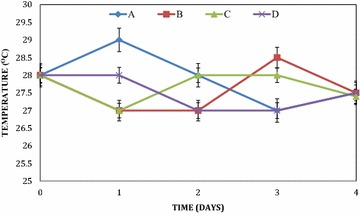
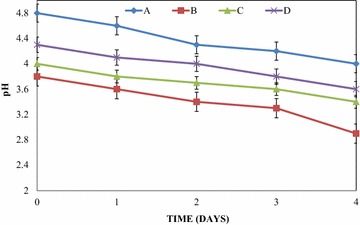
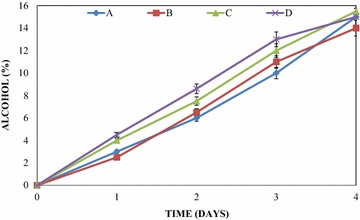
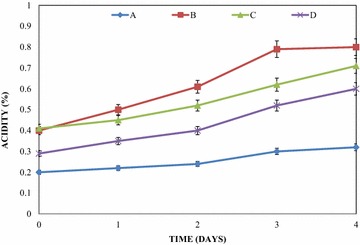
- During primary fermentation, alcohol increased from 0.0 to 15.0%, total acidity from 0.20 to 0.80%, specific gravity decreased from 1.060 to 0.9800, and temperature stayed between 27°C and 29°C.
- Final alcohol contents were 17.50 ± 0.02% (pawpaw + watermelon), 16.00 ± 0.02% (pawpaw + banana), 18.50 ± 0.02% (banana + watermelon), and 18.00 ± 0.02% (pawpaw + banana + watermelon); the paper says these did not differ significantly (p > 0.05).
- Final pH values were acidic, ranging from 2.5 ± 0.01 to 3.8 ± 0.01, and final acidity ranged from 0.35 ± 0.02 to 0.88 ± 0.01%; the paper says these were within acceptable limits and not significantly different.
- Sensory ranking of acceptability was pawpaw and banana wine > pawpaw and watermelon > pawpaw, banana and watermelon > banana and watermelon wine; the paper says sensory differences were not significant (P > 0.05).
## Methods
- Experimental wine production from mixed fruit musts using pawpaw, banana, and watermelon in two- and three-fruit combinations; the fruits were mixed with water (1:1 w/v), sugar (0.656 kg), and sodium metabisulphite before fermentation.
- Saccharomyces cerevisiae was isolated from fresh palm wine: 19 isolates were obtained, 6 were identified as *S. cerevisiae*, and the isolate with the highest sugar and alcohol tolerance was selected as the starter.
- Primary fermentation lasted 4 days, secondary fermentation 21 days, and the wines were then clarified, filtered, and matured for 6 months; analysis included chemical tests, microbial isolation, sensory evaluation by 20 judges, and ANOVA with P < 0.05 as the significance threshold.
## Limitations
- The paper does not report a control treatment using a commercial wine yeast or a non-inoculated fermentation for direct comparison; this is evident from the text.
- The sensory evaluation was done by 20 judges on a seven-point hedonic scale, which is a relatively small panel; this is evident from the text.
- The paper states some results were based on “did not differ significantly,” but it does not provide detailed statistical outputs beyond that; this is evident from the text.
Model-written summary. Check it against the paper before relying on it.
Integrity signals
Registry
Cites
Statistics
Figures
Verification
Claims the paper makes
2 Valid · 0 Not valid · 9 Not checked · 32 Own results and interpretations
A result the paper reports from its own data — it cites no other source for it, so there is none to check. The quote shows it is in the paper.
In the paper
“The alcoholic content of the final wines were 17.50 ± 0.02 % (pawpaw and watermelon), 16.00 ± 0.02 % (pawpaw and banana), 18.50 ± 0.02 % (banana and watermelon wine) and 18.00 ± 0.02 % (pawpaw, banana and watermelon).”
- Also stated in: § Results · hedged
“The result indicated that the final alcohol concentration of pawpaw and watermelon wine, pawpaw and banana wine, pawpaw, banana and watermelon wine, and banana and watermelon wine, were 17.50 ± 0.02, 16.00 ± 0.02, 18.00 ± 0.02 and 18.50 ± 0.02 % respectively (Table 3).”
§ Production of mixed fruit (pawpaw, banana and watermelon) wine using Saccharomyces cerevisiae isolated from palm wine > Abstract
plain- Asserted: passes — The authors put it forward as true.
- Checkable: passes — It can be checked against evidence.
- Load-bearing: unclear — It is unclear whether the paper’s conclusions depend on it.
- Based: passes — The paper gives a reason why it holds.
- Also stated in: § Results · hedged
A result the paper reports from its own data — it cites no other source for it, so there is none to check. The quote shows it is in the paper.
In the paper
“During primary fermentation, consistent increases in alcohol contents (ranging from 0.0 to 15.0 %) and total acidities (ranging from 0.20 to 0.80 %) were observed with gradual decrease in specific gravities (ranging from 1.060 to 0.9800) and pH (ranging from 4.80 to 2.90).”
§ Production of mixed fruit (pawpaw, banana and watermelon) wine using Saccharomyces cerevisiae isolated from palm wine > Abstract
plainstates a cause- Asserted: passes — The authors put it forward as true.
- Checkable: passes — It can be checked against evidence.
- Load-bearing: unclear — It is unclear whether the paper’s conclusions depend on it.
- Based: passes — The paper gives a reason why it holds.
A result the paper reports from its own data — it cites no other source for it, so there is none to check. The quote shows it is in the paper.
In the paper
“The alcoholic content of the final wines were 17.50 ± 0.02 % (pawpaw and watermelon), 16.00 ± 0.02 % (pawpaw and banana), 18.50 ± 0.02 % (banana and watermelon wine) and 18.00 ± 0.02 % (pawpaw, banana and watermelon).”
- Also stated in: § Results · hedged
“The result indicated that the final alcohol concentration of pawpaw and watermelon wine, pawpaw and banana wine, pawpaw, banana and watermelon wine, and banana and watermelon wine, were 17.50 ± 0.02, 16.00 ± 0.02, 18.00 ± 0.02 and 18.50 ± 0.02 % respectively (Table 3).”
§ Production of mixed fruit (pawpaw, banana and watermelon) wine using Saccharomyces cerevisiae isolated from palm wine > Abstract
plain- Asserted: passes — The authors put it forward as true.
- Checkable: passes — It can be checked against evidence.
- Load-bearing: unclear — It is unclear whether the paper’s conclusions depend on it.
- Based: passes — The paper gives a reason why it holds.
- Also stated in: § Results · hedged
A result the paper reports from its own data — it cites no other source for it, so there is none to check. The quote shows it is in the paper.
In the paper
“The acid concentration (residual and volatile acidity) were within the acceptable limit and ranged from 0.35 ± 0.02 to 0.88 ± 0.01 % (p > 0.05).”
- Also stated in: § Discussion · plain
“ranging from 0.35 ± 0.02 to 0.88 ± 0.01 %.”
§ Production of mixed fruit (pawpaw, banana and watermelon) wine using Saccharomyces cerevisiae isolated from palm wine > Abstract
plain- Asserted: passes — The authors put it forward as true.
- Checkable: passes — It can be checked against evidence.
- Load-bearing: passes — The paper’s conclusions depend on it.
- Based: passes — The paper gives a reason why it holds.
- Also stated in: § Discussion · plain
A result the paper reports from its own data — it cites no other source for it, so there is none to check. The quote shows it is in the paper.
In the paper
“The alcoholic content of the final wines were 17.50 ± 0.02 % (pawpaw and watermelon), 16.00 ± 0.02 % (pawpaw and banana), 18.50 ± 0.02 % (banana and watermelon wine) and 18.00 ± 0.02 % (pawpaw, banana and watermelon).”
- Also stated in: § Results · hedged
“The result indicated that the final alcohol concentration of pawpaw and watermelon wine, pawpaw and banana wine, pawpaw, banana and watermelon wine, and banana and watermelon wine, were 17.50 ± 0.02, 16.00 ± 0.02, 18.00 ± 0.02 and 18.50 ± 0.02 % respectively (Table 3).”
§ Production of mixed fruit (pawpaw, banana and watermelon) wine using Saccharomyces cerevisiae isolated from palm wine > Abstract
plain- Asserted: passes — The authors put it forward as true.
- Checkable: passes — It can be checked against evidence.
- Load-bearing: unclear — It is unclear whether the paper’s conclusions depend on it.
- Based: passes — The paper gives a reason why it holds.
- Also stated in: § Results · hedged
21 more claims
Create a free account to see all 43 claims and every source verdict.
- It may state two separate claims as one. 12
- Probably not a substantial claim. 4
- The quote only partly states this claim. 1
Citations
Cites
Belle, G. V., Fisher, L. D., Heagerty, P. J., & Lumley, T. (1958) · Wiley eBooks · doi:10.1002/0471602396.ch1 · Cited by 1,861
Yeast interactions and wine flavour
Fleet, G. (2003) · International Journal of Food Microbiology · doi:10.1016/s0168-1605(03)00245-9 · Cited by 1,020 · cited 5×
“Also, because different fruits have different composition, there is the need for yeast strains to adapt to different environments, such as sugar composition and concentration of acetic acid (Fleet 2003; Chilaka et al.”
BackgroundMethodInfluentialBread, beer and wine: Saccharomyces cerevisiae diversity reflects human history
LEGRAS, J., MERDINOGLU, D., CORNUET, J., & KARST, F. (2007) · Molecular Ecology · doi:10.1111/j.1365-294x.2007.03266.x · Cited by 548
Wall, M. M. (2006) · Journal of Food Composition and Analysis · doi:10.1016/j.jfca.2006.01.002 · Cited by 429
Westermann, B., & Neupert, W. (2000) · Yeast · doi:10.1002/1097-0061(200011)16:15<1421::aid-yea624>3.0.co;2-u · Cited by 401
Fermentation of pomegranate juice by probiotic lactic acid bacteria
Mousavi, Z. E., Mousavi, S. M., Razavi, S. H., Emam-Djomeh, Z., & Kiani, H. (2011) · World Journal of Microbiology and Biotechnology · doi:10.1007/s11274-010-0436-1 · Cited by 293
Characterization of different fruit wines made from cacao, cupuassu, gabiroba, jaboticaba and umbu
Duarte, W. F., Dias, D. R., Oliveira, J. M., Teixeira, J. A., de Almeida e Silva, J. B., & Schwan, R. F. (2010) · LWT - Food Science and Technology · doi:10.1016/j.lwt.2010.03.010 · Cited by 213
Influence of sequential yeast mixtures on wine fermentation
Clemente-Jimenez, J. M., Mingorance-Cazorla, L., Martínez-Rodríguez, S., Las Heras-Vázquez, F. J., & Rodríguez-Vico, F. (2005) · International Journal of Food Microbiology · doi:10.1016/j.ijfoodmicro.2004.06.007 · Cited by 173
Oms-Oliu, G., Odriozola-Serrano, I., Soliva-Fortuny, R., & Martín-Belloso, O. (2009) · Food Chemistry · doi:10.1016/j.foodchem.2009.01.049 · Cited by 171
Banana improvement : cellular, molecular biology, and induced mutations
Jain, S. M., & Swennen, R. L. (2004) · Science Publishers eBooks · Cited by 163
Research works printed but not linked: 9
- Awe S Production and microbiology of pawpaw (Caricapapaya L) wine Curr Res J Biol Sci 2011 3 5 443 447
- Barnett JA Payne RW Yarrow D Yeast characterization and identification 2000 3 Cambridge Cambridge University Press
- Kerje T Grum M The origin of watermelon (Cucumismelo): a review of the literature Pak J Nutr 2003 9 8 647 654
- McClements JD Analysis of food products Food Sci 2003 581 1 57
- Obaedo ME Ikenebomeh MJ Microbiology and production of banana (Musasapientum) wine Niger J Microbiol 2009 23 1 1886 1891
- OECD Consensus document on compositional considerations for new varieties of papaya (Caricapapaya L.): key food and feed nutrients, antinutrients, toxicant and allergens series of the safety of novel foods and feed Organ Econ Cooperation Dev 2010 28 21 1 40
- Okoro CE Production of red wine from roselle (Hibiscussabdariffa) and pawpaw (caricapapaya) using palm-wine yeast (S. cerevisiae) Niger Food J 2007 25 2 158 164
- Pillay M Tripathi L Kole C Banana Genome mapping and molecular breeding in plants, fruits and nuts 2007 Varlay Berlin Springer 281 301
- Reddy LV Reddy OVS Production, optimization and characterization of wine from mango Mangiferaindica L.) Nat Prod Radiance 2009 8 4 426 435
Cited by
Strategies to Improve the Potential Functionality of Fruit-Based Fermented Beverages
Keșa, A.-L., Pop, C. R., Mudura, E., Salanță, L. C., Pasqualone, A., Dărab, C. P., Burja-Udrea, C., Zhao, H., & Coldea, T. E. (2021) · Plants · doi:10.3390/plants10112263 · Cited by 77
“These types of wines are made from blackberry (representing a traditional Croatian alcoholic beverage, a source of minerals and polyphenolics) [70], mulberry [71], pineapple and passion fruit [72], mango [73], and mixtures of banana, pawpaw, and watermelon [74].”
BackgroundEnzymatic treatment, unfermented and fermented fruit-based products: current state of knowledge
Toy, J. Y. H., Lu, Y., Huang, D., Matsumura, K., & Liu, S. (2020) · Critical Reviews in Food Science and Nutrition · doi:10.1080/10408398.2020.1848788 · Cited by 50
“Other than banana juice, bananas have also been fermented into alcoholic beverages, wines, or vinegars (Ogodo et al. 2015; Qamar and Shaikh 2018).”
BackgroundTsegay, Z. T. (2020) · Food Science & Nutrition · doi:10.1002/fsn3.1745 · Cited by 68
“Similar situation was observed during the production of mixed fruits wine (pawpaw, watermelon, and pawpaw fruits wine) (Ogodo et al., 2015).”
BackgroundResultInfluentialLiu, M., Feng, Y., Zhao, M., & Huang, M. (2023) · Food Bioscience · doi:10.1016/j.fbio.2023.102889 · Cited by 35
Advances in the Quality Improvement of Fruit Wines: A Review
He, L., Yan, Y., Min, W., & Ke, L. (2024) · Horticulturae · doi:10.3390/horticulturae10010093 · Cited by 39
“The Saccharomyces cerevisiae strain can also produce a mixed fruit wine from pawpaw, banana, and watermelon, which was acceptable by consumers [46].”
Background(2021) · doi:10.1002/fsn3.2328 · Cited by 24
“…fruits are used in many parts of the world for the production of wine, such as raspberry, cherry, strawberries, pawpaw, banana, watermelon, mango, guava, kiwi, carambola, apple, plum, peach, and wild apricot (Duarte et al., 2010; Ogodo et al., 2015, 2018; Sevda et al., 2011; Vidya & Neela, 2004).”
BackgroundKitessa, D. A., Bacha, K., Tola, Y. B., Murimi, M., Gershe, S., & Guta, M. (2022) · Fermentation · doi:10.3390/fermentation8030124 · Cited by 24
(2020) · doi:10.1155/2020/8647262 · Cited by 19
“Pawpaw, banana, and watermelon fruits were used to produce mixed fruit wines using Saccharomyces cerevisiae with improved physicochemical and sensorial properties of the final wine [1].”
MethodNutritional, microbial and sensory attributes of bread fortified with defatted watermelon seed flour
(2018) · doi:10.1111/ijfs.13727 · Cited by 19
“The predominant proteins therein are arginine, leucine, aspartic acid and glutamic acid (Ogodo et al., 2015).”
BackgroundEffect of fermentation parameters on physicochemical and sensory properties of Burans wine
Yadav, D. K., Chand, K., & Kumari, P. (2022) · Systems Microbiology and Biomanufacturing · doi:10.1007/s43393-021-00074-4 · Cited by 27
“A similar observation was reported by Sahu [24] in tendu wine preparation and also by Ogodo [25] for the production of mixed fruit wine from papaya, banana and watermelon.”
ResultElectrolytic treatment and biosurfactants applied to the conservation of Eugenia uniflora fruit
Dilarri, G., da Silva, V. L., Pecora, H. B., Montagnolli, R. N., Corso, C. R., & Bidóia, E. D. (2016) · Food Science and Technology · doi:10.1590/1678-457x.00516 · Cited by 19
“Bacterial growth in fruit is characterized by the slimy state of the surface of the food (Dgodo et al., 2015).”
BackgroundTsegay, Z. T., & Gebremedhin, K. M. (2019) · Journal of Food Quality · doi:10.1155/2019/6834946 · Cited by 18
“/e improved sensory qualities of the produced wine are consistent with fruit wine produced from blended fruits of pawpaw with banana [8].”
Background(2019) · doi:10.26656/fr.2017.4(1).230 · Cited by 14
“Obviously, watermelon has sweet and juicy flesh and colour varying from deep red to pink, with many black seeds while seedless varieties are also common (Ogodo et al., 2015).”
BackgroundInfluentialCao, H., Bai, M., Lou, Y., Yang, X., Zhao, C., Lu, K., & Zhang, P. (2023) · Fermentation · doi:10.3390/fermentation9030276 · Cited by 14
Devaki, C. S., & Premavalli, K. S. (2019) · Elsevier eBooks · doi:10.1016/b978-0-12-815271-3.00008-7 · Cited by 24
Ebana, R., Edet, U. O., Anosike, K. I., Etok, C. A., & Kanu, T. O. (2019) · doi:10.5281/zenodo.19296730 · Cited by 10
Temperature Effect on Densification of Banana Peels Briquette
Mitan, N. M. M., & Sa'adon, M. F. R. (2019) · Materials Today Proceedings · doi:10.1016/j.matpr.2019.11.159 · Cited by 13
(2020) · doi:10.17508/cjfst.2020.12.1.07 · Cited by 9
“It contains large amounts of beta carotene, which are significant sources of lycopene (Ogodo et al., 2015).”
BackgroundWójcik, M., Bieńczak, A., Woźniak, P., & Różyło, R. (2023) · Processes · doi:10.3390/pr11123282 · Cited by 10
“The main proteins found in watermelon seeds include arginine, leucine, glutamic acid and aspartic acid [7].”
BackgroundPhytochemical Analysis of Some Selected Indigenous Fruits Collected from Lokogoma-Abuja, Nigeria
Mariya, A., Abdulrasheed, H., & Babangida, A. Z. (2020) · Journal of Diseases and Medicinal Plants · doi:10.11648/j.jdmp.20200602.14 · Cited by 8
“Watermelon juice can be blended with other fruit juices or made into wine [10].”
BackgroundTan, X. S., Ding, M., Wang, C., Huang, L., & Bai, J. (2025) · Foods · doi:10.3390/foods14132207 · Cited by 12
Production and Evaluation of Table Wine Using Two Different Varieties of Pawpaw (Carica papaya)
Kiin-Kabari, D. B., Igbo, Q., & Barber, L. I. (2019) · Journal of Food Science and Engineering · doi:10.17265/2159-5828/2019.06.002 · Cited by 7
Olaniran, A. F., Okonkwo, C. E., Osemwegie, O. O., Iranloye, Y. M., Adewumi, A. D., Taiwo, A. E., Erinle, O. C., Ajayi, I. E., & Ojo, O. A. (2024) · Scientific Reports · doi:10.1038/s41598-024-55312-1 · Cited by 6
Ajogun, C. O., Achinewhu, S. C., Kiin-Kabari, D. B., & Akusu, O. M. (2020) · European Journal of Agriculture and Food Sciences · doi:10.24018/ejfood.2020.2.5.102 · Cited by 5
“A similar observation has been reported by [30] in their study on Mixed Fruits (Pineapple and Watermelon).”
ResultApple and Grape Waste Pomace Fermentation and Co-Ferment Product Chemistry
Wang, Z., Svyantek, A. W., & Miller, Z. J. (2025) · Fermentation · doi:10.3390/fermentation11030126 · Cited by 6
“Through mixed fruit fermentation, producers can achieve methods to preserve and enhance fruit nutrients, minerals, vitamins, aroma, and tastes [15].”
Microbial Quality, Vitamin, Mineral and Proximate Composition of Some Fresh Fruit Juice Samples
Oladipo, I. C., Oyelami, R., Ogundeji, K. D., Akinteye, E. O., Adewoyin, A. G., & Oladipo, A. O. (2022) · European Journal of Biology and Biotechnology · doi:10.24018/ejbio.2022.3.5.397 · Cited by 5
Watermelon waste as a growth media substitute for bacterial cellulose production
Nasharudin, M. I. H., Mahmud, N., & Rahim, M. H. A. (2024) · AIP conference proceedings · doi:10.1063/5.0188785 · Cited by 5
Amadou, N. M., Jean, S., Waingeh, N. C., & Yam, S. A. (2020) · SDRP Journal of Food Science & Technology · doi:10.25177/jfst.5.3.ra.10632 · Cited by 5
“In fact, Ogodo et al (2015) suggested that volatile acids can easily be removed from the body system of wine through perspiration.”
BackgroundAlabere, A., & Adebayo-Olajide, T. C. (2023) · Asian Journal of Applied Science and Technology · doi:10.38177/ajast.2023.7103 · Cited by 4
Adesokan, I. A. (2022) · Journal of Food Technology Research · doi:10.18488/jftr.v9i3.3191 · Cited by 3
Quality Evaluation of Wine Produced from Tiger Nut (Cyperus esculentus L.) Drink
(2019) · doi:10.12691/ajfst-7-4-2 · Cited by 3
“However, low total titrable acidity have been the major problem associated with making non-grape wine [38].”
BackgroundProduction and evaluation of wine prepared from banana (Saccharomyces Cerevisiae)
Kandhare, K. S., Gaikwad, R. S., & Pate, S. S. (2023) · World Journal of Biology Pharmacy and Health Sciences · doi:10.30574/wjbphs.2023.13.1.0044 · Cited by 3
Adebowale, A. P., Adegoke, G. O., & Adeboyejo, F. O. (2020) · Acta Scientifci Nutritional Health · doi:10.31080/asnh.2020.04.0637 · Cited by 3
Edima-Nyah, A. P., Amande, E. I., & Ekanem, K. E. (2024) · African Journal of Advances in Science and Technology Research · doi:10.62154/dz9a7140 · Cited by 2
Process optimization and quality evaluation of sugar cane-guava blend wine
Ewunetu, M. G., & Asemu, A. M. (2025) · Food Chemistry Advances · doi:10.1016/j.focha.2025.101070 · Cited by 2
Ugbogu, O. C., Ogodo, A. C., Ugbogu, E. A., Nwachukwu, K. C., & Orji, F. A. (2025) · Sustainable Food Technology · doi:10.1039/d5fb00085h · Cited by 1
Self-citationSilas, T. V., & Abah, M. A. (2024) · Asian Journal of Biological Sciences · doi:10.3923/ajbs.2025.168.178 · Cited by 2
“26 on fermenting palm wine using Saccharomyces cerevisiae , they made pawpaw, banana and watermelon wine.”
Jideani, V. A. (2019) · IntechOpen eBooks · doi:10.5772/intechopen.84857 · Cited by 1
“[21] reported mixed fruit (pawpaw, banana and watermelon) wine using Saccharomyces cerevisiae isolated from palm wine.”
Background(2021) · doi:10.4316/fens.2021.039 · Cited by 1
“previously reported by [16,32] for alcoholic fruit beverages.”
Background(2024) · doi:10.5897/ajb2023.17632 · Cited by 1
“It is in agreement with earlier studies which involved the use of S. cerevisiae isolated from fresh palm wine to ferment fruit juice into wine (Okoro, 2007; Ogodo et al ., 2015; Okeke et al ., 2015; Hafsat et al., 2015; Nwinyi and Hassan, 2021).”
BackgroundMethodResultOwoh, S. (2022) · International Journal of Home Economics Hospitality and Allied Research · doi:10.57012/ijhhr.v1n2.026 · Cited by 1
Ohoke, F. O., & Nwokonkwo, D. C. (2019) · International Journal of ChemTech Research · doi:10.20902/ijctr.2019.120603 · Cited by 2
“In wine making, grapes are usually preferred because of the natural chemical balance of the grape juice which aids their fermentation process without the addition of sugars, acids, enzymes, or other nutrients [3][4].”
BackgroundMethodInfluentialAlabere, A., & Adebayo-Olajide, T. C. (2022) · Microbiology Research Journal International · doi:10.9734/mrji/2022/v32i11-121357 · Cited by 4
Gayathri, K. C., Somda, M. K., Pereira, G. V. D. M., Lokeshwari, B., Manigandan, M., & Saranraj, P. (2024) · Elsevier eBooks · doi:10.1016/b978-0-443-13966-6.00008-7
Recent trends in production of wine from tropical fruits
Lebaka, V. R., Jyothi, S. S., Wee, Y. J., & Panesar, P. S. (2026) · Elsevier eBooks · doi:10.1016/b978-0-443-38317-5.00005-9
Edeghor, U. O., Egbelo, J., Nwokpuru, J. C., Achokwu, C. O., & Igwe, V. C. (2026) · bioRxiv (Cold Spring Harbor Laboratory) · doi:10.64898/2026.02.28.708690
Production and Comprehensive Characterization of Banana Fruit Wine Using Saccharomyces Cerevisiae
Boggale, W. (2025) · American Journal of Applied and Industrial Chemistry · doi:10.11648/j.ajaic.20250902.15
Features of table wine production technology
(2026) · Elsevier eBooks · doi:10.1016/b978-0-443-38317-5.01008-0
O., A. P., & OMONIGHO, S. E. (2018) · Nigerian journal of microbiology · doi:10.67614/njm.2018.fjr62pu1 · Cited by 1
Owoicho, M. C., Idoko, F. A. O., G, Z. G. N., & Zainab, A. (2023) · Journal of Food and Nutrition · doi:10.58489/2836-2276/012
(2022) · doi:10.36632/ije/2022.11.1.2
“The predominant proteins contained there in are arginine, leucine, aspartic acid, and glutamic acid, and they have excellent functional properties that have been found to be effective in baking (El-Adawy and Taha, 2001 and Ogodo et al., 2015).”
BackgroundPreparation of “Ginger-Enriched Wine” and Study of Its Physicochemical and Organoleptic Stability
(2025) · doi:10.3390/beverages11060170
“Sensory analysis of wines, such as those made of papaya, banana [24], and watermelon [25], revealed that spice addition can improve wine characteristics without compromising overall sensory acceptance [26].”
Research Progress on Fermentation Technology and Flavor Compounds of Fruit Wine
黄, 茵. (2025) · Advances in Microbiology · doi:10.12677/amb.2025.141002
Narapong, B. C., Tansui, P., Nuchanatai, P., Whangchai, N., & Thiammueang, D. (2023) · Maejo International Journal of Energy and Environmental Communication · doi:10.54279/mijeec.v5i1.250559 · Cited by 1
Metadata
- Authors
- Ogodo, A. C., Ugbogu, O. C., Ugbogu, A. E., & Ezeonu, C. S.
- Affiliations
- Federal University Wukari (NG)
- Corresponding author
- Ogodo, Alloysius Chibuike
- Venue
- SpringerPlus
- Published
- 2015-11-09
- Volume
- 4
- Issue
- 1
- Pages
- 683-683
- ISSN
- 2193-1801 (ISSN-L)
- PMC
- PMC4639538
- OpenAlex
- W2145831852
- Cited by
- 64
- References
- 50
- Citations by year
- 2026: 5 · 2025: 8 · 2024: 9 · 2023: 8 · 2022: 11 · 2021: 3 · 2020: 8 · 2019: 9 · 2018: 2 · 2016: 1
- FWCI
- 1.34
- Type
- journal article
- Language
- en
- Open access
- diamond
- doi.org
- Locations
- SpringerPlus (publishedVersion, cc-by)
- Europe PMC (PubMed Central) (publishedVersion, cc-by)
- PubMed Central (publishedVersion, cc-by)
- PubMed (publishedVersion)
- Topics
- Life Sciences › Agricultural and Biological Sciences › Food Science › Fermentation and Sensory Analysis
- Physical Sciences › Engineering › Biomedical Engineering › Biofuel production and bioconversion
- Life Sciences › Agricultural and Biological Sciences › Food Science › Advanced Scientific Research Methods
- Keywords
- Saccharomyces cerevisiae, alcohol content, total acidity, volatile acidity, sensory evaluation, post-harvest loss reduction, shelf life extension, pH, relative density
About these checks
Registry, retraction, Cites and statistics results are computed, not judged, with one exception: a printed reference that no index lists is read once by a model before it counts as a citation error. Claims are extracted by a model and kept only when their quote appears verbatim in the text; each cited source is then checked, with a model’s help, for whether it says what the claim relies on. Those verdicts can be wrong — read the claim’s quote and the cited source before relying on one.
The claim verdicts this report counts are experimental: their accuracy is not yet measured.
A language model drew the claims from the paper on 2026-10-10, under version 3 of the claim definition (model deepseek-v4.1-flash, prompt extract-v3).
A second model labelled each claim on 2026-10-10 (model jev-1.13-20260917, definition revision gold-guideline-v0.2).
Statistics and arithmetic are recomputed, not judged.
Confidence bands are shown only for fields calibrated on our annotated test set. None is calibrated yet, so no band is shown.
What counts as a claim ›How we measure confidence ›How we check this ›
Are you an author, or do you see a problem with this page? Request a review
Data sources
Bibliographic data: Semantic Scholar, OpenAlex, Crossref.
Contains information from the Semantic Scholar Academic Graph Datasets, made available under the ODC Attribution License (ODC-BY 1.0).
Semantic Scholar’s data is described in: Kinney, R., et al. (2023). The Semantic Scholar Open Data Platform. arXiv:2301.10140.
