

Farmer-herder conflicts, tenure insecurity and farmer’s investment decisions in Agogo, Ghana
Open accessThe DOI matches its Crossref record; 120 of the 124 references it cites were found in a registry or an index.
Abstract
Owing to climate change, population growth and tenurial changes, the past decade has witnessed high interest among migrant and settler pastoralist groups in the vegetal-rich customary lands of the Agogo Traditional Area. This has resulted in lease grants of large land areas to pastoralists by traditional authorities and usufruct families, for reasons of ensuring optimum use and gaining the highest returns from lands. This paper examines the implications of consequent competing interests over land resources between farmers and herders on indigenous farmer’s agricultural investment decisions. The study uses qualitative methods and empirical evidence is given by primary data from semi-structured interviews and focus group discussions in the case study area. Results indicated that land owners exploit lapses in customary land administration systems to allocate lands in exchange for money, to pastoralists while neglecting indigenous farmers’ land use rights. Thus, indigenous farmers report land tenure insecurity and a sense of deprivation from their customary lands. Despite tenure insecurity concerns, farmer’s agricultural investment decisions remain unchanged because such changes in investment decisions may reduce incomes and compromise their livelihoods. The findings herein contradict theoretical expectations and provide new perspectives for understanding the relationship between tenure (in)security and investment decisions.
Overview
The claims and statistics of this paper haven’t been checked yet.
Free: it reads the open-access text and checks the first 5 claims that cite a source we can check. Create a free account to check every claim.
Integrity signals
Registry
Cites
Statistics
Figures
Verification
Claims the paper makes
The claims and statistics of this paper haven’t been checked yet.
Free: it reads the open-access text and checks the first 5 claims that cite a source we can check. Create a free account to check every claim.
Claims other papers make about this one
Each is checked against this paper’s own text: does it say what the citing paper says it does?
The source backs part of the claim, not all of it — or backs it for a different population, condition or comparison.
In the citing paper
“Farmers avoided conflict by not going to their fields when cattle herds were nearby, changing crops (e.g. not growing plantains, which require 12 months to mature), and changing growing schedules (Opoku 2014, Kugbega and Aboagye 2021).”
From Farmer–herder conflicts in sub-Saharan Africa: drivers, impacts, and resolution and peacebuilding strategies (2023) · cites this paper as Kugbega and Aboagye 2021
Experimental — accuracy not yet measuredThe source backs part of the claim, not all of it — or backs it for a different population, condition or comparison.
In the citing paper
“In most of these cases, conflicts were addressed at the community level, often with leaders arbitrating between conflict parties (Kugbega and Aboagye 2021, Paalo 2021, Vahyala 2021).”
From Farmer–herder conflicts in sub-Saharan Africa: drivers, impacts, and resolution and peacebuilding strategies (2023) · cites this paper as Kugbega and Aboagye 2021
Experimental — accuracy not yet measuredThe source backs part of the claim, not all of it — or backs it for a different population, condition or comparison.
In the citing paper
“In Agogo, Ghana, 85% of the farmers in one study did not trust traditional leaders in matters of conflict resolution (Kugbega and Aboagye 2021), accusing chiefs of engaging in illicit land deals and offering land to herders in exchange for cattle.”
From Farmer–herder conflicts in sub-Saharan Africa: drivers, impacts, and resolution and peacebuilding strategies (2023) · cites this paper as Kugbega and Aboagye 2021
Experimental — accuracy not yet measuredThe cited source says what the claim attributes to it.
In the citing paper
“The courts, like traditional leader systems, were not immune to perceptions of bias or corruption (Brottem 2016, Walwa 2020, Kugbega and Aboagye 2021).”
From Farmer–herder conflicts in sub-Saharan Africa: drivers, impacts, and resolution and peacebuilding strategies (2023) · cites this paper as Kugbega and Aboagye 2021
The cited source says what the claim attributes to it.
In the citing paper
“Although farmers sought solutions through the court system, they perceived it to be influenced by wealthy cattle owners (Semiono and Niboye 2019, Kugbega and Aboagye 2021).”
From Farmer–herder conflicts in sub-Saharan Africa: drivers, impacts, and resolution and peacebuilding strategies (2023) · cites this paper as Kugbega and Aboagye 2021
Self-check
Percentages, sums and reported differences re-computed from the paper’s own numbers.
The self-check needs the paper’s full text.
Citations
Cites
(1984) · Cited by 81,983
Case Study Research: Design and Methods
Chaiklin, H. (1991) · The Journal of Nervous and Mental Disease · doi:10.1097/00005053-199102000-00025 · Cited by 39,535
Eysenck, H. J. (1985) · Behaviour Research and Therapy · doi:10.1016/0005-7967(85)90087-7 · Cited by 31,975
“Stress: appraisal and coping,”
Folkman, S. (2013) · Encyclopedia of Behavioral Medicine · doi:10.1007/978-1-4419-1005-9_215 · Cited by 27,833
Research Design: Qualitative, Quantitative, and Mixed Methods Approaches
Creswell, J. W. (1994) · Cited by 21,325
Research Methods for Business Students
Saunders, M. N. K., Lewis, P., & Thornhill, A. R. (2003) · Cited by 18,357
The Coding Manual for Qualitative Researchers
Saldana, J. (2025) · SAGE Publications Ltd eBooks · doi:10.4135/9781036235611 · Cited by 17,944
Research Design: Qualitative, Quantitative, and Mixed Methods Approaches
Sloane-Seale, A. (2009) · Canadian Journal of University Continuing Education · doi:10.21225/d54s3d · Cited by 14,328
Five misunderstandings about case-study research
Flyvbjerg, B. (2006) · Qualitative Inquiry · doi:10.1177/1077800405284363 · Cited by 14,266 · cited 5×
“Furthermore, the widespread and long-lasting nature of farmer-herder conflicts in the area justifies the purposive selection of ATA (Flyvbjerg 2006).”
BackgroundMethodInfluential(2010) · Sociology for Pharmacists · doi:10.4324/9780203381175_chapter_9 · Cited by 14,152
Research works printed but not linked: 23
- Administration of Lands Act (1962) Government of Ghana (Act 123), Accra-Ghana
- Andersen KE (2011) Communal tenure and the governance of common property resources in Asia, lessons from experiences in selected countries Land Tenure Working Paper, UN-FAO
- Atta-Asamoah A, Aning EK (2012) Environment and conflict in West Africa. CODESRIA J 8:98-119
- Bennett O (1991) Greenwar: environment and conflict in the Sahel. Panos, London
- Bonfiglioli AM (1993) Agro-pastoralism in Chad as a strategy for survival, World Bank Technical Paper No. 214. World Bank, Washington, DC
- Deininger KW (2003) Land policies for growth and poverty reduction. World Bank Policy Research Report. World Bank and Oxford University Press, Washington, DC
- Department Of State (1989) County Reports on Human Rights Practices for 1988, Washington, USA
- FAO (2009) How to feed the world 2050; the special challenge for sub-Saharan Africa. FAO, Rome
- Flintan F (2012) Making rangelands secure. International Land Coalition (ILC), Rome
- Graphic Online (2017) We feel neglected and abandoned -Agogo residents cry over Fulani herdsmen activities. Graphic Communications Group Limited, Accra Available: https://www.graphic.com.gh/news/general-news/we-feel-neglected-a nd-abandoned-agogo-residents-cry-over-fulani-herdsmen-activities.html. Accessed 13th Nov 2019
- Josiah-Aryeh NA (2005) The property law of Ghana. Sakumo Publishers, Accra
- Kasanga K (1988) Land tenure and the development dialogue: the myth concerning communal landholding in Ghana. University of Cambridge, Department of Land Economy
- Kasanga K (2002) Undestanding the dynamics of land tenure; land tenure, resource access and decentralization in Ghana. In:
- Kuusaana EDB, K. N (2018) Impact of large-scale land holdings on Fulani pastoralists' livelihoods in Agogo traditional area of Ghana. Land Use Policy 79:748-758 · DOI
- Low D (1844) Landed property and the economy of estates, London
- Lund C, Odgaard R, Sjaastad E (2006) Land rights and land conflicts in Africa: a review of issues and experience. DIIS, Copenhagen
- Marx K (1961) Capital: A critique of political economy (Volume 1). Progress Publishers, Moscow
- Ollennu NA (1962) Principles of customary land law in Ghana. Sweet & Maxwell, London
- Shipton P (1989) How private property emerges in Africa -directed and undirected land tenure reforms in densely settled areas south of the Sahara. Harvard University, Boston
- Tonah S (2002b) The politics of exclusion: the expulsion of the Fulbe pastoralists from Ghana in 1999/2000. Max Planck Institute for Social Anthropology. Working Paper No. 44.
- Tonah S (2002b) The politics of exclusion: the expulsion of the Fulbe pastoralists from Ghana in 1999/2000. Max Planck Institute for Social Anthropology. Working Paper No. 44. Tonah S (2005) Fulani in Ghana : migration history, integration, and resistance. Research and Publication Unit, Department of Sociology, University of Ghana, Legon-Accra, Ghana
- UN (1996) Land administration guidelines. Economic Commission for Europe, Geneva
- Woodman GR (1996) Customary land law in the Ghanaian courts. Ghana Universities Press, Accra, Ghana
Cited by
Murken, L., & Gornott, C. (2022) · Climate Risk Management · doi:10.1016/j.crm.2022.100419 · Cited by 136
Abiodun, B. J., Odoulami, R. C., Sawadogo, W., Oloniyo, O. A., Abatan, A. A., New, M. G., Lennard, C., Pinto, I., Egbebiyi, T. S., & MacMartin, D. G. (2021) · Climatic Change · doi:10.1007/s10584-021-03268-w · Cited by 73
Climate change, migration and farmer–herder conflict in Ghana
Issifu, A. K., Darko, F. D., & Paalo, S. A. (2022) · Conflict Resolution Quarterly · doi:10.1002/crq.21346 · Cited by 62
Nkansah‐Dwamena, E. (2023) · Circular Economy and Sustainability · doi:10.1007/s43615-023-00320-y · Cited by 56
“The municipality’s population is 85,788, with 42,000 males and 43,788 females [60].”
InfluentialGender, agriculture and sustainable livelihood among rural farmers in northern Ghana
Azumah, F. D., Onzaberigu, N. J., & Adongo, A. A. (2022) · Economic Change and Restructuring · doi:10.1007/s10644-022-09399-z · Cited by 51
“In developing countries such as Ghana, customary systems govern access to and use of large areas of unregistered land (Kugbega and Aboagye, 2021).”
BackgroundAlhola, S., & Gwaindepi, A. (2024) · Land Use Policy · doi:10.1016/j.landusepol.2024.107195 · Cited by 49
Adams, E. A., Thill, A., Kuusaana, E. D., & Mittag, A. (2023) · Environmental Research Letters · doi:10.1088/1748-9326/ad0702 · Cited by 44
“They investigated incidents of crop destruction (Adelakun et al 2015, Kugbega and Aboagye 2021) or ensured that conflicting groups paid compensation for damage (Benjaminsen et al 2009, Bukari et al 2018).”
BackgroundInfluentialOwusu, A. B., Fynn, I. E. M., Adu‐Boahen, K., Kwang, C., Mensah, C. A., & Atubiga, J. A. (2024) · Environmental and Sustainability Indicators · doi:10.1016/j.indic.2024.100433 · Cited by 30
Olawuyi, S. O., Ijila, O. J., Adegbite, A. A., Olawuyi, T. D., & Farayola, C. O. (2024) · Research on World Agricultural Economy · doi:10.36956/rwae.v5i2.1056 · Cited by 26
Kimengsi, J. N., Charmakar, S., Balgah, R. A., & Gießen, L. (2024) · Forest Policy and Economics · doi:10.1016/j.forpol.2024.103395 · Cited by 18
Oladehinde, G. J., Olayiwola, L. M., & Popoola, K. O. (2024) · Land Use Policy · doi:10.1016/j.landusepol.2023.107035 · Cited by 16
Mafe, A. N., Otieno, C. A., Edo, G. I., Akpoghelie, P. O., Yousif, E. A., Isoje, E. F., Igbuku, U. A., Ismael, S. A., Makia, R. S., Essaghah, A. E. A., et al. (2025) · Discover Food · doi:10.1007/s44187-025-00452-0 · Cited by 13
Rejuvenating Smallholder Oil Palm Plantations: Challenges and Pathways To Sustainability
Judijanto, L. (2024) · Jambura Agribusiness Journal · doi:10.37046/jaj.v6i1.31609 · Cited by 13
Wongnaa, C. A., Nti, E. K., Acheampong, P. P., Bannor, R. K., Prah, S., & Babu, S. C. (2024) · Environmental Challenges · doi:10.1016/j.envc.2024.100835 · Cited by 10
Tseer, T., Salifu, K., & Yiridomoh, G. Y. (2024) · Third World Quarterly · doi:10.1080/01436597.2024.2318474 · Cited by 8
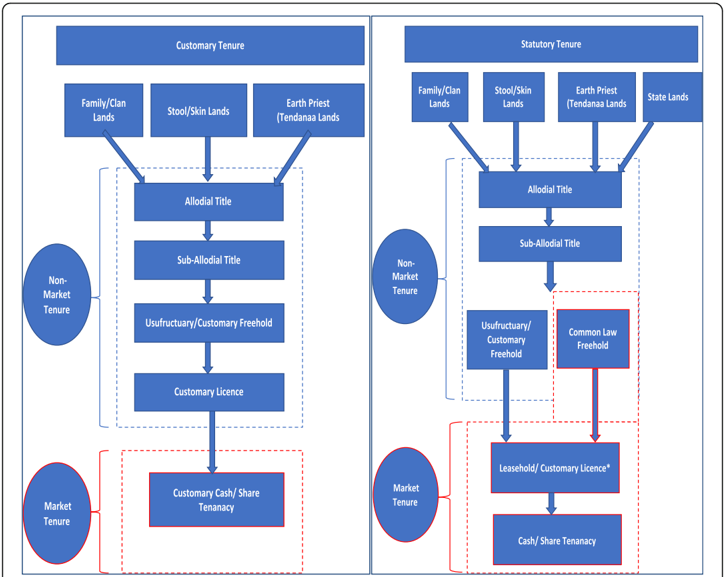
“Kugbega and Aboagye (2021) also noted that lands in Ghana are classified into three categories: state lands, vested lands, and customary lands.”
BackgroundResultCorrelates of farmers’ resilience to food insecurity in South-West Nigeria
Olawuyi, S. O., & Ijila, O. J. (2023) · International Journal of Research in Business and Social Science (2147-4478) · doi:10.20525/ijrbs.v12i2.2376 · Cited by 7
Kimengsi, J. N., Mairomi, H. W., Forje, G. W., Kometa, R. N., & Abam, C. E. (2023) · GeoJournal · doi:10.1007/s10708-023-10884-9 · Cited by 7
Tinsley, J. H. I., & Gwiriri, L. C. (2022) · Nomadic Peoples · doi:10.3197/np.2022.260105 · Cited by 7
“Land tenure in Ghana and Nigeria may be customary or statutory, with 80 percent of land under customary tenure in Ghana (Kugbega and Aboagye, 2021).”
BackgroundNdimbo, G. K., & Sanga, F. (2026) · Cogent Social Sciences · doi:10.1080/23311886.2026.2646711 · Cited by 6
Otu, B. O., & Sarfo, K. (2023) · African Journal on Conflict Resolution · doi:10.17159/ajcr.v23i1.16786 · Cited by 6
Tarimo, W. M., Chipofya, M. C., & Zevenbergen, J. A. (2025) · Applied Geography · doi:10.1016/j.apgeog.2025.103827 · Cited by 5
Eke, O. G., Moudrý, J., Eze, F. O., Obazi, S. A., Ifoh, I. P., Mukosha, C. E., Ntezimana, M. G., & Muhammad, A. (2025) · Sustainability · doi:10.3390/su172411316 · Cited by 5
Kimengsi, J. N., Awazi, N. P., Awuh, R. N., Kwalar, G., & Tamnjong, B. (2022) · Journal of Environmental Planning and Management · doi:10.1080/09640568.2022.2099358 · Cited by 5
“Studies carried out in Ghana (Kugbega and Aboagye, 2021) and Nigeria (Baderinwa 2019) have shown that tenure and pasture security coupled with power relationships which tilt toward the natives are major drivers of the recurrent deadly confrontations between farmers and herders in Ghana and Nigeria.”
BackgroundLand Tenure and Legal Pluralism in Africa and Asia: Gender, Reform, and Recognition
Sutikno, A. Y. W. (2024) · Legalis Journal of Law Review · doi:10.61978/legalis.v2i1.795 · Cited by 4
“Kugbega and Aboagye (2021) further argue that this insecurity influences farmers' investment decisions, deterring them from making long-term improvements to their land.”
Adofu, I., Okwanya, I., Adofu, S. O., & Eraye, C. M. (2024) · Futurity Economics&Law · doi:10.57125/fel.2024.09.25.08 · Cited by 4
“Additionally, Kugbega and Aboagye (2021) delved into the impact of farmer-herders conflict and tenure insecurity on investment decisions in Ghana.”
BackgroundResultOtu, B. O., Sarfo, K., & Impraim, K. (2024) · Journal of Asian and African Studies · doi:10.1177/00219096241235291 · Cited by 4
“However, the study contradicts the findings by Kugbega and Aboagye (2021) that despite concerns about tenure insecurity, and farmer–herder conflicts, farmers’ agricultural investment decisions stay unchanged since changes in investment decisions may cut revenue and jeopardize their livelihoods.”
Alhassan, S., Kyereh, B., Pouliot, M., & Derkyi, M. A. A. (2024) · African Journal of Agricultural and Resource Economics · doi:10.53936/afjare.2024.19(2).11 · Cited by 4
“2018; Krätli & Toulmin 2020; Kugbega & Aboagye 2021).”
Assessment of climate risks in Central and Northern Liberia
Sarnoh, Y. M. (2024) · Enlighten: Theses (The University of Glasgow) · doi:10.5525/gla.thesis.84580 · Cited by 4
Unraveling the spatial patterns of water conflicts in Africa through a multi-scale lens
Song, C., Petsakos, A., & Gotor, E. (2025) · Water Policy · doi:10.2166/wp.2025.065 · Cited by 3
Derkyi, M. A. A., & Gyamfi, E. (2025) · Ghana Journal of Development Studies · doi:10.4314/gjds.v21i2.1 · Cited by 3
Thissen, P., Siddiqui, T., Lakhote, D., Kastel, F., Sahu, S., Ungwang, L., Benesch, T., & Ansari, S. (2026) · Journal of Development Effectiveness · doi:10.1080/19439342.2026.2713143 · Cited by 2
“Conflict management often happens at the local level with the payment of compensation and mediation by traditional institutions, courts, or police (Adams et al. 2023; Bwala and Ogirima 2020; Kugbega and Young Aboagye 2021).”
ETHNOSCIENTIFIC PRODUCTION OF NTFPs IN MATO GROSSO, BRAZIL
Prado, N. L., Fontes, C. V. V., Espírito-Santo, A. B. M. M. D., Gomes, D. K. D. M., da Costa, J. R., Birkinshaw, L. J. N., Costa, T. Y. E. S., Chinikoski, M. B., & Pasa, M. C. (2024) · Biodiversidade · Cited by 2
Stakeholders’ Evaluation of a Farmer-Herder Conflict Research Project in the Ashanti Region of Ghana
Alhassan, S. (2024) · Sustainable Agriculture Research · doi:10.5539/sar.v13n2p84 · Cited by 2
“One prominent area of attention is support for research aimed at gaining better understanding of the conflict for informed policy decisions and effective conflict management (Kugbega and Aboagye, 2021; Nassef et al., 2023).”
Yenibehit, N., Amikuzuno, J., & Abubakari, A. (2022) · Asian Journal of Agricultural Extension Economics & Sociology · doi:10.9734/ajaees/2022/v40i111727 · Cited by 2
Exploring the Systemic Causes of Land Inequality with Systems Thinking
Massey, M.-L., & Parra-Valencia, J.-A. (2023) · Understanding complex systems · doi:10.1007/978-3-031-40635-5_12 · Cited by 2
Abubakari, A., Boateng, K., Mercy, A. A. D., & Paul, O. (2024) · African Journal of Agricultural Research · doi:10.5897/ajar2024.16735 · Cited by 1
Enhancing Legal Accountability through Corporate Governance: A Narrative Review
Kusmiadi, M. E., Dauwi, L., Nadila, & Basuki, S. H. A. (2025) · Legalis Journal of Law Review · doi:10.61978/legalis.v3i1.793 · Cited by 1
“Studies published prior to 2014, unless cited for theoretical grounding, were also generally excluded to maintain temporal relevance (Lawry et al., 2016; Kugbega & Aboagye, 2021).”
Land tenure conflicts in Ghana and Zimbabwe: An institutional perspective
Gwaindepi, A., & Akolgo‐Azupogo, H. (2026) · World Development · doi:10.1016/j.worlddev.2026.107438 · Cited by 1
Nyarko, K. F., Wanke, S., Basco‐Carrera, L., & McFee, E. K. (2026) · Frontiers in Climate · doi:10.3389/fclim.2026.1663337 · Cited by 1
Sub-Saharan Africa’s Customary Practices and Land Titling Policy Reforms
Ige, V. O., Akinbogun, S. P., & Jones, C. A. (2024) · Sustainable development goals series · doi:10.1007/978-3-031-59587-5_4 · Cited by 1
Adewale, A. O., & Akwayi, I. (2023) · Advances in Multidisciplinary & Scientific Research Journal Publication · doi:10.22624/aims/humanities/v11n3p5
Abubakari, A. (2024) · International Journal of Humanities and Social Science · doi:10.14445/23942703/ijhss-v11i4p107
Fertile ground for conflict: evidence revisited using spatial first differences
Emediegwu, L., Animashaun, J. O., & Iloanugo, U. (2025) · Defence and Peace Economics · doi:10.1080/10242694.2025.2456780
ANALYSIS OF FARMERS INCOME SELLING IN SUCO LOUR ZUMALAI ADMINISTRATIVE POST-COVALIMA MUNICIPALITY
Colo, H. A., Tilman, M., & Martins, A. (2025) · International Journal of Social Service and Research · doi:10.46799/ijssr.v5i3.1206
Social capital: A mitigation asset to minimize farmer-herder conflicts
Mercy, A. A. D., & Eric, G. (2025) · Journal of Horticulture and Forestry · doi:10.5897/jhf2025.0730
GROWTH RESPONSE OF WEST AFRICAN DWARF (WAD) GOATS FED MICROBIAL TREATED RICE HUSK BASED DIETS
Olanrewaju, A., Ogunbosoye, D. O., Imam, R. O., Ogunsola, O. K., Muhammadnasir, A. O., Afolayan, F. O., & Amole, M. D. (2025) · FUDMA Journal of Animal Production and Environmental Science · doi:10.33003/japes.2025.v1i3.74-81
“This challenge is compounded by competition between humans and livestock for feed resources, as well as farmer-herder conflicts that limit grazing access (Wilkinson & Lee, 2017; Kugbega & Aboagye, 2021).”
The Influence of Conflict on Food Security in Post-Pandemic Northern Nigeria.
Obiora, E. C. (2024) · Epsilon Archive for Student Projects (Swedish University of Agricultural Sciences)
Francis, D., & Mustapha, A. (2025) · NIGERIAN JOURNAL OF CRIMINOLOGY AND SECURITY STUDIES · doi:10.63725/njcss.v1i1.18
Aduko, J., Sumani, J. B. B., & Anokye, K. (2026) · Agroforestry Systems · doi:10.1007/s10457-026-01580-x
“Landless farmers and migrants often lack the tenure security required to invest in tree planting, meaning agroforestry may inadvertently benefit landowners while excluding vulnerable households (Damnyag et al. 2012; Kugbega and Aboagye 2021).”
Pastoralism and Forest Conservation in Ghana’s Forestry Sector
Gyamfi, E., Dei-Kusi, D., & Ankomah, F. (2026) · Journal of Geoscience and Environment Protection · doi:10.4236/gep.2026.148007
Adeboye, F. I., & Otaiku, A. A. (2026) · International Journal of Development and Economic Sustainability · doi:10.37745/ijdes.13/vol14n3170
Muhammed, A. Y., Gbadeyan, O. J., Adisa, W. B., Ayodele, J. O., & Garba, E. (2024) · Zhongguo Kuangye Daxue Xuebao
consequences of the “double crises” on the triple nexus in West Africa
Jabik, B. B. (2025) · African Journal of Defence, Security and Strategy · doi:10.66544/ajodss.v5i1.5
(2025) · UpSpace Institutional Repository (University of Pretoria) · doi:10.25403/upresearchdata.30916463
Securitization of Insecurity and its Effects on Sustainable Development in West Africa – A review
Jabik, B. B. (2026) · African Journal of Defence, Security and Strategy · doi:10.66544/ajodss.v6i1.45
Farmer–Herder Conflict and Agricultural Productivity in Mangu, Plateau State, Nigeria
Adikwu, I. A., Amarachi, E. P., & Wilson, O. V. (2026) · International Journal of Humanities Education and Social Sciences · doi:10.58578/ijhess.v4i3.11984
Importance of land tenure for agricultural development: A review
Meinzen-Dick, R. S., & ElDidi, H. (2026) · CGSPace A Repository of Agricultural Research Outputs (Consultative Group for International Agricultural Research)
Metadata
- Authors
- Kugbega, S. K., & Aboagye, P. Y.
- Affiliations
- Lund University (SE)
- Corresponding author
- Kugbega, Selorm Kobla
- Venue
- Agricultural and Food Economics
- Published
- 2021-08-10
- Volume
- 9
- Issue
- 1
- ISSN
- 2193-7532 (ISSN-L)
- OpenAlex
- W3189112362
- Semantic Scholar
- 7150c9d3a9c237b0f254ed5f0181e40d52ab91fa
- Cited by
- 38
- References
- 124
- Citations by year
- 2026: 6 · 2025: 8 · 2024: 10 · 2023: 7 · 2022: 6 · 2021: 1
- FWCI
- 3.50
- Type
- journal article
- Language
- en
- Open access
- gold
- doi.org
- Licence
- cc-by
- creativecommons.org/licenses/by/4.0 (tdm)
- creativecommons.org/licenses/by/4.0 (vor)
- Locations
- Agricultural and Food Economics (publishedVersion, cc-by)
- Lund University Publications (Lund University) (submittedVersion, other-oa)
- RePEc: Research Papers in Economics (submittedVersion)
- DOAJ (DOAJ: Directory of Open Access Journals) (submittedVersion, cc-by-sa)
- Econstor (Econstor) (submittedVersion, cc-by)
- Funders
- Lunds Universitet
- Topics
- Life Sciences › Agricultural and Biological Sciences › Soil Science › Land Rights and Reforms
- Social Sciences › Development › Agriculture, Land Use, Rural Development
- Physical Sciences › Environmental Science › Management, Monitoring, Policy and Law › Rangeland Management and Livestock Ecology
- Keywords
- farmer-herder conflict, land tenure insecurity, agricultural investment decisions, pastoralism, customary land rights, indigenous farmers, livelihoods
About these checks
Registry, retraction, Cites and statistics results are computed, not judged, with one exception: a printed reference that no index lists is read once by a model before it counts as a citation error. Claims are extracted by a model and kept only when their quote appears verbatim in the text; each cited source is then checked, with a model’s help, for whether it says what the claim relies on. Those verdicts can be wrong — read the claim’s quote and the cited source before relying on one.
Statistics and arithmetic are recomputed, not judged.
Confidence bands are shown only for fields calibrated on our annotated test set. None is calibrated yet, so no band is shown.
What counts as a claim ›How we measure confidence ›How we check this ›
Are you an author, or do you see a problem with this page? Request a review
Data sources
Bibliographic data: Semantic Scholar, OpenAlex, Crossref.
Contains information from the Semantic Scholar Academic Graph Datasets, made available under the ODC Attribution License (ODC-BY 1.0).
Semantic Scholar’s data is described in: Kinney, R., et al. (2023). The Semantic Scholar Open Data Platform. arXiv:2301.10140.
