

Farmer-herder conflicts, tenure insecurity and farmer’s investment decisions in Agogo, Ghana
Open accessThe DOI matches its Crossref record; 120 of the 124 references it cites were found in a registry or an index.
Abstract
Owing to climate change, population growth and tenurial changes, the past decade has witnessed high interest among migrant and settler pastoralist groups in the vegetal-rich customary lands of the Agogo Traditional Area. This has resulted in lease grants of large land areas to pastoralists by traditional authorities and usufruct families, for reasons of ensuring optimum use and gaining the highest returns from lands. This paper examines the implications of consequent competing interests over land resources between farmers and herders on indigenous farmer’s agricultural investment decisions. The study uses qualitative methods and empirical evidence is given by primary data from semi-structured interviews and focus group discussions in the case study area. Results indicated that land owners exploit lapses in customary land administration systems to allocate lands in exchange for money, to pastoralists while neglecting indigenous farmers’ land use rights. Thus, indigenous farmers report land tenure insecurity and a sense of deprivation from their customary lands. Despite tenure insecurity concerns, farmer’s agricultural investment decisions remain unchanged because such changes in investment decisions may reduce incomes and compromise their livelihoods. The findings herein contradict theoretical expectations and provide new perspectives for understanding the relationship between tenure (in)security and investment decisions.
Overview
The claims and statistics of this paper haven’t been checked yet.
Free: it reads the open-access text and checks the first 5 claims that cite a source we can check. Create a free account to check every claim.
Integrity signals
Registry
Cites
Statistics
Figures
Verification
Claims the paper makes
The claims and statistics of this paper haven’t been checked yet.
Free: it reads the open-access text and checks the first 5 claims that cite a source we can check. Create a free account to check every claim.
Claims other papers make about this one
Each is checked against this paper’s own text: does it say what the citing paper says it does?
The source backs part of the claim, not all of it — or backs it for a different population, condition or comparison.
In the citing paper
“Farmers avoided conflict by not going to their fields when cattle herds were nearby, changing crops (e.g. not growing plantains, which require 12 months to mature), and changing growing schedules (Opoku 2014, Kugbega and Aboagye 2021).”
From Farmer–herder conflicts in sub-Saharan Africa: drivers, impacts, and resolution and peacebuilding strategies (2023) · cites this paper as Kugbega and Aboagye 2021
Experimental — accuracy not yet measuredThe source backs part of the claim, not all of it — or backs it for a different population, condition or comparison.
In the citing paper
“In most of these cases, conflicts were addressed at the community level, often with leaders arbitrating between conflict parties (Kugbega and Aboagye 2021, Paalo 2021, Vahyala 2021).”
From Farmer–herder conflicts in sub-Saharan Africa: drivers, impacts, and resolution and peacebuilding strategies (2023) · cites this paper as Kugbega and Aboagye 2021
Experimental — accuracy not yet measuredThe source backs part of the claim, not all of it — or backs it for a different population, condition or comparison.
In the citing paper
“In Agogo, Ghana, 85% of the farmers in one study did not trust traditional leaders in matters of conflict resolution (Kugbega and Aboagye 2021), accusing chiefs of engaging in illicit land deals and offering land to herders in exchange for cattle.”
From Farmer–herder conflicts in sub-Saharan Africa: drivers, impacts, and resolution and peacebuilding strategies (2023) · cites this paper as Kugbega and Aboagye 2021
Experimental — accuracy not yet measuredThe cited source says what the claim attributes to it.
In the citing paper
“The courts, like traditional leader systems, were not immune to perceptions of bias or corruption (Brottem 2016, Walwa 2020, Kugbega and Aboagye 2021).”
From Farmer–herder conflicts in sub-Saharan Africa: drivers, impacts, and resolution and peacebuilding strategies (2023) · cites this paper as Kugbega and Aboagye 2021
The cited source says what the claim attributes to it.
In the citing paper
“Although farmers sought solutions through the court system, they perceived it to be influenced by wealthy cattle owners (Semiono and Niboye 2019, Kugbega and Aboagye 2021).”
From Farmer–herder conflicts in sub-Saharan Africa: drivers, impacts, and resolution and peacebuilding strategies (2023) · cites this paper as Kugbega and Aboagye 2021
Self-check
Percentages, sums and reported differences re-computed from the paper’s own numbers.
The self-check needs the paper’s full text.
Citations
Cites
(1984) · Cited by 81,983
Case Study Research: Design and Methods
Chaiklin, H. (1991) · The Journal of Nervous and Mental Disease · doi:10.1097/00005053-199102000-00025 · Cited by 39,535
Eysenck, H. J. (1985) · Behaviour Research and Therapy · doi:10.1016/0005-7967(85)90087-7 · Cited by 31,975
“Stress: appraisal and coping,”
Folkman, S. (2013) · Encyclopedia of Behavioral Medicine · doi:10.1007/978-1-4419-1005-9_215 · Cited by 27,833
Research Design: Qualitative, Quantitative, and Mixed Methods Approaches
Creswell, J. W. (1994) · Cited by 21,325
Research Methods for Business Students
Saunders, M. N. K., Lewis, P., & Thornhill, A. R. (2003) · Cited by 18,357
The Coding Manual for Qualitative Researchers
Saldana, J. (2025) · SAGE Publications Ltd eBooks · doi:10.4135/9781036235611 · Cited by 17,944
Research Design: Qualitative, Quantitative, and Mixed Methods Approaches
Sloane-Seale, A. (2009) · Canadian Journal of University Continuing Education · doi:10.21225/d54s3d · Cited by 14,328
Five misunderstandings about case-study research
Flyvbjerg, B. (2006) · Qualitative Inquiry · doi:10.1177/1077800405284363 · Cited by 14,266 · cited 5×
“Furthermore, the widespread and long-lasting nature of farmer-herder conflicts in the area justifies the purposive selection of ATA (Flyvbjerg 2006).”
BackgroundMethodInfluential(2010) · Sociology for Pharmacists · doi:10.4324/9780203381175_chapter_9 · Cited by 14,152
Research Design: Qualitative, Quantitative, and Mixed Methods Approaches
ภู่พันธ์, ศ. (2018) · วารสารวิธีวิทยาการวิจัย (Journal of Research Methodology: JRM) · Cited by 13,060
Great transformation: The political and economic origins of our time
Polanyi, K., Stiglitz, J. E., & Block, F. (1944) · Cited by 10,600
Research Methods for Business Students
(2000) · Qualitative Market Research: An International Journal · doi:10.1108/qmr.2000.3.4.215.2 · Cited by 5,592
(2000) · Cited by 5,104
Ali, E. M. (2016) · Cited by 4,441
Toward a Theory of Property Rights
Demsetz, H. (1974) · Classic Papers in Natural Resource Economics · doi:10.1057/9780230523210_9 · Cited by 3,816
World development report, 2008: agriculture for development
(2008) · Choice Reviews Online · doi:10.5860/choice.45-4765 · Cited by 3,436 · cited 5×
“Customary licensees reserve the right to use land without payment requirements (Woodman 1996; Da Rocha and Lodoh 1999).”
BackgroundInfluentialNaturalistic inquiry and the saturation concept: a research note
Bowen, G. A. (2008) · Qualitative Research · doi:10.1177/1468794107085301 · Cited by 2,749
Household strategies and rural livelihood diversification
Ellis, F. (1998) · Journal of Development Studies · doi:10.1080/00220389808422553 · Cited by 2,325 · cited 1×
“Similar results were found by Trærup and Mertz (2011) in Tanzania while investigating climate vulnerabilities and associated coping strategies thus validating the hypothesis that farmers adopt partial or permanent diversification activities when threats to their livelihood is imminent (Ellis 1998).”
ResultProperty rights and investment incentives: theory and evidence from Ghana
Besley, T. (1995) · Journal of Political Economy · doi:10.1086/262008 · Cited by 2,016 · cited 8×
“This finding appears counterintuitive and paradoxical as it contrasts sharply with theoretical conceptions by Besley (1995) who hypothesised that threats to tenure security will invariably lead to reductions in farm sizes.”
BackgroundResultInfluentialDe Soto, H., & Co-PLAN (2000) · doi:10.37199/t40002609 · Cited by 1,960
Ishtiaq, M. (2019) · English Language Teaching · doi:10.5539/elt.v12n5p40 · Cited by 1,732
The Challenge of Slums: Global Report on Human Settlements 2003
UN‐Habitat (2004) · Management of Environmental Quality: An International Journal · doi:10.1108/meq.2004.15.3.337.3 · Cited by 1,466
Population and Housing Census.
Tobago (2011) · Cited by 1,384
No Condition Is Permanent: The Social Dynamics of Agrarian Change in Sub-Saharan Africa
Fruzzetti, L. M., & Berry, S. (1994) · The International Journal of African Historical Studies · doi:10.2307/220797 · Cited by 1,233
The profits of power: land rights and agricultural investment in Ghana
Goldstein, M., & Udry, C. (2008) · Journal of Political Economy · doi:10.1086/595561 · Cited by 1,142
Land Policies for Growth and Poverty Reduction
Bank, W. (2003) · World Bank, Washington, DC eBooks · doi:10.1596/0-8213-5071-4 · Cited by 1,034 · cited 17×
“World Dev 25:549–562 Tonah S (2002a) Fulani pastoralists, indigenous farmers and the contest for land in northern Ghana.”
BackgroundInfluentialThe new enclosures: critical perspectives on corporate land deals
White, B., Borras Jr., S. M., Hall, R., Scoones, I., & Wolford, W. (2012) · The Journal of Peasant Studies · doi:10.1080/03066150.2012.691879 · Cited by 913
CONTRACTING FOR PROPERTY RIGHTS
Libecap, G. D. (2018) · Property Rights · doi:10.2307/j.ctv301f7w.14 · Cited by 766
The evolutionary theory of land rights as applied to sub-Saharan Africa: A critical assessment
Platteau, J. (1996) · Development and Change · doi:10.1111/j.1467-7660.1996.tb00578.x · Cited by 687 · cited 5×
“Regardless of the advantages of individualised tenure, Platteau (1996) recognises that statutory tenure suffers from problems of inequity where property rights are concentrated with rich and powerful individuals.”
BackgroundInfluentialJain, S., & Shyam, M. (2024) · Population Census in India · doi:10.4324/9781003586524-3 · Cited by 635
The 'New' Imperialism: Accumulation by Dispossession
Harvey, D. (2017) · Karl Marx · doi:10.4324/9781315251196-10 · Cited by 630
Institutions, Social Norms and Economic Development
Platteau, J.-P. (2015) · Routledge eBooks · doi:10.4324/9780203357606 · Cited by 621 · cited 4×
“He argues that as population pressures on land increase and subsistence production patterns become commercialised, customary land tenure systems will become inefficient for ensuring tenure security and naturally replaced by a more efficient private property rights regime, safeguarded by state authority (Baland and Pla…”
BackgroundInfluentialWorld Trade Report 2008: Trade in a Globalizing World
World Trade Organization (2008) · doi:10.30875/e89f8212-en · Cited by 580
Contracting for Property Rights
Libecap, G. D. (1990) · Cambridge University Press eBooks · doi:10.1017/cbo9780511664120 · Cited by 564
(1994) · Medical Entomology and Zoology · Cited by 536
Methods for Development Work and Research: A Guide for Practitioners
Mikkelsen, B. (1995) · Medical Entomology and Zoology · Cited by 497
Indigenous Land Rights Systems in Sub-Saharan Africa: A Constraint on Productivity?
Migot-Adholla, S., Hazell, P., Blarel, B., & Place, F. (1991) · The World Bank Economic Review · doi:10.1093/wber/5.1.155 · Cited by 491
Institutions, Social Norms and Economic Development
Raiser, M. (2001) · Economic Systems · doi:10.1016/s0939-3625(01)00036-x · Cited by 467
Constitution of the Republic of Ghana
Ghana (1979) · Medical Entomology and Zoology · Cited by 414
(2001) · OpenGrey (Institut de l'Information Scientifique et Technique) · Cited by 389
Evolving land rights, policy and tenure in Africa.
Toulmin, C., & Quan, J. (2000) · Greenwich Academic Literature Archive (University of Greenwich) · Cited by 380
Land tenure and investment incentives: evidence from West Africa
Fenske, J. (2011) · Journal of Development Economics · doi:10.1016/j.jdeveco.2010.05.001 · Cited by 369
Turner, M. D. (2004) · Political Geography · doi:10.1016/j.polgeo.2004.05.009 · Cited by 326 · cited 2×
“…example, competing use rights to land has historically degenerated into conflicts in parts of northern Nigeria, Mali, Chad, Ghana and between the Nuer and Dinka ethnic groups in South Sudan (see Bennett 1991; Blench 1996; Blench 2004; Turner 2004; Benjaminsen et al. 2009; Abubakari and Longi 2014).”
BackgroundCHIMHOWU, A., & WOODHOUSE, P. (2006) · Journal of Agrarian Change · doi:10.1111/j.1471-0366.2006.00125.x · Cited by 319
Land Ownership Security and Farm Investment in Thailand
Feder, G., & Onchan, T. (1987) · American Journal of Agricultural Economics · doi:10.2307/1242281 · Cited by 318
Melton, W., & Schaefer, R. T. (1989) · Teaching Sociology · doi:10.2307/1318099 · Cited by 307
Indigenous land rights in sub-Saharan Africa: Appropriation, security and investment demand
Sjaastad, E., & Bromley, D. W. (1997) · World Development · doi:10.1016/s0305-750x(96)00120-9 · Cited by 278
Changes in "customary" land tenure systems in Africa
Cotula, L. (2001) · Digital Library Of The Commons Repository (Indiana University) · Cited by 265
The politics of evidence: methodologies for understanding the global land rush
Scoones, I., Hall, R., Borras, S. M., White, B., & Wolford, W. (2013) · Journal of Peasant Studies · doi:10.1080/03066150.2013.801341 · Cited by 262
Land Tenure and Investment in African Agriculture: Theory and Evidence
Barrows, R., & Roth, M. (1990) · The Journal of Modern African Studies · doi:10.1017/s0022278x00054458 · Cited by 247
Schoneveld, G. C., German, L. A., & Nutakor, E. (2011) · Ecology and Society · doi:10.5751/es-04424-160410 · Cited by 245
Land Tenure and Allocative Efficiency in Niger
Gavian, S., & Fafchamps, M. (1996) · American Journal of Agricultural Economics · doi:10.2307/1243717 · Cited by 243
The Kilosa Killings: Political Ecology of a Farmer–Herder Conflict in Tanzania
Benjaminsen, T. A., Maganga, F. P., & Abdallah, J. M. (2009) · Development and Change · doi:10.1111/j.1467-7660.2009.01558.x · Cited by 237
Chimhowu, A. (2019) · Land Use Policy · doi:10.1016/j.landusepol.2018.04.014 · Cited by 219 · cited 1×
“Commodification of customary tenure through market processes encourages the individualisation and consequent privatisation of land rights (Besley 1995; Chimhowu 2019); a development which is in sharp contrast to the definitive communal characteristics of customary land ownership.”
BackgroundWhat tenure security? The case for a tripartite view
van Gelder, J.-L. (2010) · Land Use Policy · doi:10.1016/j.landusepol.2009.06.008 · Cited by 215 · cited 1×
“Van Gelder (2010) argues that tenure security incorporates three components including legal security (arising from formal titling), de facto security (arising from factors including long occupation) and perceived security (subjective beliefs of property rights).”
BackgroundContesting Land and Custom in Ghana : State, Chief and the Citizen
Ubink, J., & Amanor, K. (2008) · Leiden University Press eBooks · doi:10.5117/9789087280475 · Cited by 210
How to combine tradition and modernity? Regulating customary land management in Ghana
Ubink, J. M., & Quan, J. F. (2008) · Land Use Policy · doi:10.1016/j.landusepol.2007.06.002 · Cited by 208
Wealth inequality and efficiency in the Commons, part II: the regulated case
Baland, J.-M., & Platteau, J.-P. (1998) · Oxford Economic Papers · doi:10.1093/oxfordjournals.oep.a028631 · Cited by 205
Family Values, Land Sales and Agricultural Commodification in South-Eastern Ghana
Amanor, K. S. (2010) · Africa · doi:10.3366/e0001972009001284 · Cited by 196 · cited 1×
“1Rural land commodification in this instance follows the definitions of Amanor (2010) and Yaro (2012) to denote the act of recognizing land and associated use rights as tradeable commodities central to the process of capital accumulation. conceptions of primitive accumulation (Marx 1961) and…”
BackgroundBerry, S. (2009) · Development and Change · doi:10.1111/j.1467-7660.2009.01504.x · Cited by 195 · cited 1×
“Despite the inherent fluidity and dynamism of customary land tenure systems in adjusting periodically to changing trends (Berry 1993; Berry 2009), it has been unable to efficiently solve land tenure insecurity problems.”
BackgroundMethods for Development Work and Research: A New Guide for Practitioners
Mikkelsen, B. (2005) · SAGE Publications India Pvt Ltd eBooks · doi:10.4135/9788132108566 · Cited by 177
Land tenure and property rights: an introduction
Payne, G. K. (2003) · Habitat International · doi:10.1016/s0197-3975(03)00066-3 · Cited by 175 · cited 1×
“Payne (2004) notes the absence of an objective measure of tenure security and instead views the concept as a continuum of tenure where some individuals can claim higher rights to land than others.”
BackgroundWang, Y., Cui, R., Xiao, Y., Fang, J., & Xu, Q. (2015) · PLOS ONE · doi:10.1371/journal.pone.0137427 · Cited by 170
WEALTH INEQUALITY AND EFFICIENCY IN THE COMMONS PART I: THE UNREGULATED CASE
BALAND, J.-M., & PLATTEAU, J.-P. (1997) · Oxford Economic Papers · doi:10.1093/oxfordjournals.oep.a028620 · Cited by 163
Are We Entering an Era of Concatenated Global Crises?
Biggs, D., Biggs, R. (., Dakos, V., Scholes, R. J., & Schoon, M. (2011) · Ecology and Society · doi:10.5751/es-04079-160227 · Cited by 161
Understanding Herder-Farmer Conflicts in West Africa: Outline of a Processual Approach
Moritz, M. (2010) · Human Organization · doi:10.17730/humo.69.2.aq85k02453w83363 · Cited by 151 · cited 1×
“This is in line with results found by (Moritz 2010) that climate change is a precipitator of farmer-herder land contestations.”
ResultGender, ethics and empowerment
Scheyvens, R. A., & Leslie, H. (2000) · Women s Studies International Forum · doi:10.1016/s0277-5395(99)00091-6 · Cited by 150
Negotiating Property in Africa
Siegel, B., Juul, K., & Luund, C. (2003) · African Studies Review · doi:10.2307/1514833 · Cited by 139
The Economics of Rural Organization
Samanta, S. K., Hoff, K., Braverman, A., & Stiglitz, J. E. (1995) · Southern Economic Journal · doi:10.2307/1061022 · Cited by 135
Boamah, F. (2014) · Review of African Political Economy · doi:10.1080/03056244.2014.901947 · Cited by 126 · cited 3×
“…West African Fulani and East African Masai, coupled with land-grabbing effects (see Schoneveld et al. 2011; Scoones et al. 2013; White et.al 2013; Boamah 2014b; Kansanga et al. 2018), increases in cattle herds and persistent reductions in vegetation cover in the arid and semi-arid regions has…”
BackgroundInterviewees with an agenda: learning from a ‘failed’ interview
Jacobsson, K., & Åkerström, M. (2012) · Qualitative Research · doi:10.1177/1468794112465631 · Cited by 126
Boamah, F. (2013) · Geoforum · doi:10.1016/j.geoforum.2013.10.009 · Cited by 122 · cited 3×
“…West African Fulani and East African Masai, coupled with land-grabbing effects (see Schoneveld et al. 2011; Scoones et al. 2013; White et.al 2013; Boamah 2014b; Kansanga et al. 2018), increases in cattle herds and persistent reductions in vegetation cover in the arid and semi-arid regions has…”
BackgroundPrinciples of Customary Land Law in Ghana
Ollennu, N. A. (1962) · Medical Entomology and Zoology · Cited by 116
African land tenure: questioning basic assumptions.
Lund, C. (2000) · OpenGrey (Institut de l'Information Scientifique et Technique) · Cited by 115
Deal or no deal: the outlook for agricultural land investment in Africa
Cotula, L., & Vermeulen, S. J. (2009) · International Affairs · doi:10.1111/j.1468-2346.2009.00859.x · Cited by 103
Negotiating Property in Africa
Juul, K., & Lund, C. (2002) · Cited by 98
Kansanga, M. M., Andersen, P., Atuoye, K. N., & Mason, S. A. (2018) · Land Use Policy · doi:10.1016/j.landusepol.2018.03.047 · Cited by 98
Building on Custom: Land Tenure Policy and Economic Development in Ghana
Blocher, J. (2006) · eYLS (Yale Law School) · Cited by 96
Tenure security for whom? Differential effects of land policy in Kenya.
Carter, M. R., Wiebe, K., & Blarel, B. (1994) · Cited by 92
Kuusaana, E. D., & Bukari, K. N. (2015) · Journal of Rural Studies · doi:10.1016/j.jrurstud.2015.09.009 · Cited by 85
The Dynamics of Resource Tenure in West Africa
Fred-Mensah, B. K., Toulmin, C., Delville, P. L., & Traore, S. (2002) · The International Journal of African Historical Studies · doi:10.2307/3097705 · Cited by 81
Interests in Land in the Customary Law of Ghana. A New Appraisal
Asante, S. (1965) · The Yale Law Journal · doi:10.2307/794709 · Cited by 77 · cited 7×
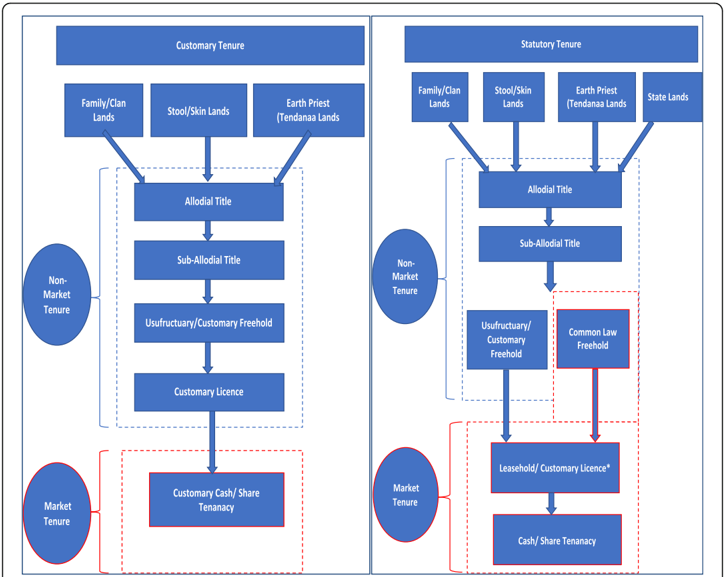
“…a an d Lo do h (1 99 9) The customary freehold (usufructuary interest) which is the near maximal interest derived from the allodial title is usually held by individuals and families that are subjects of the chief, earth priest or clan vested with the allodial title (Ollennu 1962; Asante 1965).”
BackgroundInfluentialASPECTS OF RESOURCE CONFLICT IN SEMI-ARID AFRICA
Blench, R. M. (1996) · Digital Library Of The Commons Repository (Indiana University) · Cited by 76
Migration and Farmer-Herder Conflicts in Ghana’s Volta Basin
Tonah, S. (2006) · Canadian Journal of African Studies / Revue canadienne des études africaines · doi:10.1080/00083968.2006.10751339 · Cited by 75 · cited 6×
“Tonah (2006) notes that it predates colonialism; however, recent clashes were mainly noticed during the development of the cattle trade and the onset of the Sahelian droughts between 1960 and 1980.”
BackgroundInfluentialThe complexity of local tenure systems: A smallholders’ perspective on tenure in Ghana
Lambrecht, I. B., & Asare, S. (2016) · Land Use Policy · doi:10.1016/j.landusepol.2016.07.029 · Cited by 69
Stereotypes, prejudices and exclusion of Fulani pastoralists in Ghana
Bukari, K. N., & Schareika, N. (2015) · Pastoralism · doi:10.1186/s13570-015-0043-8 · Cited by 68 · cited 7×
“Kuusaana and Bukari (2015) find that their reintroduction resulted partly from sublease agreements between the original lessors and non-Ghanaian Fulani herders.”
BackgroundInfluentialThe Expansion and Adaptation of Fulbe Pastoralism to Subhumid and Humid Conditions in Nigeria
Blench, R. (1994) · Cahiers d'études africaines · doi:10.3406/cea.1994.2047 · Cited by 64 · cited 1×
“Indigenous pastoral tribes who traditionally rear livestock on a free-range and migratory basis have existed in Africa for centuries (Blench 1994).”
BackgroundYaro, J. A. (2012) · Geografiska Annaler Series B Human Geography · doi:10.1111/geob.12003 · Cited by 64 · cited 1×
“1Rural land commodification in this instance follows the definitions of Amanor (2010) and Yaro (2012) to denote the act of recognizing land and associated use rights as tradeable commodities central to the process of capital accumulation. conceptions of primitive accumulation (Marx 1961) and…”
BackgroundPastoralism within land administration in Kenya—The missing link
Lengoiboni, M., Bregt, A. K., & van der Molen, P. (2009) · Land Use Policy · doi:10.1016/j.landusepol.2009.07.013 · Cited by 61
Security of tenure in international development discourse
Obeng‐Odoom, F., & Stilwell, F. (2013) · International Development Planning Review · doi:10.3828/idpr.2013.23 · Cited by 60
Better land access for the rural poor: lessons from experience and challenges ahead
Cotula, L., Toulmin, C., & Quan, J. (2006) · Digital Library Of The Commons Repository (Indiana University) · Cited by 54
Land Registration in Ghana: Past, Present and the Future
Agbosu, L. K. (1990) · Journal of African Law · doi:10.1017/s0021855300008251 · Cited by 51 · cited 1×
“While deed registration connotes the statutory registration of a transaction for transfer of land, land title registration involves registration of interests in the land, secured by the state (Agbosu 1990).”
BackgroundBenokraitis, N. V., & T.Schaefer, R. (1980) · Contemporary Sociology A Journal of Reviews · doi:10.2307/2064289 · Cited by 51
Tenure security and agricultural production under land scarcity: the case of Rwanda.
Blarel, B., Bruce, J. W., & Migot-Adholla, S. E. (1994) · Cited by 50
Agricultural Maladjustment in Africa: What Have We Learned after Two Decades of Liberalisation?
Oya, C. (2007) · Journal of Contemporary African Studies · doi:10.1080/02589000701396355 · Cited by 50 · cited 1×
“This legal focus has been described by Oya (2007) as a simplistic definition that attempts to utilise a market solution, based on the assumption of economic rationality, for poverty reduction through releasing the latent potential of what De Soto (2000) described as dead capital9.”
BackgroundContesting land and custom in Ghana : state, chief and the citizen
Ubink, J., & Amanor, K. (2008) · doi:10.24415/9789087280475 · Cited by 48
Impacts of large-scale land holdings on Fulani pastoralists’ in the Agogo Traditional Area of Ghana
Bukari, K. N., & Kuusaana, E. D. (2018) · Land Use Policy · doi:10.1016/j.landusepol.2018.09.018 · Cited by 47
Fulani Herdsmen, Indigenous Farmers and the Contest for Land in Northern Ghana
Tonah, S. (2002) · Africa Spectrum · Cited by 44
Bukari, K. N. (2017) · eDiss (Georg-August-Universität Göttingen) · doi:10.53846/goediss-6461 · Cited by 44
Ghana land law, an exposition, analysis and critique.
Bentsi-Enchill, K. (1964) · bepress Legal Repository · Cited by 37
Trærup, S. L. M., & Mertz, O. (2010) · Regional Environmental Change · doi:10.1007/s10113-010-0156-y · Cited by 36
Sarbah, J. M. (2020) · Medical Entomology and Zoology · Cited by 34
From communal grazing to ‘economic’ units: Changing access to land in a Namaqualand reserve
Boonzaier, E. (1987) · Development Southern Africa · doi:10.1080/03768358708439336 · Cited by 33 · cited 5×
“Specifically, rural land demands have been influenced by the heightened demand for pasture by pastoralists who migrate towards hitherto uncharted parts of the forest and coastal zones of Sub-Saharan Africa in search of water and pasture (Tonah 2002a; Tonah 2006).”
BackgroundInfluentialXiao, N., Cai, S., Moritz, M., Garabed, R. B., & Pomeroy, L. W. (2015) · PLoS ONE · doi:10.1371/journal.pone.0131697 · Cited by 32 · cited 1×
“They settle in these arid and semi-arid zones, construct their homestead and tend to livestock for longer periods of the year, depending on the rainfall patterns in and around the zone (Oxby 1984; Xiao et al. 2015).”
BackgroundEconomic Analysis of Rural Land Administration ProjectsPreprint
Pagiola, S. (2004) · RePEc: Research Papers in Economics · Cited by 18
Meinzen-Dick, R. S., Pradhan, R., & Gregorio, M. D. (2004) · AgEcon Search (University of Minnesota, USA) · doi:10.22004/ag.econ.16560 · Cited by 17
Pastoralists seasonal land rights in land administration : a study of Northern Kenya
Lengoiboni, M. (2011) · doi:10.3990/1.9789085858669 · Cited by 17 · cited 3×
“Pastoralists land rights have been described as spatiotemporal since they apply across different geographical spaces in time (Lengoiboni 2011).”
BackgroundFrom environment to sustainability
Leipziger, D. (2018) · Routledge eBooks · doi:10.4324/9781351278881-17 · Cited by 14
Rosenzweig, M. R. (2009) · Cited by 13
Oxby, C. (1984) · Development Policy Review · doi:10.1111/j.1467-7679.1984.tb00354.x · Cited by 12 · cited 1×
“They settle in these arid and semi-arid zones, construct their homestead and tend to livestock for longer periods of the year, depending on the rainfall patterns in and around the zone (Oxby 1984; Xiao et al. 2015).”
BackgroundExploring the Causes and Management of Pastoralists-Farmer Conflicts in Ghana
Opoku, P. (2018) · Journal of Energy and Natural Resource Management · doi:10.26796/jenrm.v1i2.35 · Cited by 12 · cited 8×
“However, disposal of the freehold interest in the land (a) cannot be customarily executed without the express consent of the allodial title (Ollennu 1962) and (b) is statutorily prohibited by the Constitution of Ghana (Constitution of the Republic of Ghana 1992).”
BackgroundInfluentialAgro-pastoralism in Chad as a strategy for survival
Bonfiglioli, A. M., & Ibrd (1993) · Cited by 11
PASTORALISM AND VIOLENCE IN NORTHERN GHANA: SOCIALIZATION AND PROFESSIONAL REQUIREMENT
Abubakari, A. (2014) · Cited by 10
Moseley, W. G. (2002) · The Professional Geographer · Cited by 6
Bennett, R., Zevenbergen, J. A., Lengoiboni, M., Waymuba, G. O., & Omondi, S. (2013) · University of Twente Research Information · Cited by 5
The Kwahus: Their Connection With the Afram Plain
Wallis, J. R. (1953) · Transactions of the Historical Society of Ghana · Cited by 5
Johnson, J. W. D. (1955) · Transactions of the Historical Society of Ghana · Cited by 4
Farah, K. O. (1990) · Cited by 4
Conflict, food security and crop diversification strategies : evidence from Cote d'Ivoire
Paul, S., & アジア経済研究所 (2015) · Research Explorer (The University of Manchester) · Cited by 2
Research works printed but not linked: 23
- Administration of Lands Act (1962) Government of Ghana (Act 123), Accra-Ghana
- Andersen KE (2011) Communal tenure and the governance of common property resources in Asia, lessons from experiences in selected countries Land Tenure Working Paper, UN-FAO
- Atta-Asamoah A, Aning EK (2012) Environment and conflict in West Africa. CODESRIA J 8:98-119
- Bennett O (1991) Greenwar: environment and conflict in the Sahel. Panos, London
- Bonfiglioli AM (1993) Agro-pastoralism in Chad as a strategy for survival, World Bank Technical Paper No. 214. World Bank, Washington, DC
- Deininger KW (2003) Land policies for growth and poverty reduction. World Bank Policy Research Report. World Bank and Oxford University Press, Washington, DC
- Department Of State (1989) County Reports on Human Rights Practices for 1988, Washington, USA
- FAO (2009) How to feed the world 2050; the special challenge for sub-Saharan Africa. FAO, Rome
- Flintan F (2012) Making rangelands secure. International Land Coalition (ILC), Rome
- Graphic Online (2017) We feel neglected and abandoned -Agogo residents cry over Fulani herdsmen activities. Graphic Communications Group Limited, Accra Available: https://www.graphic.com.gh/news/general-news/we-feel-neglected-a nd-abandoned-agogo-residents-cry-over-fulani-herdsmen-activities.html. Accessed 13th Nov 2019
- Josiah-Aryeh NA (2005) The property law of Ghana. Sakumo Publishers, Accra
- Kasanga K (1988) Land tenure and the development dialogue: the myth concerning communal landholding in Ghana. University of Cambridge, Department of Land Economy
- Kasanga K (2002) Undestanding the dynamics of land tenure; land tenure, resource access and decentralization in Ghana. In:
- Kuusaana EDB, K. N (2018) Impact of large-scale land holdings on Fulani pastoralists' livelihoods in Agogo traditional area of Ghana. Land Use Policy 79:748-758 · DOI
- Low D (1844) Landed property and the economy of estates, London
- Lund C, Odgaard R, Sjaastad E (2006) Land rights and land conflicts in Africa: a review of issues and experience. DIIS, Copenhagen
- Marx K (1961) Capital: A critique of political economy (Volume 1). Progress Publishers, Moscow
- Ollennu NA (1962) Principles of customary land law in Ghana. Sweet & Maxwell, London
- Shipton P (1989) How private property emerges in Africa -directed and undirected land tenure reforms in densely settled areas south of the Sahara. Harvard University, Boston
- Tonah S (2002b) The politics of exclusion: the expulsion of the Fulbe pastoralists from Ghana in 1999/2000. Max Planck Institute for Social Anthropology. Working Paper No. 44.
- Tonah S (2002b) The politics of exclusion: the expulsion of the Fulbe pastoralists from Ghana in 1999/2000. Max Planck Institute for Social Anthropology. Working Paper No. 44. Tonah S (2005) Fulani in Ghana : migration history, integration, and resistance. Research and Publication Unit, Department of Sociology, University of Ghana, Legon-Accra, Ghana
- UN (1996) Land administration guidelines. Economic Commission for Europe, Geneva
- Woodman GR (1996) Customary land law in the Ghanaian courts. Ghana Universities Press, Accra, Ghana
Cited by
Murken, L., & Gornott, C. (2022) · Climate Risk Management · doi:10.1016/j.crm.2022.100419 · Cited by 136
Abiodun, B. J., Odoulami, R. C., Sawadogo, W., Oloniyo, O. A., Abatan, A. A., New, M. G., Lennard, C., Pinto, I., Egbebiyi, T. S., & MacMartin, D. G. (2021) · Climatic Change · doi:10.1007/s10584-021-03268-w · Cited by 73
Climate change, migration and farmer–herder conflict in Ghana
Issifu, A. K., Darko, F. D., & Paalo, S. A. (2022) · Conflict Resolution Quarterly · doi:10.1002/crq.21346 · Cited by 62
Nkansah‐Dwamena, E. (2023) · Circular Economy and Sustainability · doi:10.1007/s43615-023-00320-y · Cited by 56
“The municipality’s population is 85,788, with 42,000 males and 43,788 females [60].”
InfluentialGender, agriculture and sustainable livelihood among rural farmers in northern Ghana
Azumah, F. D., Onzaberigu, N. J., & Adongo, A. A. (2022) · Economic Change and Restructuring · doi:10.1007/s10644-022-09399-z · Cited by 51
“In developing countries such as Ghana, customary systems govern access to and use of large areas of unregistered land (Kugbega and Aboagye, 2021).”
Background
Metadata
- Authors
- Kugbega, S. K., & Aboagye, P. Y.
- Affiliations
- Lund University (SE)
- Corresponding author
- Kugbega, Selorm Kobla
- Venue
- Agricultural and Food Economics
- Published
- 2021-08-10
- Volume
- 9
- Issue
- 1
- ISSN
- 2193-7532 (ISSN-L)
- OpenAlex
- W3189112362
- Semantic Scholar
- 7150c9d3a9c237b0f254ed5f0181e40d52ab91fa
- Cited by
- 38
- References
- 124
- Citations by year
- 2026: 6 · 2025: 8 · 2024: 10 · 2023: 7 · 2022: 6 · 2021: 1
- FWCI
- 3.50
- Type
- journal article
- Language
- en
- Open access
- gold
- doi.org
- Licence
- cc-by
- creativecommons.org/licenses/by/4.0 (tdm)
- creativecommons.org/licenses/by/4.0 (vor)
- Locations
- Agricultural and Food Economics (publishedVersion, cc-by)
- Lund University Publications (Lund University) (submittedVersion, other-oa)
- RePEc: Research Papers in Economics (submittedVersion)
- DOAJ (DOAJ: Directory of Open Access Journals) (submittedVersion, cc-by-sa)
- Econstor (Econstor) (submittedVersion, cc-by)
- Funders
- Lunds Universitet
- Topics
- Life Sciences › Agricultural and Biological Sciences › Soil Science › Land Rights and Reforms
- Social Sciences › Development › Agriculture, Land Use, Rural Development
- Physical Sciences › Environmental Science › Management, Monitoring, Policy and Law › Rangeland Management and Livestock Ecology
- Keywords
- farmer-herder conflict, land tenure insecurity, agricultural investment decisions, pastoralism, customary land rights, indigenous farmers, livelihoods
About these checks
Registry, retraction, Cites and statistics results are computed, not judged, with one exception: a printed reference that no index lists is read once by a model before it counts as a citation error. Claims are extracted by a model and kept only when their quote appears verbatim in the text; each cited source is then checked, with a model’s help, for whether it says what the claim relies on. Those verdicts can be wrong — read the claim’s quote and the cited source before relying on one.
Statistics and arithmetic are recomputed, not judged.
Confidence bands are shown only for fields calibrated on our annotated test set. None is calibrated yet, so no band is shown.
What counts as a claim ›How we measure confidence ›How we check this ›
Are you an author, or do you see a problem with this page? Request a review
Data sources
Bibliographic data: Semantic Scholar, OpenAlex, Crossref.
Contains information from the Semantic Scholar Academic Graph Datasets, made available under the ODC Attribution License (ODC-BY 1.0).
Semantic Scholar’s data is described in: Kinney, R., et al. (2023). The Semantic Scholar Open Data Platform. arXiv:2301.10140.
