

Simultaneous fecal microbial and metabolite profiling enables accurate classification of pediatric irritable bowel syndrome
Open accessThe DOI matches its Crossref record; 19 of the 19 references it cites were found in a registry or an index.
Abstract
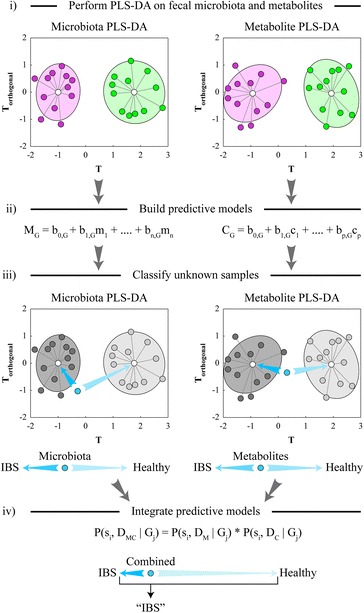
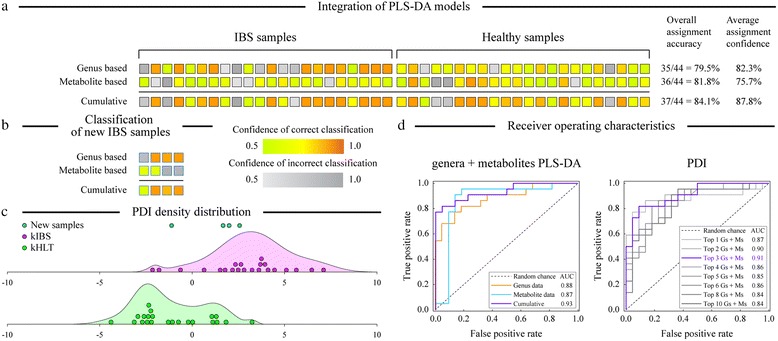
BACKGROUND: We previously showed that stool samples of pre-adolescent and adolescent US children diagnosed with diarrhea-predominant IBS (IBS-D) had different compositions of microbiota and metabolites compared to healthy age-matched controls. Here we explored whether observed fecal microbiota and metabolite differences between these two adolescent populations can be used to discriminate between IBS and health. FINDINGS: We constructed individual microbiota- and metabolite-based sample classification models based on the partial least squares multivariate analysis and then applied a Bayesian approach to integrate individual models into a single classifier. The resulting combined classification achieved 84 % accuracy of correct sample group assignment and 86 % prediction for IBS-D in cross-validation tests. The performance of the cumulative classification model was further validated by the de novo analysis of stool samples from a small independent IBS-D cohort. CONCLUSION: High-throughput microbial and metabolite profiling of subject stool samples can be used to facilitate IBS diagnosis.
Overview
The claims and statistics of this paper haven’t been checked yet.
Free: it reads the open-access text and checks the first 5 claims that cite a source we can check. Create a free account to check every claim.
Integrity signals
Registry
Cites
Statistics
Figures
Verification
Claims the paper makes
The claims and statistics of this paper haven’t been checked yet.
Free: it reads the open-access text and checks the first 5 claims that cite a source we can check. Create a free account to check every claim.
Claims other papers make about this one
Each is checked against this paper’s own text: does it say what the citing paper says it does?
In the citing paper
“By adding fecal metabolomic profiling to microbiome signatures, stool from children with IBS-D could be more accurately discriminated from that of healthy controls, with formate, pyruvate, and glucose being the most predictive metabolites130.”
From The gut Microbiome in adult and pediatric functional gastrointestinal disorders (2019) · cites this paper as [130]
Self-check
Percentages, sums and reported differences re-computed from the paper’s own numbers.
The self-check needs the paper’s full text.
Citations
Cites
Changes of Intestinal Functions in Liver Cirrhosis
Fukui, H., & Wiest, R. (2016) · Inflammatory Intestinal Diseases · doi:10.1159/000444436 · Cited by 6,808
Longstreth, G. F., Thompson, W. G., Chey, W. D., Houghton, L. A., Mearin, F., & Spiller, R. C. (2006) · Gastroenterology · doi:10.1053/j.gastro.2005.11.061 · Cited by 4,856
Alterations of the human gut microbiome in liver cirrhosis
Qin, N., Yang, F., Li, A., Prifti, E., Chen, Y., Shao, L., Guo, J., Le Chatelier, E., Yao, J., Wu, L., et al. (2014) · Nature · doi:10.1038/nature13568 · Cited by 2,177 · cited 1×
“To facilitate the application of fecal microbiota- and metabolite-based sample classification in the clinical setting, we also calculated an IBS-vs-health patient discrimination index (PDI) following a recently described strategy [18].”
MethodAn irritable bowel syndrome subtype defined by species-specific alterations in faecal microbiota
Jeffery, I. B., O'Toole, P. W., Öhman, L., Claesson, M. J., Deane, J., Quigley, E. M. M., & Simrén, M. (2012) · Gut · doi:10.1136/gutjnl-2011-301501 · Cited by 835 · cited 1×
“Several of these causes are linked to the functionality of human intestinal microbiota [4], and a number of recent studies have provided emerging evidence of gut microbiota alterations in IBS [5–8].”
BackgroundGastrointestinal microbiome signatures of pediatric patients with irritable bowel syndrome
Saulnier, D. M., Riehle, K., Mistretta, T., Diaz, M., Mandal, D., Raza, S., Weidler, E. M., Qin, X., Coarfa, C., Milosavljevic, A., et al. (2011) · Gastroenterology · doi:10.1053/j.gastro.2011.06.072 · Cited by 672 · cited 1×
“Several of these causes are linked to the functionality of human intestinal microbiota [4], and a number of recent studies have provided emerging evidence of gut microbiota alterations in IBS [5–8].”
Gastrointestinal microbiota in irritable bowel syndrome: present state and perspectives
Salonen, A., de Vos, W. M., & Palva, A. (2010) · Microbiology · doi:10.1099/mic.0.043257-0 · Cited by 264 · cited 1×
“Several of these causes are linked to the functionality of human intestinal microbiota [4], and a number of recent studies have provided emerging evidence of gut microbiota alterations in IBS [5–8].”
BackgroundCremonini, F., & Talley, N. J. (2005) · Gastroenterology Clinics of North America · doi:10.1016/j.gtc.2005.02.008 · Cited by 214 · cited 2×
“Because of symptom overlap with other disorders, IBS can often be misdiagnosed, and IBS patients undergo unnecessary invasive tests such as colonoscopy [14].”
Grundmann, O., & Yoon, S. L. (2010) · Journal of Gastroenterology and Hepatology · doi:10.1111/j.1440-1746.2009.06120.x · Cited by 209 · cited 1×
“This syndrome affects young children, adolescents, and adults, with higher prevalence in adolescence [2].”
Rigsbee, L., Agans, R., Shankar, V., Kenche, H., Khamis, H. J., Michail, S., & Paliy, O. (2012) · American Journal of Gastroenterology · doi:10.1038/ajg.2012.287 · Cited by 207 · cited 5×
“The datasets of relative microbial abundances and metabolite levels (abundances of 115 genera and 19 metabolites) measured in the set of 44 fecal samples were available from our previous studies [6, 12] and are provided in Additional file 1.”
BackgroundMethodResultInfluentialSelf-citationTreem, W. R., Ahsan, N., Kastoff, G., & Hyams, J. S. (1996) · Journal of Pediatric Gastroenterology & Nutrition · doi:10.1097/00005176-199610000-00013 · Cited by 146 · cited 1×
“Thus, differences in microbial communities between healthy individuals and those with IBS can manifest themselves as disparities in luminal metabolite profiles, a hypothesis supported by several reports [10–12].”
Jahng, J., Jung, I. S., Choi, E. J., Conklin, J. L., & Park, H. (2012) · Neurogastroenterology & Motility · doi:10.1111/j.1365-2982.2011.01819.x · Cited by 131
Quigley, E. M. M., Abdel-Hamid, H., Barbara, G., Bhatia, S. J., Boeckxstaens, G., De Giorgio, R., Delvaux, M., Drossman, D. A., Foxx-Orenstein, A. E., Guarner, F., et al. (2012) · Journal of Clinical Gastroenterology · doi:10.1097/mcg.0b013e318247157c · Cited by 130 · cited 5×
“Several different subtypes of IBS are recognized including diarrhea-predominant (IBS-D), constipation-predominant, mixed-type, and unsubtyped IBS [1, 3].”
BackgroundMethodInfluentialScarpellini, E., Giorgio, V., Gabrielli, M., Lauritano, E. C., Pantanella, A., Fundaro, C., & Gasbarrini, A. (2009) · The Journal of Pediatrics · doi:10.1016/j.jpeds.2009.03.033 · Cited by 91 · cited 1×
“types of questionnaires and lactulose or glucose hydrogen breath tests are sometimes used in the clinic to rule out alternative causes [3, 4, 13].”
Sood, R., Gracie, D. J., Law, G. R., & Ford, A. C. (2015) · Alimentary Pharmacology & Therapeutics · doi:10.1111/apt.13283 · Cited by 86 · cited 2×
“The diagnostic accuracy of the integrative PLS-DA model compared favorably to other IBS diagnostic tools and biomarkers [17].”
Shankar, V., Homer, D., Rigsbee, L., Khamis, H. J., Michail, S., Raymer, M., Reo, N. V., & Paliy, O. (2015) · The ISME Journal · doi:10.1038/ismej.2014.258 · Cited by 77 · cited 7×
“The datasets of relative microbial abundances and metabolite levels (abundances of 115 genera and 19 metabolites) measured in the set of 44 fecal samples were available from our previous studies [6, 12] and are provided in Additional file 1.”
InfluentialSelf-citationSmall intestinal bacterial overgrowth in irritable bowel syndrome: are there any predictors?
Reddymasu, S. C., Sostarich, S., & McCallum, R. W. (2010) · BMC Gastroenterology · doi:10.1186/1471-230x-10-23 · Cited by 74 · cited 2×
“Several of these causes are linked to the functionality of human intestinal microbiota [4], and a number of recent studies have provided emerging evidence of gut microbiota alterations in IBS [5–8].”
Bala, L., Ghoshal, U. C., Ghoshal, U., Tripathi, P., Misra, A., Gowda, G. A. N., & Khetrapal, C. L. (2006) · Magnetic Resonance in Medicine · doi:10.1002/mrm.21041 · Cited by 72 · cited 1×
“Thus, differences in microbial communities between healthy individuals and those with IBS can manifest themselves as disparities in luminal metabolite profiles, a hypothesis supported by several reports [10–12].”
ResultDo gut microbial communities differ in pediatric IBS and health?
Shankar, V., Agans, R., Holmes, B., Raymer, M., & Paliy, O. (2013) · Gut Microbes · doi:10.4161/gmic.24827 · Cited by 36 · cited 3×
“We have thus conducted PLS-DA analyses of fecal microbiota and metabolite datasets obtained previously for the IBS-D (denoted kIBS) and healthy (denoted kHLT) child cohorts [6, 12, 15].”
MethodResultSelf-citationRigsbee, L., Agans, R., Foy, B. D., & Paliy, O. (2011) · FEMS Microbiology Ecology · doi:10.1111/j.1574-6941.2010.01009.x · Cited by 34 · cited 1×
“Phylogenetic Microbiota Array was used to obtain quantitative microbial phylotype and genus abundance values from all collected fecal samples [16].”
Self-citation
Cited by
The gut Microbiome in adult and pediatric functional gastrointestinal disorders
Shin, A., Preidis, G. A., Shulman, R., & Kashyap, P. C. (2019) · Clinical Gastroenterology and Hepatology · doi:10.1016/j.cgh.2018.08.054 · Cited by 163
“By adding fecal metabolomic profiling to microbiome signatures, stool from children with IBS-D could be discriminated from that of healthy controls more accurately, with formate, pyruvate, and glucose being the most predictive metabolites.(130) Fecal microbial community composition also might be used to predict which…”
BackgroundAutism Spectrum Disorder as a Brain-Gut-Microbiome Axis Disorder
Saurman, V., Margolis, K. G., & Luna, R. A. (2020) · Digestive Diseases and Sciences · doi:10.1007/s10620-020-06133-5 · Cited by 137
Leveraging Human Microbiome Features to Diagnose and Stratify Children with Irritable Bowel Syndrome
Hollister, E. B., Oezguen, N., Chumpitazi, B. P., Luna, R. A., Weidler, E. M., Rubio-Gonzales, M., Dahdouli, M., Cope, J. L., Mistretta, T.-A., Raza, S., et al. (2019) · The Journal of Molecular Diagnostics · doi:10.1016/j.jmoldx.2019.01.006 · Cited by 89
Mathew, S., Smatti, M. K., Alansari, K., Nasrallah, G. K., Thani, A. A. A., & Yassine, H. M. (2019) · Scientific Reports · doi:10.1038/s41598-018-37162-w · Cited by 83
Keshteli, A. H., Madsen, K. L., Mandal, R., Boeckxstaens, G. E., Berčík, P., Palma, G. D., Reed, D. E., Wishart, D. S., Vanner, S. J., & Dieleman, L. A. (2019) · Alimentary Pharmacology & Therapeutics · doi:10.1111/apt.15141 · Cited by 60
“Currently there is no biological marker or a distinct observable intestinal pathophysiology that is specific for IBS; thus diagnosis remains challenging.(5) At the present time, diagnosis of IBS is based on Rome IV criteria, which are symptom‐based.”
Background
Metadata
- Authors
- Shankar, V., Reo, N. V., & Paliy, O.
- Affiliations
- Wright State University (US)
- Corresponding author
- Paliy, Oleg
- Venue
- Microbiome
- Published
- 2015-12
- Volume
- 3
- Issue
- 1
- Pages
- 73-73
- ISSN
- 2049-2618 (ISSN-L)
- PMC
- PMC4675077
- OpenAlex
- W2192147642
- Cited by
- 26
- References
- 19
- Citations by year
- 2024: 2 · 2023: 3 · 2022: 3 · 2021: 2 · 2020: 5 · 2019: 6 · 2018: 1 · 2017: 3 · 2016: 1
- FWCI
- 0.72
- Type
- journal article
- Language
- en
- Open access
- gold
- doi.org
- Licence
- cc-by
- creativecommons.org/licenses/by/4.0/ (tdm)
- creativecommons.org/licenses/by/4.0/ (vor, 8 d)
- Locations
- Microbiome (publishedVersion, cc-by)
- Europe PMC (PubMed Central) (publishedVersion, cc-by)
- PubMed Central (publishedVersion, cc-by)
- PubMed (publishedVersion)
- Funders
- National Institutes of Health (AT003423, HD065575)
- Topics
- Life Sciences › Biochemistry, Genetics and Molecular Biology › Molecular Biology › Gut microbiota and health
- Health Sciences › Medicine › Gastroenterology › Gastrointestinal motility and disorders
- Health Sciences › Medicine › Pediatrics, Perinatology and Child Health › Infant Health and Development
- Keywords
- pediatric irritable bowel syndrome, diarrhea-predominant irritable bowel syndrome, fecal microbiota, fecal metabolites, Bayesian classifier, sample classification, IBS diagnosis, adolescents, PLS-DA
- MeSH terms
- Adolescent, Bayes Theorem, Child, DNA, Bacterial, Feces, Female, Humans, Male, Irritable Bowel Syndrome, Metabolomics, Microbiota
About these checks
Registry, retraction, Cites and statistics results are computed, not judged, with one exception: a printed reference that no index lists is read once by a model before it counts as a citation error. Claims are extracted by a model and kept only when their quote appears verbatim in the text; each cited source is then checked, with a model’s help, for whether it says what the claim relies on. Those verdicts can be wrong — read the claim’s quote and the cited source before relying on one.
Statistics and arithmetic are recomputed, not judged.
Confidence bands are shown only for fields calibrated on our annotated test set. None is calibrated yet, so no band is shown.
What counts as a claim ›How we measure confidence ›How we check this ›
Are you an author, or do you see a problem with this page? Request a review
Data sources
Bibliographic data: Semantic Scholar, OpenAlex, Crossref.
Contains information from the Semantic Scholar Academic Graph Datasets, made available under the ODC Attribution License (ODC-BY 1.0).
Semantic Scholar’s data is described in: Kinney, R., et al. (2023). The Semantic Scholar Open Data Platform. arXiv:2301.10140.
