

Profiling bacterial communities by MinION sequencing of ribosomal operons
Open accessThe DOI matches its Crossref record; 37 of the 38 references it cites were found in a registry or an index.
Abstract
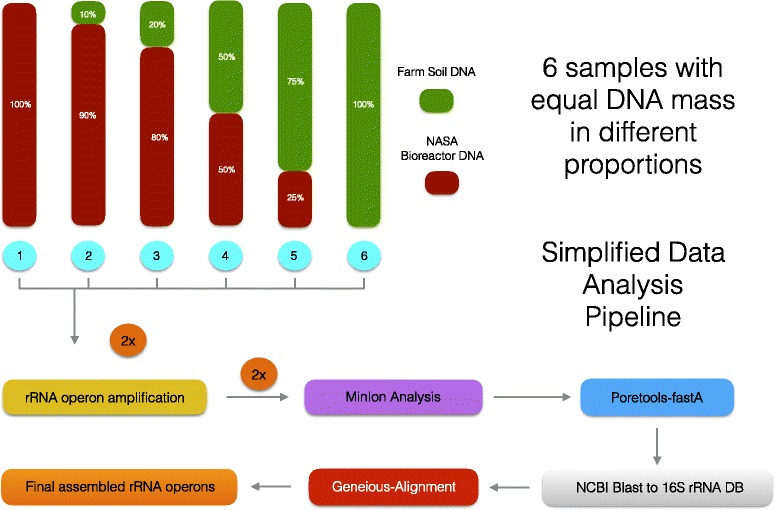
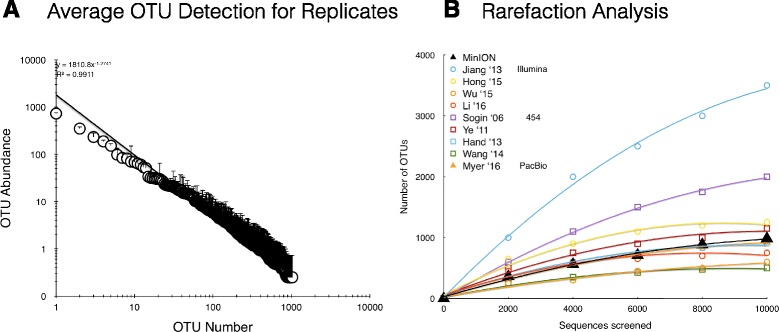
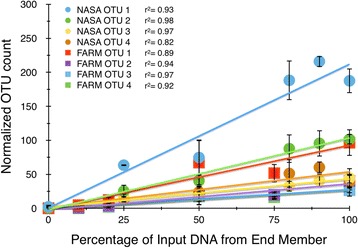
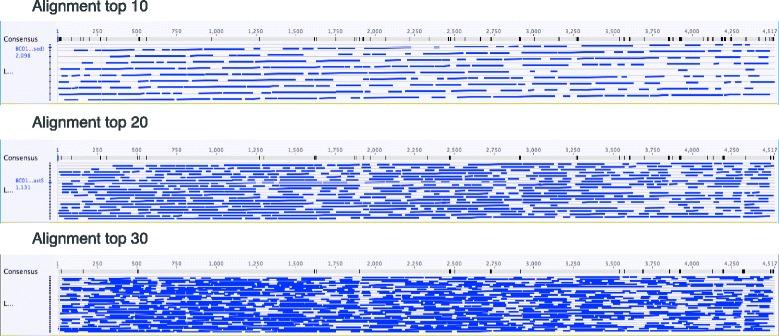
BACKGROUND: An approach utilizing the long-read capability of the Oxford Nanopore MinION to rapidly sequence bacterial ribosomal operons of complex natural communities was developed. Microbial fingerprinting employs domain-specific forward primers (16S rRNA subunit), reverse primers (23S rRNA subunit), and a high-fidelity Taq polymerase with proofreading capabilities. Amplicons contained both ribosomal subunits for broad-based phylogenetic assignment (~ 3900 bp of sequence), plus the intergenic spacer (ITS) region (~ 300 bp) for potential strain-specific identification. RESULTS: To test the approach, bacterial rRNA operons (~ 4200 bp) were amplified from six DNA samples employing a mixture of farm soil and bioreactor DNA in known concentrations. Each DNA sample mixture was barcoded, sequenced in quadruplicate (n = 24), on two separate 6-h runs using the MinION system (R7.3 flow cell; MAP005 and 006 chemistry). From nearly 90,000 MinION reads, roughly 33,000 forward and reverse sequences were obtained. This yielded over 10,000 2D sequences which were analyzed using a simplified data analysis pipeline based on NCBI Blast and assembly with Geneious software. The method could detect over 1000 operational taxonomic units in the sample sets in a quantitative manner. Global sequence coverage for the various rRNA operons ranged from 1 to 1951x. An iterative assembly scheme was developed to reconstruct those rRNA operons with > 35x coverage from a set of 30 operational taxonomic units (OTUs) among the Proteobacteria, Actinobacteria, Acidobacteria, Firmicutes, and Gemmatimonadetes. Phylogenetic analysis of the 16S rRNA and 23S rRNA genes from each operon demonstrated similar tree topologies with species/strain-level resolution. CONCLUSIONS: This sequencing method represents a cost-effective way to profile microbial communities. Because the MinION is small, portable, and runs on a laptop, the possibility of microbiota characterization in the field or on robotic platforms becomes realistic.
Overview
The claims and statistics of this paper haven’t been checked yet.
Free: it reads the open-access text and checks the first 5 claims that cite a source we can check. Create a free account to check every claim.
Integrity signals
Registry
Cites
Statistics
Figures
Verification
Claims the paper makes
The claims and statistics of this paper haven’t been checked yet.
Free: it reads the open-access text and checks the first 5 claims that cite a source we can check. Create a free account to check every claim.
Claims other papers make about this one
Each is checked against this paper’s own text: does it say what the citing paper says it does?
In the citing paper
“Research studies have also demonstrated the clinical potential of nanopore sequencing in targeted universal 16S ribosomal RNA (rRNA) bacterial detection127, microbiome analyses128, whole-genome sequencing of bacteria129 and outbreak viruses44,45,47, RNA sequencing (RNA-seq) using standardized controls130 and diagnosis of prosthetic joint131 and lower respiratory infections99.”
From Clinical metagenomics (2019) · cites this paper as [128]
Self-check
Percentages, sums and reported differences re-computed from the paper’s own numbers.
The self-check needs the paper’s full text.
Citations
Cites
Lane, D. (1991) · Medical Entomology and Zoology · Cited by 12,696
Muyzer, G., de Waal, E. C., & Uitterlinden, A. G. (1993) · Applied and Environmental Microbiology · doi:10.1128/aem.59.3.695-700.1993 · Cited by 11,429
Kozich, J. J., Westcott, S. L., Baxter, N. T., Highlander, S. K., & Schloss, P. D. (2013) · Applied and Environmental Microbiology · doi:10.1128/aem.01043-13 · Cited by 7,112
Microbial diversity in the deep sea and the underexplored “rare biosphere”
Sogin, M. L., Morrison, H. G., Huber, J. A., Welch, D. M., Huse, S. M., Neal, P. R., Arrieta, J. M., & Herndl, G. J. (2006) · Proceedings of the National Academy of Sciences · doi:10.1073/pnas.0605127103 · Cited by 3,701
Pyrosequencing enumerates and contrasts soil microbial diversity
Roesch, L. F. W., Fulthorpe, R. R., Riva, A., Casella, G., Hadwin, A. K. M., Kent, A. D., Daroub, S. H., Camargo, F. A. O., Farmerie, W. G., & Triplett, E. W. (2007) · The ISME Journal · doi:10.1038/ismej.2007.53 · Cited by 1,852
The Oxford Nanopore MinION: delivery of nanopore sequencing to the genomics community
Jain, M., Olsen, H. E., Paten, B., & Akeson, M. (2016) · Genome Biology · doi:10.1186/s13059-016-1103-0 · Cited by 1,588 · cited 1×
“Additionally, improvements in chemistry and library prep have led to increasing accuracy from 66 to 92% within the last few years [33] and ONT has released a newer version of their analysis software (MinKnow v51.”
BackgroundA complete bacterial genome assembled de novo using only nanopore sequencing data
Loman, N. J., Quick, J., & Simpson, J. T. (2015) · Nature Methods · doi:10.1038/nmeth.3444 · Cited by 1,294
Microbial Ecology and Evolution: A Ribosomal RNA Approach
Olsen, G. J., Lane, D. J., Giovannoni, S. J., Pace, N. R., & Stahl, D. A. (1986) · Annual Review of Microbiology · doi:10.1146/annurev.mi.40.100186.002005 · Cited by 1,078
Genome sequencing of the sweetpotato whitefly Bemisia tabaci MED/Q
Xie, W., Chen, C., Yang, Z., Guo, L., Yang, X., Wang, D., Chen, M., Huang, J., Wen, Y., Zeng, Y., et al. (2017) · GigaScience · doi:10.1093/gigascience/gix018 · Cited by 473
Jiang, X.-T., Peng, X., Deng, G.-H., Sheng, H.-F., Wang, Y., Zhou, H.-W., & Tam, N. F.-Y. (2013) · Microbial Ecology · doi:10.1007/s00248-013-0238-8 · Cited by 403
Research works printed but not linked: 1
- Harris RS Improved pairwise alignment of genomic DNA. PhD thesis. The Center for Comparative Genomics and Bioinformatics, The Pennsylvania State University, 501 Wartik Laboratory, University Park, PA 16802; 2007.
Cited by
Chiu, C. Y., & Miller, S. A. (2019) · Nature Reviews Genetics · doi:10.1038/s41576-019-0113-7 · Cited by 1,620
Asaf, S., Numan, M., Khan, A. L., & Al-Harrasi, A. (2020) · Critical Reviews in Biotechnology · doi:10.1080/07388551.2019.1709793 · Cited by 724
The Future Agricultural Biogas Plant in Germany: A Vision
Theuerl, S., Herrmann, C., Heiermann, M., Grundmann, P., Landwehr, N., Kreidenweis, U., & Prochnow, A. (2019) · Energies · doi:10.3390/en12030396 · Cited by 196
Kai, S., Matsuo, Y., Nakagawa, S., Kryukov, K. A., Matsukawa, S., Tanaka, H., Iwai, T., Imanishi, T., & Hirota, K. (2019) · FEBS Open Bio · doi:10.1002/2211-5463.12590 · Cited by 187
Computational methods for 16S metabarcoding studies using Nanopore sequencing data
Santos, A., van Aerle, R., Barrientos, L., & Martinez-Urtaza, J. (2020) · Computational and Structural Biotechnology Journal · doi:10.1016/j.csbj.2020.01.005 · Cited by 175
Metadata
- Authors
- Kerkhof, L. J., Dillon, K. P., Häggblom, M. M., & McGuinness, L. R.
- Affiliations
- Rutgers, The State University of New Jersey (US)
- Corresponding author
- Kerkhof, Lee J.
- Venue
- Microbiome
- Published
- 2017-09-15
- Volume
- 5
- Issue
- 1
- Pages
- 116-116
- ISSN
- 2049-2618 (ISSN-L)
- PMC
- PMC5599880
- OpenAlex
- W2751691605
- Cited by
- 115
- References
- 38
- Citations by year
- 2026: 8 · 2025: 9 · 2024: 7 · 2023: 11 · 2022: 12 · 2021: 15 · 2020: 14 · 2019: 26 · 2018: 12
- FWCI
- 5.81
- Type
- journal article
- Language
- en
- Open access
- gold
- doi.org
- Licence
- cc-by
- creativecommons.org/licenses/by/4.0/ (tdm)
- creativecommons.org/licenses/by/4.0/ (vor)
- Locations
- Microbiome (publishedVersion, cc-by)
- Europe PMC (PubMed Central) (publishedVersion, cc-by)
- PubMed Central (publishedVersion, cc-by)
- PubMed (publishedVersion)
- DOAJ (DOAJ: Directory of Open Access Journals) (submittedVersion, cc-by-sa)
- Funders
- Directorate for Geosciences (NSF #1131022)
- Topics
- Life Sciences › Biochemistry, Genetics and Molecular Biology › Molecular Biology › Genomics and Phylogenetic Studies
- Physical Sciences › Environmental Science › Ecology › Microbial Community Ecology and Physiology
- Physical Sciences › Environmental Science › Ecology › Environmental DNA in Biodiversity Studies
- Keywords
- bacterial community profiling, ribosomal RNA operon, 16S rRNA, 23S rRNA, ITS region, Oxford Nanopore MinION, long-read sequencing, microbial fingerprinting, operational taxonomic units, phylogenetic analysis, strain-level identification, soil microbiome, portable sequencing
- MeSH terms
- Bacteria, DNA, Bacterial, DNA, Ribosomal, Operon, Phylogeny, RNA, Bacterial, RNA, Ribosomal, RNA, Ribosomal, 16S, Sequence Analysis, DNA, Gene Expression Profiling, Microbial Consortia, High-Throughput Nucleotide Sequencing
About these checks
Registry, retraction, Cites and statistics results are computed, not judged, with one exception: a printed reference that no index lists is read once by a model before it counts as a citation error. Claims are extracted by a model and kept only when their quote appears verbatim in the text; each cited source is then checked, with a model’s help, for whether it says what the claim relies on. Those verdicts can be wrong — read the claim’s quote and the cited source before relying on one.
Statistics and arithmetic are recomputed, not judged.
Confidence bands are shown only for fields calibrated on our annotated test set. None is calibrated yet, so no band is shown.
What counts as a claim ›How we measure confidence ›How we check this ›
Are you an author, or do you see a problem with this page? Request a review
How to cite
Cite CoChat for the checks on this page, and the paper for its own findings.
- This page
- CoChat. (2026). Citation check: Profiling bacterial communities by MinION sequencing of ribosomal operons. https://app.cochat.ai/papers/10.1186/s40168-017-0336-9
- The paper
- Kerkhof, L. J., Dillon, K. P., Häggblom, M. M., & McGuinness, L. R. (2017). Profiling bacterial communities by MinION sequencing of ribosomal operons. Microbiome. https://doi.org/10.1186/s40168-017-0336-9
Data sources
Bibliographic data: Semantic Scholar, OpenAlex, Crossref.
Contains information from the Semantic Scholar Academic Graph Datasets, made available under the ODC Attribution License (ODC-BY 1.0).
Semantic Scholar’s data is described in: Kinney, R., et al. (2023). The Semantic Scholar Open Data Platform. arXiv:2301.10140.
