

The DOI matches its Crossref record; 69 of the 70 references it cites were found in a registry or an index; 1 of the 329 sources its claims cite were checked for support.
Paper 1: a systematic synthesis of narrative therapy treatment components for the treatment of eating disorders
Open accessAbstract
Background: There are presently a number of eating disorder treatment interventions that have a research-evidence base to support their effectiveness. However, rates of attrition and treatment outcomes demonstrate that there is no one-size fits all for the treatment of eating disorders. Narrative therapy is a promising, but under-researched, intervention for the treatment of eating disorders (EDs). The aim of this study was to conduct a narrative synthesis of the literature to explore the content and use of narrative therapy in the treatment of EDs. Method: Data were extracted from 33 eligible included studies following systematic search of five data bases. Data included aims and objectives, sample characteristics, treatment details and components of narrative therapy, which informed the narrative synthesis. The study is reported according to the Preferred Reporting items for Systematic Reviews and Meta-Analyses (PRISMA) guidelines. Results: Narrative therapy interventions for EDs consisted of several components including the narrative worldview; unpacking the problem story; finding, thickening the meaning and performance of stories hidden by the problem story; and safety considerations. A notable proportion of the extracted articles discussed components of unpacking problem stories, and finding and re-authoring openings (or unique outcomes) that were hidden by problematic stories. Relatively fewer papers discussed the processes by identity shifts were performed or lived out, including in the eating practices of those with a lived ED experience. Furthermore, few papers addressed how therapists established client safety within the narrative framework when working with EDs. Conclusion: This narrative synthesis found that narrative practitioners utilise a variety of narrative therapy techniques in working with individuals with a lived ED experience. The current literature has emphasis on specific narrative therapy techniques used in ED treatments, with some aspects of the narrative worldview and safety considerations left undiscussed. Additional research is needed to explore how identity shifts in narrative therapy are performed and lead to measurable behavioural changes, and to consider how safety considerations can be established within the narrative worldview. Plain English summary: There are a number of psychological therapies for eating disorders that have research evidence-base. These treatments, however, do not work for everyone as indicated by drop-out rates and eating disorders running a severe and enduring course for some people. Narrative therapy is a therapeutic intervention that has been reported as a promising intervention for people with an eating disorder. The focus of narrative therapy is to engage the person in finding identities hidden by problem-saturated identities and in the performance of these hidden identities. In this review, we have explored the use of narrative therapy for eating disorders to identify what aspects of this therapy are currently being used and which components are less referenced in the literature. Findings from this study support the need for further research into narrative therapy components in the treatment of eating disorders, particularly how hidden identities are performed and safety considerations are integrated into this therapeutic intervention.
Overview
AI snapshot
Written from the paper’s full text.
TL;DR
This narrative synthesis of 33 studies mapped narrative therapy components used in eating disorder treatment, finding strong emphasis on unpacking problem stories and finding/thickening hidden stories. It concludes that further research is needed on how identity shifts are performed or lived out and how safety considerations are integrated into the narrative worldview.
Key findings
- Across 33 included texts, all included at least one aspect of unpacking problem stories; deconstruction was referenced in 31 papers, externalisation in 30, and experience-near naming in 21.
- Narrative worldview appeared in 28 articles, finding hidden openings/unique outcomes in 28, and thickening hidden/revealed stories in 30; letter and creative writing appeared in 12, while safety considerations appeared in only 6 of 33.
- Few papers addressed how identity shifts were performed or lived out, including in eating practices; only half mentioned ways identity shifts were performed, and most lacked discussion of meaningful ED symptom outcomes.
- Quality appraisal found only 2 papers cited ethics approval; most studies had small samples or case-study designs, and many were written by narrative therapists delivering the treatment, indicating possible selection and performance/confounding bias.
Methods
- Narrative synthesis registered with Open Science and reported per PRISMA; searched PsychINFO, MEDLINE, EMBASE, SocIndex, and ProQuest Dissertations and Theses plus an author’s personal library, covering 1979 to 4 July 2021.
- From 1434 database records plus 11 library records, 33 texts were included after screening; inclusion required English publication, focus on narrative therapy intervention content, and a sample in treatment for any ED, including books and case studies.
- Data extracted included aims/objectives, sample characteristics, treatment details, and narrative therapy components; quality was assessed with adapted Downs & Black and Joanna Briggs Institute checklists, and findings were synthesised into categories A–E.
Limitations
- Stated: the most frequent quality limitation was lack of evidence for ethics approval; most articles had small participant numbers, often case studies; only half mentioned how identity shifts were performed; few focused on eating patterns or relationship with the body; many were authored by narrative therapists delivering the treatment, risking selection and performance/confounding bias.
- Stated: researcher judgements were used to assess quality and contribution, and all studies meeting selection criteria were retained regardless of quality score.
- Evident from the text: the synthesis maps intervention components and practice-based evidence but does not establish treatment effectiveness or quantify outcomes.
Model-written summary. Check it against the paper before relying on it.
Integrity signals
Registry
Cites
Statistics
Figures
Verification
Claims the paper makes
43 Not checked yet · 41 Own result · 40 Sources not found · 18 Check pending · 11 No basis given · 10 No full text of the sources · 8 Own interpretation · 4 Own method · 1 Partly supported · accuracy not yet measured
The cited sources support only part of this claim — read each source’s verdict below.
In the paper
“Further research has shown that treatments that focus primarily on eating behaviour and weight restoration may inadequately address the broader needs and preferences of those with a lived ED experience [21–25].”
§ Paper 1: a systematic synthesis of narrative therapy treatment components for the treatment of eating disorders > Background > Treatments and outcomes
What the sources say
- Not checked — no full text of the sourcecites [21] Steinhausen H-C. the outcome of anorexia nervosa in the 20th century. Am J Psychiatry. 2002;159(8):1284–93. source
- Not checked — no full text of the sourcecites [22] Fox JRE, Diab P. An exploration of the perceptions and experiences of living with chronic anorexia nervosa while an inpatient on an eating disorders unit: an interpretative phenomenological analysis (IPA) study. J Health Psychol. 2015;20(1):27–36. source
- Check pendingcites [23] Rance N, Moller NP, Clarke V. ‘Eating disorders are not about food, they’re about life’: client perspectives on anorexia nervosa treatment. J Health Psychol. 2017;22(5):582–94. source
- Not checked — no full text of the sourcecites [24] Hay PJ, Cho K. A qualitative exploration of influences on the process of recovery from personal written accounts of people with anorexia nervosa. Women Health. 2013;53(7):730–40. source
- Partly supportedcites [25] Conti JE, Joyce C, Hay P, Meade T. “Finding my own identity”: a qualitative metasynthesis of adult anorexia nervosa treatment experiences. BMC Psychol. 2020;8(1):1–110. sourceExperimental — accuracy not yet measured
The Results (Synthesis of results) report that participants with anorexia nervosa resisted treatments focused on weight restoration and eating-behaviour change when those treatments neglected emotional needs and personal preferences. This supports the concern in the claim, but the metasynthesis concerns adults with anorexia nervosa; it does not establish the point for people with all eating disorders. (LLM, conf=0.82)
hedgedconditional- Asserted: passes — The authors put it forward as true.
- Checkable: passes — It can be checked against evidence.
- Load-bearing: passes — The paper’s conclusions depend on it.
- Based: passes — The paper gives a reason why it holds.
In the paper
“Three of the articles indicated that clients were directly invited to guide the direction of therapy or contribute to the content of structured sessions, such as in group therapy programs [74, 79, 81].”
§ Paper 1: a systematic synthesis of narrative therapy treatment components for the treatment of eating disorders > Method > Synthesis of results
What the sources say
- Check pendingcites [74] Golan M. The journey from opposition to recovery from eating disorders: multidisciplinary model integrating narrative counseling and motivational interviewing in traditional approaches. J Eat Disord. 2013;1(1):19. source
- Not matchedcites [79] Courtney J, Williams L. Linking lives: Working with women experiencing eating problems. Gecko A J Deconstr Narrat Ideas Ther Pract 2000:17–38.
Couldn’t be matched to a paper in Crossref, so it can’t be checked.
- Not matchedcites [81] Kraner MIK. Bursting Out - Breaking Free. A group program for young women wanting to reclaim their lives from anorexia nervosa. Gecko. 1997;3:31–57.
Couldn’t be matched to a paper in Crossref, so it can’t be checked.
hedged- Asserted: passes — The authors put it forward as true.
- Checkable: passes — It can be checked against evidence.
- Load-bearing: unclear — It is unclear whether the paper’s conclusions depend on it.
- Based: passes — The paper gives a reason why it holds.
None of the sources cited for this claim have been checked yet.
In the paper
“Several identified articles indicated that placing the client in a position of authority and privileging their ‘insider’ knowledge is a fundamental component of the narrative worldview [73, 76, 77, 84, 96].”
§ Paper 1: a systematic synthesis of narrative therapy treatment components for the treatment of eating disorders > Method > Synthesis of results
What the sources say
- Not matchedcites [73] Lundby G. Creating different versions of life: talking about problems with children and their parents. Int J Narrat Ther Commun Work. 2014;1:18–26.
Couldn’t be matched to a paper in Crossref, so it can’t be checked.
- Not matchedcites [76] Borden A. Every conversation is an opportunity. Int J NT Commun Work. 2007;4:38–53.
Couldn’t be matched to a paper in Crossref, so it can’t be checked.
- Not matchedcites [77] Brown C. The dangers of trauma talk: counterstorying co-occuring strategies for coping with trauma. J Syst Ther. 2018;37:42–60.
Couldn’t be matched to a paper in Crossref, so it can’t be checked.
- Not checked — no full text of the sourcecites [84] Lock A, Epston D, Maisel R, Faria N. Resisting anorexia/bulimia: Foucauldian perspectives in narrative therapy. Br J Guid Couns. 2005;33(3):315–32. source
- Not matchedcites [96] Dennstedt C. The interplay of substance misuse and disordered eating practices in the lives of young women. Int J Narrat Ther Commun Work. 2010;3:52–63.
Couldn’t be matched to a paper in Crossref, so it can’t be checked.
hedged- Asserted: passes — The authors put it forward as true.
- Checkable: passes — It can be checked against evidence.
- Load-bearing: passes — The paper’s conclusions depend on it.
- Based: passes — The paper gives a reason why it holds.
- Not matched
A result the paper reports from its own data — it cites no other source for it, so there is none to check. The quote shows it is in the paper.
In the paper
“Relatively fewer papers discussed the processes by identity shifts were performed or lived out, including in the eating practices of those with a lived ED experience.”
§ Paper 1: a systematic synthesis of narrative therapy treatment components for the treatment of eating disorders > Abstract > Results
plain- Asserted: passes — The authors put it forward as true.
- Checkable: passes — It can be checked against evidence.
- Load-bearing: unclear — It is unclear whether the paper’s conclusions depend on it.
- Based: passes — The paper gives a reason why it holds.
None of the sources cited for this claim have been checked yet.
In the paper
“Six of the articles demonstrated or spoke to the process of regularly seeking feedback and asking for consent from their clients throughout narrative conversations [53, 61, 75, 92–94].”
§ Paper 1: a systematic synthesis of narrative therapy treatment components for the treatment of eating disorders > Method > Synthesis of results
What the sources say
- Not matchedcites [53] Maisel R, Epston, D., & Borden, A. Biting the hand that starves you: inspiring resistance to anorexia/bulimia. Libra Publishers Inc; 2006
Couldn’t be matched to a paper in Crossref, so it can’t be checked.
- Not matchedcites [61] White M. Deconstruction and therapy. Dulwich Cent Newsl. 1991;3:21–40.
Couldn’t be matched to a paper in Crossref, so it can’t be checked.
- Not matchedcites [75] Pedersen K. Uncovering bulimia’s demanding voice: challenges from a narrative therapist’s perspective. Int J Narrat Ther Commun Work. 2016;4:1–13.
Couldn’t be matched to a paper in Crossref, so it can’t be checked.
- Not matchedcites [92] Ingamells KM. Wilbur the worrier becomes wilbur the warrior: a teaching story for narrative family therapists. J Syst Ther. 2016;35(4):43–57.
Couldn’t be matched to a paper in Crossref, so it can’t be checked.
- Not checked — no full text of the sourcecites [93] Ibrahim J, Tchanturia K. Patients’ experience of a narrative group therapy approach informed by the “tree of life” model for individuals with anorexia nervosa. Int J Group Psychother. 2018;68(1):80–91. source
- Not matchedcites [94] Weber M. Narrative therapy, “eating disorders”, and assessment: exploring constraints, dilemmas, and opportunities. Int J Narrat Ther Commun Work. 2007;2:63–70.
Couldn’t be matched to a paper in Crossref, so it can’t be checked.
plain- Asserted: passes — The authors put it forward as true.
- Checkable: passes — It can be checked against evidence.
- Load-bearing: unclear — It is unclear whether the paper’s conclusions depend on it.
- Based: passes — The paper gives a reason why it holds.
- Not matched
None of the sources cited for this claim could be matched to a paper in Crossref, so there is nothing to check it against.
In the paper
“Lainson [82] and Ingamells [92] noted instances throughout exemplar clinical transcripts where the therapist took a stance of radical genuineness and self-disclosure.”
§ Paper 1: a systematic synthesis of narrative therapy treatment components for the treatment of eating disorders > Method > Synthesis of results
What the sources say
- Not matchedcites [82] Lainson KJ. From “disorder” to political action: Conversations that invite collective considerations to individual experiences of women who express concerns about eating and their bodies. Int J Narrat Ther Commun Work. 2016;2:1–16.
Couldn’t be matched to a paper in Crossref, so it can’t be checked.
- Not matchedcites [92] Ingamells KM. Wilbur the worrier becomes wilbur the warrior: a teaching story for narrative family therapists. J Syst Ther. 2016;35(4):43–57.
Couldn’t be matched to a paper in Crossref, so it can’t be checked.
plain- Asserted: passes — The authors put it forward as true.
- Checkable: passes — It can be checked against evidence.
- Load-bearing: unclear — It is unclear whether the paper’s conclusions depend on it.
- Based: passes — The paper gives a reason why it holds.
- Not matched
A result the paper reports from its own data — it cites no other source for it, so there is none to check. The quote shows it is in the paper.
In the paper
“This narrative synthesis found that narrative practitioners utilise a variety of narrative therapy techniques in working with individuals with a lived ED experience.”
§ Paper 1: a systematic synthesis of narrative therapy treatment components for the treatment of eating disorders > Abstract > Conclusion
plain- Asserted: passes — The authors put it forward as true.
- Checkable: passes — It can be checked against evidence.
- Load-bearing: passes — The paper’s conclusions depend on it.
- Based: passes — The paper gives a reason why it holds.
A result the paper reports from its own data — it cites no other source for it, so there is none to check. The quote shows it is in the paper.
In the paper
“Seventeen articles had a focus on the key components of the therapist stance within NT.”
§ Paper 1: a systematic synthesis of narrative therapy treatment components for the treatment of eating disorders > Method > Synthesis of results
plain- Asserted: passes — The authors put it forward as true.
- Checkable: passes — It can be checked against evidence.
- Load-bearing: unclear — It is unclear whether the paper’s conclusions depend on it.
- Based: passes — The paper gives a reason why it holds.
None of the sources cited for this claim could be matched to a paper in Crossref, so there is nothing to check it against.
In the paper
“In five of the papers, power imbalances within the therapeutic relationship were explicitly named by the therapist and explored with the client during the intervention [75, 76, 82, 91, 92].”
§ Paper 1: a systematic synthesis of narrative therapy treatment components for the treatment of eating disorders > Method > Synthesis of results
What the sources say
- Not matchedcites [75] Pedersen K. Uncovering bulimia’s demanding voice: challenges from a narrative therapist’s perspective. Int J Narrat Ther Commun Work. 2016;4:1–13.
Couldn’t be matched to a paper in Crossref, so it can’t be checked.
- Not matchedcites [76] Borden A. Every conversation is an opportunity. Int J NT Commun Work. 2007;4:38–53.
Couldn’t be matched to a paper in Crossref, so it can’t be checked.
- Not matchedcites [82] Lainson KJ. From “disorder” to political action: Conversations that invite collective considerations to individual experiences of women who express concerns about eating and their bodies. Int J Narrat Ther Commun Work. 2016;2:1–16.
Couldn’t be matched to a paper in Crossref, so it can’t be checked.
- Not matchedcites [91] Craggs T, Reed A. A service-user and therapist reflect on context, difference, and dialogue in a therapy for anorexia. Int J Narrat Ther Commun Work. 2007;3:30–8.
Couldn’t be matched to a paper in Crossref, so it can’t be checked.
- Not matchedcites [92] Ingamells KM. Wilbur the worrier becomes wilbur the warrior: a teaching story for narrative family therapists. J Syst Ther. 2016;35(4):43–57.
Couldn’t be matched to a paper in Crossref, so it can’t be checked.
plain- Asserted: passes — The authors put it forward as true.
- Checkable: passes — It can be checked against evidence.
- Load-bearing: unclear — It is unclear whether the paper’s conclusions depend on it.
- Based: passes — The paper gives a reason why it holds.
- Not matched
In the paper
“Early work by White [59] highlighted the importance of separating the problem from the person by viewing the problem as developing despite the best efforts of the individual and their family to reach a solution.”
§ Paper 1: a systematic synthesis of narrative therapy treatment components for the treatment of eating disorders > Method > Synthesis of results
What the sources say
- Not checked — no full text of the sourcecites [59] White M. Anorexia nervosa: A cybernetic perspective. Selected papers. Dulwich Centre. 1986:65–75. source
plain- Asserted: passes — The authors put it forward as true.
- Checkable: passes — It can be checked against evidence.
- Load-bearing: unclear — It is unclear whether the paper’s conclusions depend on it.
- Based: passes — The paper gives a reason why it holds.
- Probably not a substantial claim. 64
- It may state two separate claims as one. 24
None of the sources cited for this claim have been checked yet.
In the paper
“The papers by Dallos [90], Lainson [83], Brown, Weber & Ali [78] and Brown [77] extended on this to postulate that the problem likely develops to meet an internal need, whether this be an individual/personal need (e.g., for control, to gain a sense of self-worth), outstanding attachment needs within the family, and/or to meet broader societal expectations (e.g., to be seen as thin or feminine).”
§ Paper 1: a systematic synthesis of narrative therapy treatment components for the treatment of eating disorders > Method > Synthesis of results
What the sources say
- Not checked — no full text of the sourcecites [90] Dallos R. Attachment narrative therapy: integrating ideas from narrative and attachment theory in systemic family therapy with eating disorders. J Fam Ther. 2004;26(1):40–65. source
- Not matchedcites [83] Lainson K. Narrative therapy, neuroscience and anorexia: a reflection on practices, problems and possibilities. Int J Narrat Ther Commun Work. 2019;3:80–95.
Couldn’t be matched to a paper in Crossref, so it can’t be checked.
- Not matchedcites [78] Brown CG, Weber S, Ali S. Women’s body talk: a feminist narrative approach. J Syst Ther. 2008;27(2):92–104.
Couldn’t be matched to a paper in Crossref, so it can’t be checked.
hedgedconditional- Asserted: passes — The authors put it forward as true.
- Checkable: passes — It can be checked against evidence.
- Load-bearing: fails — The paper’s conclusions may not depend on it.
- Based: passes — The paper gives a reason why it holds.
Probably not a substantial claim. The paper’s conclusions may not depend on it.
In the paper
“In particular, Borden [76] argued against unitary or ‘thin’ understandings of identity, which may inadvertently reduce the person to a problem-saturated story.”
§ Paper 1: a systematic synthesis of narrative therapy treatment components for the treatment of eating disorders > Method > Synthesis of results
What the sources say
- Not matchedcites [76] Borden A. Every conversation is an opportunity. Int J NT Commun Work. 2007;4:38–53.
Couldn’t be matched to a paper in Crossref, so it can’t be checked.
plainconditional- Asserted: passes — The authors put it forward as true.
- Checkable: passes — It can be checked against evidence.
- Load-bearing: fails — The paper’s conclusions may not depend on it.
- Based: passes — The paper gives a reason why it holds.
Probably not a substantial claim. The paper’s conclusions may not depend on it.
- Not matched
None of the sources cited for this claim have been checked yet.
In the paper
“These papers emphasised the importance of the use of client-centred constructions of the problem and consideration of what recovery looks like for the individual (e.g., broadening social circles, returning to work, enjoyment of a variety of foods, etc.) [53, 78, 79, 93, 94].”
§ Paper 1: a systematic synthesis of narrative therapy treatment components for the treatment of eating disorders > Method > Synthesis of results
What the sources say
- Not matchedcites [53] Maisel R, Epston, D., & Borden, A. Biting the hand that starves you: inspiring resistance to anorexia/bulimia. Libra Publishers Inc; 2006
Couldn’t be matched to a paper in Crossref, so it can’t be checked.
- Not matchedcites [78] Brown CG, Weber S, Ali S. Women’s body talk: a feminist narrative approach. J Syst Ther. 2008;27(2):92–104.
Couldn’t be matched to a paper in Crossref, so it can’t be checked.
- Not matchedcites [79] Courtney J, Williams L. Linking lives: Working with women experiencing eating problems. Gecko A J Deconstr Narrat Ideas Ther Pract 2000:17–38.
Couldn’t be matched to a paper in Crossref, so it can’t be checked.
- Not checked — no full text of the sourcecites [93] Ibrahim J, Tchanturia K. Patients’ experience of a narrative group therapy approach informed by the “tree of life” model for individuals with anorexia nervosa. Int J Group Psychother. 2018;68(1):80–91. source
- Not matchedcites [94] Weber M. Narrative therapy, “eating disorders”, and assessment: exploring constraints, dilemmas, and opportunities. Int J Narrat Ther Commun Work. 2007;2:63–70.
Couldn’t be matched to a paper in Crossref, so it can’t be checked.
plain- Asserted: passes — The authors put it forward as true.
- Checkable: passes — It can be checked against evidence.
- Load-bearing: passes — The paper’s conclusions depend on it.
- Based: passes — The paper gives a reason why it holds.
It may state two separate claims as one.
- Not matched
A claim is checked only against the cited paper’s full text, never its abstract, and none is available for its sources.
In the paper
“In particular, the narrative worldview was depicted by the studies as including the stance of the therapist, the client positioned as the expert on their life, and ‘the problem is the problem’ [59, 85].”
§ Paper 1: a systematic synthesis of narrative therapy treatment components for the treatment of eating disorders > Method > Synthesis of results
What the sources say
- Not checked — no full text of the sourcecites [59] White M. Anorexia nervosa: A cybernetic perspective. Selected papers. Dulwich Centre. 1986:65–75. source
- Not checked — no full text of the sourcecites [85] Lock A, Epston D, Maisel R. Countering that which is called anorexia. Narrat Inq. 2004;14(2):275–301. source
plain- Asserted: passes — The authors put it forward as true.
- Checkable: passes — It can be checked against evidence.
- Load-bearing: unclear — It is unclear whether the paper’s conclusions depend on it.
- Based: passes — The paper gives a reason why it holds.
It may state two separate claims as one.
The paper states this without a source or data behind it here, so there is nothing to check it against. The quote shows it is in the paper.
In the paper
“Likewise, the narrative worldview conceptualised identity as multi-storied, used non-pathologising language, and considered the person’s readiness for change.”
§ Paper 1: a systematic synthesis of narrative therapy treatment components for the treatment of eating disorders > Method > Synthesis of results
plain- Asserted: passes — The authors put it forward as true.
- Checkable: passes — It can be checked against evidence.
- Load-bearing: unclear — It is unclear whether the paper’s conclusions depend on it.
- Based: passes — The paper gives a reason why it holds.
It may state two separate claims as one.
A result the paper reports from its own data — it cites no other source for it, so there is none to check. The quote shows it is in the paper.
In the paper
“The current literature has emphasis on specific narrative therapy techniques used in ED treatments, with some aspects of the narrative worldview and safety considerations left undiscussed.”
§ Paper 1: a systematic synthesis of narrative therapy treatment components for the treatment of eating disorders > Abstract > Conclusion
plain- Asserted: passes — The authors put it forward as true.
- Checkable: passes — It can be checked against evidence.
- Load-bearing: passes — The paper’s conclusions depend on it.
- Based: passes — The paper gives a reason why it holds.
It may state two separate claims as one.
A result the paper reports from its own data — it cites no other source for it, so there is none to check. The quote shows it is in the paper.
In the paper
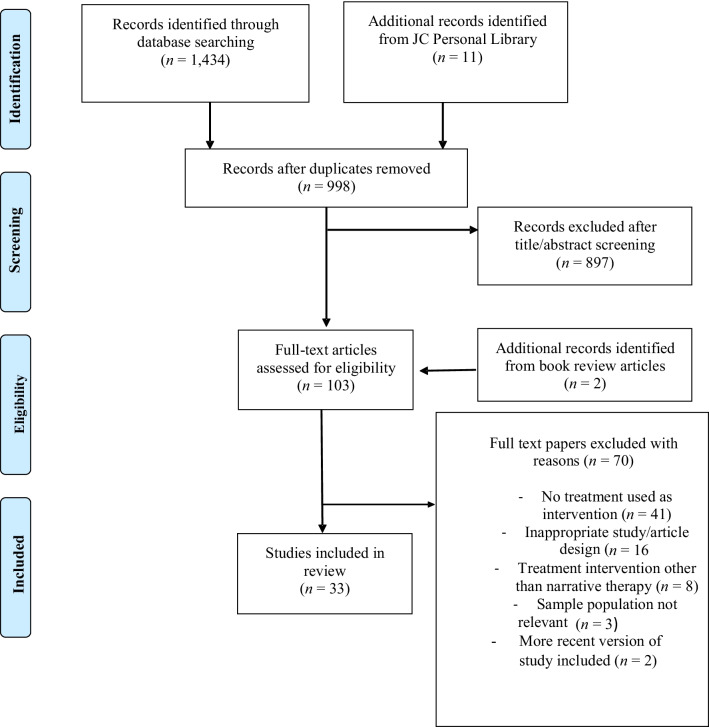
“Following title and abstract screening according to exclusion and inclusion criteria, and the addition of two records identified from book review articles, 103 articles remained.”
§ Paper 1: a systematic synthesis of narrative therapy treatment components for the treatment of eating disorders > Method > Results
plain- Asserted: passes — The authors put it forward as true.
- Checkable: passes — It can be checked against evidence.
- Load-bearing: fails — The paper’s conclusions may not depend on it.
- Based: passes — The paper gives a reason why it holds.
Probably not a substantial claim. The paper’s conclusions may not depend on it.
A result the paper reports from its own data — it cites no other source for it, so there is none to check. The quote shows it is in the paper.
In the paper
“Full-text screening was then conducted, and the remaining 33 texts were included (see Fig. 1).”
§ Paper 1: a systematic synthesis of narrative therapy treatment components for the treatment of eating disorders > Method > Results
plain- Asserted: passes — The authors put it forward as true.
- Checkable: passes — It can be checked against evidence.
- Load-bearing: passes — The paper’s conclusions depend on it.
- Based: passes — The paper gives a reason why it holds.
Probably not a substantial claim. It may state two separate claims as one.
None of the sources cited for this claim have been checked yet.
In the paper
“The theory proposed that clients and families have been restrained by external forces from participating in alternative interactions and have fallen into the problem as the only workable solution to a potentially broader problem.”
§ Paper 1: a systematic synthesis of narrative therapy treatment components for the treatment of eating disorders > Method > Synthesis of results
plaindirect- Asserted: passes — The authors put it forward as true.
- Checkable: passes — It can be checked against evidence.
- Load-bearing: fails — The paper’s conclusions may not depend on it.
- Based: passes — The paper gives a reason why it holds.
Probably not a substantial claim. The paper’s conclusions may not depend on it. It may state two separate claims as one.
A result the paper reports from its own data — it cites no other source for it, so there is none to check. The quote shows it is in the paper.
In the paper
“A total of 1434 articles were identified from the online database search, with an additional 11 from JC’s personal library.”
§ Paper 1: a systematic synthesis of narrative therapy treatment components for the treatment of eating disorders > Method > Results
plain- Asserted: passes — The authors put it forward as true.
- Checkable: passes — It can be checked against evidence.
- Load-bearing: fails — The paper’s conclusions may not depend on it.
- Based: passes — The paper gives a reason why it holds.
Probably not a substantial claim. The paper’s conclusions may not depend on it. It may state two separate claims as one.
In the paper
“Brown, Weber & Ali [78] explored how the women communicated and performed social expectations of self-restraint through the dieting and weight control of their bodies, i.e., ‘body talk’.”
§ Paper 1: a systematic synthesis of narrative therapy treatment components for the treatment of eating disorders > Method > Synthesis of results
What the sources say
- Not matchedcites [78] Brown CG, Weber S, Ali S. Women’s body talk: a feminist narrative approach. J Syst Ther. 2008;27(2):92–104.
Couldn’t be matched to a paper in Crossref, so it can’t be checked.
plain- Asserted: passes — The authors put it forward as true.
- Checkable: passes — It can be checked against evidence.
- Load-bearing: fails — The paper’s conclusions may not depend on it.
- Based: passes — The paper gives a reason why it holds.
Probably not a substantial claim. The paper’s conclusions may not depend on it.
- Not matched
None of the sources cited for this claim have been checked yet.
In the paper
“Within this framework, the individual and/or family were not viewed as inherently inadequate or deficient, but as responding to pressures and contradictory influences within their environment.”
§ Paper 1: a systematic synthesis of narrative therapy treatment components for the treatment of eating disorders > Method > Synthesis of results
plain- Asserted: passes — The authors put it forward as true.
- Checkable: passes — It can be checked against evidence.
- Load-bearing: fails — The paper’s conclusions may not depend on it.
- Based: passes — The paper gives a reason why it holds.
Probably not a substantial claim. The paper’s conclusions may not depend on it.
In the paper
“Maisel, Epston & Borden [53] positioned the person as having access to the most intimate knowledge about the problem precisely because they have lived through it.”
§ Paper 1: a systematic synthesis of narrative therapy treatment components for the treatment of eating disorders > Method > Synthesis of results
What the sources say
- Not matchedcites [53] Maisel R, Epston, D., & Borden, A. Biting the hand that starves you: inspiring resistance to anorexia/bulimia. Libra Publishers Inc; 2006
Couldn’t be matched to a paper in Crossref, so it can’t be checked.
plaindirect- Asserted: passes — The authors put it forward as true.
- Checkable: passes — It can be checked against evidence.
- Load-bearing: fails — The paper’s conclusions may not depend on it.
- Based: passes — The paper gives a reason why it holds.
Probably not a substantial claim. The paper’s conclusions may not depend on it.
- Not matched
In the paper
“This was described in White’s [59] early work through the lens of ‘cybernetics theory’.”
§ Paper 1: a systematic synthesis of narrative therapy treatment components for the treatment of eating disorders > Method > Synthesis of results
What the sources say
- Not checked — no full text of the sourcecites [59] White M. Anorexia nervosa: A cybernetic perspective. Selected papers. Dulwich Centre. 1986:65–75. source
plain- Asserted: passes — The authors put it forward as true.
- Checkable: passes — It can be checked against evidence.
- Load-bearing: fails — The paper’s conclusions may not depend on it.
- Based: passes — The paper gives a reason why it holds.
Probably not a substantial claim. The paper’s conclusions may not depend on it.
None of the sources cited for this claim could be matched to a paper in Crossref, so there is nothing to check it against.
In the paper
“Lainson [82] and Pedersen [75] demonstrated attempts to ensure client consent to engage in the intervention at various points in the process.”
§ Paper 1: a systematic synthesis of narrative therapy treatment components for the treatment of eating disorders > Method > Synthesis of results
What the sources say
- Not matchedcites [82] Lainson KJ. From “disorder” to political action: Conversations that invite collective considerations to individual experiences of women who express concerns about eating and their bodies. Int J Narrat Ther Commun Work. 2016;2:1–16.
Couldn’t be matched to a paper in Crossref, so it can’t be checked.
- Not matchedcites [75] Pedersen K. Uncovering bulimia’s demanding voice: challenges from a narrative therapist’s perspective. Int J Narrat Ther Commun Work. 2016;4:1–13.
Couldn’t be matched to a paper in Crossref, so it can’t be checked.
boosted- Asserted: passes — The authors put it forward as true.
- Checkable: passes — It can be checked against evidence.
- Load-bearing: fails — The paper’s conclusions may not depend on it.
- Based: passes — The paper gives a reason why it holds.
Probably not a substantial claim. The paper’s conclusions may not depend on it.
- Not matched
In the paper
“In particular, Borden [76] emphasised the importance of making visible and deconstructing discourses surrounding power dynamics within broader treatment settings, including public hospitals, community centres or private practice clinics.”
§ Paper 1: a systematic synthesis of narrative therapy treatment components for the treatment of eating disorders > Method > Synthesis of results
What the sources say
- Not matchedcites [76] Borden A. Every conversation is an opportunity. Int J NT Commun Work. 2007;4:38–53.
Couldn’t be matched to a paper in Crossref, so it can’t be checked.
plain- Asserted: passes — The authors put it forward as true.
- Checkable: passes — It can be checked against evidence.
- Load-bearing: fails — The paper’s conclusions may not depend on it.
- Based: passes — The paper gives a reason why it holds.
Probably not a substantial claim. The paper’s conclusions may not depend on it.
- Not matched
A result the paper reports from its own data — it cites no other source for it, so there is none to check. The quote shows it is in the paper.
In the paper
“Duplicates were removed and 998 references remained.”
§ Paper 1: a systematic synthesis of narrative therapy treatment components for the treatment of eating disorders > Method > Results
plain- Asserted: passes — The authors put it forward as true.
- Checkable: passes — It can be checked against evidence.
- Load-bearing: fails — The paper’s conclusions may not depend on it.
- Based: passes — The paper gives a reason why it holds.
Probably not a substantial claim. The paper’s conclusions may not depend on it.
In the paper
“Similarly, Lundby [73] proposed that the primary goal of narrative family therapy is to collaboratively create multi-storied accounts of the person’s life and identity.”
§ Paper 1: a systematic synthesis of narrative therapy treatment components for the treatment of eating disorders > Method > Synthesis of results
What the sources say
- Not matchedcites [73] Lundby G. Creating different versions of life: talking about problems with children and their parents. Int J Narrat Ther Commun Work. 2014;1:18–26.
Couldn’t be matched to a paper in Crossref, so it can’t be checked.
plain- Asserted: passes — The authors put it forward as true.
- Checkable: passes — It can be checked against evidence.
- Load-bearing: fails — The paper’s conclusions may not depend on it.
- Based: passes — The paper gives a reason why it holds.
Probably not a substantial claim. The paper’s conclusions may not depend on it.
- Not matched
In the paper
“Pedersen [75] defined narrative therapy as a belief system or philosophy, rather than being limited to a collection of psychological techniques.”
§ Paper 1: a systematic synthesis of narrative therapy treatment components for the treatment of eating disorders > Method > Synthesis of results
What the sources say
- Not matchedcites [75] Pedersen K. Uncovering bulimia’s demanding voice: challenges from a narrative therapist’s perspective. Int J Narrat Ther Commun Work. 2016;4:1–13.
Couldn’t be matched to a paper in Crossref, so it can’t be checked.
plain- Asserted: passes — The authors put it forward as true.
- Checkable: passes — It can be checked against evidence.
- Load-bearing: fails — The paper’s conclusions may not depend on it.
- Based: passes — The paper gives a reason why it holds.
Probably not a substantial claim. The paper’s conclusions may not depend on it.
- Not matched
In the paper
“Nylund [95] argued for the importance of this when working with individuals with eating concerns, as they may have had previous negative, judgemental or pathologizing experiences of treatment.”
§ Paper 1: a systematic synthesis of narrative therapy treatment components for the treatment of eating disorders > Method > Synthesis of results
What the sources say
- Not matchedcites [95] Nylund D. Poetic means to anti-anorexic Ends. J Syst Ther. 2002;21(4):18–34.
Couldn’t be matched to a paper in Crossref, so it can’t be checked.
plain- Asserted: passes — The authors put it forward as true.
- Checkable: passes — It can be checked against evidence.
- Load-bearing: fails — The paper’s conclusions may not depend on it.
- Based: passes — The paper gives a reason why it holds.
Probably not a substantial claim. The paper’s conclusions may not depend on it.
- Not matched
None of the sources cited for this claim could be matched to a paper in Crossref, so there is nothing to check it against.
In the paper
“Four of the studies extended this idea to suggest that any action that lay outside of stories built on socially or culturally constructed taken for granted assumptions could be understood as an act of political resistance or unrestrained expression of the self [53, 75, 83, 86].”
§ Paper 1: a systematic synthesis of narrative therapy treatment components for the treatment of eating disorders > Method > Synthesis of results
What the sources say
- Not matchedcites [53] Maisel R, Epston, D., & Borden, A. Biting the hand that starves you: inspiring resistance to anorexia/bulimia. Libra Publishers Inc; 2006
Couldn’t be matched to a paper in Crossref, so it can’t be checked.
- Not matchedcites [75] Pedersen K. Uncovering bulimia’s demanding voice: challenges from a narrative therapist’s perspective. Int J Narrat Ther Commun Work. 2016;4:1–13.
Couldn’t be matched to a paper in Crossref, so it can’t be checked.
- Not matchedcites [83] Lainson K. Narrative therapy, neuroscience and anorexia: a reflection on practices, problems and possibilities. Int J Narrat Ther Commun Work. 2019;3:80–95.
Couldn’t be matched to a paper in Crossref, so it can’t be checked.
- Not matchedcites [86] Russell S. Deconstructing perfectionism: narrative conversations with those suffering from eating issues. Int J Narrat Ther Commun Work. 2007;3:21–9.
Couldn’t be matched to a paper in Crossref, so it can’t be checked.
hedged- Asserted: passes — The authors put it forward as true.
- Checkable: passes — It can be checked against evidence.
- Load-bearing: fails — The paper’s conclusions may not depend on it.
- Based: passes — The paper gives a reason why it holds.
Probably not a substantial claim. The paper’s conclusions may not depend on it.
- Not matched
The paper states this without a source or data behind it here, so there is nothing to check it against. The quote shows it is in the paper.
In the paper
“In this process, new identity stories were generated for old experiences.”
§ Paper 1: a systematic synthesis of narrative therapy treatment components for the treatment of eating disorders > Method > Synthesis of results
plaindirect- Asserted: passes — The authors put it forward as true.
- Checkable: passes — It can be checked against evidence.
- Load-bearing: fails — The paper’s conclusions may not depend on it.
- Based: passes — The paper gives a reason why it holds.
Probably not a substantial claim. The paper’s conclusions may not depend on it.
None of the sources cited for this claim have been checked yet.
In the paper
“The process of thickening hidden stories was described by the papers as building a detailed picture of what life outside of the problem looked like.”
§ Paper 1: a systematic synthesis of narrative therapy treatment components for the treatment of eating disorders > Method > Synthesis of results
plain- Asserted: passes — The authors put it forward as true.
- Checkable: passes — It can be checked against evidence.
- Load-bearing: fails — The paper’s conclusions may not depend on it.
- Based: passes — The paper gives a reason why it holds.
Probably not a substantial claim. The paper’s conclusions may not depend on it.
In the paper
“Deconstruction was described by White [61] as the identification of taken-for-granted practices, attitudes, and ideologies that the problem story is built upon.”
§ Paper 1: a systematic synthesis of narrative therapy treatment components for the treatment of eating disorders > Method > Synthesis of results
What the sources say
- Not matchedcites [61] White M. Deconstruction and therapy. Dulwich Cent Newsl. 1991;3:21–40.
Couldn’t be matched to a paper in Crossref, so it can’t be checked.
plain- Asserted: passes — The authors put it forward as true.
- Checkable: passes — It can be checked against evidence.
- Load-bearing: fails — The paper’s conclusions may not depend on it.
- Based: passes — The paper gives a reason why it holds.
Probably not a substantial claim. The paper’s conclusions may not depend on it.
- Not matched
In the paper
“Epston, Morris & Maisel [100] described the thickening process as establishing a ‘history’ of the values underlying anti-AN/BN achievements by exploring other instances in a person’s life where they stood against AN/BN.”
§ Paper 1: a systematic synthesis of narrative therapy treatment components for the treatment of eating disorders > Method > Synthesis of results
What the sources say
- Not matchedcites [100] Epston D, Morris F, Maisel R. A narrative approach to so-called anorexia/bulimia. J Fem Fam Ther. 1995;7(1–2):69–96.
Couldn’t be matched to a paper in Crossref, so it can’t be checked.
plaindirect- Asserted: passes — The authors put it forward as true.
- Checkable: passes — It can be checked against evidence.
- Load-bearing: fails — The paper’s conclusions may not depend on it.
- Based: passes — The paper gives a reason why it holds.
Probably not a substantial claim. The paper’s conclusions may not depend on it.
- Not matched
In the paper
“Additionally, Tsun on-Kee [103] explored what was absent but implicit in the client’s experience of guilt about their eating patterns.”
§ Paper 1: a systematic synthesis of narrative therapy treatment components for the treatment of eating disorders > Method > Synthesis of results
What the sources say
- Not matchedcites [103] Tsun O-K. Overeating as a serious problem and foods as real good friends: revising the relationship with food and self in narrative conversations. Int J Narrat Ther Commun Work. 2011;2:3–15.
Couldn’t be matched to a paper in Crossref, so it can’t be checked.
plain- Asserted: passes — The authors put it forward as true.
- Checkable: passes — It can be checked against evidence.
- Load-bearing: fails — The paper’s conclusions may not depend on it.
- Based: passes — The paper gives a reason why it holds.
Probably not a substantial claim. The paper’s conclusions may not depend on it.
- Not matched
In the paper
“Maisel, Epston & Borden [53] provided several examples of this, including the ‘dark tunnel’ (p. 65), ‘devil’ (p. 63), ‘evil’ (p. 92), and ‘death row’ (p. 107).”
§ Paper 1: a systematic synthesis of narrative therapy treatment components for the treatment of eating disorders > Method > Synthesis of results
What the sources say
- Not matchedcites [53] Maisel R, Epston, D., & Borden, A. Biting the hand that starves you: inspiring resistance to anorexia/bulimia. Libra Publishers Inc; 2006
Couldn’t be matched to a paper in Crossref, so it can’t be checked.
plain- Asserted: passes — The authors put it forward as true.
- Checkable: passes — It can be checked against evidence.
- Load-bearing: fails — The paper’s conclusions may not depend on it.
- Based: passes — The paper gives a reason why it holds.
Probably not a substantial claim. The paper’s conclusions may not depend on it.
- Not matched
The paper states this without a source or data behind it here, so there is nothing to check it against. The quote shows it is in the paper.
In the paper
“Roleplays were also used to challenge the problem directly and encourage perspective taking (e.g., family members role-playing each other to explore their varying thoughts, feelings and experiences of a situation).”
§ Paper 1: a systematic synthesis of narrative therapy treatment components for the treatment of eating disorders > Method > Synthesis of results
plaindirect- Asserted: passes — The authors put it forward as true.
- Checkable: passes — It can be checked against evidence.
- Load-bearing: fails — The paper’s conclusions may not depend on it.
- Based: passes — The paper gives a reason why it holds.
Probably not a substantial claim. The paper’s conclusions may not depend on it. It may state two separate claims as one.
In the paper
“Lock, Epston, Maisel & de Faria [84] explained externalisation as the positioning of the problem outside of the person, meaning that it can then be objectified and a cognitive stance taken with respect to it.”
§ Paper 1: a systematic synthesis of narrative therapy treatment components for the treatment of eating disorders > Method > Synthesis of results
What the sources say
- Not checked — no full text of the sourcecites [84] Lock A, Epston D, Maisel R, Faria N. Resisting anorexia/bulimia: Foucauldian perspectives in narrative therapy. Br J Guid Couns. 2005;33(3):315–32. source
plain- Asserted: passes — The authors put it forward as true.
- Checkable: passes — It can be checked against evidence.
- Load-bearing: fails — The paper’s conclusions may not depend on it.
- Based: passes — The paper gives a reason why it holds.
Probably not a substantial claim. The paper’s conclusions may not depend on it.
None of the sources cited for this claim could be matched to a paper in Crossref, so there is nothing to check it against.
In the paper
“Specifically, Russell [86] and Pedersen [75] indicated that this process is not only a technique to be used within therapy, but is a way of understanding the problem and the client within a poststructuralist framework.”
§ Paper 1: a systematic synthesis of narrative therapy treatment components for the treatment of eating disorders > Method > Synthesis of results
What the sources say
- Not matchedcites [86] Russell S. Deconstructing perfectionism: narrative conversations with those suffering from eating issues. Int J Narrat Ther Commun Work. 2007;3:21–9.
Couldn’t be matched to a paper in Crossref, so it can’t be checked.
- Not matchedcites [75] Pedersen K. Uncovering bulimia’s demanding voice: challenges from a narrative therapist’s perspective. Int J Narrat Ther Commun Work. 2016;4:1–13.
Couldn’t be matched to a paper in Crossref, so it can’t be checked.
hedged- Asserted: passes — The authors put it forward as true.
- Checkable: passes — It can be checked against evidence.
- Load-bearing: fails — The paper’s conclusions may not depend on it.
- Based: passes — The paper gives a reason why it holds.
Probably not a substantial claim. The paper’s conclusions may not depend on it.
- Not matched
In the paper
“Likewise, other articles asserted that meaning is made through daily interactions in addition to therapy and proposed that narrative conversations explore opportunities to negotiate and perform aspects of identity [74, 76, 82, 86].”
§ Paper 1: a systematic synthesis of narrative therapy treatment components for the treatment of eating disorders > Method > Synthesis of results
What the sources say
- Check pendingcites [74] Golan M. The journey from opposition to recovery from eating disorders: multidisciplinary model integrating narrative counseling and motivational interviewing in traditional approaches. J Eat Disord. 2013;1(1):19. source
- Not matchedcites [76] Borden A. Every conversation is an opportunity. Int J NT Commun Work. 2007;4:38–53.
Couldn’t be matched to a paper in Crossref, so it can’t be checked.
- Not matchedcites [82] Lainson KJ. From “disorder” to political action: Conversations that invite collective considerations to individual experiences of women who express concerns about eating and their bodies. Int J Narrat Ther Commun Work. 2016;2:1–16.
Couldn’t be matched to a paper in Crossref, so it can’t be checked.
- Not matchedcites [86] Russell S. Deconstructing perfectionism: narrative conversations with those suffering from eating issues. Int J Narrat Ther Commun Work. 2007;3:21–9.
Couldn’t be matched to a paper in Crossref, so it can’t be checked.
plain- Asserted: passes — The authors put it forward as true.
- Checkable: passes — It can be checked against evidence.
- Load-bearing: fails — The paper’s conclusions may not depend on it.
- Based: passes — The paper gives a reason why it holds.
Probably not a substantial claim. The paper’s conclusions may not depend on it. It may state two separate claims as one.
None of the sources cited for this claim could be matched to a paper in Crossref, so there is nothing to check it against.
In the paper
“This was achieved by asking clients which of the available ways to speak about the problem they preferred [75, 94] and the therapist using the client’s own words to refer to the identified problem [53, 61, 73, 79, 81–83, 86–88, 93, 101, 102].”
§ Paper 1: a systematic synthesis of narrative therapy treatment components for the treatment of eating disorders > Method > Synthesis of results
What the sources say
- Not matchedcites [75] Pedersen K. Uncovering bulimia’s demanding voice: challenges from a narrative therapist’s perspective. Int J Narrat Ther Commun Work. 2016;4:1–13.
Couldn’t be matched to a paper in Crossref, so it can’t be checked.
- Not matchedcites [94] Weber M. Narrative therapy, “eating disorders”, and assessment: exploring constraints, dilemmas, and opportunities. Int J Narrat Ther Commun Work. 2007;2:63–70.
Couldn’t be matched to a paper in Crossref, so it can’t be checked.
- Not matchedcites [53] Maisel R, Epston, D., & Borden, A. Biting the hand that starves you: inspiring resistance to anorexia/bulimia. Libra Publishers Inc; 2006
Couldn’t be matched to a paper in Crossref, so it can’t be checked.
- Not matchedcites [61] White M. Deconstruction and therapy. Dulwich Cent Newsl. 1991;3:21–40.
Couldn’t be matched to a paper in Crossref, so it can’t be checked.
- Not matchedcites [73] Lundby G. Creating different versions of life: talking about problems with children and their parents. Int J Narrat Ther Commun Work. 2014;1:18–26.
Couldn’t be matched to a paper in Crossref, so it can’t be checked.
- Not matchedcites [79] Courtney J, Williams L. Linking lives: Working with women experiencing eating problems. Gecko A J Deconstr Narrat Ideas Ther Pract 2000:17–38.
Couldn’t be matched to a paper in Crossref, so it can’t be checked.
- Not matchedcites [81] Kraner MIK. Bursting Out - Breaking Free. A group program for young women wanting to reclaim their lives from anorexia nervosa. Gecko. 1997;3:31–57.
Couldn’t be matched to a paper in Crossref, so it can’t be checked.
- Not matchedcites [82] Lainson KJ. From “disorder” to political action: Conversations that invite collective considerations to individual experiences of women who express concerns about eating and their bodies. Int J Narrat Ther Commun Work. 2016;2:1–16.
Couldn’t be matched to a paper in Crossref, so it can’t be checked.
- Not matchedcites [83] Lainson K. Narrative therapy, neuroscience and anorexia: a reflection on practices, problems and possibilities. Int J Narrat Ther Commun Work. 2019;3:80–95.
Couldn’t be matched to a paper in Crossref, so it can’t be checked.
- Not matchedcites [86] Russell S. Deconstructing perfectionism: narrative conversations with those suffering from eating issues. Int J Narrat Ther Commun Work. 2007;3:21–9.
Couldn’t be matched to a paper in Crossref, so it can’t be checked.
plaindirect- Asserted: passes — The authors put it forward as true.
- Checkable: passes — It can be checked against evidence.
- Load-bearing: passes — The paper’s conclusions depend on it.
- Based: passes — The paper gives a reason why it holds.
It may state two separate claims as one.
- Not matched
In the paper
“Likewise, Golan [74] concluded that the assumptions that underlie narrative therapy and motivational interviewing are able to empower the client in therapy and in their influence over the problem.”
§ Paper 1: a systematic synthesis of narrative therapy treatment components for the treatment of eating disorders > Method > Synthesis of results
What the sources say
- Check pendingcites [74] Golan M. The journey from opposition to recovery from eating disorders: multidisciplinary model integrating narrative counseling and motivational interviewing in traditional approaches. J Eat Disord. 2013;1(1):19. source
plaindirect- Asserted: passes — The authors put it forward as true.
- Checkable: passes — It can be checked against evidence.
- Load-bearing: fails — The paper’s conclusions may not depend on it.
- Based: passes — The paper gives a reason why it holds.
Probably not a substantial claim. The paper’s conclusions may not depend on it.
None of the sources cited for this claim could be matched to a paper in Crossref, so there is nothing to check it against.
In the paper
“The ‘absent but implicit’ was described by the papers as engaging the person to explore what was implicit and relied upon in their discernment of their experiences as problematic [61, 76, 77, 96, 100, 103].”
§ Paper 1: a systematic synthesis of narrative therapy treatment components for the treatment of eating disorders > Method > Synthesis of results
What the sources say
- Not matchedcites [61] White M. Deconstruction and therapy. Dulwich Cent Newsl. 1991;3:21–40.
Couldn’t be matched to a paper in Crossref, so it can’t be checked.
- Not matchedcites [76] Borden A. Every conversation is an opportunity. Int J NT Commun Work. 2007;4:38–53.
Couldn’t be matched to a paper in Crossref, so it can’t be checked.
- Not matchedcites [77] Brown C. The dangers of trauma talk: counterstorying co-occuring strategies for coping with trauma. J Syst Ther. 2018;37:42–60.
Couldn’t be matched to a paper in Crossref, so it can’t be checked.
- Not matchedcites [96] Dennstedt C. The interplay of substance misuse and disordered eating practices in the lives of young women. Int J Narrat Ther Commun Work. 2010;3:52–63.
Couldn’t be matched to a paper in Crossref, so it can’t be checked.
- Not matchedcites [100] Epston D, Morris F, Maisel R. A narrative approach to so-called anorexia/bulimia. J Fem Fam Ther. 1995;7(1–2):69–96.
Couldn’t be matched to a paper in Crossref, so it can’t be checked.
- Not matchedcites [103] Tsun O-K. Overeating as a serious problem and foods as real good friends: revising the relationship with food and self in narrative conversations. Int J Narrat Ther Commun Work. 2011;2:3–15.
Couldn’t be matched to a paper in Crossref, so it can’t be checked.
plain- Asserted: passes — The authors put it forward as true.
- Checkable: passes — It can be checked against evidence.
- Load-bearing: fails — The paper’s conclusions may not depend on it.
- Based: passes — The paper gives a reason why it holds.
Probably not a substantial claim. The paper’s conclusions may not depend on it.
- Not matched
In the paper
“In particular, they discussed the importance of working with their clients at their ‘stage of readiness to change’ [97].”
§ Paper 1: a systematic synthesis of narrative therapy treatment components for the treatment of eating disorders > Method > Synthesis of results
What the sources say
- Not checked — no full text of the sourcecites [97] Davidson H, Birmingham CL. Letter writing as a therapeutic tool. Eat Weight Disord. 2001;6(1):40–4. source
plain- Asserted: passes — The authors put it forward as true.
- Checkable: passes — It can be checked against evidence.
- Load-bearing: fails — The paper’s conclusions may not depend on it.
- Based: passes — The paper gives a reason why it holds.
Probably not a substantial claim. The paper’s conclusions may not depend on it.
None of the sources cited for this claim have been checked yet.
In the paper
“Using externalising language to separate the client from the problem allowed for the tactics, intentions and agendas of the problem to be explored, assisting the person to engage critically in deconstructing the problem [53, 73, 85, 86, 89, 92, 100].”
§ Paper 1: a systematic synthesis of narrative therapy treatment components for the treatment of eating disorders > Method > Synthesis of results
What the sources say
- Not matchedcites [53] Maisel R, Epston, D., & Borden, A. Biting the hand that starves you: inspiring resistance to anorexia/bulimia. Libra Publishers Inc; 2006
Couldn’t be matched to a paper in Crossref, so it can’t be checked.
- Not matchedcites [73] Lundby G. Creating different versions of life: talking about problems with children and their parents. Int J Narrat Ther Commun Work. 2014;1:18–26.
Couldn’t be matched to a paper in Crossref, so it can’t be checked.
- Not checked — no full text of the sourcecites [85] Lock A, Epston D, Maisel R. Countering that which is called anorexia. Narrat Inq. 2004;14(2):275–301. source
- Not matchedcites [86] Russell S. Deconstructing perfectionism: narrative conversations with those suffering from eating issues. Int J Narrat Ther Commun Work. 2007;3:21–9.
Couldn’t be matched to a paper in Crossref, so it can’t be checked.
- Not checked — no full text of the sourcecites [89] Robbins JM, Pehrsson D-E. Anorexia nervosa: a synthesis of poetic and narrative therapies in the outpatient treatment of young adult women. J Creat Ment Health. 2009;4(1):42–56. source
- Not matchedcites [92] Ingamells KM. Wilbur the worrier becomes wilbur the warrior: a teaching story for narrative family therapists. J Syst Ther. 2016;35(4):43–57.
Couldn’t be matched to a paper in Crossref, so it can’t be checked.
- Not matchedcites [100] Epston D, Morris F, Maisel R. A narrative approach to so-called anorexia/bulimia. J Fem Fam Ther. 1995;7(1–2):69–96.
Couldn’t be matched to a paper in Crossref, so it can’t be checked.
plaindirect- Asserted: passes — The authors put it forward as true.
- Checkable: passes — It can be checked against evidence.
- Load-bearing: passes — The paper’s conclusions depend on it.
- Based: passes — The paper gives a reason why it holds.
It may state two separate claims as one.
- Not matched
In the paper
“For example, Howells [101] used the metaphor of ‘home’ to explore what was currently absent from the client’s conceptualisation of home that they valued.”
§ Paper 1: a systematic synthesis of narrative therapy treatment components for the treatment of eating disorders > Method > Synthesis of results
What the sources say
- Not matchedcites [101] Howells K. Narrative work and the metaphor of “home.” Int J Narrat Ther Commun Work. 2009;4:32–42.
Couldn’t be matched to a paper in Crossref, so it can’t be checked.
plainSingle case- Asserted: passes — The authors put it forward as true.
- Checkable: passes — It can be checked against evidence.
- Load-bearing: fails — The paper’s conclusions may not depend on it.
- Based: passes — The paper gives a reason why it holds.
Probably not a substantial claim. The paper’s conclusions may not depend on it.
- Not matched
In the paper
“These new-old stories [64] were thickened through linking these previously un-authored actions with the client’s values and personal aptitudes [74, 77, 79, 81] and the development of counter-narratives that stood in opposition to the problem narrative [59, 85].”
§ Paper 1: a systematic synthesis of narrative therapy treatment components for the treatment of eating disorders > Method > Synthesis of results
What the sources say
- Not matchedcites [64] Hewson D. From laboratory to therapy room: prediction questions for reconstructing the ‘new-old’ story. Dulwich Cent Newsl. 1991;3:5–12.
Couldn’t be matched to a paper in Crossref, so it can’t be checked.
- Check pendingcites [74] Golan M. The journey from opposition to recovery from eating disorders: multidisciplinary model integrating narrative counseling and motivational interviewing in traditional approaches. J Eat Disord. 2013;1(1):19. source
- Not matchedcites [77] Brown C. The dangers of trauma talk: counterstorying co-occuring strategies for coping with trauma. J Syst Ther. 2018;37:42–60.
Couldn’t be matched to a paper in Crossref, so it can’t be checked.
- Not matchedcites [79] Courtney J, Williams L. Linking lives: Working with women experiencing eating problems. Gecko A J Deconstr Narrat Ideas Ther Pract 2000:17–38.
Couldn’t be matched to a paper in Crossref, so it can’t be checked.
- Not matchedcites [81] Kraner MIK. Bursting Out - Breaking Free. A group program for young women wanting to reclaim their lives from anorexia nervosa. Gecko. 1997;3:31–57.
Couldn’t be matched to a paper in Crossref, so it can’t be checked.
- Not checked — no full text of the sourcecites [59] White M. Anorexia nervosa: A cybernetic perspective. Selected papers. Dulwich Centre. 1986:65–75. source
- Not checked — no full text of the sourcecites [85] Lock A, Epston D, Maisel R. Countering that which is called anorexia. Narrat Inq. 2004;14(2):275–301. source
plaindirect- Asserted: passes — The authors put it forward as true.
- Checkable: passes — It can be checked against evidence.
- Load-bearing: passes — The paper’s conclusions depend on it.
- Based: passes — The paper gives a reason why it holds.
It may state two separate claims as one.
- Not matched
None of the sources cited for this claim could be matched to a paper in Crossref, so there is nothing to check it against.
In the paper
“This included the authority that is often given to health professionals in defining sickness and wellness [76, 81, 88, 91].”
§ Paper 1: a systematic synthesis of narrative therapy treatment components for the treatment of eating disorders > Method > Synthesis of results
What the sources say
- Not matchedcites [76] Borden A. Every conversation is an opportunity. Int J NT Commun Work. 2007;4:38–53.
Couldn’t be matched to a paper in Crossref, so it can’t be checked.
- Not matchedcites [81] Kraner MIK. Bursting Out - Breaking Free. A group program for young women wanting to reclaim their lives from anorexia nervosa. Gecko. 1997;3:31–57.
Couldn’t be matched to a paper in Crossref, so it can’t be checked.
- Not matchedcites [88] Ziimmerman JL. Tales of the body thief. Externalising and deconstructing eating problems. In: Constructive Therapies, Guilford Press; 1994. pp. 295–318.
Couldn’t be matched to a paper in Crossref, so it can’t be checked.
- Not matchedcites [91] Craggs T, Reed A. A service-user and therapist reflect on context, difference, and dialogue in a therapy for anorexia. Int J Narrat Ther Commun Work. 2007;3:30–8.
Couldn’t be matched to a paper in Crossref, so it can’t be checked.
plain- Asserted: passes — The authors put it forward as true.
- Checkable: passes — It can be checked against evidence.
- Load-bearing: fails — The paper’s conclusions may not depend on it.
- Based: passes — The paper gives a reason why it holds.
Probably not a substantial claim. The paper’s conclusions may not depend on it.
- Not matched
A result the paper reports from its own data — it cites no other source for it, so there is none to check. The quote shows it is in the paper.
In the paper
“The spirit of narrative therapy was evident across the articles, including the view that the person is: (1) not the problem, the problem is the problem, and (2) the expert of their life.”
§ Paper 1: a systematic synthesis of narrative therapy treatment components for the treatment of eating disorders > Discussion
plain- Asserted: passes — The authors put it forward as true.
- Checkable: passes — It can be checked against evidence.
- Load-bearing: unclear — It is unclear whether the paper’s conclusions depend on it.
- Based: passes — The paper gives a reason why it holds.
It may state two separate claims as one.
None of the sources cited for this claim have been checked yet.
In the paper
“Such teams were comprised of referring general practitioners, nutritionists, dietitians, nursing staff, and psychiatrists.”
§ Paper 1: a systematic synthesis of narrative therapy treatment components for the treatment of eating disorders > Method > Synthesis of results
plain- Asserted: passes — The authors put it forward as true.
- Checkable: passes — It can be checked against evidence.
- Load-bearing: fails — The paper’s conclusions may not depend on it.
- Based: passes — The paper gives a reason why it holds.
Probably not a substantial claim. The paper’s conclusions may not depend on it.
In the paper
“Furthermore, this synthesis has identified that there are considerable gaps within our current understandings of how issues pertaining to client safety should be explored within the narrative worldview [1].”
§ Paper 1: a systematic synthesis of narrative therapy treatment components for the treatment of eating disorders > Discussion > Implications
What the sources say
- Not checked yetcites [1] American Psychiatric Association. Diagnostic and statistical manual of mental disorders: DSM-5. 5th ed. Washington, DC: American Psychiatric Publishing; 2013. source
plain- Asserted: passes — The authors put it forward as true.
- Checkable: passes — It can be checked against evidence.
- Load-bearing: passes — The paper’s conclusions depend on it.
- Based: passes — The paper gives a reason why it holds.
Probably not a substantial claim.
None of the sources cited for this claim have been checked yet.
In the paper
“Within the articles, this worldview was located within the philosophical traditions of social constructionism and poststructuralism [52], including an emphasis of therapy unpacking or deconstructing social, cultural and political ideas and expectations [60, 65].”
§ Paper 1: a systematic synthesis of narrative therapy treatment components for the treatment of eating disorders > Discussion
What the sources say
- Not checked yetcites [52] White M, Epston D. Narrative means to therapeutic ends. New York: Norton; 1990.
- Not matchedcites [60] Morgan A. What is Narrative Therapy? Publications DC; 2000.
Couldn’t be matched to a paper in Crossref, so it can’t be checked.
- Not matchedcites [65] Archer J MC. Theories of counseling and psychotherapy: Contemporary Applications. Prentice Hall; 2007.
Couldn’t be matched to a paper in Crossref, so it can’t be checked.
plain- Asserted: passes — The authors put it forward as true.
- Checkable: passes — It can be checked against evidence.
- Load-bearing: unclear — It is unclear whether the paper’s conclusions depend on it.
- Based: passes — The paper gives a reason why it holds.
It may state two separate claims as one.
A result the paper reports from its own data — it cites no other source for it, so there is none to check. The quote shows it is in the paper.
In the paper
“Many articles discussed the importance of the therapist taking a collaborative, genuine, and curious stance.”
§ Paper 1: a systematic synthesis of narrative therapy treatment components for the treatment of eating disorders > Discussion
plain- Asserted: passes — The authors put it forward as true.
- Checkable: passes — It can be checked against evidence.
- Load-bearing: fails — The paper’s conclusions may not depend on it.
- Based: passes — The paper gives a reason why it holds.
Probably not a substantial claim. The paper’s conclusions may not depend on it.
None of the sources cited for this claim have been checked yet.
In the paper
“This included gaining information about the client’s wishes should they require tube-feeding or other invasive procedures and obtaining a kind of ‘pre-consent’.”
§ Paper 1: a systematic synthesis of narrative therapy treatment components for the treatment of eating disorders > Method > Synthesis of results
plain- Asserted: passes — The authors put it forward as true.
- Checkable: passes — It can be checked against evidence.
- Load-bearing: fails — The paper’s conclusions may not depend on it.
- Based: passes — The paper gives a reason why it holds.
Probably not a substantial claim. The paper’s conclusions may not depend on it. It may state two separate claims as one.
A result the paper reports from its own data — it cites no other source for it, so there is none to check. The quote shows it is in the paper.
In the paper
“Some of the papers spoke to the clinician’s experience and client preferences for treatment, including how the client’s expertise was honoured in their life, and the clinician’s experience in tailoring treatment to the client.”
§ Paper 1: a systematic synthesis of narrative therapy treatment components for the treatment of eating disorders > Discussion
plain- Asserted: passes — The authors put it forward as true.
- Checkable: passes — It can be checked against evidence.
- Load-bearing: fails — The paper’s conclusions may not depend on it.
- Based: passes — The paper gives a reason why it holds.
Probably not a substantial claim. The paper’s conclusions may not depend on it. It may state two separate claims as one.
None of the sources cited for this claim have been checked yet.
In the paper
“This included women who had multiple medical problems or life-threatening eating-disturbed behaviour, those who were assessed as having higher or different needs, and/or those who had a recent history of a previous suicide attempt.”
§ Paper 1: a systematic synthesis of narrative therapy treatment components for the treatment of eating disorders > Method > Synthesis of results
plain- Asserted: passes — The authors put it forward as true.
- Checkable: passes — It can be checked against evidence.
- Load-bearing: fails — The paper’s conclusions may not depend on it.
- Based: passes — The paper gives a reason why it holds.
Probably not a substantial claim. The paper’s conclusions may not depend on it. It may state two separate claims as one.
None of the sources cited for this claim have been checked yet.
In the paper
“They asserted that whilst impositions may be needed at times to save lives, there are precautions that can be taken ahead of time to mitigate the damage caused by the experience.”
§ Paper 1: a systematic synthesis of narrative therapy treatment components for the treatment of eating disorders > Method > Synthesis of results
plainconditional- Asserted: passes — The authors put it forward as true.
- Checkable: passes — It can be checked against evidence.
- Load-bearing: fails — The paper’s conclusions may not depend on it.
- Based: passes — The paper gives a reason why it holds.
Probably not a substantial claim. The paper’s conclusions may not depend on it. It may state two separate claims as one.
A result the paper reports from its own data — it cites no other source for it, so there is none to check. The quote shows it is in the paper.
In the paper
“This included a lack of focus on ways that the reported narrative interventions impacted an individual’s eating patterns and their relationship with their body.”
§ Paper 1: a systematic synthesis of narrative therapy treatment components for the treatment of eating disorders > Discussion > Limitations and strengths
plain- Asserted: passes — The authors put it forward as true.
- Checkable: passes — It can be checked against evidence.
- Load-bearing: fails — The paper’s conclusions may not depend on it.
- Based: passes — The paper gives a reason why it holds.
Probably not a substantial claim. The paper’s conclusions may not depend on it.
The paper states this without a source or data behind it here, so there is nothing to check it against. The quote shows it is in the paper.
In the paper
“The papers cited examples of other ways of thickening hidden stories, including letter writing and creating an audience to witness the stories previously obscured by the problem narrative.”
§ Paper 1: a systematic synthesis of narrative therapy treatment components for the treatment of eating disorders > Method > Synthesis of results
plain- Asserted: passes — The authors put it forward as true.
- Checkable: passes — It can be checked against evidence.
- Load-bearing: fails — The paper’s conclusions may not depend on it.
- Based: passes — The paper gives a reason why it holds.
Probably not a substantial claim. The paper’s conclusions may not depend on it.
The paper states this without a source or data behind it here, so there is nothing to check it against. The quote shows it is in the paper.
In the paper
“The selected papers provide a particular sort of evidence that is, the first-hand experience of narrative practitioners who report narrative therapy to be a helpful way to engage clients in the treatment of ED.”
§ Paper 1: a systematic synthesis of narrative therapy treatment components for the treatment of eating disorders > Discussion > Implications
plain- Asserted: passes — The authors put it forward as true.
- Checkable: passes — It can be checked against evidence.
- Load-bearing: fails — The paper’s conclusions may not depend on it.
- Based: passes — The paper gives a reason why it holds.
Probably not a substantial claim. The paper’s conclusions may not depend on it.
None of the sources cited for this claim have been checked yet.
In the paper
“These letters included prompting questions and reflections to be considered at the beginning of the next session [53, 73, 75, 79, 89, 95, 97, 100, 101].”
§ Paper 1: a systematic synthesis of narrative therapy treatment components for the treatment of eating disorders > Method > Synthesis of results
What the sources say
- Not matchedcites [53] Maisel R, Epston, D., & Borden, A. Biting the hand that starves you: inspiring resistance to anorexia/bulimia. Libra Publishers Inc; 2006
Couldn’t be matched to a paper in Crossref, so it can’t be checked.
- Not matchedcites [73] Lundby G. Creating different versions of life: talking about problems with children and their parents. Int J Narrat Ther Commun Work. 2014;1:18–26.
Couldn’t be matched to a paper in Crossref, so it can’t be checked.
- Not matchedcites [75] Pedersen K. Uncovering bulimia’s demanding voice: challenges from a narrative therapist’s perspective. Int J Narrat Ther Commun Work. 2016;4:1–13.
Couldn’t be matched to a paper in Crossref, so it can’t be checked.
- Not matchedcites [79] Courtney J, Williams L. Linking lives: Working with women experiencing eating problems. Gecko A J Deconstr Narrat Ideas Ther Pract 2000:17–38.
Couldn’t be matched to a paper in Crossref, so it can’t be checked.
- Not checked — no full text of the sourcecites [89] Robbins JM, Pehrsson D-E. Anorexia nervosa: a synthesis of poetic and narrative therapies in the outpatient treatment of young adult women. J Creat Ment Health. 2009;4(1):42–56. source
- Not matchedcites [95] Nylund D. Poetic means to anti-anorexic Ends. J Syst Ther. 2002;21(4):18–34.
Couldn’t be matched to a paper in Crossref, so it can’t be checked.
- Not checked — no full text of the sourcecites [97] Davidson H, Birmingham CL. Letter writing as a therapeutic tool. Eat Weight Disord. 2001;6(1):40–4. source
- Not matchedcites [100] Epston D, Morris F, Maisel R. A narrative approach to so-called anorexia/bulimia. J Fem Fam Ther. 1995;7(1–2):69–96.
Couldn’t be matched to a paper in Crossref, so it can’t be checked.
- Not matchedcites [101] Howells K. Narrative work and the metaphor of “home.” Int J Narrat Ther Commun Work. 2009;4:32–42.
Couldn’t be matched to a paper in Crossref, so it can’t be checked.
plain- Asserted: passes — The authors put it forward as true.
- Checkable: passes — It can be checked against evidence.
- Load-bearing: fails — The paper’s conclusions may not depend on it.
- Based: passes — The paper gives a reason why it holds.
Probably not a substantial claim. The paper’s conclusions may not depend on it.
- Not matched
In the paper
“Maisel, Epston & Borden [53] extensively discussed how essential medical practices may be understood and utilised whilst still maintaining a narrative worldview.”
§ Paper 1: a systematic synthesis of narrative therapy treatment components for the treatment of eating disorders > Method > Synthesis of results
What the sources say
- Not matchedcites [53] Maisel R, Epston, D., & Borden, A. Biting the hand that starves you: inspiring resistance to anorexia/bulimia. Libra Publishers Inc; 2006
Couldn’t be matched to a paper in Crossref, so it can’t be checked.
plain- Asserted: passes — The authors put it forward as true.
- Checkable: passes — It can be checked against evidence.
- Load-bearing: fails — The paper’s conclusions may not depend on it.
- Based: passes — The paper gives a reason why it holds.
Probably not a substantial claim. The paper’s conclusions may not depend on it.
- Not matched
None of the sources cited for this claim have been checked yet.
In the paper
“This included how the person’s actions spoke to their underlying values or identities and acts of resistance they had witnessed the individual take against the problem [61, 75, 76, 80, 81, 85, 93].”
§ Paper 1: a systematic synthesis of narrative therapy treatment components for the treatment of eating disorders > Method > Synthesis of results
What the sources say
- Not matchedcites [61] White M. Deconstruction and therapy. Dulwich Cent Newsl. 1991;3:21–40.
Couldn’t be matched to a paper in Crossref, so it can’t be checked.
- Not matchedcites [75] Pedersen K. Uncovering bulimia’s demanding voice: challenges from a narrative therapist’s perspective. Int J Narrat Ther Commun Work. 2016;4:1–13.
Couldn’t be matched to a paper in Crossref, so it can’t be checked.
- Not matchedcites [76] Borden A. Every conversation is an opportunity. Int J NT Commun Work. 2007;4:38–53.
Couldn’t be matched to a paper in Crossref, so it can’t be checked.
- Not matchedcites [80] Kantor A. Narrative therapy with adolescent females with eating disturbed behaviour. The University of Manitoba; 2000.
Couldn’t be matched to a paper in Crossref, so it can’t be checked.
- Not matchedcites [81] Kraner MIK. Bursting Out - Breaking Free. A group program for young women wanting to reclaim their lives from anorexia nervosa. Gecko. 1997;3:31–57.
Couldn’t be matched to a paper in Crossref, so it can’t be checked.
- Not checked — no full text of the sourcecites [85] Lock A, Epston D, Maisel R. Countering that which is called anorexia. Narrat Inq. 2004;14(2):275–301. source
- Not checked — no full text of the sourcecites [93] Ibrahim J, Tchanturia K. Patients’ experience of a narrative group therapy approach informed by the “tree of life” model for individuals with anorexia nervosa. Int J Group Psychother. 2018;68(1):80–91. source
plain- Asserted: passes — The authors put it forward as true.
- Checkable: passes — It can be checked against evidence.
- Load-bearing: unclear — It is unclear whether the paper’s conclusions depend on it.
- Based: passes — The paper gives a reason why it holds.
It may state two separate claims as one.
- Not matched
In the paper
“Ingamells [92] explored future implications and potential actions if the person with lived experience were to ‘live out’ their new identity (e.g., ‘Are you about to become Wilbur the Warrior?’ and ‘Is there a little bit more of warrior in Wilbur than there was the last time we met?’).”
§ Paper 1: a systematic synthesis of narrative therapy treatment components for the treatment of eating disorders > Method > Synthesis of results
What the sources say
- Not matchedcites [92] Ingamells KM. Wilbur the worrier becomes wilbur the warrior: a teaching story for narrative family therapists. J Syst Ther. 2016;35(4):43–57.
Couldn’t be matched to a paper in Crossref, so it can’t be checked.
plain- Asserted: passes — The authors put it forward as true.
- Checkable: passes — It can be checked against evidence.
- Load-bearing: fails — The paper’s conclusions may not depend on it.
- Based: passes — The paper gives a reason why it holds.
Probably not a substantial claim. The paper’s conclusions may not depend on it.
- Not matched
None of the sources cited for this claim could be matched to a paper in Crossref, so there is nothing to check it against.
In the paper
“Two papers noted that they provided clients with a physical certificate or memorabilia to stand as tangible evidence of their recovery at these ceremonies [82, 100].”
§ Paper 1: a systematic synthesis of narrative therapy treatment components for the treatment of eating disorders > Method > Synthesis of results
What the sources say
- Not matchedcites [82] Lainson KJ. From “disorder” to political action: Conversations that invite collective considerations to individual experiences of women who express concerns about eating and their bodies. Int J Narrat Ther Commun Work. 2016;2:1–16.
Couldn’t be matched to a paper in Crossref, so it can’t be checked.
- Not matchedcites [100] Epston D, Morris F, Maisel R. A narrative approach to so-called anorexia/bulimia. J Fem Fam Ther. 1995;7(1–2):69–96.
Couldn’t be matched to a paper in Crossref, so it can’t be checked.
plain- Asserted: passes — The authors put it forward as true.
- Checkable: passes — It can be checked against evidence.
- Load-bearing: fails — The paper’s conclusions may not depend on it.
- Based: passes — The paper gives a reason why it holds.
Probably not a substantial claim. The paper’s conclusions may not depend on it.
- Not matched
In the paper
“This process involved inviting an audience of observers of the client’s journey to act as witnesses to the ways in which they had seen the client living out the hidden and revealed storylines in the present and in the past [53].”
§ Paper 1: a systematic synthesis of narrative therapy treatment components for the treatment of eating disorders > Method > Synthesis of results
What the sources say
- Not matchedcites [53] Maisel R, Epston, D., & Borden, A. Biting the hand that starves you: inspiring resistance to anorexia/bulimia. Libra Publishers Inc; 2006
Couldn’t be matched to a paper in Crossref, so it can’t be checked.
plain- Asserted: passes — The authors put it forward as true.
- Checkable: passes — It can be checked against evidence.
- Load-bearing: fails — The paper’s conclusions may not depend on it.
- Based: passes — The paper gives a reason why it holds.
Probably not a substantial claim. The paper’s conclusions may not depend on it.
- Not matched
In the paper
“The key treatment components of narrative therapy are first, deconstruction and externalisation of the problem story, and second finding, thickening, and performing the meaning of identity stories hidden by dominant, problem-saturated stories [53, 54, 56–64].”
§ Paper 1: a systematic synthesis of narrative therapy treatment components for the treatment of eating disorders > Background > Narrative therapy
What the sources say
- Not matchedcites [53] Maisel R, Epston, D., & Borden, A. Biting the hand that starves you: inspiring resistance to anorexia/bulimia. Libra Publishers Inc; 2006
Couldn’t be matched to a paper in Crossref, so it can’t be checked.
- Not matchedcites [54] White M. Maps of narrative practice: WW Norton & Company. 2007.
Couldn’t be matched to a paper in Crossref, so it can’t be checked.
- Not checked — no full text of the sourcecites [56] Garrett CJ. Recovery from anorexia nervosa: a sociological perspective. Int J Eat Disord. 1997;21(3):261–72. source
- Check pendingcites [57] Conti J, Rhodes P, Adams H. Listening in the dark: why we need stories of people living with severe and enduring anorexia nervosa. J Eat Disord. 2016;4(1):33. source
- Not checked yetcites [58] White M. Narrative practice: continuing the conversations. New York: WW Norton; 2011.
- Not checked — no full text of the sourcecites [59] White M. Anorexia nervosa: A cybernetic perspective. Selected papers. Dulwich Centre. 1986:65–75. source
- Not matchedcites [60] Morgan A. What is Narrative Therapy? Publications DC; 2000.
Couldn’t be matched to a paper in Crossref, so it can’t be checked.
- Not matchedcites [61] White M. Deconstruction and therapy. Dulwich Cent Newsl. 1991;3:21–40.
Couldn’t be matched to a paper in Crossref, so it can’t be checked.
- Not matchedcites [62] White M. Narrative practice and community assignments. The International Journal of NT and Community Work. 2003;2.
Couldn’t be matched to a paper in Crossref, so it can’t be checked.
- Not matchedcites [63] White M. Reflections on narrative practice: Essays and interviews. Dulwich Centre Publications. 2000.
Couldn’t be matched to a paper in Crossref, so it can’t be checked.
plain- Asserted: passes — The authors put it forward as true.
- Checkable: passes — It can be checked against evidence.
- Load-bearing: passes — The paper’s conclusions depend on it.
- Based: passes — The paper gives a reason why it holds.
Probably not a substantial claim. It may state two separate claims as one.
- Not matched
What the paper did — it cites no source for this, so there is none to check. The quote shows it is in the paper.
In the paper
“This narrative synthesis was registered with Open Science (10.17605/OSF.IO/2KU3C)”
§ Paper 1: a systematic synthesis of narrative therapy treatment components for the treatment of eating disorders > Method
plain- Asserted: passes — The authors put it forward as true.
- Checkable: passes — It can be checked against evidence.
- Load-bearing: fails — The paper’s conclusions may not depend on it.
- Based: passes — The paper gives a reason why it holds.
Probably not a substantial claim. The paper’s conclusions may not depend on it.
None of the sources cited for this claim have been checked yet.
In the paper
“This is particularly relevant when considering the perspective that people live out or perform the meaning of their identity narratives or the stories they tell about themselves [51, 52].”
§ Paper 1: a systematic synthesis of narrative therapy treatment components for the treatment of eating disorders > Background > Treatments and outcomes
What the sources say
- Not matchedcites [51] Bruner J. Acts of Meaning. Harvard University Press; 1990.
Couldn’t be matched to a paper in Crossref, so it can’t be checked.
- Not checked yetcites [52] White M, Epston D. Narrative means to therapeutic ends. New York: Norton; 1990.
plaindirect- Asserted: passes — The authors put it forward as true.
- Checkable: passes — It can be checked against evidence.
- Load-bearing: passes — The paper’s conclusions depend on it.
- Based: passes — The paper gives a reason why it holds.
Probably not a substantial claim.
- Not matched
In the paper
“Narrative therapy proposes that a person’s identity is constructed in storied form and these identity stories guide how they think, feel and act in their lives [66].”
§ Paper 1: a systematic synthesis of narrative therapy treatment components for the treatment of eating disorders > Background > Narrative therapy
What the sources say
- Not matchedcites [66] Karl T. Externalizing the problem and internalizing personal agency. J Syst Ther. 1989;8(1):54.
Couldn’t be matched to a paper in Crossref, so it can’t be checked.
plaindirect- Asserted: passes — The authors put it forward as true.
- Checkable: passes — It can be checked against evidence.
- Load-bearing: fails — The paper’s conclusions may not depend on it.
- Based: passes — The paper gives a reason why it holds.
Probably not a substantial claim. The paper’s conclusions may not depend on it. It may state two separate claims as one.
- Not matched
In the paper
“was conducted in line with the Preferred Reporting Items for Systematic Reviews and Meta-Analyses (PRISMA) guidelines [70].”
§ Paper 1: a systematic synthesis of narrative therapy treatment components for the treatment of eating disorders > Method
What the sources say
- Not checked yetcites [70] Moher D, Liberati A, Tetzlaff J, Altman D. Preferred reporting items for systematic review and meta-analysis protocols (PRISMA-P): elaboration and explanation. BMJ. 2015;349:7647. source
plain- Asserted: passes — The authors put it forward as true.
- Checkable: passes — It can be checked against evidence.
- Load-bearing: fails — The paper’s conclusions may not depend on it.
- Based: passes — The paper gives a reason why it holds.
Probably not a substantial claim. The paper’s conclusions may not depend on it.
None of the sources cited for this claim have been checked yet.
In the paper
“This positioned narrative therapy as intrinsically political [53, 59, 61, 73, 75–88].”
§ Paper 1: a systematic synthesis of narrative therapy treatment components for the treatment of eating disorders > Method > Synthesis of results
What the sources say
- Not matchedcites [53] Maisel R, Epston, D., & Borden, A. Biting the hand that starves you: inspiring resistance to anorexia/bulimia. Libra Publishers Inc; 2006
Couldn’t be matched to a paper in Crossref, so it can’t be checked.
- Not checked — no full text of the sourcecites [59] White M. Anorexia nervosa: A cybernetic perspective. Selected papers. Dulwich Centre. 1986:65–75. source
- Not matchedcites [61] White M. Deconstruction and therapy. Dulwich Cent Newsl. 1991;3:21–40.
Couldn’t be matched to a paper in Crossref, so it can’t be checked.
- Not matchedcites [73] Lundby G. Creating different versions of life: talking about problems with children and their parents. Int J Narrat Ther Commun Work. 2014;1:18–26.
Couldn’t be matched to a paper in Crossref, so it can’t be checked.
- Not matchedcites [75] Pedersen K. Uncovering bulimia’s demanding voice: challenges from a narrative therapist’s perspective. Int J Narrat Ther Commun Work. 2016;4:1–13.
Couldn’t be matched to a paper in Crossref, so it can’t be checked.
- Not matchedcites [76] Borden A. Every conversation is an opportunity. Int J NT Commun Work. 2007;4:38–53.
Couldn’t be matched to a paper in Crossref, so it can’t be checked.
- Not matchedcites [77] Brown C. The dangers of trauma talk: counterstorying co-occuring strategies for coping with trauma. J Syst Ther. 2018;37:42–60.
Couldn’t be matched to a paper in Crossref, so it can’t be checked.
- Not matchedcites [78] Brown CG, Weber S, Ali S. Women’s body talk: a feminist narrative approach. J Syst Ther. 2008;27(2):92–104.
Couldn’t be matched to a paper in Crossref, so it can’t be checked.
- Not matchedcites [79] Courtney J, Williams L. Linking lives: Working with women experiencing eating problems. Gecko A J Deconstr Narrat Ideas Ther Pract 2000:17–38.
Couldn’t be matched to a paper in Crossref, so it can’t be checked.
- Not matchedcites [80] Kantor A. Narrative therapy with adolescent females with eating disturbed behaviour. The University of Manitoba; 2000.
Couldn’t be matched to a paper in Crossref, so it can’t be checked.
plain- Asserted: passes — The authors put it forward as true.
- Checkable: passes — It can be checked against evidence.
- Load-bearing: fails — The paper’s conclusions may not depend on it.
- Based: passes — The paper gives a reason why it holds.
Probably not a substantial claim. The paper’s conclusions may not depend on it.
- Not matched
What the paper did — it cites no source for this, so there is none to check. The quote shows it is in the paper.
In the paper
“All the studies meeting selection criteria were retained as it was thought that each study provided relevant qualitative data, regardless of their quality assessment score.”
§ Paper 1: a systematic synthesis of narrative therapy treatment components for the treatment of eating disorders > Method > Quality assessment
plain- Asserted: passes — The authors put it forward as true.
- Checkable: passes — It can be checked against evidence.
- Load-bearing: passes — The paper’s conclusions depend on it.
- Based: passes — The paper gives a reason why it holds.
Probably not a substantial claim.
- Rests on an assumption: Each study meeting selection criteria provided relevant qualitative data regardless of its quality assessment score.
None of the sources cited for this claim have been checked yet.
In the paper
“Furthermore, psychological treatments for EDs have not been shown to be consistently more effective than treatment as usual, and no specific treatment is consistently more successful than others [15, 19, 20].”
§ Paper 1: a systematic synthesis of narrative therapy treatment components for the treatment of eating disorders > Background > Treatments and outcomes
What the sources say
- Not checked — no full text of the sourcecites [15] Hay PJ, Touyz S, Claudino AM, Lujic S, Smith CA, Madden S, et al. Inpatient versus outpatient care, partial hospitalisation and waiting list for people with eating disorders. Cochrane Database Syst Rev. 2019. https://doi.org/10.1002/14651858.CD010827. source
- Not checked — no full text of the sourcecites [19] Fairburn CG. Evidence-based treatment of anorexia nervosa. Int J Eat Disord. 2005;37(S1):26–30. source
- Not checked yetcites [20] Kazdin AE, Fitzsimmons-Craft EE, Wilfley DE. Addressing critical gaps in the treatment of eating disorders. Int J Eat Disord. 2017;50(3):170–89. source
plain- Asserted: passes — The authors put it forward as true.
- Checkable: passes — It can be checked against evidence.
- Load-bearing: passes — The paper’s conclusions depend on it.
- Based: passes — The paper gives a reason why it holds.
It may state two separate claims as one.
What the paper did — it cites no source for this, so there is none to check. The quote shows it is in the paper.
In the paper
“The title and abstract of each paper were individually evaluated by two reviewers (LH and JC) for their adherence to inclusion criteria”
§ Paper 1: a systematic synthesis of narrative therapy treatment components for the treatment of eating disorders > Method > Study selection
plain- Asserted: passes — The authors put it forward as true.
- Checkable: passes — It can be checked against evidence.
- Load-bearing: fails — The paper’s conclusions may not depend on it.
- Based: passes — The paper gives a reason why it holds.
Probably not a substantial claim. The paper’s conclusions may not depend on it.
A conclusion the paper draws from its own results — it cites no other source for it, so there is none to check. The quote shows it is in the paper.
In the paper
“This collaborative approach challenges the notion that therapists hold objective knowledge in dealing with problems.”
§ Paper 1: a systematic synthesis of narrative therapy treatment components for the treatment of eating disorders > Method > Synthesis of results
plaindirect- Asserted: passes — The authors put it forward as true.
- Checkable: passes — It can be checked against evidence.
- Load-bearing: fails — The paper’s conclusions may not depend on it.
- Based: passes — The paper gives a reason why it holds.
Probably not a substantial claim. The paper’s conclusions may not depend on it.
What the paper did — it cites no source for this, so there is none to check. The quote shows it is in the paper.
In the paper
“any discrepancies were resolved by a third reviewer (PH).”
§ Paper 1: a systematic synthesis of narrative therapy treatment components for the treatment of eating disorders > Method > Study selection
plain- Asserted: passes — The authors put it forward as true.
- Checkable: passes — It can be checked against evidence.
- Load-bearing: fails — The paper’s conclusions may not depend on it.
- Based: passes — The paper gives a reason why it holds.
Probably not a substantial claim. The paper’s conclusions may not depend on it.
None of the sources cited for this claim have been checked yet.
In the paper
“Narrative therapy, as developed by Michael White and David Epston, has been proposed as a therapeutic intervention for a range of psychological difficulties, including EDs [53–55].”
§ Paper 1: a systematic synthesis of narrative therapy treatment components for the treatment of eating disorders > Background > Narrative therapy
What the sources say
- Not matchedcites [53] Maisel R, Epston, D., & Borden, A. Biting the hand that starves you: inspiring resistance to anorexia/bulimia. Libra Publishers Inc; 2006
Couldn’t be matched to a paper in Crossref, so it can’t be checked.
- Not matchedcites [54] White M. Maps of narrative practice: WW Norton & Company. 2007.
Couldn’t be matched to a paper in Crossref, so it can’t be checked.
- Not checked — no full text of the sourcecites [55] Potter J WM. Analyzing discourse. Analyzing QualitativeDdata; 1994:47–66. source
plain- Asserted: passes — The authors put it forward as true.
- Checkable: passes — It can be checked against evidence.
- Load-bearing: fails — The paper’s conclusions may not depend on it.
- Based: passes — The paper gives a reason why it holds.
Probably not a substantial claim. The paper’s conclusions may not depend on it.
- Not matched
In the paper
“All included publications were assessed independently by two reviewers (LH and JC) using independent quality appraisal assessment tools adapted from the Downs & Black Checklist (1998) [71] and the Joanna Briggs Institute’s Checklist for Text and Opinion (2015) [72].”
§ Paper 1: a systematic synthesis of narrative therapy treatment components for the treatment of eating disorders > Method > Quality assessment
What the sources say
- Check pendingcites [71] Downs SH, Black N. The feasibility of creating a checklist for the assessment of the methodological quality both of randomised and non-randomised studies of health care interventions. J Epidemiol Commun Health. 1998;52(6):377–84. source
- Not matchedcites [72] Institute JB. Checklist for text and opinion; 2015.
Couldn’t be matched to a paper in Crossref, so it can’t be checked.
plain- Asserted: passes — The authors put it forward as true.
- Checkable: passes — It can be checked against evidence.
- Load-bearing: fails — The paper’s conclusions may not depend on it.
- Based: passes — The paper gives a reason why it holds.
Probably not a substantial claim. The paper’s conclusions may not depend on it.
A conclusion the paper draws from its own results — it cites no other source for it, so there is none to check. The quote shows it is in the paper.
In the paper
“This prioritises the person as having autonomy in their decisions to mobilise change in their lives.”
§ Paper 1: a systematic synthesis of narrative therapy treatment components for the treatment of eating disorders > Method > Synthesis of results
plaindirect- Asserted: passes — The authors put it forward as true.
- Checkable: passes — It can be checked against evidence.
- Load-bearing: fails — The paper’s conclusions may not depend on it.
- Based: passes — The paper gives a reason why it holds.
Probably not a substantial claim. The paper’s conclusions may not depend on it.
None of the sources cited for this claim have been checked yet.
In the paper
“This has been termed by David Epston as practice-based evidence [108], which is one arm evidence-based practice informed by therapist expertise [109].”
§ Paper 1: a systematic synthesis of narrative therapy treatment components for the treatment of eating disorders > Discussion > Implications
What the sources say
- Not checked yetcites [108] Epston D. Experience, contradiction, narrative & imagination: selected papers of David Epston & Michael White, 1989–1991. Dulwich Centre Publications; 1992.
- Not checked — no full text of the sourcecites [109] Epston D, Stillman JR, Erbes CR. Speaking two languages: a conversation between narrative therapy and scientific practices. J Syst Ther. 2012;31(1):74–88. source
plain- Asserted: passes — The authors put it forward as true.
- Checkable: passes — It can be checked against evidence.
- Load-bearing: fails — The paper’s conclusions may not depend on it.
- Based: passes — The paper gives a reason why it holds.
Probably not a substantial claim. The paper’s conclusions may not depend on it. It may state two separate claims as one.
A conclusion the paper draws from its own results — it cites no other source for it, so there is none to check. The quote shows it is in the paper.
In the paper
“The findings of this systematic review further the understanding of the specific components of narrative therapy that are currently well documented and used in clinical practice in the treatment of EDs.”
§ Paper 1: a systematic synthesis of narrative therapy treatment components for the treatment of eating disorders > Discussion > Concluding remarks
plain- Asserted: passes — The authors put it forward as true.
- Checkable: fails — It may be too vague to check against evidence.
- Load-bearing: passes — The paper’s conclusions depend on it.
- Based: passes — The paper gives a reason why it holds.
Probably not a substantial claim. It may be too vague to check against evidence.
A conclusion the paper draws from its own results — it cites no other source for it, so there is none to check. The quote shows it is in the paper.
In the paper
“The findings of this review demonstrated that the current literature on narrative therapy for EDs emphasises not only the use of specific therapeutic techniques but also the process of narrative therapy.”
§ Paper 1: a systematic synthesis of narrative therapy treatment components for the treatment of eating disorders > Discussion > Implications
boosted- Asserted: passes — The authors put it forward as true.
- Checkable: passes — It can be checked against evidence.
- Load-bearing: passes — The paper’s conclusions depend on it.
- Based: passes — The paper gives a reason why it holds.
It may state two separate claims as one.
- Rests on an assumption: The narrative worldview positions the person as the expert of their life and holds that the problem, not the person, is the problem.
In the paper
“A dilemma of researching narrative therapy has been outlined by Epston, Stillman & Erbes [109] as: “…science is about generalising broad truths that apply to everyone, while narrative is about elucidating local truths that apply to those who construct them and live them” (p. 77).”
§ Paper 1: a systematic synthesis of narrative therapy treatment components for the treatment of eating disorders > Discussion > Implications
What the sources say
- Not checked — no full text of the sourcecites [109] Epston D, Stillman JR, Erbes CR. Speaking two languages: a conversation between narrative therapy and scientific practices. J Syst Ther. 2012;31(1):74–88. source
plain- Asserted: passes — The authors put it forward as true.
- Checkable: passes — It can be checked against evidence.
- Load-bearing: fails — The paper’s conclusions may not depend on it.
- Based: passes — The paper gives a reason why it holds.
Probably not a substantial claim. The paper’s conclusions may not depend on it.
In the paper
“Sackett [107] has purported that evidence-based practice consists of client preferences, clinician experiences, and research outcomes.”
§ Paper 1: a systematic synthesis of narrative therapy treatment components for the treatment of eating disorders > Discussion
What the sources say
- Not checked — no full text of the sourcecites [107] Sackett DL, Rosenberg WMC, Gray JAM, Haynes RB, Richardson WS. Evidence based medicine: what it is and what it isn’t 1996. Clin Orthop Relat Res. 2007;455:3–5.
plain- Asserted: passes — The authors put it forward as true.
- Checkable: passes — It can be checked against evidence.
- Load-bearing: fails — The paper’s conclusions may not depend on it.
- Based: passes — The paper gives a reason why it holds.
Probably not a substantial claim. The paper’s conclusions may not depend on it.
The paper relies on this without support.
There are few comprehensive systematic reviews on the content or treatment outcomes studies of narrative therapy conducted to treat eating disorders.
“Despite this, there are few comprehensive systematic reviews on the content or treatment outcomes studies of narrative therapy conducted to treat EDs.”
The paper relies on this without support.
There does not currently exist a manualised approach to using narrative therapy in the treatment of eating disorders.
“Likewise, there does not currently exist a manualised approach to using narrative therapy in the treatment of EDs.”
The paper relies on this without support.
Each study meeting selection criteria provided relevant qualitative data regardless of its quality assessment score.
“All the studies meeting selection criteria were retained as it was thought that each study provided relevant qualitative data, regardless of their quality assessment score.”
The paper relies on this without support.
The identified articles are a representative and comprehensive sample of narrative therapy for eating disorders.
“Aspects of the narrative worldview were expressed in 28 of the identified articles.”
“All of the identified articles included one aspect of narrative therapy that unpacked the dominant problem story.”
The paper relies on this without support.
The components described in the articles accurately reflect the practice of narrative therapy.
“The findings of this synthesis indicated that the underlying philosophies and frameworks of narrative therapy (i.e., ‘the narrative worldview’) were evident and well-embedded in the in the delivery of narrative interventions and practice of subsequent techniques across the selected studies.”
The paper relies on this without support.
The presence of a component in an article indicates it is a component of narrative therapy.
“Thirty of the articles included reference to the practice of externalisation in unpacking the problem story.”
The paper relies on this without support.
There is a current paucity of research synthesising narrative therapy interventions for EDs.
“Specifically, this paper was developed in response to the current paucity of research synthesising narrative therapy interventions for EDs thus far.”
The paper relies on this without support.
The broader spirit or worldview that informs narrative therapy practices includes the use of experience near naming, where the client is positioned as the expert on how the problem is talked about.
“This includes the use of experience near naming, where the client is positioned as the expert on how the problem is talked about (e.g. as a “dark tunnel” rather than through the medical language of “illness”).”
The paper relies on this without support.
The narrative worldview positions the person as the expert of their life and holds that the problem, not the person, is the problem.
“This therapeutic process is informed by the narrative worldview where the person is (1) positioned as the expert of their life; and (2) not the problem but rather the problem is the problem.”
The paper relies on this without support.
The exploration of the nature and effectiveness of narrative therapy for the treatment of EDs is an emerging area of research.
“The exploration of the nature and effectiveness of narrative therapy for the treatment of EDs is an emerging area of research.”
Self-check
Percentages, sums and reported differences re-computed from the paper’s own numbers.
Each contradiction between two passages listed here was confirmed by an independent check.
Rated minor: it would not touch a result — a value no result rests on, a p-value that stays on the same side of the significance level, or a conflict that is clerical, resolved elsewhere in the paper, or outside its own findings.
In the paper
§ Paper 1: a systematic synthesis of narrative therapy treatment components for the treatment of eating disorders > Method > Synthesis of results
“Maisel, Epston & Borden (2004) [52]”
§ Paper 1: a systematic synthesis of narrative therapy treatment components for the treatment of eating disorders > References
“53. Maisel R, Epston, D., & Borden, A. Biting the hand that starves you: inspiring resistance to anorexia/bulimia. Libra Publishers Inc; 2006”
Rated minor: it would not touch a result — a value no result rests on, a p-value that stays on the same side of the significance level, or a conflict that is clerical, resolved elsewhere in the paper, or outside its own findings.
In the paper
§ Paper 1: a systematic synthesis of narrative therapy treatment components for the treatment of eating disorders > Method > Synthesis of results
“Beaudoin (2020) [72]”
§ Paper 1: a systematic synthesis of narrative therapy treatment components for the treatment of eating disorders > References
“72. Institute JB. Checklist for text and opinion; 2015.”
Citations
Cites
Diagnostic and Statistical Manual of Mental Disorders
American Psychiatric Association (2013) · doi:10.1176/appi.books.9780890425596 · Cited by 116,369
(1980) · Cited by 22,286
Shamseer, L., Moher, D., Clarke, M., Ghersi, D., Liberati, A., Petticrew, M., Shekelle, P., Stewart, L. A., & the PRISMA-P Group (2015) · BMJ · doi:10.1136/bmj.g7647 · Cited by 13,120
Downs, S. H., & Black, N. (1998) · Journal of Epidemiology and Community Health · doi:10.1136/jech.52.6.377 · Cited by 8,252
(1990) · Medical Entomology and Zoology · Cited by 5,835
Cognitive behaviour therapy for eating disorders: a “transdiagnostic” theory and treatment
Fairburn, C. G., Cooper, Z., & Shafran, R. (2003) · Behaviour Research and Therapy · doi:10.1016/s0005-7967(02)00088-8 · Cited by 3,374
Arcelus, J., Mitchell, A. J., Wales, J., & Nielsen, S. (2011) · Archives of General Psychiatry · doi:10.1001/archgenpsychiatry.2011.74 · Cited by 2,864
Psychosomatic medicine in Germany: more timely than ever
Zipfel, S., Herzog, W., Kruse, J., & Henningsen, P. (2016) · Psychotherapy and Psychosomatics · doi:10.1159/000447701 · Cited by 2,323
The outcome of anorexia nervosa in the 20th century
Steinhausen, H.-C. (2002) · American Journal of Psychiatry · doi:10.1176/appi.ajp.159.8.1284 · Cited by 1,761
Comorbidity of Anxiety Disorders With Anorexia and Bulimia Nervosa
Kaye, W. H., Bulik, C. M., Thornton, L., Barbarich, N., Masters, K., & the Price Foundation Collaborative Group (2004) · American Journal of Psychiatry · doi:10.1176/appi.ajp.161.12.2215 · Cited by 1,162 · cited 1×
“AN and BN also have high comorbidity with other psychiatric disorders, including anxiety and obsessive– compulsive disorders [4, 5], depression [6], and cluster B personality disorders (anxious-avoidant, obsessive– compulsive, and dependant) [7, 8].”
Background
Research works printed but not linked: 34
- Keys A, Brozek A, Henschel A, Mickelsen O, Taylor H. The biology of human starvation. Two volumes. Q Rev Biol. 1951;26(1):88–9.
- Pike K, Carter J, Olmsted M. Cognitive behavioural therapy manual for anorexia nervosa. Treat Eat Disord Clin Handb; 2010:83–107.
- Duker M. SR. Anorexia and bulimia: how to help. Open University Press; 2003.
- Conti JE. Recovering identity from anorexia nervosa: women’s constructions of their experiences of recovery from anorexia nervosa over 10 years. J Constr Psychol. 2018;31(1):72–94.
- Cruzat-Mandich C, Díaz-Castrillón F, Escobar-Koch T, Simpson S. From eating identity to authentic selfhood: Identity transformation in eating disorder sufferers following psychotherapy. Clin Psychol Aust Psychol Soc. 2017;21(3):227–35.
- Bruner J. Acts of Meaning. Harvard University Press; 1990.
- White M. Deconstruction and therapy. Dulwich Cent Newsl. 1991;3:21–40.
- White M. Narrative practice and community assignments. The International Journal of NT and Community Work. 2003;2.
- Hewson D. From laboratory to therapy room: prediction questions for reconstructing the ‘new-old’ story. Dulwich Cent Newsl. 1991;3:5–12.
- Archer J MC. Theories of counseling and psychotherapy: Contemporary Applications. Prentice Hall; 2007.
- Karl T. Externalizing the problem and internalizing personal agency. J Syst Ther. 1989;8(1):54.
- Foucault M. Power/knowledge: selected interviews and other writings. Brighton: Harvester Press; 1980.
- White M. Working with people who are suffering and the consequences of multiple trauma. Int J Narrat Ther Commun Work. 2004;1:44–75.
- Lundby G. Creating different versions of life: talking about problems with children and their parents. Int J Narrat Ther Commun Work. 2014;1:18–26.
- Pedersen K. Uncovering bulimia’s demanding voice: challenges from a narrative therapist’s perspective. Int J Narrat Ther Commun Work. 2016;4:1–13.
- Borden A. Every conversation is an opportunity. Int J NT Commun Work. 2007;4:38–53.
- Brown C. The dangers of trauma talk: counterstorying co-occuring strategies for coping with trauma. J Syst Ther. 2018;37:42–60.
- Brown CG, Weber S, Ali S. Women’s body talk: a feminist narrative approach. J Syst Ther. 2008;27(2):92–104.
- Kraner MIK. Bursting Out - Breaking Free. A group program for young women wanting to reclaim their lives from anorexia nervosa. Gecko. 1997;3:31–57.
- Lainson KJ. From “disorder” to political action: Conversations that invite collective considerations to individual experiences of women who express concerns about eating and their bodies. Int J Narrat Ther Commun Work. 2016;2:1–16.
- Lainson K. Narrative therapy, neuroscience and anorexia: a reflection on practices, problems and possibilities. Int J Narrat Ther Commun Work. 2019;3:80–95.
- Russell S. Deconstructing perfectionism: narrative conversations with those suffering from eating issues. Int J Narrat Ther Commun Work. 2007;3:21–9.
- Ziimmerman JL. Tales of the body thief. Externalising and deconstructing eating problems. In: Constructive Therapies, Guilford Press; 1994. pp. 295–318.
- Craggs T, Reed A. A service-user and therapist reflect on context, difference, and dialogue in a therapy for anorexia. Int J Narrat Ther Commun Work. 2007;3:30–8.
- Ingamells KM. Wilbur the worrier becomes wilbur the warrior: a teaching story for narrative family therapists. J Syst Ther. 2016;35(4):43–57.
- Weber M. Narrative therapy, “eating disorders”, and assessment: exploring constraints, dilemmas, and opportunities. Int J Narrat Ther Commun Work. 2007;2:63–70.
- Nylund D. Poetic means to anti-anorexic Ends. J Syst Ther. 2002;21(4):18–34.
- Dennstedt C. The interplay of substance misuse and disordered eating practices in the lives of young women. Int J Narrat Ther Commun Work. 2010;3:52–63.
- Miller WRS. Motivational interviewing: preparing people to change addictive behaviour. New York: Guilford Press; 1991.
- Beaudoin M. Affective double listening: 16 Dimensions to facilitate the exploration of affect, emotions, and embodiment in narrative therapy. J Syst Ther. 2020;39:1–8.
- Epston D, Morris F, Maisel R. A narrative approach to so-called anorexia/bulimia. J Fem Fam Ther. 1995;7(1–2):69–96.
- Howells K. Narrative work and the metaphor of “home.” Int J Narrat Ther Commun Work. 2009;4:32–42.
- Tsun O-K. Overeating as a serious problem and foods as real good friends: revising the relationship with food and self in narrative conversations. Int J Narrat Ther Commun Work. 2011;2:3–15.
- Bruner J. Life as narrative. Soc Res Int Q. 2004;71:690–710.
Cited by
Sorted by citations
Webb, H., Griffiths, M., & Schmidt, U. H. (2024) · Journal of Eating Disorders · doi:10.1186/s40337-024-01061-5 · Cited by 26
Experiences of externalisation in recovery from Anorexia Nervosa: a reflexive thematic analysis
Cripps, S., Pugh, M., & Serpell, L. (2024) · Journal of Eating Disorders · doi:10.1186/s40337-024-01087-9 · Cited by 17
Conti, J., Heywood, L., Hay, P., Shrestha, R. M., & Perich, T. (2022) · Journal of Eating Disorders · doi:10.1186/s40337-022-00636-4 · Cited by 14
Self-citationAnorexia nervosa through the lens of a severe and enduring experience: ‘lost in a big world’
Kiely, L., Conti, J., & Hay, P. (2024) · Journal of Eating Disorders · doi:10.1186/s40337-023-00953-2 · Cited by 13
Self-citationMarano, G., Napolitano, D., Capristo, E., Traversi, G., Mazza, O., Gaetani, E., & Mazza, M. (2025) · Children · doi:10.3390/children12111465 · Cited by 6
Metadata
- Authors
- Heywood, L., Conti, J., & Hay, P.
- Affiliations
- Western Sydney University (AU)
- Corresponding author
- Conti, Janet
- Venue
- Journal of Eating Disorders
- Published
- 2022-09-08
- Volume
- 10
- Issue
- 1
- Pages
- 137-137
- ISSN
- 2050-2974 (ISSN-L)
- PMC
- PMC9461296
- OpenAlex
- W4295079420
- Cited by
- 24
- References
- 70
- Citations by year
- 2026: 10 · 2025: 2 · 2024: 7 · 2023: 3 · 2022: 2
- FWCI
- 0.47
- Type
- journal article
- Language
- en
- Open access
- gold
- doi.org
- Locations
- Journal of Eating Disorders (publishedVersion, cc-by)
- PubMed (publishedVersion)
- PubMed Central (publishedVersion, cc-by)
- DOAJ (DOAJ: Directory of Open Access Journals) (submittedVersion, cc-by-sa)
- Funders
- Macquarie University
- Topics
- Social Sciences › Psychology › Clinical Psychology › Eating Disorders and Behaviors
- Social Sciences › Psychology › Clinical Psychology › Counseling, Therapy, and Family Dynamics
- Health Sciences › Nursing › Nutrition and Dietetics › Nutrition, Health and Food Behavior
- Keywords
- narrative therapy, eating disorders, identity transition, client safety, secret identity, treatment discontinuation, dietary habits, therapeutic relationship, therapist supervision, therapist burnout
About these checks
Registry, retraction, Cites and statistics results are computed, not judged, with one exception: a printed reference that no index lists is read once by a model before it counts as a citation error. Claims are extracted by a model and kept only when their quote appears verbatim in the text; each cited source is then checked, with a model’s help, for whether it says what the claim relies on. Those verdicts can be wrong — read the claim’s quote and the cited source before relying on one.
A language model drew the claims from the paper on 2026-11-11, under version 3 of the claim definition (model deepseek-v4.1-flash, prompt extract-v3).
A second model labelled each claim on 2026-11-11 (model jev-1.13-20260917, definition revision gold-guideline-v0.2).
Cited sources are checked with a language model’s help (gpt-6-sol).
Statistics and arithmetic are recomputed, not judged.
Confidence bands are shown only for fields calibrated on our annotated test set. None is calibrated yet, so no band is shown.
What counts as a claim ›How we measure confidence ›How we check this ›
Are you an author, or do you see a problem with this page? Request a review
How to cite
Cite CoChat for the checks on this page, and the paper for its own findings.
- This page
- CoChat. (2026). Citation check: Paper 1: a systematic synthesis of narrative therapy treatment components for the treatment of eating disorders. https://app.cochat.ai/papers/10.1186/s40337-022-00635-5
- The paper
- Heywood, L., Conti, J., & Hay, P. (2022). Paper 1: a systematic synthesis of narrative therapy treatment components for the treatment of eating disorders. Journal of Eating Disorders. https://doi.org/10.1186/s40337-022-00635-5
