

Long-term lithium treatment in bipolar disorder: effects on glomerular filtration rate and other metabolic parameters
Open accessThe DOI matches its Crossref record; 65 of the 65 references it cites were found in a registry or an index.
Abstract
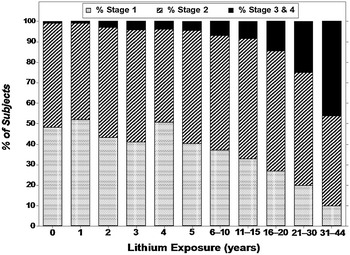
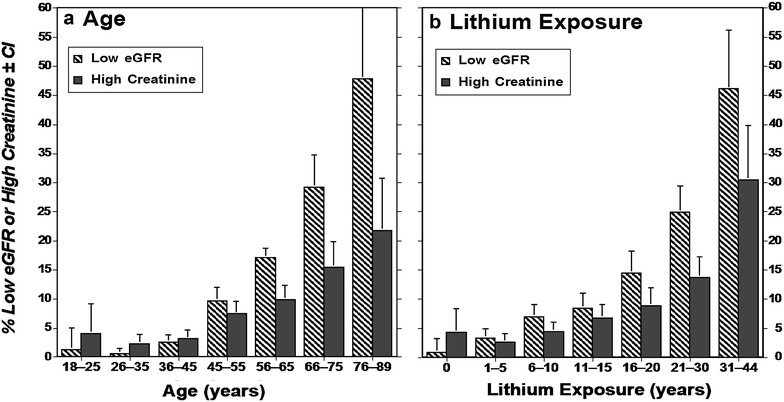
BACKGROUND: Concerns about potential adverse effects of long-term exposure to lithium as a mood-stabilizing treatment notably include altered renal function. However, the incidence of severe renal dysfunction; rate of decline over time; effects of lithium dose, serum concentration, and duration of treatment; relative effects of lithium exposure vs. aging; and contributions of sex and other factors all remain unclear. METHODS: Accordingly, we acquired data from 12 collaborating international sites and 312 bipolar disorder patients (6142 person-years, 2669 assays) treated with lithium carbonate for 8-48 (mean 18) years and aged 20-89 (mean 56) years. We evaluated changes of estimated glomerular filtration rate (eGFR) as well as serum creatinine, urea-nitrogen, and glucose concentrations, white blood cell count, and body-mass index, and tested associations of eGFR with selected factors, using standard bivariate contrasts and regression modeling. RESULTS: . By multivariate regression, risk factors for declining eGFR ranked: longer lithium treatment, lower lithium dose, higher serum lithium concentration, older age, and medical comorbidity. Later low eGFR was also predicted by lower initial eGFR, and starting lithium at age ≥ 40 years. LIMITATIONS: Control data for age-matched subjects not exposed to lithium were lacking. CONCLUSIONS: Long-term lithium treatment was associated with gradual decline of renal functioning (eGFR) by about 30% more than that was associated with aging alone. Risk of subnormal eGFR was from 18.1% (≥2 low values) to 29.5% (≥1 low value), requiring about 30 years of exposure. Additional risk factors for low eGFR were higher serum lithium level, longer lithium treatment, lower initial eGFR, and medical comorbidity, as well as older age.
Overview
The claims and statistics of this paper haven’t been checked yet.
Free: it reads the open-access text and checks the first 5 claims that cite a source we can check. Create a free account to check every claim.
Integrity signals
Registry
Cites
Statistics
Figures
Verification
Claims the paper makes
The claims and statistics of this paper haven’t been checked yet.
Free: it reads the open-access text and checks the first 5 claims that cite a source we can check. Create a free account to check every claim.
Claims other papers make about this one
Each is checked against this paper’s own text: does it say what the citing paper says it does?
The source backs part of the claim, not all of it — or backs it for a different population, condition or comparison.
In the citing paper
“Because of its narrow therapeutic window, acute lithium intoxication is also a complication, which, though reversible, can lead to reductions in glomerular filtration rate.825, 826”
From Canadian Network for Mood and Anxiety Treatments ( CANMAT ) and International Society for Bipolar Disorders ( ISBD ) 2018 guidelines for the management of patients with bipolar disorder (2018) · cites this paper as [826]
Experimental — accuracy not yet measured
Self-check
Percentages, sums and reported differences re-computed from the paper’s own numbers.
The self-check needs the paper’s full text.
Citations
Cites
Toprak, O., Kurt, H., Sarı, Y., Şarkış, C., Us, H., & Kırık, A. (2017) · Kidney and Blood Pressure Research · doi:10.1159/000468530 · Cited by 29,627
A New Equation to Estimate Glomerular Filtration Rate
Levey, A. S., Stevens, L. A., Schmid, C. H., Zhang, Y. (., Castro, A. F., Feldman, H. I., Kusek, J. W., Eggers, P., Van Lente, F., Greene, T., et al. (2009) · Annals of Internal Medicine · doi:10.7326/0003-4819-150-9-200905050-00006 · Cited by 25,603
Levey, A. S., Coresh, J., Bolton, K., Culleton, B. F., Harvey, K. S., Ikizler, T. A., Johnson, C. A., Kausz, A., Kimmel, P. L., Kusek, J. W., et al. (2002) · University of Groningen research database (University of Groningen / Centre for Information Technology) · Cited by 11,633
Stevens, P. E., Levin, A., & for the Kidney Disease: Improving Global Outcomes Chronic Kidney Disease Guideline Development Work Group Members* (2013) · Annals of Internal Medicine · doi:10.7326/0003-4819-158-11-201306040-00007 · Cited by 3,607
Doqi, K. (2002) · American Journal of Kidney Diseases · Cited by 1,285
Lithium toxicity profile: a systematic review and meta-analysis
McKnight, R. F., Adida, M., Budge, K., Stockton, S., Goodwin, G. M., & Geddes, J. R. (2012) · The Lancet · doi:10.1016/s0140-6736(11)61516-x · Cited by 877
The Aging Kidney: Physiological Changes
Weinstein, J. R., & Anderson, S. (2010) · Advances in Chronic Kidney Disease · doi:10.1053/j.ackd.2010.05.002 · Cited by 639
Lithium toxicity profi le: a systematic review and meta-analysis
McKnight, R. F., Budge, K., Ba, S., Goodwin, G. M., Geddes, J. R., & Adida, M. (2012) · Cited by 544
Measured and estimated GFR in healthy potential kidney donors
Rule, A. D., Gussak, H. M., Pond, G. R., Bergstralh, E. J., Stegall, M. D., Cosio, F. G., & Larson, T. S. (2004) · American Journal of Kidney Diseases · doi:10.1053/j.ajkd.2003.09.026 · Cited by 383
Baldessarini, R. J. (2013) · doi:10.1007/978-1-4614-3710-9 · Cited by 365
Self-citationShine, B., McKnight, R. F., Leaver, L., & Geddes, J. R. (2015) · The Lancet · doi:10.1016/s0140-6736(14)61842-0 · Cited by 313
Lithium for prevention of mood episodes in bipolar disorders: systematic review and meta-analysis
Severus, E., Taylor, M. J., Sauer, C., Pfennig, A., Ritter, P., Bauer, M., & Geddes, J. R. (2014) · International Journal of Bipolar Disorders · doi:10.1186/s40345-014-0015-8 · Cited by 216
Self-citationRenal failure occurs in chronic lithium treatment but is uncommon
Bendz, H., Schön, S., Attman, P.-O., & Aurell, M. (2010) · Kidney International · doi:10.1038/ki.2009.433 · Cited by 183
Can body mass index help predict outcome in patients with bipolar disorder?
Calkin, C., Van De Velde, C., Růžičková, M., Slaney, C., Garnham, J., Hajek, T., O’Donovan, C., & Alda, M. (2009) · Bipolar Disorders · doi:10.1111/j.1399-5618.2009.00730.x · Cited by 158
Self-citationKessing, L. V., Gerds, T. A., Feldt-Rasmussen, B., Andersen, P. K., & Licht, R. W. (2015) · JAMA Psychiatry · doi:10.1001/jamapsychiatry.2015.1834 · Cited by 156
Hwang, Y. J., Dixon, S. N., Reiss, J. P., Wald, R., Parikh, C. R., Gandhi, S., Shariff, S. Z., Pannu, N., Nash, D. M., Rehman, F., et al. (2014) · Annals of Internal Medicine · doi:10.7326/m13-2796 · Cited by 136
Valproic Acid Attenuates Proteinuria and Kidney Injury
Van Beneden, K., Geers, C., Pauwels, M., Mannaerts, I., Verbeelen, D., van Grunsven, L. A., & Van den Branden, C. (2011) · Journal of the American Society of Nephrology · doi:10.1681/asn.2010111196 · Cited by 129
Clos, S., Rauchhaus, P., Severn, A., Cochrane, L., & Donnan, P. T. (2015) · The Lancet Psychiatry · doi:10.1016/s2215-0366(15)00316-8 · Cited by 117
Hayes, J. F., Marston, L., Walters, K., Geddes, J. R., King, M., & Osborn, D. P. J. (2016) · PLOS Medicine · doi:10.1371/journal.pmed.1002058 · Cited by 115
Azab, A. N., Shnaider, A., Osher, Y., Wang, D., Bersudsky, Y., & Belmaker, R. H. (2015) · International Journal of Bipolar Disorders · doi:10.1186/s40345-015-0028-y · Cited by 109
Lithium in the Kidney: Friend and Foe?
Alsady, M., Baumgarten, R., Deen, P. M. T., & de Groot, T. (2015) · Journal of the American Society of Nephrology · doi:10.1681/asn.2015080907 · Cited by 100
Renal function after long-term treatment with lithium.
Hullin, R. P., Coley, V. P., Birch, N. J., Thomas, T. H., & Morgan, D. B. (1979) · BMJ · doi:10.1136/bmj.1.6176.1457 · Cited by 99
Lithium in Neuropsychiatry: The Comprehensive Guide
(2013) · CRC Press eBooks · doi:10.3109/9780203007051 · Cited by 92
Renal Failure in Lithium-Treated Bipolar Disorder: A Retrospective Cohort Study
Close, H., Reilly, J., Mason, J. M., Kripalani, M., Wilson, D., Main, J., & Hungin, A. P. S. (2014) · PLoS ONE · doi:10.1371/journal.pone.0090169 · Cited by 92
Bendz, H., Sjödin, I., & Aurell, M. (1996) · Nephrology Dialysis Transplantation · doi:10.1093/ndt/11.3.457 · Cited by 92
Castro, V. M., Roberson, A. M., McCoy, T. H., Wiste, A., Cagan, A., Smoller, J. W., Rosenbaum, J. F., Ostacher, M., & Perlis, R. H. (2016) · Neuropsychopharmacology · doi:10.1038/npp.2015.254 · Cited by 90 · cited 1×
“7%, and was higher with multiple daily doses, higher serum concentrations, and co-treatment with first-generation neuroleptics (Castro et al. 2016); [s] eGFR < 60 units was about twofold more prevalent among 2148 lithium-treated patients than among those treated with valproate (n = 1670), olanzapine (n = 1477), or que…”
BackgroundSchou, M., Amdisen, A., Thomsen, K., Vestergaard, P., Hetmar, O., Mellerup, E. T., Plenge, P., & Rafaelsen, O. J. (1982) · Psychopharmacology · doi:10.1007/bf00432777 · Cited by 89
Effects of 10 to 30 years of lithium treatment on kidney function
Aiff, H., Attman, P.-O., Aurell, M., Bendz, H., Ramsauer, B., Schön, S., & Svedlund, J. (2015) · Journal of Psychopharmacology · doi:10.1177/0269881115573808 · Cited by 86
The Effects of Lithium on Renal Function in Older Adults—A Systematic Review
Rej, S., Herrmann, N., & Shulman, K. (2012) · Journal of Geriatric Psychiatry and Neurology · doi:10.1177/0891988712436690 · Cited by 82
de Oliveira, J. L., da Silva, G. B., Abreu, K. L. S., Rocha, N. D. A., Franco, L. F. L. G., Araújo, S. M. H. A., & Daher, E. D. F. (2010) · Revista da Associação Médica Brasileira · doi:10.1590/s0104-42302010000500025 · Cited by 82
Aprahamian, I., Santos, F. S., dos Santos, B., Talib, L., Diniz, B. S., Radanovic, M., Gattaz, W. F., & Forlenza, O. V. (2014) · The Journal of Clinical Psychiatry · doi:10.4088/jcp.13m08741 · Cited by 78
Renal function during long-term lithium treatment: a cross-sectional and longitudinal study
Bocchetta, A., Ardau, R., Fanni, T., Sardu, C., Piras, D., Pani, A., & Del Zompo, M. (2015) · BMC Medicine · doi:10.1186/s12916-014-0249-4 · Cited by 77
Self-citationEnd-stage renal disease associated with prophylactic lithium treatment
Aiff, H., Attman, P., Aurell, M., Bendz, H., Schön, S., & Svedlund, J. (2014) · European Neuropsychopharmacology · doi:10.1016/j.euroneuro.2014.01.002 · Cited by 75
Increased risk of solid renal tumors in lithium-treated patients
Zaidan, M., Stucker, F., Stengel, B., Vasiliu, V., Hummel, A., Landais, P., Boffa, J., Ronco, P. M., Grünfeld, J., & Servais, A. (2014) · Kidney International · doi:10.1038/ki.2014.2 · Cited by 71
Weight Gain and Serum Leptin Levels in Patients on Lithium Treatment
Atmaca, M., Kuloğlu, M., Tezcan, E., & Üstündağ, B. (2002) · Neuropsychobiology · doi:10.1159/000065414 · Cited by 65
Bocchetta, A., Ardau, R., Carta, P., Ligas, F., Sardu, C., Pani, A., & Del Zompo, M. (2013) · BMC Medicine · doi:10.1186/1741-7015-11-33 · Cited by 64
Self-citationLithium Increases Susceptibility of Muscle Glucose Transport to Stimulation by Various Agents
Tabata, I., Schluter, J., Gulve, E. A., & Holloszy, J. O. (1994) · Diabetes · doi:10.2337/diab.43.7.903 · Cited by 64
The Essential Guide to Lithium Treatment
Bauer, M., & Gitlin, M. J. (2016) · Springer eBooks · doi:10.1007/978-3-319-31214-9 · Cited by 63
Self-citationTuran, T., Eşel, E., Tokgöz, B., Aslan, S. S., Sofuoǧlu, S., Utaş, C., & Keleştimur, F. (2002) · Progress in Neuro-Psychopharmacology and Biological Psychiatry · doi:10.1016/s0278-5846(01)00308-6 · Cited by 48
Renal Function and Biopsy in Patients on Lithium-Therapy*
Albrecht, J., Kampf, D., & Müller-Oerlinghausen, B. (2008) · Pharmacopsychiatry · doi:10.1055/s-2007-1019635 · Cited by 46
Self-citationReview: Meta-analysis of the effects of lithium usage on serum creatinine levels
Paul, R., Minay, J., Cardwell, C., Fogarty, D., & Kelly, C. (2010) · Journal of Psychopharmacology · doi:10.1177/0269881109104930 · Cited by 44
An Updated Review of the Optimal Lithium Dosage Regimen for Renal Protection
Carter, L., Zolezzi, M., & Lewczyk, A. (2013) · The Canadian Journal of Psychiatry · doi:10.1177/070674371305801009 · Cited by 42
Bendz, H. (1985) · Acta Psychiatrica Scandinavica · doi:10.1111/j.1600-0447.1985.tb02639.x · Cited by 42
Kirkham, E. N., Skinner, J. S., Anderson, T., Bazire, S., Twigg, M. J., & Desborough, J. (2014) · BMJ Open · doi:10.1136/bmjopen-2014-006020 · Cited by 39
Long-Term Lithium Use and Risk of Renal and Upper Urinary Tract Cancers
Pottegård, A., Hallas, J., Jensen, B. L., Madsen, K., & Friis, S. (2016) · Journal of the American Society of Nephrology · doi:10.1681/asn.2015010061 · Cited by 37
Lithium in neuropsychiatry the comprehensive guide
Bauer, M. (2006) · Cited by 37
Self-citationRenal side-effects of long-term lithium treatment
Çoşkunol, H., Vahip, S., Mees, E. J. D., Başçı, A., Bayındır, O., & Tuğlular, I. (1997) · Journal of Affective Disorders · doi:10.1016/s0165-0327(96)00046-8 · Cited by 36
Renal Reactions to Changes of Lithium Dosage
Kusalic, M., & Engelsmann, F. F. (2008) · Neuropsychobiology · doi:10.1159/000119301 · Cited by 34
Renal glomerular function and long-term lithium therapy
DePaulo, J. R., Correa, E. I., & SAPIR, D. G. (1981) · American Journal of Psychiatry · doi:10.1176/ajp.138.3.324 · Cited by 32
Shah, J. H., & Pishdad, G. (1980) · Endocrinology · doi:10.1210/endo-107-5-1300 · Cited by 24
Commentary on a recent review of lithium toxicity: what are its implications for clinical practice?
Müller-Oerlinghausen, B., Bauer, M., & Grof, P. (2012) · BMC Medicine · doi:10.1186/1741-7015-10-132 · Cited by 24
Self-citationMolecular mechanisms in lithium-associated renal disease: a systematic review
Rej, S., Pira, S., Marshe, V. S., Do, A., Élie, D., Looper, K. J., Herrmann, N., & Müller, D. J. (2016) · International Urology and Nephrology · doi:10.1007/s11255-016-1352-6 · Cited by 23
Severus, E., & Bauer, M. (2013) · BMC Medicine · doi:10.1186/1741-7015-11-34 · Cited by 22
Self-citationScreening for the markers of kidney damage in men and women on long-term lithium treatment
RYBAKOWSKI, J. K., Abramowicz, M., Drogowska, J., Chłopocka-Woźniak, M., Michalak, M., & Czekałski, S. (2012) · Medical Science Monitor · doi:10.12659/msm.883543 · Cited by 20
Self-citationImaging findings of renal toxicity in patients on chronic lithium therapy
Karaosmanoğlu, A. D., Butros, S. R., & Arellano, R. S. (2013) · Diagnostic and Interventional Radiology · doi:10.5152/dir.2013.097 · Cited by 19
Lithium usage and renal function testing in a large UK community population; a case–control study
Minay, J., Paul, R., McGarvey, D., Savage, G., Stevenson, M., Fogarty, D. G., Mulholland, C. C., & Kelly, C. J. (2013) · General Hospital Psychiatry · doi:10.1016/j.genhosppsych.2012.10.016 · Cited by 18
Lithium and renal tumors: a critical comment to the report by Zaidan et al.
Licht, R. W., Grabenhenrich, L., Nielsen, R. E., & Berghöfer, A. (2014) · Kidney International · doi:10.1038/ki.2014.178 · Cited by 17
Lithium-Associated Kidney Microcysts
Tuazon, J. A., Casalino, D. D., Syed, E., & BATLLE, D. C. (2008) · The Scientific World JOURNAL · doi:10.1100/tsw.2008.112 · Cited by 16
Prevention of lithium-associated renal failure: recent evidence
Davis, J. M., Rosenbaum, A., Shahinian, V. B., & Brosius, F. C. (2015) · The Lancet Psychiatry · doi:10.1016/s2215-0366(15)00498-8 · Cited by 14
MRI findings and renal function in patients on lithium therapy
Farshchian, N., Farnia, V., Aghaiani, M., & Abdoli, N. (2013) · Current Drug Safety · doi:10.2174/15748863113089990047 · Cited by 13
MRI Findings in Chronic Lithium Nephropathy: A Case Report
Jambhekar, K. R., Slaughter, A. J., & Pandey, T. (2010) · Journal of Radiology Case Reports · doi:10.3941/jrcr.v4i8.470 · Cited by 11
Renal sonography in bipolar patients on long‐term lithium treatment
Jończyk‐Potoczna, K., Abramowicz, M., Chłopocka-Woźniak, M., Strzelczuk‐Judka, L., Michalak, M., Czekałski, S., & RYBAKOWSKI, J. K. (2016) · Journal of Clinical Ultrasound · doi:10.1002/jcu.22336 · Cited by 10
Self-citationLithium‐induced changes in the body mass index
Mathew, B., Rao, J. M., & Sundari, U. (1989) · Acta Psychiatrica Scandinavica · doi:10.1111/j.1600-0447.1989.tb03022.x · Cited by 8
Are renal tumors associated with lithium treatment?
Baldessarini, R. J., & Tondo, L. (2014) · International Journal of Bipolar Disorders · doi:10.1186/2194-7511-2-6 · Cited by 6
Self-citationLong-term lithium and estimated glomerular filtration rate
Bocchetta, A., Sardu, C., Piras, D., & Pani, A. (2016) · The Lancet Psychiatry · doi:10.1016/s2215-0366(15)00547-7 · Cited by 4
Self-citation
Cited by
Yatham, L. N., Kennedy, S. H., Parikh, S. V., Schaffer, A., Bond, D. J., Frey, B. N., Sharma, V., Goldstein, B. I., Rej, S., Beaulieu, S., et al. (2018) · Bipolar Disorders · doi:10.1111/bdi.12609 · Cited by 1,852
Self-citationDiagnosis and Treatment of Bipolar Disorder: A Review
Nierenberg, A. A., Agustini, B., Köhler-Forsberg, O., Cusin, C., Katz, D., Sylvia, L. G., Peters, A., & Berk, M. (2023) · JAMA · doi:10.1001/jama.2023.18588 · Cited by 395
Pharmacological treatment of adult bipolar disorder
Baldessarini, R. J., Tondo, L., & Vázquez, G. H. (2019) · Molecular Psychiatry · doi:10.1038/s41380-018-0044-2 · Cited by 272
Self-citationMazereel, V., Detraux, J., Vancampfort, D., van Winkel, R., & De Hert, M. (2020) · Frontiers in Endocrinology · doi:10.3389/fendo.2020.573479 · Cited by 205
Clinical use of lithium salts: guide for users and prescribers
for the International Group for Studies of Lithium (IGSLi), Tondo, L., Alda, M., Bauer, M., Bergink, V., Grof, P., Hajek, T., Lewitka, U., Licht, R. W., Manchia, M., et al. (2019) · International Journal of Bipolar Disorders · doi:10.1186/s40345-019-0151-2 · Cited by 204
Self-citation
Metadata
- Authors
- Tondo, L., Abramowicz, M., Alda, M., Bauer, M., Bocchetta, A., Bolzani, L., Calkin, C. V., Chillotti, C., Hidalgo-Mazzei, D., Manchia, M., Müller-Oerlinghausen, B., Murru, A., Perugi, G., Pinna, M., Quaranta, G., Reginaldi, D., Reif, A., Ritter, P., Rybakowski, J. K., Saiger, D., Sani, G., Selle, V., Stamm, T., Vázquez, G. H., Veeh, J., Vieta, E., & Baldessarini, R. J.
- Affiliations
- Harvard University (US)
- Dalhousie University (CA)
- University Hospital Carl Gustav Carus (DE)
- University of Cagliari (IT)
- Azienda Ospedaliero-Universitaria Cagliari (IT)
- Freie Universität Berlin (DE)
- University of Pisa (IT)
- University of Padua (IT)
- University Hospital Frankfurt (DE)
- Poznan University of Medical Sciences (PL)
- Charité – Universitätsmedizin Berlin (DE)
- Sapienza University of Rome (IT)
- Queen's University (CA)
- Centro de Investigación Biomédica en Red de Salud Mental (ES)
- Corresponding author
- Tondo, Leonardo
- ORCID
- Venue
- International Journal of Bipolar Disorders
- Published
- 2017-08-01
- Volume
- 5
- Issue
- 1
- Pages
- 27-27
- ISSN
- 2194-7511 (ISSN-L)
- PMC
- PMC5537163
- OpenAlex
- W2610823330
- Cited by
- 125
- References
- 65
- Citations by year
- 2026: 9 · 2025: 15 · 2024: 16 · 2023: 17 · 2022: 15 · 2021: 11 · 2020: 17 · 2019: 11 · 2018: 11 · 2017: 3
- FWCI
- 9.44
- Type
- journal article
- Language
- en
- Open access
- gold
- doi.org
- Licence
- cc-by
- creativecommons.org/licenses/by/4.0 (tdm)
- Locations
- International Journal of Bipolar Disorders (publishedVersion, cc-by)
- PubMed Central (publishedVersion, cc-by)
- PubMed (publishedVersion)
- Research Portal (King's College London) (publishedVersion, cc-by)
- IRIS Research product catalog (Sapienza University of Rome) (submittedVersion, cc-by)
- Digital Access to Scholarship at Harvard (DASH) (Harvard University) (submittedVersion, cc-by)
- CINECA IRIS Institutial research information system (University of Pisa) (submittedVersion)
- DOAJ (DOAJ: Directory of Open Access Journals) (submittedVersion, cc-by-sa)
- UNICA IRIS Institutional Research Information System (University of Cagliari) (submittedVersion, cc-by)
- Funders
- Aretæus Foundation
- Angelini Pharma
- American Foundation for Suicide Prevention
- Bundesministerium für Bildung und Forschung
- German Excellence Initiative to the Graduate School of Life Sciences
- Instituto de Salud Carlos III, Subdirección General de Evaluación y Fomento de la Investigación
- Canadian Institutes of Health Research (64410)
- Spanish Ministry of Economy and Competitiveness (00912)
- Deutsche Forschungsgemeinschaft, European Commission (FP7)
- the RTG “gk emotions” (1256/2)
- Fondo Europeo de Desarrollo Regional, Unión Europea
- CIBERSAM and the Secretaria d’Universitats i Recerca del Departament d’Economia i Coneixement (2014-SGR-398)
- Bruce J. Anderson Foundation
- McLean Private Donors Research Fund
- Topics
- Health Sciences › Medicine › Psychiatry and Mental health › Bipolar Disorder and Treatment
- Health Sciences › Medicine › Psychiatry and Mental health › Schizophrenia research and treatment
- Health Sciences › Medicine › Endocrinology, Diabetes and Metabolism › Thyroid Disorders and Treatments
- Keywords
- lithium, bipolar disorder, glomerular filtration rate, renal function, lithium carbonate, serum lithium levels, lithium dose, aging, risk factors, serum creatinine, urea nitrogen, glucose, body mass index, white blood cell count, comorbidities
About these checks
Registry, retraction, Cites and statistics results are computed, not judged, with one exception: a printed reference that no index lists is read once by a model before it counts as a citation error. Claims are extracted by a model and kept only when their quote appears verbatim in the text; each cited source is then checked, with a model’s help, for whether it says what the claim relies on. Those verdicts can be wrong — read the claim’s quote and the cited source before relying on one.
Statistics and arithmetic are recomputed, not judged.
Confidence bands are shown only for fields calibrated on our annotated test set. None is calibrated yet, so no band is shown.
What counts as a claim ›How we measure confidence ›How we check this ›
Are you an author, or do you see a problem with this page? Request a review
Data sources
Bibliographic data: Semantic Scholar, OpenAlex, Crossref.
Contains information from the Semantic Scholar Academic Graph Datasets, made available under the ODC Attribution License (ODC-BY 1.0).
Semantic Scholar’s data is described in: Kinney, R., et al. (2023). The Semantic Scholar Open Data Platform. arXiv:2301.10140.
