

German version of the Death Attitudes Profile- Revised (DAP-GR) – translation and validation of a multidimensional measurement of attitudes towards death
Open accessThe DOI matches its Crossref record; 51 of the 52 references it cites were found in a registry or an index; none of the 13 sources its claims cite is checked for support yet.
Abstract
Background: In Germany, only limited data are available on attitudes towards death. Existing measurements are complex and time consuming, and data on psychometric properties are limited. The Death Attitude Profile- Revised (DAP-R) captures attitudes towards dying and death. The measure consists of 32 items, which are assigned to 5 dimensions (Fear of Death, Death Avoidance, Neutral Acceptance, Approach Acceptance, Escape Acceptance). It has been translated and tested in several countries, but no German version exists to date. This study reports the translation of the Death Attitudes Profile-Revised (DAP-R) into German (DAP-GR) using a cross-cultural adaption process methodology and its psychometric assessment. Methods: The DAP-R was translated following guidelines for cultural adaption. A total of 216 medical students of the Heinrich Heine University Duesseldorf participated in this study. Interrater reliability was investigated by means of Kendall’s W concordance coefficient. The internal consistency of the DAP-GR Scales was assessed with Cronbach’s alpha coefficients. Split-half reliability was estimated using Spearman-Brown coefficients. Convergent validity was measured by Spearman’s correlation coefficient. Content validity was assessed by means of confirmatory factor analysis (CFA). All statistical analyses were performed using SPSS 24 and AMOS 22. Results: The items showed fair to good interrater reliability, with W-values ranging from .30 to .79. Internal consistency of the five subscales ranged from .61 (Neutral Acceptance) to .94 (Approach Acceptance). Split-half reliability was good, with a Spearman-Brown-coefficient of .83. The results of CFA slightly diverged from the original scale. Conclusion: Our results suggest overall good reliability of the German version of the DAP-R. The DAP-GR promises to be a robust instrument to establish normative data on death attitudes for use in German-speaking countries.
Overview
CoChat Summary
## TL;DR
This study translated the Death Attitudes Profile-Revised into German (DAP-GR) and tested it in 216 medical students. Overall reliability was good, but confirmatory factor analysis showed a fit that was only borderline acceptable unless one error covariance was allowed, and one item loaded poorly.
## Key findings
- Face validity was acceptable: Kendall’s W values for item sorting ranged from .30 to .79, indicating fair-to-good interrater agreement.
- Internal consistency of the five subscales ranged from .61 for Neutral Acceptance to .94 for Approach Acceptance; split-half reliability was .83.
- In the confirmatory factor analysis with n = 216, the initial model fit was χ2(454) = 811.74, CMIN/DF = 1.79, CFI = .90, RMSEA = .06, SRMR = .08; after allowing the error terms of Items 1 and 18 to correlate, fit improved to χ2(453) = 791.461, CMIN/DF = 1.74, CFI = .90, RMSEA = .05, SRMR = .08.
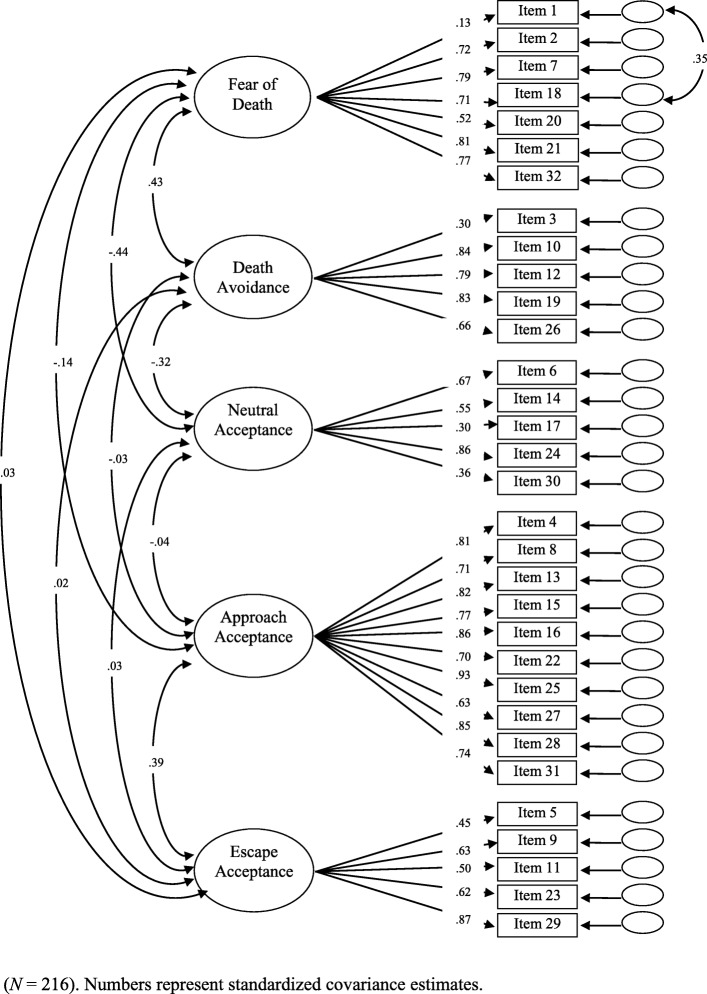
- The factor pattern was mostly similar to the original scale, but Item 1 had a low loading of .13 and Item 3 may have loaded as low as .30; the authors note some items in Approach Acceptance may be redundant.
## Methods
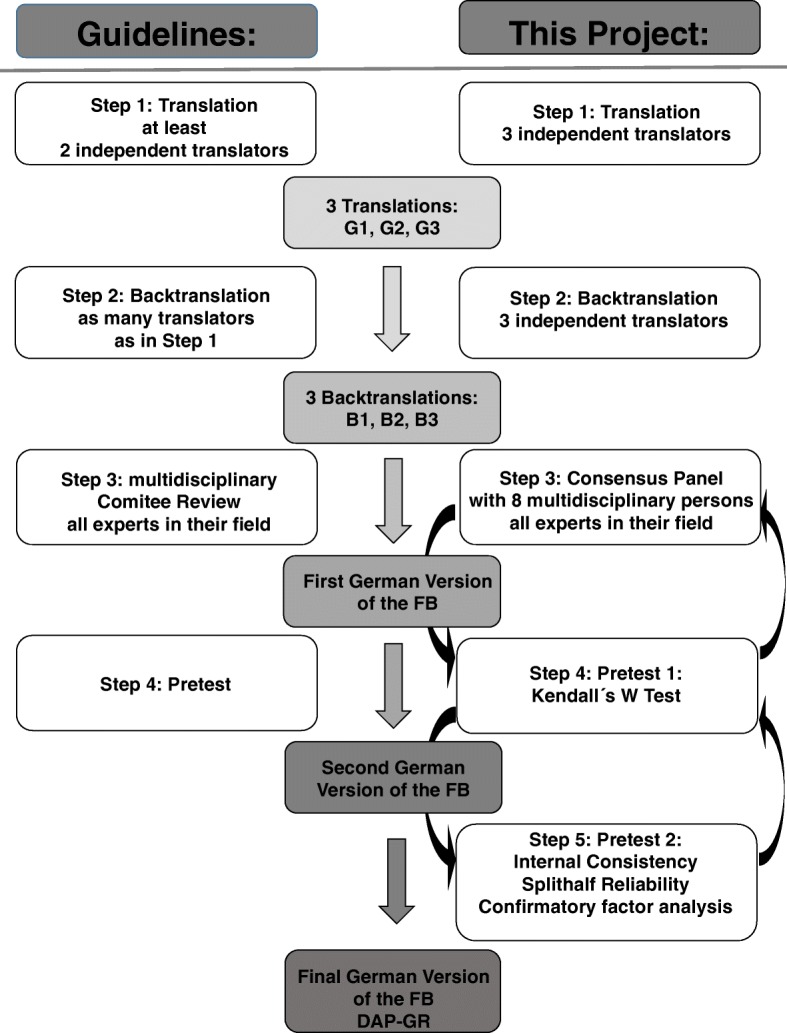
- The DAP-R was translated from English to German using a cross-cultural adaptation process with three independent forward translations, three back-translations, and a 9-person multidisciplinary consensus panel.
- Participants were medical students at Heinrich Heine University Düsseldorf; the face-validity sample was n = 32 and the main sample was n = 216.
- Analyses included Kendall’s W for face validity/interrater reliability, Cronbach’s alpha and Spearman-Brown for reliability, Spearman correlations for subscale associations, and confirmatory factor analysis in AMOS/SPSS for the factor structure.
## Limitations
- The paper states that the measure is only a quantitative approach; it notes that qualitative studies such as interviews or focus groups could provide deeper understanding and validate the quantitative results.
- The authors state that validation in palliative care patients was not established, because recruiting a comparable palliative care sample in the same time frame was difficult and they instead used medical students.
- The text also makes evident that the sample is limited to medical students from one German university, so generalizability beyond that group is unclear (evident from the sample description).
Model-written summary. Check it against the paper before relying on it.
Integrity signals
Registry
Cites
Statistics
Figures
Verification
Claims the paper makes
0 Valid · 0 Not valid · 11 Not checked · 20 Own results and interpretations
A result the paper reports from its own data — it cites no other source for it, so there is none to check. The quote shows it is in the paper.
In the paper
“The fit was on the border of being acceptable, χ2 (454) = 811.74, p < .001, CMIN/DF = 1.79, CFI = .90, RMSEA = .06, SRMR = .08.”
§ German version of the Death Attitudes Profile- Revised (DAP-GR) – translation and validation of a multidimensional measurement of attitudes towards death > Results > Main sample
plainn = 216- Asserted: passes — The authors put it forward as true.
- Checkable: passes — It can be checked against evidence.
- Load-bearing: passes — The paper’s conclusions depend on it.
- Based: passes — The paper gives a reason why it holds.
A result the paper reports from its own data — it cites no other source for it, so there is none to check. The quote shows it is in the paper.
In the paper
“Although in most cases there were no problematic levels of skewness and kurtosis, the scales did not show a normal distribution (in each case, Shapiro-Wilk tests were p < .05).”
§ German version of the Death Attitudes Profile- Revised (DAP-GR) – translation and validation of a multidimensional measurement of attitudes towards death > Results > Main sample
plain- Asserted: passes — The authors put it forward as true.
- Checkable: passes — It can be checked against evidence.
- Load-bearing: unclear — It is unclear whether the paper’s conclusions depend on it.
- Based: passes — The paper gives a reason why it holds.
A result the paper reports from its own data — it cites no other source for it, so there is none to check. The quote shows it is in the paper.
In the paper
“Split-half reliability was good, with a Spearman-Brown-coefficient of .83.”
- Also stated in: § Main sample · plain
“Split-half reliability analysis also yielded good results as the Spearman-Brown-coefficient was .83.”
- Also stated in: § Discussion · plain
“our data showed good split-half reliability of .83”
§ German version of the Death Attitudes Profile- Revised (DAP-GR) – translation and validation of a multidimensional measurement of attitudes towards death > Abstract > Results
plain- Asserted: passes — The authors put it forward as true.
- Checkable: passes — It can be checked against evidence.
- Load-bearing: passes — The paper’s conclusions depend on it.
- Based: passes — The paper gives a reason why it holds.
- Also stated in: § Main sample · plain
In the paper
“Internal consistency of the five subscales ranged from .61 (Neutral Acceptance) to .94 (Approach Acceptance).”
- Also stated in: § Main sample · plain
“The internal consistency of the five subscales was in line with the original measure [13] and ranged from a low of .61 (Neutral Acceptance) to a high of .94 (Approach Acceptance) (see Table 4).”
§ German version of the Death Attitudes Profile- Revised (DAP-GR) – translation and validation of a multidimensional measurement of attitudes towards death > Abstract > Results
What the sources say
- Not checked yetcites [13] Wong PTP Reker GT Gesser G Niemayer RA Death attitude profile-revised: a multidimensional measure of attitudes towards death Death anxiety handbook: research, instrumentation, and application 1994 Washington, DC Taylor& Francis 121 148
plain- Asserted: passes — The authors put it forward as true.
- Checkable: passes — It can be checked against evidence.
- Load-bearing: passes — The paper’s conclusions depend on it.
- Based: passes — The paper gives a reason why it holds.
- Also stated in: § Main sample · plain
A result the paper reports from its own data — it cites no other source for it, so there is none to check. The quote shows it is in the paper.
In the paper
“The analysis of the factor loadings shown in Fig. 2 suggest that Item 1 with a factor loading of .13 (and possibly Item 3 with a factor loading as low as .30) may be removed from the model as it does not load on the factor “Fear of Death”.”
§ German version of the Death Attitudes Profile- Revised (DAP-GR) – translation and validation of a multidimensional measurement of attitudes towards death > Results > Main sample
hedgedn = 216- Asserted: passes — The authors put it forward as true.
- Checkable: passes — It can be checked against evidence.
- Load-bearing: passes — The paper’s conclusions depend on it.
- Based: passes — The paper gives a reason why it holds.
9 more claims
Create a free account to see all 31 claims and to verify the 13 references still open.
- It may state two separate claims as one. 10
- Probably not a substantial claim. 8
- The quote only partly states this claim. 1
Claims other papers make about this one
Each is checked against this paper’s own text: does it say what the citing paper says it does?
The source backs part of the claim, not all of it — or backs it for a different population, condition or comparison.
In the citing paper
“Neutral acceptance of death is negatively correlated with fears of death and death avoidance, both in the general community [47-49] and in medical professionals [49, 50].”
From Stoicism and death acceptance: integrating Stoic philosophy in cognitive behaviour therapy for death anxiety (2022) · cites this paper as [50]
Experimental — accuracy not yet measured
Statistics recomputed
Every reported test result, recomputed from its test statistic and degrees of freedom. A result shows as not adding up only once an independent check has confirmed it.
- Consistentχ²(705) = 685.66reported p = .692 · recomputed p = .692
“χ2 (705) = 685.66, p = .692”
- Consistentχ²(454) = 811.74reported p < .001 · recomputed p < .001
“χ2 (454) = 811.74, p < .001”
- Consistentχ²(453) = 791461reported p < .001 · recomputed p < .001
“χ2 (453) = 791,461, p < .001”
Self-check
Percentages, sums and reported differences re-computed from the paper’s own numbers.
Self-check results appear here once an independent check has confirmed them.
Citations
Cites
Faul, F., Erdfelder, E., Lang, A.-G., & Buchner, A. (2007) · Behavior Research Methods · doi:10.3758/bf03193146 · Cited by 65,971
Alternative Ways of Assessing Model Fit
Browne, M. W., & Cudeck, R. (1992) · Sociological Methods & Research · doi:10.1177/0049124192021002005 · Cited by 27,200 · cited 1×
“08 as a reasonable fit of the model [43].”
Hu, L.-T., & Bentler, P. M. (1998) · Psychological Methods · doi:10.1037/1082-989x.3.4.424 · Cited by 12,298 · cited 1×
“Thus, the CMIN/DF is preferred instead, with values between 1 and 3 indicate a good-fitting model [42].”
BackgroundSchermelleh-Engel, K., Moosbrugger, H., & Müller, H. (2003) · Department of Psychology - University of Koblenz-Landau · doi:10.23668/psycharchives.12784 · Cited by 8,975
Reporting Structural Equation Modeling and Confirmatory Factor Analysis Results: A Review
Schreiber, J. B., Nora, A., Stage, F. K., Barlow, E. A., & King, J. (2006) · The Journal of Educational Research · doi:10.3200/joer.99.6.323-338 · Cited by 6,937
Toward a definition of mixed methods research
Johnson, R. B., Onwuegbuzie, A. J., & Turner, L. A. (2007) · Journal of Mixed Methods Research · doi:10.1177/1558689806298224 · Cited by 6,464
Guillemin, F., Bombardier, C., & Beaton, D. (1993) · Journal of Clinical Epidemiology · doi:10.1016/0895-4356(93)90142-n · Cited by 6,060 · cited 2×
“1 Flowchart Process adapted to: Guidelines for cultural adaption (Guill According to [26], differing interpretations and translation errors of ambiguous items in the original can be detected by this procedure.”
BackgroundMethodCurran, P. J., West, S. G., & Finch, J. F. (1996) · Psychological Methods · doi:10.1037/1082-989x.1.1.16 · Cited by 5,512
A First Course in Factor Analysis
Comrey, A. L., & Lee, H. B. (2013) · doi:10.4324/9781315827506 · Cited by 4,546
A New Incremental Fit Index for General Structural Equation Models
BOLLEN, K. A. (1989) · Sociological Methods & Research · doi:10.1177/0049124189017003004 · Cited by 3,002
(2004) · Cited by 1,588
Instrument translation process: a methods review
Maneesriwongul, W., & Dixon, J. K. (2004) · Journal of Advanced Nursing · doi:10.1111/j.1365-2648.2004.03185.x · Cited by 1,320 · cited 1×
“Without verification of the adequacy of translation, differences found while using the target language version in the target population might be due to errors in translation rather than representing true differences between countries [32].”
MethodGjersing, L., Caplehorn, J. R., & Clausen, T. (2010) · BMC Medical Research Methodology · doi:10.1186/1471-2288-10-13 · Cited by 879 · cited 1×
“To study the health care needs of people with diverse cultural backgrounds, research instruments must be reliable and valid in each culture studied [30, 31].”
BackgroundMasculinity-femininity: An exception to a famous dictum?
Constantinople, A. (1973) · Psychological Bulletin · doi:10.1037/h0035334 · Cited by 851
Priester, J. R., & Petty, R. E. (1996) · Journal of Personality and Social Psychology · doi:10.1037/0022-3514.71.3.431 · Cited by 817
Kaplan, K. J. (1972) · Psychological Bulletin · doi:10.1037/h0032590 · Cited by 807
(1995) · Cited by 751
Einführung in die Test- und Fragebogenkonstruktion
Bühner, M. (2008) · doi:10.17877/de290r-6148 · Cited by 622 · cited 1×
“Face validity was investigated by means of Kendall’s W concordance coefficient test of interrater reliability [35].”
MethodMeier, E. A., Gallegos, J. V., Thomas, L. P. M., Depp, C. A., Irwin, S. A., & Jeste, D. V. (2016) · The American Journal of Geriatric Psychiatry · doi:10.1016/j.jagp.2016.01.135 · Cited by 566
PSYCHOLOGICAL RESEARCH ON DEATH ATTITUDES: AN OVERVIEW AND EVALUATION
NEIMEYER, R. A., WITTKOWSKI, J., & MOSER, R. P. (2004) · Death Studies · doi:10.1080/07481180490432324 · Cited by 364
Traditional Masculinity and Femininity: Validation of a New Scale Assessing Gender Roles
Kachel, S., Steffens, M. C., & Niedlich, C. (2016) · Frontiers in Psychology · doi:10.3389/fpsyg.2016.00956 · Cited by 302
Lessons of Loss: A Guide to Coping
Neimeyer, R. A., & Lyddon, W. J. (1999) · Journal of Cognitive Psychotherapy · doi:10.1891/0889-8391.13.4.393 · Cited by 293
Bowers, M. K., & Feifel, H. (1962) · Journal for the Scientific Study of Religion · doi:10.2307/1384713 · Cited by 267
Kombination und Integration qualitativer und quantitativer Analyse
Mayring, P. (2008) · Forum qualitative Sozialforschung · doi:10.17169/fqs-2.1.967 · Cited by 238 · cited 1×
“Qualitative studies may not only help to deepen understanding of this field of study but also validate existing quantitative results [62, 63].”
ResultDeath anxiety handbook: Research, instrumentation and application
Lewis, J. E. (1995) · Journal of Anxiety Disorders · doi:10.1016/0887-6185(95)90002-0 · Cited by 216
Existential and Spiritual Issues in Death Attitudes
(2007) · Psychology Press eBooks · doi:10.4324/9780203809679 · Cited by 191
Acculturation, Resilience, and Depression in Midlife Women From the Former Soviet Union
Miller, A. M., & Chandler, P. J. (2002) · Nursing Research · doi:10.1097/00006199-200201000-00005 · Cited by 156
Meaning management theory and death acceptance.
Wong, P. T. P. (2007) · doi:10.4324/9780203809679-10 · Cited by 144 · cited 1×
“In this context, [9, 10] presented his meaning-management theory (MMT) of death acceptance.”
BackgroundSelf-citationAnother look at fear of death.
Feifel, H., & Nagy, V. T. (1981) · Journal of Consulting and Clinical Psychology · doi:10.1037//0022-006x.49.2.278 · Cited by 120
Marsh, H. W. (1985) · Multivariate Behavioral Research · doi:10.1207/s15327906mbr2004_5 · Cited by 102
Combination and Integration of Qualitative and Quantitative Analysis
Mayring, P. (2001) · DOAJ (DOAJ: Directory of Open Access Journals) · Cited by 96
Last chapters, a sociology of aging and dying
Marshall, V. W. (1980) · Medical Entomology and Zoology · Cited by 96
Hendricson, W. D., Jon Russell, I., Prihoda, T. J., Jacobson, J. M., Rogan, A., Bishop, G. D., & Castillo, R. (1989) · Arthritis & Rheumatism · doi:10.1002/anr.1780320915 · Cited by 90 · cited 1×
“We used only qualified translators who translated into German, their mother tongue [34].”
MethodTowards a definition of death anxiety
Nyatanga, B., & de Vocht, H. (2006) · International Journal of Palliative Nursing · doi:10.12968/ijpn.2006.12.9.21868 · Cited by 83
Schulz-Quach, C., Wenzel-Meyburg, U., & Fetz, K. (2018) · BMC Medical Education · doi:10.1186/s12909-018-1186-2 · Cited by 57
Self-citationThe attitude of medical students toward death: A cross-sectional study in Rafsanjan
Bidaki, R., Asadpour, M., Sabzevari, L., & Ekramifar, A. (2016) · Indian Journal of Palliative Care · doi:10.4103/0973-1075.185084 · Cited by 47
Reliability Issues of the Family Environment Scale For Cross-Cultural Research
MUNET-VILAR, F., & EGAN, M. (1990) · Nursing Research · doi:10.1097/00006199-199007000-00015 · Cited by 42 · cited 1×
“To study the health care needs of people with diverse cultural backgrounds, research instruments must be reliable and valid in each culture studied [30, 31].”
BackgroundSchulz-Quach, C., Wenzel-Meyburg, U., Karger, A., Scherg, A., der Schmitten, J. I., Trapp, T., Paling, A., Bakus, S., Schatte, G., Rudolf, E., et al. (2015) · PubMed Central · doi:10.3205/zma000948 · Cited by 36
Self-citationPerceptions of a Good Death Among German Medical Students
Meffert, C., Stößel, U., Körner, M., & Becker, G. (2015) · Death Studies · doi:10.1080/07481187.2014.951496 · Cited by 23
Junge Menschen sprechen mit sterbenden Menschen
Schnell, M. W., Schulz-Quach, C., Kuckartz, U., & Dunger, C. (2016) · Springer eBooks · doi:10.1007/978-3-658-12317-8 · Cited by 22
Self-citationCharta zur Betreuung schwerstkranker und sterbender Menschen in Deutschland
Dlubis-Mertens, K., & Bolze, B. (2014) · Vandenhoeck & Ruprecht eBooks · doi:10.13109/9783666403415.35 · Cited by 20
Fetz, K., Wenzel-Meyburg, U., & Schulz-Quach, C. (2017) · BMC Palliative Care · doi:10.1186/s12904-017-0263-3 · Cited by 18
Self-citationPresentation The quality of epidemiological data in coronary heart disease and atherosclerosis
Stehbens, W. E. (1993) · Journal of Clinical Epidemiology · doi:10.1016/0895-4356(93)90133-l · Cited by 17
Berger, K., Hütter, M., & Corneille, O. (2019) · Journal of Experimental Psychology General · doi:10.1037/xge0000572 · Cited by 17
Karger, A., Scherg, A., Schmitz, A., Wenzel Meyburg, U., & Raski, B. (2015) · Journal of Palliative Care & Medicine · doi:10.4172/2165-7386.1000236 · Cited by 14
Cross-Cultural Adaptation of an Intimate Partner Violence Questionnaire
Sundborg, E., Törnkvist, L., Wändell, P. E., & Stattin, N. S. (2012) · Clinical Nursing Research · doi:10.1177/1054773812436374 · Cited by 11
Influence of Item Direction on Student Responses in Attitude Assessment.
Campbell, N. J., & Grissom, S. (1979) · Cited by 9
Transformation of Grief Through Meaning: Meaning-Centered Counseling for Bereavement
Tomer, A., Eliason, G. T., & Wong, P. T. P. (2013) · doi:10.4324/9780203809679-24 · Cited by 9 · cited 1×
“In this context, [9, 10] presented his meaning-management theory (MMT) of death acceptance.”
BackgroundSelf-citationAbdel‐Khalek, A. M. (2006) · Psychological Reports · doi:10.2466/pr0.98.3.712-714 · Cited by 7
SESTD - Satzergänzungstest zu Einstellungen zu Sterben, Tod und Danach
Klug, A. (1997) · doi:10.23668/psycharchives.321 · Cited by 4
Research works printed but not linked: 17
- Schnell MW Schulz C 30 Gedanken zum Tod: mit Fotografien von Olaf Schlotte und einem Vorwort von Klaus Honnef: Nicolaische Verlagsbuchhandlung 2016
- Schulz C Macleod S Schulz C Ängste und Anpassungstörungen Psychiatrie in der Palliativmedizin- Behandlung psychiatrischer und psychosomatischer Probleme am Lebensende 2013 Bern Hans Huber Verlag 25 45
- Schulz C Schnell MW Schulz C Angst Bassiswissen Palliativmedizin 2012 Heidelberg Springer Medizin Verlag 94 100
- Wong PTP Viktor Frankl: prophet of hope for the 21st century. In: Batthyany a, Levinson J, editors. Anthology of Viktor Frankl’s logotherapy 2005 Phoenix Zeig, Tucker & Theisen
- Bakan D Disease, pain and sacrifice: toward a psychology of suffering 1971 Boston Beacon Press
- Becker E The denial of death 1973 New York Free Press
- Wong PTP. Meaning Making and the positive Psychology of Death acceptance. Int J Existent Psychol Psychother. 2010;3(2):73–82.
- Schulz-Quach C. The Nakedness of the Dead Body – the meaning of death to health care professionals working with the dying. Existent Anal 2018;29(2):301–23.
- Wittkowski J Fragebogeninventar zur mehrdimensionalen Erfassung des Erlebens gegenüber Sterben und Tod (FIMEST) 1996 Göttingen Hogrefe
- Klug A Einstellungen zu Sterben, Tod und Danach 1997 Verlag Mainz Aachen
- Jansen J, Scherg A, Schulz C, Lindblad A. Searching for a good death: A review of medical students’ perceptions. In: Beckers T, Siegers P, editors. Boundaries of Life and Changing Conceptions of Birth and Death - Social and Political Contexts of Assisted Reproduction and Assisted Dying. International Library of Ethics, Law, and the New Medicine. Heidelberg: Springer; 2017.
- Scherg A Vogt H Wenzel-Meyburg U Schmitz A Schulz-Quach C Medical students’ perception of undergraduate end of life care education: a metasynthesis 2018
- Arbuckle J Amos (version 22.0) [computer program] 2013 Chicago IBM SPSS
- Brown TA Confirmatory factor analysis for applied research: Guilford publications 2006
- Auf dem Weg zur Gleichstellung- Bildung Arbeit und Soziales –Unterschiede zwischen Frauen und Männern [press release] 2014 Wiesbaden Statistisches Bundesamt
- Palumbo E Influence of positive and negative death attitudes on medical Students’ empathy and attitudes toward end-of-life care: Philadephia College of Osteopathic Medicine Department of Psychology 2015
- Scherg A Vogt H Wenzel-Meyburg U Schmitz A Schulz C What is the published evidence on undergraduate medical students’ values on the topic of palliative care education? - a qualitative metasynthesis 2016
Cited by
Spitzenstätter, D., & Schnell, T. (2020) · Death Studies · doi:10.1080/07481187.2020.1848944 · Cited by 57
“To assess different attitudes toward death, the Death Attitude Profile-Revised (Wong et al., 1994) was employed in its German translation (DAP-GR, Jansen et al., 2019).”
MethodMenzies, R. E., & Whittle, L. F. (2022) · Discover Psychology · doi:10.1007/s44202-022-00023-9 · Cited by 14
“Neutral acceptance of death is negatively correlated with fears of death and death avoidance, both in the general community [47–49] and in medical professionals [49, 50].”
BackgroundAttitudes toward Death among Health Care Professionals in the Balkan Region
Kovačević, T., Zarić, B., Malbaša, J. D., Bokan, D., Nikolin, B., Bursać, D., Simurdić, P., Stojšić, V., Stojanovic, G., & Marić, D. (2024) · Current Oncology · doi:10.3390/curroncol31060255 · Cited by 14
“…the majority of research showed the highest values in NA dimensions, with the exception of those from Portugal, Jordan and Poland [1,3,7,12,16–18, 25 , There is no doubt that heightened negative attitudes toward death and grief resulting from patient deaths can contribute to burnout and many…”
BackgroundResultDEATH ANXIETY AND CONCEPT OF GOOD DEATH IN THE ELDERLY
Şahin, D. S., & Büken, N. Ö. (2020) · The Turkish Journal of Geriatrics · doi:10.31086/tjgeri.2020.133 · Cited by 17
“…while the highest score in the personal control subdimen-sion was received for the option “ability to communicate until death” (3.47±0.83) (21, 23), and in the psychosocial and spiritual dimension “having an opportunity to say goodbye to loved ones” (3.93±0.61) (2, 12, 20); these results…”
InfluentialPralong, A., Herling, M., Holtick, U., Scheid, C., Hellmich, M., Hallek, M. J., Pauli, B., Reimer, A., Schepers, C., & Simon, S. T. (2023) · BMJ Open · doi:10.1136/bmjopen-2022-066948 · Cited by 11
Metadata
- Authors
- Jansen, J., Schulz-Quach, C., Eisenbeck, N., Carreno, D. F., Schmitz, A., Fountain, R., Franz, M., Schäfer, R., Wong, P. T. P., & Fetz, K.
- Affiliations
- Düsseldorf University Hospital (DE)
- University Health Network (CA)
- Károli Gáspár University of the Reformed Church in Hungary (HU)
- University of Almería (ES)
- Dana-Farber Cancer Institute (US)
- Witten/Herdecke University (DE)
- Corresponding author
- Fetz, Katharina
- ORCID
- Venue
- BMC Psychology
- Published
- 2019-09-11
- Volume
- 7
- Issue
- 1
- Pages
- 61-61
- ISSN
- 2050-7283 (ISSN-L)
- PMC
- PMC6740004
- OpenAlex
- W2973147966
- Semantic Scholar
- 4f23fd51b0b0e0db019f03c20d2090647e97b3bb
- Cited by
- 28
- References
- 52
- Citations by year
- 2026: 5 · 2025: 5 · 2024: 3 · 2023: 3 · 2022: 7 · 2021: 1 · 2020: 4
- FWCI
- 13.82
- Type
- journal article
- Language
- en
- Open access
- gold
- doi.org
- Licence
- cc-by
- creativecommons.org/licenses/by/4.0/ (tdm)
- creativecommons.org/licenses/by/4.0/ (vor)
- Locations
- BMC Psychology (publishedVersion, cc-by)
- PubMed Central (publishedVersion, cc-by)
- PubMed (publishedVersion)
- TSpace (University of Toronto) (submittedVersion, cc-by)
- DOAJ (DOAJ: Directory of Open Access Journals) (submittedVersion, cc-by-sa)
- Funders
- Bundesministerium für Bildung und Forschung
- Topics
- Social Sciences › Anthropology › Death, Funerary Practices, and Mourning
- Social Sciences › Psychology › Social Psychology › Death Anxiety and Social Exclusion
- Social Sciences › Decision Sciences › Management Science and Operations Research › Psychometric Methodologies and Testing
- Keywords
- attitudes toward death, German translation, cross-cultural adaptation, psychometric validation, fear of death, death avoidance, death acceptance, medical students, reliability statistics, convergent validity
- MeSH terms
- Adult, Attitude to Death, Factor Analysis, Statistical, Female, Germany, Humans, Male, Psychological Tests, Psychometrics, Translations, Reproducibility of Results, Young Adult
About these checks
Registry, retraction, Cites and statistics results are computed, not judged, with one exception: a printed reference that no index lists is read once by a model before it counts as a citation error. Claims are extracted by a model and kept only when their quote appears verbatim in the text; each cited source is then checked, with a model’s help, for whether it says what the claim relies on. Those verdicts can be wrong — read the claim’s quote and the cited source before relying on one.
A language model drew the claims from the paper on 2026-10-11, under version 3 of the claim definition (model deepseek-v4.1-flash, prompt extract-v3).
A second model labelled each claim on 2026-10-11 (model jev-1.13-20260917, definition revision gold-guideline-v0.2).
Statistics and arithmetic are recomputed, not judged.
Confidence bands are shown only for fields calibrated on our annotated test set. None is calibrated yet, so no band is shown.
What counts as a claim ›How we measure confidence ›How we check this ›
Are you an author, or do you see a problem with this page? Request a review
Data sources
Bibliographic data: Semantic Scholar, OpenAlex, Crossref.
Contains information from the Semantic Scholar Academic Graph Datasets, made available under the ODC Attribution License (ODC-BY 1.0).
Semantic Scholar’s data is described in: Kinney, R., et al. (2023). The Semantic Scholar Open Data Platform. arXiv:2301.10140.
