

Evaluation and analysis of anxiety and depression symptoms for college students during COVID-19 pandemic
Open accessThe DOI matches its Crossref record; 51 of the 52 references it cites were found in a registry or an index.
Abstract
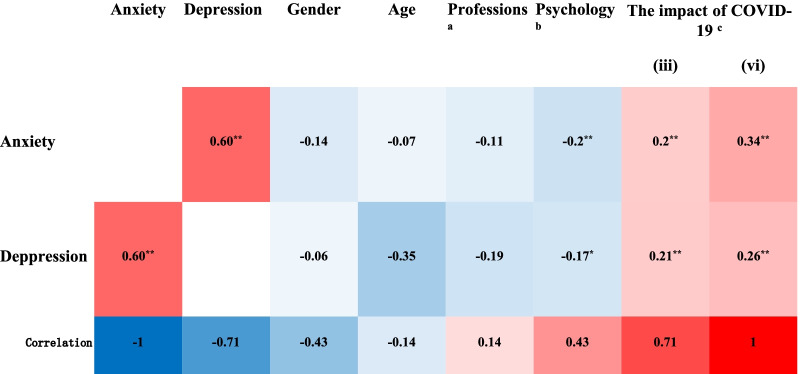
Background: The mental health of students is affected by COVID-19. We aim to evaluate the anxiety and depression symptoms among college students during COVID-19 pandemic, analyze the influence factors that contribute to college students’ anxiety and depression symptoms, and provide some suggestions for improving the mental health of college students. Methods: With 179 college students participating, an online questionnaire consisting of a general questionnaire, Generalized Anxiety Disorder (GAD-7), and Patient Health Questionnaire (PHQ-9) was conducted in universities in Shanghai. The anxiety and depression symptoms among college students were evaluated using GAD-7 and PHQ-9 scales, and influence factors were analyzed using an unordered multi-class Logistic regression model. Results: The reliability and validity of the GAD-7 and PHQ-9 scales were good (reliability ≥ 0.9, validity = 100%). The incidence of anxiety was 32.4%, of which were 23.5%, 8.4%, and 0.6% in mild, moderate, and severe, respectively; and the incidence of depression was 46.40%, of which in mild, moderate, moderate to severe, and severe were 28.5%, 10.1%, 7.3%, and 0.6%, respectively. Multivariate analysis revealed that male students with strong psychological quality, who were not easily affected by the COVID-19 pandemic, who received less negative or false information, and who had a strong grasp of psychology and related knowledge were less likely to suffer from mild or moderate anxiety symptoms [OR (95% CI) 0.18 (0.04, 0.81), 0.12 (0.05, 0.33), 0.23 (0.06, 0.89) and 0.07 (0.01, 0.74)]. Furthermore, college students who were not affected by the COVID-19 pandemic were less likely to suffer from mild, moderate, and moderate to severe depression symptoms [OR (95% CI) 0.23 (0.08, 0.65), 0.22 (0.05, 0.93), 0.10 (0.02, 0.54)]. Conclusion: The GAD-7 and PHQ-9 scales are suitable for evaluating anxiety and depression symptoms in college students. The COVID-19 pandemic was associated with a high incidence of anxiety and depression symptoms among college students, although gender and mental state fluctuations during the pandemic, negative and false information, and exposure to psychology and related courses were the main influencing factors.
Overview
The claims and statistics of this paper haven’t been checked yet.
Free: it reads the open-access text and checks the first 5 claims that cite a source we can check. Create a free account to check every claim.
Integrity signals
Registry
Cites
Statistics
Figures
Verification
Claims the paper makes
The claims and statistics of this paper haven’t been checked yet.
Free: it reads the open-access text and checks the first 5 claims that cite a source we can check. Create a free account to check every claim.
Claims other papers make about this one
Each is checked against this paper’s own text: does it say what the citing paper says it does?
The source backs part of the claim, not all of it — or backs it for a different population, condition or comparison.
In the citing paper
“Cross-sectional data collected early in the pandemic period suggested that college students were disproportionately affected by stress, depression, anxiety, and loneliness due to reduced social interactions, lack of social support, and newly arising stressors associated with the COVID-19 crisis [28, 34–37].”
From Psychological correlates of perceived loneliness in college students before and during the COVID-19 stay-at-home period: a longitudinal study (2023) · cites this paper as [35]
Experimental — accuracy not yet measured
Self-check
Percentages, sums and reported differences re-computed from the paper’s own numbers.
The self-check needs the paper’s full text.
Citations
Cites
The PHQ-9: Validity of a brief depression severity measure
Kroenke, K., Spitzer, R. L., & Williams, J. B. W. (2001) · Journal of General Internal Medicine · doi:10.1046/j.1525-1497.2001.016009606.x · Cited by 44,910
A Brief Measure for Assessing Generalized Anxiety Disorder: The GAD-7
Spitzer, R. L., Kroenke, K., Williams, J. B. W., & Löwe, B. (2006) · Archives of Internal Medicine · doi:10.1001/archinte.166.10.1092 · Cited by 31,765
Spitzer, R. L. (1999) · JAMA · doi:10.1001/jama.282.18.1737 · Cited by 9,802
Wiersinga, W. J., Rhodes, A., Cheng, A. C., Peacock, S. J., & Prescott, H. C. (2020) · JAMA · doi:10.1001/jama.2020.12839 · Cited by 4,609 · cited 1×
“Previous studies have demonstrated that such public health events were sudden, public attributes, and serious social harmfulness [41].”
BackgroundHui, D. S., I Azhar, E., Madani, T. A., Ntoumi, F., Kock, R., Dar, O., Ippolito, G., Mchugh, T. D., Memish, Z. A., Drosten, C., et al. (2020) · International Journal of Infectious Diseases · doi:10.1016/j.ijid.2020.01.009 · Cited by 3,809
The outbreak of COVID-19 coronavirus and its impact on global mental health
Torales, J., O’Higgins, M., Castaldelli-Maia, J. M., & Ventriglio, A. (2020) · International Journal of Social Psychiatry · doi:10.1177/0020764020915212 · Cited by 3,013
More than 50 long-term effects of COVID-19: a systematic review and meta-analysis
Lopez-Leon, S., Wegman-Ostrosky, T., Perelman, C., Sepulveda, R., Rebolledo, P. A., Cuapio, A., & Villapol, S. (2021) · Scientific Reports · doi:10.1038/s41598-021-95565-8 · Cited by 2,757 · cited 1×
“COVID-19 poses enormous risks, as it not only aggravates the condition of patients with underlying diseases and accelerates death in the elderly [8–10], but also has many long-term symptoms that cannot be ignored, such as fatigue, muscle, and joint pain, lung abnormalities, abnormal liver, and kidney function, loss of…”
BackgroundOnline mental health services in China during the COVID-19 outbreak
Liu, S., Yang, L., Zhang, C., Xiang, Y.-T., Liu, Z., Hu, S., & Zhang, B. (2020) · The Lancet Psychiatry · doi:10.1016/s2215-0366(20)30077-8 · Cited by 1,992
Elmer, T., Mepham, K., & Stadtfeld, C. (2020) · PLOS ONE · doi:10.1371/journal.pone.0236337 · Cited by 1,658 · cited 1×
“Compared with other surveys during the COVID-19 pandemic, anxiety and depression were significantly higher than in other surveys [46, 47] but lower than in adolescents [42]; it is possible that the anxiety and depression among college students may be related to the regional distribution, or that the anxiety and depres…”
Result
Cited by
Liu, X., Guo, Y.-X., & Xu, Y. (2023) · World Journal of Clinical Cases · doi:10.12998/wjcc.v11.i7.1442 · Cited by 115
Two years COVID-19 pandemic: Development of university students' mental health 2020–2022
Kohls, E., Guenthner, L., Baldofski, S., Brock, T., Schuhr, J., & Rummel‐Kluge, C. (2023) · Frontiers in Psychiatry · doi:10.3389/fpsyt.2023.1122256 · Cited by 78
Conti, C., Lanzara, R., Rosa, I., Müller, M. M., & Porcelli, P. (2023) · BMC Psychology · doi:10.1186/s40359-023-01099-1 · Cited by 26
Dao, A., Pegg, S. L., Okland, S., Green, H. E., & Kujawa, A. (2024) · Journal of American College Health · doi:10.1080/07448481.2024.2355162 · Cited by 29
Zila-Velasque, J. P., Grados‐Espinoza, P., Regalado-Rodríguez, K. M., Sosa-Nuñez, F., Alcarraz-Jaime, A., Cortez-Soto, A. G., Chambergo‐Michilot, D., & Soriano-Moreno, A. N. (2023) · PLoS ONE · doi:10.1371/journal.pone.0286338 · Cited by 17
Metadata
- Authors
- Gao, D., Xiang, Q., Lu, G., Tong, J., Jiang, W., Yu, X., Wang, R., Lv, Z., & Li, D.
- Affiliations
- Tongji University (CN)
- Corresponding author
- Lv, Zhongwei
- Li, Dan
- Venue
- BMC Psychology
- Published
- 2022-09-30
- Volume
- 10
- Issue
- 1
- Pages
- 227-227
- ISSN
- 2050-7283 (ISSN-L)
- PMC
- PMC9523640
- OpenAlex
- W4298142277
- Cited by
- 17
- References
- 52
- Citations by year
- 2026: 2 · 2025: 3 · 2024: 5 · 2023: 7
- FWCI
- 3.42
- Type
- journal article
- Language
- en
- Open access
- gold
- doi.org
- Licence
- cc-by
- creativecommons.org/licenses/by/4.0 (tdm)
- creativecommons.org/licenses/by/4.0 (vor)
- Locations
- BMC Psychology (publishedVersion, cc-by)
- PubMed Central (publishedVersion, cc-by)
- PubMed (publishedVersion)
- DOAJ (DOAJ: Directory of Open Access Journals) (submittedVersion, cc-by-sa)
- Funders
- National Natural Science Foundation of China (82071964)
- Shanghai Leading Talent Program sponsored by Shanghai Human Resources and Social Security Bureau (03.05.19005)
- Topics
- Social Sciences › Psychology › Clinical Psychology › COVID-19 and Mental Health
- Social Sciences › Psychology › Developmental and Educational Psychology › Student Stress and Coping
- Social Sciences › Psychology › Experimental and Cognitive Psychology › Anxiety, Depression, Psychometrics, Treatment, Cognitive Processes
- Keywords
- anxiety, depression, university students, COVID-19 pandemic, student mental health, risk factors, psychological quality, psychological knowledge, GAD-7, PHQ-9, prevalence of anxiety and depression
- MeSH terms
- COVID-19, SARS-CoV-2, Anxiety, Anxiety Disorders, China, Depression, Humans, Male, Students, Reproducibility of Results, Pandemics
About these checks
Registry, retraction, Cites and statistics results are computed, not judged, with one exception: a printed reference that no index lists is read once by a model before it counts as a citation error. Claims are extracted by a model and kept only when their quote appears verbatim in the text; each cited source is then checked, with a model’s help, for whether it says what the claim relies on. Those verdicts can be wrong — read the claim’s quote and the cited source before relying on one.
Statistics and arithmetic are recomputed, not judged.
Confidence bands are shown only for fields calibrated on our annotated test set. None is calibrated yet, so no band is shown.
What counts as a claim ›How we measure confidence ›How we check this ›
Are you an author, or do you see a problem with this page? Request a review
How to cite
Cite CoChat for the checks on this page, and the paper for its own findings.
- This page
- CoChat. (2026). Citation check: Evaluation and analysis of anxiety and depression symptoms for college students during COVID-19 pandemic. https://app.cochat.ai/papers/10.1186/s40359-022-00934-1
- The paper
- Gao, D., Xiang, Q., Lu, G., Tong, J., Jiang, W., Yu, X., Wang, R., Lv, Z., & Li, D. (2022). Evaluation and analysis of anxiety and depression symptoms for college students during COVID-19 pandemic. BMC Psychology. https://doi.org/10.1186/s40359-022-00934-1
Data sources
Bibliographic data: Semantic Scholar, OpenAlex, Crossref.
Contains information from the Semantic Scholar Academic Graph Datasets, made available under the ODC Attribution License (ODC-BY 1.0).
Semantic Scholar’s data is described in: Kinney, R., et al. (2023). The Semantic Scholar Open Data Platform. arXiv:2301.10140.
