

The DOI matches its Crossref record; 187 of the 189 references it cites were found in a registry or an index.
Deprescribing benzodiazepines and Z-drugs in community-dwelling adults: a scoping review
Open accessAbstract
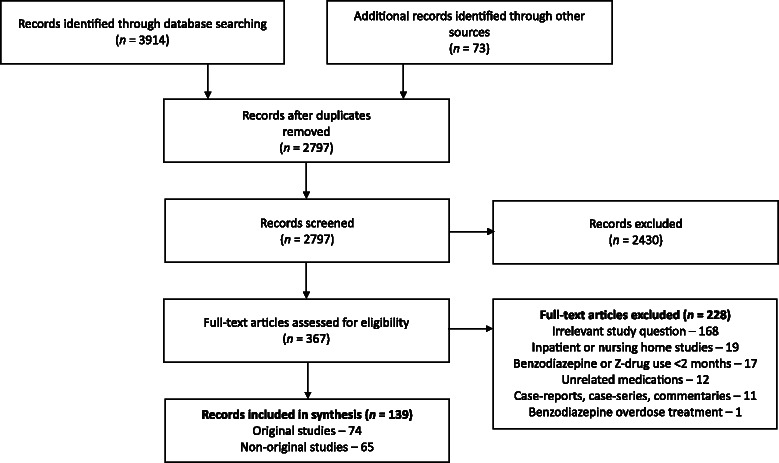
BACKGROUND: Long-term sedative use is prevalent and associated with significant morbidity, including adverse events such as falls, cognitive impairment, and sedation. The development of dependence can pose significant challenges when discontinuation is attempted as withdrawal symptoms often develop. We conducted a scoping review to map and characterize the literature and determine opportunities for future research regarding deprescribing strategies for long-term benzodiazepine and Z-drug (zopiclone, zolpidem, and zaleplon) use in community-dwelling adults. METHODS: We searched PubMed, Cochrane Central Register of Controlled Trials, EMBASE, PsycINFO, CINAHL, TRIP, and JBI Ovid databases and conducted a grey literature search. Articles discussing methods for deprescribing benzodiazepines or Z-drugs in community-dwelling adults were selected. RESULTS: Following removal of duplicates, 2797 articles were reviewed for eligibility. Of these, 367 were retrieved for full-text assessment and 139 were subsequently included for review. Seventy-four (53%) articles were original research, predominantly randomized controlled trials (n = 52 [37%]), whereas 58 (42%) were narrative reviews and seven (5%) were guidelines. Amongst original studies, pharmacologic strategies were the most commonly studied intervention (n = 42 [57%]). Additional deprescribing strategies included psychological therapies (n = 10 [14%]), mixed interventions (n = 12 [16%]), and others (n = 10 [14%]). Behaviour change interventions were commonly combined and included enablement (n = 56 [76%]), education (n = 36 [47%]), and training (n = 29 [39%]). Gradual dose reduction was frequently a component of studies, reviews, and guidelines, but methods varied widely. CONCLUSIONS: Approaches proposed for deprescribing benzodiazepines and Z-drugs are numerous and heterogeneous. Current research in this area using methods such as randomized trials and meta-analyses may too narrowly encompass potential strategies available to target this phenomenon. Realist synthesis methods would be well suited to understand the mechanisms by which deprescribing interventions work and why they fail.
Overview
The claims and statistics of this paper haven’t been checked yet.
Run the check — free, no account needed. It reads the open-access text and checks the sources it cites.
Integrity signals
Registry
Cites
Statistics
Figures
Verification
Claims the paper makes
The claims and statistics of this paper haven’t been checked yet.
Run the check — free, no account needed. It reads the open-access text and checks the sources it cites.
Claims other papers make about this one
Each is checked against this paper’s own text: does it say what the citing paper says it does?
The source backs part of the claim, not all of it — or backs it for a different population, condition or comparison.
In the citing paper
“however, dependence, and withdrawal still commonly occur (Nice, 2004; Pollmann et al., 2015) even after brief or intermittent use (Kales et al., 1991).”
From Pharmacological principles for safe benzodiazepine and Z-drug dose reduction (2026) · cites this paper as Pollmann et al., 2015
Experimental — accuracy not yet measuredThe source backs part of the claim, not all of it — or backs it for a different population, condition or comparison.
In the citing paper
“Guidelines universally recommend tapering benzodiazepines, yet there is no definitive method, and most advice is based on expert consensus rather than empirical evidence or pharmacological principles, resulting in conflicting advice (Brunner et al., 2025; Pollmann, Murphy, Bergman, & Gardner, 2015).”
From Pharmacological principles for safe benzodiazepine and Z-drug dose reduction (2026) · cites this paper as Pollmann, Murphy, Bergman, & Gardner, 2015
Experimental — accuracy not yet measuredThe source backs part of the claim, not all of it — or backs it for a different population, condition or comparison.
In the citing paper
“In two scoping reviews of benzodiazepine tapering studies (Brandt et al., 2024; Pollmann et al., 2015), most original investigations and guidelines employed reductions of 10%–25% every 1–2 weeks in linear fashion (i.e. 75% of the original daily dose, then 50% of the original dose, 25% of the original dose), and then discontinuation (Pollmann et al., 2015).”
From Pharmacological principles for safe benzodiazepine and Z-drug dose reduction (2026) · cites this paper as Pollmann et al., 2015
Experimental — accuracy not yet measuredThe source backs part of the claim, not all of it — or backs it for a different population, condition or comparison.
In the citing paper
“The use of pharmacological strategies involving the addition of a second agent is among the most commonly-employed approaches in the process of Z-drug deprescription.”
From Z-drug abuse and dependence: Clinical guideline of the Brazilian Academy of Neurology for diagnosis and management (2025) · cites this paper as [81]
Experimental — accuracy not yet measured
The source backs part of the claim, not all of it — or backs it for a different population, condition or comparison.
In the citing paper
“Despite this growing concern, there is a scarcity of clinical trials and studies exploring therapeutic strategies to manage zolpidem dependence in adults and older populations. 81”
From Z-drug abuse and dependence: Clinical guideline of the Brazilian Academy of Neurology for diagnosis and management (2025) · cites this paper as [81]
Experimental — accuracy not yet measuredThe cited source says what the claim attributes to it.
In the citing paper
“Guidelines universally recommend tapering benzodiazepines, yet there is no definitive method, and most advice is based on expert consensus rather than empirical evidence or pharmacological principles, resulting in conflicting advice (Brunner et al., 2025; Pollmann, Murphy, Bergman, & Gardner, 2015).”
From Pharmacological principles for safe benzodiazepine and Z-drug dose reduction (2026) · cites this paper as Pollmann, Murphy, Bergman, & Gardner, 2015
The cited source says what the claim attributes to it.
In the citing paper
“The final dose before complete cessation was generally 25% or 50% of the original dose, when reported, in these studies (Pollmann et al., 2015), with some implying a final dose of 5%–10% of the original dose (Brandt et al., 2024).”
From Pharmacological principles for safe benzodiazepine and Z-drug dose reduction (2026) · cites this paper as Pollmann et al., 2015
In the citing paper
“This is likely explained by the limited number of randomised controlled trials and lower quality heterogenous evidence variably supporting their use, as reviewed in further detail elsewhere.163,169,170”
In the citing paper
“The focus of BZD deprescribing, especially among older adults, has become more prominent in Western and European nations especially in recent years given an aging demographic trend and the known risks of these agents in this population.163,164”
Self-check
Percentages, sums and reported differences re-computed from the paper’s own numbers.
The self-check needs the paper’s full text.
Citations
Cites
Scoping studies: towards a methodological framework
Arksey, H., & O'Malley, L. (2005) · International Journal of Social Research Methodology · doi:10.1080/1364557032000119616 · Cited by 36,742
Scoping studies: advancing the methodology
Levac, D., Colquhoun, H., & O'Brien, K. K. (2010) · Implementation Science · doi:10.1186/1748-5908-5-69 · Cited by 15,268
Damschroder, L. J., Aron, D. C., Keith, R. E., Kirsh, S. R., Alexander, J. A., & Lowery, J. C. (2009) · Implementation Science · doi:10.1186/1748-5908-4-50 · Cited by 14,496
Michie, S., van Stralen, M. M., & West, R. (2011) · Implementation Science · doi:10.1186/1748-5908-6-42 · Cited by 13,697
Hoffmann, T. C., Glasziou, P. P., Boutron, I., Milne, R., Perera, R., Moher, D., Altman, D. G., Barbour, V., Macdonald, H., Johnston, M., et al. (2014) · BMJ · doi:10.1136/bmj.g1687 · Cited by 10,548
Grading quality of evidence and strength of recommendations
(2004) · BMJ · doi:10.1136/bmj.328.7454.1490 · Cited by 8,477
Realist review - a new method of systematic review designed for complex policy interventions
Pawson, R., Greenhalgh, T., Harvey, G., & Walshe, K. (2005) · Journal of Health Services Research & Policy · doi:10.1258/1355819054308530 · Cited by 3,190
Users' Guides to the Medical Literature
Guyatt, G. H. (1993) · JAMA · doi:10.1001/jama.270.17.2096 · Cited by 3,083
The well-built clinical question: A key to evidence-based decisions
(1995) · ACP Journal Club · doi:10.7326/acpjc-1995-123-3-a12 · Cited by 2,931
The Agency for Healthcare Research and Quality
Baine, W. B. (2006) · Italian Journal of Public Health · doi:10.2427/5924 · Cited by 1,191
Research works printed but not linked: 11
- Ballenger JC, Pecknold J, Rickels K, Sellers EM. Medication discontinuation in panic disorder. J Clin Psychiatry. 1993;54 Suppl 10:15–21.
- Bartholomew S. Benzodiazepine dependence in the elderly. J Am Acad Phys Assist. 1990;3:535–9.
- Choy Y. Managing side effects of anxiolytics. Primary Psychiatry. 2007;14:68–76.
- Benzodiazepines: good practice guidelines for clinicians. Department of Health and Children, Ireland. 2002. http://hdl.handle.net/10147/46748 . Accessed 19 Jan 2014.
- DuPont RL. Thinking about stopping treatment for panic disorder. J Clin Psychiatry. 1990;51:38–45.
- Huston PG. Moderating benzodiazepine use in the elderly. Can Fam Phys. 1992;38:2459–67.
- Jensen B. Benzodiazepine comparison chart. In: Jensen B, Regier L, editors. RxFiles Drug Comparison Charts. 9th ed. Saskatoon: Saskatoon Health Region; 2013. p. 101.
- Management options for improving sleep. National Prescribing Service. 2010. http://www.nps.org.au/publications/health-professional/prescribing-practice-review/2010/prescribing-practice-review-49 . Accessed 31 Mar 2014.
- Saul PA, Korlipara K, Presley P. A randomised, multicentre, double-blind, comparison of atenolol and placebo in the control of benzodiazepine withdrawal symptoms. Acta Ther. 1989;15:117–23.
- Sloan E. Medication and substance use: keeping insomnia treatment safe. Insomnia Rounds. 2013;2:1–6.
- Zee P, Wang-Weigand S, Roth T. Facilitation of zolpidem discontinuation using ramelteon in subjects with chronic insomnia. Am J Addict. 2011;20:380–1.
Cited by
Sorted by citations
Page, A. T., Clifford, R. M., Potter, K., Schwartz, D., & Etherton‐Beer, C. (2016) · British Journal of Clinical Pharmacology · doi:10.1111/bcp.12975 · Cited by 513
Deprescribing benzodiazepine receptor agonists: Evidence-based clinical practice guideline.
(2018) · Europe PMC (PubMed Central) · Cited by 250
Schifano, F., Chiappini, S., Corkery, J. M., & Guirguis, A. (2019) · International Journal of Neuropsychopharmacology · doi:10.1093/ijnp/pyz007 · Cited by 194
Reeve, E., Ong, M., Wu, A., Jansen, J., Petrovic, M., & Gnjidic, D. (2017) · European Journal of Clinical Pharmacology · doi:10.1007/s00228-017-2257-8 · Cited by 192
Ng, B. J., Le Couteur, D. G., & Hilmer, S. N. (2018) · Drugs & Aging · doi:10.1007/s40266-018-0544-4 · Cited by 118
Metadata
- Authors
- Pollmann, A. S., Murphy, A. L., Bergman, J. C., & Gardner, D. M.
- Affiliations
- Dalhousie University (CA)
- Corresponding author
- Pollmann, André S.
- Venue
- BMC Pharmacology and Toxicology
- Published
- 2015-07-04
- Volume
- 16
- Issue
- 1
- Pages
- 19-19
- ISSN
- 2050-6511 (ISSN-L)
- PMC
- PMC4491204
- OpenAlex
- W2170043108
- Cited by
- 114
- References
- 189
- Citations by year
- 2026: 7 · 2025: 7 · 2024: 7 · 2023: 14 · 2022: 18 · 2021: 16 · 2020: 6 · 2019: 13 · 2018: 16 · 2017: 6 · 2016: 4
- FWCI
- 4.34
- Type
- journal article
- Language
- en
- Open access
- gold
- doi.org
- Locations
- BMC Pharmacology and Toxicology (publishedVersion, cc-by)
- Europe PMC (PubMed Central) (publishedVersion, cc-by)
- PubMed Central (publishedVersion, cc-by)
- PubMed (publishedVersion)
- Funders
- Dalhousie University
- College of Pharmacy, Dalhousie University
- Topics
- Health Sciences › Medicine › Geriatrics and Gerontology › Pharmaceutical Practices and Patient Outcomes
- Health Sciences › Medicine › Epidemiology › Substance Abuse Treatment and Outcomes
- Social Sciences › Psychology › Experimental and Cognitive Psychology › Sleep and related disorders
- Keywords
- deprescribing, benzodiazepines, Z-drugs, zopiclone, zolpidem, zaleplon, community-dwelling adults, benzodiazepine withdrawal, gradual dose reduction, behaviour change interventions, psychotherapy, realist synthesis
- MeSH terms
- Deprescriptions, Zolpidem, Acetamides, Benzodiazepines, Humans, Piperazines, Pyridines, Pyrimidines, Azabicyclo Compounds
About these checks
Registry, retraction, Cites and statistics results are computed, not judged, with one exception: a printed reference that no index lists is read once by a model before it counts as a citation error. Claims are extracted by a model and kept only when their quote appears verbatim in the text; each cited source is then checked, with a model’s help, for whether it says what the claim relies on. Those verdicts can be wrong — read the claim’s quote and the cited source before relying on one.
Statistics and arithmetic are recomputed, not judged.
Confidence bands are shown only for fields calibrated on our annotated test set. None is calibrated yet, so no band is shown.
What counts as a claim ›How we measure confidence ›How we check this ›
Are you an author, or do you see a problem with this page? Request a review
